


Search results
Search for "X-ray" in Full Text gives 1076 result(s) in Beilstein Journal of Nanotechnology. Showing first 200.
Potential of a deep eutectic solvent in silver nanoparticle fabrication for antibiotic residue detection
Beilstein J. Nanotechnol. 2024, 15, 426–434, doi:10.3762/bjnano.15.38
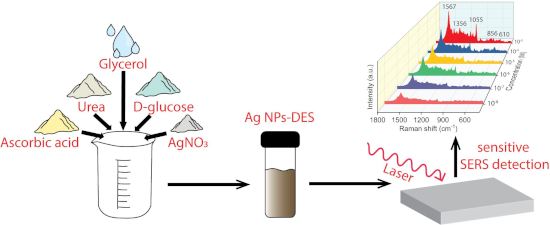
- scholars, the rod-like morphology is better than a spherical one at increasing the extinction coefficient, about 109 to 1011 M−1·cm−1 higher [43][44], which proves the applicability of Ag NPs-DES in SERS biosensors. Furthermore, X-ray fluorescence mapping was used to evaluate the presence of silver in the
- characterization and apparatus The absorbance properties of the sample were recorded using a V-730 UV–vis–NIR spectrophotometer supplied by JASCO, Japan. The crystallinity of the Ag NPs-DES thin film was determined using a D8 Advance diffractometer, Bruker, UK, with a Ni-filtered Cu Kα X-ray source. To evaluate
- the nanostructure and surface morphology of the nanoparticles, as well as the elemental distribution of silver on the substrate, a S4800 field-emission scanning electron microscope purchased from Hitachi, Japan, and an M4 TORNADOPlus Micro X-ray fluorescence spectrometer with a Rh tube at 30 W micro


Controllable physicochemical properties of WOx thin films grown under glancing angle
Beilstein J. Nanotechnol. 2024, 15, 350–359, doi:10.3762/bjnano.15.31
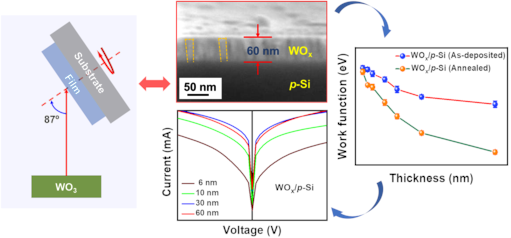
- bias voltage was applied to the p-Si substrates, whereas the WOx films were kept grounded. The crystallinity of the WOx films was examined using X-ray diffraction (XRD) (Bruker) under Bragg–Brentano geometry (θ–2θ) in an angular window of 2θ = 20° to 80°. The chemical composition of the WOx films was
- identified using X-ray photoelectron spectroscopy (XPS) measurements (PHI 5000 VersaProbeII, ULVAC – PHI, INC) with a monochromatic Al Kα source (hν = 1486.6 eV), and a microfocus (100 µm, 15 kV, 25 W) arrangement along with a multichannel detector and a hemispherical analyser. The microstructure of the WOx




Vinorelbine-loaded multifunctional magnetic nanoparticles as anticancer drug delivery systems: synthesis, characterization, and in vitro release study
Beilstein J. Nanotechnol. 2024, 15, 256–269, doi:10.3762/bjnano.15.24
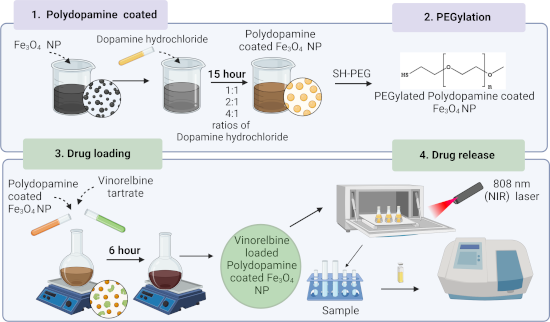
- -resolution analytical electron microscope (FE-SEM, Thermo Scientific, Apreo 2S LoVac) and a scanning transmission electron microscope (STEM, Phillips XL, 30 ESEM-FEG/EDAX) operating at 120 kV acceleration voltage. The structure of the nanoparticles was analyzed by X-ray diffraction (XRD, PANalytical, Xpert
- between peak broadening and particle size in X-ray analysis. In this equation, the symbols D, K, λ, β, and θ represent the particle size, Scherrer shape factor (here 0.89), X-ray wavelength (0.15418 nm), half-maximum width, and diffraction angle, respectively [43]. Using the X-ray diffraction (XRD
- ) spectrum and Equation 5, the particle size of Fe3O4 NPs was calculated and determined to be 18 nm on average. X-ray patterns showing the distribution of Fe3O4 NPs in their uncoated state are shown in Figure 2a. XRD analysis reveals the presence of seven distinct peaks at 30.13°, 35.48°, 43.12°, 53.6


Exploring disorder correlations in superconducting systems: spectroscopic insights and matrix element effects
Beilstein J. Nanotechnol. 2024, 15, 199–206, doi:10.3762/bjnano.15.19
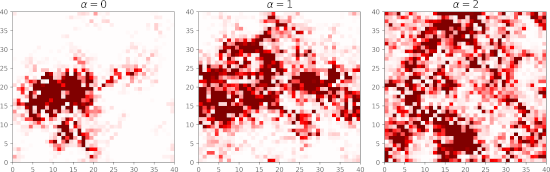
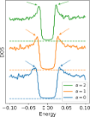
- kind of X-ray microscopy and has come to the conclusion that such fractal structures boost superconductivity. In particular, the work demonstrates that this material has a small number of very highly ordered regions and larger numbers of disordered regions, with a power-law distribution describing them


Modification of graphene oxide and its effect on properties of natural rubber/graphene oxide nanocomposites
Beilstein J. Nanotechnol. 2024, 15, 168–179, doi:10.3762/bjnano.15.16
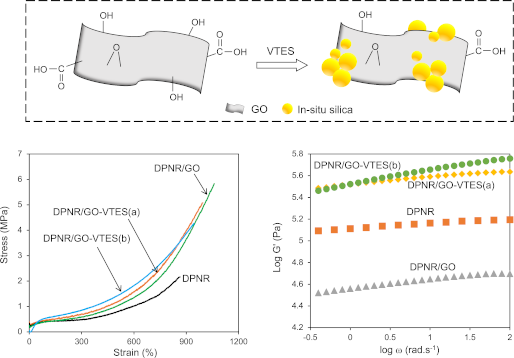
- characterized by X-ray diffraction (XRD), Fourier-transform infrared spectroscopy, contact angle, thermal gravimetric analysis, and scanning electron microscopy. The XRD results showed the appearance of an amorphous region of silica particles at a diffraction angle of 22°. The formation of silica was
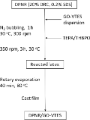
- conditions to determine the ideal condition to modify GO for grafting onto NR. The GO-VTES products were characterized using X-ray diffraction (XRD), contact angle, 29Si NMR, Fourier-transform infrared spectroscopy (FTIR), and morphology analysis. The GO-VTES was expected to improve the mechanical properties
- , 200 g of DPNR (DRC 20%, SDS 0.2%), and with the same amount of TEPA/TBHPO as in the preparation of DPNR/GO-VTES. Characterizations X-ray diffraction patterns of graphite and GO were acquired by using a Panalytical X'Pert Pro X-ray diffractometer. The measurements were performed at room temperature






Assessing phytotoxicity and tolerance levels of ZnO nanoparticles on Raphanus sativus: implications for widespread adoptions
Beilstein J. Nanotechnol. 2024, 15, 115–125, doi:10.3762/bjnano.15.11

- on Raphanus sativus (R. sativus) concerning its tolerance levels, toxicity, and accumulation. ZnO NPs were synthesized by the wet chemical method and characterized by powder X-ray diffraction (PXRD), Fourier-transform infrared (FTIR) spectroscopy, ultraviolet–visible (UV–vis) spectroscopy, dynamic
- synthesized ZnO NPs were characterized via several techniques such as powder X-ray diffraction (PXRD), Fourier-transform infrared (FTIR) spectroscopy, solid-UV–vis spectroscopy, dynamic light scattering (DLS), and scanning electron microscopy (SEM). Then the potential phytotoxicity of the synthesized ZnO NPs
- ZnO NPs characterization The PXRD technique provides important insights into the chemical composition, physical characteristics of the material and crystallographic structure, and crystalline particle size based on the scattered X-ray beam intensity [20][21]. The PXRD pattern (Figure 1a) of


New application of bimetallic Ag/Pt nanoplates in a colorimetric biosensor for specific detection of E. coli in water
Beilstein J. Nanotechnol. 2024, 15, 95–103, doi:10.3762/bjnano.15.9

- microscopy (FE-SEM) was used to investigate the form and shapes of NPLs. The size of the NPLs is approx. 42 nm. Figure 1a shows a combination of truncated triangular and circular plates of Ag/Pt NPLs. The NPLs were evenly distributed and shaped in the form of discs or triangles. Energy-dispersive X-ray


Berberine-loaded polylactic acid nanofiber scaffold as a drug delivery system: The relationship between chemical characteristics, drug-release behavior, and antibacterial efficiency
Beilstein J. Nanotechnol. 2024, 15, 71–82, doi:10.3762/bjnano.15.7

- separation during the electrospinning process [17][38][39], leading to the formation of a BBR-rich phase on the surface of nanofibers. The crystallinity of the PLA pellet and electrospun nanofiber scaffolds were examined by X-ray diffraction (XRD) analysis (Figure 3B). The XRD pattern of the PLA pellet shows
- chemical characteristics of prepared scaffolds in the wavelength range of 200–3200 cm−1. X-ray diffraction measurements of PLA pellets and BBR-loaded PLA nanofiber scaffolds were analyzed with Cu Kα radiation in a 2θ range from 5 to 80° using EQUINOX 5000 – Thermo Scientific X-ray diffractometer. Static


Influence of conductive carbon and MnCo2O4 on morphological and electrical properties of hydrogels for electrochemical energy conversion
Beilstein J. Nanotechnol. 2024, 15, 57–70, doi:10.3762/bjnano.15.6
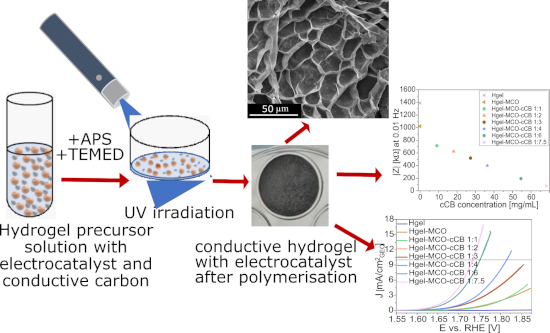
- influence of porosity and conductive properties of these composites on the electrochemical activity of catalyst particles in OER. Elemental mapping by energy-dispersive X-ray spectroscopy (EDS) confirmed the presence of MCO particles inside the hydrogel structure (Figure 2 and Supporting Information File 1
- an accelerating voltage of 10 kV. Before imaging, the hydrogel samples were freeze-dried and coated with a 10 nm gold layer. The chemical composition of the hydrogel was analysed with a Thermo Fisher Scientific silicon drift detector energy-dispersive X-ray spectroscope. For characterisation of the


TEM sample preparation of lithographically patterned permalloy nanostructures on silicon nitride membranes
Beilstein J. Nanotechnol. 2024, 15, 1–12, doi:10.3762/bjnano.15.1

- ], transmission electron microscopy (TEM) [1][8][9][10][11], scanning transmission X-ray microscopy [12][13], and magneto-optical Kerr effect microscopy [14][15]. Possible applications of Py nanodisks were proposed for zero-hysteresis magnet sensors, magnetic logic devices, and data storage [16]. Py is a nickel
- Lorentz microscopy and electron holography, along with simultaneous structural and chemical characterization techniques such as electron diffraction, 4D STEM, and energy-dispersive X-ray (EDX) and electron energy loss spectroscopy (EELS), enable a correlative characterization to investigate magnetic


A combined gas-phase dissociative ionization, dissociative electron attachment and deposition study on the potential FEBID precursor [Au(CH3)2Cl]2
Beilstein J. Nanotechnol. 2023, 14, 1178–1199, doi:10.3762/bjnano.14.98
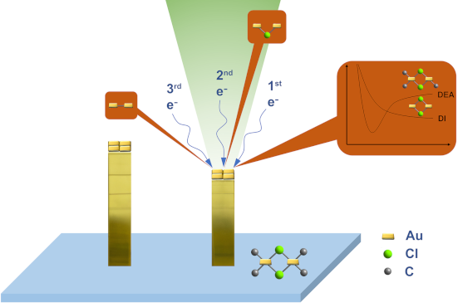
- precursor (i.e., [Au(CH3)2Cl]2) was used to create FEBID deposits on a SiO2 substrate by using 5 keV and 0.1/0.4 nA in an HV atmosphere [33]. The composition of the structures was checked via energy dispersion X-ray (EDX) mapping and reported to be 29–41 atom % Au, 2–6 atom % Cl, and 53–68 atom % C. The SEM



Sulfur nanocomposites with insecticidal effect for the control of Bactericera cockerelli
Beilstein J. Nanotechnol. 2023, 14, 1106–1115, doi:10.3762/bjnano.14.91

- rosemary essential oils with the three concentrations of 0.25%, 0.5%, and 0.75%. The samples were characterized by UV–visible spectroscopy, energy-dispersive X-ray spectroscopy, transmission electron microscopy, and scanning electron microscopy. The insecticidal efficacy of the nanocomposites was evaluated
- eucalyptus and rosemary at different concentrations. Characterizations were carried out through UV–visible spectroscopy, energy-dispersive X-ray spectroscopy (EDS), transmission electron microscopy (TEM), and scanning electron microscopy (SEM); also the insecticidal efficacy of the NCMPs for the control of
- stabilizing agent. Characterization techniques and equipment UV–visible spectroscopy was performed on an Analytik Jena SPECORD® S 600 spectrophotometer. Size and morphology of the SNPs were determined using an FEI Tecnai G2 Spirit Twin transmission electron microscope. Energy-dispersive X-ray spectroscopy



Density functional theory study of Au-fcc/Ge and Au-hcp/Ge interfaces
Beilstein J. Nanotechnol. 2023, 14, 1093–1105, doi:10.3762/bjnano.14.90

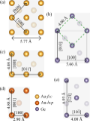
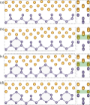
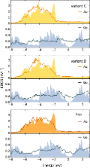
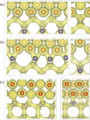
- bonds, see Figure 12b. The integrated charge density of the bonding electrons, however, can be expected to be significantly smaller. Also, one can observe that the Au–Ge bond is strongly asymmetrical. Similar bonding states were already observed for Au atoms deposited on a Ge(001) surface using X-ray





Properties of tin oxide films grown by atomic layer deposition from tin tetraiodide and ozone
Beilstein J. Nanotechnol. 2023, 14, 1085–1092, doi:10.3762/bjnano.14.89
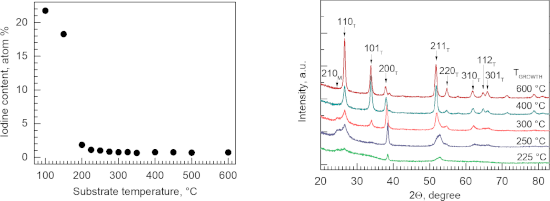
- , the cycle times for SnO2 were kept at 5-2-5-5 s, respectively, for the following sequence: metal precursor pulse, N2 purge pulse, O3 pulse, and N2 purge pulse. The films were grown on Si(100) cleansed and etched prior to the growth. An X-ray fluorescence spectrometer Rigaku ZSX 400 with the program
- grazing incidence X-ray diffractometry (GIXRD), using an X-ray diffractometer SmartLab Rigaku with Cu Kα radiation, which corresponds to an X-ray wavelength of 0.15406 nm. X-ray photoelectron emission and X-ray absorption spectroscopy (XPS and XAS, respectively) measurements were made at the FinEstBeAMS
- ]. The SnO2 films grown at 300 and 500 °C, that is, those with low residual iodine content, were analysed ex situ in terms of surface chemistry using soft X-ray spectroscopy methods. The Sn 3d XPS data (Figure 10a) show almost identical spectra for the samples deposited at 300 and 500 °C, and the narrow


Dual-heterodyne Kelvin probe force microscopy
Beilstein J. Nanotechnol. 2023, 14, 1068–1084, doi:10.3762/bjnano.14.88




Experimental investigation of usage of POE lubricants with Al2O3, graphene or CNT nanoparticles in a refrigeration compressor
Beilstein J. Nanotechnol. 2023, 14, 1041–1058, doi:10.3762/bjnano.14.86
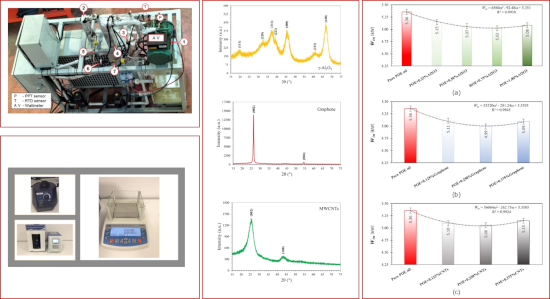
- nanoparticles is presented separately in the subsequent sections to verify the catalog information provided by the manufacturer. In the characterization of the nanoparticles used in the study, field-emission scanning electron microscopy (FE-SEM), energy-dispersive X-ray spectroscopy (EDS), and X-ray diffraction
- micrograph and b) EDS analysis of Al2O3 nanoparticles. X-ray diffraction pattern of Al2O3 nanoparticles [21]. The a) FE-SEM micrograph with a scale bar of 20 µm, b) FE-SEM micrograph with a scale bar of 10 µm, and c) EDS analysis of the graphene nanoplatelets. The XRD pattern of the graphene nanoplatelets





A visible-light photodetector based on heterojunctions between CuO nanoparticles and ZnO nanorods
Beilstein J. Nanotechnol. 2023, 14, 1018–1027, doi:10.3762/bjnano.14.84
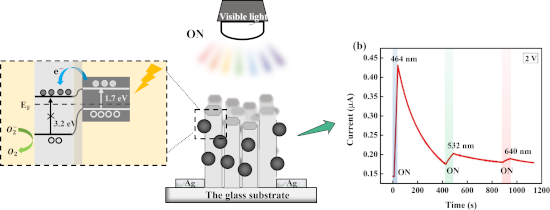
- . The energy-dispersive X-ray spectroscopy (EDS) results in Figure 1c show Zn, Cu, and O, which indicates the presence of ZnO and CuO. No further impurities were found. The results from X-ray diffractometry (XRD) and UV–vis absorption spectroscopy confirm that the nanoparticles covering the surfaces and
- length and 0.02 cm channel width. Characterizations The crystal structure of the materials was investigated by X-ray diffractometry on a Bruker D8 Advance diffractometer with Cu Kα radiation (λ = 1.5406 Å). An energy-dispersive X-ray spectrometer (FEI iQUANTA FEG-200) was used to determine the chemical


Exploring internal structures and properties of terpolymer fibers via real-space characterizations
Beilstein J. Nanotechnol. 2023, 14, 1004–1017, doi:10.3762/bjnano.14.83

- , this distinction in fundamental chemistry has significant implications for the structures and properties of the resulting fibers. To date, structure–property characterizations of Technora® in the literature have primarily focused on (i) X-ray diffraction (XRD), (ii) nuclear magnetic resonance (NMR





Isolation of cubic Si3P4 in the form of nanocrystals
Beilstein J. Nanotechnol. 2023, 14, 971–979, doi:10.3762/bjnano.14.80

- nanoparticles with a defective zinc blende structure under mild conditions through thermal annealing of hydrogenated silicon nanoparticles with red phosphorus. The synthesized Si3P4 nanoparticles were analyzed using FTIR, XRD, electron diffraction, EDX, TEM, Raman spectroscopy, X-ray fluorescence spectrometry
- , the less noticeable (400), (331), (422) and (511) signals were observed). Amorphous material is present in the sample, which is most noticeable as a ca. 2 nm layer on the surface of the NPs (Figure 7a). Energy-dispersive X-ray (EDX) elemental maps (Figure 7c,d) for Si Kα and P Kα do not show any
- “WinXPow”. Elemental analysis was carried out on an X-ray fluorescence spectrometer S2 Picofox (Bruker) with total external reflection. Transmission electron microscopy (TEM) samples were dispersed in an ultrasonic bath with hexane and then deposited on copper grids with lacey carbon film (SPI Supplies


Low temperature atomic layer deposition of cobalt using dicobalt hexacarbonyl-1-heptyne as precursor
Beilstein J. Nanotechnol. 2023, 14, 951–963, doi:10.3762/bjnano.14.78
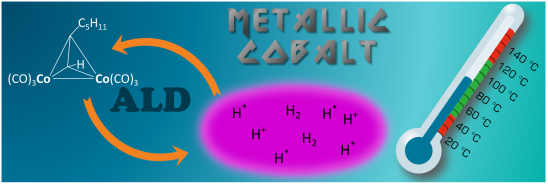
- saturation behaviour of the process was investigated. X-ray photoelectron spectroscopy measurements could show that the deposited cobalt is in the metallic state. The finally established process in ALD mode shows a homogeneous coating at the wafer level. Keywords: atomic layer deposition (ALD); cobalt; low
- with a deposition rate of approximately 0.1 Å/cycle. The deposited films were analysed by X-ray photoelectron spectroscopy and are well in the metallic state. We also show the optimization of the overall process through varying the pulse times for precursor, purging, and the plasma pulse. Experimental
- metallic cobalt according to Ward [24] combined with a Tauc–Lorentzian model for possible occurrences of oxidised cobalt [25][26]. The film compositions were measured ex situ by X-ray photoelectron spectroscopy (XPS) on a PRECAV sp. Z. o. o. XPS system using a MX-650 Al X-ray source and a R3000 analyser


Upscaling the urea method synthesis of CoAl layered double hydroxides
Beilstein J. Nanotechnol. 2023, 14, 927–938, doi:10.3762/bjnano.14.76

- identity of the impurity observed in sample x25M, X-ray photoelectron spectroscopy (XPS) was conducted (Figure 1C). In the case of reference x1, the observed main peaks at 781.23 eV (Co 23/2) and 797.36 eV (Co 21/2), as well as their satellites at 783.13 and 798.83 eV, confirm the occurrence of CoII [15
- process and aiming to quantify the amount of this Co-based α-LH impurity, X-ray absorption spectroscopy (XAS) measurements were performed at the CLÆSS BL22 beamline at the ALBA synchrotron. Figure 2A depicts the X-ray absorption near-edge structure (XANES) spectra for the Co K edge. In all samples, the
- of the structural features of the scale-up samples determined by extended X-ray absorption fine structure (EXAFS) measurements, the used model, and the corresponding fits can be found in Supporting Information File 1 (Figure S9 and Table S3). Thermal decomposition in both inert (nitrogen) and


Green SPIONs as a novel highly selective treatment for leishmaniasis: an in vitro study against Leishmania amazonensis intracellular amastigotes
Beilstein J. Nanotechnol. 2023, 14, 893–903, doi:10.3762/bjnano.14.73

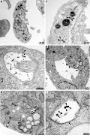
- , arrowheads). The ferrous nature of the observed structures was assessed by chemical element mapping analysis using energy-dispersive X-ray spectroscopy (Figure 2C), confirming that the electron-lucent structures contain iron atoms (Figure 2D). Transmission electron microscopy (TEM) was used to confirm the
- 20 kV equipped with an OXFORD X-MaxN 20 mm2 detector (Oxford Instruments, United Kingdom) for energy-dispersive X-ray spectroscopy. For transmission electron microscopy, after fixation, samples were dehydrated in increasing acetone concentrations and embedded in Epon. Ultrathin sections were obtained
- ). Digital magnification (highlighted rectangular area) showed electron-lucent aggregates even inside intracellular amastigotes (arrowheads). Panels C and D show the X-ray microanalysis mapping of infected macrophages, indicating the presence of iron in the cytosol (red color in Figure 2D). Transmission




N-Heterocyclic carbene-based gold etchants
Beilstein J. Nanotechnol. 2023, 14, 865–871, doi:10.3762/bjnano.14.71
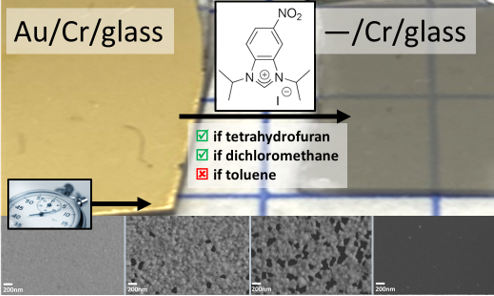
- dissolution of gold. We present scanning electron micrographs and elemental imaging analyses by energy dispersive X-ray spectroscopy to examine the effect of solutions of each species on the gold film. This work highlights the risk of unwanted etching during some routes to NHC-based surface functionalization
- % nitrogen gas. Electron micrographs were recorded using the SE2 detector of a Zeiss SIGMA VP field emission scanning electron microscope (SEM). Energy dispersive X-ray spectroscopy (EDS) spectra were obtained for each sample using an Oxford Instruments X-max 50 mm2 EDS attachment. Peaks were identified



A wearable nanoscale heart sound sensor based on P(VDF-TrFE)/ZnO/GR and its application in cardiac disease detection
Beilstein J. Nanotechnol. 2023, 14, 819–833, doi:10.3762/bjnano.14.67

- . Composition and β-phase content of the piezoelectric composite films were analyzed using X-ray diffraction. The morphology of the composite film fibers was observed through scanning electron microscopy. Finally, the P(VDF-TrFE)/ZnO/graphene composite film was encapsulated in a sandwich-structure heart sound
- underwent characterization through electron microscopy, X-ray diffraction (XRD), and piezoelectric performance testing. The results indicated that the piezoelectric film with a composition ratio of 12% P(VDF-TrFE) + 10% ZnO + 0.1% GR exhibited superior performance regarding various aspects. Consequently, in
- -TrFE)/ZnO flexible piezoelectric composite films without GR. Analysis of X-ray diffraction patterns indicated that the β-phase content of P(VDF-TrFE)/ZnO/GR piezoelectric composite films was higher than that of P(VDF-TrFE)/ZnO and P(VDF-TrFE). P(VDF-TrFE)/ZnO/GR was packaged into a flexible


Nanostructured lipid carriers containing benznidazole: physicochemical, biopharmaceutical and cellular in vitro studies
Beilstein J. Nanotechnol. 2023, 14, 804–818, doi:10.3762/bjnano.14.66
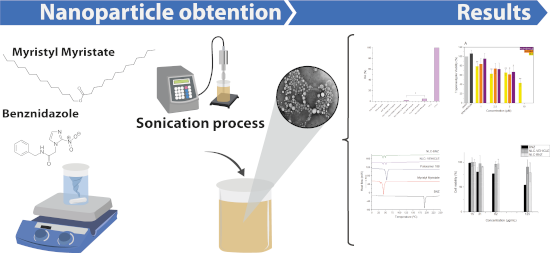
- observed by transmission electron microscopy. Fourier-transform infrared spectroscopy, differential scanning calorimetry, thermogravimetric analysis, and small-angle X-ray scattering analyses of the nanoparticles indicated that BNZ might be dispersed in the nanoparticle matrix in an amorphous state. The
- ]. Structural analysis was performed by selecting different angular regions from the small-angle X-ray scattering (SAXS) and wide-angle X-ray scattering (WAXS) patterns. The WAXS patterns (Figure 5) showed contributions of diffraction peaks from BNZ, myristyl myristate, and NLC. The nanostructured lipid
- medium observed after the initial stage could be attributed to the gradual release of drug molecules from the matrix core, where the drug is mainly located according to X-ray diffraction (XRD) results [33]. Remarkably, although our NLC possess a comparatively lower drug load, the maximal accumulated drug





