Search results
Search for "aggregate" in Full Text gives 196 result(s) in Beilstein Journal of Nanotechnology.
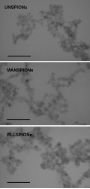
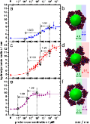
Streptavidin-coated gold nanoparticles: critical role of oligonucleotides on stability and fractal aggregation
Beilstein J. Nanotechnol. 2017, 8, 1–11, doi:10.3762/bjnano.8.1

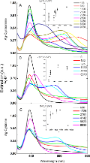
- , respectively. The shift is a consequence of changes in the local dielectric constant and effective thickness of the layer adsorbed on the AuNP surface [30]. No significant broadening of peaks is observed after the functionalization steps, indicating that particles did not appreciably aggregate. The 4 nm shift
- nanoparticles have been investigated. Most of them rely on the integrated extinction, which increases with the degree of aggregate formation in agreement with theoretical principles based on the different contribution of transversal and longitudinal surface plasmons [60][61]. The integrated extinction between




Effect of Anderson localization on light emission from gold nanoparticle aggregates
Beilstein J. Nanotechnol. 2016, 7, 2013–2022, doi:10.3762/bjnano.7.192
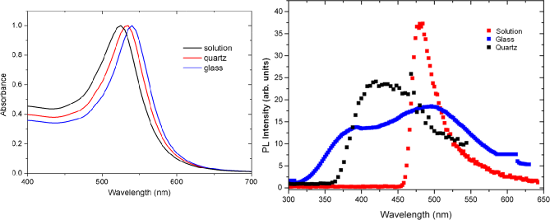
- electron microscopy, X-ray diffraction and X-ray photoelectron spectroscopy. The dielectric constant of the surrounding medium plays a crucial role in determining the aggregate geometry, which affects the Anderson localization of light in the aggregates and hence causes a red-shift in the plasmonic
- resonance and in the photoluminescence emission. The geometry of the gold nanoparticle aggregates determine the strength of the Anderson localization, and hence, the light emission from the aggregates. The photoluminescence lifetime was found to be dependent on the AuNP aggregate geometry and the dielectric
- . The simplest system of generation of such hot spots is through aggregation of nanoparticles, as seen in the work of Anker et al. [12]. The aggregate mass, m, which affects the plasmonic absorption can be introduced in the calculation using the Brownian aggregation rate, according to [21][22]. As the


A dioxaborine cyanine dye as a photoluminescence probe for sensing carbon nanotubes
Beilstein J. Nanotechnol. 2016, 7, 1991–1999, doi:10.3762/bjnano.7.190
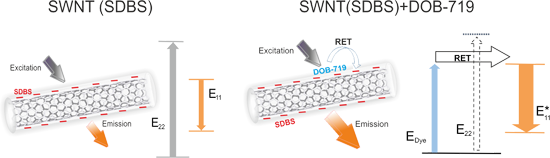
- dispersions were subjected to ultracentrifugation for 3 h at 17 °C at 45000 rpm (Beckman Coulter Optima Max-XP, MLS 50 rotor) to remove the aggregate phase and obtain the supernatant solutions of debundled SWNTs. The top 70% of the dispersion is then decanted. To prepare mixture of DOB-719, we used 20% of the


Surface-enhanced infrared absorption studies towards a new optical biosensor
Beilstein J. Nanotechnol. 2016, 7, 1736–1742, doi:10.3762/bjnano.7.166

- . The increase of the water absorption band in the case of aggregated nanoparticles may have two explanations: first, the SEIRA effect is enhanced when nanoparticles aggregate (addition of anisotropy, see [15]); second, the backscattering cross section is increased. Peak shift A further interesting


Straightforward and robust synthesis of monodisperse surface-functionalized gold nanoclusters
Beilstein J. Nanotechnol. 2016, 7, 1278–1283, doi:10.3762/bjnano.7.118

- -thioglucose (Figure S1, Supporting Information File 1). At higher gold ion concentrations, NCs that are not fully coated with stabilizer aggregate. At high thioglucose concentrations, NCs do not form. Monodisperse gold NCs (2.02 ± 0.18 nm) were obtained as determined by high resolution TEM (Figure 1C,D) and
- ). Unfunctionalized Glc-NCs fail to aggregate since oxidized thio-glucose is not recognized by ConA (Figure 2C). Glc-NC@Man are monodisperse prior to aggregation by the addition of ConA as judged by TEM (Figure S12, Supporting Information File 1). Nanocluster cytotoxicity was assessed by incubating the nanoclusters


Tunable longitudinal modes in extended silver nanoparticle assemblies
Beilstein J. Nanotechnol. 2016, 7, 1219–1228, doi:10.3762/bjnano.7.113

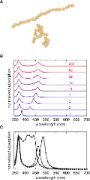
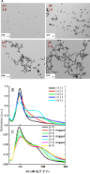
- and aggregates based on the discrete dipole approximation. The models support the experimental findings and reveal the importance of aggregate size and shape as well as particle polarizability in the plasmon coupling between nanoparticles. Keywords: plasmon coupling; self-assembly; silver
- hydrogen-bonding short ligands that are known to well passivate the AgNPs surface [30]. We report the substantial influence of the ligand-to-particle ratio on the aggregate configuration and its optical signal. We observe a large influence of NP ensemble size and inter-nanoparticle spacing on the emergence
- aggregate size upon increasing the ligand concentration. At lower ligand-to-nanoparticle ratios, short-chained segments are predominant, and a number of branching points are observed, which are believed to mediate the plasmon flux. Some closed loops are also present. It is clearly evident that for AgNP–DTT



The influence of phthalocyanine aggregation in complexes with CdSe/ZnS quantum dots on the photophysical properties of the complexes
Beilstein J. Nanotechnol. 2016, 7, 1018–1027, doi:10.3762/bjnano.7.94

- photophysical properties of the complexes. For the first time this concentration dependence has been well described by the developed model taking into account the heterogeneity of QD–monomer and QD–aggregate complexes. We show that a reduction in the concentration of phthalocyanine aggregates in complex with
- molecules are bound in complexes with QDs, but free QDs can be present in the mixture. Molecules in the complexes can be present as monomers (case (a) in Figure 3) or as non-luminescent aggregates formed by adjoining molecules bound to the QD (cases (b) and (c) in Figure 3). The probability of aggregate
- quenched in complexes with acceptors. The PL quantum yield of monomeric acceptors in the complexes is constant. Molecular aggregates, if present, act as energy acceptors. Here, QDs and monomeric molecules act as energy donors. We propose that complexes containing at least one nonluminescent aggregate do



Dielectrophoresis of gold nanoparticles conjugated to DNA origami structures
Beilstein J. Nanotechnol. 2016, 7, 948–956, doi:10.3762/bjnano.7.87

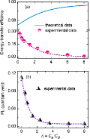
- irreversibly aggregate during DEP deposition, as it was observed for the formation of conducting wires by DEP deposition of plain, unsupported gold nanoparticles [35][36][37][38][39]. On the other hand, the disassembly of our chain structures upon switching off the electrical field prohibits any further high
- formation of stable nanoparticle wires. We suppose that this is due to two reasons. First, the DNA origami, to which the nanoparticles are attached, keeps them at a distance that does not facilitate direct contact between them to aggregate. TEM imaging revealed a gap size between the gold nanoparticles of




Selective photocatalytic reduction of CO2 to methanol in CuO-loaded NaTaO3 nanocubes in isopropanol
Beilstein J. Nanotechnol. 2016, 7, 776–783, doi:10.3762/bjnano.7.69

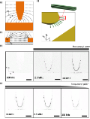
- particles were dispersed on the surface of the NaTaO3 nanocubes with an average size of tens of nanometers (Figure 5b and Figure 5c). When the loading reached 5 wt %, the CuO nanoparticles began to aggregate and large clusters were formed (Figure 5d). The UV–vis diffuse reflectance spectra of CuO–NaTaO3 are


Surface coating affects behavior of metallic nanoparticles in a biological environment
Beilstein J. Nanotechnol. 2016, 7, 246–262, doi:10.3762/bjnano.7.23
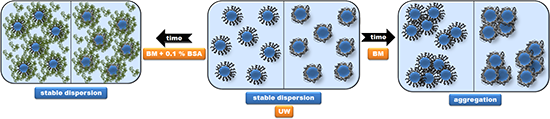
- media like dissolution, adsorption, binding, and aggregation, all influencing biological impacts by affecting reactive oxygen species generation, cellular uptake and NP biodistribution [15][16][17][18]. Metallic NPs usually aggregate in media with high electrolyte content that correspond to biological




Impact of ultrasonic dispersion on the photocatalytic activity of titania aggregates
Beilstein J. Nanotechnol. 2015, 6, 2423–2430, doi:10.3762/bjnano.6.250

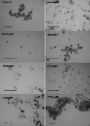
- path of the molecules to be treated. This paper investigates the effect of aggregate size on the photocatalytic activity of pyrogenic titania (Aeroxide® P25, Evonik), which is widely used in fundamental photocatalysis research. Well-defined and reproducible aggregate sizes were achieved by ultrasonic
- . Our results firstly show that a complete dispersion of the P25 aggregates is not practical. Secondly, the photocatalytic activity is not further increased beyond a certain degree of dispersion, which probably corresponds to a critical size for which UV irradiation can penetrate the aggregate without
- from the transmitted light measured with a Varian Cary 100 Bio UV–vis spectrometer [31]. The transmittance was investigated through 10 mm path length P25 suspensions with concentration in the range of 0.01–0.1 g/L and with the aggregate size varying from 234–343 nm. Note that for the second suspension


Two step formation of metal aggregates by surface X-ray radiolysis under Langmuir monolayers: 2D followed by 3D growth
Beilstein J. Nanotechnol. 2015, 6, 2406–2411, doi:10.3762/bjnano.6.247
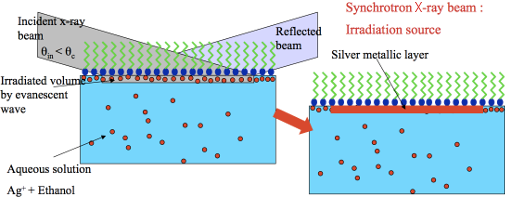
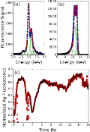
- induces the radiolysis of water. This results in the formation of various radicals (e.g., H•, HO•, e−aq). In the presence of a radical scavenger, H• and e−aq induce reduction of the metal ions into atoms that further aggregate in the solution to form metallic clusters. Usually γ rays or electrons [3] and


Silica-coated upconversion lanthanide nanoparticles: The effect of crystal design on morphology, structure and optical properties
Beilstein J. Nanotechnol. 2015, 6, 2290–2299, doi:10.3762/bjnano.6.235

- number-average diameter (TEM) and the hydrodynamic diameter (DLS) is due to the fact that hydrophobic particles tend to aggregate and cannot be resolved as individual particles by DLS. Morphology and crystalline structure of the dry OM–NaYF4:Yb3+/Er3+ nanocrystals were determined by TEM/BF, TEM/ED and






An adapted Coffey model for studying susceptibility losses in interacting magnetic nanoparticles
Beilstein J. Nanotechnol. 2015, 6, 2173–2182, doi:10.3762/bjnano.6.223

- , and a clustered subsystem of nanoparticles. We considered the case of cluster forming because nanoparticles aggregate and form clusters in real-world specimens. Simulated clusters contain 50 nanoparticles with random local distribution. We defined the local volume fraction rV,loc, i.e., the volume


Self-assembly mechanism of Ni nanowires prepared with an external magnetic field
Beilstein J. Nanotechnol. 2015, 6, 2123–2128, doi:10.3762/bjnano.6.217
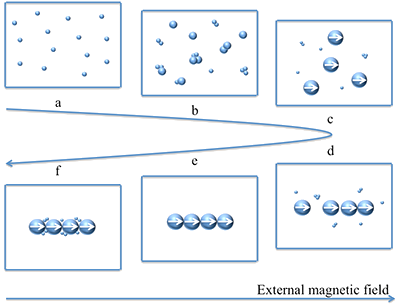
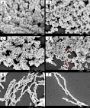
- diameter of about 95 nm and a length of about 26 μm are composed of spherical-like particles that are connected with each other and form straight chains. Notably, the Ni samples remain chain-like after ultrasonication for 30 min, which implies that the Ni particles grow together and do not simply aggregate




Selective porous gates made from colloidal silica nanoparticles
Beilstein J. Nanotechnol. 2015, 6, 2105–2112, doi:10.3762/bjnano.6.215

- brings them to spontaneously segregate in well-defined nanostructures. Therefore, when block copolymers are mixed to solvents which are selective for one of the blocks, polymer chains spontaneously aggregate into micelles having different architectures (i.e., spheres, rods, tubes, lamellae) and degree of


Synthesis, characterization and in vitro biocompatibility study of Au/TMC/Fe3O4 nanocomposites as a promising, nontoxic system for biomedical applications
Beilstein J. Nanotechnol. 2015, 6, 1677–1689, doi:10.3762/bjnano.6.170

- distribution, facile and low cost synthesis process, and ease of surface modification, biological and medical applications using uncoated iron oxide nanoparticles are limited because of their tendency to aggregate and oxidize [9][19]. Covering their surface with organic molecules (e.g., biodegradable polymers
- nanoparticles size measurements, especially in magnetic samples, has been previously reported and could be due to the high tendency of the nanoparticles to aggregate [43][44]. To attempt to overcome this problem, ultrasonic agitation was applied for about 10 min before the measurements. Nevertheless, it seems




How decision analysis can further nanoinformatics
Beilstein J. Nanotechnol. 2015, 6, 1594–1600, doi:10.3762/bjnano.6.162
- , nanoinformatics, determining gaps in the information and risk management technologies, and evaluating opportunities for improvement. These nanoinformatics workshops highlighted a number of resources that were already using nanoinformatics to aggregate and organize nanomaterial data [6]. The Nanoparticle
- literature. Monte Carlo simulations were used to normalize and aggregate individual criteria distributions into distributions of overall performance using criteria weights associated with preferences of different key stakeholders [20]. After developing result distributions that reflect current uncertainties
Using natural language processing techniques to inform research on nanotechnology
Beilstein J. Nanotechnol. 2015, 6, 1439–1449, doi:10.3762/bjnano.6.149

- , nanomedicine, and environmental risk assessment. We believe these approaches can be expanded upon to automatically aggregate studies on the exposure and hazard of ENMs as well as link the physico-chemical properties to the measured effects. Towards this end, we conclude with the following recommendations: Add
The Kirkendall effect and nanoscience: hollow nanospheres and nanotubes
Beilstein J. Nanotechnol. 2015, 6, 1348–1361, doi:10.3762/bjnano.6.139
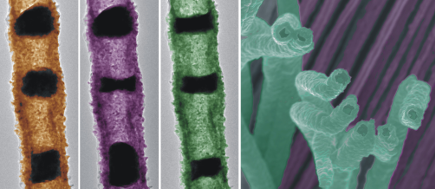
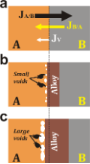
- injected at the Ni/NiO interface as a consequence of the outward diffusion of Ni are comparable, the vacancies have the ability to migrate toward a position over a long-range distance where they aggregate and form a large single void instead of forming small voids distributed along the Ni/NiO interface
- of Cu, the generated vacancies do not have sufficient mobility to migrate over a long-range distance before they aggregate into one single large void. Rather, they form multiple small voids distributed along the Cu/Cu2O interface (as illustrated in Figure 5e), which leads to an additional step in the
- that the nanodroplet tends to split into multiple tiny dewetting metal bismuth nanodroplets. The droplets then migrate and aggregate on the curved inner surface of the oxide shell before the bismuth wets the surface again (between 410.4 and 413.6 s). They attributed this reversible wetting transition



Heterometal nanoparticles from Ru-based molecular clusters covalently anchored onto functionalized carbon nanotubes and nanofibers
Beilstein J. Nanotechnol. 2015, 6, 1287–1297, doi:10.3762/bjnano.6.133

- , these Au atoms tend to aggregate into larger particles. The TEM images of the other Au-containing clusters 6 to 8 on MWNT–PPh2 (Figure S2c–e Supporting Information File 1) also show ultrasmall particles with diameters <3 nm and larger particles of different sizes depending on the cluster. For Ru5Au2C(CO




Preparation of Ni/Cu composite nanowires
Beilstein J. Nanotechnol. 2015, 6, 1268–1271, doi:10.3762/bjnano.6.130
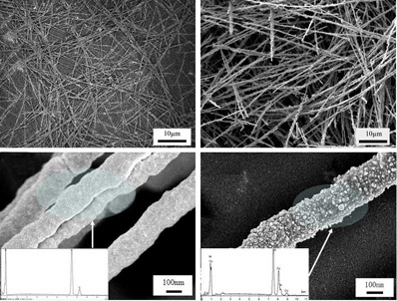
- mechanical stability of Ni/Cu composite nanowires and confirms that they are not merely a loose aggregate of spherical nanoparticles. The EDS graph of the synthesized Ni/Cu composite nanowires in a typical experiment is shown in Figure 1d. The analysis data show that the contents of nickel and copper were


Protein corona – from molecular adsorption to physiological complexity
Beilstein J. Nanotechnol. 2015, 6, 857–873, doi:10.3762/bjnano.6.88

- current achievements and remaining gaps. Review Colloidal stability and the corona Many NPs are found to aggregate in media that contain electrolytes in high concentrations [74][100][101][102][103]. To prevent NPs from agglomeration upon collision with one another, they are usually stabilized in solution



Morphology control of zinc oxide films via polysaccharide-mediated, low temperature, chemical bath deposition
Beilstein J. Nanotechnol. 2015, 6, 799–808, doi:10.3762/bjnano.6.83

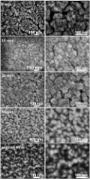
- experiments in which HYA adsorbs onto ZnO crystallites during their growth and thereby influences their size and aspect ratio. Furthermore, those ZnO subunits aggregate under the influence of HYA into highly ordered mesocrystals, which was evidenced by SEM investigations and selected area electron diffraction




Overview of nanoscale NEXAFS performed with soft X-ray microscopes
Beilstein J. Nanotechnol. 2015, 6, 595–604, doi:10.3762/bjnano.6.61

- studied with the HZB-TXM. The electronic states of freestanding CNH aggregate in a dahlia-like shape were investigated and could be related to the presence of pentagonal rings and folding of the graphene sheet in the CNH [66]. Metal impurities due to the exfoliation process of graphite give rise to a pre