Search results
Search for "density" in Full Text gives 1733 result(s) in Beilstein Journal of Nanotechnology. Showing first 200.
Thickness dependent oxidation in CrCl3: a scanning X-ray photoemission and Kelvin probe microscopies study
Beilstein J. Nanotechnol. 2025, 16, 749–761, doi:10.3762/bjnano.16.58
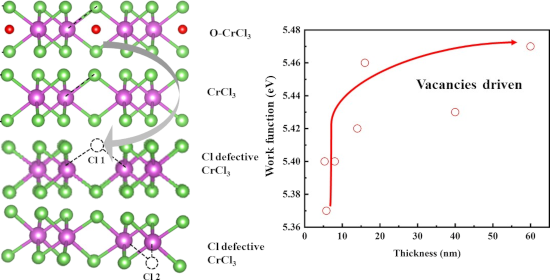
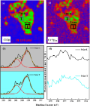
- contrast, in Figure 5c the Cr 2p3/2 spectrum shows also a second component at 576 eV in addition to the main component at 577.5 eV. Both maps display an increased intensity of Cl emission from the parts on the right side of the flake. On the left side, the density of Cl vacancies is supposedly higher (see
- the surface potential represents the most evident variation on the CrCl3 surface, where a higher surface potential is related to a higher level of oxidation of the thicker flakes, probably related to an increased density of Cl vacancies acting as dissociation centers and the formation of a Cl





Synthesis of a multicomponent cellulose-based adsorbent for tetracycline removal from aquaculture water
Beilstein J. Nanotechnol. 2025, 16, 728–739, doi:10.3762/bjnano.16.56
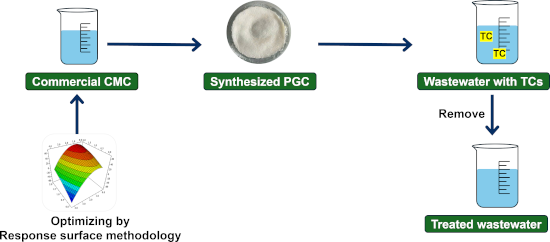
- . Additionally, the detection of sulfur in PGC indicates the potential presence of residual ZnSO4 precursor. Figure 3c–l present significant changes in the elemental distribution of O, S, Zn, and Ca in PGC compared to pristine CMC. These elements display a higher density on the surface of PGC. Brunauer–Emmett
- employed to identify key influencing factors and optimize the synthesis process using RSM. The independent variables included CMC mass (X1) [31], PVA mass (X2), and GA volume (X3) [32], along with the molar ratio of Ca2+ and Zn2+ (X4) [25]. Polyvinyl alcohol (PVA), characterized by a high density of


Efficiency of single-pulse laser fragmentation of organic nutraceutical dispersions in a circular jet flow-through reactor
Beilstein J. Nanotechnol. 2025, 16, 711–727, doi:10.3762/bjnano.16.55
- colloids, for example, to increase their defect density in favor of electrocatalytic or optical properties without changing their size [6][7][8]. In addition, the acronym PUDEL has recently been used for pulsed laser diffusion enhancement in liquids, which refers to an increase in diffusion without
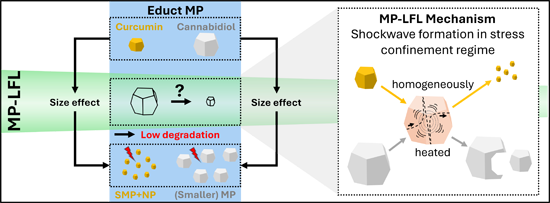
- , the number-weighted particle density distribution was used. The corresponding results are shown in Figure 3 for curcumin and in Figure 4 for CBD. The exemplary SEM images of curcumin in Figure 3A of the starting material and Figure 3B of the laser-treated product qualitatively indicate a recognizable
- order of magnitude larger compared to the curcumin particles, which is also reflected in the number-weighted particle density distribution in Figure 4C, and the density of both materials is similar, the method of analytical centrifugation is useful to compare the hydrodynamic particle size distribution


Nanostructured materials characterized by scanning photoelectron spectromicroscopy
Beilstein J. Nanotechnol. 2025, 16, 700–710, doi:10.3762/bjnano.16.54
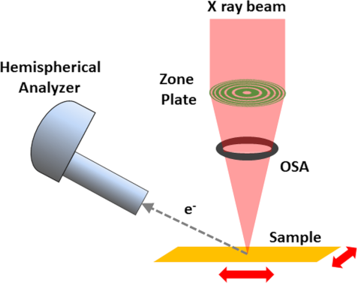
- the samples. Those may be spent to increase energy resolutions at values lower than 80–100 meV and also at higher energies. Similar improvements may also be reached in the spatial resolution; however, any increase in photon density goes with an enhancement of undesired beam-induced effects, such as


High-temperature epitaxial growth of tantalum nitride thin films on MgO: structural evolution and potential for SQUID applications
Beilstein J. Nanotechnol. 2025, 16, 690–699, doi:10.3762/bjnano.16.53
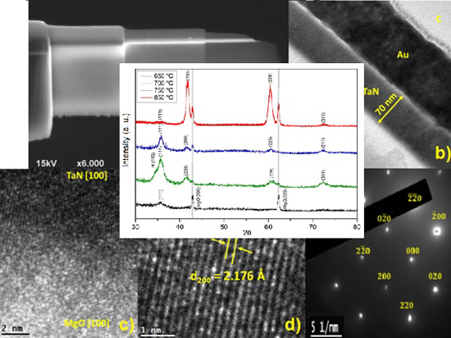
- and chemical properties, including ultrahardness (comparable to that of diamond) and high melting points around 3000 °C. These properties can be qualitatively understood by observing that the Fermi energy falls within a pronounced minimum of the density of states [7]. Some reports have shown that TaN
- frequency of 7.5 Hz, the substrate-to-target distance was 5 cm, and the incident energy density was 4.88 J·cm−2. We studied the stoichiometry and properties of the thin films as a function of gas pressure by introducing N2 to realize RPLD. At this time, the ion pumps were closed and isolated from the PLD


The impact of tris(pentafluorophenyl)borane hole transport layer doping on interfacial charge extraction and recombination
Beilstein J. Nanotechnol. 2025, 16, 678–689, doi:10.3762/bjnano.16.52
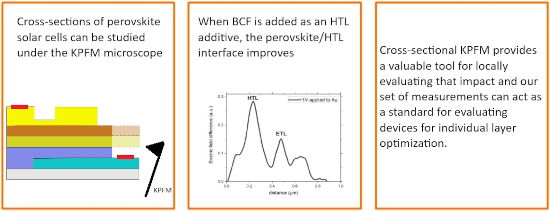
- of each batch. A slow scan rate of 60 mV/s was used for the current density–voltage (J–V) curves so as the ion distribution within the cell is under quasi-equilibrium [39]. We notice that BCF had a beneficial effect on both spiro-OMeTAD and PTAA in terms of photovoltaic parameters. Whilst the
- the solar cells. By plotting charge density profiles we can more clearly point out the sum of photo-charge that has been extracted at the perovskite interfaces and accumulated under open-circuit conditions. Unlike the measurements under bias, here we excited a large number of charges within the
- absorber, which diffuse, get extracted, and aggregate at the interfaces, giving rise to a large charge density magnitude we can plot. In order to generate the photo-carrier density profiles, we applied the Poisson’s equation: Here, ε0 is the permittivity of free space, ε is the relative permittivity of


Colloidal few layered graphene–tannic acid preserves the biocompatibility of periodontal ligament cells
Beilstein J. Nanotechnol. 2025, 16, 664–677, doi:10.3762/bjnano.16.51
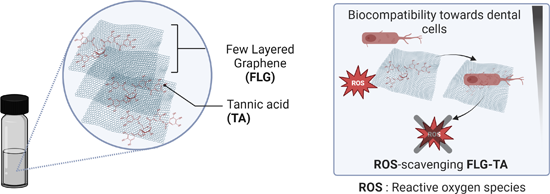
- test compounds [46]. Briefly, cells were seeded at a density of 1 × 10⁵ cells/well (passages 3 to 7) in a 96-well plate with α-MEM essential medium supplemented with 10% FBS, 100 µg·mL−1 penicillin, and 100 µg·mL−1 streptomycin (Dutscher). The cells were treated with FLG and TA in fresh medium at
- ). Oxidative stress Reactive oxygen species (ROS) levels were evaluated using CellROXgreen (Molecular Probes Inc., Eugene, OR). PDL cells at a density of 1 × 10⁵ cells/mL were cultured on glass coverslips (CML, France). PDL cells were then treated with various concentrations of FLG–TA or left untreated for 24
- density and identify condensed chromatin regions. Cell nuclei were segmented using ImageJ's “crop and split” approach before CV calculation. Statistical analysis Statistical analysis was conducted using GraphPad Prism software version 8.0 (GraphPad Software, San Diego, CA, USA). For continuous responses




A formulation containing Cymbopogon flexuosus essential oil: improvement of biochemical parameters and oxidative stress in diabetic rats
Beilstein J. Nanotechnol. 2025, 16, 617–636, doi:10.3762/bjnano.16.48
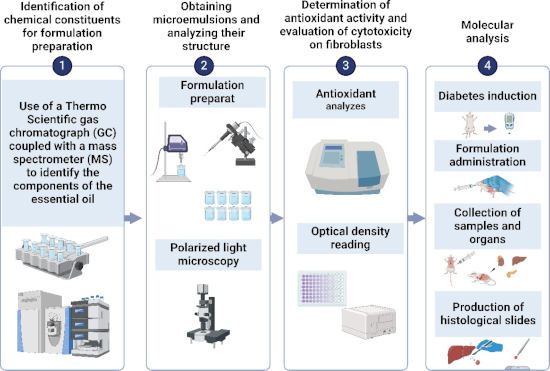
- . Additionally, the ME was able to provide additional benefits, such as reduced liver damage, improved renal function, reduced systemic inflammation, and increased high-density lipoprotein levels. Overall, the results show that EOCF was efficiently incorporated into the microemulsion, improving its antioxidant
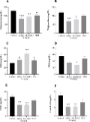
- Figure 7 shows that exposure of rats to STZ induced significant metabolic lipid disturbances. In the control group of diabetic rats, there was a considerable increase in plasma concentrations of total cholesterol (TC = 128.33 mg/dL), triglycerides (TG = 119.22 mg/dL), and low-density lipoprotein (LDL
- ) cholesterol (155.67 mg/dL), along with a decrease in high-density lipoprotein (HDL) cholesterol levels (34.67 mg/dL) and an increase in Castelli-2 index (2.60 mg/dL). The positive control group (MET) only showed a difference in TC levels (102.11 mg/dL), with no significant change in the other metabolic




Polyurethane/silk fibroin-based electrospun membranes for wound healing and skin substitute applications
Beilstein J. Nanotechnol. 2025, 16, 591–612, doi:10.3762/bjnano.16.46
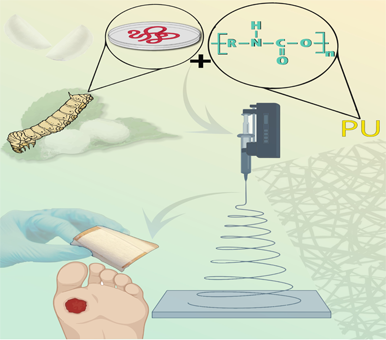
- electrospun polymer fibers is affected by electric field intensity, solution viscosity, charge density of the solution, and solution supply rate [56]. The size of the fibers also affects the performance of electrospun nanofiber composites [57]. Numerous polymers and precursors including polylactic acid, PU



Feasibility analysis of carbon nanofiber synthesis and morphology control using a LPG premixed flame
Beilstein J. Nanotechnol. 2025, 16, 581–590, doi:10.3762/bjnano.16.45
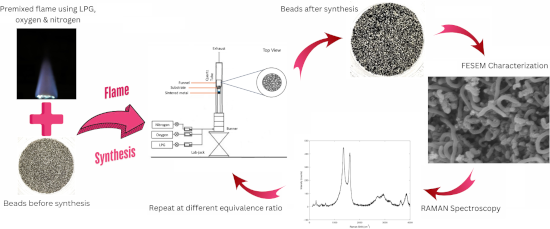
- at 1607 cm−1 and a few broad peaks, indicating less graphitization [14]. In another work, a high-density inductively coupled plasma chemical vapor deposition method yielded vertically aligned CNFs using acetylene and hydrogen on a p-type Si wafer with a 10 nm Ni catalyst layer at 20 mTorr and 550 °C
- . CNF length increases with deposition time, but density decreases because of the detachment of smaller CNFs [15]. A study by Ibrahim et al. showed that CNT growth extends from near the flame sheet toward the centerline within the fuel stream, where carbon sources are abundant. Growth regions cease
- . A higher presence of defects was found before in CNFs via Raman spectroscopy [12]. A slightly elevated defect density was also observed in CNTs derived from LPG [16][31]. The D band and G band intensities show an ID/IG ratio of more than 1.13, which is a clear indicator for high disorder and



Nanomaterials in targeting amyloid-β oligomers: current advances and future directions for Alzheimer's disease diagnosis and therapy
Beilstein J. Nanotechnol. 2025, 16, 561–580, doi:10.3762/bjnano.16.44
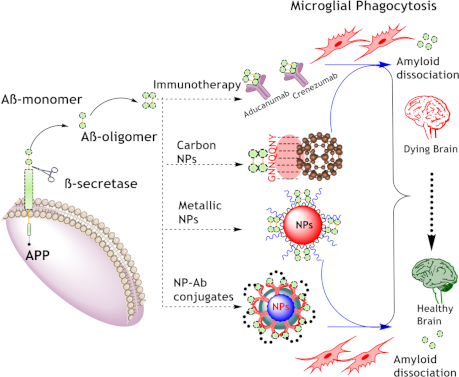
- @CA-AuNP), which demonstrated strong inhibition of hen egg-white lysozyme oligomers (HEWLO) in comparison to fibrils (HEWLF) (Figure 4). The high density of carbohydrate moieties on the NP surface facilitated strong hydrogen bonding with protein oligomers, preventing their aggregation. Additionally


Retrieval of B1 phase from high-pressure B2 phase for CdO nanoparticles by electronic excitations in CdxZn1−xO composite thin films
Beilstein J. Nanotechnol. 2025, 16, 551–560, doi:10.3762/bjnano.16.43
- ρ is the specific mass of the lattice. In Equation 2, B(r,t) indicates the energy density provided to the electron subsystem by the SHI [22][23]. The numerical solutions of the coupled differential equation, obtained through simulation codes, yield a graph depicting the temperature of the ion core
- minimal variation in lattice temperature (≈300 K) and Debye temperature (≈255 K) for CdO, the electron–phonon coupling constant can be expressed using the following equations: where v is the velocity of sound in CdO, ne is the electron number density, Ke and Te are the specific heat and temperature of the
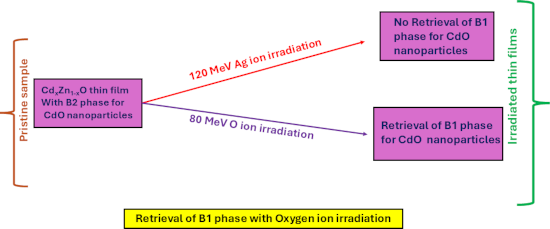
- electronic system, and where TD is the Debye temperature and na is the atomic number density. All the calculated values used in the simulation code are mentioned in Table 2. Discussion for retrieval of the B1 phase with O ion irradiation The thermal annealing at temperatures exceeding 800 °C induces atomic


Electron beam-based direct writing of nanostructures using a palladium β-ketoesterate complex
Beilstein J. Nanotechnol. 2025, 16, 530–539, doi:10.3762/bjnano.16.41
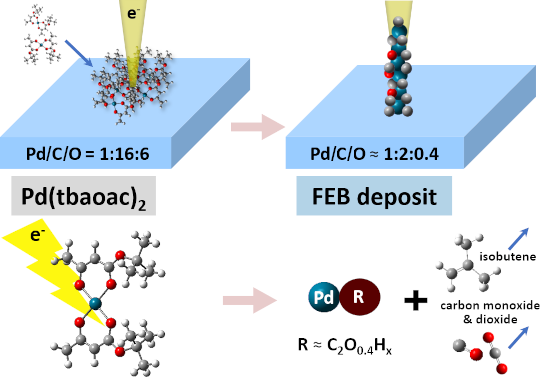
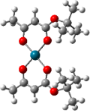
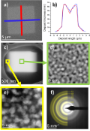
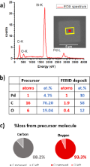
- these k-ratios, Stratagem then recalculates the composition for a thin film (multi)layered structure. The native-oxide Si(100) substrate was accounted for by including a 1 nm thick SiO2 layer of density 2.65 g·cm−3 between the Si substrate and the deposit for the thin film correction. This way, the
- carbon and oxygen). Stratagem thin film correction is applied for removing Si and SiOx as described in the Experimental section. From the measured composition, for the Pd FEBID deposit, the density is evaluated as the weighted average of Pd and C, and for all residual gas deposits having the composition
- CxO1−x, the density is assumed as 1.5 g·cm−3 [48]. AFM thickness measurements were used to determine the volume of the deposits and from there, the mass of the deposits was calculated. The individual numbers of O and C atoms in the residual gas FEB deposits and Pd precursor gas FEB deposits were


Water in nanoporous hexagonal boron nitride nanosheets: a first-principles study
Beilstein J. Nanotechnol. 2025, 16, 510–519, doi:10.3762/bjnano.16.39
- on the density functional theory (DFT) as implemented in the SIESTA [28] code. For the calculations we have used the generalized gradient approximation (GGA), proposed by Perdew, Burke, and Ernzerhof (PBE) [29] as exchange–correlation functional. For the studies of water adsorption, we also use the
- BH van der Waals functional [30]. We make use of norm-conserving Troullier–Martins [31] pseudopotentials in the Kleinman–Bylander [32] factorized form. Also, we have used as basis set the standard double-ζ plus polarizations orbitals (DZP). The basis functions and the electron density were projected
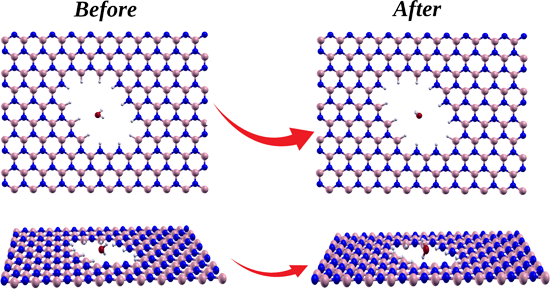
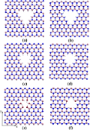
- strong affinity between the rhombic pore and the water molecule. Notably, this affinity is much higher than that observed in triangular pores, as we will discuss. Figure 5 illustrates the density of states (DOS) for an isolated water molecule and the DOS of a system comprising a water molecule




N2+-implantation-induced tailoring of structural, morphological, optical, and electrical characteristics of sputtered molybdenum thin films
Beilstein J. Nanotechnol. 2025, 16, 495–509, doi:10.3762/bjnano.16.38
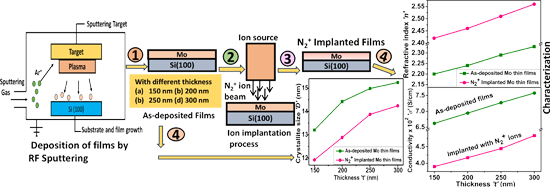
- implanted with 1 × 10¹⁷ N2+·cm−2 at 30 keV using a current density of 4 µA·cm−2. Surface morphology and structural, optical, and electrical properties of the as-deposited and implanted Mo thin films have been systematically investigated. The crystallinity of Mo thin films is enhanced with increasing
- . Some films with different thicknesses were implanted with 1 × 10¹⁷ N2+·cm−2 at 30 keV using a current density of 4 µA·cm−2. This study illustrates the effects of nitrogen ion implantation and film thickness on the structural, optical, and electrical properties of thin molybdenum films. Experimental In
- thicknesses were implanted with 1 × 10¹⁷ N2+·cm−2 at 30 keV using a current density of 4 µA·cm−2. The structural properties of the deposited Mo thin films were investigated using a GXRD Bruker AXS GmbH D8 Advance X-ray diffractometer in grazing incidence geometry, employing Cu Kα radiation with a wavelength


Performance optimization of a microwave-coupled plasma-based ultralow-energy ECR ion source for silicon nanostructuring
Beilstein J. Nanotechnol. 2025, 16, 484–494, doi:10.3762/bjnano.16.37
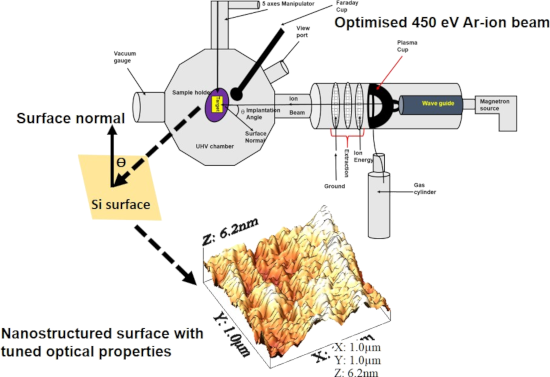
- density of plasma) with lower maintenance. To address this challenge, ECR-based ion sources were developed [24][25]. ECR ion sources are one of the most preferred ion sources for the easy production of ions with different energies and charge states. Since the discharge is maintained in the quartz cup via
- a strong electric field generated in the cavity, the ECR-based ion sources equipped with microwave cavities neither contain any filament nor any type of electrode [26]. The high plasma density within a quartz cup is confined by solenoid magnets surrounding it, creating a multi-cusp magnetic field
- for sustaining the plasma. The ion source’s compact design is user-friendly and capable of producing a high beam current density using single- or multigrid extraction systems [27][28]. The extracted beam current is influenced by magnetron power, gas pressure, and extraction voltage. Furthermore, the


Impact of adsorbate–substrate interaction on nanostructured thin films growth during low-pressure condensation
Beilstein J. Nanotechnol. 2025, 16, 473–483, doi:10.3762/bjnano.16.36
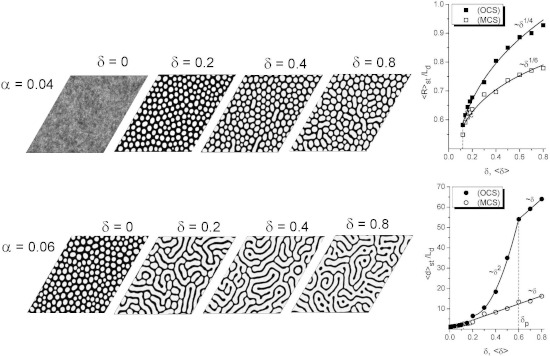
- on the substrate–adsorbate interaction strength δ at different adsorption rates α and adsorbate–adsorbate interaction strengths ε are shown in Figure 1. It follows that an increase in the interaction strength δ from zero results in first-order transitions from a low-density state towards a high
- -density state at δ = δc1 (see solid curve in Figure 1. A decrease in δ leads to the reverse transition at δ = δc2. By comparing curves in Figure 1, one finds that an increase in either adsorption rate α or adatom interaction strength ε induces these transitions. The critical values δc1,c2 depend on both α
- adsorbate–substrate interactions results in first-order transitions from a low-density state toward a high-density state. It is found that at extremely low pressures of the gaseous phase, these interactions induce self-organization processes of adatoms leading to the formation of separated adsorbate islands


Synthetic-polymer-assisted antisense oligonucleotide delivery: targeted approaches for precision disease treatment
Beilstein J. Nanotechnol. 2025, 16, 435–463, doi:10.3762/bjnano.16.34
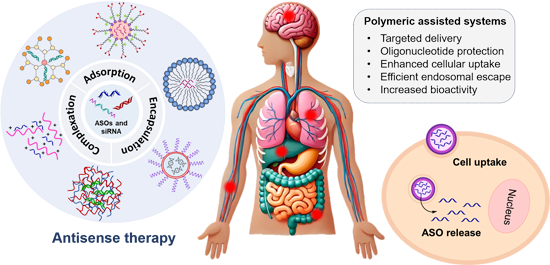
- (e.g., generations 5 and 6) significantly improved the delivery efficiency of ASOs into HeLa cells, as evidenced by increased luciferase activity in a splicing correction assay. This was attributed to the higher charge density and molecular size of the higher-generation DPLs, which facilitated more
- ][106], architecture [107][108], degree of amine/phosphate complexation [109], and surface charge density of the polymers [110] strongly affect the transfection efficiency and toxicity of these cationic platforms. In this section of the review, we discuss the progress and challenges associated with the
- G4) with low and high surface charge density, that is, open shell and dense shell, respectively [133]. In addition, reduced systemic cytotoxicity was achieved through partial modification of PPI G4 with oligosaccharides such as maltose (Mal) and maltotriose (Mal-III), while maintaining optimal


Quantification of lead through rod-shaped silver-doped zinc oxide nanoparticles using an electrochemical approach
Beilstein J. Nanotechnol. 2025, 16, 422–434, doi:10.3762/bjnano.16.33
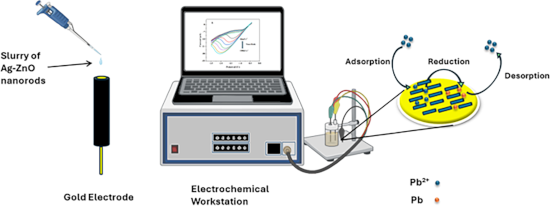
- response, and have a vast range of uses. Zinc oxide shows excellent features, such as nanoscale particles, highly crystalline nature, tunable shape, size and density, and a high aspect ratio. In summary, ZnO nanoparticles offer a versatile platform for technological advancements across fields such as
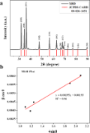
- calculate the average crystallite size of the Ag@ZnO NRs: where λ = 1.54 Å (wavelength of the Kα radiation of Cu), β = full width at half maximum, and θ = peak position. The average crystal size of Ag@ZnO NRs is found to be approximately 28 nm. The dislocation density (δ) of the crystalline material
- corresponds to the Zn 2p1/2 and the 1019.2 eV peak corresponds to Zn 2p3/2. The peak location was marginally changed toward lower binding energy values with the addition of Ag. The peak shift observed was a consequence of the increase in electron density in the host matrix which is caused by the doping of Ag




Size control of nanoparticles synthesized by pulsed laser ablation in liquids using donut-shaped beams
Beilstein J. Nanotechnol. 2025, 16, 407–417, doi:10.3762/bjnano.16.31
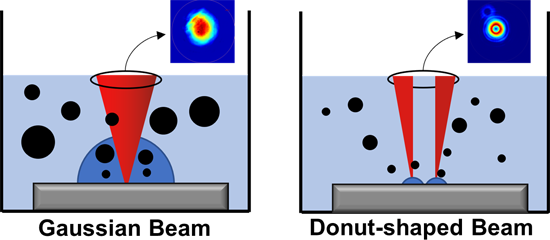
- plumes induced by donut-shaped pulses [44] predicted unusual plume expansion dynamics with the formation of multiple internal shock waves, which strongly increase plume density and temperature. It can be expected that donut-shaped laser pulses can also offer new possibilities for NP production via PLAL
- hydrodynamic instability of the decelerating plume interpenetrating the liquid’s low-density region, the metal vapor condensation, and the emission of metal nanojets. Thus, the donut-shaped beam, which forms a more homogeneous temperature field than the Gaussian beam, affects the material melt’s hydrodynamics


ReactorAFM/STM – dynamic reactions on surfaces at elevated temperature and atmospheric pressure
Beilstein J. Nanotechnol. 2025, 16, 397–406, doi:10.3762/bjnano.16.30
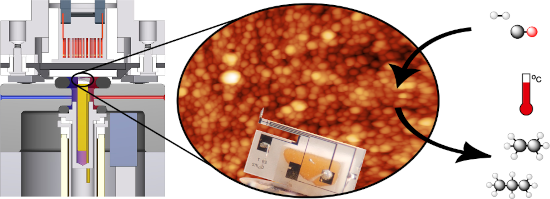
- larger. The QTF’s resonance frequency depends on pressure according to the following equation: where μ is the added mass due to the interaction with surrounding gas molecules, ρ is the density of the quartz tuning fork, and A is the area of the cross section [19]. Basically, the pressure dependence is
- signal in Figure 5d. At a different field of view, we observe Pd(100) steps angled slightly off the vertical direction and less well-defined than under UHV conditions. Most notably is the appearance of high-density, insulating islands illustrated in the current signal image (appearing as dark spots with
- K under 2 bar of CO and H2. Due to significant changes in temperature, the tip had to be retracted and re-approached after recording the image in Figure 6a, which means that we have a new field of view. We observe that the surface otherwise looks similar to Figure 6a with respect to the density and


Engineered PEG–PCL nanoparticles enable sensitive and selective detection of sodium dodecyl sulfate: a qualitative and quantitative analysis
Beilstein J. Nanotechnol. 2025, 16, 385–396, doi:10.3762/bjnano.16.29
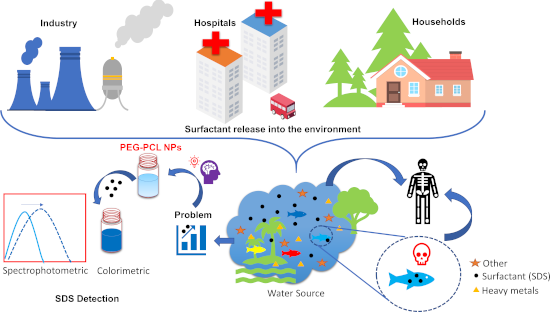
- of SDS was calculated using a linear equation between the concentration of SDS and their respective optical density. For a quantitative estimation of SDS, a series of samples with decreasing SDS concentrations were prepared to determine the detection limit while maintaining constant concentrations of


Development of a mucoadhesive drug delivery system and its interaction with gastric cells
Beilstein J. Nanotechnol. 2025, 16, 371–384, doi:10.3762/bjnano.16.28
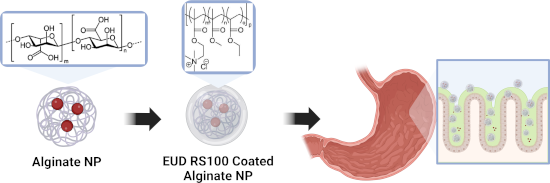
- gastrointestinal system, which leads to higher effectiveness [4][5]. Over the years, different types of gastroretentive drug delivery systems have been developed, including floating, expandable, high-density, or mucoadhesive systems [6]. Among these, mucoadhesive systems are quite effective in localizing the drugs
- for 1 day for complete attachment. The cells were then treated with EudAlg NPs (1 mg/mL) for 3 days. On days 1, 2, and 3, the medium was withdrawn, and colorless DMEM with 10% alamarBlue was added to each well and incubated for 1.5 h at 37 °C under 5% CO2. The optical density was measured at 570 and
- 595 nm with a microplate reader (BioTek Synergy H1). From these optical density values, percent reduction values (representing the metabolic activity) were calculated for each time point. Data is represented as percent viability, which was calculated by the formula below. The viability percentages of


Vortex lattices of layered HTSCs at different vortex–vortex interaction potentials
Beilstein J. Nanotechnol. 2025, 16, 362–370, doi:10.3762/bjnano.16.27
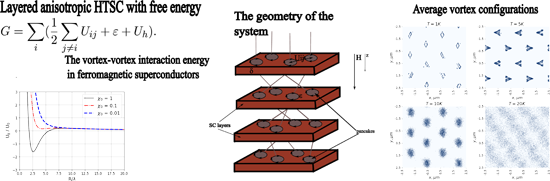
- sample, and the clusters are replaced by regions with a higher average vortex distribution density. It should be noted that clusters in the form of stripes were observed in the numerical simulation in [19]. Conclusion Within the framework of a two-dimensional model of a layered HTSC, the configurations


Pulsed laser in liquid grafting of gold nanoparticle–carbon support composites
Beilstein J. Nanotechnol. 2025, 16, 349–361, doi:10.3762/bjnano.16.26
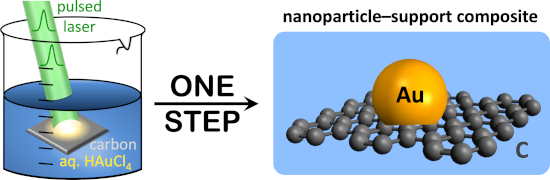
- and creating a high density of graphitic edges on the surfaces of carbon fibers [22]. Our process provides a carbon support material with retained porosity that does not slow mass transport in electrode processes [22], with a high surface area of carbon of 468 cm2 per geometric cm2 [23], derived from
- paper composite fabrication. The mass activity of pulsed laser-grafted cathodes was a factor of 1.65 higher than that of conventionally prepared electrodes (Figure 6A). Chronopotentiometry data, collected in an H-cell at a constant current density of −10 mA·cm−2, corroborated the exceptional stability
- density of −10 mA·cm−2, at which proton-generating water oxidation occurred at the anode, we detected a small amount of CO2 in the GC data of the cathode headspace (Supporting Information File 1, Figure S2 and Figure S4). We observed an exponential asymptotic growth of CO2 that reached steady state after