

Search results
Search for "electronic" in Full Text gives 1112 result(s) in Beilstein Journal of Nanotechnology. Showing first 200.
Interface properties of nanostructured carbon-coated biological implants: an overview
Beilstein J. Nanotechnol. 2024, 15, 1041–1053, doi:10.3762/bjnano.15.85
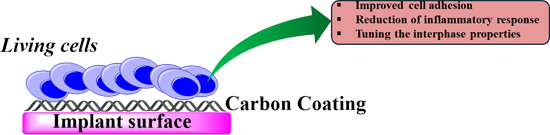
- carbon materials has several members with peculiar properties, namely, (i) graphene-related materials, (ii) CNTs, and (iii) nanodiamonds (NDs) as shown in Figure 2. All nanosized carbon materials show remarkable properties regarding both thermal and electronic conduction, but they should be treated
- rings, which prevents planar deformations [33]. The same phenomenon explains the high thermal conductivity of up to 3000 W·m−1·K−1 [34][35] and the outstanding electrical properties [36][37][38]. Compared to conventional 3D materials, the understanding of electronic transport and carrier dynamics in
- graphene is significantly complicated by the extreme anisotropy intrinsic to its crystal structure and its large compositional and structural variability [39]. Beyond the obvious consequences arising from the chemical composition, some of the main aspects affecting electronic transport in graphene are




Can neutral clusters: a two-step G0W0 and DFT benchmark
Beilstein J. Nanotechnol. 2024, 15, 1010–1016, doi:10.3762/bjnano.15.82
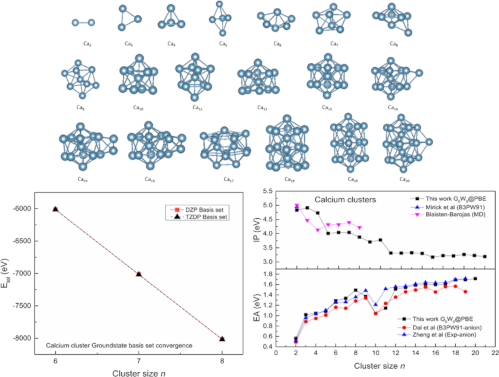
- /bjnano.15.82 Abstract Electronic and structural properties of calcium clusters with a varying size range of 2–20 atoms are studied using a two-step scheme within the GW and density functional theory (DFT) with generalized gradient approximation (GGA). The GGA overestimates the binding energies, optimized
- , except for a few stable even and odd clusters. The electronic properties of the calcium cluster were studied with an all-electron FHI-aims code. In the G0W0 calculation, the magic cluster Ca10 has relatively high ionization potential and low electron affinity. The obtained ionization potentials from the
- -capacity hydrogen storage [8]. As cluster size grows, the electronic configuration changes its semiconducting behavior from nonmetal to metallic due to the overlap between the s and p orbitals. Moreover, the geometry of clusters is related to their structural properties. Most of the studies on calcium


Recent progress on field-effect transistor-based biosensors: device perspective
Beilstein J. Nanotechnol. 2024, 15, 977–994, doi:10.3762/bjnano.15.80
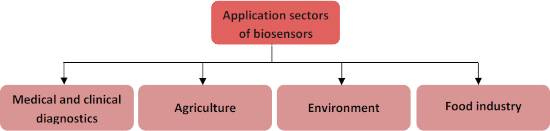
- hybrid partially gated design is reported as an exceptional device allowing digital gates with biosensing integration. Also, a hardware description language (Verilog-A) has been used for the modeling of each device structure to be incorporated into various system designs via electronic design automation





Identification of structural features of surface modifiers in engineered nanostructured metal oxides regarding cell uptake through ML-based classification
Beilstein J. Nanotechnol. 2024, 15, 909–924, doi:10.3762/bjnano.15.75

- ionization potential with the Moreau–Broto autocorrelation to measure the structural and electronic properties of surface modifiers [51] and has a negative impact on the cellular uptake of ENMOs. For example, in the case of surface modifiers 11, 24, 59, and 97, higher values of the AATS7i descriptor result
- , the maxsNH2 value indicates the maximum electronic state value of a single-bonded NH2 group [53]. It is observed that the structures of surface modifiers 74, 77, and 93 are not suitable for higher cellular uptake of ENMOs in the PaCa2 cell line because of the increased maxsNH2 values. Conversely, the
- ENMOs in the PaCa2 cell line. The descriptor maxssO denotes the maximum electronic states of the ether-type oxygen (–O–) present in the structure of a compound [58]. It has been observed that the surface modifiers 23, 29, and 49, which have a higher value of the maxssO descriptor, are suitable for the


A review on the structural characterization of nanomaterials for nano-QSAR models
Beilstein J. Nanotechnol. 2024, 15, 854–866, doi:10.3762/bjnano.15.71

- complexity of inorganic materials and, in place of structural features, focus on electronic features. In this regard, several descriptors were obtained from quantum mechanics (QM) calculations of small clusters or periodic models [26][27][28][29][30]. Although cluster-calculated QM descriptors are inherently
- size-dependent, they are calculated using smaller, single-size model clusters, which are not related to the size of the nanoparticles; thus, they should be considered size-independent. Cluster-related values include standard heat of formation, total energy, electronic energy, core–core repulsion energy
- incorporating the electronic structure in the model, that is, by using the electron configuration of the elements (e.g., by using electron configuration fingerprints) [32]. In this way, the atomic orbitals can be easily represented and used to estimate the molecular/crystal orbitals in the NM without requiring


Intermixing of MoS2 and WS2 photocatalysts toward methylene blue photodegradation
Beilstein J. Nanotechnol. 2024, 15, 817–829, doi:10.3762/bjnano.15.68
- experiments, we weighed the samples using a sensitive electronic balance (Secura microbalance, Sartorius) with an accuracy down to 0.01 mg. Structural, crystalline, and vibrational properties of the fabricated materials were examined utilizing X-ray diffraction (D8 Discover diffractometer, Bruker) with a Kα
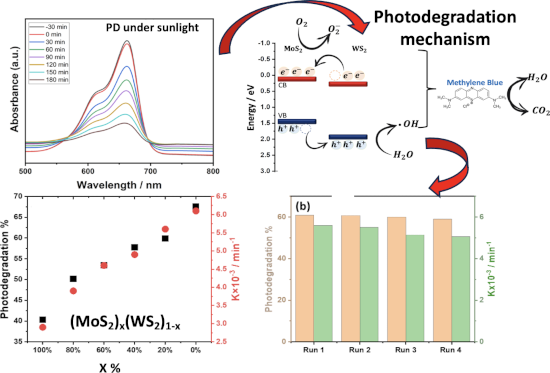
- excitations from a) sunlight and b) solar simulator. Proposed PD mechanisms of MB by MoS2/WS2 catalysts. PD stability comparison between WS2, MoS2 and WS2/MoS2 composite samples. Schematic diagram of the photocatalyst preparation. Electronic band structure for both MoS2 and WS2. Reported MoS2 and WS2-based


Synthesis of silver–palladium Janus nanoparticles using co-sputtering of independent sources: experimental and theorical study
Beilstein J. Nanotechnol. 2024, 15, 808–816, doi:10.3762/bjnano.15.67
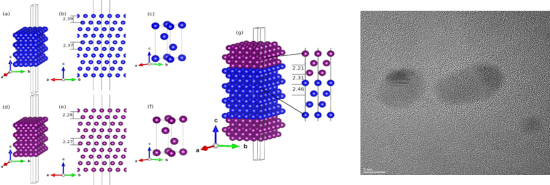
- melting temperature and, partly, because the appearance of moisture delays the diffusion of silver atoms. The synthesis of AgPd nanocrystals with sizes ranging from 2.46 to 6.65 nm has been reported for applications in the manufacturing of electronic components [6]. Chu et al. [7] synthesized Pd–Ag
- complement the structural analysis of Janus BNPs, we performed a set of atomic-scale studies using density functional theory [19][20] as implemented in the Vienna Ab Initio Simulation (VASP) package [21][22]. VASP employs a plane wave basis set to represent the electronic states. We used the generalized




Electron-induced ligand loss from iron tetracarbonyl methyl acrylate
Beilstein J. Nanotechnol. 2024, 15, 797–807, doi:10.3762/bjnano.15.66
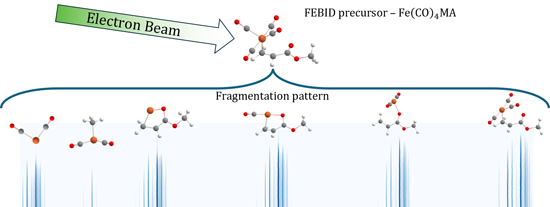
- the gas phase has been probed with respect to its dissociative ionization [10] and dissociative electron attachment [11][12]; there is even information available on its electronic excitation, which is the first step towards neutral dissociation [11]. The gas-phase studies have been complemented by
- with an odd number of electrons were assumed to be in doublet spin states. Threshold energies listed in the tables were obtained as differences of sums of the electronic and zero-point energies of products and reactants as Here, Ei is the sum of electronic and zero point energies of a given fragment
- higher vibrational density of states. It is well established that, upon vertical electron removal, which can create a cation in many different electronic states, the cation relaxes to its electronic ground state on an ultrafast timescale (typically via a series of conical intersections). The excess



Exploring surface charge dynamics: implications for AFM height measurements in 2D materials
Beilstein J. Nanotechnol. 2024, 15, 767–780, doi:10.3762/bjnano.15.64
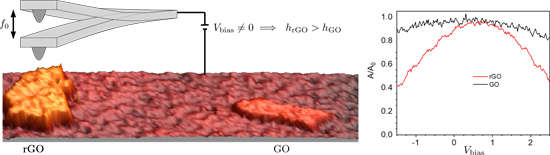
- of surface charges and their intricate interaction with the tip. Keywords: 2D materials; incorrect height measurements; Joule dissipation; surface conductivity; tip influence; Introduction Two-dimensional (2D) materials have emerged as a promising platform for next-generation electronic devices [1
- facilitates the creation of new heterostructures with tailored properties [15][16], making 2D materials suitable for different applications. Understanding the correlation between structural and topographical variations and their impact on mechanical [17][18], optical [19][20], magnetic [21][22], electronic
- microscopy (AFM) techniques emerge as ideal tools to investigate them [26][27]. Depending on the operation mode and under controlled environmental conditions, AFM offers the possibility to record morphology along with relevant electronic, mechanical, or magnetic properties with nanoscale resolution. In


Green synthesis of biomass-derived carbon quantum dots for photocatalytic degradation of methylene blue
Beilstein J. Nanotechnol. 2024, 15, 755–766, doi:10.3762/bjnano.15.63
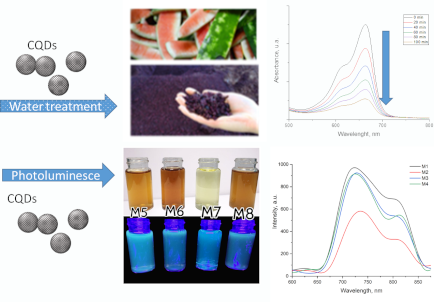
- the biomass source. Considering that the MB molecule contains azo bonds consisting of double bonds (–N=N–), it is possible to foresee a strong interaction with C–N groups on the surface of species M3 and M7. On the other hand, such C–N groups could cause a shift in the electronic energy states [43


Effect of repeating hydrothermal growth processes and rapid thermal annealing on CuO thin film properties
Beilstein J. Nanotechnol. 2024, 15, 743–754, doi:10.3762/bjnano.15.62
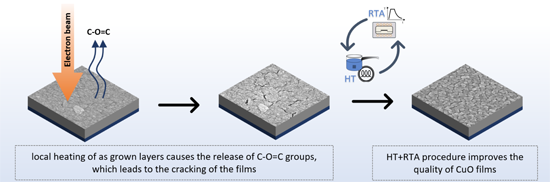
- hydrothermal method ensures homogeneous single-phase films initially. However, their electrical instability and susceptibility to cracking under the influence of temperature have posed a challenge to their utilization in electronic devices. To address this limitation, the HT+RTA procedure has been developed
- crystalline quality of the films. The implementation of the HT+RTA procedure significantly enhances the potential of CuO films for electronic applications. Key findings from Kelvin probe force microscopy analysis demonstrate the possibility of modulating the work function of the material. In addition
- , scanning capacitance microscopy measurements provided information on the changes in the local carrier concentration with each repetition. These studies indicate the increased usefulness of CuO thin films obtained from the HT+RTA procedure, which expands the possibilities of their applications in electronic




Level set simulation of focused ion beam sputtering of a multilayer substrate
Beilstein J. Nanotechnol. 2024, 15, 733–742, doi:10.3762/bjnano.15.61
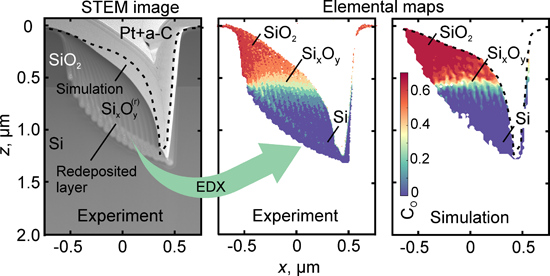
- Alexander V. Rumyantsev Nikolai I. Borgardt Roman L. Volkov Yuri A. Chaplygin National Research University of Electronic Technology - MIET, Bld. 1, Shokin Square, Zelenograd, Moscow, 124498, Russia 10.3762/bjnano.15.61 Abstract The evolution of a multilayer sample surface during focused ion beam
- calculated ion trajectories for each angle θ was equal to 107. The electronic energy loss was described by the equipartition of Oen–Robinson [42] and Lindhard–Scharff [43] models. The atomic density of amorphous SiO2 was assumed as = 6.9·1022 cm−3 in accordance with [44]. Conclusion In this study, an

![[Graphic 55]](/bjnano/content/inline/2190-4286-15-61-i68.svg?max-width=637&scale=1.18182)


Reduced subthreshold swing in a vertical tunnel FET using a low-work-function live metal strip and a low-k material at the drain
Beilstein J. Nanotechnol. 2024, 15, 713–718, doi:10.3762/bjnano.15.59
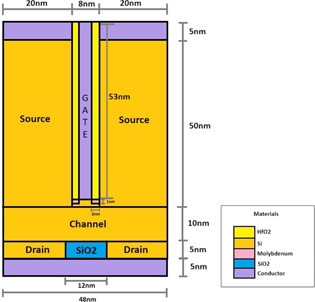
- ); tunnel field-effect transistor (TFET); Introduction Rapid miniaturization of electronic devices has led to an increase in leakage current. Leakage current is a big challenge in miniaturized circuits. Miniaturization, at the same time, increased the device performance and reduced the area occupied by the


Elastic modulus of β-Ga2O3 nanowires measured by resonance and three-point bending techniques
Beilstein J. Nanotechnol. 2024, 15, 704–712, doi:10.3762/bjnano.15.58
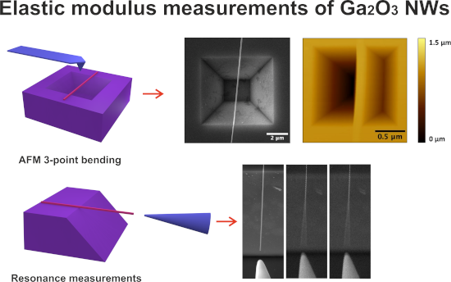
- suitable for use on bendable and stretchable substrates in line with the current trends in electronic technologies focusing on flexible electronic device development [11][12]. Consequently, understanding the mechanical properties of β-Ga2O3 NWs becomes an important step. For instance, precise determination


Gold nanomakura: nanoarchitectonics and their photothermal response in association with carrageenan hydrogels
Beilstein J. Nanotechnol. 2024, 15, 678–693, doi:10.3762/bjnano.15.56
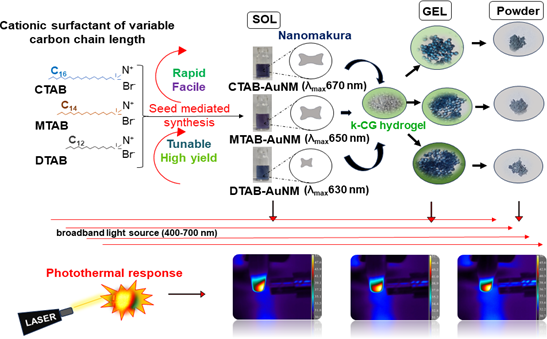
- temperature [2]. The mean free path of an electron is influenced by shape/size of the metal nanoparticles which ultimately governs their physical, chemical, optical, magnetic, catalytic, and electronic properties [3]. All plasmonic metals exhibit optical phenomena over a range of electromagnetic radiation







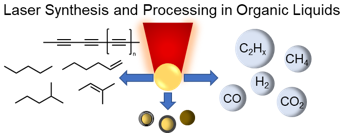
Laser synthesis of nanoparticles in organic solvents – products, reactions, and perspectives
Beilstein J. Nanotechnol. 2024, 15, 638–663, doi:10.3762/bjnano.15.54





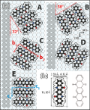
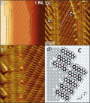
Directed growth of quinacridone chains on the vicinal Ag(35 1 1) surface
Beilstein J. Nanotechnol. 2024, 15, 556–568, doi:10.3762/bjnano.15.48
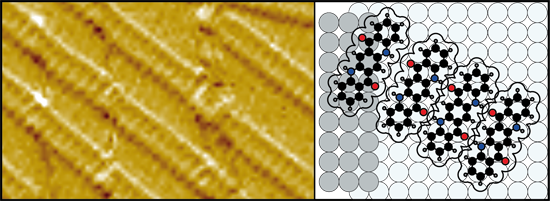
- hydrogen bonds (H-bonds) [19] support the growth of long 1D chains of parallel oriented QA molecules, both in bulk crystals and on surfaces. It has been shown by Głowacki et al. that QA exhibits promising properties for applications in electronic and optoelectronic devices [20][21]. In particular, they


Aero-ZnS prepared by physical vapor transport on three-dimensional networks of sacrificial ZnO microtetrapods
Beilstein J. Nanotechnol. 2024, 15, 490–499, doi:10.3762/bjnano.15.44
- , Chisinau, Republic of Moldova Institute of Electronic Engineering and Nanotechnology „D. Ghitu”, Technical University of Moldova, Chisinau, Republic of Moldova Institute of Applied Physics, State University of Moldova, Chisinau, Republic of Moldova Department of Physics, University of Cagliari, Italy
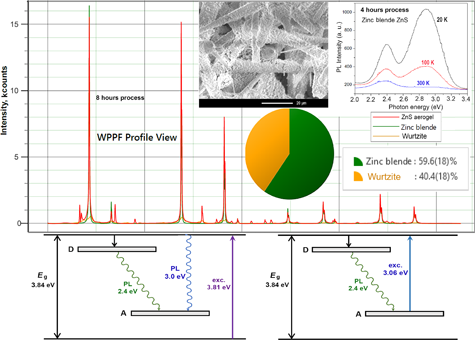
- phase content of the prepared aerogels by the duration of the technological procedure. A scheme of deep energy levels and electronic transitions in the ZnS skeleton of the aeromaterial was deduced from the PL analysis, suggesting that the produced aerogel is a potential candidate for photocatalytic and
- pollutants from the atmosphere and from water, in other catalytic processes, including photocatalytic water splitting, in energy production and storage, in microfluidic systems, in drug delivery and other biomedical applications, in sensing, in electronic, photoelectronic, optoelectronic and nanophotonic



Photocatalytic degradation of methylene blue under visible light by cobalt ferrite nanoparticles/graphene quantum dots
Beilstein J. Nanotechnol. 2024, 15, 475–489, doi:10.3762/bjnano.15.43
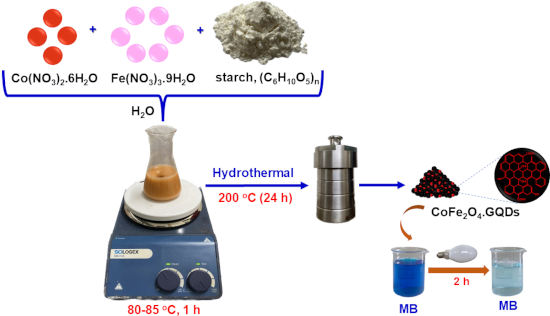
- slight MB adsorption and decolourisation. The combination of GQDs and CoFe2O4 improves the decolourisation capacity significantly. Stacking CoFe2O4 crystals onto GQDs sheets not only prevents agglomeration but also creates heterojunction contacts or intermediate steps in the electronic structure. These




Fabrication of nanocrystal forms of ᴅ-cycloserine and their application for transdermal and enteric drug delivery systems
Beilstein J. Nanotechnol. 2024, 15, 465–474, doi:10.3762/bjnano.15.42
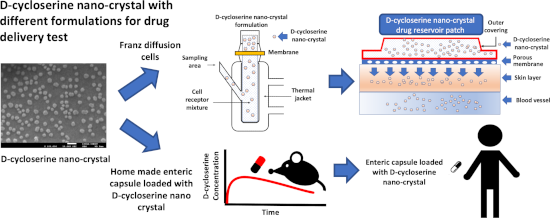
- improve the bioavailability. In this study, for the first time, DCS, a highly water-soluble compound, has formed nanocrystals and this was confirmed by scanning electronic microscopy and X-ray powder diffraction. Furthermore, DCS nanocrystals were applied to several formulations to test their stability
- ., Ltd.) for 10 min. The collection was vacuum-dried to obtain DCS nanocrystals. Characterization of DCS nanocrystals The DCS nanocrystals were analyzed via scanning electronic microscopy (SEM, JEOL Ltd.) and X-ray powder diffraction (XRPD, Bruker AXS GmbH). For SEM, commercial DCS was spreaded onto a


Unveiling the nature of atomic defects in graphene on a metal surface
Beilstein J. Nanotechnol. 2024, 15, 416–425, doi:10.3762/bjnano.15.37
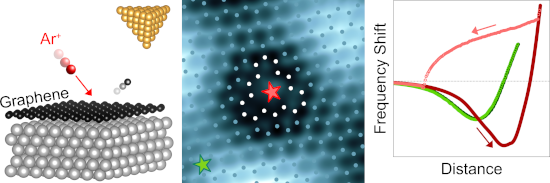
- ; scanning tunneling microscopy and spectroscopy; Introduction Defects in lattices of two-dimensional (2D) materials are considered as promising building blocks for tailoring electronic and phononic band structures, magnetic texture, photon emission, and charge carrier concentration [1]. In addition
- , defects profoundly impact, in a beneficial or detrimental manner, characteristic properties of 2D materials [2]. A prominent 2D material is graphene. Intact graphene, the 2D sp2 arrangement of C atoms in a honeycomb mesh, is well known for its appealing electronic and mechanical properties [3][4]. However
- ][14][15][16][17][18][19][20][21][22][23]. Even single missing C atoms were demonstrated to severely change electronic [11][13][14][18], mechanical [17], and magnetic [7][8][10][12] characteristics. It is therefore not surprising that the intentional creation of defects, which has mainly been achieved


Investigating ripple pattern formation and damage profiles in Si and Ge induced by 100 keV Ar+ ion beam: a comparative study
Beilstein J. Nanotechnol. 2024, 15, 367–375, doi:10.3762/bjnano.15.33
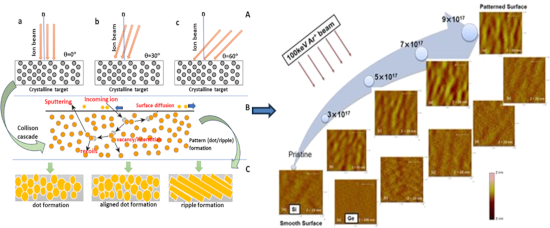
- ) facility of the Inter University Accelerator Centre, New Delhi. The electronic and nuclear energy losses of 100 keV Ar+ inside Si and Ge were calculated using the SRIM software [39]. The electronic energy loss values were found to be 37.67 and 36.51 eV/Å for Si and Ge, respectively, and the nuclear energy


Controllable physicochemical properties of WOx thin films grown under glancing angle
Beilstein J. Nanotechnol. 2024, 15, 350–359, doi:10.3762/bjnano.15.31
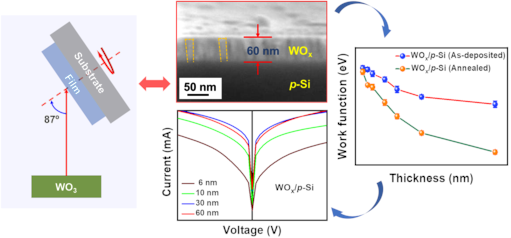
- , film crystallinity and compositional variations in such films can also be adjusted as a function of the growth angle [27][28], making GLAD a promising approach to yield nanostructured (NS) films [29][30][31]. Electronic devices consisting of multilayers often require information on surface
- concentration within a metal oxide film is known to influence its bandgap and work function values. As OV increases, there is a corresponding rise in electron concentration within the bandgap region, which results in the formation of certain localized electronic states associated with these vacancy defects




Investigating structural and electronic properties of neutral zinc clusters: a G0W0 and G0W0Г0(1) benchmark
Beilstein J. Nanotechnol. 2024, 15, 310–316, doi:10.3762/bjnano.15.28

- /bjnano.15.28 Abstract The structural and electronic properties of zinc clusters (Znn) for a size range of n = 2–15 are studied using density functional theory. The particle swarm optimization algorithm is employed to search the structure and to determine the ground-state structure of the neutral Zn
- literature to study the stability of these structures. We further assess the electronic properties, including the ionization potential, using the all-electron FHI-aims code employing G0W0 calculations, and the G0W0Г0(1) correction for a few smaller clusters, which provides a better estimation of the
- decreases. Bulk zinc has metallic characteristics because of the overlap of the s and p orbitals. In the past, Zn clusters have been analyzed both experimentally and theoretically, where the studies were mainly conducted to determine the stability and electronic properties of the zinc cluster ground state


![[Graphic 14]](/bjnano/content/inline/2190-4286-15-28-i15.svg?max-width=637&scale=1.18182)
Determining by Raman spectroscopy the average thickness and N-layer-specific surface coverages of MoS2 thin films with domains much smaller than the laser spot size
Beilstein J. Nanotechnol. 2024, 15, 279–296, doi:10.3762/bjnano.15.26
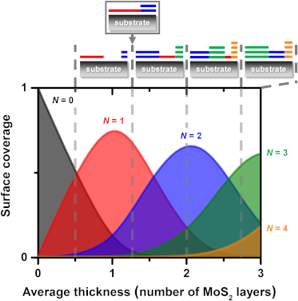
- transition to a direct bandgap semiconductor with very high photoluminescence quantum yield when thinned down to a monolayer [13][14][15][16][17]. Its unique electronic and optical properties could provide an edge in many future applications. The multilayers MoS2 structures are of the most common 2Hc type