

Search results
Search for "cell viability" in Full Text gives 187 result(s) in Beilstein Journal of Nanotechnology.
In vitro interaction of colloidal nanoparticles with mammalian cells: What have we learned thus far?
Beilstein J. Nanotechnol. 2014, 5, 1477–1490, doi:10.3762/bjnano.5.161
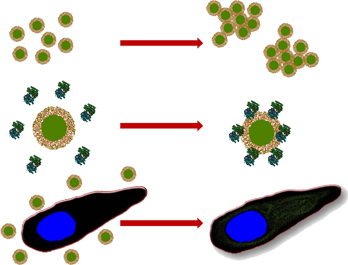
- geometry, in which the culture medium is on top of the cells, a reduced colloidal stability leads to the precipitation of NP agglomerates onto the cells and, thus, to enhanced uptake, which can influence the cell viability negatively [89]. Such different exposure scenarios are highly relevant for the


Protein-coated pH-responsive gold nanoparticles: Microwave-assisted synthesis and surface charge-dependent anticancer activity
Beilstein J. Nanotechnol. 2014, 5, 1452–1462, doi:10.3762/bjnano.5.158
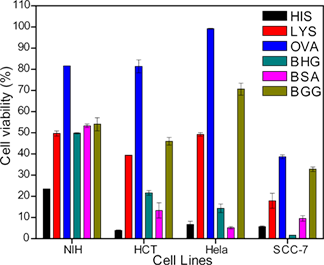
- also observed in the UV–vis studies for the blank proteins (Figure S3, Supporting Information File 1). Cell viability after exposure to AuNPs To investigate the cell viability after the exposure to AuNPs, MTT assays were conducted with mouse embryonic fibroblasts (NIH-3T3) by treating them with AuNPs
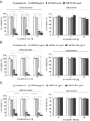
- samples prepared by using different proteins (Figure 4A). Exposure to AuNPs resulted in different cell viability values based on the protein used for capping. The OVA-coated AuNPs had the highest IC50 value, and HIS-AuNPs had the lowest. From the zeta potential titration studies (Figure 3), HIS-AuNPs had
- of the different AuNPs revealed that the cell viabilities after exposure to the AuNPs decreased with increasing IEP values. Therefore, the HIS-AuNPs, which had an IEP value of 10.58, resulted in the lowest cell viability, leading to high toxicity. The OVA-AuNPs, which had an IEP value of 5.08


The protein corona protects against size- and dose-dependent toxicity of amorphous silica nanoparticles
Beilstein J. Nanotechnol. 2014, 5, 1380–1392, doi:10.3762/bjnano.5.151
- established a dual-color fluorescence cell vitality assay. By employing fluorescent probes that recognize cell viability by measuring intracellular esterase activity (calcein-AM; green) as well as plasma membrane integrity (ethidium homodimer-1/EthD-1; red), the assay allows for the simultaneous quantitation
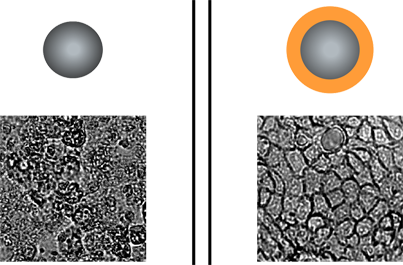
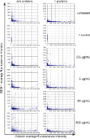
- vitality of Caco-2, automated high-throughput microscopy revealed that cell death was almost completely prevented upon treatment in the presence of serum or human plasma proteins (Figure 4, right panel). Similar results were obtained by assessing the cell viability using independent methods, such as the
- living cells, image analysis and presentation were performed as described in detail in [53]. Measurement of cell viability Cell viability was determined by using the electric sensing zone method (CASY® TT Cell Counter; Schärfe SystemGmbH, Reutlingen, Germany) or by the mitochondria-dependent reduction of




Model systems for studying cell adhesion and biomimetic actin networks
Beilstein J. Nanotechnol. 2014, 5, 1193–1202, doi:10.3762/bjnano.5.131
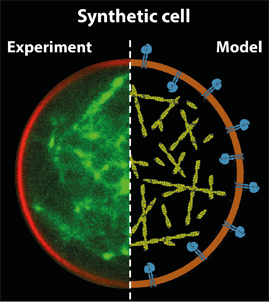
- shape and for maintaining cell viability, migration, and tissue integrity [3]. Cell–cell and cell–substrate adhesion are mediated by different proteins, the cell adhesion molecules (CAMs). A very important group of CAMs is the integrin family, which functions both as cell–substrate and cell–cell


Nanodiamond-DGEA peptide conjugates for enhanced delivery of doxorubicin to prostate cancer
Beilstein J. Nanotechnol. 2014, 5, 937–945, doi:10.3762/bjnano.5.107
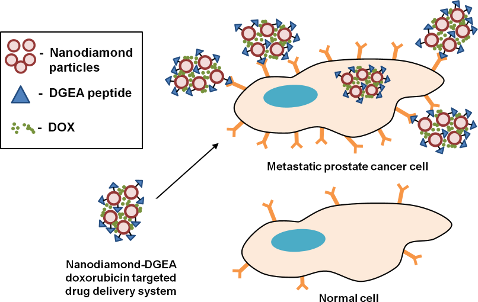
- effects of the drug delivery system were due to the combination of enhanced targeting and drug delivery instead of potential toxicity of ND or DGEA peptide, PC3 cells were also exposed to ND, ND-DGEA, and free DGEA. The cell viability was quantified with a 3-(4,5-dimethylthiazol-2-yl)-5-(3
- -carboxymethoxyphenyl)-2-(4-sulfophenyl)-2H-tetrazolium (MTS, Promega, Madison, WI) assay. Briefly, MTS assay reagent was added to the cells, and the plates were incubated for 2 h. The absorbance at 490 nm was read with a microplate reader. Cell viability was represented as percentages in reference to the control
- exposed to these treatments for 32 h, and MTS cell viability assay was performed. As shown in Figure 6a, there were no significant differences in cell viability for any of the treatments; the cell viabilities for NDs, DGEA, and ND-DGEA conjugates were all comparable to the control. With the demonstration


Optimizing the synthesis of CdS/ZnS core/shell semiconductor nanocrystals for bioimaging applications
Beilstein J. Nanotechnol. 2014, 5, 919–926, doi:10.3762/bjnano.5.105

- studies, a cell viability (MTS) assay was carried out for F127-CdS/ZnS QDs. As shown in Figure 10, we tested the cell viability of Panc-1 cells, treating them with various concentrations of ternary nanocrystal formulations for 48 h. The cell viability remained at 84% even at a concentration as high as 500
- for in vitro and in vivo studies. In addition, from our study of cell viability, the prepared ternary nanocrystals were shown to have a low cytotoxicity. Given their biocompatibility and the high efficiency in relation to targeted delivery, these nanoparticles have great potential to serve as a new
- (FBS, Hyclone) and cultured at 37 °C in a humidified atmosphere with 5% CO2. For cell imaging, cells were treated with F127-CdS/ZnS micelles formulations for 2 h. The cells were then washed with PBS for three times and imaged using a Leica confocal microscopy system (TCS SP2). For the cell viability


Antimicrobial nanospheres thin coatings prepared by advanced pulsed laser technique
Beilstein J. Nanotechnol. 2014, 5, 872–880, doi:10.3762/bjnano.5.99

- secondary electron beams with energies of 30 keV on samples covered with a thin gold layer. Cell viability Human endothelial cells (EAhy926 cell line, ATCC, USA) were grown in Dulbecco's Modified Eagle Medium (DMEM) culture medium containing 10% Fetal Bovine Serum (FBS), and 1% penicillin and neomycin




Antimicrobial properties of CuO nanorods and multi-armed nanoparticles against B. anthracis vegetative cells and endospores
Beilstein J. Nanotechnol. 2014, 5, 789–800, doi:10.3762/bjnano.5.91
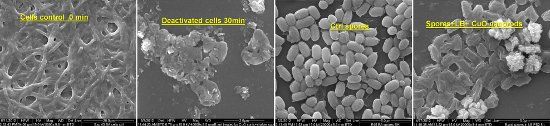
- the cell viability. A mere 13.33% reduction in the control set cell count may be treated as natural. PS2 NPs demonstrated an even better bactericidal action against E. coli at a dose of 1 mg/mL, with which 100% of 2.3 × 10⁷ CFU/mL of bacteria were killed within 2 h of treatment. In fact a reduction of


In vitro toxicity and bioimaging studies of gold nanorods formulations coated with biofunctional thiol-PEG molecules and Pluronic block copolymers
Beilstein J. Nanotechnol. 2014, 5, 546–553, doi:10.3762/bjnano.5.64
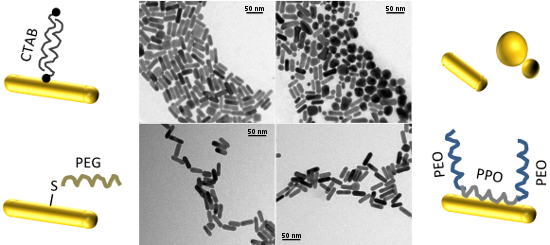
- in the overall cell viability. We also demonstrate the use of the functionalized gold nanorods as scattering probes for dark-field imaging of cancer cells thereby demonstrating their biocompatibility. Our results offer a unique solution for the future development of safe scattering color probes for
- , transmission electron microscopy (TEM), cell viability assay, dynamic light scattering (DLS), and dark-field imaging microscopy. The non-specific uptake of these AuNRs by cells was also studied under dark-field microscopy. Our work demonstrates that the coating of AuNRs surfaces with PEG-SH or PEO–PPO–PEO
- molecules significantly improved the colloidal and optical stability of the gold nanoformulation. No aggregation is found even a few weeks after the preparation. More importantly, the cell viability and dark-field imaging studies indicate that the AuNRs functionalized with PEG-SH or PEO–PPO–PEO molecules


Near-infrared dye loaded polymeric nanoparticles for cancer imaging and therapy and cellular response after laser-induced heating
Beilstein J. Nanotechnol. 2014, 5, 313–322, doi:10.3762/bjnano.5.35
- themselves. Cytotoxicity assessment Cell viability after five different treatments (laser only, void PGMD NPs w/ laser, IR820-PGMD NPs, IR820-PGMD NPs w/ laser, incubator HT w/ IR820-PGMD NPs) was measured with the Sulforhodamine B colorimetric (SRB) assay 24 h post-treatment, as previously described in our


Cytotoxic and proinflammatory effects of PVP-coated silver nanoparticles after intratracheal instillation in rats
Beilstein J. Nanotechnol. 2013, 4, 933–940, doi:10.3762/bjnano.4.105
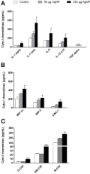
- -dependent decrease in cell viability. In addition, a proinflammatory response was shown by increased levels of tumor necrosis factor-α (TNF-α), macrophage inflammatory protein-2 (MIP-2), and interleukin-1β (IL-1β) [18]. Furthermore, AgNP caused damage to mitochondria and an increased production of reactive




Magnetic-Fe/Fe3O4-nanoparticle-bound SN38 as carboxylesterase-cleavable prodrug for the delivery to tumors within monocytes/macrophages
Beilstein J. Nanotechnol. 2012, 3, 444–455, doi:10.3762/bjnano.3.51
- . To assay the cell viability, MTT reagent solution 1:10 (v/v, reagent solution/cell medium) was added to the cells and incubated at 37 °C for 4 h. After incubation, the MTT solution in buffer (1:1, medium/buffer) was added to the medium, incubated overnight, and the absorbance at 550 nm and 690 nm, as
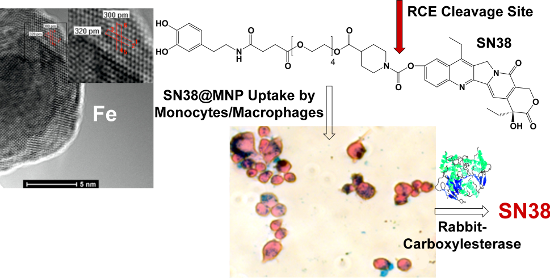
- spectra of MNP-SN38 and free SN38 released from MNP. Toxicity of MNP-SN38 on double stable Mo/Ma after 24 h of loading; the MTT assay was performed for cell viability, and cell viability of 100% is considered in the case of the control group. Double-stable Mo/Ma loaded with MNP-SN38 320 g/mL(medium). a