

Search results
Search for "mixed state" in Full Text gives 4 result(s) in Beilstein Journal of Nanotechnology.
Microscopic study of the intermediate mixed state in intertype superconductors
Beilstein J. Nanotechnol. 2026, 17, 57–62, doi:10.3762/bjnano.17.5
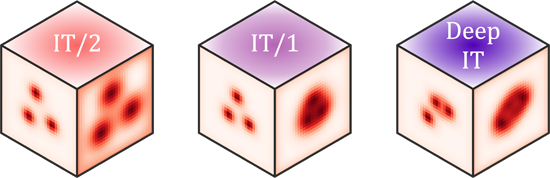
- /bjnano.17.5 Abstract We present a comprehensive microscopic study of the intermediate mixed state in superconductors of the intertype (IT) regime separating types I and II. Using fully self-consistent Bogoliubov–de Gennes calculations for a lattice model, we analyze few-vortex configurations across the
- quantized vortices forming a mixed state [1][2][3]. Within the Ginzburg–Landau (GL) framework, the boundary between these regimes is determined by the GL parameter κ = λL/ξGL, where λL is the magnetic London penetration depth and ξGL is Ginsburg–Landau coherence length, with the critical value separating
- complex, irregular patterns that cannot be attributed to type-I or type-II behavior [5][6][7][8][9][10][11][12][13][14][15][16]. These patterns are referred to as intermediate mixed state (IMS) and are characterized by the coexistence of Meissner domains and vortex clusters, chains, or fragmented lattices


Vortex lattices of layered HTSCs at different vortex–vortex interaction potentials
Beilstein J. Nanotechnol. 2025, 16, 362–370, doi:10.3762/bjnano.16.27
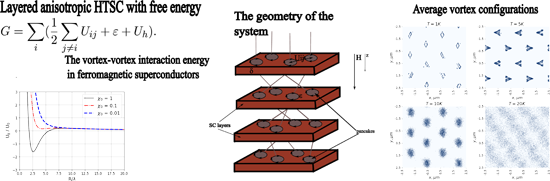
- ; Introduction Type-II superconductors, as shown by numerous studies, have a complex phase diagram in a magnetic field. In fields greater than the first critical field Hc1 and less than the second critical field Hc2, at temperatures below the critical temperature the superconductor is in a mixed state, in which


Proximity effect in [Nb(1.5 nm)/Fe(x)]10/Nb(50 nm) superconductor/ferromagnet heterostructures
Beilstein J. Nanotechnol. 2020, 11, 1254–1263, doi:10.3762/bjnano.11.109
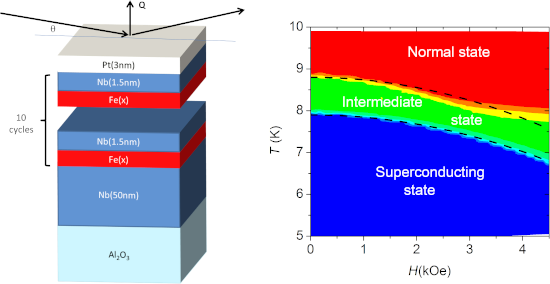
- the thickness of the Fe layer to x = 4 nm the intermediate phase disappears. We attribute the intermediate state to proximity induced non-homogeneous superconductivity in the structure. Keywords: ferromagnet; iron (Fe); mixed state; neutron reflectometry; niobium (Nb); proximity effects

![[Graphic 13]](/bjnano/content/inline/2190-4286-11-109-i17.svg?max-width=637&scale=1.18182) ) substrate, (b) the Pt cap layer, and the Nb buffer layer grown at...
) substrate, (b) the Pt cap layer, and the Nb buffer layer grown at...
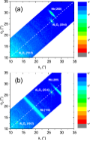


![[Graphic 16]](/bjnano/content/inline/2190-4286-11-109-i20.svg?max-width=637&scale=1.18182) (T) for the samples s4 (black) and s3 (red) in the vicinity of the superconducting transition m...
(T) for the samples s4 (black) and s3 (red) in the vicinity of the superconducting transition m...
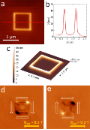
Magnetic characterization of cobalt nanowires and square nanorings fabricated by focused electron beam induced deposition
Beilstein J. Nanotechnol. 2018, 9, 1040–1049, doi:10.3762/bjnano.9.97

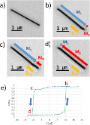
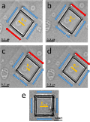
- magnetization directions under different magnetic fields Beff and at remanence after applying an external magnetic field Bext. The series starts from a saturated horseshoe state in (a). When the external field is reversed, a mixed state is visible, with the lower-left side exhibiting a kink generated by a
Other Beilstein-Institut Open Science Activities