


Search results
Search for "simulations" in Full Text gives 620 result(s) in Beilstein Journal of Nanotechnology. Showing first 200.
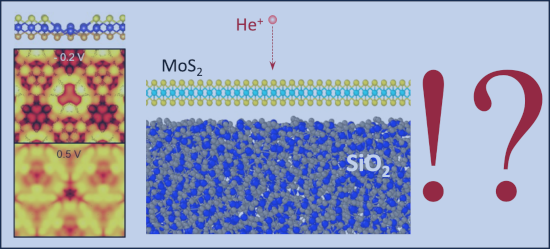
Substrate-dependent pore formation in molybdenum disulfide monolayers under ion irradiation
Beilstein J. Nanotechnol. 2026, 17, 769–780, doi:10.3762/bjnano.17.54
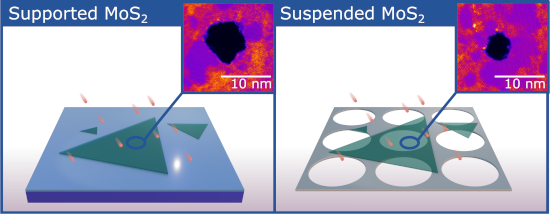
- layers in van der Waals heterostructures. Although graphene is an excellent in-plane conductor, the out-of-plane electrical (and thermal) coupling across the graphene/MoS2 interface is comparatively weak [57][58]. Indeed, simulations by Schwestka et al. [28] suggest that the out-of-plane conductance


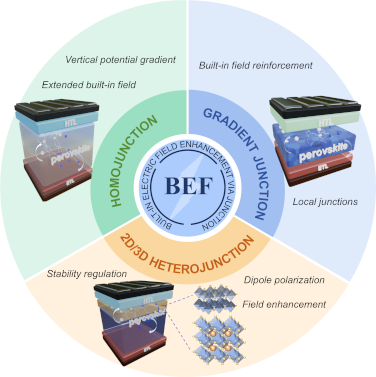
Recent progress in enhancing built-in electric fields of perovskite solar cells via junction engineering
Beilstein J. Nanotechnol. 2026, 17, 602–621, doi:10.3762/bjnano.17.42



Probing tribological evolution in atomically thin MoS2 at different scales
Beilstein J. Nanotechnol. 2026, 17, 586–597, doi:10.3762/bjnano.17.40
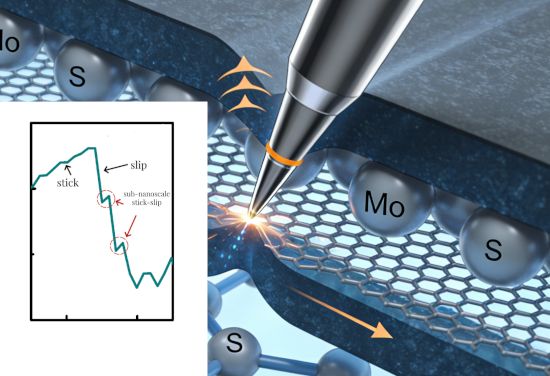
- –slip events driven by in-plane tip apex motion and modulated by contact geometry via molecular dynamics (MD) simulations and frictional force microscopy (FFM) [11][12]. Despite these theoretical and simulation insights, experimental observation and quantification of sub-nanoscale stick–slip motion in
- loads. We experimentally determined the sub-nanoscale stick–slip motion and quantified its dependence on load and layer thickness. The corresponding mechanisms were proposed to explain the friction behaviors. This work bridges the gap between MD simulations and experiments, advancing 2D material
- nanoscale slip phase. It is consistent with the observation in MD simulations [11][12], where the slip motion is a complex procedure rather than a simple jumping motion. These sub-nanoscale events cause the lateral force to decrease gradually (not abruptly) during slip, increasing the total slip distance


Impacts of annealing on structural and photophysical properties of zinc phthalocyanine adsorbed on graphene
Beilstein J. Nanotechnol. 2026, 17, 576–585, doi:10.3762/bjnano.17.39
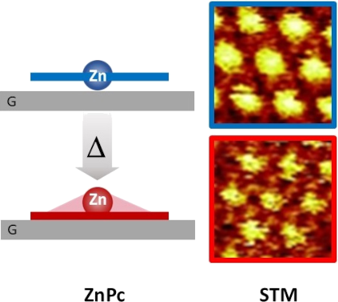
- -enhanced Raman scattering (GERS) [27]. Such combinations allow atomic-scale inspection of both molecular organization and electronic structures. These 2D systems are accessible to numerical simulations such as density-functional theories, in particular concerning Pcs [18][28]. Such simulations can be


Laser–material interactions in liquids for the synthesis of nanomaterials: current status and perspectives
Beilstein J. Nanotechnol. 2026, 17, 571–575, doi:10.3762/bjnano.17.38
- [33]. Representative examples of this approach include the combination of pump–probe measurements with atomistic simulations to reveal spallation and phase explosion regimes during pulsed laser ablation of Fe–Ni alloys [39], the identification and experimental confirmation of two mechanisms of
- nanoparticle generation in picosecond laser ablation in liquids [40], the elucidation of processes responsible for the formation of periodic surface structures on Cr targets irradiated by femtosecond pulses in water [41], and the integration of X-ray probing with simulations to study the transition from
Fractional shot noise of an SU(N) Kondo system
Beilstein J. Nanotechnol. 2026, 17, 515–540, doi:10.3762/bjnano.17.34
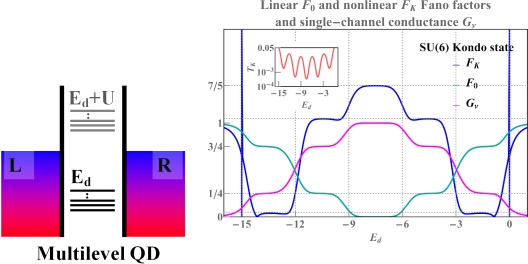
- ) generators for an N-dimensional space of the Lie group [42][43][44]. Recently, interest in quantum simulators, engineered quantum many-body systems that can controllably simulate complex quantum phenomena, has rapidly risen. Multilevel dots or dot systems provide a versatile platform for such simulations
- addressing questions across various domains of condensed matter and field theory [45][46][47][48]. Using spin or charge Kondo building blocks could eventually lead to quantum simulations of exotic lattice models, including those almost unrealistic in solid-state systems. The motivation for studies of high


![[Graphic 127]](/bjnano/content/inline/2190-4286-17-34-i187.svg?max-width=637&scale=1.18182)

Defects and defect-mediated engineering of two-dimensional materials: challenges and open questions
Beilstein J. Nanotechnol. 2026, 17, 454–488, doi:10.3762/bjnano.17.31
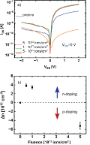
- . Despite the high reactivity of larger S vacancy clusters, several challenges remain in describing the oxidation kinetics. O2 is bound weakly to TMD surfaces with a binding energy of ≈0.14 eV [55][63][64][65]. Ab initio molecular dynamics (MD) simulations show that O2 is therefore mobile on the pristine
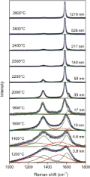
- been computationally prohibitively costly, but modern machine learning models have enabled such simulations for non-resonant Raman experiments. Therefore, the great challenge is the development of higher-precision measurements utilizing nano-Raman spectroscopy (see Figure 3). When nano-Raman is





Nanoinformatics: spanning scales, systems and solutions
Beilstein J. Nanotechnol. 2026, 17, 423–427, doi:10.3762/bjnano.17.28
- nanomaterial’s behaviour, preparation, or test conditions) [2]. Voyiatzis et al. computationally studied, using atomistic molecular dynamics simulations, the morphological transformations (from molten/amorphous to crystalline) during rapid cooling of 1–8 nm spherical gold and platinum nanoparticles (NPs), which
- reactivity [3]. Amini et al. combined atomistic molecular dynamics, a coarse-grained model of protein adsorption, and kinetic Monte Carlo simulations to predict the protein corona composition formed on aluminium surfaces with different crystal faces, (i.e., (100), (110), and (111)) from a simplified model of

Beam shaping techniques for pulsed laser ablation in liquids: Unlocking tunable control of nanoparticle synthesis in liquids
Beilstein J. Nanotechnol. 2026, 17, 309–342, doi:10.3762/bjnano.17.22
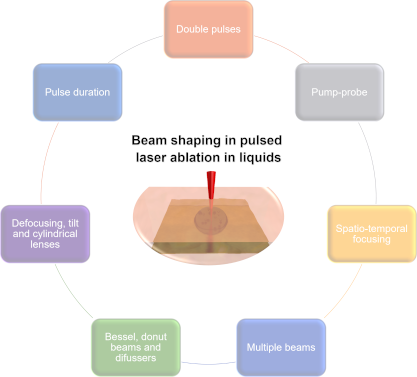
- environment [9]. The early stages of laser ablation, along with variations in material density, temperature, and phase states, can be effectively modelled using large-scale atomistic simulations [26][27]. PLAL is a simple, fast, and versatile technique that has been employed to produce ligand-free NPs [28







Advancing nanolithography: a comprehensive review of materials for local anodic oxidation with AFM
Beilstein J. Nanotechnol. 2026, 17, 275–291, doi:10.3762/bjnano.17.19
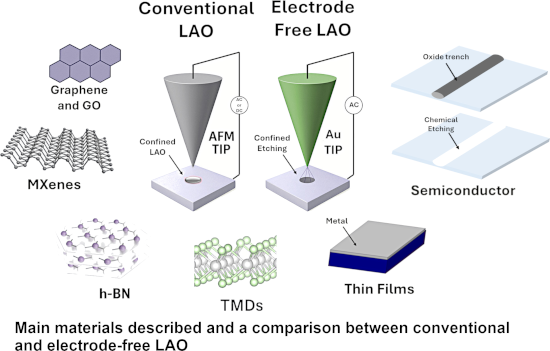
- complexities and might reduce dependency on trial-and-error methodologies. For example, numerical simulations can be employed to explore complex reaction mechanisms involved in nanomanufacturing processes at the nanoscale. This approach has recently been used to clarify the anisotropic effects observed during


Multilayered hyperbolic Au/TiO2 nanostructures for enhancing the nonlinear response around the epsilon-near-zero point
Beilstein J. Nanotechnol. 2026, 17, 251–261, doi:10.3762/bjnano.17.17
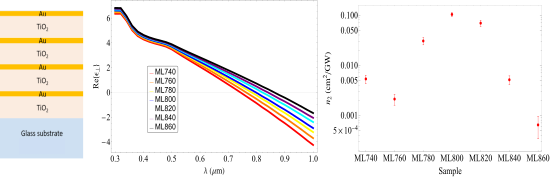
- initial simulations. Figure 3d shows the measured permittivity of the thin gold layer compared to the values of ℜ{ε} and ℑ{ε} from literature; they are very similar, indicating that the gold layers have a good morphology with no voids. Also using ellipsometry, we were able to measure the thicknesses of
- the layers deposited have different thicknesses throughout the structure. Adding the change in permittivity of the deposited gold and titanium dioxide layers, together with the changes layer thickness, we repeated the simulations to see where the ENZ points will be. With the measured permittivities
- deposited layers, we repeated the simulations in order to check if the ENZ points remain the same. In Figure 4b, we present the new simulated permittivities, and in Table 1, we can observe that the ENZ wavelengths have changed for every stack. Although the ENZ points have shifted slightly, they still remain


Comparative study on 3D morphologies of delignified, single tracheids and fibers of five wood species
Beilstein J. Nanotechnol. 2026, 17, 239–250, doi:10.3762/bjnano.17.16
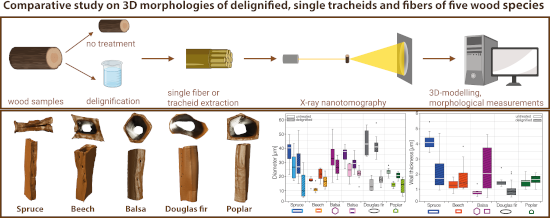
- fibers and tracheids, paving the way for more effective modeling applications, such as finite element modeling or computational simulations of fluid flow or heat transfer, aiding in development of various industrial applications of delignified wood. Accurate 3D models provide valuable insights into


Micro- and nanoscale effects in biological and bioinspired materials and surfaces
Beilstein J. Nanotechnol. 2026, 17, 214–217, doi:10.3762/bjnano.17.14
- ] provided insights into biological plant materials combining experiments with simulations that provide inspiration for biomimetic actuators. For animals, Jain et al. [20] applied a multiscale computational model to gain detailed insights into the molecular and mechanical behavior of gecko setae during
Safe and sustainable by design with ML/AI: A transformative approach to advancing nanotechnology
Beilstein J. Nanotechnol. 2026, 17, 176–185, doi:10.3762/bjnano.17.11
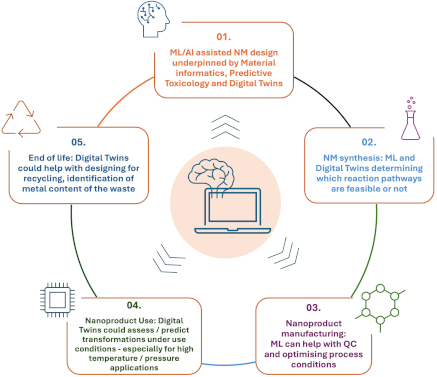
- potential EHS risks as they evolve, ensuring proactive rather than reactive risk management. Third, dynamic simulations – including digital twin technologies – provide a virtual environment for researchers to run “what if” scenarios, allowing them to explore the impact of variable parameters (e.g., pH
- , their interactions with biomolecules and toxicity endpoints that may be overlooked by traditional methods [39][40][41]. (3) Lifecycle modelling: AI-assisted simulations and probabilistic methods support comprehensive lifecycle analyses including prospective approaches, evaluating environmental fate and
- comparison to what is possible with the standard approach alone. The future of SSbD in nanotechnology will likely be driven by hybrid modelling frameworks that unite ML/AI techniques with physics-based simulations, creating a more precise and scalable approach to nanomaterial risk assessment [71]. By


Capabilities of the 3D-MLSI software tool in superconducting neuron design
Beilstein J. Nanotechnol. 2026, 17, 122–138, doi:10.3762/bjnano.17.8
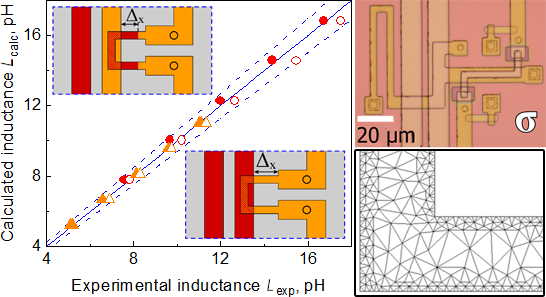
- investigations were performed as described in Appendix A. Numerical simulations were carried out assuming a truncated superconducting screen with a gap between the structure and the screen edge of 50 μm. Thus, the screen size (225…170 μm × 243…177 μm) was larger compared to test C-shaped SQUIDs, which led to an
- the size of superconducting ground plane. In fact, the screen-mediated interaction is determined by the ring currents circulating in the screen to close the return current caused by the magnetic field of the control line. Obviously, the forced truncation of the ground plane in simulations (see lower
- with varying ahb at a fixed ah = 2 μm. Simulations were performed on an Intel Core(TM) i9-13900KF with 128 GB RAM and 24 cores (16 efficiency cores and 8 performance cores). When OpenMP multithreading is used, the computation time depends on the number of threads nthr approximately with inverse square



Functional surface engineering for cultural heritage protection: the role of superhydrophobic and superoleophobic coatings – a comprehensive review
Beilstein J. Nanotechnol. 2026, 17, 63–96, doi:10.3762/bjnano.17.6
- non-destructive [7]. The papers discussing monitoring and the evaluation of the damages to monuments or landscapes, by means of topographic surveys and successive numerical simulations, are the most cited in this area [8][9][10][11][12]. Probably, one of the most detailed examples is represented by




Microscopic study of the intermediate mixed state in intertype superconductors
Beilstein J. Nanotechnol. 2026, 17, 57–62, doi:10.3762/bjnano.17.5
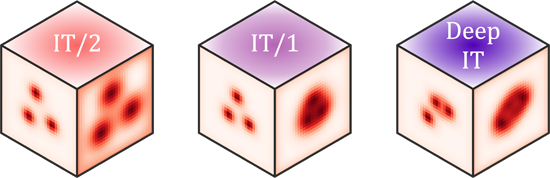
- study of three-vortex configurations presented here. Conclusion This work presents a fully microscopic analysis of the intermediate mixed state in IT superconductors between the type-I and type-II regimes. Using self-consistent Bogoliubov–de Gennes simulations, we traced the evolution of vortex


Terahertz-range on-chip local oscillator based on Josephson junction arrays for superconducting quantum-limited receivers
Beilstein J. Nanotechnol. 2025, 16, 2296–2305, doi:10.3762/bjnano.16.158
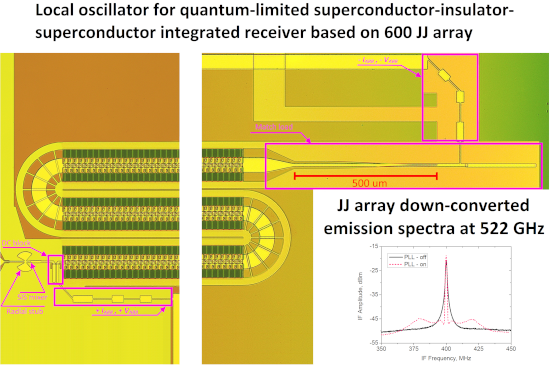
- much higher than the characteristic noise level (0.5 mA ≫ 0.5 μA). Acknowledgements The authors would like to thank Prof. S.E. Bankov for helpful discussions in problems of modelling and simulations. Funding This study was supported by the Ministry of Science and Higher Education of the Russian


Geometry-controlled engineering of the low-temperature proximity effect in normal metal–superconductor junctions
Beilstein J. Nanotechnol. 2025, 16, 2265–2273, doi:10.3762/bjnano.16.155
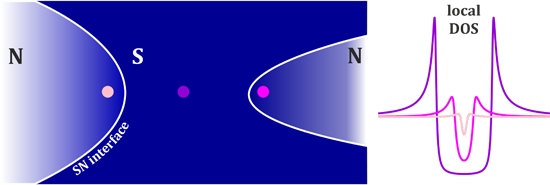
- lines in Figure 1. For numerical simulations, we used a discretized lattice model with a system size of 128 unit cells along the z-direction (the principal axis of the NS transition) and 64 unit cells in the perpendicular x-direction. A total of twelve different geometries were modeled by varying η in


Chiral plasmonic nanostructures fabricated with circularly polarized light
Beilstein J. Nanotechnol. 2025, 16, 2245–2264, doi:10.3762/bjnano.16.154
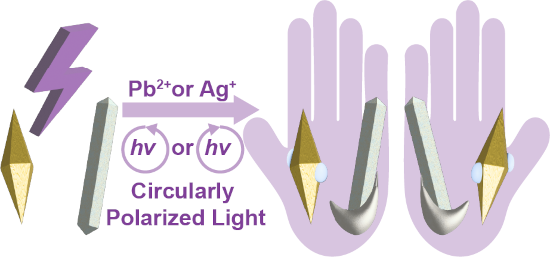
- geometrical profile that can asymmetrically distribute photochemical reactions. Numerous numerical simulations have demonstrated the dissymmetric near-field intensity profile of PNSs under CPL. This chirality can be explained by a simple model based on classical physics, which treats transverse (T) and
- , simulations were carried out to predict the physical locations of PMCRs through the distribution of the electric field and hot carriers. In Section 2, we discussed the physical insights of the chiral EM field distribution of achiral PNSs under CPL, based on a plasmon interference model derived from classical
- physics. The different shapes, sizes, and dielectric environments of the achiral PNSs were more accurately accounted for using numerical simulations. Govorov et al. described the inhomogeneous distribution of hot electrons in PNSs under CPL [75][76]. The map of the differential hot electron excitation





Electromagnetic study of a split-ring resonator metamaterial with cold-electron bolometers
Beilstein J. Nanotechnol. 2025, 16, 2199–2206, doi:10.3762/bjnano.16.152
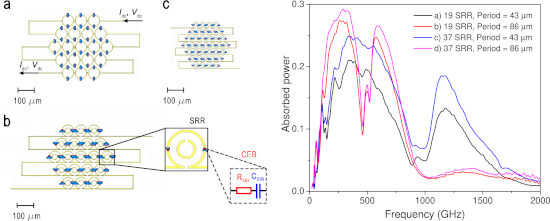
- -established magnetic metamaterial element whose resonant properties are governed by its internal inductance and capacitance, allowing for a strong magnetic response and associated current loops at the designed resonance frequency. The simulations of the metamaterial arrays were performed in the time-domain
- CEBs are embedded into the outer ring of each SRR element. In the simulations, each CEB is modeled as an RC circuit (see inset in Figure 1), where Rabs = 75 Ω represents the resistance of the CEB’s normal-metal absorber, and CSIN = 20 fF is the capacitance of the two SIN junctions of the CEB connected
- ). Parameters of metamaterials with CEBs and different designs are given in Table 1. As an experimental reference for our simulations, Figure 2 also shows the frequency response measured for a fabricated sample consisting of a 19-element single-ring metamaterial (black dashed curve). This sample had the design


Electron transport through nanoscale multilayer graphene and hexagonal boron nitride junctions
Beilstein J. Nanotechnol. 2025, 16, 2132–2143, doi:10.3762/bjnano.16.147
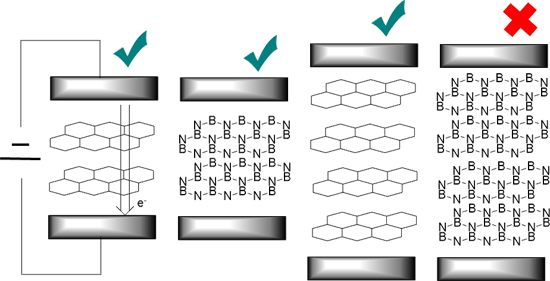
- platinum is often used in the field of electrochemistry and energy materials. In addition, we implement two possible defects in multilayer graphene, namely, Stone–Wales defects and graphitic nitrogen substitution. In the case of h-BN, we perform simulations with Stone–Wales defects. We investigate devices
- with A–B graphene stacking with one to six layers, which correspond to thicknesses of 0.5–3.0 nm, respectively. We provide comparison between the different junctions and explanation for the observed trends in the quantum electron transport. Our simulations are based on the NEGF method combined with
- the c-direction was selected to be 150 k-points per angstrom. Benchmark tests were performed using the NEGF method with Au electrodes instead of Pt, and the Heyd–Scuseria–Ernzerhof 2006 screened hybrid functional (HSE06) instead of PBE. The results obtained from those benchmark simulations showed


Molecular and mechanical insights into gecko seta adhesion: multiscale simulations combining molecular dynamics and the finite element method
Beilstein J. Nanotechnol. 2025, 16, 2055–2076, doi:10.3762/bjnano.16.141
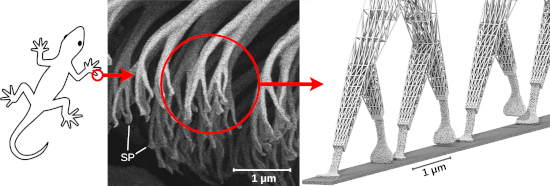
- dynamics to capture molecular interactions at the spatula–substrate interface and finite element method to simulate the mechanical behavior of the larger setal shaft. This hybrid approach enables synchronized simulations that resolve both fine-scale interfacial dynamics and overall structural deformation
- detachment, thereby enhancing adhesion strength. The computed pull-off forces and observed mechanisms are consistent with atomic force microscopy measurements and previous simulations. These results align with existing experimental and computational studies. They also overcome scale and resolution
- limitations inherent in single-scale models. Keywords: finite element method; gecko adhesion; hybrid modeling; molecular dynamics; multiscale simulations; seta; spatula; Introduction Geckos possess the ability to adhere to a variety of substrates, a trait attributed to specialized micro- and nanoscale






Laser ablation in liquids for shape-tailored synthesis of nanomaterials: status and challenges
Beilstein J. Nanotechnol. 2025, 16, 1963–1997, doi:10.3762/bjnano.16.137




Programmable soliton dynamics in all-Josephson-junction logic cells and networks
Beilstein J. Nanotechnol. 2025, 16, 1883–1893, doi:10.3762/bjnano.16.131
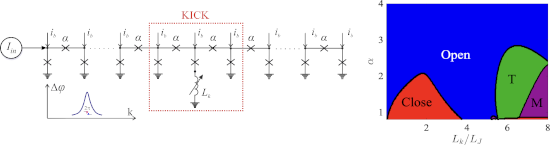
- normalized time, τ. Our simulations revealed a critical damping threshold at αcrit ≈ 0.8; below this value, stable soliton propagation is not supported. Also, under this condition, the energy dissipation rate is too high relative to the energy transfer between adjacent junctions, causing the soliton to decay





