


Search results
Search for "superconductor" in Full Text gives 81 result(s) in Beilstein Journal of Nanotechnology.
Superconducting artificial neural networks and quantum circuits
Beilstein J. Nanotechnol. 2026, 17, 744–747, doi:10.3762/bjnano.17.51
- predict unique magnetic properties of thin cobalt-based layers widely used in hybrid superconductor–ferromagnet structures for superconducting spintronics [18][19]. New elements of quantum circuits based on transmon “superconducting atoms” demonstrate rapid qubit control in real superconducting systems
- superconducting devices. Geometry-controlled engineering of superconducting systems shows that geometric factors, such as interface curvature in normal metal–superconductor junctions, strongly influence the proximity effect and the decay length of Cooper-pair correlations [25]. For superconducting systems with
- materials with complex and fractal topology [27][28]. Proximity-coupled superconductor/ferromagnet heterostructures demonstrate a number of novel phenomena, including the Fulde–Ferrell–Larkin–Ovchinnikov nonuniform superconducting state with singlet pairing [29], nonuniform superconducting states with
Fast vortex dynamics and relaxation times in NbRe-based heterostructures
Beilstein J. Nanotechnol. 2026, 17, 292–302, doi:10.3762/bjnano.17.20
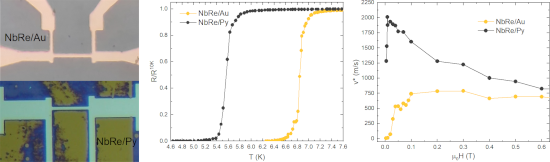
- that trap vortices. As a result, a finite current density is required to initiate vortex motion. When the value of the external current density, jex, applied to the superconductor exceeds the value of the critical current density, jc, vortices begin to move, giving rise to a viscous flow regime known
- strongly depend on the microscopic properties of the superconductor and on the degree of electronic disorder [1]. In this context, NbRe has emerged as a promising material that exhibits exceptionally fast vortex dynamics [19]. Extensive structural characterizations performed by X-ray diffraction have shown
- critical velocity is inversely proportional to the square root of the inelastic scattering time τE, and it is independent on the external magnetic field. This result follows from the core assumption of the LO theory, namely that f(E) is spatially uniform within the superconductor. Consequently, while the


Capabilities of the 3D-MLSI software tool in superconducting neuron design
Beilstein J. Nanotechnol. 2026, 17, 122–138, doi:10.3762/bjnano.17.8
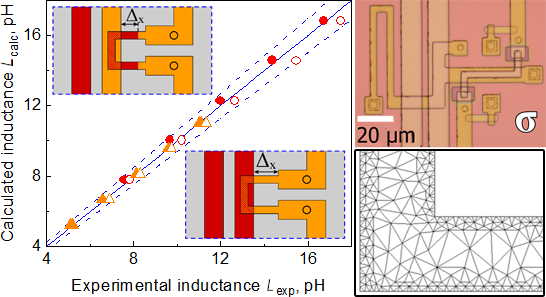
- design of superconducting electronics components. Keywords: adiabatic superconductor cells; inductance extraction; Josephson interferometers; multilayer niobium technology; superconductivity; Introduction This article is devoted to one of the issues related to the design of adiabatic superconducting
- primary subject of this article is the detailed verification of 3D-MLSI software tool. The main task of this inductance extractor is an evaluation of two-terminal partial inductances [48] associated with equivalent scheme ones. The general mathematical model for all superconductor inductance calculations
- on averaging the 3D current over the thin thickness of a superconductor film [49][50]. In contrast to InductEx and SuperVoxHenry, it leads to a set of 2D integro-differential equations instead of three-dimensional ones. As a result, 3D-MLSI can work without the large matrix procession techniques



Microscopic study of the intermediate mixed state in intertype superconductors
Beilstein J. Nanotechnol. 2026, 17, 57–62, doi:10.3762/bjnano.17.5
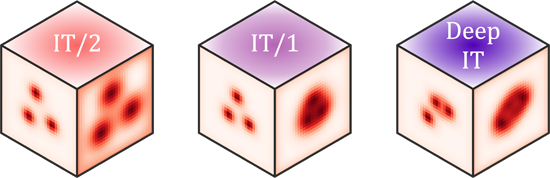
- method The vortex configurations are analyzed within a microscopic lattice model of a superconductor described by the attractive Hubbard Hamiltonian: where () are the annihilation (creation) operator for an electron with spin σ at site i, is the electron number operator, tij = −t is the nearest


Competitive helical bands and highly efficient diode effect in F/S/TI/S/F hybrid structures
Beilstein J. Nanotechnol. 2026, 17, 15–23, doi:10.3762/bjnano.17.2
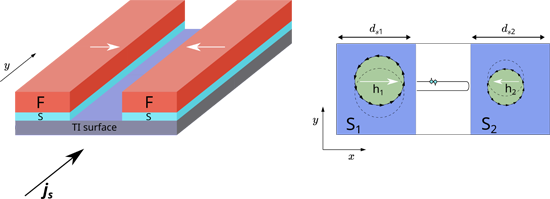
- tunability. In these devices, the polarity of the diode cannot be changed without reversing the Zeeman field, although in long ballistic S/TI/S (S denotes a superconductor) Josephson junctions such a situation is possible [52]. In the present work, we propose a superconducting diode based on two


![[Graphic 16]](/bjnano/content/inline/2190-4286-17-2-i31.svg?max-width=637&scale=1.18182)
![[Graphic 17]](/bjnano/content/inline/2190-4286-17-2-i32.svg?max-width=637&scale=1.18182)


Terahertz-range on-chip local oscillator based on Josephson junction arrays for superconducting quantum-limited receivers
Beilstein J. Nanotechnol. 2025, 16, 2296–2305, doi:10.3762/bjnano.16.158
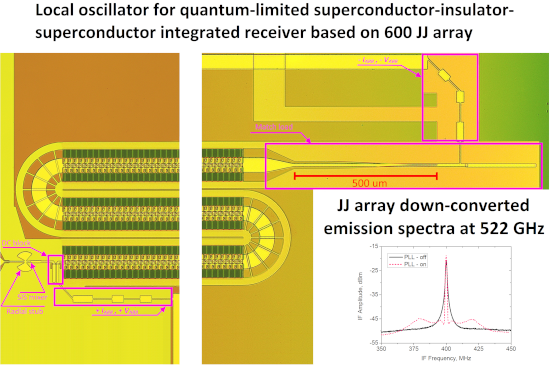
- improvement of the oscillator performance. Keywords: Josephson junction arrays; phase-locking; superconducting local oscillator; superconductor integrated receiver; terahertz-range oscillators; Introduction Superconducting heterodyne receivers based on superconductor–insulator–superconductor (SIS) tunnel
- fabricated on the same chip and in the same technological process as that of the SIS mixer. This approach allowed for superconductor integrated receivers (SIRs) with some of the characteristics even superior to those of SIS receivers with conventional LO based on Schottky diodes. The concept of the SIR has
- superconductor planar structures are described in works [51][52] and will not be duplicated here. In total, two designs were calculated and tested, covering the 300–550 GHz and 500–700 GHz range. The first matching circuit has a bandwidth of more than 50% relative to the central frequency (250 GHz with a central


Geometry-controlled engineering of the low-temperature proximity effect in normal metal–superconductor junctions
Beilstein J. Nanotechnol. 2025, 16, 2265–2273, doi:10.3762/bjnano.16.155
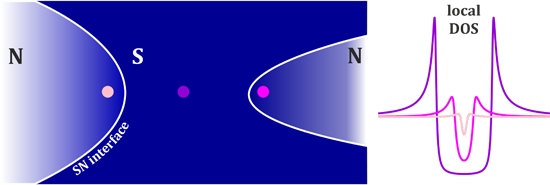
- a decay characterized by a power law with a dimensionality-dependent exponent. Here, we extend the current understanding of the proximity effect by exploring the role of normal metal–superconductor (NS) junction geometry in altering the spatial propagation of the superconducting order. Specifically
- Gennes equations; normal metal–superconductor junction; order parameter; proximity effect; superconductivity; Introduction When a superconductor (SC) is brought into contact with a normal metal (NM) or a ferromagnet (FM), Cooper pairs penetrate the adjacent material, imparting superconducting properties
- electrons from the normal side scatter into the superconductor, suppressing the superconducting order parameter near the interface [5][6][7]. In the normal region, the absence of intrinsic attractive electron–electron interaction causes Cooper pairs to break up beyond a characteristic length scale, namely


Quantum circuits with SINIS structures
Beilstein J. Nanotechnol. 2025, 16, 1931–1941, doi:10.3762/bjnano.16.134
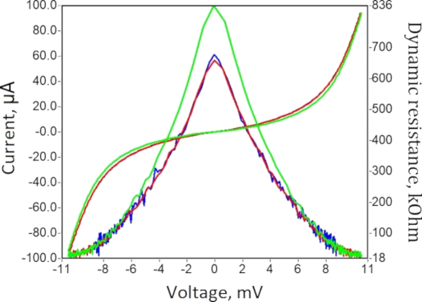
- "Higher School of Economics," Moscow, 101000 Russia P. Kapitza Institute for Physical Problems RAS, Moscow, Russia 10.3762/bjnano.16.134 Abstract The superconductor–insulator–normal metal–insulator–superconductor (SINIS) tunnel junction structure is the basic building block for various cryogenic devices
- superconducting quantum interference devices (SQUIDs) and rapid single flux quantum circuits, are based on superconductor–insulator–superconductor (SIS) junctions, another uses superconductor–insulator–normal metal (SIN) junctions. Tunnel junctions based on the SIN structure are widely used, and many different
- devices are manufactured on their basis [1][2][3]. These extend from cryogenic thermometers [4][5][6] and electron coolers [7][8][9][10] to various detectors such as Andreev bolometers [11][12][13], cold electron bolometers [14][15], superconductor–insulator–normal metal–insulator–superconductor (SINIS


Programmable soliton dynamics in all-Josephson-junction logic cells and networks
Beilstein J. Nanotechnol. 2025, 16, 1883–1893, doi:10.3762/bjnano.16.131
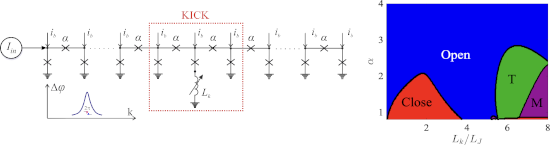
- ], voltage [20], or magnetic fields [21][22]. At the same time, the use of hybrid superconductor–normal metal structures makes it possible to increase the effect of frequency tuning [23][24], while the addition of ferromagnetic layers permits the non-volatile control [25][26]. Another feature of tunable
- particular method of signal propagation delay influence depends on the realization of interneuron interactions and the need to adjust a particular interneuron connection. Moreover, these approaches can be combined into one by using a chain of superconductor diodes. Using cells with kinetic inductances, we


Modeling magnetic properties of cobalt nanofilms used as a component of spin hybrid superconductor–ferromagnetic structures
Beilstein J. Nanotechnol. 2025, 16, 1557–1566, doi:10.3762/bjnano.16.110
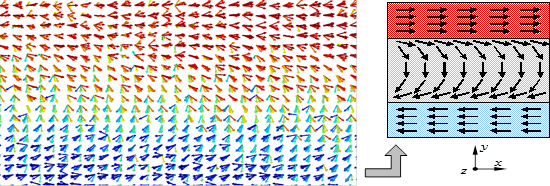
- possible to optimize them for specific applications and tasks. The present work is a development of earlier publications by the authors [14][15][16]. The cobalt thin films studied in this work can be a component of superconductor–ferromagnetic hybrid nanostructures, which are the basis for the formation of


High-temperature epitaxial growth of tantalum nitride thin films on MgO: structural evolution and potential for SQUID applications
Beilstein J. Nanotechnol. 2025, 16, 690–699, doi:10.3762/bjnano.16.53
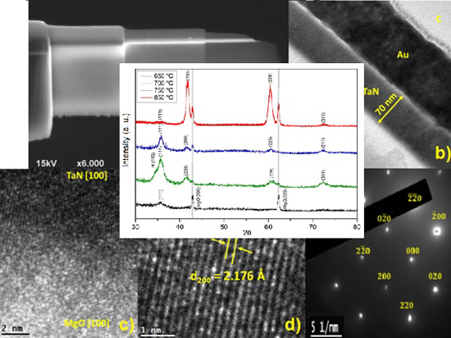
- nitride system TaNx can be an insulator, semiconductor, or superconductor and also can exhibit a variety of crystallographic phases [8][9]. For example, Nie and collaborators mentioned that Ta2N thin films presented a high-temperature coefficient of resistance, and resistors using this material as a


Vortex lattices of layered HTSCs at different vortex–vortex interaction potentials
Beilstein J. Nanotechnol. 2025, 16, 362–370, doi:10.3762/bjnano.16.27
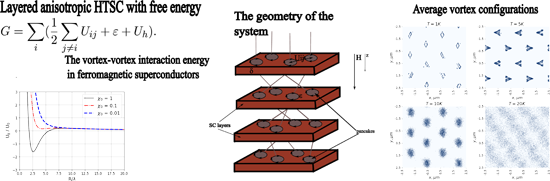
- using the Monte Carlo method within the framework of a two-dimensional model of a layered high-temperature superconductor. Interaction potentials close to the potential applicable in superconductors with the Ginzburg–Landau parameter κ = 1/2 (intertype superconductors) and in ferromagnetic
- superconductors have been analyzed. Clustering of the vortex system is demonstrated. The melting of a vortex lattice with increasing temperature has been studied. Keywords: high-temperature superconductor; HTSC; intertype superconductors; Monte Carlo method; vortex lattice; vortex–vortex interaction potential
- ; Introduction Type-II superconductors, as shown by numerous studies, have a complex phase diagram in a magnetic field. In fields greater than the first critical field Hc1 and less than the second critical field Hc2, at temperatures below the critical temperature the superconductor is in a mixed state, in which


Investigation of Hf/Ti bilayers for the development of transition-edge sensor microcalorimeters
Beilstein J. Nanotechnol. 2024, 15, 1353–1361, doi:10.3762/bjnano.15.108
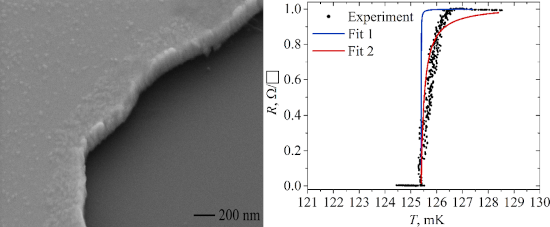
- ongoing, and the choice of a superconductor material plays an important role here [6][7]. An increase in sensitivity can be achieved by lowering the critical temperature TC below 100 mK. A known solution is two- or multilayer films of various superconductors and normal metals to suppress the transition
- superconductor. More importantly, the superconducting properties of the structures fabricated by lift-off photolithography not only did not deteriorate compared to continuous films, but became much more suitable for use in TES. Based on the obtained data on the sensitivity of the detector resistance to


Superconducting spin valve effect in Co/Pb/Co heterostructures with insulating interlayers
Beilstein J. Nanotechnol. 2024, 15, 457–464, doi:10.3762/bjnano.15.41
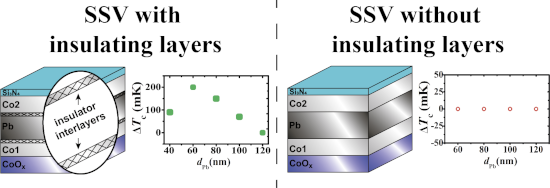
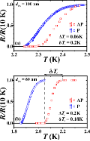
- insulating interlayers. The main specific feature of these structures is the intentional oxidation of both superconductor/ferromagnet (S/F) interfaces. We study the variation of the critical temperature of our systems due to switching between parallel and antiparallel configurations of the magnetizations of
- superconducting spin valves. Keywords: ferromagnet; insulator layers; proximity effect; superconducting spin-valve; superconductor; Introduction Models and specific realizations of the superconducting spin valve (SSV) have been the subject of intensive research over the past 25 years [1][2][3][4][5][6][7][8][9



![[Graphic 6]](/bjnano/content/inline/2190-4286-15-41-i6.svg?max-width=637&scale=1.18182)
Exploring disorder correlations in superconducting systems: spectroscopic insights and matrix element effects
Beilstein J. Nanotechnol. 2024, 15, 199–206, doi:10.3762/bjnano.15.19
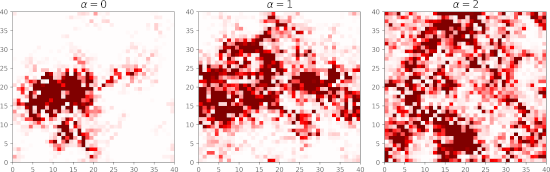
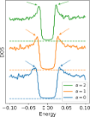
- superconducting systems, going beyond the traditional assumption of spatially uncorrelated disorder. In particular, we investigate the influence of disorder correlations on key spectroscopic superconductor properties, including the density of states, as well as on the matrix elements of the superconducting
- previously reported in [47]. This work focuses on a different aspect of the influence of the disorder correlations, investigating how the latter affect key spectral characteristics of a superconductor, that is, the energy level distribution. Recent scanning tunneling spectroscopy experiments on highly
- disordered amorphous superconductors [50] revealed that in the regime of superconductor–insulator transition the superconducting gap is stable, whereas the coherence peaks in the single-particle density of states (DOS) disappear. Following this observation, it was suggested that the system exhibits


Measurements of dichroic bow-tie antenna arrays with integrated cold-electron bolometers using YBCO oscillators
Beilstein J. Nanotechnol. 2024, 15, 26–36, doi:10.3762/bjnano.15.3
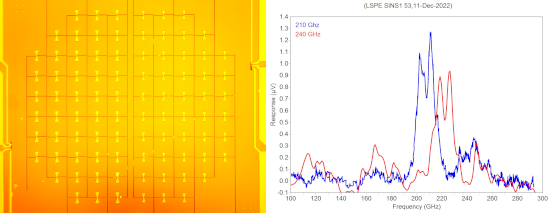
- of 1.2 nm of Fe and 30 nm of Al on top; then, 60 nm of aluminum are deposited at an angle of 45°. Thus, we form a superconductor–normal metal (SN) Andreev contact. Subsequently, oxidation is carried out at a relatively high pressure (1–2 Torr) in the working chamber of the sputtering unit. The last


Spin dynamics in superconductor/ferromagnetic insulator hybrid structures with precessing magnetization
Beilstein J. Nanotechnol. 2023, 14, 233–239, doi:10.3762/bjnano.14.22

- ways of spin current injection into a superconductor, for example, the spin Hall effect [5], the spin Seebek effect [6], and ferromagnetic resonance spin pumping [7][8]. The spin pumping technique in hybrid structures consisting of a ferromagnetic insulator and a superconductor is considered to be the
- nonsuperconducting layer, which serves as an origin of the Josephson effect, for example. While the reverse influence of a magnetic layer on a superconducting condensate is called the inverse proximity effect. Both spin current and induced magnetization in the superconductor originate from singlet–triplet Cooper
- pair conversion, which is the main mechanism of the inverse proximity effect. The magnetization in a superconductor is induced by the proximity in a stationary case, and the spin current is pumped only via magnetic dynamics in the adjacent layer. The quasiclassical theory of proximity effect in


Frontiers of nanoelectronics: intrinsic Josephson effect and prospects of superconducting spintronics
Beilstein J. Nanotechnol. 2023, 14, 79–82, doi:10.3762/bjnano.14.9
- -electron bolometers, with photon NEP of 1.1 × 10⁻¹⁶ W/Hz(1/2), achieved by replacing one of two single superconductor–insulator–normal (SIN) tunnel junctions with a single superconductor–normal (SN) contact [21]. Proposing a new type of cold electron bolometers with traps and hybrid superconducting
- magnetic proximity effect at a ferromagnetic–insulator–superconductor (FIS) interface was investigated through combined experimental and theoretical work [25]. Manifestations of nonlinear features in magnetic dynamics and current–voltage characteristics of the 0 Josephson junction in superconductor
- –ferromagnet–superconductor (SFS) structures have been predicted and calculated [26]. A quantitative study of the density of states (DOS) in bulk superconductor/ferromagnetic (S/F) bilayers in the diffusive limit has been presented. In addition, an analysis of the dependencies of DOS on magnetic and spin–orbit
Cooper pair splitting controlled by a temperature gradient
Beilstein J. Nanotechnol. 2023, 14, 61–67, doi:10.3762/bjnano.14.7

- ; Introduction Normal metals connected to a superconductor exhibit a variety of non-trivial phenomena associated with the existence of proximity-induced superconducting correlations spreading over long distances at sufficiently low temperatures [1]. One of these phenomena is the so-called crossed Andreev
- reflection (CAR): A Cooper pair may split into two electrons [2] (see Figure 1a), thereby generating pairs of entangled electrons in different metallic electrodes [3]. This phenomenon and its effect on electron transport in normal metal–superconductor–normal metal (NSN) hybrid structures were intensively
- the energy gap inside the superconductor, see Figure 1b. Unlike CAR, EC does not produce entangled electrons. In the zero-temperature limit, CAR and EC contributions to the low-bias non-local conductance of an NSN device cancel each other in the limit of low-transparency barriers [4]. In contrast, at


Upper critical magnetic field in NbRe and NbReN micrometric strips
Beilstein J. Nanotechnol. 2023, 14, 45–51, doi:10.3762/bjnano.14.5

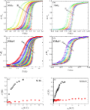
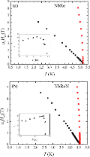
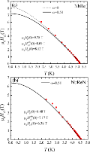
- the robustness of the superconductivity in a specific material. For a standard BCS s-wave type-II superconductor, Werthamer, Helfand, and Hohenberg (WHH) have calculated the temperature dependence of the critical field [19]. In this model, two mechanisms are responsible for the breaking of the

The influence of structure and local structural defects on the magnetic properties of cobalt nanofilms
Beilstein J. Nanotechnol. 2023, 14, 23–33, doi:10.3762/bjnano.14.3
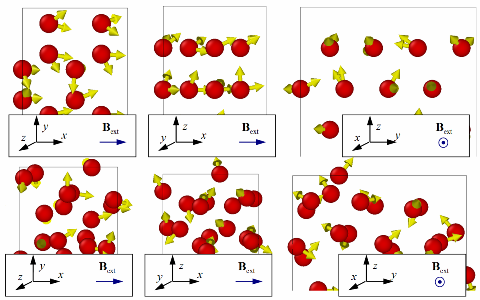
- cobalt and cobalt from the deposited nanofilm obtained in the numerical experiment. Funding The research was supported by the Russian Science Foundation project 20-62-47009, "Physical and Engineering Foundations of Non-Von Neumann Architecture Computers Based on Superconductor Spintronics".


Induced electric conductivity in organic polymers
Beilstein J. Nanotechnol. 2022, 13, 1551–1557, doi:10.3762/bjnano.13.128

- of thin-film lead electrodes with thicknesses from 50 nm to 200 nm was carried out by thermal evaporation in vacuum. The critical temperature of bulk lead is Тс(Pb3D) = 7.2 K. However, in the form of a thin film, the critical temperature of a superconductor can differ significantly from the tabulated



Density of states in the presence of spin-dependent scattering in SF bilayers: a numerical and analytical approach
Beilstein J. Nanotechnol. 2022, 13, 1418–1431, doi:10.3762/bjnano.13.117

- 10.3762/bjnano.13.117 Abstract We present a quantitative study of the density of states (DOS) in SF bilayers (where S is a bulk superconductor and F is a ferromagnetic metal) in the diffusive limit. We solve the quasiclassical Usadel equations in the structure considering the presence of magnetic and spin
- behavior of DOS dependencies on magnetic and spin–orbit scattering times is discussed. Keywords: density of states; Josephson junctions; proximity effect; superconductivity; superconductor/ferromagnet hybrid nanostructures; Introduction It is well-known that superconductivity can be induced in a non
- -superconducting metal in hybrid structures due to the proximity effect [1][2][3][4][5][6][7]. For instance, in NS bilayers (where N denotes a normal metal and S denotes a superconductor), the superconducting correlations penetrate into the normal metal layer over a characteristic decay length ξn = where Dn is


Nonlinear features of the superconductor–ferromagnet–superconductor φ0 Josephson junction in the ferromagnetic resonance region
Beilstein J. Nanotechnol. 2022, 13, 1155–1166, doi:10.3762/bjnano.13.97
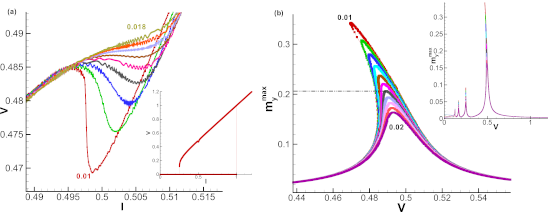
- characteristics. The generated current I0 can be expressed through the amplitude of my and the SOI parameter r, with (ωJ) being the frequency response of my. At small model parameters α ≪ Gr ≪ 1 of a superconductor-ferromagnet-superconductor (SFS) φ0 Josephson junction, states with a negative differential
- ADD. In order to clarify this question, we show in Figure 5 a part of the I–V characteristics of the φ0 junction together with the I–V characteristics of a superconductor-insulator-superconductor (SIS) junction in the ferromagnetic resonance region and the numerically calculated superconducting
- superconductor–ferromagnet–superconductor Josephson junctions and their manifestation in the I–V characteristics has implications for superconductor spintronics and modern information technology. In φ0 junctions, the nonlinear features can affect the control of magnetization precession by the superconducting


![[Graphic 14]](/bjnano/content/inline/2190-4286-13-97-i38.svg?max-width=637&scale=1.18182) at differ...
at differ...


![[Graphic 18]](/bjnano/content/inline/2190-4286-13-97-i42.svg?max-width=637&scale=1.18182) (V) on α in the damping parameter interval [0.001–0.12]....
(V) on α in the damping parameter interval [0.001–0.12]....

Efficiency of electron cooling in cold-electron bolometers with traps
Beilstein J. Nanotechnol. 2022, 13, 896–901, doi:10.3762/bjnano.13.80
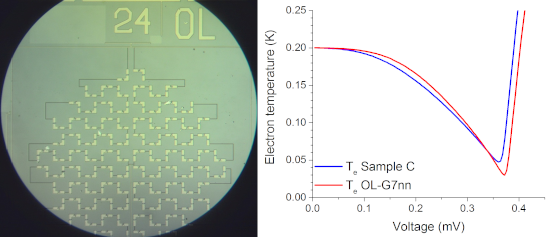
- efficiency. This concept is based on negative electrothermal feedback for an incoming signal, which is due to the direct electron cooling of the absorber by the normal metal–insulator–superconductor (NIS) tunnel junctions. Recently, in receivers with cold-electron bolometers [4][5][6], electron cooling from
- superconductor/ferromagnet hybrid absorbers based on Al/Fe films, as the previous samples. However, there are different oxidation parameters. This work aims to improve our new fit methodology, which takes into account both leakage and Andreev currents and also uses the sixth power of phonon and electron
- is the NIS junction voltage, Te and Ts are the electron temperatures in the normal metal and the superconductor, is the density of states in the superconductor, Δ is the superconducting gap, and kB is the Boltzmann constant. Using the integral of the tunneling current through the NIS junction





