Search results
Search for "C–H-insertion" in Full Text gives 36 result(s) in Beilstein Journal of Organic Chemistry.
Synthesis of quinoline-3-carboxylates by a Rh(II)-catalyzed cyclopropanation-ring expansion reaction of indoles with halodiazoacetates
Beilstein J. Org. Chem. 2015, 11, 1944–1949, doi:10.3762/bjoc.11.210

- many of the reactions between indoles and metal-bound carbenes are unclear [5][6][7][8]. We have for some time worked with halodiazoacetates and studied their reactivity in cyclopropanation reactions [17], C–H insertion and Si–H insertion reactions [18]. Halodiazoacetates can be made quantiatively and
- Scheme 5. We found no trace of a cyclopropanation-ring expansion product in the crude reaction mixture, but isolated ethyl 2,2-bis(1-methyl-1H-indol-3-yl)acetate in 69% yield. A possible explanation for the formation of the bisindol acetate can be rationalized by assuming a C–H insertion of the Rh


Stereoselective cathodic synthesis of 8-substituted (1R,3R,4S)-menthylamines
Beilstein J. Org. Chem. 2015, 11, 294–301, doi:10.3762/bjoc.11.34
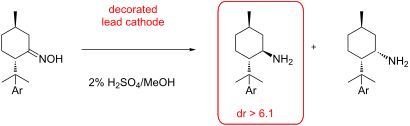
- stereoselective preparation of such amines. Throughout the last decades, several strategies [3] such as stereospecific amination via C–H insertion [5][6][7][8] or asymmetric olefin hydroamination [9][10][11][12][13] have been investigated in order to obtain access to optically pure amines. However, the major


C–H-Functionalization logic guides the synthesis of a carbacyclopamine analog
Beilstein J. Org. Chem. 2014, 10, 1564–1569, doi:10.3762/bjoc.10.161
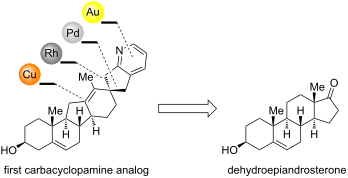
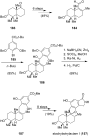
- intermediate in the synthesis of 2 (see Scheme 1). We envisioned a rhodium-catalyzed C–H-insertion into the C17–H bond to occur with a high degree of selectivity (both regio- and stereoselectivity) to form the all-carbon E-ring (for its structure see 11, Scheme 2). Furthermore, a Wagner–Meerwein rearrangement
- this point, extensive experimentation suggested a change of protecting groups to enable the pending C–H insertion reaction at C17. Therefore, the i-steroid was reverted to the homoallylic alcohol (cat. para-toluenesulfonic acid, 1,4-dioxane/H2O, 10:1, 65 °C), the methyl ester was hydrolyzed under basic
- the corresponding acid chloride (oxalyl chloride, CH2Cl2, 25 °C; then diazomethane, THF, 25 °C, 85% yield for the two steps) [33]. The anticipated C–H insertion then proceeded uneventfully under oxygen-free conditions (cat. Rh2(OAc)4, CH2Cl2, 41 °C) [34][35] to give cyclopentanone 11 in 52% yield as a


Theoretical studies on the intramolecular cyclization of 2,4,6-t-Bu3C6H2P=C: and effects of conjugation between the P=C and aromatic moieties
Beilstein J. Org. Chem. 2014, 10, 1032–1036, doi:10.3762/bjoc.10.103
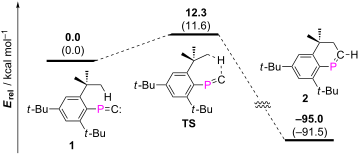
- Abstract The intramolecular C–H insertion of the Mes*-substituted phosphanylidenecarbene [Mes*P=C:] (Mes* = 2,4,6-t-Bu3C6H2) and physicochemical properties of the cyclized product, 6,8-di-tert-butyl-3,4-dihydro-4,4-dimethyl-1-phosphanaphthalene were studied based on ab initio calculations. Whereas the
- 2) [15]. In contrast to the selective formation of Mes*C≡P from (E)-Mes*P=C(Cl)Li [11][12], facile removal of the bromide ion in Mes*P=C(Br)Li might be critical for the C–H insertion. The C–H insertion of carbene has been studied well [16], and thus intensive studies on the intramolecular
- conclusion, the chemistry of the intramolecular C–H insertion of phosphanylidenecarbene 1 affording 2 was studied by ab initio and DFT calculations. The intramolecular cyclization requires an activation energy, whereas the phosphorus version of the FBW rearrangement proceeded without an energetic barrier


An investigation of the observed, but counter-intuitive, stereoselectivity noted during chiral amine synthesis via N-chiral-ketimines
Beilstein J. Org. Chem. 2013, 9, 2103–2112, doi:10.3762/bjoc.9.247

- , nitrogen C–H insertion [10][11][12], hydroamination [13][14][15][16], hydroaminoalkylation [17][18], reductive amination [19][20][21][22][23], and enamine reduction [23][24][25][26][27] are experiencing a renaissance; while imine reduction [23][28][29][30], N-acylenamide reduction [23][24], and carbanion


The chemistry of isoindole natural products
Beilstein J. Org. Chem. 2013, 9, 2048–2078, doi:10.3762/bjoc.9.243
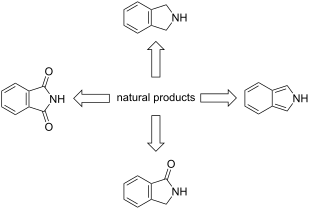
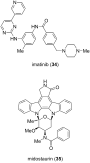
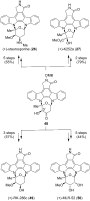
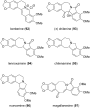
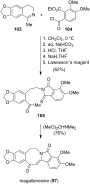
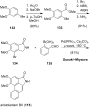
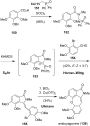
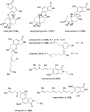
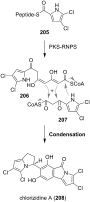
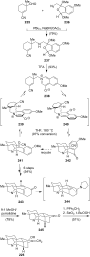
- ozonolysis and acid-promoted cyclization afforded (+)-41 and (−)-41 in an overall yield of 60% and 46%, respectively. For the synthesis of staurosporinone (30) and its 3,4-dimethoxybenzyl (DMB)-protected derivative 45, a ruthenium-catalyzed C–H insertion/electrocyclization cascade using 2,2’-bisindole 44 and
















Gold-catalyzed regioselective oxidation of propargylic carboxylates: a reliable access to α-carboxy-α,β-unsaturated ketones/aldehydes
Beilstein J. Org. Chem. 2013, 9, 1925–1930, doi:10.3762/bjoc.9.227
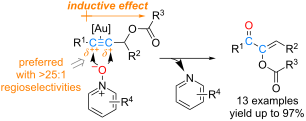
- excellent regioselectivity, which is ascribed to inductive polarization of the C–C triple bond by the electron-withdrawing carboxy group. The gold carbene intermediates thus generated undergo selective 1,2-acyloxy migration over a 1,2-C–H insertion, and the selectivities could be dramatically improved by
- rationalized as the results of divergent transformations of the α-oxo gold carbene B: the former is formed via a two-step 2,3-acetoxy migration [22][23], and the latter most likely via a concerted carbene 1,2-C–H insertion[2]. The selective formation of the Z isomer of 5a-OAc can be attributed to that B adopts
- , better than ~7:1 in the latter case, albeit both lower than that by IPrAuNTf2 (>50:1, see Scheme 3). The enhanced preference of AcO migration en route to the formation of 5a-OAc over the 1,2-C-H insertion is attributed to attenuation of the electrophilicity of the gold carbene moiety via the formation of


α-Bromodiazoacetamides – a new class of diazo compounds for catalyst-free, ambient temperature intramolecular C–H insertion reactions
Beilstein J. Org. Chem. 2013, 9, 1407–1413, doi:10.3762/bjoc.9.157

- cycloaddition, ylide formation, cyclopropanation and C–H insertion reactions [1][2][3]. A generally useful modification of diazo compounds is the substitution of the α-hydrogen for an electrophile. This substitution can be effected in the presence of a base or starting from the metalated diazo compound, and
- interpreted from Table 1, the dominant reaction pathway in the high-yielding reactions (Table 1, entries 2–3), is apparently the intramolecular C–H insertion to form a β-lactam. The preferential formation of intramolecular products from N,N’-disubstituted diazoacetamides, as compared to diazoacetates has
- which the α-substituent on the carbene carbon varies (see below). The α-phenyl analogue of β-lactam 5b has previously been prepared by carbene C–H insertion. In these reports, the base-promoted decomposition of a hydrazone and subsequent thermolysis of the diazo compound in, e.g., toluene under reflux


Metal–ligand multiple bonds as frustrated Lewis pairs for C–H functionalization
Beilstein J. Org. Chem. 2012, 8, 1554–1563, doi:10.3762/bjoc.8.177
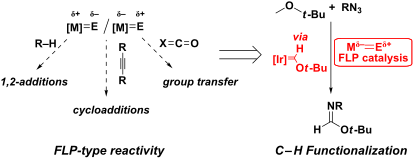
- the types of reactivity discussed thus far, there are several distinct routes to the functionalization of C–H (or E–H) bonds using metal–ligand multiply bonded FLPs. If C–H activation is effected by 1,2-addition across a M═E bond, then reductive elimination could result in a net C–H insertion of




Intramolecular hydroxycarbene C–H-insertion: The curious case of (o-methoxyphenyl)hydroxycarbene
Beilstein J. Org. Chem. 2010, 6, 1061–1069, doi:10.3762/bjoc.6.121
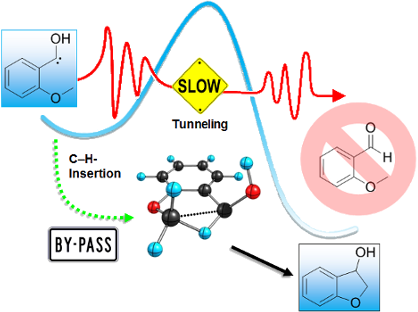
- Dennis Gerbig David Ley Hans Peter Reisenauer Peter R. Schreiner Institut für Organische Chemie, Justus-Liebig University Giessen, Heinrich-Buff-Ring 58, 35392 Giessen, Germany 10.3762/bjoc.6.121 Abstract The first C–H insertion of a hydroxycarbene species in the gas phase has been observed
- intermediate leading to the tautomeric formyl group. Thermochemical computations at M06-2X/cc-pVDZ in conjunction with a self-consistent solvent reaction field model support this suggested reaction pathway. Keywords: benzofuran; C–H-insertion; hydroxycarbene; singlet carbene; tunneling; Introduction
- existing signals, thereby verifying the complete absence of 5. Analysis of the IR spectrum showed that 8 was the main product instead. To confirm the C–H-insertion into the neighboring methyl group, to yield 2,3-dihydrobenzofuran-3-ol (8), a sample of 8 was prepared by the reduction of commercially


Mitomycins syntheses: a recent update
Beilstein J. Org. Chem. 2009, 5, No. 33, doi:10.3762/bjoc.5.33

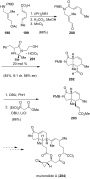
- of the indoline intermediate to the indole. The regioselectivity is in accord with the results of Adams who showed that the C–H bond with the highest electron density was the most likely to migrate during rhodium(II) mediated C–H insertion [113]. A related study assessed the possibility of
- circumventing this regioselectivity issue by exploiting the enantioselective intramolecular C–H insertion of diazoester 144 into a meso pyrrolidine using chiral catalyst 145. Unfortunately the reaction displayed low enantio- and diastereoselectivity, with the major isomer 146 having an ee of only 51% (Scheme 40