


Search results
Search for "alkyl bromide" in Full Text gives 32 result(s) in Beilstein Journal of Organic Chemistry.
The application of a monolithic triphenylphosphine reagent for conducting Ramirez gem-dibromoolefination reactions in flow
Beilstein J. Org. Chem. 2013, 9, 1781–1790, doi:10.3762/bjoc.9.207
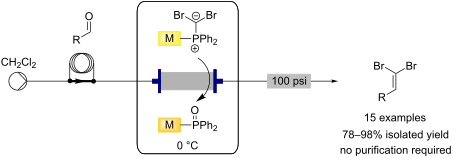
- -dibromoolefination active species through multiple Ramirez reactions, the monolith could then be used to successfully perform the Appel reaction in flow. Approximately 0.55 mmol of alcohol could be transformed into the corresponding alkyl bromide following approximately 0.80 mmol of successful gem-dibromoolefination


Copper-catalyzed CuAAC/intramolecular C–H arylation sequence: Synthesis of annulated 1,2,3-triazoles
Beilstein J. Org. Chem. 2012, 8, 1771–1777, doi:10.3762/bjoc.8.202
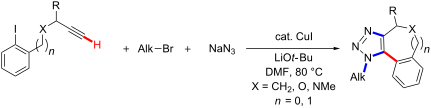
- apparatus SMP3, Barlworld Scientific; values are uncorrected. General procedure for the synthesis of triazoles 4 NaN3 (1.05 equiv), CuI (10 mol %), LiOt-Bu (2.00 equiv), alkyne 1 (1.00 equiv) and alkyl bromide 2 (1.00 equiv) were dissolved in DMF (3.0 mL) and stirred at 80 °C for 20 h. Then, H2O (50 mL) was


The application of a monolithic triphenylphosphine reagent for conducting Appel reactions in flow microreactors
Beilstein J. Org. Chem. 2011, 7, 1648–1655, doi:10.3762/bjoc.7.194
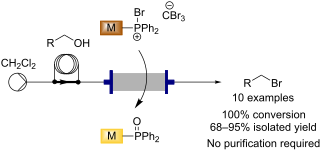
- application of this monolith to the transformation of an alkyl alcohol into the corresponding alkyl bromide by using carbon tetrabromide in the Appel reaction. In the 1960s Ramirez and co-workers reported the formation of a phosphine–methylene species when triphenylphosphine was mixed with carbon tetrabromide


Metathesis access to monocyclic iminocyclitol-based therapeutic agents
Beilstein J. Org. Chem. 2011, 7, 699–716, doi:10.3762/bjoc.7.81

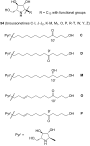
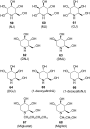
- produce the (+)-DMDP (49) and (−)-bulgecinine (50) (Scheme 8). The starting point in the synthesis of (+)-broussonetine G, 53, was the same annulated oxazolone 48 which, after conversion into the Weinreb amide 51, was coupled with the alkyl bromide substituted spiro compound 52 (Scheme 9). In fact, the





EPR and pulsed ENDOR study of intermediates from reactions of aromatic azides with group 13 metal trichlorides
Beilstein J. Org. Chem. 2010, 6, 713–725, doi:10.3762/bjoc.6.84
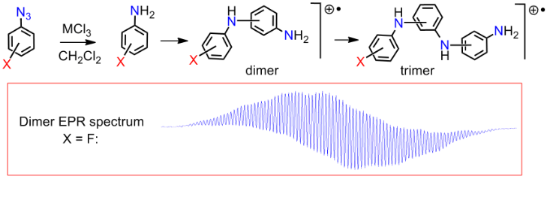
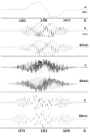
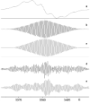
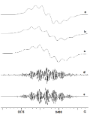
- sample was analysed by EPR spectroscopy at several different temperatures. Products analysis was performed as above. Ethyl 5-azidopentanoate (9) [48] was prepared by treatment of the corresponding alkyl bromide with sodium azide in DMSO [49]; IR (νmax, CHCl3), 1718 (CO) and 2092 (N3) cm−1; 1H NMR (400








2-Phenyl- tetrahydropyrimidine- 4(1H)-ones – cyclic benzaldehyde aminals as precursors for functionalised β2-amino acids
Beilstein J. Org. Chem. 2009, 5, No. 43, doi:10.3762/bjoc.5.43

- to the reaction mixture for an in situ conversion of the alkyl bromide to the alkyl iodide [48] did not increase reactivity. The alkylation reaction started to proceed only after warming the lithium enolate solution to −55 °C, but still remained incomplete after 20 h reaction time. By adding DMPU as


An expedient synthesis of 5-n-alkylresorcinols and novel 5-n-alkylresorcinol haptens
Beilstein J. Org. Chem. 2009, 5, No. 22, doi:10.3762/bjoc.5.22

- investigated using alkyl bromide, PPh3 and 6 in various organic solvents but remained unsuccessful. Mixtures of cis and trans isomers 7a–d and 8 had Z/E ratios varying from ca. 40:60 (8) to ca. 80:20 (7a, both in open and sealed vessel) according to 1H NMR and GC-MS. As the ultimate targets were the C=C
- alkyl bromide precursors are not available (Scheme 1). 5a was readily synthesised by Swern-type oxidation (see Supporting Information File 1). The Wittig reagents were poorly soluble in water. Nevertheless, functional groups enhancing their solubility, such as previously reported –COOH or PEG


Other Beilstein-Institut Open Science Activities



