Search results
Search for "electrophiles" in Full Text gives 318 result(s) in Beilstein Journal of Organic Chemistry. Showing first 200.
Multi-redox indenofluorene chromophores incorporating dithiafulvene donor and ene/enediyne acceptor units
Beilstein J. Org. Chem. 2024, 20, 59–73, doi:10.3762/bjoc.20.8
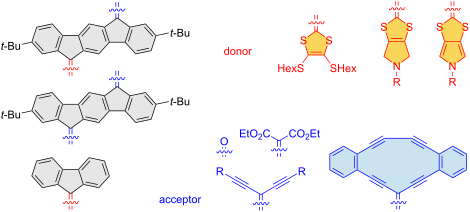
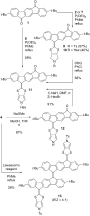
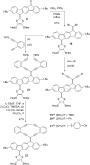
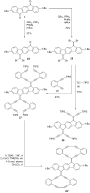
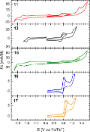
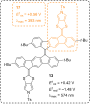
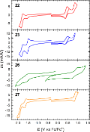
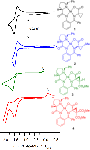
- could potentially after deprotonation be reacted with electrophiles as previously established [29] for the parent structure [30] without tert-butyl substituents. UV–vis absorption spectroscopy UV–vis absorption spectra of the known compound 4 [14] and new compounds 9–12 and 15 are depicted in Figure 3







Controlling the reactivity of La@C82 by reduction: reaction of the La@C82 anion with alkyl halide with high regioselectivity
Beilstein J. Org. Chem. 2023, 19, 1858–1866, doi:10.3762/bjoc.19.138
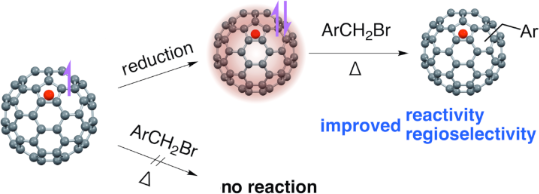
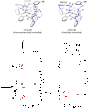
- produced chemically or electrochemically. C602− is a strong electron donor and potential nucleophile that reacts with electrophiles [6][7][8][9][10][11]. The mechanism for the reaction of C602− with alkyl halides has been studied in detail by Fukuzumi et al., who found that the reaction occurs via electron


N-Sulfenylsuccinimide/phthalimide: an alternative sulfenylating reagent in organic transformations
Beilstein J. Org. Chem. 2023, 19, 1471–1502, doi:10.3762/bjoc.19.106
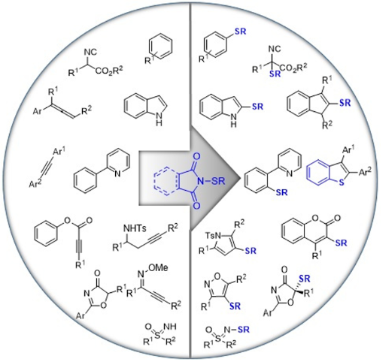
- construction of 4-chalcogenylated pyrazoles 57 and 59 was carried out starting from α,β-alkynic hydrazones 55 (Scheme 24) [60]. In the procedure, α,β-alkynic hydrazones were subjected to S- or Se-electrophiles 56 and cyclization reaction. Additionally, NCS and ArSH produced the S-electrophile for the




α-(Aminomethyl)acrylates as acceptors in radical–polar crossover 1,4-additions of dialkylzincs: insights into enolate formation and trapping
Beilstein J. Org. Chem. 2023, 19, 1443–1451, doi:10.3762/bjoc.19.103
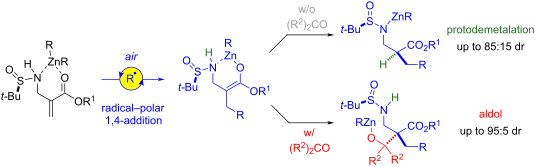
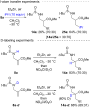
- atom to zinc enables this SH2 process which represents a rare example of alkylzinc-group transfer to a tertiary α-carbonyl radical. The zinc enolate thus formed readily undergoes β-fragmentation unless it is trapped by electrophiles in situ. Enolates of substrates having free N–H bonds undergo
- enolate with electrophiles in protocols wherein all the reactive partners can be introduced from the start, given that dialkylzinc reagents offer a large functional group tolerance; and 3) the radical character of the process allows for the use of alkyl iodides as alkyl source in multicomponent reactions
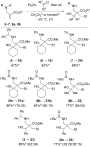
- interesting to note that the levels of induction for the 1,4-addition–aldol condensations are somewhat higher than those obtained for the 1,4-additions. Aldehydes also proved competent terminal electrophiles for the tandem sequence. Illustratively, adducts 23 and 24 were obtained from α-(aminomethyl)acrylates






Consecutive four-component synthesis of trisubstituted 3-iodoindoles by an alkynylation–cyclization–iodination–alkylation sequence
Beilstein J. Org. Chem. 2023, 19, 1379–1385, doi:10.3762/bjoc.19.99
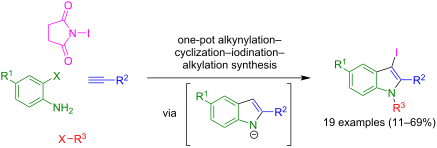
- summary the indole anion intermediate resulting from a one-pot alkynylation–cyclization sequence, which has been previously shown to be efficiently trapped by carbon electrophiles to give N-substituted indoles in a consecutive three-component synthesis, can be selectively iodinated in the 3-position with


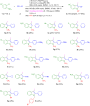


Visible-light-induced nickel-catalyzed α-hydroxytrifluoroethylation of alkyl carboxylic acids: Access to trifluoromethyl alkyl acyloins
Beilstein J. Org. Chem. 2023, 19, 1372–1378, doi:10.3762/bjoc.19.98
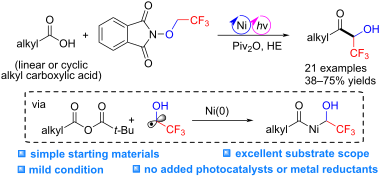
- nickel-catalyzed coupling of aryl bromides with an α-hydroxytrifluoroethyl radical for the synthesis of trifluoromethyl aryl alcohols [39]. Encouraged by this work, we envisioned that the nickel-catalyzed coupling of carboxylic acids-derived acyl electrophiles with an α-hydroxytrifluoroethyl radical


Acetaldehyde in the Enders triple cascade reaction via acetaldehyde dimethyl acetal
Beilstein J. Org. Chem. 2023, 19, 1243–1250, doi:10.3762/bjoc.19.92
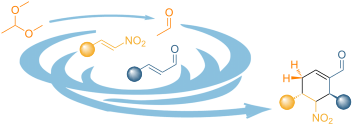
- process. The ingenious crafting of the reaction lies in the selection of the reactivity of the different nucleophiles and electrophiles present in the mixture, both as reagents and as intermediates. First, the chiral aminocatalyst 1 activates the saturated aldehyde 2 via enamine intermediate A, which


Selective construction of dispiro[indoline-3,2'-quinoline-3',3''-indoline] and dispiro[indoline-3,2'-pyrrole-3',3''-indoline] via three-component reaction
Beilstein J. Org. Chem. 2023, 19, 1234–1242, doi:10.3762/bjoc.19.91
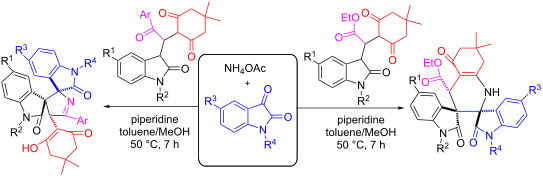
- nucleophiles, especially active methylene compounds, have attracted much attentions [36][37][38][39][40][41]. This kind of Michael adduct has more than one reactive site and could proceed domino reactions with various electrophiles [42][43][44][45][46][47][48][49]. In this respect, several elegant domino or



Aromatic C–H bond functionalization through organocatalyzed asymmetric intermolecular aza-Friedel–Crafts reaction: a recent update
Beilstein J. Org. Chem. 2023, 19, 956–981, doi:10.3762/bjoc.19.72

- enantioselective aza-Friedel–Crafts addition. In the first step, the DDQ-promoted oxidation of 3-indolinonecarboxylate 22 generated indolenines that performed as the potential electrophiles towards indoles 4. The chiral catalyst effectively assembled the reacting partners in a chiral transition state through H
- of indole 9 through aza-Friedel–Crafts reaction with aryl-α-ketimino esters 26/29. They also utilized unsubstituted and 2,3-disubstituted pyrroles 9 as π-nucleophile towards the same electrophiles to incorporate an amine-substituted quaternary stereocenter at the C2’ position (Scheme 8b) [33]. In
- 2019, Inokuma, Yamada and co-workers reported the C3–H bond functionalization of indoles 4 through aza-Friedel–Crafts reaction utilizing N-o-nitrophenylsulfenyl (Nps)-iminophosphonates 32 as electrophiles. The chiral phosphoric acid P11 was used as H-bonding catalyst to impart stereoselectivities into


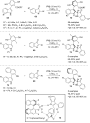


Asymmetric tandem conjugate addition and reaction with carbocations on acylimidazole Michael acceptors
Beilstein J. Org. Chem. 2023, 19, 881–888, doi:10.3762/bjoc.19.65

- , because of their particular chemical and physical properties [15]. In addition to ester/amide synthesis, enoyl imidazolides were developed as excellent Michael acceptors. Acylimidazoles are unique electrophiles that demonstrate moderate reactivity, relatively high stability, chemical selectivity, and high
- ]. These non-traditional electrophiles allow access to structurally highly interesting motifs. In addition, they are amenable to valuable synthetic transformations such as oxidative ring contraction of the cycloheptatrienyl ring or reduction of the benzodithiolyl group. In this context, we decided to study


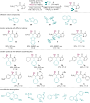


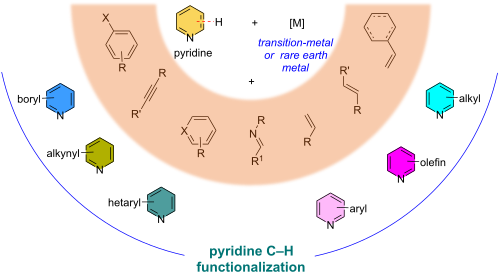
Pyridine C(sp2)–H bond functionalization under transition-metal and rare earth metal catalysis
Beilstein J. Org. Chem. 2023, 19, 820–863, doi:10.3762/bjoc.19.62
- with 1° alkyl electrophiles has been known in the past, however, the C–H alkylation with nonactivated secondary (2°) alkyl electrophiles and tertiary alkyl electrophiles was little known. In this context, in 2013, Fu and co-workers came across an unexpected finding with Pd-catalyzed C–H activation/C–C
- cross-coupling of pyridine N-oxides with nonactivated secondary (2°) alkyl bromides [51]. The cross-coupling is difficult to achieve as the Pd-catalyzed SN2 process is sensitive towards the steric bulk of the secondary or tertiary alkyl electrophiles. The optimized conditions for the ortho-alkylation of


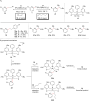














Enolates ambushed – asymmetric tandem conjugate addition and subsequent enolate trapping with conventional and less traditional electrophiles
Beilstein J. Org. Chem. 2023, 19, 593–634, doi:10.3762/bjoc.19.44
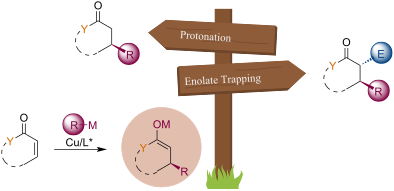
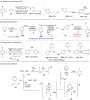
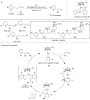
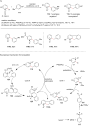
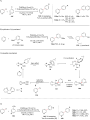
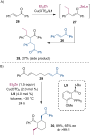
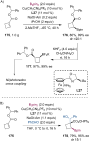
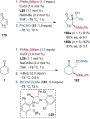
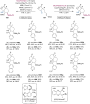
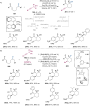
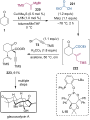
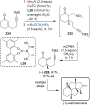
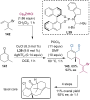
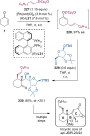
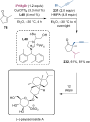
- years of development. The effort of our group to broaden possibilities to engage metal enolates in reactions with new electrophiles is described. The material is divided according to the organometallic reagent employed in the conjugate addition step, and thus to the particular metal enolate formed
- stereogenic information, thus leading to chiral products. Enolate species are uniquely positioned for reactivity with a broad array of electrophiles and thus allowing quick and efficient construction of highly complex structures from readily available starting materials. Various polar organometallic reagents
- nucleophile (R3Zn−) to the ketone with moderate yields but still good stereoselectivities (Scheme 9B). In 2018, Wang and co-workers extended the group of applicable electrophiles for the zinc enolate-based tandem reactions. Following the conjugate addition of Et2Zn to acyclic α,β-unsaturated ketones 41, they









A new oxidatively stable ligand for the chiral functionalization of amino acids in Ni(II)–Schiff base complexes
Beilstein J. Org. Chem. 2023, 19, 566–574, doi:10.3762/bjoc.19.41
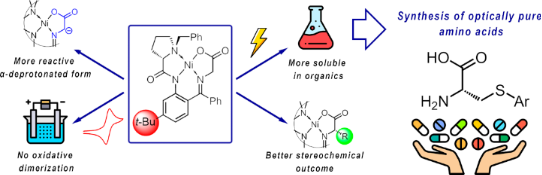
- thermodynamically controlled stereoselectivity as compared to the parent Belokon complex. Additionally, functionalization with the tert-butyl group significantly enhances the reactivity of the deprotonated glycine complex towards electrophiles as compared to the anionic species formed from the original Belokon
- chemical transformations. The oxidation potential value of the deprotonated glycine complex correlates with the reactivity of the α-carbanionic species towards electrophiles [37]. Therefore, the electrochemical approach is very convenient and informative for the estimation of the relative reactivity of the
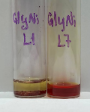
- determined previously for the parent Belokon complex (GlyNi)L1 (−0.32 V vs Ag/AgCl/KCl(sat.) [37]) and (GlyNi)L4 (−0.22 V [37]) showed that the nucleophilic equivalent of (GlyNi)L7 (Eox = −0.41 V, see Table 4) should be much more reactive towards electrophiles than the deprotonated (GlyNi)L1 and (GlyNi)L4



Transition-metal-catalyzed domino reactions of strained bicyclic alkenes
Beilstein J. Org. Chem. 2023, 19, 487–540, doi:10.3762/bjoc.19.38
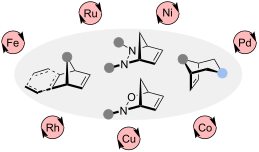
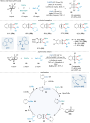
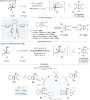
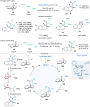
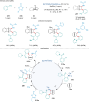
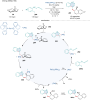
- intercepted by an electrophile to generate the difunctionalized system. This methodology has been applied several times to strained bicyclic alkenes with a variety of electrophiles. In 2015, Hirano and Miura developed a Cu-catalyzed aminoboration of bicyclic alkenes 1 with bis(pinacolato)diboron (B2pin2) (53

















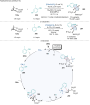


Group 13 exchange and transborylation in catalysis
Beilstein J. Org. Chem. 2023, 19, 325–348, doi:10.3762/bjoc.19.28
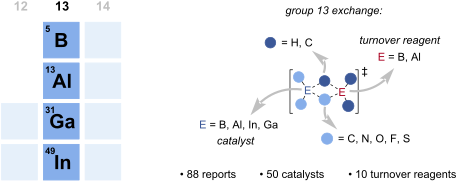
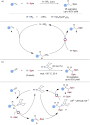
- transborylation with HBpin, to give the thioBpin 77 product and regenerate the amine-borane catalyst 73 (Scheme 17). Yamamoto reported the borane-catalysed hydroalumination of alkenes and allenes (Scheme 18) [80][81][82][83] in which the organoaluminium products were reacted in situ with various electrophiles to










Investigation of cationic ring-opening polymerization of 2-oxazolines in the “green” solvent dihydrolevoglucosenone
Beilstein J. Org. Chem. 2023, 19, 217–230, doi:10.3762/bjoc.19.21
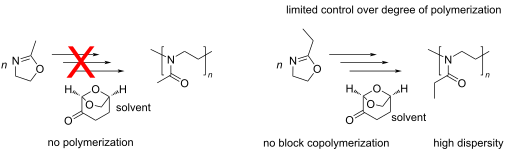
- polymerization (CROP) of the respective 2-substituted 2-oxazoline (Figure 1) initiated with various electrophiles [18][19][20][21]; most commonly alkyl tosylates or triflates are applied [21][22][23][24]. The use of suitable solvents plays a significant role in obtaining well-defined polymers with a narrow molar
- NMR spectra (Figure S6), indicating no interaction between the solvent and the monomer. Polymerization of 2-ethyl-2-oxazoline Six different electrophiles, acetyl chloride (AcCl), propionyl chloride (PrCl), benzyl bromide (BnBr), MeOTf, MeOTs, and EtOxMeOTf, were examined as initiators for the EtOx


Total synthesis of insect sex pheromones: recent improvements based on iron-mediated cross-coupling chemistry
Beilstein J. Org. Chem. 2023, 19, 158–166, doi:10.3762/bjoc.19.15
- could afford satisfying coupling yields by a suitable variation of the nature of the leaving group. In 2008, Cahiez reported an iron-catalyzed alkenylation of organomagnesium reagents with enol phosphates as electrophiles, instead of alkenyl halides [19]. In this case, when reactive enol phosphates
- ) as a co-solvent. Nevertheless, capitalizing on these results, Cahiez further developed this iron-catalyzed cross coupling reaction with dienol phosphates as electrophiles, which are thermally more stable than dienyl halides [20]. It was found that when dienol phosphates were used as electrophiles
- 1 by the M2i Company. Magnesium alkoxides used as additives Although it can lead to efficient NMP-free cross-coupling procedures, the use of enol phosphates as coupling electrophiles also brings several issues for efficient and sustainable procedures meant to be carried out at large scales. First


1,4-Dithianes: attractive C2-building blocks for the synthesis of complex molecular architectures
Beilstein J. Org. Chem. 2023, 19, 115–132, doi:10.3762/bjoc.19.12
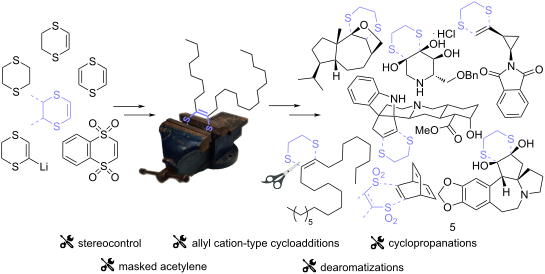
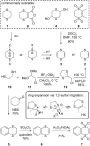
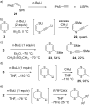
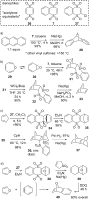
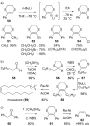
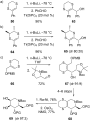
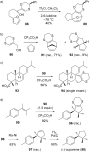
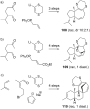
- highly reactive electrophiles. The homologous 1,4-dithianes or 1,4-dioxanes are readily available as simple building blocks, but also undergo a swift β-elimination following the metalation of one of their ring carbons, again limiting their appeal as building blocks [16][17]. In his landmark synthesis of
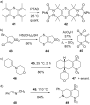
- expected fragmentation (Scheme 6e) [42]. The metalated dihydrodithiins can thus also be reacted with less activated electrophiles, including secondary alkylating agents. As we shall discuss in chapter 4, this makes 5,6-dihydro-1,4-dithiins the most suitable building blocks for Corey–Seebach-type
- opens up options for Corey–Seebach-type alkylation reactivity with a wider range of electrophiles. The method is demonstrated by the smooth lithiation and subsequent alkylation of the acetophenone-derived dithiin 50 (Scheme 10a) [42]. Palumbo’s elegant overall approach to dihydrodithiin-mediated











Synthetic study toward tridachiapyrone B
Beilstein J. Org. Chem. 2022, 18, 1741–1748, doi:10.3762/bjoc.18.183
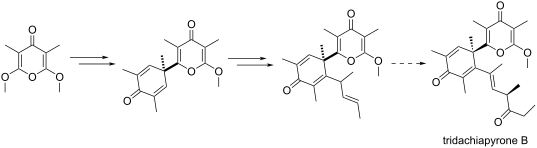
- enolate was treated with 4-nitrobenzaldehyde to promote the aldolization reaction but the corresponding alcohol was not observed, which confirmed the reluctance of 6a·Li to react with other electrophiles than protons. Unable to form the quaternary carbon of the target from this intermediate, the pathway


Redox-active molecules as organocatalysts for selective oxidative transformations – an unperceived organocatalysis field
Beilstein J. Org. Chem. 2022, 18, 1672–1695, doi:10.3762/bjoc.18.179
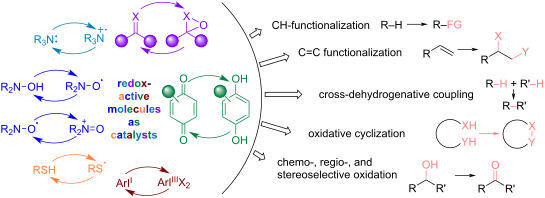
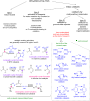
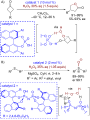
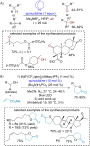
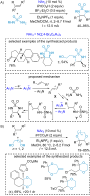
- a nucleophilic reacting center. In addition to umpolung reactions with electrophiles, Breslow intermediates can undergo oxidation with the formation of radical cations or electrophilic acylazolium cations. The acylazolium cation in turn can undergo nucleophilic attack resulting in C–O and C–N
- , organocatalysis by the modulation of redox properties of reagents has much in common with redox-neutral organocatalysis. With the exception of free-radical processes, the distinguishing feature of these organocatalyzed oxidations frequently lies in the involvement of peroxides as O-nucleophiles or O-electrophiles
- instead of corresponding C-nucleophiles or C-electrophiles in redox-neutral organocatalyzed reactions. Organocatalysis by redox-active organic molecules N-Oxyl radical catalysis Reactive N-oxyl radicals generated in situ from the corresponding N-hydroxy compounds have found numerous applications in CH









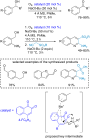


Ferrocenoyl-adenines: substituent effects on regioselective acylation
Beilstein J. Org. Chem. 2022, 18, 1270–1277, doi:10.3762/bjoc.18.133
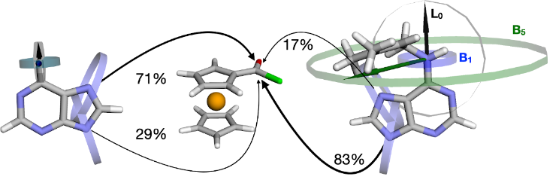
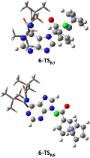
- more nucleophilic than the N9 atom. It comes out that the N7-nitrogen in the adenine anion reacts more readily with electrophiles, i.e., nucleophilic reactions occur preferably at the N7-position. The same conclusion was made by Stachowicz–Kuśnierz and Korchowiec who have shown that the inherent



Modular synthesis of 2-furyl carbinols from 3-benzyldimethylsilylfurfural platforms relying on oxygen-assisted C–Si bond functionalization
Beilstein J. Org. Chem. 2022, 18, 1256–1263, doi:10.3762/bjoc.18.131
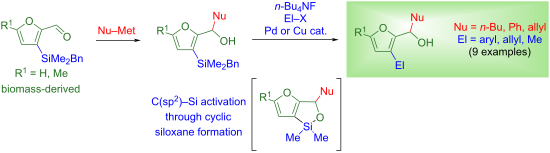
- ). With the 3-silylated 2-furyl carbinol substrates at hand, we then considered C–Si bond activation strategies relying on the assistance of the oxygen atom to promote electrophilic substitution reactions with carbon electrophiles. C3–Si bond functionalization through intramolecular activation by
- of electrophiles to deliver product D, resulting from the overall C2–Si functionalization (Scheme 3, top) [24][25]. The key to the viability of this process is the formation of pentavalent silicon intermediate B. This suggested that a related pentavalent intermediate F could be similarly accessible
- furan rings, which gave products 25 and 26 in 42% and 40% yield, respectively. Electrophiles other than methallyl chloride could also be used. C3-Allylation of substrate 4c, leading to 27, was achieved in 52% yield by reaction with allyl chloride and in a better 61% yield using allyl bromide. It should


Dienophilic reactivity of 2-phosphaindolizines: a conceptual DFT investigation
Beilstein J. Org. Chem. 2022, 18, 1217–1224, doi:10.3762/bjoc.18.127
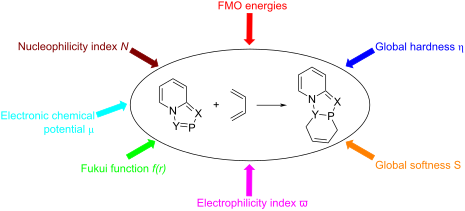
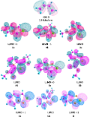
- ), global softness (S), electronic chemical potential (µ), electrophilicity (ω) and nucleophilicity (N) indices of 2-phosphaindolizines 6 and 1,3-butadiene (7) are given in Table 2. 2-Phosphaindolizines and 1,3-butadiene are soft electrophiles and nucleophile, respectively, and in accordance with the HSAB


Reductive opening of a cyclopropane ring in the Ni(II) coordination environment: a route to functionalized dehydroalanine and cysteine derivatives
Beilstein J. Org. Chem. 2022, 18, 1166–1176, doi:10.3762/bjoc.18.121
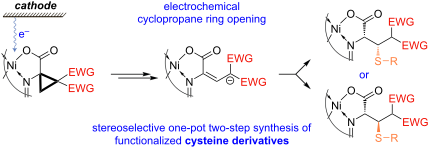
- reactions with electrophiles, intramolecular cyclization and disproportionation process. The synthetic viability of the approach will be considered. A one-pot multistep synthetic protocol is suggested, based on addition of thiols to the mixture of isomeric alkenes formed in an electroreductive opening of a
- well as to steric reasons. Reaction with electrophiles Anions formed in the reductive ring opening in complex 4 are stable enough: they survive even in the presence of acetic acid and do not react with electrophiles (CH3I, benzaldehyde). In contrast, addition of external electrophiles in the reaction
- that follow-up functionalization of the anions formed after the ring opening with electrophiles (except H+) has low synthetic value due to multiple competing reaction channels observed in case of 3 and decreased nucleophilicity of 4. Consequently, it seems reasonable to focus on the one-pot



Electrochemical formal homocoupling of sec-alcohols
Beilstein J. Org. Chem. 2022, 18, 1062–1069, doi:10.3762/bjoc.18.108
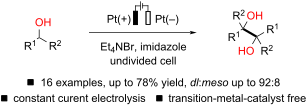
- catalytic amount of transition-metal reductants have been developed, but stoichiometric silicon electrophiles and co-reductants such as Zn were commonly required to complete the catalytic cycle [14]. More recently, visible light-mediated pinacol coupling reactions have been disclosed by several groups [15