Search results
Search for "epimer" in Full Text gives 99 result(s) in Beilstein Journal of Organic Chemistry.
Stereoselective synthesis of tricyclic compounds by intramolecular palladium-catalyzed addition of aryl iodides to carbonyl groups
Beilstein J. Org. Chem. 2016, 12, 1236–1242, doi:10.3762/bjoc.12.118
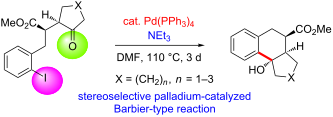
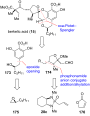
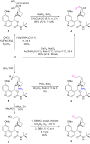
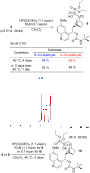
- by conventional column chromatography and hence a detailed analysis of the stereochemical features of this transformation was possible. Configurationally homogeneous compound 4a furnished diastereomerically pure cyclization product 13a in excellent yield, whereas epimer 4b was converted into product




Muraymycin nucleoside-peptide antibiotics: uridine-derived natural products as lead structures for the development of novel antibacterial agents
Beilstein J. Org. Chem. 2016, 12, 769–795, doi:10.3762/bjoc.12.77
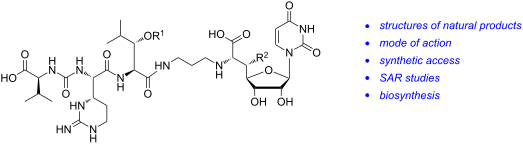
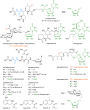
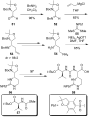
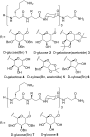
- urea dipeptide 27 [96][97]. Starting from the uridine derivative 28 used in the synthesis of (+)-caprazol, Ichikawa and Matsuda built up muraymycin D2 and its epimer (Scheme 4). They used an Ugi four-component reaction with an isonitrile derivative 29 obtained from the uridine-derived core structure 28
- , aldehyde 30, amine 31 and the urea dipeptide building block 27. A two-step global deprotection then gave the desired muraymycin D2 and its epimer which could be separated by HPLC [96][97]. In 2012, Kurosu et al. also reported the synthesis of potential key intermediates for the total synthesis of
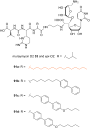
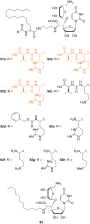
- muraymycin D2 33 (with an L-leucine unit) and its epimer (with a D-leucine unit) on the purified MraY enzyme from B. subtilis were determined. Both compounds showed good inhibitory activities with IC50 values of 0.01 μM and 0.09 μM, respectively. However, their antibacterial activities against several Gram













Synthesis and in vitro cytotoxicity of acetylated 3-fluoro, 4-fluoro and 3,4-difluoro analogs of D-glucosamine and D-galactosamine
Beilstein J. Org. Chem. 2016, 12, 750–759, doi:10.3762/bjoc.12.75
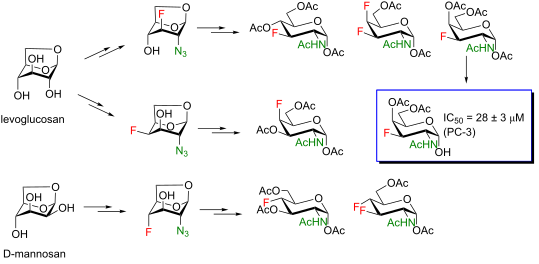
- a case the reaction is unexpectedly sensitive to minor steric alterations of the substrate because the C-4 epimer 15 (Scheme 3) did not react. An internal fluorine attack from the β-face of the tetrahydropyran ring through a concerted (Scheme 4C) or contact ion-pair (Scheme 4D) SNi mechanism cannot
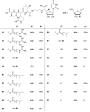
- to furnish acetylated 3-fluoro-GalNAc 6 isolated as a separable mixture of anomers. The D-galacto configuration of 6 is manifested by the lower 3JH3,H4 coupling value (3.4 Hz, α-anomer) in comparison with that of its C-4 epimer 5 (8.6 Hz, α-anomer). Acetolysis of the internal acetal in 26 proceeded





Synthesis of Xenia diterpenoids and related metabolites isolated from marine organisms
Beilstein J. Org. Chem. 2015, 11, 2521–2539, doi:10.3762/bjoc.11.273
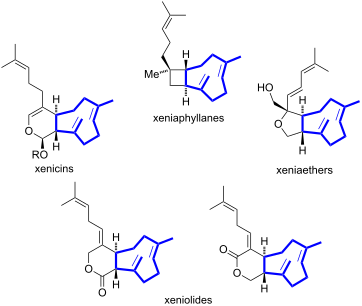
- afforded lactone 64. For the introduction of the side chain, the enolate derived from lactone 64 was treated with 1-bromo-4-methylpent-2-ene, giving a 1:6 mixture of coraxeniolide A (10) and its epimer 65. By equilibration with triazabicyclodecene (TBD), the ratio of 10:65 could be inverted to 3:1. In
- reactive methylenetriphenylphosphorane was used. Finally, α-alkylation of the lactone with iodide 83 provided coraxeniolide A (10) and its epimer in a 1:6 ratio which could be reversed to 4:1 by base-mediated equilibration. Purification by column chromatography, allowed the two epimers to be separated and







Stereoselective synthesis of hernandulcin, peroxylippidulcine A, lippidulcines A, B and C and taste evaluation
Beilstein J. Org. Chem. 2015, 11, 2117–2124, doi:10.3762/bjoc.11.228

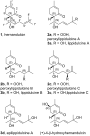
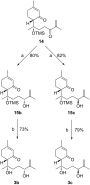
- (+)-β-hydroxyhernadulcin isomer (Figure 1), which has been described as a sweetener [39]. Intrigued by the behavior of 3a we prepared the epimer 3d ([α]D −107° (c 1.2, CHCl3) vs lit. [8] [α]D −118.4° (c 0.5, CHCl3)) by the acid catalyzed racemization of C(6) stereogenic center. Remarkably, the absolute



Cross-metathesis reaction of α- and β-vinyl C-glycosides with alkenes
Beilstein J. Org. Chem. 2015, 11, 1392–1397, doi:10.3762/bjoc.11.150

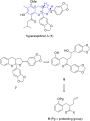
- quantitatively the same mixture of epimeric 1-(D-galactopyranosyl)prop-2-enes that were dissolved in ethanol and treated with ether. This allowed the α-epimer to precipitate and it could afterwards be isolated as a pure crystalline product in 60% yield [42]. Its acetylation afforded 1-(tetra-O-acetyl-α-D


Synthesis of the furo[2,3-b]chromene ring system of hyperaspindols A and B
Beilstein J. Org. Chem. 2015, 11, 265–270, doi:10.3762/bjoc.11.29
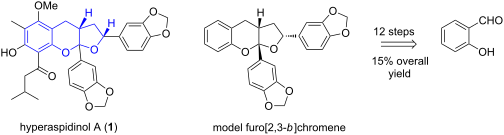
- methylenedioxyphenyl groups at C-10 and C-11. The NOESY spectrum of 7b exhibited a NOESY correlation between H-8 and H-2′ showed the syn relationship between these two groups but no correlation between H-8 and H-10 was observed, suggesting 7b to be the C-10 epimer of 7a. A correlation of H-10 to the H-9b, which was on
- protons (Figure 5) [26]. Overall this represents an anti-relationship between H-8 and H-10 confirming 7b to be the C-10 epimer of 7a. The ratio of diastereoisomers in ketal 22 was 1:1, however in the cyclised products 7 the ratio of diastereoisomers 7a to 7b was 1.6:1. This suggests partial isomerisation




NAA-modified DNA oligonucleotides with zwitterionic backbones: stereoselective synthesis of A–T phosphoramidite building blocks
Beilstein J. Org. Chem. 2015, 11, 50–60, doi:10.3762/bjoc.11.8
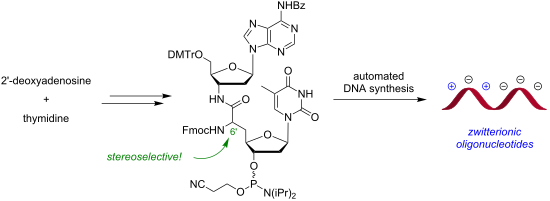
- )-protected Z-17 in the presence of (S,S)-Me-DuPHOS-Rh thus furnished thymidine-derived nucleosyl amino acid (S)-19 in 94% yield, and its 6'-epimer (R)-19 was obtained from the same starting material in 99% yield using catalytic amounts of (R,R)-Me-DuPHOS-Rh (Table 1, entries 1 and 2). Both transformations



Application of cyclic phosphonamide reagents in the total synthesis of natural products and biologically active molecules
Beilstein J. Org. Chem. 2014, 10, 1848–1877, doi:10.3762/bjoc.10.195
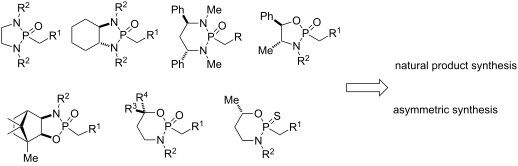
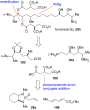
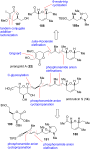
- primary alcohol of the side chain was oxidized with Dess–Martin periodinane (DMP) to give aldehyde 183. The latter was subsequently reacted with trimethylsilyl ketene acetal 184 in the presence of oxazaborolidinone 185 to afford aldol product 186 and the C22-epimer as only isomers in a 1:1 mixture. Dess












Structure/affinity studies in the bicyclo-DNA series: Synthesis and properties of oligonucleotides containing bcen-T and iso-tricyclo-T nucleosides
Beilstein J. Org. Chem. 2014, 10, 1840–1847, doi:10.3762/bjoc.10.194
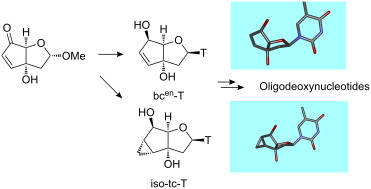
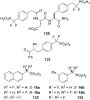
- , compound 1 was subjected to carbonyl reduction which occurred with high stereoselectivity from the less hindered, convex side of the bicyclic system, resulting in alcohol 2 along with traces of its epimer. To increase the stereoselectivity of the upcoming cyclopropanation reaction it seemed appropriate to
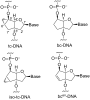
- structures (right); bottom row: tc-T (Mol A, left, Mol B, right). Conditions: (a) NaBH4, CeCl3·7H2O, MeOH, −78 °C → rt, 1.5 h, 73% (+9% of C6-epimer); (b) TBS-Cl, imidazole, CH2Cl2, rt, 16 h, 79%; (c) Et2Zn in hexane (1 M), CH2I2, CH2Cl2, 0 °C → rt, 16 h, 86%; (d) PivCl, DMAP, pyridine, ClH2C–CH2Cl, 70 °C



Multicomponent reactions in nucleoside chemistry
Beilstein J. Org. Chem. 2014, 10, 1706–1732, doi:10.3762/bjoc.10.179
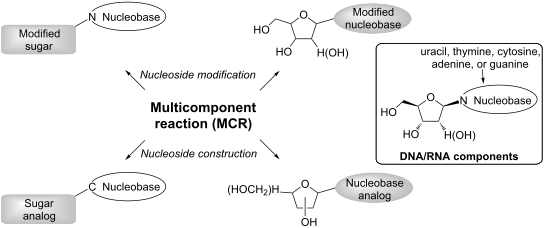
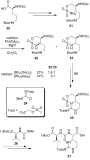
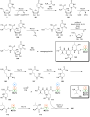
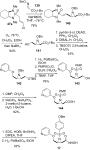
- its epimer (Scheme 21) [87]. After completion of the synthesis of the urea dipeptide 53 bearing the cyclic moiety found in muraymycin D2, the four-component condensation was performed similarly as in [86] to yield the protected product 54 as a 1:1 diastereomeric mixture. Functional group manipulation
- 22) [89]. The urea dipeptide 55, 2,4-dimethoxybenzylamine, the protected (S)-2-(methylamino)propanal, and isonitrile 56 were simply combined in ethanol at ambient temperature for 48 h. The expected compound 57 and its epimer were obtained in reasonable yields, and were separated by column
- chromatography. The syntheses of 3′-hydroxypacidamycin D and its epimer were then accomplished in four steps from intermediates 57 or epi-57, including selective deprotection of the N-methyl-Boc group, coupling with N-Boc-L-alanine, and global deprotection. This strategy was also applicable to the synthesis of a


Olefin cross metathesis based de novo synthesis of a partially protected L-amicetose and a fully protected L-cinerulose derivative
Beilstein J. Org. Chem. 2014, 10, 1023–1031, doi:10.3762/bjoc.10.102
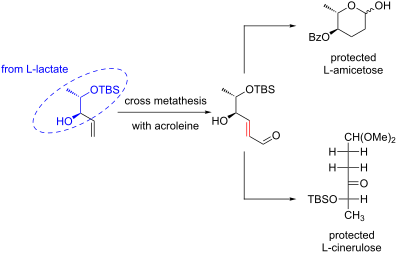
- or its epimer rhodinose, respectively [33]. An approach to amicetose (and a few other 6-desoxy sugars) involves the formation of an enantiopure β,γ-unsaturated δ-valerolactone via ring closing metathesis (RCM). The RCM product is subsequently converted into L-amicetose in four steps [34


Molecular architecture with carbohydrate functionalized β-peptides adopting 314-helical conformation
Beilstein J. Org. Chem. 2014, 10, 948–955, doi:10.3762/bjoc.10.93

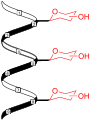
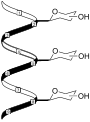
- acid using Fmoc N-hydroxysuccinimidyl carbonate (Fmoc-OSu) under basic conditions gave sugar β-amino acid Fmoc-L-glycero-glucose(Bn)-OH 12a in 81% yield (Scheme 1). The C6-epimer Fmoc-D-glycero-glucose(Bn)-OH 12b was obtained by analogous procedures as performed for 12a. The synthesis of Fmoc-D-glycero


Addition of H-phosphonates to quinine-derived carbonyl compounds. An unexpected C9 phosphonate–phosphate rearrangement and tandem intramolecular piperidine elimination
Beilstein J. Org. Chem. 2014, 10, 883–889, doi:10.3762/bjoc.10.85
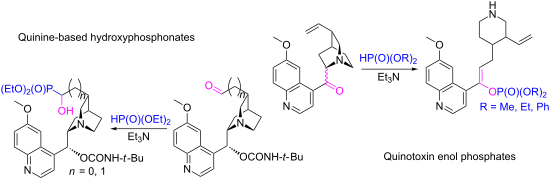
- cleavage on silica in a two-phase system led predominantly to the C3 epimer of the R configuration 90:10 (yield 93%) in a short reaction time [27]. In our case, when the reaction time was prolonged to 2 hours, the overall yield remained at the same level while the diastereoselectivity was reduced to 71:29
- varied in the range of 40–50% (Scheme 3). The R-C3 epimer gave rise to somewhat more pronounced induction. The 31P NMR resonances of the predominating forms of the hydroxyphosphonate are shifted apart by approximately 1.0 ppm. We speculate that this means a diastereomeric relationship of their C3–C10




Intermediates in monensin biosynthesis: A late step in biosynthesis of the polyether ionophore monensin is crucial for the integrity of cation binding
Beilstein J. Org. Chem. 2014, 10, 361–368, doi:10.3762/bjoc.10.34
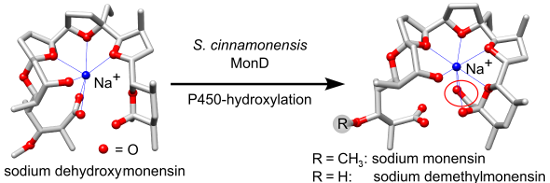
- epimer of monensin A at C-9 [17] has provided clear evidence that both MonD and MonE are capable of acting on altered substrates, which is encouraging for future engineering experiments aimed at production of novel derivatives. To help to provide a platform for such experiments, and to further elucidate



Total synthesis and cytotoxicity of the marine natural product malevamide D and a photoreactive analog
Beilstein J. Org. Chem. 2014, 10, 316–322, doi:10.3762/bjoc.10.29
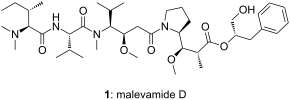
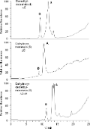
- . There are also other, enantioselective syntheses of 7 [7] and Boc-protected versions of MMMAH [8][9], but we intended to also have the (3S)-epimer of 7 at our disposal. After hydrogenation of 7, the resulting secondary amine was coupled with Cbz-valine (8) affording dipeptide 9 (DEPCl, diethyl




Decandrinin, an unprecedented C9-spiro-fused 7,8-seco-ent-abietane from the Godavari mangrove Ceriops decandra
Beilstein J. Org. Chem. 2014, 10, 276–281, doi:10.3762/bjoc.10.23
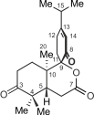
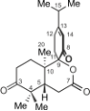
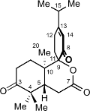
- decandrinin (1), NOE interactions for the B97D/TZVP-optimized structure diagnostic for the 9-epimer of decandrinin (1), and comparison of the calculated ORD with the experimental one. Acknowledgements This work was financially supported by NSFC (31100258, 31170331, and 81125022), the Guangdong Key Science


New hydrogen-bonding organocatalysts: Chiral cyclophosphazanes and phosphorus amides as catalysts for asymmetric Michael additions
Beilstein J. Org. Chem. 2014, 10, 224–236, doi:10.3762/bjoc.10.18
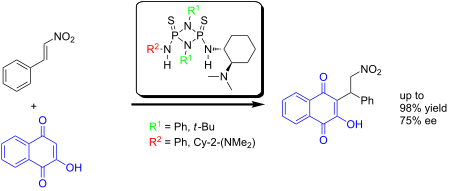
- epimer (R)-5 and the 9-epi-amino derivatives (R)-6/7a–f give unexpectedly complex 1H/31P NMR spectra in CDCl3/DMSO-d6 at room temperature. Signals that belong to any one proton split into two signals with a ratio of ~5:1/20:1 depending on the solvent. The reason for this is conformational isomerism
- quinine, gives modest yields (60%) albeit with low enantiomeric excess (13% ee). Lowering the reaction temperature with catalyst 4 results in a slightly higher enantiomeric excess (27% ee, Table 2), however the yield drops to only 30%. We anticipated an increase in enantioselectivity for the epimer 5 as


Recent applications of the divinylcyclopropane–cycloheptadiene rearrangement in organic synthesis
Beilstein J. Org. Chem. 2014, 10, 163–193, doi:10.3762/bjoc.10.14
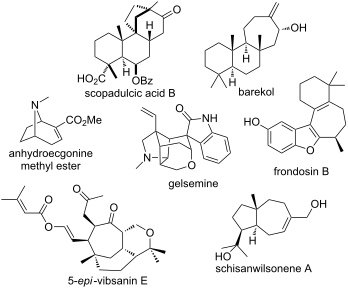
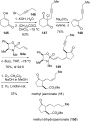
- both good yield and good diastereomeric ratio. Selective hydrogenation of the more electron rich double bond followed by reduction of the ester furnished α,β-unsaturated ketone 104 after PPTS-catalyzed elimination of water. Subsequent DIBAL-H reduction yielded the alcohol epimer 105 of barekol (107




The total synthesis of D-chalcose and its C-3 epimer
Beilstein J. Org. Chem. 2013, 9, 2620–2624, doi:10.3762/bjoc.9.296

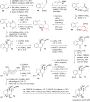
- , Boston, MA 02215, United States 10.3762/bjoc.9.296 Abstract We completed a new and efficient synthesis of D-chalcose (I) and the first synthesis of its C-3 epimer (I′) in nine steps with overall yields of 23% and 24%, respectively. The key steps in the sequence were the formation of the stereocenter on
- -10-camphorsulfonic acid (CSA) in MeOH. Keywords: asymmetric dihydroxylation; chalcose; epimer; total synthesis; Introduction Chalcose (4,6-dideoxy-3-O-methyl-D-xylo-hexose, I [1][2]) is a structural component of many macrolide antibiotics, such as chalcomycin [3], neutramycin [4], and lankamycin [5
- new and efficient 9-step synthesis of D-chalcose (I) with a 23% overall yield. In addition its efficiency, the route enabled facile preparation of chalcose’s C-3 epimer (4,6-dideoxy-3-O-methyl-D-ribo-hexose, I′); the C-3 epimer has not been synthesized previously. Results and Discussion The


Stereodivergent synthesis of jaspine B and its isomers using a carbohydrate-derived alkoxyallene as C3-building block
Beilstein J. Org. Chem. 2013, 9, 2564–2569, doi:10.3762/bjoc.9.291
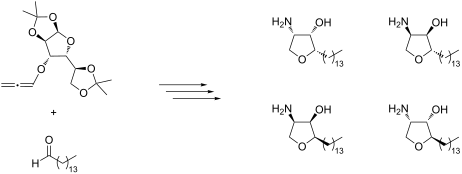
- biological activities (Scheme 2). Results and Discussion Synthesis of racemic jaspine B and its C-2-epimer Initial studies examined the feasibility of this planned approach for the generation of the functionalized tetrahydrofuran system. They were based on methoxyallene (5) and led to the preparation of the
- reduction of carbonyl compounds bearing an electronegative group in α-position [37]. After palladium-catalyzed hydrogenolysis of α-azidotetrahydrofuranols rac-9 and rac-10 an inseparable mixture of racemic jaspine B (rac-1) and its C-2-epimer rac-2 was obtained. Hence the natural product and its


Biosynthesis of rare hexoses using microorganisms and related enzymes
Beilstein J. Org. Chem. 2013, 9, 2434–2445, doi:10.3762/bjoc.9.281
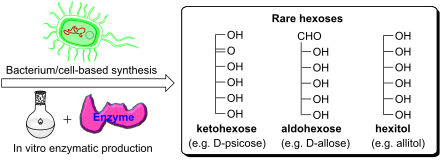
- -Psicose is a C-3 epimer of D-fructose and a potential sucrose substitute sweetening agent. The suppression of hepatic lipogenic enzymes activity of D-psicose has been noticed for its use as a non-caloric sweetener [25][26]. In addition, antioxidant properties have been observed for foods containing this
- -rhamnitol) which was subsequently oxidized by Enterobacter aerogenes IK7 to afford the rare sugar 1-deoxy-L-fructose. The whole process was performed in an environmentally friendly fashion. II. Biosynthesis of rare aldohexoses D-Allose D-Allose is the C-3 epimer of D-glucose or the aldo/keto-isomer of D
- oxygen. L-Talose and D-gulose The aldohexoses L-talose and D-gulose (C-3 epimer of D-galactose) are both very expensive owing to their scarcity in nature. L-Talofuranosyladenine, an adenine nucleoside derivative of L-talose, was found to be a slow-reacting substrate for calf intestinal adenosine


Synthetic scope and DFT analysis of the chiral binap–gold(I) complex-catalyzed 1,3-dipolar cycloaddition of azlactones with alkenes
Beilstein J. Org. Chem. 2013, 9, 2422–2433, doi:10.3762/bjoc.9.280
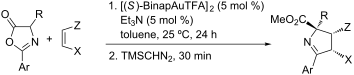
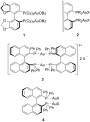
- submitted to different transformations. For example, it could be reduced to the corresponding pyrrolidines employing sodium cyanoborohydride in acidic media. In this reaction, a 1:1 mixture of 2,5-cis-pyrrolidine 13 and its 5-epimer 14 (2,5-trans) was isolated in good chemical yield (71%) (Scheme 7
- , reaction a). Fortunately, 5-epimer 14 (2,5-trans) was diastereoselectively generated through a 10% Pd/C-catalyzed hydrogenation using 4 atmospheres of hydrogen during three days at 25 °C (Scheme 7, reaction b). This trans- arrangement in molecule 14 is not very easy to built because several steps were





Towards stereochemical control: A short formal enantioselective total synthesis of pumiliotoxins 251D and 237A
Beilstein J. Org. Chem. 2013, 9, 2358–2366, doi:10.3762/bjoc.9.271
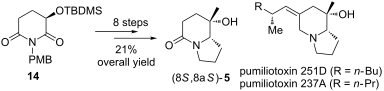
- as an advanced intermediate for the synthesis of pumiliotoxin 251D [12]. Later on, Nubbemeyer and co-workers used the Horner olefination to convert 5 and its diastereomer into (+)-PTX 251D (2) and the 8-epimer of PTX 209F (4), respectively [17]. Recently, (8S,8aS)-5 has been used for the synthesis of


Cyclopamine analogs bearing exocyclic methylenes are highly potent and acid-stable inhibitors of hedgehog signaling
Beilstein J. Org. Chem. 2013, 9, 2328–2335, doi:10.3762/bjoc.9.267
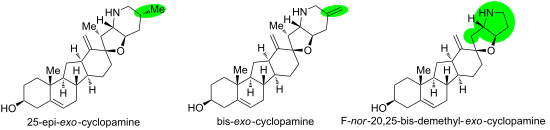
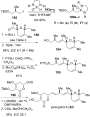
- catalyst in benzene yielded previously described exo-cyclopamine 2 and its C25 epimer 5. Deprotection with Raney-nickel (EtOH, 78 °C) and then sodium naphthalenide (DME, −78 °C, 41% over two steps) furnished 25-epi-exo-cyclopamine 5 in 3% overall yield from 3. A first set of exo-cyclopamine analogs with a