Search results
Search for "luminescence" in Full Text gives 133 result(s) in Beilstein Journal of Organic Chemistry.
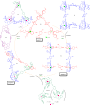
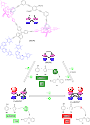
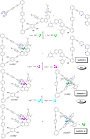
Using multiple self-sorting for switching functions in discrete multicomponent systems
Beilstein J. Org. Chem. 2020, 16, 2831–2853, doi:10.3762/bjoc.16.233

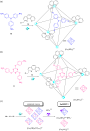
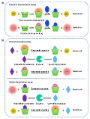
- reversibility was achieved by the addition of the rhodium porphyrin 19 that reversed the system reviving the state SelfSORT-I. Since both self-sorted states exhibited a distinct fluorescence due to the changes at the zinc porphyrin sites, luminescence was used for the selective detection of DABCO in a mixture
- innovative catch–release system with multiple functions combined the ON/OFF-adjustment of silver(I) catalysis and fluorescence monitoring [59]. Actually, the ratiometric luminescence response allowed the exact monitoring of the catalytic activity. In the initial incomplete self-sorting (state SelfSORT-I
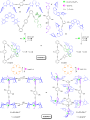
- reversed back to the initial state (Figure 15b). Here, all translocations happen in an off-equilibrium system. Since the kinetic evolution of the lithium pulses was followed by color and luminescence changes of the lithium-sensitive probe 36, the system is suited for a multitude of new applications









Selective recognition of ATP by multivalent nano-assemblies of bisimidazolium amphiphiles through “turn-on” fluorescence response
Beilstein J. Org. Chem. 2020, 16, 2728–2738, doi:10.3762/bjoc.16.223
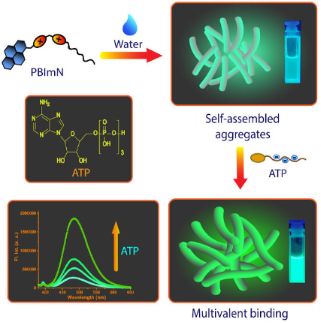
- multiple imidazolium groups to overcome the high hydration enthalpy of phosphates and b) the imidazolium groups are connected to aromatic moieties such as anthracene, pyrene, etc. The variation in the luminescence of the aromatic moieties signals the binding event and furthermore, they provide additional
- buffer and produced nanoaggregates with surface exposed positive charges. Interestingly, the aggregates displayed cyanic green luminescence which originated from the excimeric emission of the stacked pyrenes [57][58][59]. In a recent work, we have demonstrated that self-assembled nanofibrous aggregates


NMR Spectroscopy of supramolecular chemistry on protein surfaces
Beilstein J. Org. Chem. 2020, 16, 2505–2522, doi:10.3762/bjoc.16.203
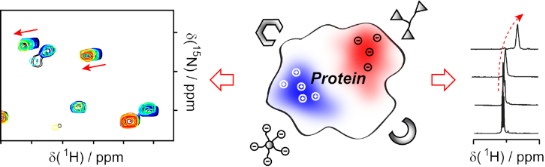
- be detected by its luminescence [77][78][79]. Overall, while crystal structures provide fantastic insight into molecular interactions of such supramolecular ligands, they do not necessarily reflect the binding situation in solution. Furthermore, to our knowledge no protein co-crystal structures with
- indeed recognize the highly positively charged area on cytochrome c (Cyt c) that binds Cyt c peroxidase. The inhibition of this protein–protein interaction was demonstrated as well using a luminescence quenching assay. The protein surface recognition of two porphyrin ligands bearing carboxylate




Styryl-based new organic chromophores bearing free amino and azomethine groups: synthesis, photophysical, NLO, and thermal properties
Beilstein J. Org. Chem. 2020, 16, 2282–2296, doi:10.3762/bjoc.16.189

- solutions in DMSO. Therefore, they showed potential to be utilized as colorimetric and luminescence pH sensors. The second-order nonlinear optical (NLO) responses of the dyes were measured by the electric field-induced second harmonic (EFISH) generation method. The highest μβ values were obtained for the


Clickable azide-functionalized bromoarylaldehydes – synthesis and photophysical characterization
Beilstein J. Org. Chem. 2020, 16, 1683–1692, doi:10.3762/bjoc.16.139
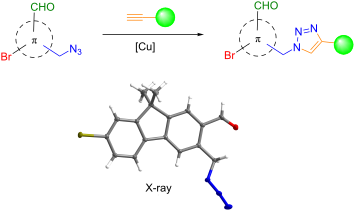
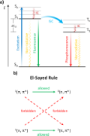
- non-radiative transitions can be achieved by the host–guest method [50][51][52] or by crystallization [53][54][55][56][57]. In difference to the liquid phase, the highly ordered packing and the restriction of molecular motions in the crystalline state favor a persistent luminescence. The promotion of
- , no luminescence was detected for the para derivatives. All ortho derivatives exhibited luminescence neither in solution nor in the solid-state [73]. These observations for the para- and ortho-bromobenzaldehydes indicate that the phosphorescence is quenched in these systems, yielding only a weak



4-Hydroxy-3-methyl-2(1H)-quinolone, originally discovered from a Brassicaceae plant, produced by a soil bacterium of the genus Burkholderia sp.: determination of a preferred tautomer and antioxidant activity
Beilstein J. Org. Chem. 2020, 16, 1489–1494, doi:10.3762/bjoc.16.124
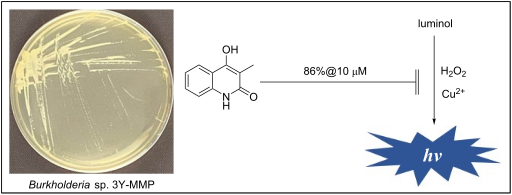
- extinction assay [41][42]. This assay quantifies the presence of the most detrimental ROS, hydroxy radical [43][44], as intensity of luminescence emitted by oxidation of luminol. Compound 1 at 10 μM, which is lower than a concentration in production liquid cultures (15 μM), decreased luminescence to 14% of


Synthesis of new fluorescent molecules having an aggregation-induced emission property derived from 4-fluoroisoxazoles
Beilstein J. Org. Chem. 2020, 16, 1411–1417, doi:10.3762/bjoc.16.117
- -opening reaction of 4-fluoroisoxazoles and exhibited highly fluorescent luminescence and aggregation-induced emission (AIE), showing promise as a new fluorophore. Keywords: aggregation-induced emission; boron ketoiminates; fluorescent probe; α-fluorinated boron ketoiminates; 4-fluoroisoxazoles
- fluorescent luminescence characteristics of 4-fluoroisoxazoles, the synthesis of α-fluorinated boron ketoiminates (F-BKIs), and their photochemical properties. Results and Discussion Synthesis and optical properties of 4-fluorinated isoxazoles Although there is a large number of fluorescent molecules
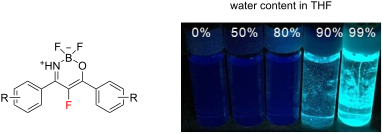
- luminescence (FL) of the solutions of 6b and 9b exhibited an increase in the emission intensities with increasing water content. It was interesting to note that the excitation maximum of 9b in the aggregated state showed a red-shift by approximately 20 nm based on the incorporation of a single fluorine atom


Synthesis and properties of quinazoline-based versatile exciplex-forming compounds
Beilstein J. Org. Chem. 2020, 16, 1142–1153, doi:10.3762/bjoc.16.101
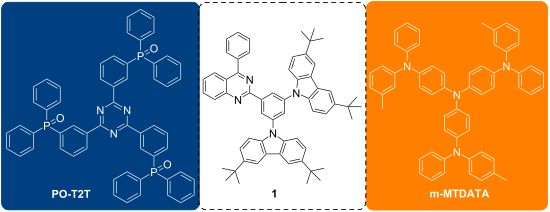
- dilute solutions (10−4–10−5 mol/L) of the compounds were recorded at room (295 K) and low (77 K) temperatures with a luminescence spectrometer Edinburgh Instruments FLS980. Photoluminescence quantum yields (PLQY) of the solutions and thin films of the materials were measured using an integrating sphere


Aryl-substituted acridanes as hosts for TADF-based OLEDs
Beilstein J. Org. Chem. 2020, 16, 989–1000, doi:10.3762/bjoc.16.88
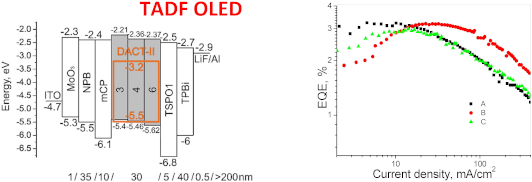
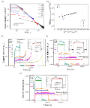
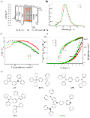
- explained by the dihedral angle between the acridanyl and naphthyl moieties, that is the largest one among all the studied compounds, leading to a reduction of π-conjugation. This observation explains the distinct ICT character of the luminescence of compound 4. The dihedral angles in the molecules of 3 and


Bipyrrole boomerangs via Pd-mediated tandem cyclization–oxygenation. Controlling reaction selectivity and electronic properties
Beilstein J. Org. Chem. 2020, 16, 895–903, doi:10.3762/bjoc.16.81
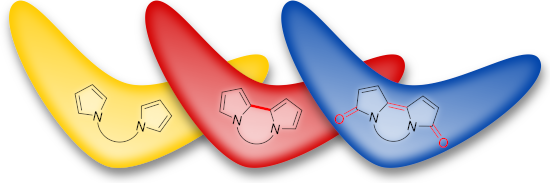
- we report that the above Pd-mediated chemistry is capable of producing highly twisted dilactam boomerangs and provide first examples of α-free boomerang systems. These new derivatives are of interest as emitters for both polarized and unpolarized luminescence. Results and Discussion Synthesis The
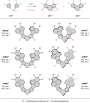
- polarized luminescence (CPL) measurements performed for enantioenriched samples of cNMI3H reveled weak signals of opposite signs, with a maximum at ca. 570 nm consistent with the unpolarized luminescence of this system (Supporting Information File 1, Figure S6). The CPL signals rapidly decayed during the




Recent advances in photocatalyzed reactions using well-defined copper(I) complexes
Beilstein J. Org. Chem. 2020, 16, 451–481, doi:10.3762/bjoc.16.42
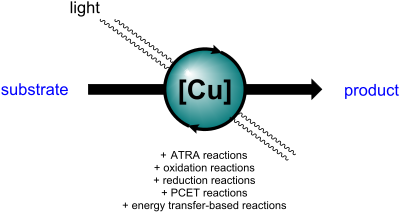
- , copper-based photocatalysts are often considered less efficient due to a lower luminescence lifetime compared to Ir and Ru complexes [6]. Review In this review, we summarized the recent significant advances that were made in the use of copper-based photocatalysts for synthetically useful transformations














Synthesis and circularly polarized luminescence properties of BINOL-derived bisbenzofuro[2,3-b:3’,2’-e]pyridines (BBZFPys)
Beilstein J. Org. Chem. 2020, 16, 325–336, doi:10.3762/bjoc.16.32
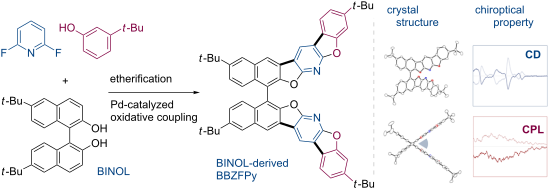
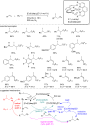
- characteristics in the solid state. The crystal structures of the coupling products were also evaluated by single crystal X-ray analysis and the well-ordered intermolecular stacking arrangements appeared to be responsible for the enhanced CPL. Keywords: BINOL; C–H activation; circularly polarized luminescence
- fluorophore unit in certain light-emitting functional materials (Scheme 1) [14]. Meanwhile, organic optoelectronic materials with circularly polarized luminescence (CPL) characteristics have attracted significant research interests in recent years [18][19][20][21] for their potential applications in three
- fluorescence emission bands, whereas the (R)-isomers emitted right-handed CPL to produce the mirror images. The calculated luminescence dissymmetry factors [48] glum for the solutions were all within the range of 3.80 × 10⁻⁴ to 6.90 × 10⁻⁴. On the other hand, in the dispersed solid state in Fomblin® PFPE


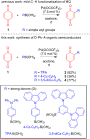
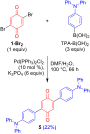
Synthesis and optoelectronic properties of benzoquinone-based donor–acceptor compounds
Beilstein J. Org. Chem. 2019, 15, 2914–2921, doi:10.3762/bjoc.15.285

- measurements using a combination of TCSPC and MCS techniques (at λPL = 550 nm) revealed two emission decay lifetimes: a prompt component, τp, of 19.4 ns and a very long delayed component, τd, of 352 μs. The two timescales of luminescence are a hallmark of delayed fluorescence behavior (Figure 6). The PL





Emission solvatochromic, solid-state and aggregation-induced emissive α-pyrones and emission-tuneable 1H-pyridines by Michael addition–cyclocondensation sequences
Beilstein J. Org. Chem. 2019, 15, 2684–2703, doi:10.3762/bjoc.15.262
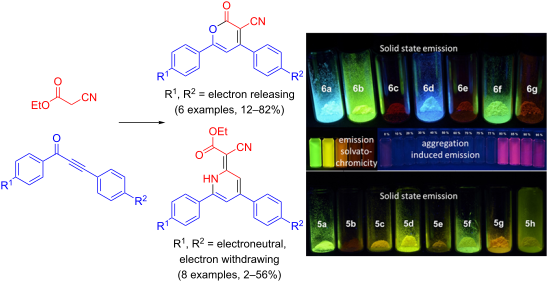
- luminescence characteristics (Table 5, entries 2, 4, 6 and 7). The Stokes shifts fall in a range between 5000 and 6100 cm−1 and the fluorescence quantum yields of the 1H-pyridines 5 account between 1 and 3%. Besides solution fluorescence all 1H-pyridines 5 also luminesce in the solid state (Figure 3, bottom
- (solid lines) and emission (dashed lines) spectra of 1H-pyridines 8a and 8b (recorded in dichloromethane at T = 298 K). Solid-state luminescence of 1H-pyridines 5a, 8a and 8b (λexc = 365 nm). α-Pyrones 6 as solids under daylight (top), selected derivatives under UV light (λexc = 365 nm, c(6) = 10−4 M) in




A photochemical determination of luminescence efficiency of upconverting nanoparticles
Beilstein J. Org. Chem. 2019, 15, 2671–2677, doi:10.3762/bjoc.15.260
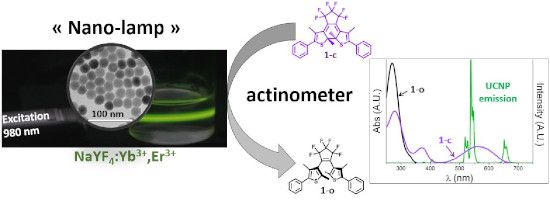
- lanthanides used. The main application foreseen for these nanomaterials is as a substitute of quantum dots [3], since the combination of anti-Stokes emission and noncoherent absorption prevent any luminescence background. Their extreme photostability [4] make them also ideal candidates for single particle
- (Jasco, Hamamatsu). A more sophisticated approach involves microscopic techniques, enabling one to determine UCQY even at the single NP scale. A seminal report was published in 2013 by Nadort et al. [20] describing the measurement of the luminescence of Er-doped UCNPs at the single NP or cluster level


Ultrafast processes triggered by one- and two-photon excitation of a photochromic and luminescent hydrazone
Beilstein J. Org. Chem. 2019, 15, 2438–2446, doi:10.3762/bjoc.15.236
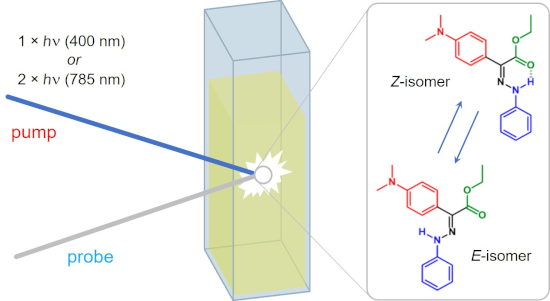
- – Istituto Nazionale di Ottica, Largo Enrico Fermi 6, 50125 Firenze, Italy 10.3762/bjoc.15.236 Abstract In this work we apply a combination of steady state and time resolved luminescence and absorption spectroscopies to investigate the excited-state dynamics of a recently developed molecular photoswitch
- isomerization occurs on a fast <1 ps timescale in both toluene and acetonitrile, while the excited state lifetime of the Z-form depends on solvent polarity, suggesting a partial charge transfer nature of its low lying excited state. Time-resolved luminescence measurements evidence the presence of a main
- the fluorescence band and the emission quantum yield depend on the solvent, with the emission strongly quenched in protic media [29]. Time-resolved fluorescence Detailed analysis of the fluorescence features of the two forms in toluene has been performed by time-resolved luminescence measurements in



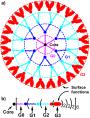
Fluorescent phosphorus dendrimers excited by two photons: synthesis, two-photon absorption properties and biological uses
Beilstein J. Org. Chem. 2019, 15, 2287–2303, doi:10.3762/bjoc.15.221
- the mechanism of action of anticancer compounds, and for safer photodynamic therapy. Keywords: bioimaging; dendrimer; fluorescence; phosphorus; two-photon absorption; Introduction Natural luminescence phenomena such as the bioluminescence of fireflies or of certain marine microorganisms, or the
- phosphorescence of certain minerals after being exposed to sun light, have fascinated Men for a long time. An important part of luminescence phenomena is due to the influence of light (generally visible or ultra-violet light) on matter, such as for instance a molecule, which can emit light at a wavelength
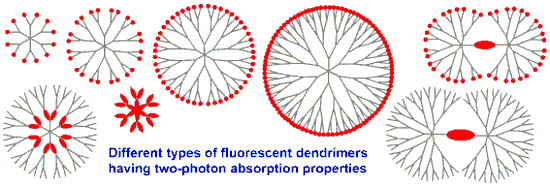
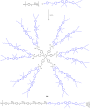
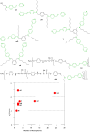
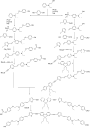
- classical fluorophores in their structure, have been already synthesized [13]. Besides, some types of dendrimers have shown non-traditional intrinsic luminescence, i.e., luminescence in the absence of known fluorophores [14]. Dendrimers functionalized with fluorophores having two-photon absorption










Aggregation-induced emission effect on turn-off fluorescent switching of a photochromic diarylethene
Beilstein J. Org. Chem. 2019, 15, 2204–2212, doi:10.3762/bjoc.15.217
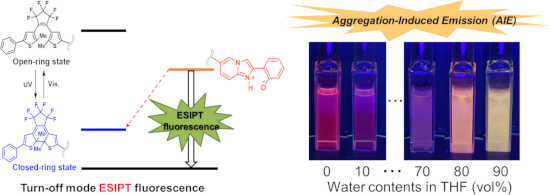
- crystals are inherently capable of photo-reversible luminescence switching because the electronic structures of photochromic molecules reversibly change upon photoisomerization [13][14]. However, such a fluorescent system in condensed phase emits fluorescence often absorbed in adjacent molecules, therefore
- because the proton transfer occurs through an intramolecular hydrogen bond. This is also an origin of a large Stokes shift (8,000–11,000 cm−1) in the emission from the ESIPT state. Consequently, yellow luminescence was observed by UV-excitation [17][18]. Mutai et al. reported an ESIPT luminescence of an
- (phenylethynyl)anthracene in hexane (Φf = 1.0) [31]. The luminescence quantum yields of crystalline solids were measured using a JASCO ILF-533 integral sphere attached to a JASCO FP-6600 spectrofluorophotometer. The mixture of microcrystalline compounds (2 mg) and powdered sodium chloride (1 g) were put into a 5


Complexation of a guanidinium-modified calixarene with diverse dyes and investigation of the corresponding photophysical response
Beilstein J. Org. Chem. 2019, 15, 1394–1406, doi:10.3762/bjoc.15.139

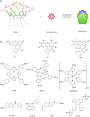
- luminescent dye by a suitable receptor leads to a readily detectable change of its luminescence property, prominently its intensity. An analyte then displaces the luminescent dye from the complex, resulting in a detectable luminescence response converting a receptor–analyte binding event into an easily
- course of an enzymatic reaction. Thus, the progress of the reaction can be signaled by a luminescence increase or decrease with time, which enables a highly sensitive real-time luminescence monitoring of the enzymatic activity [6]. STA has been applied to screening enzyme inhibitors or activators
- binding of the analyte gives rise to an extraordinary luminescence response of the reporter dye. Macrocyclic hosts constitute a family of well-studied artificial receptors with a discrete cavity that is selective for complementary binding to certain guests [9]. Modulation of properties of organic



Selective detection of DABCO using a supramolecular interconversion as fluorescence reporter
Beilstein J. Org. Chem. 2019, 15, 1371–1378, doi:10.3762/bjoc.15.137
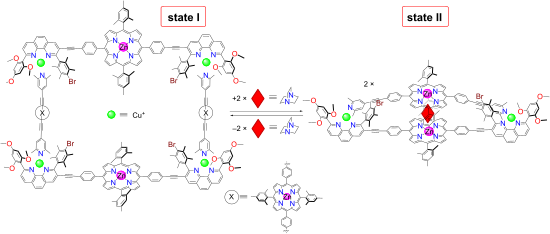
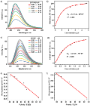
- to the fact, that the interconversion is accompanied by a diagnostic change in the fluorescence spectra, the present system represents a supramolecular reporter for the selective detection of DABCO. It is thus a rare example of DABCO sensing by luminescence [41]. Molecular structures of ligands 1, 2


A convenient and practical synthesis of β-diketones bearing linear perfluorinated alkyl groups and a 2-thienyl moiety
Beilstein J. Org. Chem. 2018, 14, 3106–3111, doi:10.3762/bjoc.14.290

- ]. Diketones bearing perfluorinated radicals are very important for the design of highly effective luminescent materials based on lanthanide coordination compounds. Substitution of aliphatic radicals by perfluorinated ones in the molecules of ligands led to a significant increase in luminescence intensity due
- MS measurements was provided by the Russian Foundation for Basic Research (grants No. 18-29-04029 and 18-02-00653). IVT is also grateful to Volkswagenstiftung (Project «Multifunctional molecular materials – bridging magnetism and luminescence»). The authors are thankful to Dr. Yu. Belousov (LPI) for


Organometallic vs organic photoredox catalysts for photocuring reactions in the visible region
Beilstein J. Org. Chem. 2018, 14, 3025–3046, doi:10.3762/bjoc.14.282
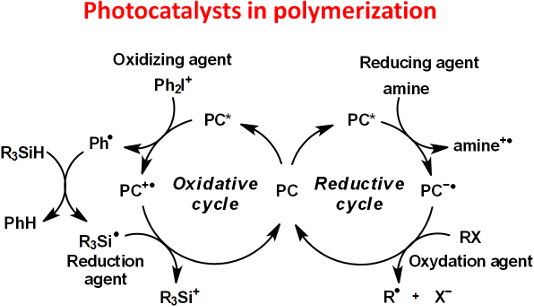
- by thermal activation. Thus, the excited states can be thermally upconverted to the singlet state by reverse intersystem crossing (RISC), giving rise to a luminescence process arising from the singlet state (fluorescence). The concept of delayed fluorescence is based on the unusual and transient



Non-native autoinducer analogs capable of modulating the SdiA quorum sensing receptor in Salmonella enterica serovar Typhimurium
Beilstein J. Org. Chem. 2018, 14, 2651–2664, doi:10.3762/bjoc.14.243
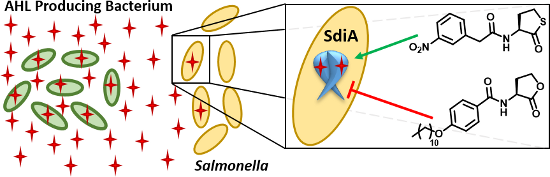
- identify an expanded range of synthetic ligands for SdiA. Herein, we report the screening of a focused library of AHL analogs for activity in the SdiA receptor from S. Typhimurium. Compound efficacies and potencies were measured in agonism and antagonism assays using an SdiA luminescence reporter system
- the positive control based on raw luminescence. Further, for the E. coli JLD271 reporter, the negative control was at 50% the level of the positive control; we reason that this higher background relative to S. Typhimurium is due to the overexpression of SdiA in this reporter. Conditions for both
- changing the expression of SdiA or by inhibiting the luminescence reporter. Conversely, the inability of F45 and 16 to even partially inhibit SdiA in the E. coli reporter system indicates that the means by which they inhibit SdiA activity in the S. Typhimurium reporter is dependent on either the expression



Synthesis of aryl sulfides via radical–radical cross coupling of electron-rich arenes using visible light photoredox catalysis
Beilstein J. Org. Chem. 2018, 14, 2520–2528, doi:10.3762/bjoc.14.228
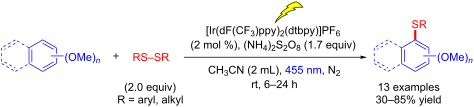
- showed that an aryl disulfide could be cleaved by irradiation with visible light [49]. Some spectroscopic investigations (Figure 3) gave valuable information about the mechanism of the photoredox catalytic cycle. The luminescence intensity of [Ir(dF(CF3)ppy)2(dtbpy)]PF6 was quenched upon successive
- addition of 1,2,4-trimethoxybenzene (oxidation potential 1.02 V vs SCE, Figure 3a). The values are similar to the estimated excited state oxidation potential of [Ir(dF(CF3)ppy)2(dtbpy)]PF6 ( +1.21 V vs SCE in acetonitrile). On the other hand, the luminescence was quenched negligible on addition of diphenyl
- disulfide (Figure 3b). Stern–Volmer quenching studies showed that the arene is quenched at a much higher rate than the disulfide (Figure 3c). This indicates that the oxidation of the arene is the key step in the C–H sulfenylation reaction. Anisole does not quench the luminescence of [Ir(dF(CF3)ppy)2(dtbpy


Synthesis and photophysical studies of a multivalent photoreactive RuII-calix[4]arene complex bearing RGD-containing cyclopentapeptides
Beilstein J. Org. Chem. 2018, 14, 1758–1768, doi:10.3762/bjoc.14.150
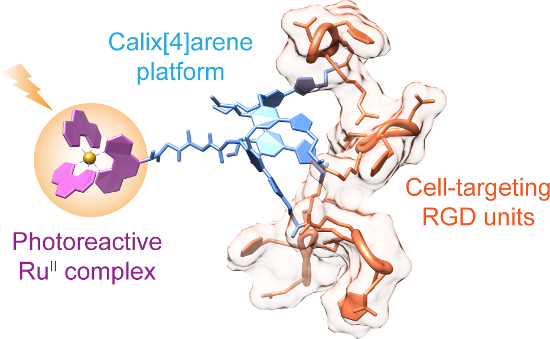
- . Barton et al. demonstrated in 1990 that [Ru(bpy)2(dppz)]2+ behaves as a light-switch for DNA [5]: this complex is not luminescent in water but upon intercalation within the DNA base pairs stack, the complex luminescence is restored. Derivatives of [Ru(bpy)2(dppz)]2+ and complexes bearing similar aromatic
- luminescence lifetime and determined the quantum yield of luminescence under air and argon atmosphere for conjugate 9 and reference [Ru(TAP)2phen]2+ in water with 5% DMSO in order to avoid any formation of aggregates. The data gathered in Table 1 clearly indicate that the tethering of the [Ru(TAP)2phen]2
- cyclic pentapeptide units c-[RGDfK] 8 (see Supporting Information File 1). No modification of the luminescence by intermolecular quenching was observed, confirming the absence of internal quenching in the conjugate 9. Photoreactivity of RuII-calixarene conjugate 9 The photoreactivity of Ru-TAP complexes