


Search results
Search for "1,3-dicarbonyl compounds" in Full Text gives 89 result(s) in Beilstein Journal of Organic Chemistry.
Organocatalytic asymmetric addition of malonates to unsaturated 1,4-diketones
Beilstein J. Org. Chem. 2012, 8, 1452–1457, doi:10.3762/bjoc.8.165
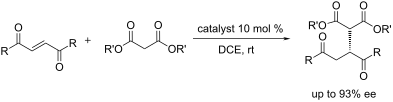
- , the increase in temperature resulted in a small drop in stereoselectivity for the model reaction with catalyst VII. The mechanism of the reaction is believed to be similar to that previously reported for 1,3-dicarbonyl compounds and acyl phosphonates [23]. Squaramide IX is a bifunctional catalyst that


Synthesis of chiral sulfoximine-based thioureas and their application in asymmetric organocatalysis
Beilstein J. Org. Chem. 2012, 8, 1443–1451, doi:10.3762/bjoc.8.164
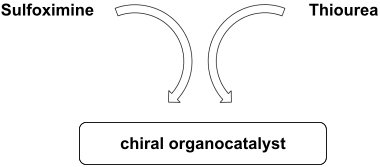
- organic transformations with hydrogen bond accepting substrates. Recently, we reported the enantioselective ring opening of cyclic meso-anhydrides and asymmetric Michael additions of 1,3-dicarbonyl compounds to nitroalkenes with thiourea-based organocatalysts [48][49]. Based on those studies and in the


Synthesis of diverse indole libraries on polystyrene resin – Scope and limitations of an organometallic reaction on solid supports
Beilstein J. Org. Chem. 2012, 8, 1191–1199, doi:10.3762/bjoc.8.132
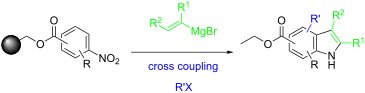
- ], palladium-catalyzed indole synthesis [34][35][36][37][38][39][40], cycloaddition strategies [41], C-arylation of substituted acetonitriles or 1,3-dicarbonyl compounds [42], halocyclization [43][44] and finally, reduction of ortho-fluoro-nitroarenes [42]. The significant biological properties and the


Expanding the chemical diversity of spirooxindoles via alkylative pyridine dearomatization
Beilstein J. Org. Chem. 2012, 8, 986–993, doi:10.3762/bjoc.8.111
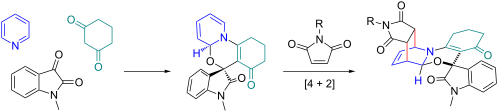
- ]oxazino derivatives from N-substituted isatins and 1,3-dicarbonyl compounds with pyridine derivatives is reported. The reactions provided good to excellent yields. Further exploration of the molecular diversity of these compounds is demonstrated through Diels–Alder reactions. Keywords: chemical diversity
- ; 1,3-dicarbonyl compounds; Diels–Alder reaction; molecular diversity; pyridine dearomatization; spirooxindole; Introduction The spirooxindole is a common structural motif found in a variety of complex alkaloids [1]. Many compounds that possess a spirooxindole moiety exhibit significant biological
- ], we previously reported a Lewis acid catalyzed, three-component synthesis of spirooxindole pyranochromenedione derivatives using isatin and two 1,3-dicarbonyl compounds (Scheme 1) [14]. Mechanistically, we believed this reaction to proceed through an intermediate isatylidene 1 [15][16][17]. As a means




Enantioselective Michael addition of 2-hydroxy-1,4-naphthoquinones to nitroalkenes catalyzed by binaphthyl-derived organocatalysts
Beilstein J. Org. Chem. 2012, 8, 699–704, doi:10.3762/bjoc.8.78
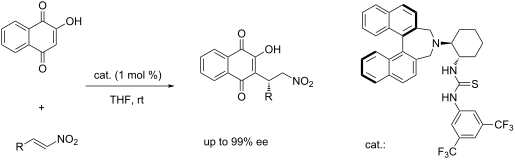
- to the development of asymmetric conjugate additions of 1,3-dicarbonyl compounds to various Michael acceptors [27][28][29][30][31][32][33]. Recently, the groups of Du and Zhou reported a highly enantioselective Michael addition of 2-hydroxy-1,4-naphthoquinones to nitroalkenes catalyzed by chiral


Catalyst-free and solvent-free Michael addition of 1,3-dicarbonyl compounds to nitroalkenes by a grinding method
Beilstein J. Org. Chem. 2012, 8, 534–538, doi:10.3762/bjoc.8.61

- , East China Institute of Technology, Fuzhou, China, 344000; Fax: (+86)794-8258320; Tel:(+86)794-8258320 10.3762/bjoc.8.61 Abstract An environmentally benign, fast and convenient protocol has been developed for the Michael addition of 1,3-dicarbonyl compounds to β-nitroalkenes in good to excellent
- method. Herein, we report a green protocol for the Michael addition of 1,3-dicarbonyl compounds to nitroalkenes under catalyst- and solvent-free conditions (Scheme 1). Utilizing this simple, rapid, low-cost and effective procedure, various nitro diketone derivatives were synthesized in high yields
- were used as the acceptors to react with 1,3-dicarbonyl compounds under the optimized conditions. The results are given in Table 1. It can be seen that a wide range of substrates were able to participate in the reaction. A series of substituted β-nitrostyrenes with electron-withdrawing or electron


Regioselectivity in the multicomponent reaction of 5-aminopyrazoles, cyclic 1,3-diketones and dimethylformamide dimethylacetal under controlled microwave heating
Beilstein J. Org. Chem. 2012, 8, 18–24, doi:10.3762/bjoc.8.3
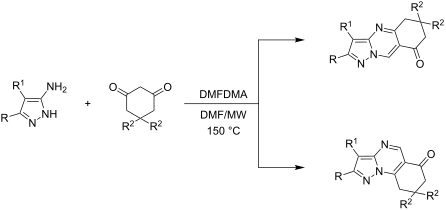
- 50918, Jeddah 21533, Kingdom of Saudi Arabia Chemistry Department, Faculty of Science, Kuwait University, PO Box 5969, Safat, 13060 Kuwait 10.3762/bjoc.8.3 Abstract The multicomponent reaction of 5-aminopyrazole derivatives with cyclic 1,3-dicarbonyl compounds and dimethylformamide dimethylacetal



Efficient synthesis of 1,3-diaryl-4-halo-1H-pyrazoles from 3-arylsydnones and 2-aryl-1,1-dihalo-1-alkenes
Beilstein J. Org. Chem. 2011, 7, 1656–1662, doi:10.3762/bjoc.7.195
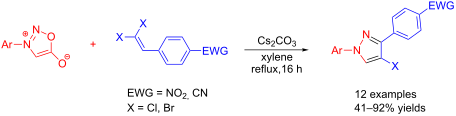
- based on the condensation of hydrazines with 1,3-dicarbonyl compounds or their equivalents. However, the 1,3-dipolar cycloaddition offers a more convenient synthetic route. Sydnones are easily accessible aromatic compounds and versatile synthetic intermediates. They can be used as unusual, alternative


Hypervalent iodine(III)-induced methylene acetoxylation of 3-oxo-N-substituted butanamides
Beilstein J. Org. Chem. 2011, 7, 1436–1440, doi:10.3762/bjoc.7.167

- , the reactions of other N-(alkylsubstituted)-3-oxobutanamides were investigated, such as that of N-methyl-3-oxobutanamide (1l), which led to 1-(methylcarbamoyl)-2-oxopropyl acetate in 89% yield. Furthermore, we applied this method to non-carbamoyl 1,3-dicarbonyl compounds. These substrates, namely 1



Development of the titanium–TADDOLate-catalyzed asymmetric fluorination of β-ketoesters
Beilstein J. Org. Chem. 2011, 7, 1421–1435, doi:10.3762/bjoc.7.166

- ketones in the presence of antimony chloride have appeared [59], while Umemoto used Lewis acids in substoichiometric amounts (0.4 equiv of ZnCl2 or AlCl3) to accelerate fluorinations of 1,3-dicarbonyl compounds with N-fluoropyridinium salts [72]. In 1998, Chambers and Hutchinson reported the reaction of




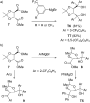


PEG-embedded KBr3: A recyclable catalyst for multicomponent coupling reaction for the efficient synthesis of functionalized piperidines
Beilstein J. Org. Chem. 2011, 7, 1334–1341, doi:10.3762/bjoc.7.157

- that it is more environmentally friendly [4][5][8][9]. Among the various known multicomponent reactions, the MCRs that involve 1,3-dicarbonyl compounds, aldehydes, and nucleophilic compounds have received particular interest in recent years owing to their potential to provide different condensation


Recent advances in the gold-catalyzed additions to C–C multiple bonds
Beilstein J. Org. Chem. 2011, 7, 897–936, doi:10.3762/bjoc.7.103
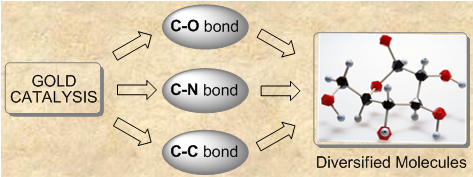
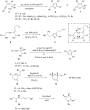
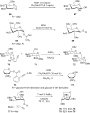
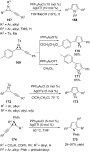
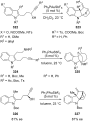
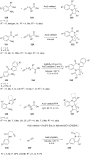
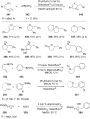
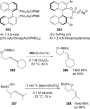
- -arylhydroxylamines with 1,3-dicarbonyl compounds in situ) to give 3-carbonylated benzofuran derivatives 300 [153]. Trisubstituted isoxazoles 303 were obtained from alkynyl oxime ether 301 through a gold-catalyzed domino reaction involving cyclization and subsequent Claisen-type rearrangement [154]. The presence of












One-pot gold-catalyzed synthesis of 3-silylethynyl indoles from unprotected o-alkynylanilines
Beilstein J. Org. Chem. 2011, 7, 565–569, doi:10.3762/bjoc.7.65
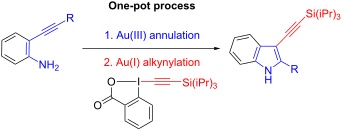
- -alkynylanilines can be followed by 1,4-addition to enones [15][16], iodination [17] or reaction with 1,3-dicarbonyl compounds [18]. Perumal recently demonstrated that aldehydes and nitroalkenes can be used as electrophilic partners [19][20]. Triple bonds can also serve as a second electrophile for the


A review of new developments in the Friedel–Crafts alkylation – From green chemistry to asymmetric catalysis
Beilstein J. Org. Chem. 2010, 6, No. 6, doi:10.3762/bjoc.6.6
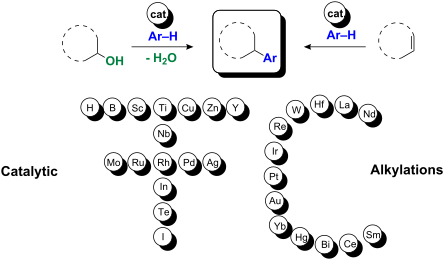
- benzylation of arenes and heteroarenes. A gold(III)-catalyzed route to beclobrate. Catalytic FC-type alkylations of 1,3-dicarbonyl compounds. Iron(III)-catalyzed synthesis of phenprocoumon. Bi(OTf)3-catalyzed FC alkylation of benzyl alcohols developed by Rueping et al. (A) Bi(OTf)3-catalyzed intramolecular FC





