


Search results
Search for "chiral ligands" in Full Text gives 103 result(s) in Beilstein Journal of Organic Chemistry.
Rational design of cyclopropane-based chiral PHOX ligands for intermolecular asymmetric Heck reaction
Beilstein J. Org. Chem. 2014, 10, 1536–1548, doi:10.3762/bjoc.10.158
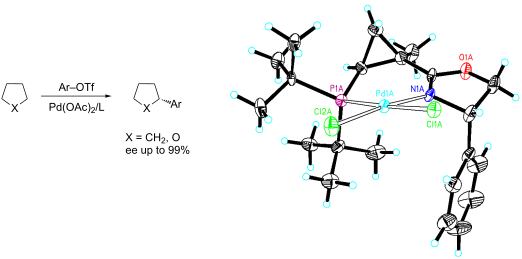
- regio- and enantioselectivities. On the other hand, superior results were obtained using chiral ligands of the P,N-type [15][41][42][43][44]. Particularly, excellent enantioselectivities were achieved using different variations of phosphanyl-oxazoline (PHOX) ligands [45][46][47][48][49][50][51][52
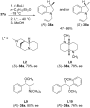
- induction imparted by chiral ligands L1 and L2 (originally published in [64]). For discussion on asymmetric induction imparted by chiral ligands L3 (originally published in [64]). Conformational equilibrium in cationic arylpalladium(II) complexes with chiral ligand L4. For discussion on asymmetric induction
- imparted by chiral ligands L4 (originally published in [64]). Mechanism of migration of C=C double bond leading to isomerization of product 3 into product 4. For discussion on isomerization 3→4 imparted by Pd/L1 complex (originally published in [64]). For discussion on isomerization 3→4 imparted by Pd/L4


Synthesis and stereochemical assignments of diastereomeric Ni(II) complexes of glycine Schiff base with (R)-2-(N-{2-[N-alkyl-N-(1-phenylethyl)amino]acetyl}amino)benzophenone; a case of configurationally stable stereogenic nitrogen
Beilstein J. Org. Chem. 2014, 10, 442–448, doi:10.3762/bjoc.10.41

- Kunijima, Higashi-Yodogawa-ku, Osaka, Japan 533-0024 Department of Organic Chemistry I, Faculty of Chemistry, University of the Basque Country, 20018 San Sebastián, Spain IKERBASQUE, Basque Foundation for Science, 48011 Bilbao, Spain 10.3762/bjoc.10.41 Abstract A family of chiral ligands derived from α
- of the methyl moiety of α-phenylethylamine to the Ni(II). Synthesis of chiral ligands 4a–f. Preparation of diastereomeric Ni(II) complexes 5a–f and 6a–f. Preparation of diastereomeric Ni(II) complexes 5a–f and 6a–f. Supporting Information Supporting Information File 244: Experimental data for


Flow synthesis of phenylserine using threonine aldolase immobilized on Eupergit support
Beilstein J. Org. Chem. 2013, 9, 2168–2179, doi:10.3762/bjoc.9.254
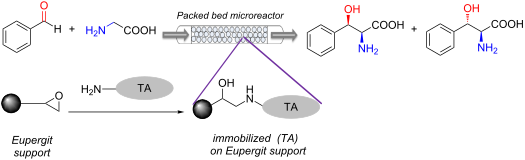
- development of an enzymatic bioreaction and found that the dynamics of a biochemical reaction can be studied in a few seconds [35]. Although many promising routes have been developed for the synthesis of chiral α-amino alcohols, these often depend on the use of toxic and expensive chiral ligands coupled to


Enantioselective synthesis of planar chiral ferrocenes via palladium-catalyzed annulation with diarylethynes
Beilstein J. Org. Chem. 2013, 9, 1891–1896, doi:10.3762/bjoc.9.222

- -Val-OH and Boc-L-Tle-OH were found to be the optimal chiral ligands, providing the desired product in 98% ee (entries 6 and 7, Table 1). Boc-L-Val-OH was chosen as the ligand for further studies because of the higher yield (42% yield) obtained compared with Boc-L-Tle-OH (31% yield). When the


Organocatalyzed enantioselective desymmetrization of aziridines and epoxides
Beilstein J. Org. Chem. 2013, 9, 1677–1695, doi:10.3762/bjoc.9.192
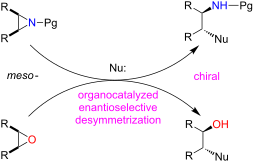
- -aziridines and meso-epoxides by metal-based Lewis acids cooperating with chiral ligands has been well established [16][17][18][19][20][21][22][23][24][25][26][27][28]. However, the enantioselective desymmetrization of meso-aziridines and meso-epoxides catalyzed by small chiral organic molecules has only








A versatile and efficient approach for the synthesis of chiral 1,3-nitroamines and 1,3-diamines via conjugate addition to new (S,E)-γ-aminated nitroalkenes derived from L-α-amino acids
Beilstein J. Org. Chem. 2013, 9, 832–837, doi:10.3762/bjoc.9.95

- enantioselective synthesis as chiral auxiliaries, chiral catalysts, chiral reagents and chiral ligands [59][60]. In our continuing interest in synthesizing new chiral nonracemic nitro compounds [61][62][63][64][65][66][67][68] by a "chiron" approach [45], we intended to develop a route for obtaining γ-nitrogenated


Inter- and intramolecular enantioselective carbolithiation reactions
Beilstein J. Org. Chem. 2013, 9, 313–322, doi:10.3762/bjoc.9.36

- chiral ligands for lithium, thus opening new opportunities for their application in asymmetric synthesis. The naturally occurring alkaloid (−)-sparteine, which has been until recently inexpensive and commercially available, is the most widely used chiral ligand in enantioselective carbolithiation
- electrophiles to give enantioenriched chiral allenes. By high-resolution control of the residence time, the epimerization of a configurationally unstable chiral organolithium intermediate 23 could be suppressed. Using this method, n-butyllithium reacts with enynes 22 in the presence of chiral ligands, and the
- the success achieved in the procedures described above, stoichiometric use of chiral ligands is usually required. However, recently a general catalytic methodology for the enantioselective intermolecular addition of alkyllithiums has been reported, though it implies transmetalation to copper complexes





Rh(III)-catalyzed directed C–H bond amidation of ferrocenes with isocyanates
Beilstein J. Org. Chem. 2012, 8, 1844–1848, doi:10.3762/bjoc.8.212
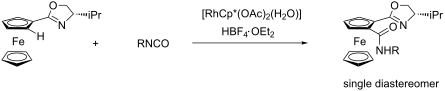
- ; ferrocene; rhodium; Introduction Ferrocene and its derivatives are among the most useful organometallic compounds because of their chemical and thermal stabilities, structures, and redox activity [1][2]. One of the most remarkable applications of ferrocene derivatives is as chiral ligands [3][4]. A variety


Palladium-catalyzed dual C–H or N–H functionalization of unfunctionalized indole derivatives with alkenes and arenes
Beilstein J. Org. Chem. 2012, 8, 1730–1746, doi:10.3762/bjoc.8.198
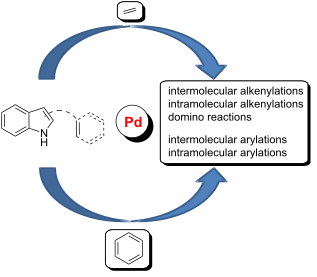
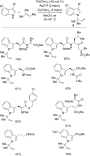
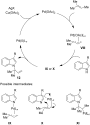
- elimination. Palladium–pyridine systems were subsequently investigated with chiral ligands to catalyze enantioselective processes involving alkenylindoles. Several enantioselective indole annulations with formation of a stereogenic quaternary carbon atom were performed by using chiral oxazoline ligands with




Synthesis of chiral sulfoximine-based thioureas and their application in asymmetric organocatalysis
Beilstein J. Org. Chem. 2012, 8, 1443–1451, doi:10.3762/bjoc.8.164
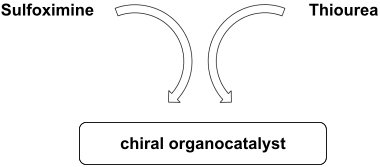
- diastereoselective transformations or as chiral ligands in enantioselective metal catalysis [25][26][27][28][29][30][31][32][33]. With respect to the latter field we have recently demonstrated that various ligands bearing a sulfonimidoyl moiety lead to excellent stereoselectivities in transition metal-catalyzed


Low-generation dendrimers with a calixarene core and based on a chiral C2-symmetric pyrrolidine as iminosugar mimics
Beilstein J. Org. Chem. 2012, 8, 951–957, doi:10.3762/bjoc.8.107
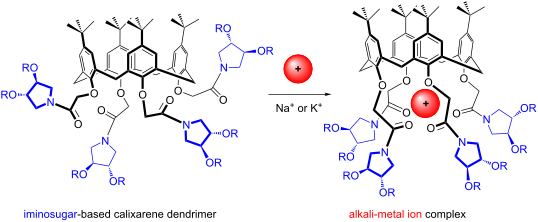
- metal-ion effect on the organisation of iminosugars and on the rigidification of the calixarene scaffold, but also to exploit the ability of these chiral ligands to enantioselectively recognise chiral salts [37] or the ability of their transition-metal complexes to catalyse enantioselective syntheses


Synthesis of axially chiral oxazoline–carbene ligands with an N-naphthyl framework and a study of their coordination with AuCl·SMe2
Beilstein J. Org. Chem. 2012, 8, 726–731, doi:10.3762/bjoc.8.81
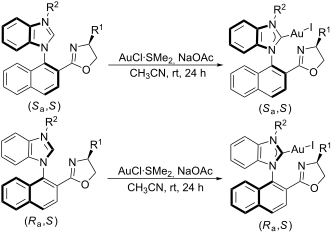
- Synthesis of axially chiral ligands Initially, we attempted to synthesize the desired axially chiral ligands 7, and the synthetic route is shown in Scheme 1. Using methyl 1-hydroxy-2-naphthoate (9) as the starting material, trifluoromethylation with Tf2O in the presence of pyridine afforded its



Carbamate-directed benzylic lithiation for the diastereo- and enantioselective synthesis of diaryl ether atropisomers
Beilstein J. Org. Chem. 2011, 7, 1327–1333, doi:10.3762/bjoc.7.156
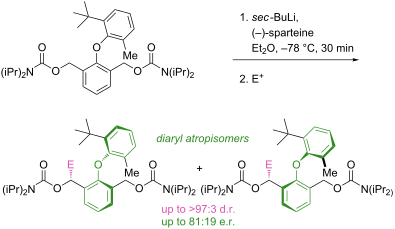
- stereochemical course of the lithiation–substitution reactions have been elucidated, and further work remains to exploit this transformation for the potential synthesis of new classes of chiral ligands [12]. Desymmetrising metallation for the enantioselective synthesis of atropisomers. Benzylic lithiation of a



Directed ortho,ortho'-dimetalation of hydrobenzoin: Rapid access to hydrobenzoin derivatives useful for asymmetric synthesis
Beilstein J. Org. Chem. 2011, 7, 1315–1322, doi:10.3762/bjoc.7.154
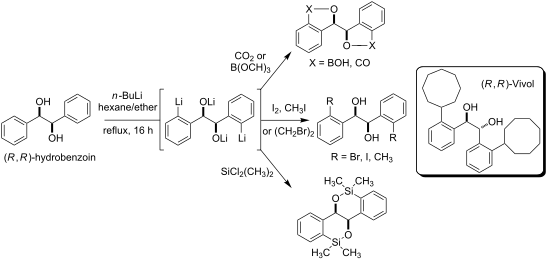
- The discovery of new chiral ligands and auxiliaries continues to expand the frontiers of catalytic asymmetric synthesis. In particular, C2-symmetric diols, such as (S)-BINOL (1) [1] and (−)-TADDOL (2) [2] (Figure 1), have garnered considerable attention owing to the wide variety of asymmetric


Bromine–lithium exchange: An efficient tool in the modular construction of biaryl ligands
Beilstein J. Org. Chem. 2011, 7, 1278–1287, doi:10.3762/bjoc.7.148
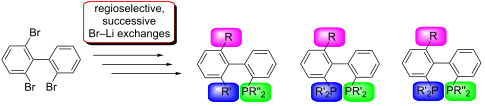
- diphosphine ligands BINAP [3], H8-BINAP [4], BIPHEMP [5], MeO-BIPHEP [6], SEGPHOS [7][8][9], P-Phos [10], SYNPHOS [11][12], Cn-TUNAPHOS [13] and DIFLUORPHOS [14][15][16] and their analogues are well known as highly efficient chiral ligands for a variety of transition metal-catalyzed asymmetric transformations


Recent advances in the gold-catalyzed additions to C–C multiple bonds
Beilstein J. Org. Chem. 2011, 7, 897–936, doi:10.3762/bjoc.7.103
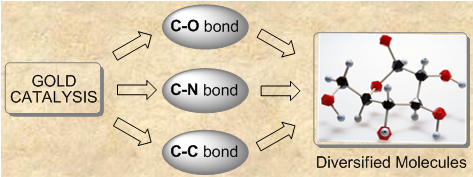
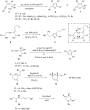
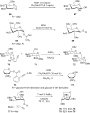
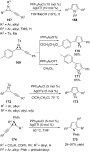
- range of chiral gold catalysts (or gold combined with chiral ligands) has been developed and screened. However, only limited success has been achieved. The most notable example is the chiral BIPHEP-based catalyst, which has been successfully employed in several asymmetric cycloadditions. Several early
- reactions do not feature often. More recently this situation has been changing with significant progress being made in this area. To date, a broad range of chiral catalysts have been developed. Despite the large amount of chiral ligands used, only a few provided good to high enantioselectivities. The best








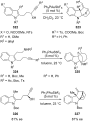
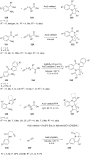
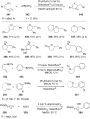


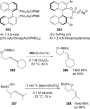


When gold can do what iodine cannot do: A critical comparison
Beilstein J. Org. Chem. 2011, 7, 847–859, doi:10.3762/bjoc.7.97
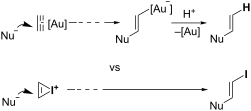
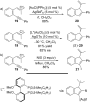
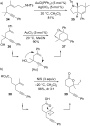
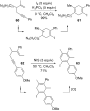
- cyclization which, after loss of a proton and protodemetallation, afforded the product in 88% yield. The reaction can also be made to proceed enantioselectively by means of a gold complex with chiral ligands. The ligand (S)-3,5-xylyl-MeO-biphep (L*) gave the best results with respect to enantioselectivity








Asymmetric synthesis of tertiary thiols and thioethers
Beilstein J. Org. Chem. 2011, 7, 582–595, doi:10.3762/bjoc.7.68

- )-thiolactomycin (66) in >99:1 er. 2.2 Electrophilic attack on α-thioorganolithiums Formation of carbon–carbon bonds adjacent to heteroatoms by deprotonation with an organolithium base and subsequent reaction with an electrophile has become an important and versatile method, especially when chiral ligands may be








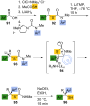
Synthesis of chiral mono(N-heterocyclic carbene) palladium and gold complexes with a 1,1'-biphenyl scaffold and their applications in catalysis
Beilstein J. Org. Chem. 2011, 7, 555–564, doi:10.3762/bjoc.7.64
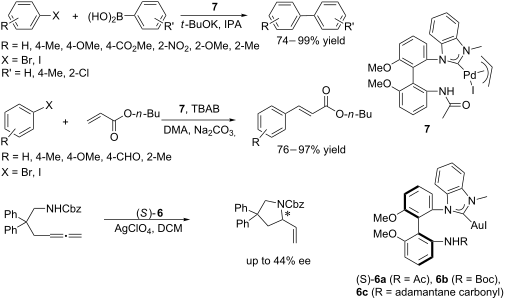
- catalysts in chiral induction reactions [19][20][21][22][23][24][25]. The axially chiral biaryl framework, widely used in the design of chiral ligands such as BINAP [26][27], BINOL [28][29], and boxax [30], has proved to be very rigid, and was introduced in the development of NHC ligands by the Hoveyda


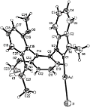


Concise methods for the synthesis of chiral polyoxazolines and their application in asymmetric hydrosilylation
Beilstein J. Org. Chem. 2010, 6, No. 29, doi:10.3762/bjoc.6.29

- concomitant removal of water or the alcohol produced in the reaction. The method is much simpler and more efficient in comparison to those methods reported in the literature. The compounds were used as chiral ligands in the rhodium-catalyzed asymmetric hydrosilylation of aromatic ketones, and the effects of
- prochiral ketones. In particular, asymmetric catalysis provides organic chemists with a unique tool for their efficient synthesis [23], although none of these are, as yet, optimal [24][25][26]. In recent years, metal-catalyzed hydrosilylation of ketones has been investigated using chiral ligands [27][28][29
- –7) are described, which are much simpler and more efficient in comparison to those reported in the literature. With these chiral ligands as templates, the rhodium-catalyzed asymmetric hydrosilylation of aromatic ketones was carried out. The effects of the linkers of oxazoline rings and the


Bis(oxazolines) based on glycopyranosides – steric, configurational and conformational influences on stereoselectivity
Beilstein J. Org. Chem. 2010, 6, No. 23, doi:10.3762/bjoc.6.23
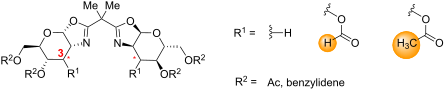
- revealed strong steric and configurational effects of position 3 on asymmetric induction, further dramatic effects of the pyranose conformation were also observed. Keywords: asymmetric synthesis; carbohydrates; copper; cyclopropanation; ligand design; Introduction The design and optimisation of chiral
- ligands for metal catalysed transformations is of crucial importance for stereoselective synthesis and is therefore an active field of research. In this context, carbohydrates are interesting, even if comparatively rarely used as starting materials for the preparation of new chiral ligand structures


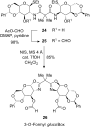

Iridium-catalyzed asymmetric ring-opening reactions of oxabicyclic alkenes with secondary amine nucleophiles
Beilstein J. Org. Chem. 2009, 5, No. 53, doi:10.3762/bjoc.5.53

- obtained only in low yield (47%) with reasonable enantioselectivity (51% ee) in the iridium-catalyzed system. This suggested that (R,S)-PPF-PtBu2 was not an ideal ligand in iridium-catalyzed reactions, which prompted us to screen other ligands. Among the several chiral ligands we had tested, (S)-BINAP and


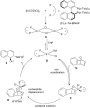
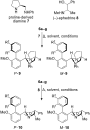
Asymmetric synthesis of biaryl atropisomers by dynamic resolution on condensation of biaryl aldehydes with (−)-ephedrine or a proline- derived diamine
Beilstein J. Org. Chem. 2008, 4, No. 47, doi:10.3762/bjoc.4.47

- the most successful of all chiral ligands for metal-catalysed asymmetric transformations [1][2]. Many biaryl ligands have been obtained in enantiomerically pure form by means of resolution [3], but there are also a number of important enantioselective methods for the synthesis of biaryls [4][5][6][7




Control of asymmetric biaryl conformations with terpenol moieties: Syntheses, structures and energetics of new enantiopure C2- symmetric diols
Beilstein J. Org. Chem. 2008, 4, No. 25, doi:10.3762/bjoc.4.25
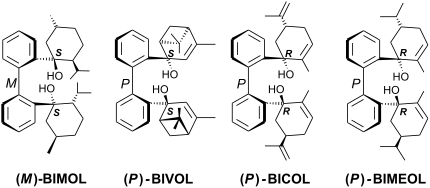
- ] are often employed as chiral ligands in enantioselective synthesis. We recently reported the synthesis and the X-ray crystal structure of (M)-BIFOL [7] (biphenyl-2,2′-bisfenchol, Scheme 1) and its derivatives [8][9][10][11]. (M)-BIFOL exhibits, in a similar way as BINOLs, a flexible biaryl axis with M


DBFOX- Ph/metal complexes: Evaluation as catalysts for enantioselective fluorination of 3-(2-arylacetyl)-2-thiazolidinones
Beilstein J. Org. Chem. 2008, 4, No. 16, doi:10.3762/bjoc.4.16
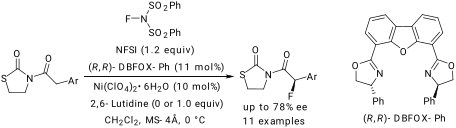
- ][59][60][61][62][63][64] procedures for enantioselective fluorination are major advances in recent years. The discovery that chiral ligands/metals can catalyze electrophilic fluorination with conventional fluorinating reagents has had a large impact on synthetic organic chemistry, because of the





