


Search results
Search for "diphosphate" in Full Text gives 91 result(s) in Beilstein Journal of Organic Chemistry.
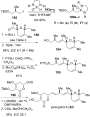
Towards inhibitors of glycosyltransferases: A novel approach to the synthesis of 3-acetamido-3-deoxy-D-psicofuranose derivatives
Beilstein J. Org. Chem. 2015, 11, 1547–1552, doi:10.3762/bjoc.11.170

- diphosphate)] acts as the donor of the GlcNAc residue while a hydroxy group situated at a specific site of the growing oligosaccharide chain serves as the acceptor [9]. The target-directed search for effective GnTs inhibitors based on the rational design of model compounds remains a difficult task due to the


A procedure for the preparation and isolation of nucleoside-5’-diphosphates
Beilstein J. Org. Chem. 2015, 11, 469–472, doi:10.3762/bjoc.11.52
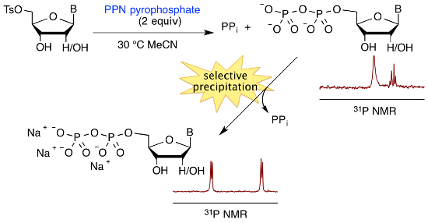
- synthesis; nucleic acids; nucleoside-5’-diphosphate; phosphorylation; Introduction Nucleoside-5'-phosphates are key to many mechanistic studies and chemical biology applications [1][2][3]. Synthetic approaches towards nucleoside-5'-phosphates are well-established [4], however, the methods tend to be
- problems [4][19]. In addition, excess pyrophosphate is usually employed in order to drive the kinetics of the displacement process, however, this excess material tends to co-elute with nucleoside-5’-diphosphate products during anion exchange chromatographic purifications. We have recently reported the
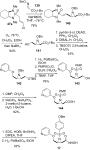
- 3, Table 1). Protected substrate 3 showed conversion to diphosphate 4 after 91 h of reaction, however, we were unable to precipitate this material after removal of excess pyrophosphate ions (Scheme 4). We believe the isopropylidene protecting group decreases the polarity of diphosphate 4 to such an


Aspergiloid I, an unprecedented spirolactone norditerpenoid from the plant-derived endophytic fungus Aspergillus sp. YXf3
Beilstein J. Org. Chem. 2014, 10, 2677–2682, doi:10.3762/bjoc.10.282
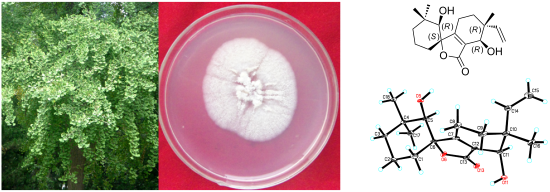
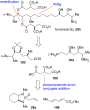
- . Here the hypothetical pimarane compound 2, the hemiketal lactone ring-opening product of aspergiloid E, was proposed as the most probable biosynthetic intermediate. As shown in Scheme 1, we suggest the biosynthesis of 1 starts from the classical diterpene precursor geranylgeranyl diphosphate [14], and


Gold(I)-catalysed synthesis of a furan analogue of thiamine pyrophosphate
Beilstein J. Org. Chem. 2014, 10, 2580–2585, doi:10.3762/bjoc.10.270
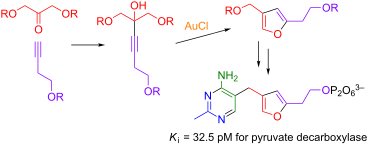
- , involving gold(I)-catalysed cyclisation of an alkynyl alcohol to form the furan ring. The furan analogue of thiamine diphosphate (ThDP) was also made and tested for binding to and inhibition of pyruvate decarboxylase (PDC) from Zymomonas mobilis (overexpressed in E. coli with a N-terminal His-tag). It is a
- ; pyruvate decarboxylase; thiamine diphosphate; Introduction The biologically active form of vitamin B1 is thiamine diphosphate (ThDP, 1, Figure 1), which is an essential cofactor and involved in a number of metabolic pathways, including oxidative and non-oxidative decarboxylation of α-keto acids (e.g
- synthesis of a furan-based analogue of thiamine. This analogue was converted to its diphosphate, which is another extremely potent inhibitor of ZmPDC, and could also be functionalised at the 2-position using a Friedel–Crafts acylation. Results and Discussion Synthesis of ThDP analogue 17 The key step in our


Organophosphorus chemistry
Beilstein J. Org. Chem. 2014, 10, 2087–2088, doi:10.3762/bjoc.10.217
- phosphanylidenecarbenes and phosphoryl azides, and bisphosphonate ethers as promising inhibitors of geranylgeranyl diphosphate synthase (GGDPS). The articles and reviews capture the emerging potential of organophosphorus compounds and exciting opportunities in the field, and hopefully, will inspire and motivate
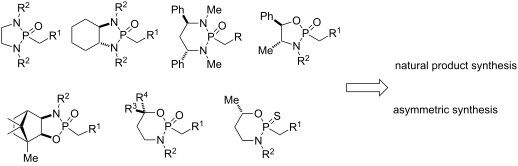
Application of cyclic phosphonamide reagents in the total synthesis of natural products and biologically active molecules
Beilstein J. Org. Chem. 2014, 10, 1848–1877, doi:10.3762/bjoc.10.195
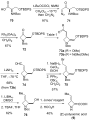
- inhibitor (1996) Inhibitors of squalene synthase have sparked interest as selective cholesterol lowering agents [76][77]. The enzyme is involved in the first committed step in the cholesterol synthesis and catalyses the conversion of two molecules of farnesyl diphosphate into squalene, which is later






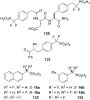






Synthesis of isoprenoid bisphosphonate ethers through C–P bond formations: Potential inhibitors of geranylgeranyl diphosphate synthase
Beilstein J. Org. Chem. 2014, 10, 1645–1650, doi:10.3762/bjoc.10.171

- enzyme geranylgeranyl diphosphate synthase (GGDPS). Five of the new compounds show IC50 values of less than 1 μM against GGDPS with little to no activity against the related enzyme farnesyl diphosphate synthase (FDPS). The most active compound displayed an IC50 value of 82 nM when assayed with GGDPS, and
- CoA reductase (HMGCoA) is viewed as the first committed step of isoprenoid and steroid biosynthesis, and is the target of the statin class of cholesterol-lowering agents including lovastatin (1, Figure 1) and pravastatin (2) [1]. The downstream enzyme farnesyl diphosphate synthase (FDPS) is the target
- other enzymes in these pathways also may have value as drug targets. One of our interests in isoprenoid biosynthesis has been the enzyme geranylgeranyl diphosphate synthase (GGDPS), which mediates the reaction of the C15 compound farnesyl diphosphate (FPP) with the C5 isopentenyl diphosphate to form the


[2H26]-1-epi-Cubenol, a completely deuterated natural product from Streptomyces griseus
Beilstein J. Org. Chem. 2013, 9, 2841–2845, doi:10.3762/bjoc.9.319
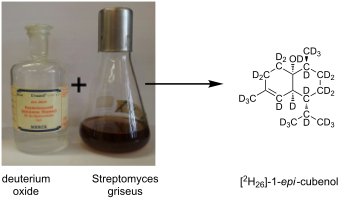
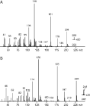
- observed on DMM (Figure 2). This demonstrated that all relevant terpene biosynthetic pathways including the deoxyxylulose phosphate pathway for the biosynthesis of the terpene monomers dimethylallyl diphosphate (DMAPP) and isopentenyl diphosphate (IPP) as well as polyisoprenoid biosynthesis for the linear
- precursors geranyl diphosphate (GPP) and farnesyl diphosphate (FPP) were active. However, the volatile 2 was found only in traces, while the production of 1 was completely abolished. Reasons for these findings may be that the production of 2 is under positive control of the bacterial hormone A-factor [1



Biosynthesis of rare hexoses using microorganisms and related enzymes
Beilstein J. Org. Chem. 2013, 9, 2434–2445, doi:10.3762/bjoc.9.281
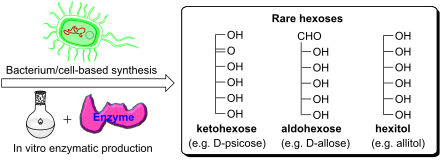
- engineered Corynebacterium glutamicum was used to produce guanosine-5’-diphosphate (GDP)-L-fucose, the precursor of fucosyl-oligosaccharides, from glucose and mannose [95]. L-Fucose (or its analogs) can also be prepared in vitro enzymatically in a three-step procedure (Scheme 16) [96]. Firstly, L-fuculose-1


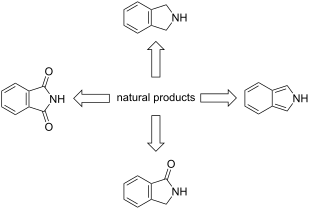
The chemistry of isoindole natural products
Beilstein J. Org. Chem. 2013, 9, 2048–2078, doi:10.3762/bjoc.9.243
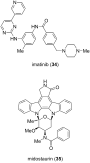
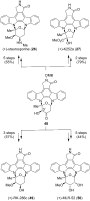
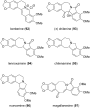
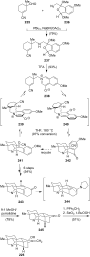
- putative biosynthetic pathway for the formation of the hetisine alkaloids is derived from phytochemical data and basic biochemical transformations (Scheme 30) [167]. Cyclization of geranylgeranyl pyrophosphate (229), involving the ent-copalyl diphosphate synthase, could give ent-copalyl diphosphate (230













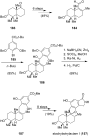
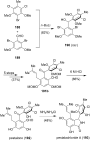

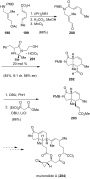
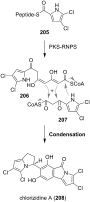


Caryolene-forming carbocation rearrangements
Beilstein J. Org. Chem. 2013, 9, 323–331, doi:10.3762/bjoc.9.37
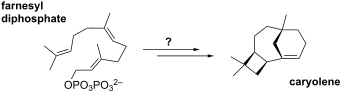
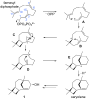
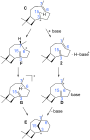
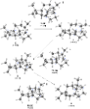
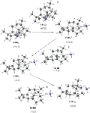
- positioned on opposite sides of the hydrocarbon substrate due to the steric congestion at its core (note the position of NH3 throughout Figure 7), a scenario that could be probed by deuterium labeling of farnesyl diphosphate if a suitable caryolene synthase were isolated. The energetics for both pathways
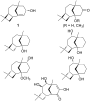
- (caryol-1(11)-en-10-ol, 1) formation. Atom numbers for farnesyl diphosphate are shown. These are used in the mechanistic discussions herein; note that this numbering system differs from that generally used for caryolene and caryolenol. Alternative mechanisms for caryolene formation. Supporting





Studies on the substrate specificity of a GDP-mannose pyrophosphorylase from Salmonella enterica
Beilstein J. Org. Chem. 2012, 8, 1219–1226, doi:10.3762/bjoc.8.136

- their ability to be converted into the corresponding guanosine diphosphate mannopyranose (GDP-Manp) analogues by a pyrophosphorylase (GDP-ManPP) from Salmonella enterica was studied. Evaluation of methoxy analogues demonstrated that GDP-ManPP is intolerant of bulky substituents at the C-2, C-3, and C-4


Mutational analysis of a phenazine biosynthetic gene cluster in Streptomyces anulatus 9663
Beilstein J. Org. Chem. 2012, 8, 501–513, doi:10.3762/bjoc.8.57
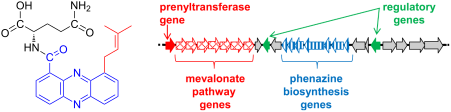
- prenyltransferase gene ppzP and, downstream thereof, the genes of the mevalonate pathway for supply of the isoprenoid precursor dimethylallyl diphosphate (DMAPP). Upstream of ppzP, four genes, orf1-orf4, could be identified. Database comparisons by using BLAST and Pfam searches gave no obvious clues as to whether


Natural product biosyntheses in cyanobacteria: A treasure trove of unique enzymes
Beilstein J. Org. Chem. 2011, 7, 1622–1635, doi:10.3762/bjoc.7.191
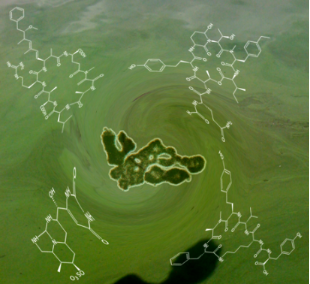
- to be generated by the putative prephenate dehydrogenase NpR1269. Both substrates are then further transformed by the thiamin diphosphate (ThDP)-dependent enzyme NpR1276 to isomeric acyloins representing one-half of the carbon framework of scytonemin [71]. The enzyme showed a remarkable selectivity


Bioorthogonal metabolic glycoengineering of human larynx carcinoma (HEp-2) cells targeting sialic acid
Beilstein J. Org. Chem. 2010, 6, No. 24, doi:10.3762/bjoc.6.24
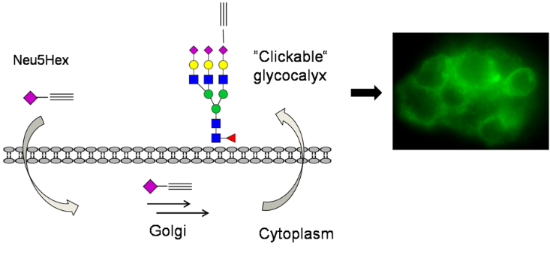
- and the genetic control of Neu5Ac 1 synthesis by feedback inhibition. The accumulation of Neu5Hex 3 is proposed by incubation of 3 with the target cell line as the synthesis of Neu5Ac 1 is down-regulated [11][13]. UDP: uridine diphosphate; GNE: UDP-N-acetylglucosamine 2-epimerase/N-acetylmannosamine




Investigation of acetyl migrations in furanosides
Beilstein J. Org. Chem. 2006, 2, No. 14, doi:10.1186/1860-5397-2-14
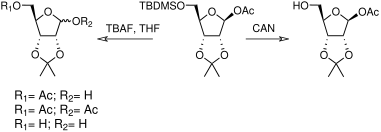
- proposed to involve the formation of an orthoester intermediate[7] between adjacent or remote alcohol and ester groups.[8] We aim to prepare analogues of 1''-O-acetyl adenosine diphosphate ribose (AcO-ADPR) incorporating modified acetylated ribosides, xylosides and arabinosides in place of the ribose





