


Search results
Search for "monitoring" in Full Text gives 396 result(s) in Beilstein Journal of Organic Chemistry. Showing first 200.
Microelectrode arrays, electrosynthesis, and the optimization of signaling on an inert, stable surface
Beilstein J. Org. Chem. 2022, 18, 1488–1498, doi:10.3762/bjoc.18.156
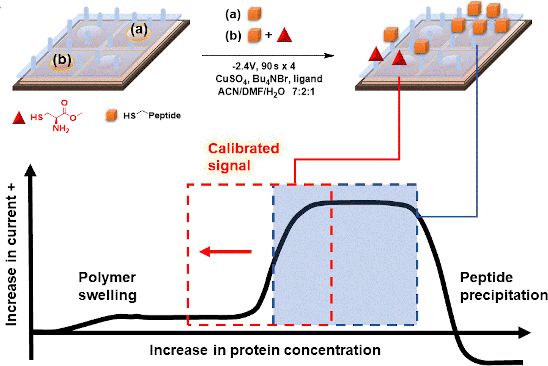
- Kendra Drayton-White Siyue Liu Yu-Chia Chang Sakashi Uppal Kevin D. Moeller Washington University in Saint Louis, Saint Louis, Missouri 63130, United States 10.3762/bjoc.18.156 Abstract Microelectrode arrays are powerful tools for monitoring binding interactions between small molecules and
- ; microelectrode array; Introduction Microelectrode arrays composed of collections of electrodes that can each be individually addressed are powerful platforms for monitoring interactions between a protein target and small molecules [1][2][3][4][5][6][7][8]. In these efforts, molecules are either placed or
- functionalized electrode into a solution containing a redox mediator and then monitoring the current associated with a redox mediator. The method is different relevant to the traditional methods lacking the polymer surface in that the current is dependent on changes to the polymer coating; a situation that can


Synthesis of C6-modified mannose 1-phosphates and evaluation of derived sugar nucleotides against GDP-mannose dehydrogenase
Beilstein J. Org. Chem. 2022, 18, 1379–1384, doi:10.3762/bjoc.18.142
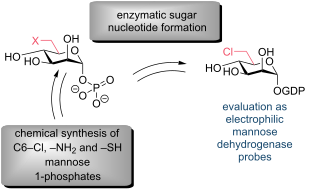
- -phosphates 13, 17, and 18 were individually incubated with GDP-Man PP at 37 °C (Scheme 2) and the reactions monitored by TLC (iPrOH/NH4OH/H2O 6:3:1). Monitoring of analytical scale reactions showed an indicative conversion for substrate 17 after 16 h; no conversion was observed after this time for 13 or 18


Ferrocenoyl-adenines: substituent effects on regioselective acylation
Beilstein J. Org. Chem. 2022, 18, 1270–1277, doi:10.3762/bjoc.18.133
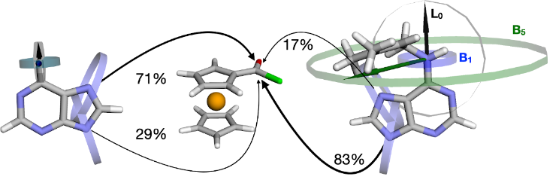
- )B3LYP/6-31+G(d) method.a Supporting Information Supporting Information File 234: Details on experimental procedures, DFT calculated energies and optimized coordinates for transition state structures and reactants, and the results of in situ 1H NMR monitoring. Acknowledgements All calculations were



Polymer and small molecule mechanochemistry: closer than ever
Beilstein J. Org. Chem. 2022, 18, 1225–1235, doi:10.3762/bjoc.18.128
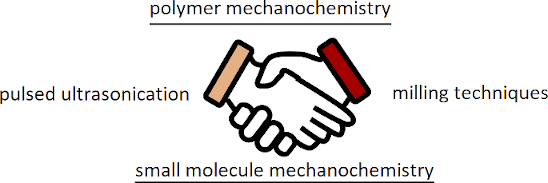
- backbone, ultimately reaching and activating the mechanophores within it (Figure 1a). The technical simplicity of the method and the compatibility with spectroscopic analytical techniques for monitoring [22] have made sonication of polymer solutions the primary method in the field of polymer


Heterogeneous metallaphotoredox catalysis in a continuous-flow packed-bed reactor
Beilstein J. Org. Chem. 2022, 18, 1123–1130, doi:10.3762/bjoc.18.115
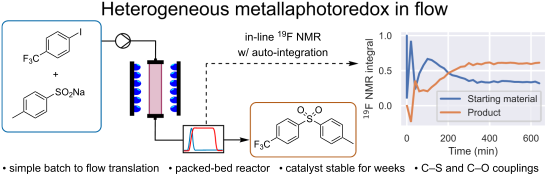
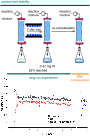
- uniformity and activity, while partially homogeneous systems would need downstream separations. We used in-line reaction monitoring to study several process parameters, such as time, temperature and the photon flux, to maximize the throughput and evaluate the long-term stability of this catalytic approach
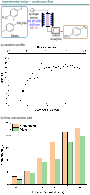
- enabled straightforward reaction monitoring via 19F NMR. To this end, a 1 T benchtop NMR equipped with a flow cell was connected to the reactor outlet and used to acquire a series of spectra. In particular, a series of 128 repetitions with a 90° pulse width and a relatively long repetition time of 5.2 s
- , because of the low flow rate some delay is also due to dead volume between the reactor and the NMR spectrometer used for reaction monitoring. For example, the NMR flow cell volume, about 1 mL, is alone responsible for 100 minutes of delay. (b) Time conversion plot, almost full conversion is observed after





New azodyrecins identified by a genome mining-directed reactivity-based screening
Beilstein J. Org. Chem. 2022, 18, 1017–1025, doi:10.3762/bjoc.18.102
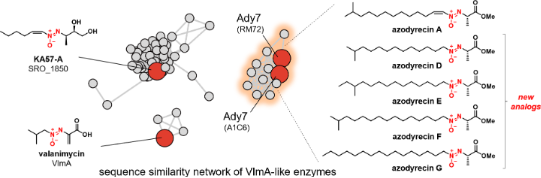
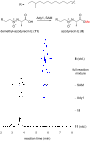
- N2H4, which could be generated upon the acid hydrolysis of azoxy natural products. In the assay, N2H4 is captured by two equivalents of p-dimethylaminobenzaldehyde (DAB) to generate p-dimethylaminobenzaldazine, which can be sensitively detected by HPLC by monitoring the UV absorption at 485 nm (Scheme




Mechanochemical halogenation of unsymmetrically substituted azobenzenes
Beilstein J. Org. Chem. 2022, 18, 680–687, doi:10.3762/bjoc.18.69
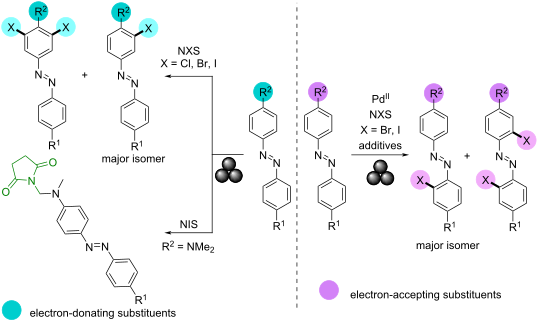
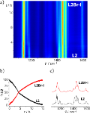
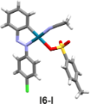
- -bromosuccinimide (NBS) under neat grinding (NG) and liquid-assisted grinding (LAG) conditions in a ball mill [51]. Insight into the dynamics of the formation of reaction intermediates and products was obtained by in situ Raman monitoring that provided information on the nature of the catalytically active PdII
- species, cyclopalladated intermediates, and products (Figure 1). The monitoring results confirmed the crucial role of TsOH and acetonitrile (MeCN) as additives in the catalytic bromination of the C–H bond in L1. The experimental results were supported by quantum-chemical calculations, which showed that
- azobenzene with NXS and Pd(OAc)2 as precatalyst in the presence of TsOH and MeCN as solid and liquid additives, respectively, led to the ortho-halogenated products relative to the azo group of the azobenzenes. In situ Raman monitoring of these reactions confirmed that the most favorable reaction pathway is





A study of the photochemical behavior of terarylenes containing allomaltol and pyrazole fragments
Beilstein J. Org. Chem. 2022, 18, 588–596, doi:10.3762/bjoc.18.61
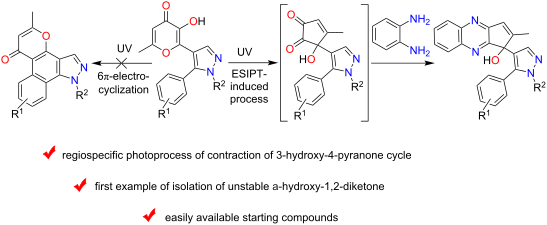
- ). The phototransformation of compound 12a was studied using NMR monitoring. UV irradiation was carried out at a wavelength of 365 nm in a solution of DMSO-d6 (Figure 1). It should be noted that after UV irradiation for 8 h of the studied sample the NMR spectrum contained signals of protons of the
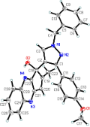
- synthesized products were confirmed by X-ray diffraction. 1H NMR monitoring of the photoreaction of compound 12a under UV irradiation (365 nm) in DMSO-d6 solution. The X-ray crystal structure of compound 15a. The X-ray crystal structure of compound 15m. The X-ray crystal structure of compound 18





Borylated norbornadiene derivatives: Synthesis and application in Pd-catalyzed Suzuki–Miyaura coupling reactions
Beilstein J. Org. Chem. 2022, 18, 368–373, doi:10.3762/bjoc.18.41
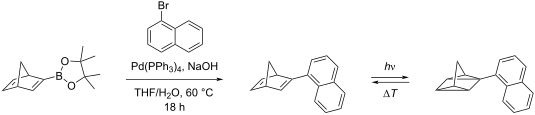
- overlap of its absorption with the one of the norbornadiene. However, upon heating to 60 °C in MeCN solution the norbornadiene was regained after 25 h, as shown by photometric monitoring of the reaction (Scheme 3 and Figure 1, inset). These photochemical properties are comparable to the ones of literature
- synthesis of monoaryl-substituted norbornadiene derivatives is possible in a highly modular approach. Considering the paucity of such derivatives in this field, this synthetic route may pave the way for a new series of promising norbornadiene-based MOST materials. Photometric monitoring of the


A resorcin[4]arene hexameric capsule as a supramolecular catalyst in elimination and isomerization reactions
Beilstein J. Org. Chem. 2022, 18, 337–349, doi:10.3762/bjoc.18.38
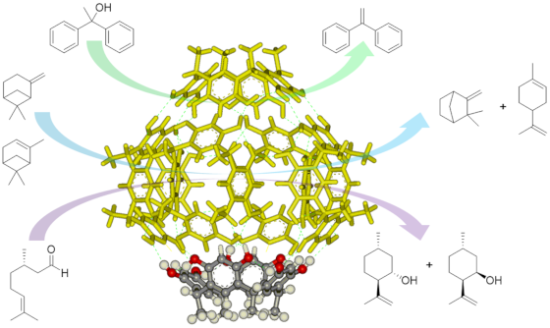
- subsequent water elimination leading to a stable tertiary, bis-benzyl carbocation that evolves forming the corresponding alkene by proton elimination (Scheme 3). The reaction was carried out at 60 °C with 10 mol % of 16 (Table 2, entry 1), monitoring the formation of the products by 1H NMR and GC–MS (see


Multi-faceted reactivity of N-fluorobenzenesulfonimide (NFSI) under mechanochemical conditions: fluorination, fluorodemethylation, sulfonylation, and amidation reactions
Beilstein J. Org. Chem. 2022, 18, 182–189, doi:10.3762/bjoc.18.20
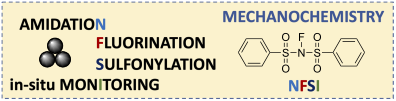
- solution, the mechanochemical reactions were accomplished in the absence of solvents, in short reaction times, and in yields comparable to or higher than their solvent-based counterparts. Keywords: amidation; ball mill; fluorination; in situ monitoring; mechanochemistry; NFSI; Raman monitoring
- sustainable point of view, experimenting in small scale could prevent waste production and increase safety. However, miniaturization of mechanochemical reactions could also be an alternative to working with precious or expensive reagents and to facilitate monitoring of the reactions [27]. Under such reaction
- performed in situ reaction monitoring of the milling process by Raman spectroscopy [32][33]. In an experiment milling 1c with NFSI (1 equiv) we observed the consumption of NFSI after ca. 30 min of milling as evidenced by a reduction in the intensity of the band at 1197 cm−1 of NFSI (Figure S3 in Supporting


Tenacibactins K–M, cytotoxic siderophores from a coral-associated gliding bacterium of the genus Tenacibaculum
Beilstein J. Org. Chem. 2022, 18, 110–119, doi:10.3762/bjoc.18.12
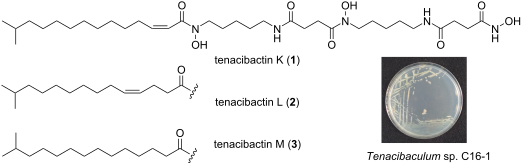
- reaction monitoring (MRM) mode with the parameter setting “isCID = 0” and “Collision = 45”. An Agilent HP1200 HPLC system equipped with a diode array detector was used for analysis and purification. The absorbance of microtitre plate wells was read on a Thermo Scientific Multiskan Sky microplate reader


The enzyme mechanism of patchoulol synthase
Beilstein J. Org. Chem. 2022, 18, 13–24, doi:10.3762/bjoc.18.2
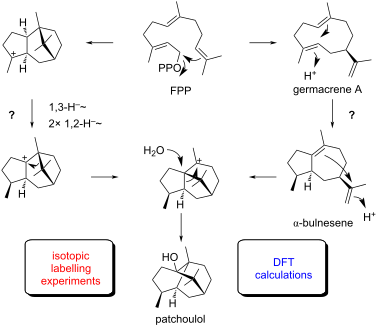
- isopentenyl diphosphate isomerase (IDI) from E. coli [20][21], FPPS, and PTS (Figure S12 in Supporting Information File 1). The additional 13C-labellings in these experiments serve for a sensitive monitoring of deuterium incorporation through HSQC spectroscopy. All X-ray and labelling experiments confirmed






Unsaturated fatty acids and a prenylated tryptophan derivative from a rare actinomycete of the genus Couchioplanes
Beilstein J. Org. Chem. 2021, 17, 2939–2949, doi:10.3762/bjoc.17.203
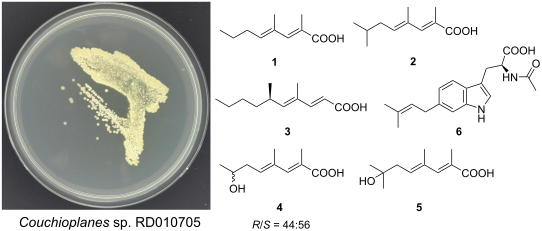
- /min. Peaks for (S)- and (R)-4' were detected at 11.3 min and 14.3 min, respectively, by monitoring the absorbance at 250 nm. Preparation of PGME amides 6a and 6b In a manner similar to a procedure from [21], to a solution of 6 (1.0 mg, 3.2 μmol) in dry N,N-dimethylformamide (100 μL) and N,N


Total synthesis of the O-antigen repeating unit of Providencia stuartii O49 serotype through linear and one-pot assemblies
Beilstein J. Org. Chem. 2021, 17, 2915–2921, doi:10.3762/bjoc.17.199
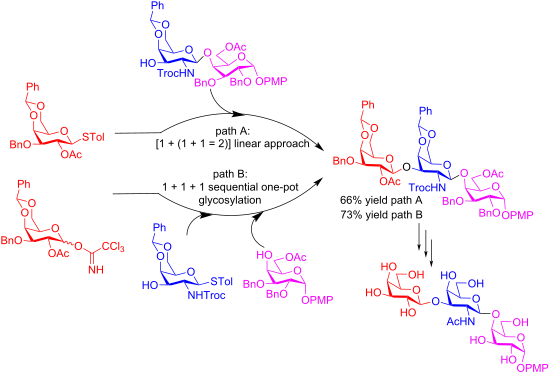
- acceptor 9 in the presence of TMSOTf as promoter (Scheme 5). After 1 h of reaction, TLC monitoring indicated the full consumption of the starting materials. Analysis of a small aliquot of the reaction mixture by HRMS confirmed the formation of the desired disaccharide. Then, to the same pot, the second
- monosaccharide acceptor 7 was added, followed by the addition of NIS and TMSOTf. After 15 min of reaction, TLC monitoring showed complete consumption of the donor. Work-up of the reaction mixture followed by chromatographic purification afforded the pure trisaccharide 2 as a single isomer in an overall yield of


Silica gel and microwave-promoted synthesis of dihydropyrrolizines and tetrahydroindolizines from enaminones
Beilstein J. Org. Chem. 2021, 17, 2543–2552, doi:10.3762/bjoc.17.170
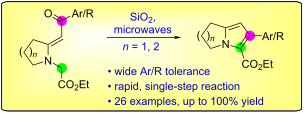
- enaminones 15 to pyrrolizines 19 was determined by TLC monitoring of the reaction mixture after successive time intervals. A fairly accurate estimate of the reaction time as a function of the changing acyl substituent could thus be obtained to within 30 seconds. As can be seen from Table 2, we observed a





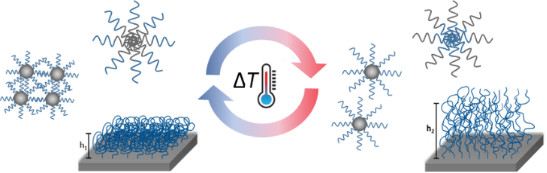
Constrained thermoresponsive polymers – new insights into fundamentals and applications
Beilstein J. Org. Chem. 2021, 17, 2123–2163, doi:10.3762/bjoc.17.138


Cerium-photocatalyzed aerobic oxidation of benzylic alcohols to aldehydes and ketones
Beilstein J. Org. Chem. 2021, 17, 1727–1732, doi:10.3762/bjoc.17.121

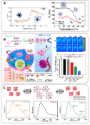
- inhibition of the catalytic cycle upon the addition of TEMPO revealed that the reaction proceeds through radical intermediates. Next, we carried out UV–vis monitoring experiments in order to verify whether the interaction with the substituted benzyl alcohols and CeIV could lead to a ligand-to-metal charge


A straightforward conversion of 1,4-quinones into polycyclic pyrazoles via [3 + 2]-cycloaddition with fluorinated nitrile imines
Beilstein J. Org. Chem. 2021, 17, 1509–1517, doi:10.3762/bjoc.17.108
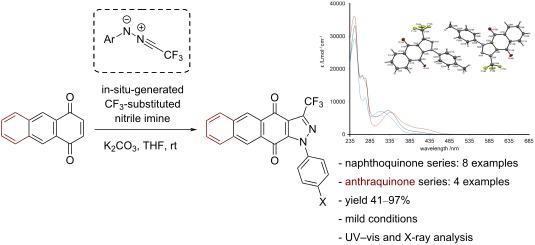
- until the starting material 1 was fully consumed (based on TLC monitoring, petroleum ether/dichloromethane 1:1). After the resulting precipitate and unconsumed carbonate were filtered off, the solvent was removed under reduced pressure. The crude mixtures were purified by CC using silica gel as the


Design, synthesis and photophysical properties of novel star-shaped truxene-based heterocycles utilizing ring-closing metathesis, Clauson–Kaas, Van Leusen and Ullmann-type reactions as key tools
Beilstein J. Org. Chem. 2021, 17, 1374–1384, doi:10.3762/bjoc.17.96
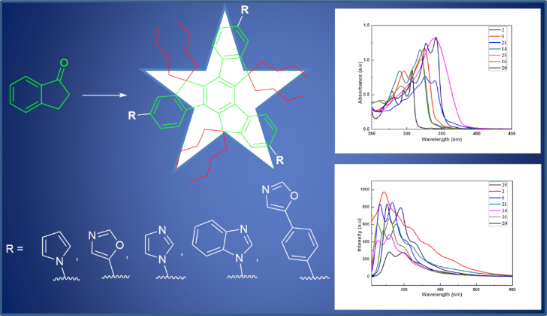
- atmosphere. The flask was cooled to 0 °C and stirred viciously after that n-BuBr (11.30 mL, 105.12 mmol) was slowly added to the flask, and the stirring was continued for 24 h at room temperature (rt), till the completion of the reaction (TLC monitoring). Then, the reaction was quenched with water and the
- , SnCl2·2H2O (16.63 g, 73.5 mmol), compound 8 (2 g, 2.45 mmol) and dry ethyl acetate (60 mL) were added. Later, the resulting mixture was refluxed for 8 h and after completion of the reaction (TLC monitoring), the solution was quenched with aqueous saturated sodium bicarbonate solution within an ice bath
- ) and allyl bromide (0.48 mL, 5.52 mmol) at 0 °C under nitrogen atmosphere. The mixture was stirred at rt for 12 h. After completion of the reaction (TLC monitoring), the reaction mixture was quenched with saturated NH4Cl and the aqueous layer was extracted with EtOAc (50 mL × 3), dried over Na2SO4. The


A comprehensive review of flow chemistry techniques tailored to the flavours and fragrances industries
Beilstein J. Org. Chem. 2021, 17, 1181–1312, doi:10.3762/bjoc.17.90
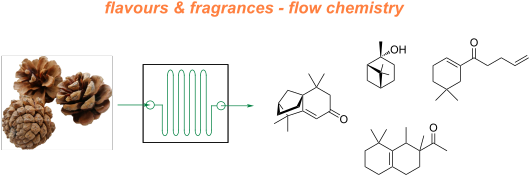
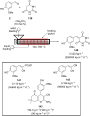
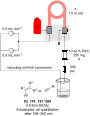
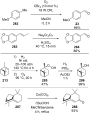
- temperature and pressure range access, the potential for in-line purification, monitoring and telescoping, linear scalability and more efficient mixing. These applications are very attractive for a synthetic chemist in all settings, especially considering the current ever-increasing industrial pressure to
- direct diagnostics to be obtained facilitating rapid analysis of the content and assessment of the extent of reaction in real-time. Several in-line monitoring tools, for example, ReactIR [58][59][60][61][62] and flow based NMR [63][64][65][66] which allow for substrate specific, non-consuming analysis
- monitoring features such as pressure sensors that can both detect, assess, and if necessary, invoke emergency venting or diversion of material to auxiliary depressurisation stages, often without needing a full reactor shut down. There are numerous examples within the literature in which a flow synthesis has











Synthesis of 10-O-aryl-substituted berberine derivatives by Chan–Evans–Lam coupling and investigation of their DNA-binding properties
Beilstein J. Org. Chem. 2021, 17, 991–1000, doi:10.3762/bjoc.17.81
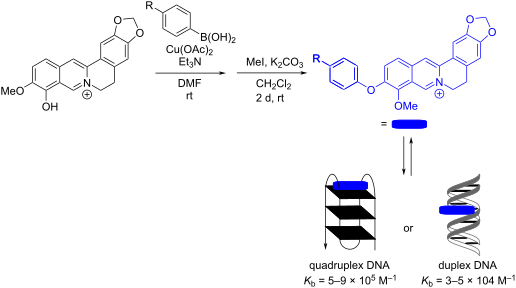
- monitoring of the temperature-dependent Förster resonance energy transfer (FRET) between the dyes [46]. The particular oligonucleotide sequences were chosen because they are known to be involved in biologically relevant processes, namely in the transcription regulation of myc (FmycT) [47][48], kit (FkitT


A chromatography-free and aqueous waste-free process for thioamide preparation with Lawesson’s reagent
Beilstein J. Org. Chem. 2021, 17, 805–812, doi:10.3762/bjoc.17.69

- following the same procedure as described above for the EtOH treatment. To our surprise, the decomposition was much slower as expected (TLC monitoring, see Supporting Information File 1). It was assumed that the ring-opening could be influenced by water or by the in situ-generated thiophosphonic acid. Thus
- longer time for the reaction with LR was essential for the completion of the reaction according to TLC monitoring. Following the similar workup procedure as described for compound 4, the resulting crude product was recrystallized from toluene to afford the product as bright-yellow crystalline solid in 91
- a nitrogen atmosphere. The reaction was completed in 3 h by TLC monitoring. Then, to the cooled mixture, were added 100 mL of ethylene glycol (excess), together with 1.0 mL of water, and the resulting mixture was stirred at 95 °C. TLC monitoring of the toluene layer showed that the byproduct A from


Effective microwave-assisted approach to 1,2,3-triazolobenzodiazepinones via tandem Ugi reaction/catalyst-free intramolecular azide–alkyne cycloaddition
Beilstein J. Org. Chem. 2021, 17, 678–687, doi:10.3762/bjoc.17.57
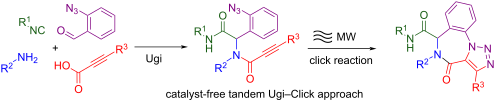
- solubility [20]. Firstly, we used a procedure similar to described by I. Akritopoulou-Zanze et al. [13] for cyclization: compound 6aab was refluxed in benzene for 8 hours until TLC monitoring demonstrated the full transformation of starting material into a new compound. The evaporation of the solution gave a


Synthesis of (Z)-3-[amino(phenyl)methylidene]-1,3-dihydro-2H-indol-2-ones using an Eschenmoser coupling reaction
Beilstein J. Org. Chem. 2021, 17, 527–539, doi:10.3762/bjoc.17.47

- minimum amount of dry DMF and a saturated solution of 3-bromooxindole (1a–c, n1a–c) in dry DMF was added. The reaction mixture was stirred for 20 h at room temperature (TLC monitoring; silica gel plates/EtOAc/hexane) and then diluted with an aqueous NaHCO3 solution (5%, 50 mL). The suspension was





