Search results
Search for "quantum yield" in Full Text gives 209 result(s) in Beilstein Journal of Organic Chemistry. Showing first 200.
Recent advances in the application of isoindigo derivatives in materials chemistry
Beilstein J. Org. Chem. 2021, 17, 1533–1564, doi:10.3762/bjoc.17.111
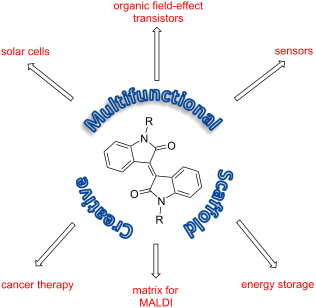
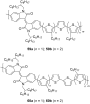
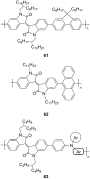
- [120]. At the same time, in vivo experiments have shown the high efficiency of low-molecular-weight isoindigo 71 in oxygen sensitization for cancer therapy [121]. Therein, a high value (84%) of the singlet oxygen quantum yield was obtained. Conclusion To summarize, it can be concluded that isoindigo is














Design, synthesis and photophysical properties of novel star-shaped truxene-based heterocycles utilizing ring-closing metathesis, Clauson–Kaas, Van Leusen and Ullmann-type reactions as key tools
Beilstein J. Org. Chem. 2021, 17, 1374–1384, doi:10.3762/bjoc.17.96
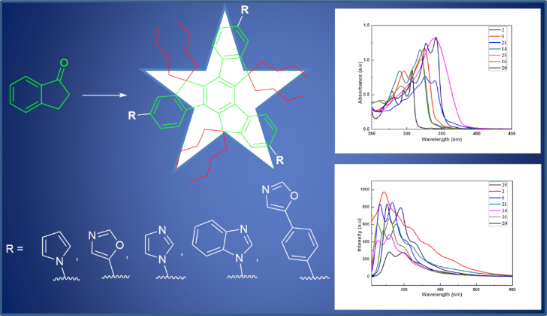
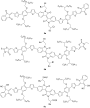
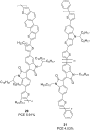
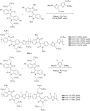
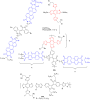
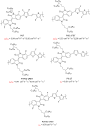
- ]. More interestingly, the high fluorescence quantum yield as well as the excellent photoluminescence quantum efficiency in addition to extraordinary thermal stability are the most significant characteristics of these systems. Interestingly, this versatile C3-symmetric aromatic framework can also formally


A new glance at the chemosphere of macroalgal–bacterial interactions: In situ profiling of metabolites in symbiosis by mass spectrometry
Beilstein J. Org. Chem. 2021, 17, 1313–1322, doi:10.3762/bjoc.17.91
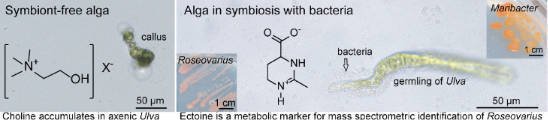
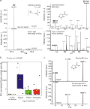
- . mutabilis germlings were stained with SYBR Gold, a sensitive probe forming a complex with DNA with high fluorescence quantum yield [36]. In the axenic callus-like form, the nuclei of algal cells and the bacterial cells accumulated around the rhizoidal tissue and exhibited the specific fluorescence after



Synthesis of 10-O-aryl-substituted berberine derivatives by Chan–Evans–Lam coupling and investigation of their DNA-binding properties
Beilstein J. Org. Chem. 2021, 17, 991–1000, doi:10.3762/bjoc.17.81
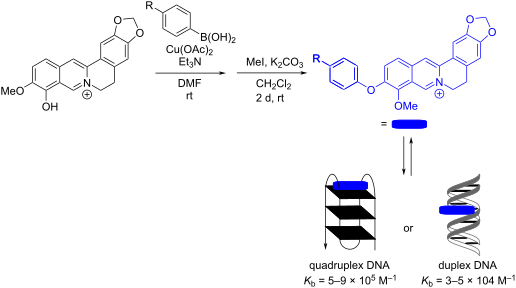
- deactivation of the excited state by conformational changes, e.g., torsional relaxation [42][43]. Since the fluorescence quantum yield of the parent berberine (1a) does not correlate well with the viscosity of the medium [40], it was concluded that the weak light-up effect in glycerol is mainly caused by the
- suppressed rotation about the Ar–O bond. Nevertheless, as the emission quantum yield of the derivatives 5a–e still remained low, even at high viscosity of the medium, there obviously exist additional relaxation pathways in the excited state, most likely a photo-induced electron transfer (PET) from the 10
- -aryl substituent to the berberine chromophore. The latter has been shown to operate also in resembling cationic, biaryl-type dyes [42][43]. Along the same lines, the low intrinsic emission quantum yield of the parent berberine (1a) has been suggested to result from an internal charge transfer (ICT


Synthetic reactions driven by electron-donor–acceptor (EDA) complexes
Beilstein J. Org. Chem. 2021, 17, 771–799, doi:10.3762/bjoc.17.67

- form the EDA complex, affording acylation product 123 under blue-light irradiation (Scheme 42). The quantum yield of the reaction was determined to be 0.08, suggesting that the reaction proceeded via radical coupling rather than a radical propagation. Moreover, the reaction was compatible with amides


Synthesis, structural characterization, and optical properties of benzo[f]naphtho[2,3-b]phosphoindoles
Beilstein J. Org. Chem. 2021, 17, 671–677, doi:10.3762/bjoc.17.56
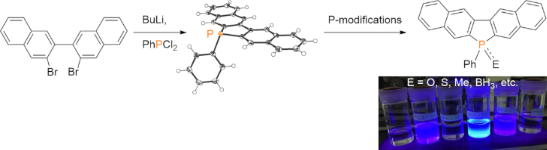
- approximately 50 nm longer than that of our oxide 3 [16]. The fluorescence wavelength, including the maximum emission (λem), and the quantum yield depend on the nature of the P-modification. Phosphine oxide 3, cation 5, and boron complex 6 emitted blue fluorescence in the visible-light region, with λem at 395
- –426 nm (Table 2). P-methylated cation 5 exhibited the longest wavelength and the highest quantum yield. The electrochemical properties of benzonaphthophosphoindoles were investigated by using cyclic voltammetry, and the electrochemical data are summarized in Table 3 and Figure S4, Supporting


Insight into functionalized-macrocycles-guided supramolecular photocatalysis
Beilstein J. Org. Chem. 2021, 17, 139–155, doi:10.3762/bjoc.17.15
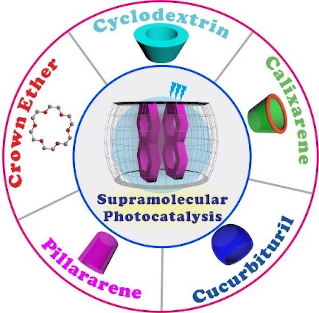
- satisfy the following criteria: i) a reaction-ready configuration, i.e., a substrate orientation in a configuration favorable for photochemical transformations, ii) in the supramolecular photocatalytic reaction (within the cavity), the quantum yield should be higher than both the unimolecular and
- bimolecular photoreaction quantum yield in an isotropic medium, and iii) the substrate and the products should be released from the supramolecular system via a dynamic exchange, which directs to a better yield and catalytic efficiency. To strengthen the above concepts, supramolecular photocatalysis needs a
- to determine the kinetic rates of the forward and reverse reactions. Instead, the supramolecular photochemical transformation efficiency is calculated via quantum yield and reaction velocity experiments. In addition, the thermodynamic and kinetic functions of the supramolecular systems can be






The fluorescence of a mercury probe based on osthol
Beilstein J. Org. Chem. 2021, 17, 22–27, doi:10.3762/bjoc.17.3
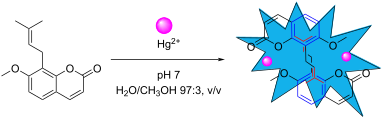
- therefore the thermodynamic parameters show that the binding process between OST and Hg2+ was mainly determined by ΔH, with an action ratio of 1:1 and a K value of 1.552 × 10⁵ L ∙ mol−1. Measurement of the fluorescence quantum yield The fluorescence quantum yield of ʟ-tryptophan at an excitation wavelength
- of 293 nm was 0.14, which was taken as the standard (Figure S5, Supporting Information File 1) [29][30]. The integration range of ʟ-tryptophan was 280–540 nm and that of OST–Hg2+ was 300–540 nm, and the fluorescence quantum yield of the aqueous probe solution was measured to be 0.08. Although this
- quantum yield is not high, the selectivity and sensitivity for the fluorescence analysis are good. This can be better used to detect Hg2+ ions and has a certain analytical value. Determination of Hg2+ in a water sample Tap water was directly used for the determination of Hg2+ using the standard addition


Metal-free synthesis of biarenes via photoextrusion in di(tri)aryl phosphates
Beilstein J. Org. Chem. 2020, 16, 3008–3014, doi:10.3762/bjoc.16.250
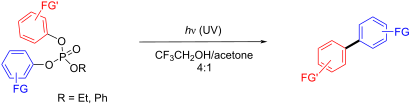
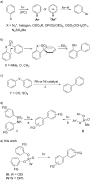
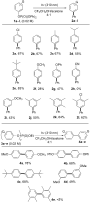
- phosphates examined were barely fluorescent in methanol, with an emission quantum yield (Φem) in the 0.005–0.06 range (see Table 2 and Supporting Information File 1 for further details). We thus focused on compounds 1e, 1h, 3a and 3c as the model substrates. In the case of compounds 1e and 1h, we observed
- of the biradical intermediate 6 [55] preceding the loss of ROP(O)(OH)2 (paths (b), (c), Scheme 3). The long irradiation time required to achieve a complete consumption of the substrates 1 and 3 is in accordance with the low quantum yield values reported for this process [58][61]. Furthermore, a



Selected peptide-based fluorescent probes for biological applications
Beilstein J. Org. Chem. 2020, 16, 2971–2982, doi:10.3762/bjoc.16.247

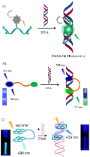
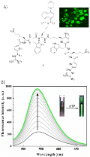
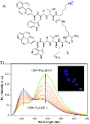
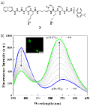
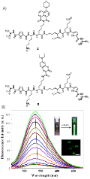
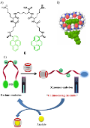
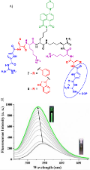
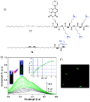
- use of pyrene as a fluorophore has two major disadvantages such as poor quantum yield and an emission in the blue region, which is unfavorable for potential applications in biological systems. The Schmuck group successfully developed several peptide-based probes using these approaches for targeting




Naphthalonitriles featuring efficient emission in solution and in the solid state
Beilstein J. Org. Chem. 2020, 16, 2960–2970, doi:10.3762/bjoc.16.246
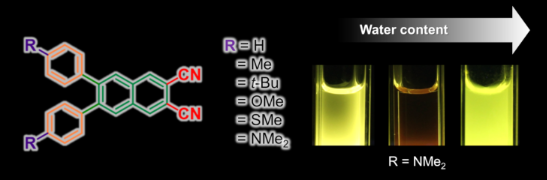
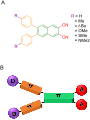
- singlet state. In the case of H, the quantum yield rises for increasing water content from 0% to 70%, which is attributed to the AIEE effect. Once it reaches 70%, a growing water fraction leads to an ACQ effect and hence the quantum yield decreases from 80% onwards (Table 2). A similar trend is observed
- of water, and later they drop due to ACQ. Also, it is possible to observe that the lifetimes follow a similar trend, where an increase of the emission intensity accompanies a minor prolongation of the lifetime and subsequently a drop of the quantum yield along with a shortening of the lifetimes
- , we observe a drastic drop in quantum yield when the water fractions are raised from 0% to 30%. As NMe2 is a pure push–pull system, the excited state can interact strongly with the solvent and due to the high polarity of water, a solvent quenching (SQ) effect is expected and also explains the observed



Dawn of a new era in industrial photochemistry: the scale-up of micro- and mesostructured photoreactors
Beilstein J. Org. Chem. 2020, 16, 2484–2504, doi:10.3762/bjoc.16.202
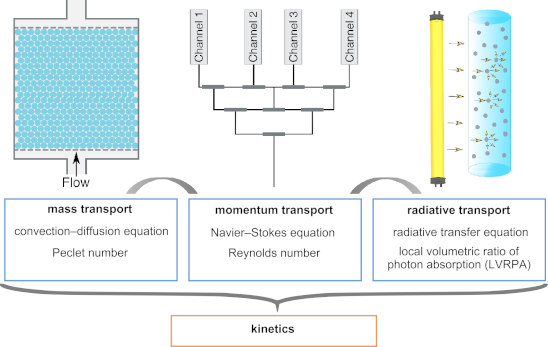
- photomicroreactor compared to a batch system [17]. Still, it should be kept in mind that such comparisons are often strongly biased due to the difference in the photons absorbed in different reactor geometries and the possible difference in mass transfer limitations. Another benchmark is the quantum yield ϕ. This
- does not account for the quantum yield. Therefore, the molecular and electronic features of the reactants, which could significantly affect the PSTY value, are not accounted for when comparing different reactions. As such, it is hard to make global conclusions just by looking at the PSTY value
- , especially when intermolecular and intramolecular reactions or homogenous and heterogeneous reactions are compared. Since the quantum yield of most photochemical reactions is not known, the PSTY still gives a good comparison between different reactor geometries. The PSTY especially gains importance when




Recent developments in enantioselective photocatalysis
Beilstein J. Org. Chem. 2020, 16, 2363–2441, doi:10.3762/bjoc.16.197
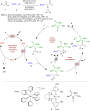
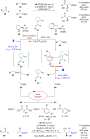
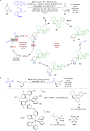
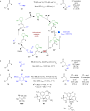
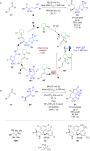
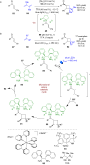
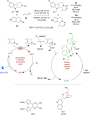
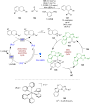
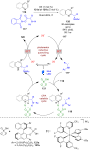
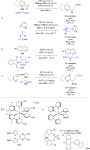
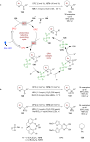
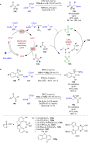
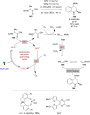
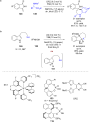
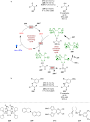
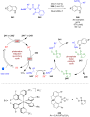
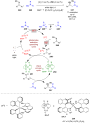
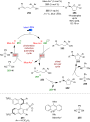
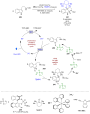
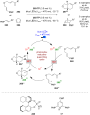
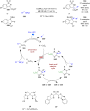
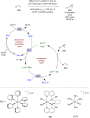
- quantifier of the efficiency of a photochemical process. The quantum yield (Φ) of a reaction is often used as a mechanistic tool to probe whether a chain reaction is active (Φ > 1) or not (Φ < 1), although it should be noted that a reaction with Φ < 1 could also still include a radical chain process with an
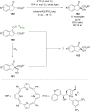
- use of light would result in a greener reaction. where (a) is the definition of quantum yield and (b) is the quantum yield of a radical chain reaction. Review Enantioselective photocatalysis Amine catalysis Much of the history of amine catalysis used in photochemical reactions can be found in a review
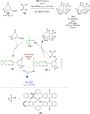
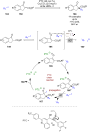
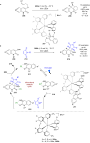
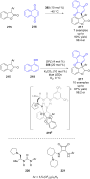
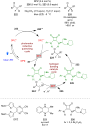
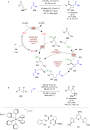
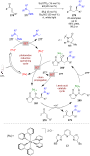
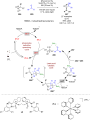
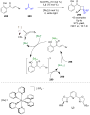
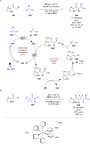
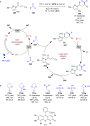
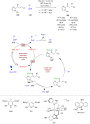
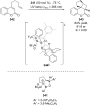
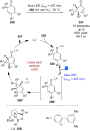
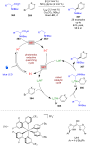
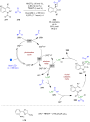
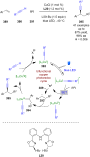
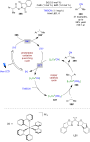
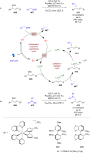
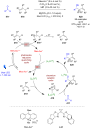
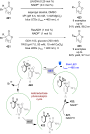
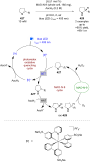
- suggests a closed catalytic cycle is in operation; however, subsequent investigations by Yoon [20] found this reaction has a quantum yield >1 (Φ = 18), which signifies a chain propagation process is dominant. Therefore, according to Yoon’s proposed mechanism, the reaction proceeds with the condensation of

























Styryl-based new organic chromophores bearing free amino and azomethine groups: synthesis, photophysical, NLO, and thermal properties
Beilstein J. Org. Chem. 2020, 16, 2282–2296, doi:10.3762/bjoc.16.189

- of all dyes was high in solvents with low polarities such as PhMe and THF, while it decreased with increasing solvent polarities such as DMSO and MeOH. The fluorescence quantum yields of the dyes were found to be very low as compared to fluorescein (ΦF= 0.95 at pH 9). For example, the quantum yield


Photosensitized direct C–H fluorination and trifluoromethylation in organic synthesis
Beilstein J. Org. Chem. 2020, 16, 2151–2192, doi:10.3762/bjoc.16.183
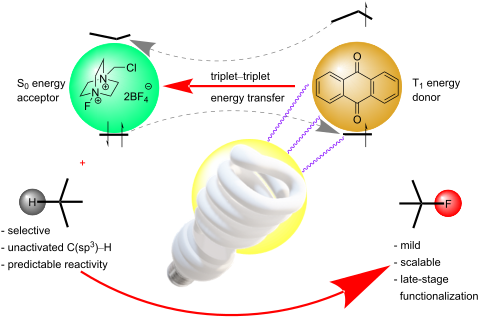
- state that collides with nearby molecules to reach its lowest vibrational energy state. Another fate of T1{PS}, permitted by spin–orbit coupling, is the radiative process of phosphorescence. If a molecule exhibits a high triplet quantum yield (rapid ISC and slow phosphorescence), this state is long
- quantum yield of the triplet state and iv) the energy transfer from the PS to the substrate must, overall, be exergonic. An ideal PS is a single, well-characterized pure substance of known composition that is stable at room temperature. In the presence of light, it is not toxic or degrades to toxic
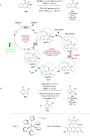
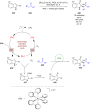
- ® radical cation is regenerated here upon FAT, the authors considered the candidacy of the Selectfluor® radical cation as a chain carrier. However, the quantum yield of the reaction was found to be only Φ = 0.13, strongly evidencing against a radical chain mechanism. The complexation of Selectfluor® with






Naphthalene diimide–amino acid conjugates as novel fluorimetric and CD probes for differentiation between ds-DNA and ds-RNA
Beilstein J. Org. Chem. 2020, 16, 2032–2045, doi:10.3762/bjoc.16.170
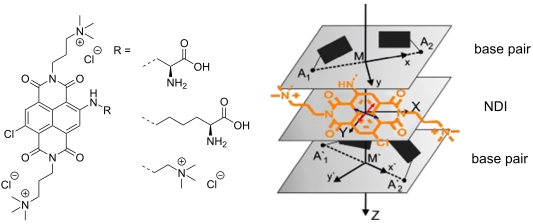
- interacted with ds-DNA/RNA by threading intercalation. Different from a reference NDI dye with identical visible range absorbance (520–540 nm) and Stokes shifts in emission (+60 nm, quantum yield > 0.2), only these amino acid–NDI conjugates showed selective fluorimetric response for GC-DNA in respect to AT(U
- colourless and non-fluorescent core-unsubstituted NDI with a new charge transfer band with an absorption maximum in the visible spectral range and a high fluorescence quantum yield (up to 58%) [23][25]. Further, the 2-amino substituent offers the possibility to connect various amino acid side chains, thus
- significant Stokes shifts of emission (+60 nm) characterised by good quantum yield in aqueous solution. Thus, NDIs 3a and 3b are novel intensively fluorescent non-natural amino acid probe molecules with both, N- and C-termini available for incorporation into any peptidoid construct requiring a fluorescent tag


When metal-catalyzed C–H functionalization meets visible-light photocatalysis
Beilstein J. Org. Chem. 2020, 16, 1754–1804, doi:10.3762/bjoc.16.147
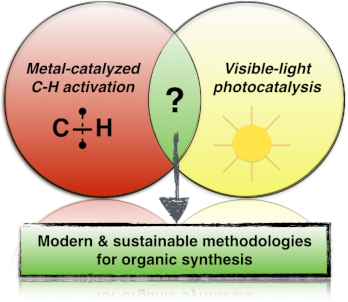
- outcome is interesting from the sophisticated molecule late-stage functionalization viewpoint. Furthermore, the quantum yield of the reaction was measured and turned out to be 6.5. This result indicated that the mechanism of this reaction involved a short radical chain process [85]. The same year, a


Et3N/DMSO-supported one-pot synthesis of highly fluorescent β-carboline-linked benzothiophenones via sulfur insertion and estimation of the photophysical properties
Beilstein J. Org. Chem. 2020, 16, 1740–1753, doi:10.3762/bjoc.16.146

- quantum yields (up to 47%), and high brightness (up to 11196). The brightness of the fluorophores was calculated by multiplication of the quantum yield (Φ) with its molar extinction coefficient (ε). In case of the β-carboline C1-substituted benzothiophenones 2aA–nA, 2bB, and 2hB, the substituents R1 and
- R2 significantly affected the fluorescence of the compounds. It was noted that the fluorescence increased with lengthening of the alkyl chain at N-9 (R2) and followed the order n-Bu > n-Pr > Et > Me > H. The β-carboline derivative with free N–H (N-9), 2aA, showed a low fluorescence quantum yield (ΦF
- = 18%) in this series (Table 2 and Figure 3). The presence of a benzyl group at R2 (2hA), improved the photophysical properties including a higher quantum yield (ΦF = 47%). With variation of the substituents at the R1 position, a regular pattern of fluorescence was observed, i.e., CO2iPr > CO2Me > H


Clickable azide-functionalized bromoarylaldehydes – synthesis and photophysical characterization
Beilstein J. Org. Chem. 2020, 16, 1683–1692, doi:10.3762/bjoc.16.139
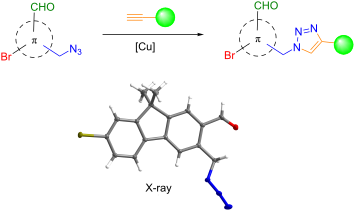
- with a quantum yield of ΦP = 2.9% in the crystalline state: this behavior was caused by intermolecular halogen bonds from the carbonyl-oxygen atom to an adjacent bromine atom (Figure 1a). Despite multifarious examples of RTP in the crystalline state, purely organic compounds showing RTP in solution are
- rare [64][65][66][67][68][69]. Takeuchi et al. [28] reported a bromofluorenecarbaldehyde 2 which shows blue fluorescence in chloroform at 298 K under air and green phosphorescence under argon with a phosphorescence quantum yield of ΦP = 5.9% (Figure 1b). This observation is reasoned by a strong (π,π



Heterogeneous photocatalysis in flow chemical reactors
Beilstein J. Org. Chem. 2020, 16, 1495–1549, doi:10.3762/bjoc.16.125














Distinctive reactivity of N-benzylidene-[1,1'-biphenyl]-2-amines under photoredox conditions
Beilstein J. Org. Chem. 2020, 16, 1335–1342, doi:10.3762/bjoc.16.114
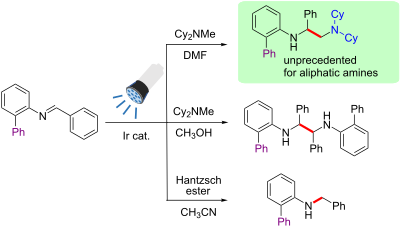
- the formation of mixtures of several types of amine compounds. A photochemical quantum yield, determined by using the standard ferrioxalate actinometry, was 83% for the radical cross-coupling between 1a and Cy2NMe (see Supporting Information File 1 for details). Next, the homocoupling reactions of

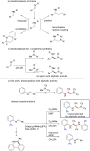


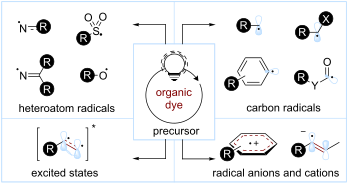
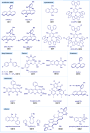
Photocatalysis with organic dyes: facile access to reactive intermediates for synthesis
Beilstein J. Org. Chem. 2020, 16, 1163–1187, doi:10.3762/bjoc.16.103
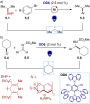
- . The formed N-alkoxylated intermediate is converted into the desired product 39.2 after oxidation and releases another alkoxy radical at the same time. The measured quantum yield (Φ = 4.4) indicates that a chain mechanism is operative. Recently, the same group applied a similar organophotocatalytic





Development of fluorinated benzils and bisbenzils as room-temperature phosphorescent molecules
Beilstein J. Org. Chem. 2020, 16, 1154–1162, doi:10.3762/bjoc.16.102
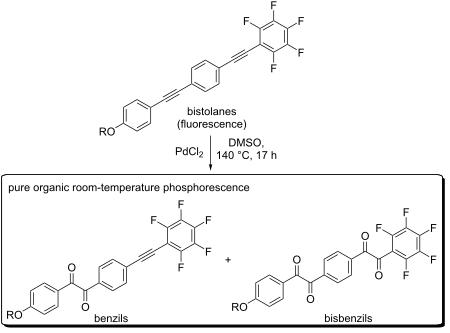
- bisbenzil molecules cause significant retardation of ISC, leading to a weaker phosphorescence intensity. Additionally, the quantum yields (ΦPL) of the PL bands in the range of 350–600 nm were acquired using an absolute quantum yield measurement system with a calibrated integrating sphere. All samples have a

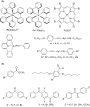


Synthesis of novel multifunctional carbazole-based molecules and their thermal, electrochemical and optical properties
Beilstein J. Org. Chem. 2020, 16, 1066–1074, doi:10.3762/bjoc.16.93
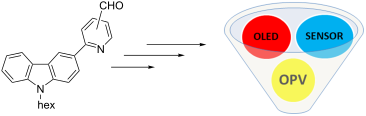
- ]. ϕFL of compounds 7a and 7b was 5.4% and 97.4%, respectively. An estimated error in quantum yield calculations is ca. 10%. The details of the calculations are given in Supporting Information File 1. Surprisingly, compound 7b, in which the formyl group is at the para position to the carbazole ring, was
- . Supporting Information The Supporting Information features the followings: 1) 1H NMR and 13C NMR spectra; 2) FTIR spectra; 3) mass and HRMS spectra; 4) calculations of relative fluorescence quantum yields. Supporting Information File 294: NMR, FTIR, MS and HRMS spectra of compounds and relative quantum yield


Aldehydes as powerful initiators for photochemical transformations
Beilstein J. Org. Chem. 2020, 16, 833–857, doi:10.3762/bjoc.16.76
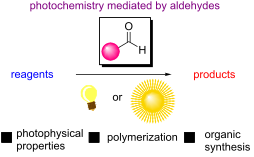
- , which were more stable than the undeuterated ones upon irradiation and subsequent excitation [27][28]. The excited triplet state T1 (n,π*) of carbonyl compounds tends to be the most reactive state (compared to the singlet state). Furthermore, this excited state is easily accessible, as the quantum yield
- fluorescence quenching studies, UV–vis spectroscopy experiments, calculation of the quantum yield, a cutoff experiment below 400 nm, GC–MS analysis, and NMR spectroscopic mechanistic experiments. They also concluded that an energy transfer mechanism could not be possible since the solvent employed affected the