


Search results
Search for "halogen" in Full Text gives 495 result(s) in Beilstein Journal of Organic Chemistry. Showing first 200.
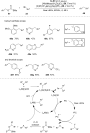
Generation of alkyl and acyl radicals by visible-light photoredox catalysis: direct activation of C–O bonds in organic transformations
Beilstein J. Org. Chem. 2024, 20, 1348–1375, doi:10.3762/bjoc.20.119
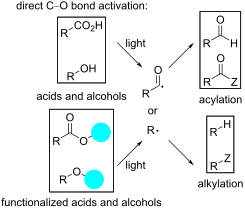
- –halogen bond formation, as well as C–H functionalization [27]. Some notable examples include C–H arylation, various cross-coupling reactions, oxidative coupling, and photocatalytic radical reactions. The advantages of visible-light-induced photoredox catalysis are due to the ability to utilize visible
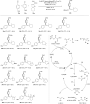
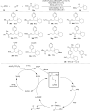
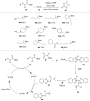
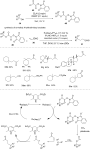
- presence of alkene, alkyne, halogen, and ether moieties. N-Boc-protected amines and esters also provided a good to excellent yield. Unfortunately, α,β-unsaturated carboxylic acids and aliphatic carboxylic acids were ineffective using this method. In 2024, Liu and co-workers [31] introduced a photocatalytic
- various hydrocarbons in good yield. Alcohols containing electron-deficient arenes delivered a comparably lower yield (i.e., 62b–d, 52–63%), probably because of the lower nucleophilicity of the alcohols. Halogen atoms present in the p-position of alcohols were tolerated well and provided a decent yield






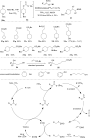
Rhodium-catalyzed homo-coupling reaction of aryl Grignard reagents and its application for the synthesis of an integrin inhibitor
Beilstein J. Org. Chem. 2024, 20, 1341–1347, doi:10.3762/bjoc.20.118
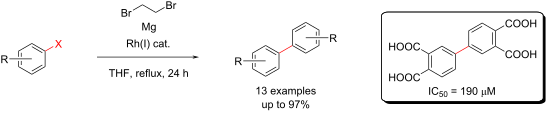
- 10.3762/bjoc.20.118 Abstract A novel Rh-catalyzed one-pot homo-coupling reaction of aryl Grignard reagents was achieved. The reaction with bromobenzenes having an electron-donating group or a halogen substituent gave the corresponding homo-coupling products in good yields, although the reaction using
- bromoanisole, the corresponding homo-coupling products 3a, 3c–3e were obtained in good yields. In addition, reactions with substrates having halogen substituents also gave the products (3h and 3i) in moderate yields. It is interesting to note, that the reaction using 3-bromofluorobenzene (5h) gave a small


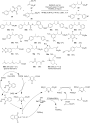
Transition-metal-catalyst-free electroreductive alkene hydroarylation with aryl halides under visible-light irradiation
Beilstein J. Org. Chem. 2024, 20, 1327–1333, doi:10.3762/bjoc.20.116
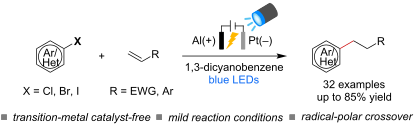
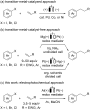
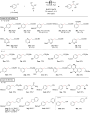
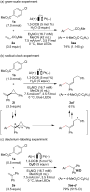
- beneficial features, such as higher chemical stability and wide commercial availability, compared with other precursors, e.g., diazonium salts [11]. Classical approaches toward aryl radical species from the corresponding halides would involve halogen abstraction or single-electron reduction processes using


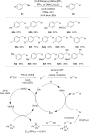
Computation-guided scaffold exploration of 2E,6E-1,10-trans/cis-eunicellanes
Beilstein J. Org. Chem. 2024, 20, 1320–1326, doi:10.3762/bjoc.20.115

- from liverwort [25], possess a similar 6/6/6-skeleton and likely originate from a cis-eunicellane skeleton. We first independently tested 2 with halogen electrophiles NCS and NBS (1.2 equivalents). NCS and NBS provided the C6-monohalogenated 6/6/6-tricyclic products 14 and 15 in 78% and 74% yields
- position and therefore the equatorial nature of the halogen. These configurations were also verified by NOESY correlations between H6 and H2 in both compounds. Some minor isomers of the halogenated derivatives were detected by LC–MS, but were deemed too low in abundance to purify. Two gersemiane


Domino reactions of chromones with activated carbonyl compounds
Beilstein J. Org. Chem. 2024, 20, 1256–1269, doi:10.3762/bjoc.20.108
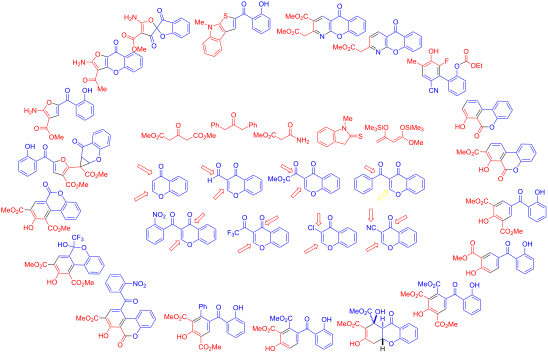
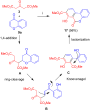
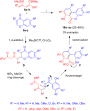
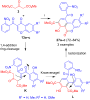
- intramolecular nucleophilic attack of the oxygen to the halide to give intermediate U and subsequent ring-cleavage. The reaction of 3-ketoamide 34a (R3 = Me, R4 = Ph) with 3-chloro-, 3-bromo-, and 3-iodochromone showed that the yields strongly depend on the type of halogen atom located at position 3 of the





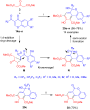

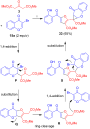

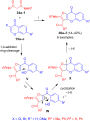
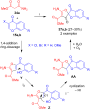


Light on the sustainable preparation of aryl-cored dibromides
Beilstein J. Org. Chem. 2024, 20, 1076–1087, doi:10.3762/bjoc.20.95
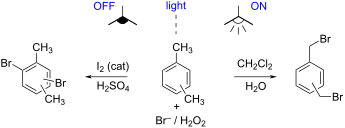
- desired reactivity. Substitution of a hydrogen atom with a halogen atom within an organic skeleton significantly increases the electrophilicity of the linked carbon centre, enhancing concerted (SN2) as well as carbenium ion-mediated (SN1) substitutions, common – for instance – on benzylic positions
- for halo compounds, potentially involving the use of eco-friendly halogenation reagents. The development of methods for the efficient removal and recycle of halogens, advocating principles of a circular economy. It is noteworthy that both aspects are influenced by the type of halogen employed. When
- ) greater electrophilicity of the halo compound due to better leaving group ability of the halide ion, (iii) reduced toxicity, presumably due to faster hydrolysis [18], and (iv) easier oxidation of the halide to molecular halogen (E0 = 1.087 V (SHE) for Br2/Br−; E0 = 1.358 V (SHE) for Cl2/Cl−) [19



A Diels–Alder probe for discovery of natural products containing furan moieties
Beilstein J. Org. Chem. 2024, 20, 1001–1010, doi:10.3762/bjoc.20.88
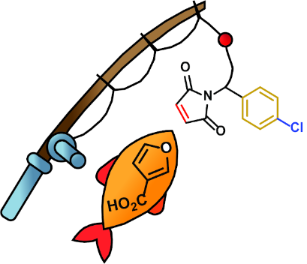
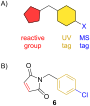
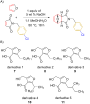
- supernatant. There are two main types of molecular probes based on their detection methods: imaging and UV–vis (Figure 2A). An imaging probe contains a mass spectrometry (MS) tag, oftentimes a halogen with a distinct isotopic ratio such as chlorine or bromine. A UV–vis probe contains a UV-tag, such as an




Enantioselective synthesis of β-aryl-γ-lactam derivatives via Heck–Matsuda desymmetrization of N-protected 2,5-dihydro-1H-pyrroles
Beilstein J. Org. Chem. 2024, 20, 940–949, doi:10.3762/bjoc.20.84
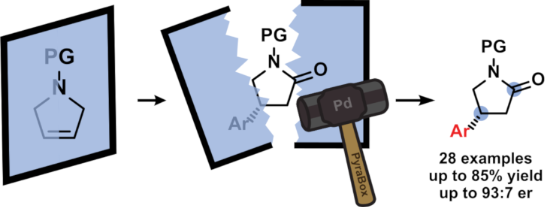
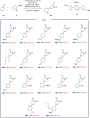
- -containing electron-withdrawing groups such as methyl ester and ketone did not show much of an effect in the outcome of the reaction, providing compounds 4bd and 4be in high yields and good er. On the other hand, product 4bq was obtained in a higher yield but with a lower er. The p-halogen-containing




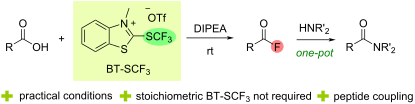
Direct synthesis of acyl fluorides from carboxylic acids using benzothiazolium reagents
Beilstein J. Org. Chem. 2024, 20, 921–930, doi:10.3762/bjoc.20.82
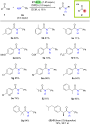
- - or meta-positions all reacted smoothly with 4a to afford the corresponding benzylamides 5a–c in very good isolated yields up to 81%. Electron-donating and -withdrawing groups at the para-position were well tolerated (5d–f), including halogen substituents that could serve as handles for follow-up



(Bio)isosteres of ortho- and meta-substituted benzenes
Beilstein J. Org. Chem. 2024, 20, 859–890, doi:10.3762/bjoc.20.78
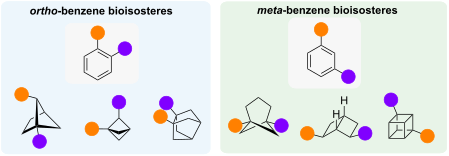
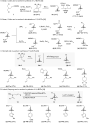
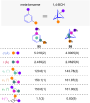
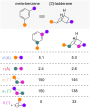
- synthesis of some 1,5-BCHeps, including 134b, was also possible on mmol scale. Through derivatization of iodine-substituted 1,5-BCHeps 134f and 134g, an even larger number of 1,5-BCHeps were accessed (Scheme 14B) [27][47]. For example, lithium–halogen exchange was used to prepare acids 135f–g and boronic
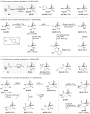
- ]. A wide variety of 1,2,3-BCPs bearing substituents in the bridge position were reported by Measom and co-workers in their study on the lithium–halogen exchange of 2-bromo-1,2,3-BCPs [78]. Larger bridged bicyclic structures such as bicyclo[2.1.1]hexane offer multiple different exit vectors for






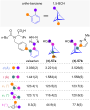
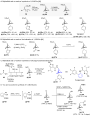


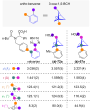


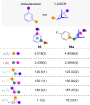







Ortho-ester-substituted diaryliodonium salts enabled regioselective arylocyclization of naphthols toward 3,4-benzocoumarins
Beilstein J. Org. Chem. 2024, 20, 841–851, doi:10.3762/bjoc.20.76
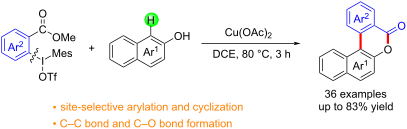
- generally moderate to good yields of 22–83% (Table 2, entries 1–17). These substituents included halogen (Br), methyl, phenyl, aldehyde, ester, and methoxy groups, all of which were compatible with the reaction conditions. Notably, compounds 3ab, 3ah, 3aj, 3am and 3ap bearing bromine are very useful modules


Skeletal rearrangement of 6,8-dioxabicyclo[3.2.1]octan-4-ols promoted by thionyl chloride or Appel conditions
Beilstein J. Org. Chem. 2024, 20, 823–829, doi:10.3762/bjoc.20.74
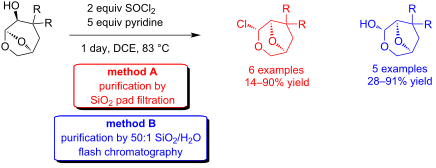
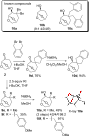
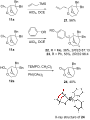
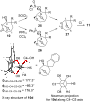
- work, which suggests a stepwise migration of oxygen from C5 to C4, followed by addition of the halogen nucleophile. Furthermore, if the halogen was involved in the transition state via the σ* orbital (avoiding intermediate 27), the opposite configuration would result at C2 in the products. The single




SOMOphilic alkyne vs radical-polar crossover approaches: The full story of the azido-alkynylation of alkenes
Beilstein J. Org. Chem. 2024, 20, 701–713, doi:10.3762/bjoc.20.64
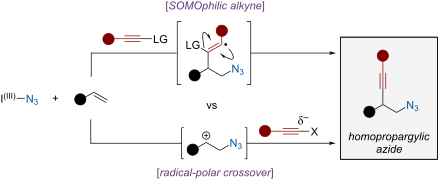
- . An halogen-substituted styrene could be azido-alkynylated to afford 4g in 71% yield. Electron-poor aryls are expected to destabilize the carbocation intermediate formed during the reaction. Nevertheless, 4h possessing a para ester could be obtained, albeit with a decreased yield. Homopropargylic


Synthesis and biological profile of 2,3-dihydro[1,3]thiazolo[4,5-b]pyridines, a novel class of acyl-ACP thioesterase inhibitors
Beilstein J. Org. Chem. 2024, 20, 540–551, doi:10.3762/bjoc.20.46
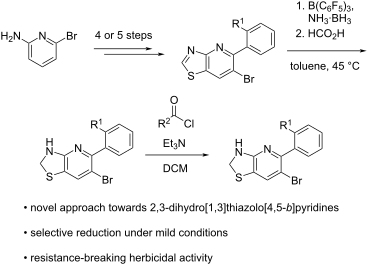
- to afford thiazolopyridines 12a–c in good yield. This allowed us to circumvent the previously employed alkylation–oxidation–reduction sequences (Scheme 2) [12]. Thereupon, we recognized that we could introduce two halogen atoms in the halogenation step and carry one through to the end of the
- (ALOMY_R, also known as slender foxtail or black twitch) and ryegrass (LOLSS_R). Remarkably, 2,3-dihydro[1,3]thiazolo[4,5-b]pyridine 7b turned out to be superior to market standards (i.e., 1 and 2 in wheat) in terms of overall efficacy and resistance breaking potential. Halogen-free target compound 7c also


Synthesis of 2,2-difluoro-1,3-diketone and 2,2-difluoro-1,3-ketoester derivatives using fluorine gas
Beilstein J. Org. Chem. 2024, 20, 460–469, doi:10.3762/bjoc.20.41
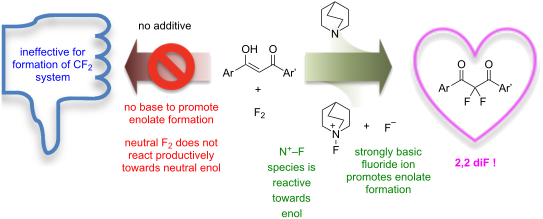
- difluoromethylene units. To meet the demands of synthetic chemists within the life science discovery and manufacturing arenas, many fluorination methods have been developed over the years to introduce difluoromethylene groups into organic systems. Approaches using nucleophilic fluorination include halogen exchange


Green and sustainable approaches for the Friedel–Crafts reaction between aldehydes and indoles
Beilstein J. Org. Chem. 2024, 20, 379–426, doi:10.3762/bjoc.20.36
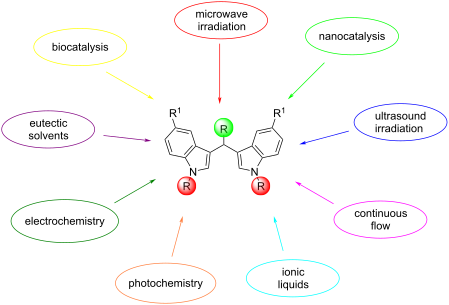
- . Finally, another nucleophilic attack by a second molecule of indole to IV is occurring, forming the desired BIM 12, while simultaneously releasing the catalyst, rendering it available for another catalytic cycle [80]. Halogen bonding processes Recently, halogen bonding (XB) interactions have emerged as an
- electron-withdrawing substituents. The reaction mechanism is based on the activation of the carbonyl group by molecular I2, through the formation of a halogen bond, which lowers the LUMO of the carbonyl moiety, increasing its electrophilicity, and thus allowing the addition of the indole group (Scheme 7
- reaction of aldehydes and ketones with indole [93][94]. Bidentate halogen-bond donors are efficient catalysts, since they can form two halogen bonds with each substrate, instead of just one. Thus, compounds 24, 25 and 26 were screened for their catalytic activity with 26 emerging as the optimum choice




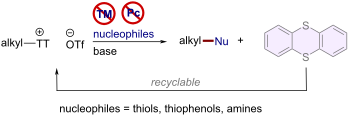
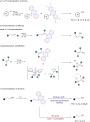
Nucleophilic functionalization of thianthrenium salts under basic conditions
Beilstein J. Org. Chem. 2024, 20, 257–263, doi:10.3762/bjoc.20.26
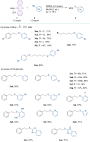
- (Me, t-Bu, OMe; 2c–e) and electron-withdrawing groups (Cl and CF3; 2f, and 2g) at the para-position of the aryl ring of thiophenols were well tolerated, furnishing the desired products (3ac–ag) in good yields. The reaction yield remains unaffected by the position of halogen substituents (2h–j), and



Copper-catalyzed multicomponent reaction of β-trifluoromethyl β-diazo esters enabling the synthesis of β-trifluoromethyl N,N-diacyl-β-amino esters
Beilstein J. Org. Chem. 2024, 20, 212–219, doi:10.3762/bjoc.20.21
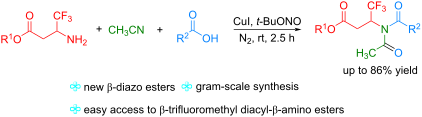
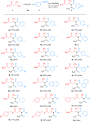
- groups, including alkyl (4a–e), halogen (4h–l), and phenyl (4m), were all suitable substrates for this reaction. However, the benzoic acid with ortho-substituent did not afford the expected product (4f) mainly due to the steric hindrance effect. Notably, substrates with electron-withdrawing groups (4h–l




Copper-promoted C5-selective bromination of 8-aminoquinoline amides with alkyl bromides
Beilstein J. Org. Chem. 2024, 20, 155–161, doi:10.3762/bjoc.20.14
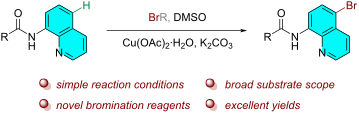
- important auxiliary group for the proximal C–H activation with the efforts of Daugulis [5] and others [6]. Results from medical research indicated that the introduction of halogen atoms into quinoline motifs has positive effects on their bioactivities, such as antimalarial, antitumor, and so on [7
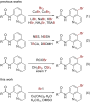
- , the synthesis of important C5-halogenated products gained particular attention since Stahl et al. reported the first chlorination example using LiCl as the halogen source [10]. Following this pioneering work, elegant strategies for the C5–H bromination of the quinoline ring employing simple inorganic
- and organic bromine-containing compounds such as Br2, CuBr, CuBr2, LiBr, NaBr, KBr, HBr, NH4Br, and tetrabutylammonium bromide (TBAB) as halogen sources have been realized (Scheme 1, reaction 1) [11][12][13][14][15][16][17][18][19][20]. Another category of extensively used bromination reagents are



Synthesis of N-acyl carbazoles, phenoxazines and acridines from cyclic diaryliodonium salts
Beilstein J. Org. Chem. 2024, 20, 12–16, doi:10.3762/bjoc.20.2
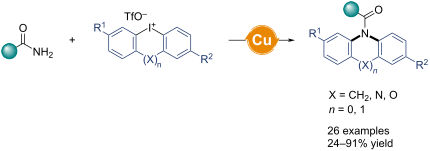
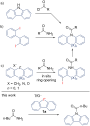
- , this new method creates two C–N bonds simultaneously based on a mono-halogenated starting material, thus allowing heterocycle formation with diminished halogen waste. Keywords: carbazoles; heteroaromatics; iodanes; metal-catalyzed; one-pot reaction; Introduction N-Acyl carbazoles are effective
- of two equivalents of halogen salt waste. Their substitution with iodolium salts will be more sustainable since it reduces these unproductive halogenide salts by half. Due to our recent activity in the field of synthesis and applications of 5- and 6-membered cyclic iodonium salts, we searched for an

Biphenylene-containing polycyclic conjugated compounds
Beilstein J. Org. Chem. 2023, 19, 1895–1911, doi:10.3762/bjoc.19.141
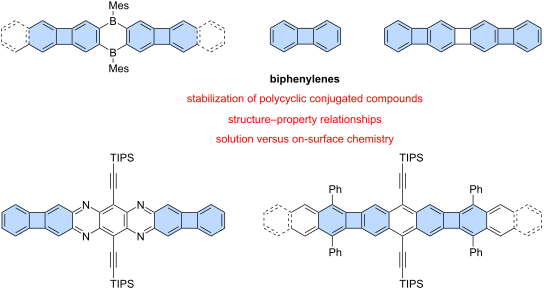
- subjecting α,α,α′,α′-tetrabromo-o-xylene (16) to t-BuOK to anhydrous conditions, biphenylene derivative 17 was obtained with a yield of 69% (Scheme 3). In the final step of the synthesis, a halogen–lithium exchange was carried out, followed by treatment with MeOH, resulting in a 79% yield of benzo[b
- , resulting in the formation of compound 75. Further transformation through lithium–halogen exchange, followed by reaction with Me3SiCl, yielded bis(trimethylsilylated) intermediate 76 in a 90% yield. By utilizing the conditions outlined in the prior investigation [49], compound 76 was subjected to a reaction



Synthesis of 7-azabicyclo[4.3.1]decane ring systems from tricarbonyl(tropone)iron via intramolecular Heck reactions
Beilstein J. Org. Chem. 2023, 19, 1615–1619, doi:10.3762/bjoc.19.118
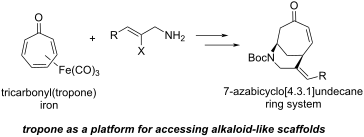
- cyclized product 16 in 75% yield. These results suggest that these Heck cyclizations are quite sensitive to the identity of the alkene substituent that is cis to the halogen. We were also interested in engaging vinyl iodide 17 in a 7-exo-trig cyclization to form 18. Z-Iodoalkene 17 appeared to react


Radical chemistry in polymer science: an overview and recent advances
Beilstein J. Org. Chem. 2023, 19, 1580–1603, doi:10.3762/bjoc.19.116
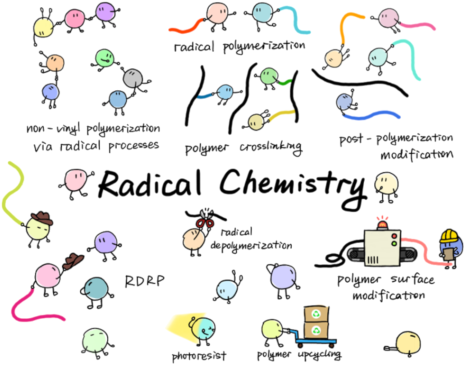
- ATRP relies on the establishment of a reversible activation/deactivation equilibrium reaction between an alkyl halide or halide-like initiator (RX) and a radical species (R·) [43]. During the activation process, the organohalides quickly lose their terminal halogen atoms in the presence of the liganded
- complex (deactivator, X–Mtz+1/L, typically X–CuII/L) to accumulate. When the accumulation reaches a certain level, the deactivator interacts with the active radical chain species (Pn·), so that the radical chain species gets into the dormant state (PnX) via a halogen atom transfer process. This is the
- process that usually qualifies for a definition of “click chemistry” [44]. A similar radical addition to vinyl groups takes place in ATRA despite the halogen atom transfer is mediated by a metal complex. Post-polymerization modification by ATRA was pioneered by Jérôme and co-workers [110][111]. In 2014




Synthesis of ether lipids: natural compounds and analogues
Beilstein J. Org. Chem. 2023, 19, 1299–1369, doi:10.3762/bjoc.19.96
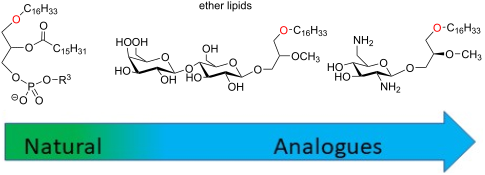
- cesium cation with the halogen atom and the activation of the Sn–O bond of the stannylene acetal via a pentacoordinated intermediate with the fluoride anion [110]. The acetylation of the secondary alcohol and the deprotection of the primary alcohol with 2,3-dichloro-5,6-dicyano-1,4-benzoquinone (DDQ






Radical ligand transfer: a general strategy for radical functionalization
Beilstein J. Org. Chem. 2023, 19, 1225–1233, doi:10.3762/bjoc.19.90
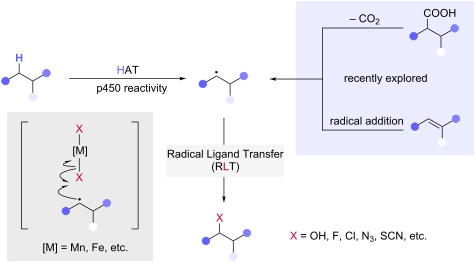
- paradigm with photocatalytic ATRA to enable the modular difunctionalization of alkenes under reagent control (Scheme 3). In Stephenson’s photocatalytic ATRA reports, the C–X bond in the product was proposed to be formed through both direct quenching of a transient alkyl radical by halogen atom transfer





