Search results
Search for "photophysical properties" in Full Text gives 209 result(s) in Beilstein Journal of Organic Chemistry. Showing first 200.
Regioselectively α- and β-alkynylated BODIPY dyes via gold(I)-catalyzed direct C–H functionalization and their photophysical properties
Beilstein J. Org. Chem. 2020, 16, 587–595, doi:10.3762/bjoc.16.53
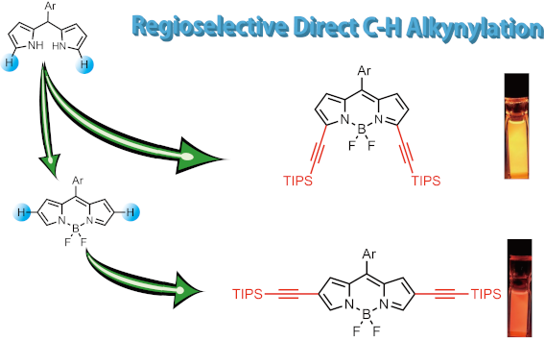
- . Depending on the position of the ethynyl substituent in the BODIPY skeleton, the photophysical properties of the resulting α- and β-substituted BODIPYs are notably altered. The lowest S0–S1 transition absorbance and fluorescence bands are both bathochromically shifted as the number of substituents increases
- , while the emission quantum yields of the β-ethynylated derivatives are significantly lower than those of α-ethynylated ones. The current method should be useful for fine-tuning of the photophysical properties of BODIPY dyes as well as for constructing BODIPY-based building cores for functional π
- afford α-monoethynyl and α,α'-diethynyl-substituted BODIPYs 3 and 4, respectively. The resulting ethynylated BODIPY isomers demonstrated site-dependent photophysical properties. Results and Discussion Synthesis and characterization To prepare the α,α'-diethynyl BODIPY 4a, 5-mesityldipyrromethane 2 was



Copper-catalyzed remote C–H arylation of polycyclic aromatic hydrocarbons (PAHs)
Beilstein J. Org. Chem. 2020, 16, 530–536, doi:10.3762/bjoc.16.49
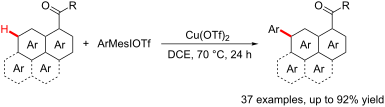
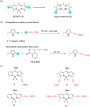
- fluorescence, and have been widely applied in many scientific areas including chemistry, biomedicine and materials science [1][2][3][4][5][6]. The arylation reaction of PAHs is an important strategy to further extend the π-conjugation length, which can effectively adjust the photophysical properties of
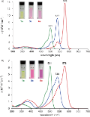
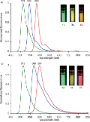
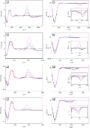
- the C8–Cu bond delivers Cu(I), meantime, the OTf anion takes away the proton from the C7-position, affording the desired product 3 or 4. Subsequently, the photophysical properties of the arylation products 4k, 4n and 4o were investigated (Figure 1). Their absorption bands cover from 300 nm to 400 nm




Six-fold C–H borylation of hexa-peri-hexabenzocoronene
Beilstein J. Org. Chem. 2020, 16, 391–397, doi:10.3762/bjoc.16.37
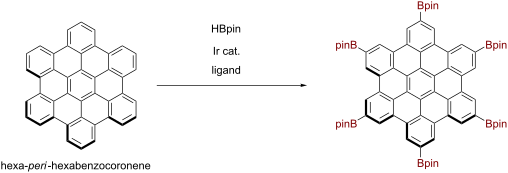
- 50% probability; all hydrogen atoms and solvent molecules (pentane) are omitted for clarity; gray: carbon; olive green: boron; red: oxygen. (b) Side view of 1. (c) Packing mode of 1. Photophysical properties of 1. (a) UV–vis absorption (solid lines) spectra, fluorescence (dotted line) spectrum


Synthesis and circularly polarized luminescence properties of BINOL-derived bisbenzofuro[2,3-b:3’,2’-e]pyridines (BBZFPys)
Beilstein J. Org. Chem. 2020, 16, 325–336, doi:10.3762/bjoc.16.32
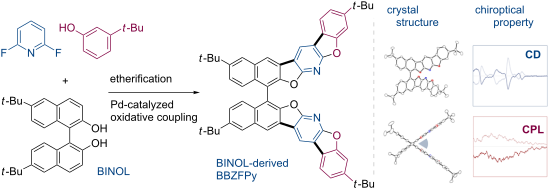
- ; palladium; Introduction Densely-fused (hetero)aromatic compounds have been a key motif in a wide range of manufactured functional molecules, as they exhibit fundamentally useful electrochemical and photophysical properties. Considerable effort has therefore taken into the development of efficient methods


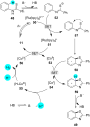
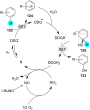
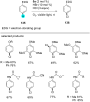
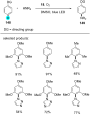
Recent developments in photoredox-catalyzed remote ortho and para C–H bond functionalizations
Beilstein J. Org. Chem. 2020, 16, 248–280, doi:10.3762/bjoc.16.26
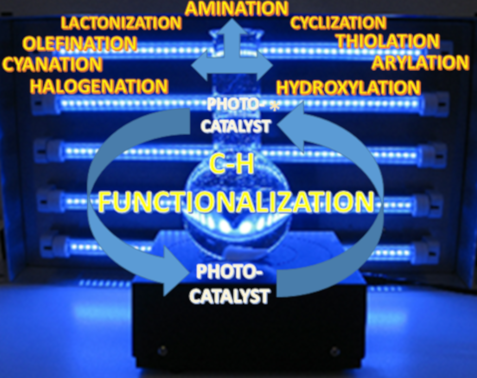
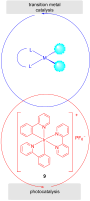
- into chemical energy via the generation of reactive intermediates through electron transfer reactions. A photochemical reaction is directed by the photophysical properties of an electronically excited molecule. The first vibrational equilibrated singlet excited state is S1, and it depends on both












Reversible photoswitching of the DNA-binding properties of styrylquinolizinium derivatives through photochromic [2 + 2] cycloaddition and cycloreversion
Beilstein J. Org. Chem. 2020, 16, 111–124, doi:10.3762/bjoc.16.13
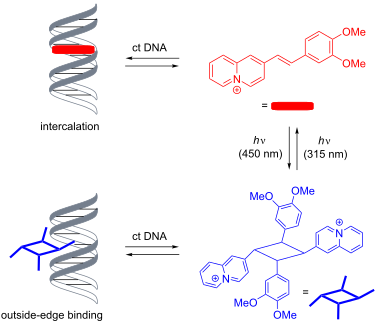
- the alkene protons (3JH–H = 16 Hz) [70]. Absorption and emission properties The photophysical properties of the styrylquinolizinium derivatives 3a and 3c have already been reported [69], while the ones of 3b and 3d were determined in this work (Table 1 and Figure 1). In acetonitrile, the derivatives




Starazo triple switches – synthesis of unsymmetrical 1,3,5-tris(arylazo)benzenes
Beilstein J. Org. Chem. 2020, 16, 22–31, doi:10.3762/bjoc.16.4
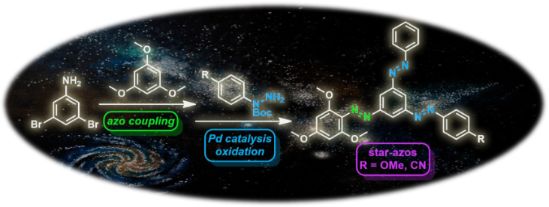
- 20% was achieved, whereas the methoxy derivative 3b could be isolated in a good yield of 59%. Having both tris(arylazo)benzenes 3a/3b in hand, UV–vis spectroscopy was used for preliminary investigations on the photophysical properties of the molecular triple switches 3. Both tris(arylazo)benzenes 3a


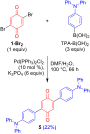
Synthesis and optoelectronic properties of benzoquinone-based donor–acceptor compounds
Beilstein J. Org. Chem. 2019, 15, 2914–2921, doi:10.3762/bjoc.15.285

- LUMO energies of 2–5 are in good agreement with the calculated values (Figure 3). Photophysical properties We next investigated the photophysical properties of 2–5. The UV–vis absorption and photoluminescence (PL) spectra in degassed DCM solution are shown in Figure 5, and the data are summarized in
- theoretical, electrochemical, and photophysical properties of the donor–acceptor compounds 2–5 were determined in solution and thin film. While compounds 2, 4, and 5 were very poorly emissive, 3 showed a green emission with a biexponential lifetime characterized by a prompt nanosecond component and a delayed





Design, synthesis and investigation of water-soluble hemi-indigo photoswitches for bioapplications
Beilstein J. Org. Chem. 2019, 15, 2822–2829, doi:10.3762/bjoc.15.275
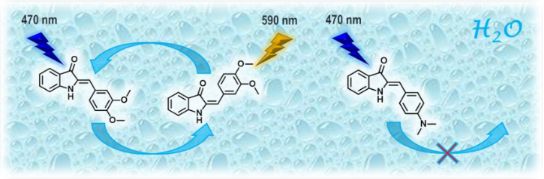
- . Photochemical and photophysical properties of hemi-indigo derivatives 1a–c and 2 in water. Supporting Information Supporting Information File 610: Additional spectral data, detailed description of the experiments performed, NMR of compounds Z-1a–c and LED characteristics. Acknowledgements This project has


Chemical tuning of photoswitchable azobenzenes: a photopharmacological case study using nicotinic transmission
Beilstein J. Org. Chem. 2019, 15, 2812–2821, doi:10.3762/bjoc.15.274
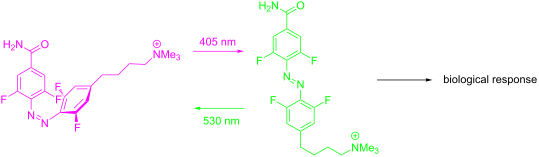
- preserving all the favorable photophysical properties of the parent 4FAB scaffold, however, the tetrafluoro motif can significantly perturb pharmacophore–protein interactions. In contrast, we found that the freely diffusible 4FABTA probe could be pre-set with green light into an OFF state that was




Fluorinated maleimide-substituted porphyrins and chlorins: synthesis and characterization
Beilstein J. Org. Chem. 2019, 15, 2704–2709, doi:10.3762/bjoc.15.263

- the maleimide group with its rich biological activity to the tetrapyrrole macrocycles with their unique photophysical properties may result in new conjugates with improved chemical, biological and anticancer characteristics [28]. Moreover, maleimide is a stable functionality that rapidly and


Emission solvatochromic, solid-state and aggregation-induced emissive α-pyrones and emission-tuneable 1H-pyridines by Michael addition–cyclocondensation sequences
Beilstein J. Org. Chem. 2019, 15, 2684–2703, doi:10.3762/bjoc.15.262
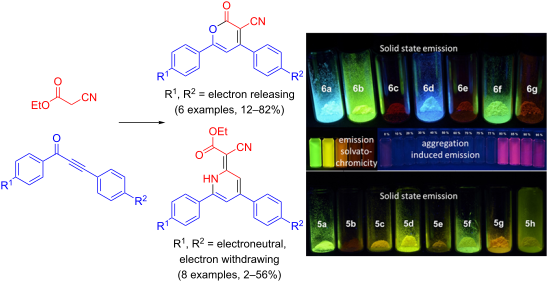
- , dimethylamino-substituted α-pyrones, as donor–acceptor systems, display remarkable photophysical properties, such as strongly red-shifted absorption and emission maxima with daylight fluorescence and fluorescence quantum yields up to 99% in solution and around 11% in the solid state, as well as pronounced
- achieved [4]. Small molecule organic fluorophores are particularly advantageous due to the potential of a tailored fine-tuning of their photophysical properties through synthetic modifications [5]. Based on their structural features, functionalized organic chromophores, containing N-, O- or S-atoms, are
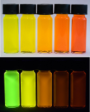
- Supporting Information File 1) [50][51][52][53][54][55][56][57]. Photophysical properties Photophysical properties of 1H-pyridines 5 and 8 1H-Pyridine derivatives 5 are yellow or orange compounds under daylight (Figure 3, top) and fluoresce in solution (Figure 3, center) and in the solid state (Figure 3




Plasma membrane imaging with a fluorescent benzothiadiazole derivative
Beilstein J. Org. Chem. 2019, 15, 2644–2654, doi:10.3762/bjoc.15.257
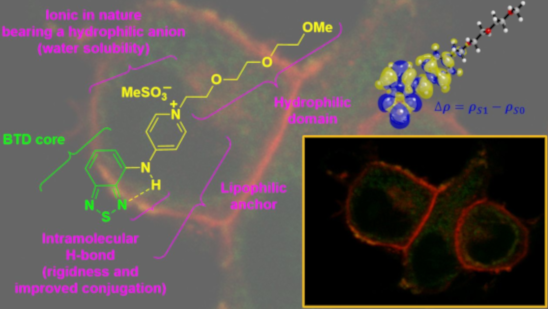
- -soluble and selective bioprobe for plasma membrane imaging. The new compound was efficiently synthesized in a two-step procedure with good yields. The photophysical properties were evaluated and the dye proved to have an excellent photostability in several solvents. DFT calculations were found in
- derivative. The photophysical properties of the new compound BTDE-4APTEG have been investigated and the results are summarized in Table 1 and presented in Figure 2. All absorption maxima were observed in the UV region close to 375 nm and with reasonable molar extinction coefficients. Large Stokes shifts were
- yielded the best overall performance across all studied solvents with an absolute deviation below 10 nm. PBE1PBE was therefore selected as the most suitable XCF (amongst the six investigated XCFs) for studying the photophysical properties of BTD-4APTEG. The structure geometry was fully optimized in


Arylisoquinoline-derived organoboron dyes with a triaryl skeleton show dual fluorescence
Beilstein J. Org. Chem. 2019, 15, 2612–2622, doi:10.3762/bjoc.15.254
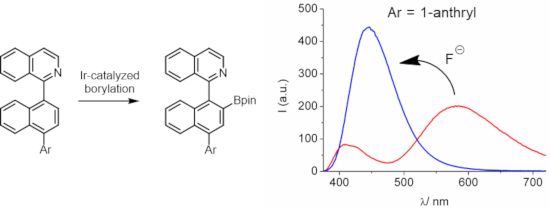
- advantageous photophysical properties that include spectrally tunable and highly intense fluorescence [1][2]. On the one hand, those compounds that contain the boron atom in a valence-saturated situation corresponding to sp3 hybridization (such as Bodipy dyes [3][4], N,C-chelate organoboron dyes [5][6][7][8][9
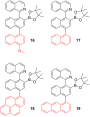
- electron-transfer phenomena or two-photon absorption [32][33][34][35][36]. As part of our research program we have developed arylisoquinolines that integrate a boronic acid ester [37][38][39] or a BMes2 unit [6][40]. The presence of the boron-substituent confers interesting photophysical properties to
- the verification of the effect of aromatic conjugation (naphthyl, anthryl, pyrenyl) and electron-donor strength (naphthyl versus 4-methoxynaphthyl) on the photophysical properties. Beside the observation of interesting dual emission properties for these dyes, some showed a pronounced ratiometric



Probing of local polarity in poly(methyl methacrylate) with the charge transfer transition in Nile red
Beilstein J. Org. Chem. 2019, 15, 2552–2562, doi:10.3762/bjoc.15.248
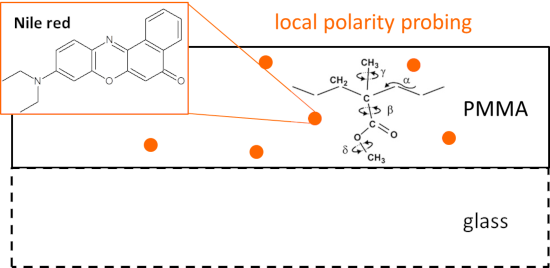
- substrate-supported ultrathin films [13], the analysis of the photophysical properties of tracer dye molecules was found to be beneficial. In time-resolved fluorescence measurements and dye diffusion studies, the nanoenvironments in polymersomes could be assigned [1][12], solute transport be characterized



Self-assembled coordination thioether silver(I) macrocyclic complexes for homogeneous catalysis
Beilstein J. Org. Chem. 2019, 15, 2465–2472, doi:10.3762/bjoc.15.239
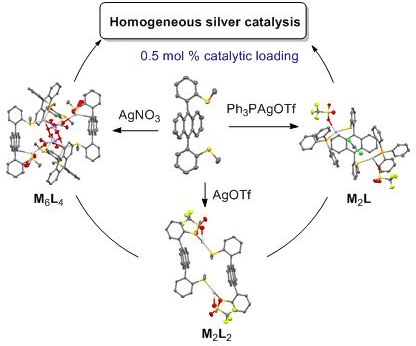
- ). Finally, the photophysical properties of ligand syn-1 (20 μM) and complexes 1a–d (30 μM) were evaluated in dichloromethane (Supporting Information File 1, Figures S4–S8). The UV–visible and fluorescence emission spectra (λexc = 345 nm) of ligand and complexes were similar and correspond to those of 9,10


Mono- and bithiophene-substituted diarylethene photoswitches with emissive open or closed forms
Beilstein J. Org. Chem. 2019, 15, 2344–2354, doi:10.3762/bjoc.15.227
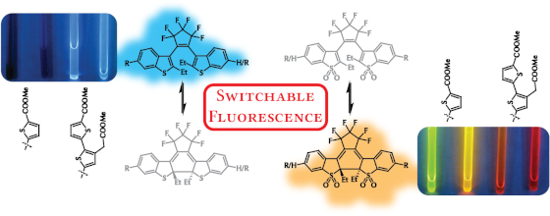
- ) were detected, confirming cleavage of the methyl esters. Photophysical properties The absorption and emission properties as well as the photochromic properties of eight “thiophenylated” DAEs were studied in acetonitrile solutions (Table 1). The properties of the OFs (open forms) were obtained from


Synthesis of a dihalogenated pyridinyl silicon rhodamine for mitochondrial imaging by a halogen dance rearrangement
Beilstein J. Org. Chem. 2019, 15, 2333–2343, doi:10.3762/bjoc.15.226
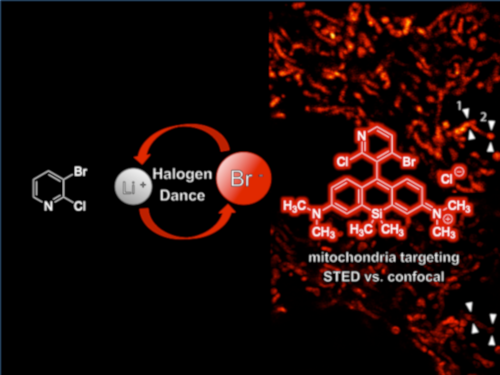
- photophysical properties of numerous silicon rhodamines leading to further insights into the correlation of the dyes’ chemical structure with their fluorogenic behavior [27]. Regarding the quantum yield, Hanaoka et al. have shown that introduction of methyl, methoxy or dimethylamine groups into the benzene
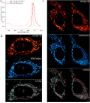
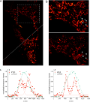
- experiments (supported by DFT calculations) on the orbital effects of both halogens and the nitrogen position in the pyridine ring are needed to explain these effects with confidence. In addition, our SiR dye 15 displays photophysical properties (extinction coefficient, quantum yield, lifetime) in the same



Fluorescent phosphorus dendrimers excited by two photons: synthesis, two-photon absorption properties and biological uses
Beilstein J. Org. Chem. 2019, 15, 2287–2303, doi:10.3762/bjoc.15.221
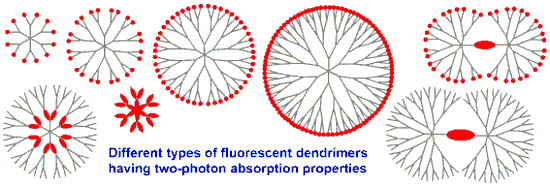
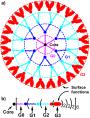
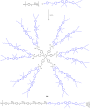
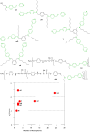
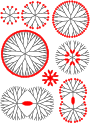
- dendrimers having TPA fluorophores as branches and water-solubilizing functions on the surface. Photophysical properties of the types of dendrimers shown in Scheme 2 (measured in toluene). Comparison of the photophysical properties (in toluene) of the spherical dendrimers shown in Scheme 2, with that of the









Synthesis and properties of sulfur-functionalized triarylmethylium, acridinium and triangulenium dyes
Beilstein J. Org. Chem. 2019, 15, 2133–2141, doi:10.3762/bjoc.15.210
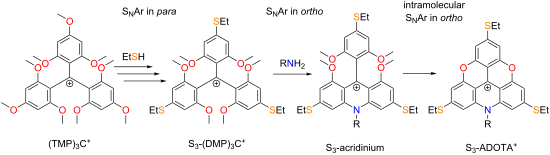
- fluorescence lifetime (τfl) [12][13] are key photophysical properties to consider and optimize for any given application. We have for quite some time been interested in the synthesis, properties and applications of dyes from the triangulenium family (Figure 1) [14][15]. The triangulenium dyes can be divided
- also in agreement with the observation that 5a (and 5b) display intense fluorescence (Figure 6). Table 3 summarizes the spectral and photophysical properties on the triangulenium dyes showing any applicable fluorescence. Beside S3-ADOTA+ (5a) that are the double and triple -SEt-substituted TOTAs 6 and


Synthesis of benzo[d]imidazo[2,1-b]benzoselenoazoles: Cs2CO3-mediated cyclization of 1-(2-bromoaryl)benzimidazoles with selenium
Beilstein J. Org. Chem. 2019, 15, 2029–2035, doi:10.3762/bjoc.15.199
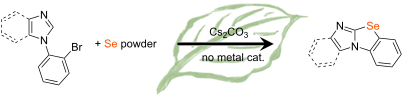
- -fluorobenzene, and Se powder under the optimized conditions, i.e., in the presence of Cs2CO3 (2 equiv) in DMF under an argon atmosphere at 150 °C. This reaction gave product 2a in only 35% yield, suggesting that the stepwise reaction via 1-(2-bromoaryl)benzimidazole 1 is superior. Next, the photophysical
- properties of the synthesized compounds were evaluated, and the corresponding data are shown in Table 2 and Figure 3. 1-Phenylbenzimidazole (11), which does not contain a selenium atom, has an absorption maximum at 283 nm. In contrast, the maximum absorption wavelength (λmax) of parent compound 2a was found


Fluorinated azobenzenes as supramolecular halogen-bonding building blocks
Beilstein J. Org. Chem. 2019, 15, 2013–2019, doi:10.3762/bjoc.15.197
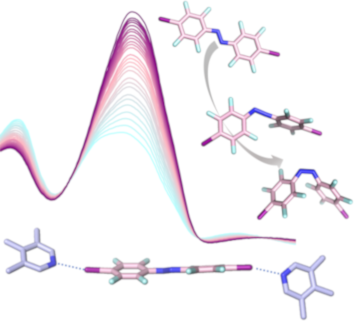
- azobenzenes with different halogen bonding donor properties are discussed in relation to their changing photophysical properties, rationalized by DFT calculations. Keywords: azobenzene; DFT calculations; fluorine chemistry; halogen bonding; photochemistry; Introduction The halogen bond is an attractive
- iodoethynyl group, as trade-off, photophysical properties are changing. The bathochromic shift of the π→π* band leads to an overlap with the n→π* excitation, making it more difficult to address, together with a diminishing thermal half-life. Both effects can be qualitatively reproduced and understood with the


Identification of optimal fluorescent probes for G-quadruplex nucleic acids through systematic exploration of mono- and distyryl dye libraries
Beilstein J. Org. Chem. 2019, 15, 1872–1889, doi:10.3762/bjoc.15.183
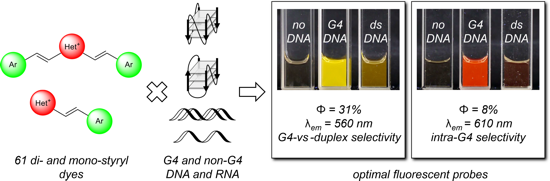
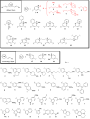
- at the improvement of photophysical properties of the dyes and the establishment of structure–properties relationships. Results Design and synthesis of the dye library On the basis of the previously established distyryl scaffold, we designed 49 novel derivatives through systematic variation of the







Norbornadiene-functionalized triazatriangulenium and trioxatriangulenium platforms
Beilstein J. Org. Chem. 2019, 15, 1815–1821, doi:10.3762/bjoc.15.175
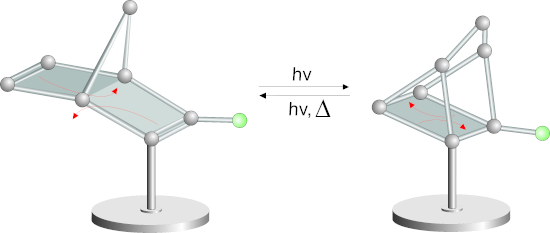
- platform 2 (44%). The photophysical properties and the switching behaviour of 1, 2 and 3 were determined in solution (THF). The UV–vis spectra of the norbornadienes (NBD, black, 1a, 2a, 3a) and quadricylanes (QC, red, 1b, 2b, 3b) and the spectra of the QCs after irradiation with 311 nm for 1b and 2b or 254


Synthesis, photophysical and electrochemical properties of pyridine, pyrazine and triazine-based (D–π–)2A fluorescent dyes
Beilstein J. Org. Chem. 2019, 15, 1712–1721, doi:10.3762/bjoc.15.167
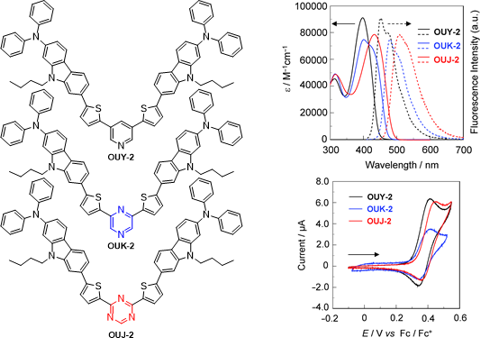
- solvents are much larger than those in nonpolar solvents (Table 1). In order to investigate the solid-state photophysical properties of OUY-2, OUK-2 and OUJ-2, we have measured the solid-state fluorescence spectra of the solids (Figure 4). The λmax,fl of the as-recrystallized dyes appears at 550 nm for OUY