Search results
Search for "Brønsted acid" in Full Text gives 161 result(s) in Beilstein Journal of Organic Chemistry.
Gold(I)-catalysed one-pot synthesis of chromans using allylic alcohols and phenols
Beilstein J. Org. Chem. 2013, 9, 1797–1806, doi:10.3762/bjoc.9.209
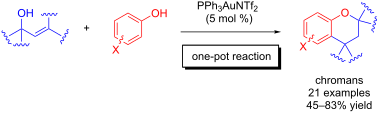
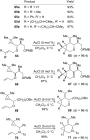
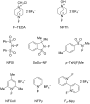
- , entries 8–10). Firstly, no reaction is observed in the absence of a catalyst (Table 1, entry 8). The Brønsted acid catalyst HNTf2 does form chroman 8, but in a poorer isolated yield (21%, Table 1, entry 9) and the silver salt [76] AgNTf2 as a catalyst does not provide any 8, yielding only 9 and 10 (Table
- 1, entry 10). The former is consistent with literature reports that Brønsted acid-catalysed reactions give poor yields when the phenol is not para-substituted [19]. Therefore, it seems that the gold(I) catalyst is most efficient in catalysing the one-pot formation of chroman 8. With these results in
- temperature (Table 2, entries 4, 7, 8 and 10). In contrast to the Brønsted acid procedure [19], the substitution position has limited effect on the efficiency of the gold-catalysed reaction, with p-cresol (5b), m-cresol (5c) and o-cresol (5d) all forming the desired chromans 8b–d in decent to good yields


A Lewis acid-promoted Pinner reaction
Beilstein J. Org. Chem. 2013, 9, 1572–1577, doi:10.3762/bjoc.9.179

- electrophile (Scheme 5). Reaction of silyl ether and nitrilium cation leads to a cationic N,O-bis(trimethylsilyl)imino ester, which is hydrolyzed to a carboxylic ester. Formation of the Brønsted acid trifluoromethanesulfonic acid is to be expected under these reaction conditions, but seems to have no influence


Organocatalytic asymmetric selenofunctionalization of tryptamine for the synthesis of hexahydropyrrolo[2,3-b]indole derivatives
Beilstein J. Org. Chem. 2013, 9, 1559–1564, doi:10.3762/bjoc.9.177
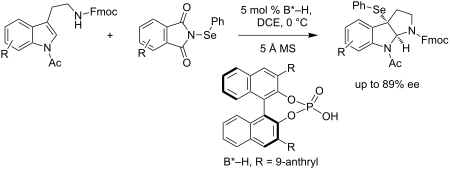
- ]. These leading findings indicate that either Lewis base or Brønsted acid shows catalytic activity for the selenofunctionalization reaction. Since chiral phosphoric acids have been shown to be Brønsted acid/Lewis base bifunctional organocatalysts [29][30][31][32][33], we ask whether the chiral BINOL-based


Re2O7-catalyzed reaction of hemiacetals and aldehydes with O-, S-, and C-nucleophiles
Beilstein J. Org. Chem. 2013, 9, 1526–1532, doi:10.3762/bjoc.9.174
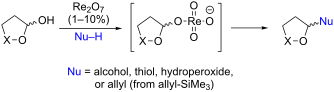
- a Brønsted acid. Keywords: allylation; hemiacetal; O,O-acetal; O,S-thioacetal; peroxyacetal; Re2O7; S,S-acetal; Introduction The synthetically important conversions of hemiacetals to acetals, thioacetals, or homoallyl ethers are typically achieved through activation of the substrate with a strong
- ], we needed to prepare a number of 3-alkoxy-1,2-dioxolanes. Brønsted acid-promoted etherification of hemiacetals (1,2-dioxolan-3-ols) required harsh conditions and proceeded in good yields only for unhindered alcohols [18]. We were curious whether Re2O7, a catalyst known to activate alcohols via a
- ions [21][22]. As illustrated in Table 5, tetrahydrofuranol and tetrahydropyranol both undergo condensation with a simple thiol in the presence of Re2O7 to provide the monothioacetal in good yield; only traces of the S,S-dithioacetal were observed. The same reaction, when catalyzed by a Brønsted acid


Thiourea-catalyzed Diels–Alder reaction of a naphthoquinone monoketal dienophile
Beilstein J. Org. Chem. 2013, 9, 1414–1418, doi:10.3762/bjoc.9.158

- of one equivalent of Brønsted acid 8 had no effect (Table 2, entry 4), the addition of TADDOL (9) improved the reaction speed (Table 2, entry 5). By the use of Schreiner's catalyst 10 [7], the highest conversion speed was observed (Table 2, entry 6). After this finding, Jacobsen's thioureas 11 [13


Mild and efficient cyanuric chloride catalyzed Pictet–Spengler reaction
Beilstein J. Org. Chem. 2013, 9, 1235–1242, doi:10.3762/bjoc.9.140
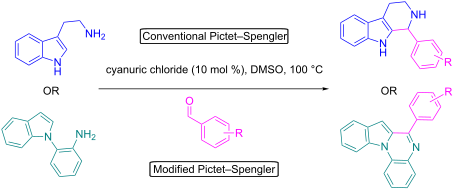
- -dimethylaminobenzaldehyde. These aldehydes failed to produce the cyclized product in desired yield under conventional Brønsted acid catalysis and often produced the oxidized products under harsher reaction conditions. TCT under an inert atmosphere allowed for a clean reaction with a broad substrate scope and application


Camera-enabled techniques for organic synthesis
Beilstein J. Org. Chem. 2013, 9, 1051–1072, doi:10.3762/bjoc.9.118
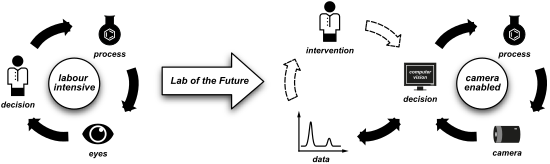
- with various solid-phase Brønsted acid catalysts in supercritical carbon dioxide (Figure 7), Poliakoff and co-workers studied the effect of varying the concentration of the organic reagent in the liquid CO2 solvent [46]. The high pressures required (100–400 bar) stipulated the use of a sealed reaction


Gold-catalyzed oxycyclization of allenic carbamates: expeditious synthesis of 1,3-oxazin-2-ones
Beilstein J. Org. Chem. 2013, 9, 818–826, doi:10.3762/bjoc.9.93
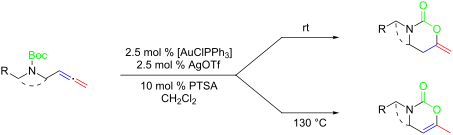
- (Scheme 2). Adding a catalytic amount of Brønsted acid (PTSA) into the reaction system did slightly improve the yield of 3a. Solvent screening demonstrated that dichloromethane was the best choice in the reaction. As revealed in Scheme 2, a variety of allenic carbamates 2 were also suitable for such



Reductions of aldehydes and ketones with a readily available N-heterocyclic carbene borane and acetic acid
Beilstein J. Org. Chem. 2013, 9, 675–680, doi:10.3762/bjoc.9.76

- acid functions as a Brønsted acid to activate the carbonyl group towards attachment by 1. This is different from NaBH4, which reacts quickly with acetic acid to liberate H2 and form a modified reducing agent, NaBH(OAc)3 [21][22]. Even with heating, the direct acid/base reaction of 2 and acetic acid was


Asymmetric Brønsted acid-catalyzed aza-Diels–Alder reaction of cyclic C-acylimines with cyclopentadiene
Beilstein J. Org. Chem. 2012, 8, 1819–1824, doi:10.3762/bjoc.8.208
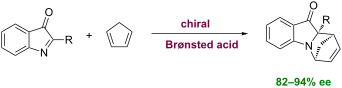
- Magnus Rueping Sadiya Raja Institute of Organic Chemistry, RWTH Aachen University, Landoltweg 1, D-52074 Aachen, Germany 10.3762/bjoc.8.208 Abstract A new chiral Brønsted acid-catalyzed aza-Diels–Alder reaction of cyclic C-acylimines with cyclopentadiene has been developed. The reaction provides
- ][29][30][31][32]. To the best of our knowledge the enantioselective Brønsted acid catalyzed aza-Diels–Alder reaction of imines with less-electron-rich dienes has not been reported. Thus, we decided to examine the unprecedented Brønsted acid catalyzed aza-Diels–Alder reaction of cyclic C-acylimines
- when the reaction was performed in toluene at −60 °C in the presence of catalyst 4a (Table 1, entry 1). A slight increase in enantioselectivity was observed when the reaction was conducted at −78 °C (Table 1, entry 2). Subsequently, different catalysts were applied in the Brønsted acid catalyzed hetero


Synthesis and ring openings of cinnamate-derived N-unfunctionalised aziridines
Beilstein J. Org. Chem. 2012, 8, 1747–1752, doi:10.3762/bjoc.8.199
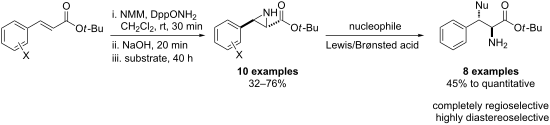
- , aziridine 1a was found to undergo ring opening under Lewis and Brønsted acid catalysed conditions with a range of nucleophiles to provide amino-acid derivatives in good to excellent yield (Figure 2). The ring openings proved to be completely regioselective for the C3-benzylic position of aziridine 1a. This


Organocatalytic cascade aza-Michael/hemiacetal reaction between disubstituted hydrazines and α,β-unsaturated aldehydes: Highly diastereo- and enantioselective synthesis of pyrazolidine derivatives
Beilstein J. Org. Chem. 2012, 8, 1710–1720, doi:10.3762/bjoc.8.195
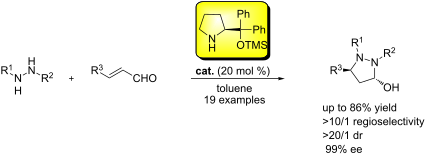
- -pyrazolines starting from α,β-unsaturated ketones and phenylhydrazine or N-tert-butyloxycarbonylhydrazine in the presence of a chiral Brønsted acid or a phase-transfer catalyst [70][71]. Compared with monosubstituted hydrazines in organocatalytic asymmetric synthesis, disubstituted hydrazines were also


Organocatalytic C–H activation reactions
Beilstein J. Org. Chem. 2012, 8, 1374–1384, doi:10.3762/bjoc.8.159
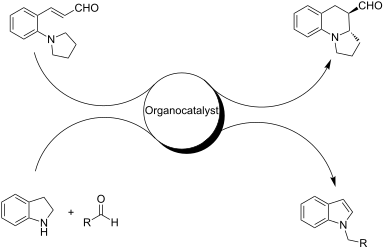
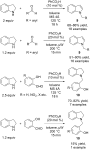
- . Akiyama and co-workers screened different Brønsted acid catalysts for their reaction, with PTSA emerging as the most effective catalyst [11]. Employing an optimized set of conditions, the reaction was conducted with different amines, and good to excellent yields (40–92%) were obtained (Scheme 2). A
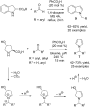
- plausible mechanism for these reactions is depicted in Scheme 3. After initial imine formation, a Brønsted acid promoted 1,5-hydride shift occurs yielding an imino-amine intermediate. Cyclization of the newly formed amine affords the desired aminal product. In 2011, Seidel and co-workers reported an indole
- -annulation cascade reaction with N,N-(dialkylamino)benzaldehydes, a process in which a 1,5-hydride shift occurs followed by larger ring formation [16]. After the evaluation of different Brønsted acid catalysts, diphenylphosphate (20 mol %) was identified as a suitable catalyst for the reaction. Toluene again





Organocatalysis
Beilstein J. Org. Chem. 2012, 8, 1358–1359, doi:10.3762/bjoc.8.156
- -molecular-weight organic compounds, in which a metal is not part of the active principle. Organocatalysts donate or remove electrons or protons as their activation mode, hence defining four distinct subareas: Lewis base and Lewis acid catalysis on the one hand, and Brønsted base and Brønsted acid catalysis
Asymmetric organocatalytic decarboxylative Mannich reaction using β-keto acids: A new protocol for the synthesis of chiral β-amino ketones
Beilstein J. Org. Chem. 2012, 8, 1279–1283, doi:10.3762/bjoc.8.144
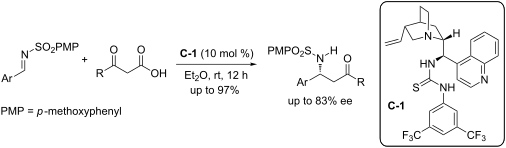
- great practical value. Indeed, direct approaches such as asymmetric enamine catalysis [14][15][16][17] and Brønsted acid catalysis [18] have been reported, through the activation of ketones or aryl imines [19]. However, substrates for the enamine activation are limited to only acetone and cyclic alkyl
- ketones. Application of aryl methyl ketones in the asymmetric Mannich reaction by enamine catalysis remains elusive. On the other hand, the only chiral Brønsted acid catalytic system based on BINOL-phosphates was reported by Rueping et al. Unfortunately, the yields of the reported reactions were


N-Heterocyclic carbene/Brønsted acid cooperative catalysis as a powerful tool in organic synthesis
Beilstein J. Org. Chem. 2012, 8, 398–402, doi:10.3762/bjoc.8.43
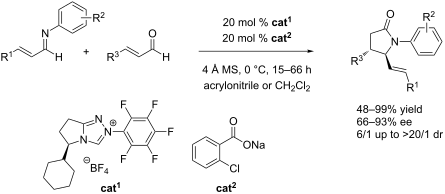
- functionalized pyrrolidin-2-ones as valuable scaffolds in heterocyclic chemistry. This Commentary will briefly highlight the concept of N-heterocyclic carbene/Brønsted acid cooperative catalysis as a new and powerful methodology in organic chemistry. Keywords: Brønsted acids; cooperative catalysis; γ-lactams; N
- that the combination of a pentafluorophenyl triazolium carbene 5 and a Brønsted acid with low pKa value may provide new opportunities for the design of reaction pathways in which the carbene and the acid play different roles. The idea to use a very weak base in NHC catalysis has also been described by
- reaction was performed by using a rather strong base (KHMDS, Et3N) to deprotonate the carbene precursor, which led to the formation of a weak Brønsted acid with low yields and poor selectivities as a consequence. The use of weaker bases (carboxylates) resulted in stronger conjugate acids capable of


Continuous-flow catalytic asymmetric hydrogenations: Reaction optimization using FTIR inline analysis
Beilstein J. Org. Chem. 2012, 8, 300–307, doi:10.3762/bjoc.8.32
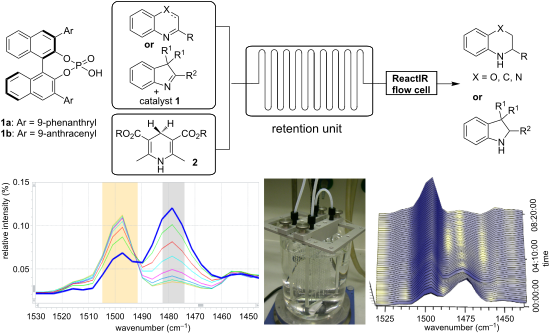
- : asymmetric reduction; binolphosphoric acid; Brønsted acid; Hantzsch dihydropyridine; IR spectroscopy; real-time analysis; Introduction In recent years, a growing interest in microreactor technology has been seen in the scientific community and the development of microfabricated reaction systems is actively
- Hantzsch dihydropyridine 2a as hydrogen source and a catalytic amount of chiral Brønsted acid 1a (Scheme 2) [102]. Initial experiments were carried out at 0.1 mL min−1 flow rate in a commercial glass microreactor, which was attached to the ReactIR flow cell for in situ reaction monitoring. In order to
- , the product was isolated in 87% and 98% yields, respectively (Table 1). Having found the optimum reaction conditions, we next investigated the scope of the Brønsted acid catalyzed reduction of 3-aryl-substituted benzoxazines 3 (Table 2). In general, 3-aryl benzoxazines 3 bearing either electron


A concise synthesis of 3-(1-alkenyl)isoindolin-1-ones and 5-(1-alkenyl)pyrrol-2-ones by the intermolecular coupling reactions of N-acyliminium ions with unactivated olefins
Beilstein J. Org. Chem. 2012, 8, 192–200, doi:10.3762/bjoc.8.21

- terminal alkynes to give the doubly alkyl-substituted acetylenes [1][2][3]; the Brønsted acid and Lewis acid catalyzed coupling of alcohols with indoles to give the 3-alkyl-substituted indoles [4][5][6]; and the Brønsted acid and Lewis acid-catalyzed coupling of alcohols with 1,3-dicarbonyls to give the 2
- ]. We have long been interested in the reactions of N-acyliminium ions produced easily by the Brønsted acid and Lewis acid catalyzed dehydroxylation of α-hydroxyamides [12][13][14]. The high electrophilicity of these species is very suitable for electrophilic addition to carbon–carbon multiple bonds


Efficient, highly diastereoselective MS 4 Å-promoted one-pot, three-component synthesis of 2,6-disubstituted-4-tosyloxytetrahydropyrans via Prins cyclization
Beilstein J. Org. Chem. 2012, 8, 177–185, doi:10.3762/bjoc.8.19
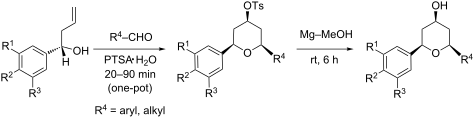
- , economical and stereoselective synthesis. To introduce the desired substituents and stereochemistry at the 2, 4 and 6-positions of the tetrahydropyran ring, Prins cyclization has been considered to be the best approach. The reaction can be conducted either with Brønsted acid catalysts – namely TFA [12], AcOH
- and unsymmetrical tetrahydropyrans can be synthesized. p-Toluenesulfonic acid (PTSA) is reported as a versatile Brønsted acid catalyst in various organic transformations [32][33][34]. Previously, PTSA has been used as a catalyst in Prins cyclizations but the product yields were low even under extended


Efficient oxidation of oleanolic acid derivatives using magnesium bis(monoperoxyphthalate) hexahydrate (MMPP): A convenient 2-step procedure towards 12-oxo-28-carboxylic acid derivatives
Beilstein J. Org. Chem. 2012, 8, 164–169, doi:10.3762/bjoc.8.17
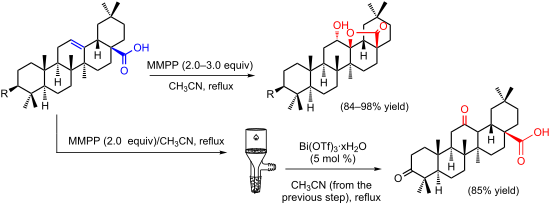
- -carboxylic acid 11 was obtained, in 85% yield, after the typical work-up procedure [18]. The formation of compound 11 from the 12α-hydroxy-28,13β-olide 2 is likely to occur due to the in situ generation of a Brønsted acid species from bismuth(III) triflate, which promotes ring opening of the 28,13β-olide


Development of the titanium–TADDOLate-catalyzed asymmetric fluorination of β-ketoesters
Beilstein J. Org. Chem. 2011, 7, 1421–1435, doi:10.3762/bjoc.7.166

- , entry 2), whereas the corresponding zirconium complex was inactive (Table 1, entry 3). Both the Brønsted acid HBF4 and the Lewis acid BF3 accelerated the reaction. Substrate 2 with a higher tendency towards enolization (Figure 2) gave higher conversions, but a similar trend. Interestingly, the






Gold(I)-catalyzed synthesis of γ-vinylbutyrolactones by intramolecular oxaallylic alkylation with alcohols
Beilstein J. Org. Chem. 2011, 7, 1198–1204, doi:10.3762/bjoc.7.139
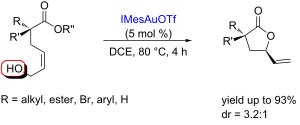
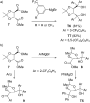
- ]. Subsequently, the direct nucleophilic attack by the carboxylate unit would lead to an oxonium intermediate III [50][51] that, after dealkylation, resulted in the final lactone 2. Control experiments have been performed to indentify the presence of a Brønsted acid cocatalysis in the ring-closing procedure (see


Recent advances in the gold-catalyzed additions to C–C multiple bonds
Beilstein J. Org. Chem. 2011, 7, 897–936, doi:10.3762/bjoc.7.103
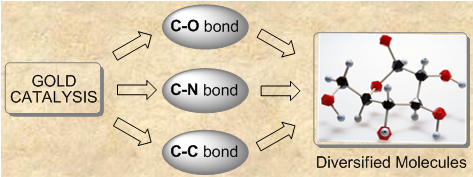
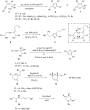
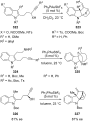
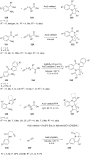
- ]. As pointed out by the researchers, the reactions proceeded with the initial formation of trans/cis mixtures of 2-alkyl-1-isopropyl-2-phenyl-1,2-dihydronaphthalene cations, which were converted into the desired cis-fused cycloadducts through the combined action of a gold catalyst and a Brønsted acid
- the Brønsted acid is both a chiral catalyst for the asymmetric cycloaddition and assists to facilitate the gold complex catalyzed hydroamination. Muratore et al. have reported an interesting example of C–N bond formation for the construction of chiral nitrogen-containing fused heterocycles 400 [191












Gold-catalyzed propargylic substitutions: Scope and synthetic developments
Beilstein J. Org. Chem. 2011, 7, 866–877, doi:10.3762/bjoc.7.99

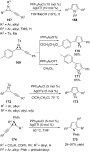
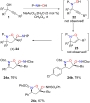
- Friedel–Crafts type reactions with benzylic and propargylic alcohols. Shortly after, Sanz and Zhan discovered, that these reactions could also be carried out under Brønsted acid and FeCl3 catalysis, respectively [26][27][28][29]. Later, the use of copper, indium, bismuth, scandium, ytterbium




When cyclopropenes meet gold catalysts
Beilstein J. Org. Chem. 2011, 7, 717–734, doi:10.3762/bjoc.7.82
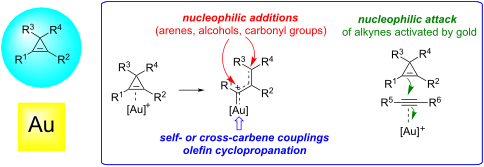
- activators [31]. Since AgOTf and BF3·OEt2 led to the same naphthalene product 21, the authors suspected that traces of the Brønsted acid (HOTf) present in the silver salt may be the actual catalyst and may also modify the regioselectivity observed in the gold-catalyzed reaction. Thus, several basic additives
- in the presence of electrophilic transition metal complexes. Shi et al. initially suggested that the formation of 22 preferentially occurs with a rather bulky electrophile such as Cu(OTf)2 to avoid repulsion with the aryl group at C2. Conversely, a Brønsted acid (generated by reaction of BF3·OEt2