


Search results
Search for "chlorination" in Full Text gives 154 result(s) in Beilstein Journal of Organic Chemistry.
An overview of the synthetic routes to the best selling drugs containing 6-membered heterocycles
Beilstein J. Org. Chem. 2013, 9, 2265–2319, doi:10.3762/bjoc.9.265
- readily prepared by chlorination of 2-pyridone (1.42) with phosphorous oxychloride (Scheme 8) [31][32]. The resulting primary alcohol 1.45 is then subjected to a second SNAr reaction with 4-fluorobenzaldehyde [33]. A Knoevenagel condensation of the aldehyde functionality in compound 1.47 with


An approach towards azafuranomycin analogs by gold-catalyzed cycloisomerization of allenes: synthesis of (αS,2R)-(2,5-dihydro-1H-pyrrol-2-yl)glycine
Beilstein J. Org. Chem. 2013, 9, 1936–1942, doi:10.3762/bjoc.9.229
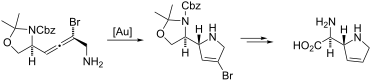
- ] (Scheme 4). This protection step was carried out in order to avoid dehydrogenation or chlorination of the secondary amine in the subsequent oxidation steps [64][65]. Acetal cleavage under mild protic conditions furnished the hydroxycarbamate, which underwent two-step oxidation with Dess–Martin periodinane


The rapid generation of isothiocyanates in flow
Beilstein J. Org. Chem. 2013, 9, 1613–1619, doi:10.3762/bjoc.9.184
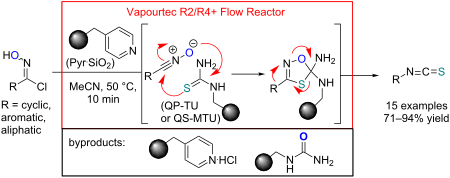
- 1a as the substrate, which was efficiently prepared on gram scale from the corresponding benzaldehyde via oxime formation and subsequent NCS-mediated chlorination [53]. Screening different solvents (MeCN, acetone, EtOAc, MeOH and iPrOH) and immobilised thiourea species (QP-TU [54] and QS-MTU [55


Copper-catalyzed aerobic aliphatic C–H oxygenation with hydroperoxides
Beilstein J. Org. Chem. 2013, 9, 1217–1225, doi:10.3762/bjoc.9.138

- chlorination using hydroperoxides as the O-radical source, in which the C-radicals generated by the 1,5-H radical shift were chlorinated (Scheme 2a) [14]. If reductive generation of the O-radicals from hydroperoxides could be achieved under an O2 atmosphere, the C-radicals generated by 1,5-H radical shift


Synthesis and physicochemical characterization of novel phenotypic probes targeting the nuclear factor-kappa B signaling pathway
Beilstein J. Org. Chem. 2013, 9, 900–907, doi:10.3762/bjoc.9.103
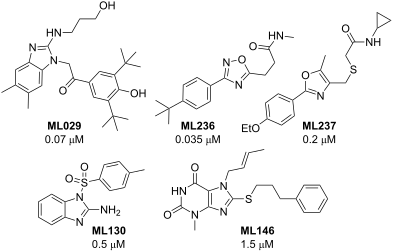
- 4-ethoxybenzaldehyde was condensed with diacetyl monoxime under acidic conditions. The resulting oxazole N-oxide 9 was converted to the chloromethyloxazole 10 via selective chlorination with phosphorous oxychloride in good yield. Addition of thioglycolic acid led to the carboxylic acid 11, which was


Synthesis of 2,3-dihydronaphtho[2,3-d][1,3]thiazole-4,9-diones and 2,3-dihydroanthra[2,3-d][1,3]thiazole-4,11-diones and novel ring contraction and fusion reaction of 3H-spiro[1,3-thiazole-2,1'-cyclohexanes] into 2,3,4,5-tetrahydro-1H-carbazole-6,11-diones
Beilstein J. Org. Chem. 2013, 9, 577–584, doi:10.3762/bjoc.9.62
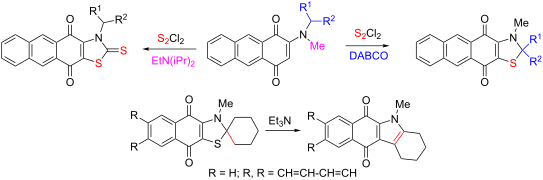
- %, respectively). Sulfur monochloride is known as a powerful chlorinating agent for chlorination of aromatic and heteroaromatic compounds [14][15]. In an attempt to increase the sulfurating ability of S2Cl2 the complex 8 obtained from S2Cl2 and 2 equiv of DABCO [16] was used. We have recently shown that this


Peptoids and polyamines going sweet: Modular synthesis of glycosylated peptoids and polyamines using click chemistry
Beilstein J. Org. Chem. 2013, 9, 56–63, doi:10.3762/bjoc.9.7
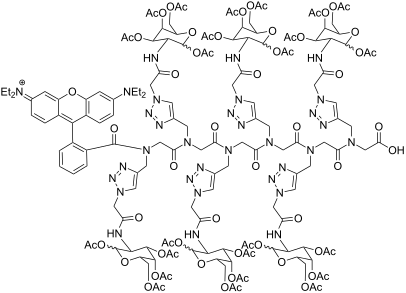
- biomacromolecules at high concentrations of strong acids, a polystyrene resin was chosen that contains a tritylchloride linker. The resin was obtained by treatment of Merrifield resin with p-hydroxytriphenylmethyl alcohol and subsequent chlorination [49][50]. This tritylchloride linker allowed a mild cleavage of


Intramolecular carbolithiation of N-allyl-ynamides: an efficient entry to 1,4-dihydropyridines and pyridines – application to a formal synthesis of sarizotan
Beilstein J. Org. Chem. 2012, 8, 2214–2222, doi:10.3762/bjoc.8.250
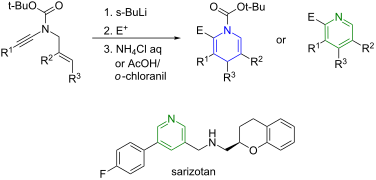
- pyridine 16, which was isolated in 61% yield. Further deprotection of the primary alcohol with TBAF followed by chlorination with thionyl chloride finally gave the desired chloromethylpyridine 17, an intermediate used for the preparation of sarizotan 19 at Merck KGaA by coupling of this pyridine fragment




Flow photochemistry: Old light through new windows
Beilstein J. Org. Chem. 2012, 8, 2025–2052, doi:10.3762/bjoc.8.229
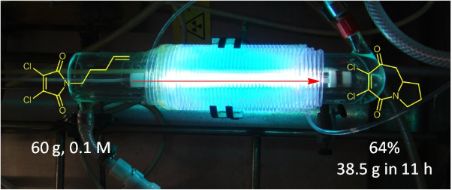
- chlorination of cyclohexane (72) with sulfuryl chloride under 15 W black-light irradiation (Scheme 23); however, the reaction was relatively inefficient and productivity was low (0.18 mmol/h) [75]. A biphasic photocyanation of pyrene (74, Scheme 24) was shown to be efficient in a polymer microchannel reactor


Unprecedented deoxygenation at C-7 of the ansamitocin core during mutasynthetic biotransformations
Beilstein J. Org. Chem. 2012, 8, 861–869, doi:10.3762/bjoc.8.96
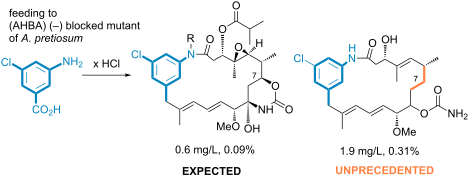
- reported the use of a mutant of A. pretiosum blocked in Asm12 (chlorination) and Asm21 (carbamoylation) and therefore producing proansamitocin (2) in good yield (up to 106 mg/L of fermentation broth) [17]. Additionally, we isolated small amounts of O-methyl proansamitocin 7 (2.3 mg/L), 10-epi
- (Scheme 1). While examining the fermentation extract for byproducts we were able to identify two new metabolites, 15 and 16. Formation of compound 15 can be traced back to inefficient chlorination, a phenomenon that we have encountered before in other feeding experiments with proansamitocin [25]. More
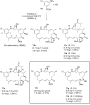
- File 1). Fermentation products, proansamitocin (2) and derivatives 7–9, of the Asm12 and Asm21-blocked (chlorination, carbamoylation) mutant strain A. pretiosum Δasm12/21 (yields given as isolated product per volume of fermentation broth) [17]. Summary of ansamitocin biosynthesis and structure of the




Regioselective chlorination and bromination of unprotected anilines under mild conditions using copper halides in ionic liquids
Beilstein J. Org. Chem. 2012, 8, 744–748, doi:10.3762/bjoc.8.84

- Science, Shanghai, 201620, China 10.3762/bjoc.8.84 Abstract By using ionic liquids as solvents, the chlorination or bromination of unprotected anilines at the para-position can be achieved in high yields with copper halides under mild conditions, without the need for potentially hazardous operations such
- as supplementing oxygen or gaseous HCl. Keywords: halogenation; ionic liquids; oxydation; regioselectivity; solvent effects; Introduction Chlorination and bromination of aromatic rings are classical and widely performed transformations, which are useful in many multistep organic-synthesis
- procedures. Regioselectivity with electron-rich substrates such as aniline will predominantly produce para- and ortho-substitutions. However, chlorination or bromination of aniline derivatives is often performed with protected anilines. This increases both the cost of synthesis and the environmental impact


Synthesis of functionalized macrocyclic derivatives of trioxabicyclo[3.3.0]nonadiene
Beilstein J. Org. Chem. 2012, 8, 738–743, doi:10.3762/bjoc.8.83

- concave, axially chiral [1], bridged bisdioxine diacid dichloride 3 is obtained by acid hydrolysis and subsequent chlorination of the surprisingly stable α-oxoketene 2, itself obtained by dimerization of dipivaloylketene (1) (Scheme 1) [2][3]. The concave structure of 3 and its derivatives together with
- dipivaloylketene (1), which slowly dimerizes to the dimeric oxoketene 2 at room temperature [2][3]. Hydrolysis and subsequent chlorination with thionyl chloride afforded the bisdioxine diacid dichloride 3 [3]. 4,4’-(2-Nitro-1,4-phenylene)bis(4-oxabutanol) (7): Diol 6 was prepared according to the literature [18


Aryl nitrile oxide cycloaddition reactions in the presence of pinacol boronic acid ester
Beilstein J. Org. Chem. 2012, 8, 606–612, doi:10.3762/bjoc.8.67
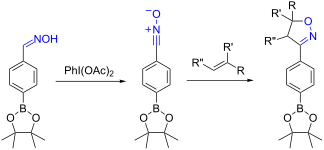
- nitrile oxides involves the dehydration of primary nitro compounds [21]. Aryl nitrile oxides are more commonly prepared by chlorination of aldoximes followed by dehydrohalogenation of the resulting hydroximoyl chlorides, or by direct oxidative dehydrogenation of the aldoximes (Scheme 2) [17]. While the
- chemical shift of the C(H)=N proton [34]. Attempted methods for the chlorination of aryl aldoximes to aryl hydroximoyl chloride include the use of N-chlorosuccinimide [35], chloramine-T [36], biphasic sodium hypochlorite [37][38], and tert-butyl hypochlorite [39]. These methods led to either no reaction or


Discovery of practical production processes for arylsulfur pentafluorides and their higher homologues, bis- and tris(sulfur pentafluorides): Beginning of a new era of “super-trifluoromethyl” arene chemistry and its industry
Beilstein J. Org. Chem. 2012, 8, 461–471, doi:10.3762/bjoc.8.53

- 1940s. The first step was chlorination of ArCH3 to ArCCl3 with Cl2 and the second step was its conversion to ArCF3 with HF or SbF3 [24][25][26]. A large number of trifluoromethyl arenes are currently produced on a large scale and used in many areas such as medicines, agrochemicals, dyes, materials for
- %) with p-dichlorobenzene (major) and trichlorobenzene (minor), which were formed by cleavage of the C–S bond, in the case of the major byproduct, and further chlorination, in the case of the minor one, during the reaction. The complete removal of the byproducts from 3f was difficult due to similar
- –mass analysis. When the reaction was conducted with the addition of KHF2, the purity greatly increased to 97% (run 5). The occurrence of an intermolecular side chlorination reaction was clearly demonstrated by the experiment of run 6 in which benzene was used as an additive. The distilled product 3b


Organic synthesis using (diacetoxyiodo)benzene (DIB): Unexpected and novel oxidation of 3-oxo-butanamides to 2,2-dihalo-N-phenylacetamides
Beilstein J. Org. Chem. 2012, 8, 344–348, doi:10.3762/bjoc.8.38

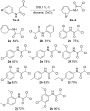
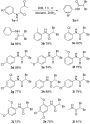
- (Scheme 2). To the best of our knowledge, there are several reports on chlorination and bromination reactions with PhI(OAc)2 and a halogen source such as TMSBr, lithium halide or pyridinium halide [32][33][34]. Also, there are several reports on the synthesis of difunctionalized acetamide derivatives [35




The application of a monolithic triphenylphosphine reagent for conducting Appel reactions in flow microreactors
Beilstein J. Org. Chem. 2011, 7, 1648–1655, doi:10.3762/bjoc.7.194
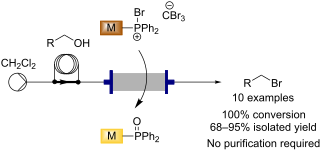
- (Table 1, entry 7) to completion, it was found that heating the monolith resulted in the production of an impurity, at 29.7% conversion by 1H NMR (with 64.5% conversion to the bromide). This was identified as 1-(chloromethyl)-4-iodobenzene, i.e., the starting material underwent chlorination rather than


Development of the titanium–TADDOLate-catalyzed asymmetric fluorination of β-ketoesters
Beilstein J. Org. Chem. 2011, 7, 1421–1435, doi:10.3762/bjoc.7.166

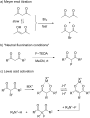
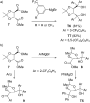
- acids) [76][77][78] also catalyzed the chlorination of β-ketoesters with N-chlorosuccinimide or N-chlorosulfonamides as halogenating agents [43]. The Lewis acid catalyzed halogenations of β-ketoesters present an interesting alternative to either radical or neutral noncatalyzed reaction modes. Catalytic
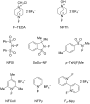
- (Table 3). Results for either fluorination (→6-F) with F–TEDA or the more soluble reagent NFSI (N-fluorobenzenesulfonimide) and NCS (N-chlorosuccinimide) for chlorination [43] (→6-Cl) are displayed in Table 3. Above ambient temperature, increasing temperatures give lower selectivity (Table 3, entries 1–3






Functionalization of heterocyclic compounds using polyfunctional magnesium and zinc reagents
Beilstein J. Org. Chem. 2011, 7, 1261–1277, doi:10.3762/bjoc.7.147
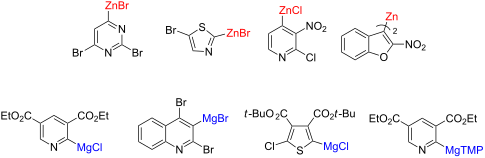
- yield, as well as the sPLA2 inhibitor 123, in a short reaction sequence (Scheme 19) [46]. Using TMPMgCl·LiCl (41), it is possible to prepare fully substituted indoles, such as 128 (Scheme 20) [47]. Thus, starting from the aniline 124, an ortho-directed chlorination with N-chlorosuccinimide at 90 °C


An overview of the key routes to the best selling 5-membered ring heterocyclic pharmaceuticals
Beilstein J. Org. Chem. 2011, 7, 442–495, doi:10.3762/bjoc.7.57
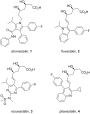
- replaced by an N-acylated amide which is suggested to mimic the C-terminus of angiotensin II [49]. The imidazole ring of losartan, an antihypertensive and angiotensin II blocker is formed in a condensation reaction between valeroamidine 160 and dihydroxyacetone [50]. It was found that direct chlorination
- of the imidazole 162 also forms the dichlorination product 164 (as shown in Scheme 33) with formaldehyde as a by-product which proved difficult to suppress and made purification of the reaction mixture problematic. Hence, a sequence involving silyl protection, chlorination and deprotection was







A two step synthesis of a key unit B precursor of cryptophycins by asymmetric hydrogenation
Beilstein J. Org. Chem. 2011, 7, 243–245, doi:10.3762/bjoc.7.32
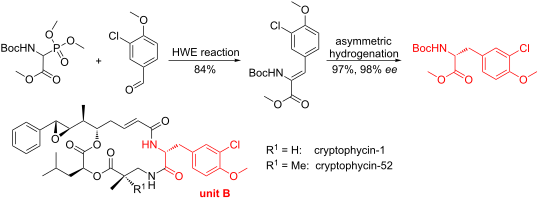
- tolerated. Both the methoxy and the chloro substituent are required for full biological activity [1][2][3][4]. The previously published synthetic route to unit B precursor 4 involves a three-step modification of D-tyrosine by chlorination, protecting group introduction and double methylation followed by a


Aromatic and heterocyclic perfluoroalkyl sulfides. Methods of preparation
Beilstein J. Org. Chem. 2010, 6, 880–921, doi:10.3762/bjoc.6.88
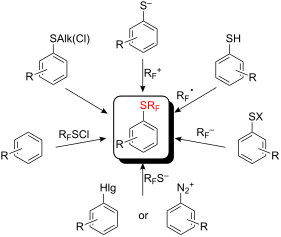
- chains have been limited to trifluoromethylated compounds. This was due to the unique preparation (at that time) of such compounds by means of two consecutive reaction steps: the chlorination of the side chain followed by replacement of the chlorine atoms by fluorine. This procedure enabled only the
- chlorination with only minor amounts of bis-(CF3S) products (Scheme 12). Aryl magnesium [78] and -mercury [79] compounds have been employed for the introduction of CF3S groups. Such reactions proceed in ether or THF at low temperatures; however, the yields of aryltrifluoromethyl sulfides do not exceed 50–60


Synthesis of bis(3-{[2-(allyloxy)ethoxy]methyl}-2,4,6-trimethylbenzoyl)(phenyl)phosphine oxide – a tailor-made photoinitiator for dental adhesives
Beilstein J. Org. Chem. 2010, 6, No. 26, doi:10.3762/bjoc.6.26
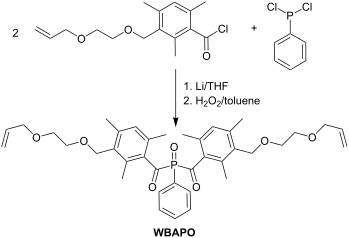
- . The identity of compound 4 was established by an independent synthesis of the compound from 2-(allyloxy)ethanol and 3-(chloromethyl)-2,4,6-trimethylbenzoyl chloride 3, prepared by chlorination of 3-(chloromethyl)-2,4,6-trimethylbenzoic acid with thionyl chloride. In the third step, the
- in acetonitrile (10−3 mol/L). DSC-plot of a mixture of Bis-GMA (42 wt %), UDMA (37 wt %), TEGDMA (21 wt %) and the PI WBAPO or BAPO. Bisacylphosphine oxide with improved solubility in polar solvents. Etherification of 3-(chloromethyl)-2,4,6-trimethylbenzoic acid and chlorination of 1. Rearrangement


A review of new developments in the Friedel–Crafts alkylation – From green chemistry to asymmetric catalysis
Beilstein J. Org. Chem. 2010, 6, No. 6, doi:10.3762/bjoc.6.6
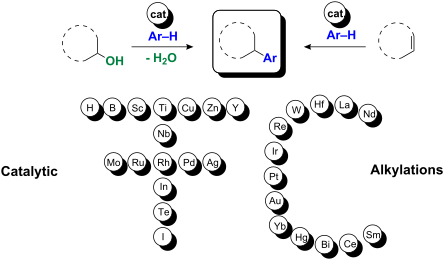
- , lower toxicity, and the fact that only stoichiometric amounts of water are generated as the side product the FC alkylation with benzyl-, allyl- and propargyl alcohols presented a first and important step toward an environmental friendly process. In 1986, Uemura et al. investigated the chlorination of
- authors explained this observation with a chlorination of 1-phenylethanol 1 and subsequent FC alkylation of the formed benzyl chloride and toluene. However, more surprisingly the reaction yield could be improved to 93% if only catalytic amounts (10 mol%) of TeCl4 were present (Scheme 3) [2]. Although the


Palladium- catalyzed cross coupling reactions of 4-bromo- 6H-1,2-oxazines
Beilstein J. Org. Chem. 2009, 5, No. 44, doi:10.3762/bjoc.5.44

- chlorination of 6H-1,2-oxazines 1a,b by addition of chlorine and subsequent base-induced dehydrochlorination. The expected 4-chloro-6H-1,2-oxazines 6a,b were obtained in good yields. In analogy to the aforementioned bromination, the chlorination of 3-phenyl-6H-1,2-oxazine 1a also led to dihalogenation
- . HRMS (80 eV, 40 °C) m/z calcd for C12H1179Br2NO2: 358.9157; found: 358.9160. Chlorination of 6H-1,2-oxazine 1b, typical procedure Chlorine gas was passed into diethyl ether (28 mL) at −30 °C until the solution became dark yellow. Then, 6H-1,2-oxazine 1b (0.200 g, 1.00 mmol) was added and the reaction


Asymmetric reactions in continuous flow
Beilstein J. Org. Chem. 2009, 5, No. 19, doi:10.3762/bjoc.5.19
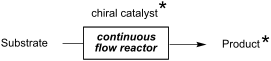
- also employed in a similar flow system for the asymmetric α-chlorination of acid chlorides (Scheme 7) [31][32]. This cinchona alkaloid derivative served the dual purpose of dehydrohalogenation and asymmetric induction, and was found to be reusable at least up to 100 times, after regeneration each time
- by flushing with a solution of i-PrNEt2 in THF. A diastereoselective synthesis of the metalloproteinase inhibitor BMS-275291 24 was developed using this column-based flow approach, with this α-chlorination reaction as a key step (Scheme 7) [32]. The Michael addition of indanone 26 to methyl vinyl
- flow. Asymmetric synthesis of ß-lactams. α-Chlorination of acid chlorides in flow. Asymmetric Michael reaction in continuous flow. Enantioselective addition of Et2Zn to benzaldehyde using monolithic chiral amino alcohol. Continuous-flow hydrolytic dynamic kinetic resolution of epibromohydrin (32





