


Search results
Search for "mechanical" in Full Text gives 262 result(s) in Beilstein Journal of Organic Chemistry. Showing first 200.
The effect of milling frequency on a mechanochemical organic reaction monitored by in situ Raman spectroscopy
Beilstein J. Org. Chem. 2017, 13, 2160–2168, doi:10.3762/bjoc.13.216
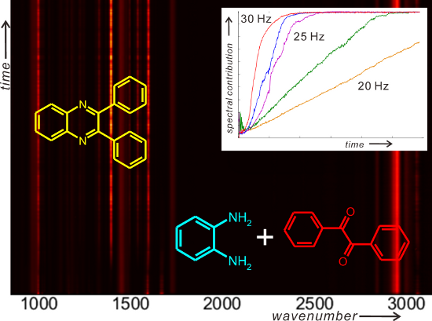
- reactivity on small variations in milling frequency. In particular, in situ measurements revealed the establishment of two different regimes of reaction kinetics at different frequencies, providing tentative insight into processes of mechanical activation in organic mechanochemical synthesis. Keywords
- : green chemistry; mechanism; mechanochemistry; milling; monitoring; Raman spectroscopy; Introduction Over the past decade, mechanochemical reactions [1][2][3][4], i.e., chemical transformations induced or sustained through the application of mechanical force in the form of grinding, milling and shearing
- reactions proceed through the introduction of mechanically activated sites at which the reactions are facilitated, such as stacking faults and structural defects in general [48]. In such a scenario, different frequencies of milling are expected to lead to different levels of mechanical activation: at lower


Superstructures with cyclodextrins: Chemistry and applications IV
Beilstein J. Org. Chem. 2017, 13, 2157–2159, doi:10.3762/bjoc.13.215
- , belong to this category and have been known since the pioneering work of Friedrich Cramer in 1951 [4][5]. Superstructures can also be held together by repulsive forces, so-called mechanical bonds [6], as exemplified in catenanes, rotaxanes, and knots [7]. Because of their restricted mobility, rotaxanes
Main group mechanochemistry
Beilstein J. Org. Chem. 2017, 13, 2068–2077, doi:10.3762/bjoc.13.204
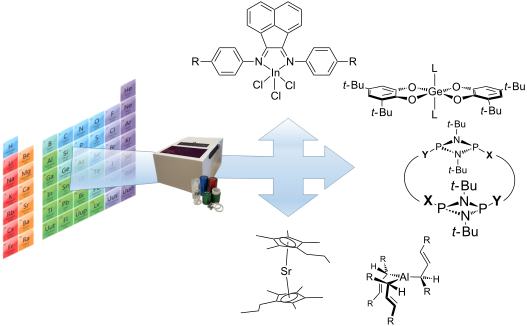
- metal leaching [28], rates of wearing [25], and/or promoting chemical reactions [9][29][30][31][32][33] must also be taken into account when selecting appropriate milling media. In addition to variable mechanical and milling media parameters, an alternative approach to controlling the mechanochemical
- , mechanochemistry dates back two millennia [20][37][38]. However, it was not until the 19th century that associations between mechanical forces and chemical reactivity were drawn [39][40][41][42][43][44][45], and a century later the currently accepted definition of mechanochemistry was proposed [46]. Since then


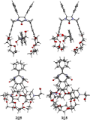
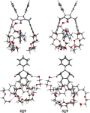
Complexation of molecular clips containing fragments of diphenylglycoluril and benzocrown ethers with paraquat and its derivatives
Beilstein J. Org. Chem. 2017, 13, 2056–2067, doi:10.3762/bjoc.13.203

- centers, similar to the operating principle of mechanical clips. The most promising for the interaction with paraquat derivatives are molecular tweezers and clips containing fragments of crown ethers, although such examples are not numerous. Nolte et al. showed that the introduction of a glycoluril moiety



Mechanically induced oxidation of alcohols to aldehydes and ketones in ambient air: Revisiting TEMPO-assisted oxidations
Beilstein J. Org. Chem. 2017, 13, 2049–2055, doi:10.3762/bjoc.13.202
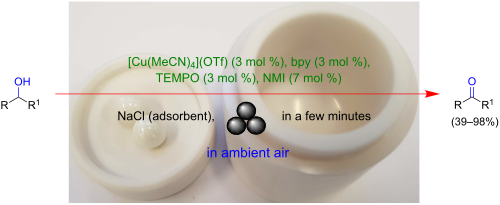
- primary and secondary alcohols to the corresponding aldehydes and ketones by mechanical processing under air. Ball milling was shown to promote the quantitative conversion of a broad set of alcohols into carbonyl compounds with no trace of an over-oxidation to carboxylic acids. The mechanochemical
- this respect, the mechanical activation of solids [38][39][40][41][42], in the absence of solvents [43], or in the presence of catalytic amounts of liquid [44][45], holds significant promise [46][47][48][49][50][51][52][53][54][55][56][57][58]. Rooted in ancient practices from the dawn of civilization
- aims to provide alternative methods to traditional syntheses in organic and inorganic chemistry [49][60][61]. Mechanochemistry is also used in supramolecular chemistry [62] and metal-organic chemistry [63]. In this work, we show that mechanical processing by ball milling can represent a viable solution


High-speed vibration-milling-promoted synthesis of symmetrical frameworks containing two or three pyrrole units
Beilstein J. Org. Chem. 2017, 13, 1957–1962, doi:10.3762/bjoc.13.190
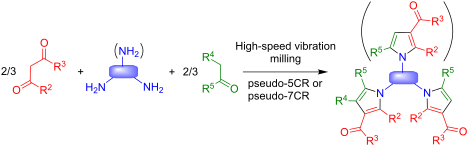
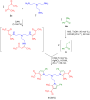
- disconnection employed and the structural diversity introduced at the three reaction components is summarized in Scheme 1. Our procedure involves the use of mechanochemistry, which deals with reactions promoted by mechanical energy and is emerging in recent years as a versatile tool that allows solvent-free


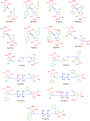

p-tert-Butylthiacalix[4]arenes functionalized by N-(4’-nitrophenyl)acetamide and N,N-diethylacetamide fragments: synthesis and binding of anionic guests
Beilstein J. Org. Chem. 2017, 13, 1940–1949, doi:10.3762/bjoc.13.188

- −, H2PO4−, NO3−) was carried out at a semi-empirical level using the quantum-mechanical method, PM3 (HyperChem 7.0). The proposed model for the binding of anions by p-tert-butylthiacalix[4]arenes containing proton–donor (amide, hydroxy) groups was studied in order to identify steric and/or electronic
- the association constants of the complexes of the studied thiacalix[4]arenes with a series of anions) and the results of quantum mechanical calculations (energy change in the formation of guest–host complexes calculated by the PM3 method) (HyperChem 7.0) was the final stage of the work (Table 4). The
- tetrahedral H2PO4−, Y-shaped CH3CO2− and NO3− ions. It is clearly seen from the Table 4 that all the studied thiacalix[4]arenes (2, 3, 5–9) bind F– ions. This agrees well with the quantum mechanical calculations. For all the complexes involving the macrocycles studied with F− ion, a significant energy gain


Mechanochemical synthesis of small organic molecules
Beilstein J. Org. Chem. 2017, 13, 1907–1931, doi:10.3762/bjoc.13.186
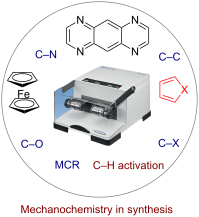
- /energy, etc. Non-conventional energy sources for chemical reactions such as microwave, mechanical mixing, visible-light and ultrasound are becoming surge of interest to the chemist as alternative energy sources in laboratories [7]. By imposing these techniques innumerable chemical transformations have
- techniques like ball-milling or hand grinding are considered to be promising candidates in solvent-free synthesis [10][11]. Mechanochemical methods deal with chemical transformations induced by mechanical energy, such as compression, shear, or friction [12]. Wilhelm Ostwald, a Russian-German chemist who
- changes of substances of all states of aggregation due to the influence of mechanical energy”. Moreover, according to IUPAC, a mechano-chemical reaction is a ‘Chemical reaction that is induced by the direct absorption of mechanical energy’ and with a note ‘Shearing, stretching, and grinding are typical


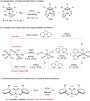


Influence of the milling parameters on the nucleophilic substitution reaction of activated β-cyclodextrins
Beilstein J. Org. Chem. 2017, 13, 1893–1899, doi:10.3762/bjoc.13.184
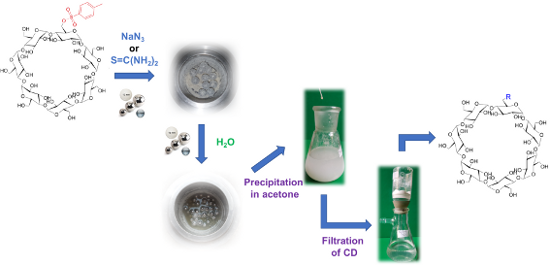
- derivatization [8]. Although the preparation of carbohydrate-based complexes in a ball mill has been already reported [9][10][11], the use of mechanical activation for the chemical derivatization of CDs has been rather sporadic [12][13][14][15]. In this respect, it is worth noting that CDs exhibit a
- to be used. However, these solvents are difficult to remove and usually have considerable energy contribution. Under these circumstances, the promise shown by the mechanical processing of solids of enabling chemical transformations in the absence of solvent phases renders mechanical activation
- extremely appealing. This is particularly true in light of the well-known capability of mechanical treatment to induce significant enhancements in chemical reactivity. Despite the vast amount of literature on the mechanically activated synthesis of organic molecules [16][17][18][19][20][21][22][23], CD


Solvent-free sonochemistry: Sonochemical organic synthesis in the absence of a liquid medium
Beilstein J. Org. Chem. 2017, 13, 1850–1856, doi:10.3762/bjoc.13.179
- Deborah E. Crawford School of Chemistry and Chemical Engineering, Queen’s University Belfast, David Keir Building, 39–123 Stranmillis Road, Belfast, BT9 5AG, Northern Ireland, UK 10.3762/bjoc.13.179 Abstract Sonochemistry, i.e., the application of mechanical energy in the form of sound waves, has
- include techniques such as shearing [2], microfluidics [3] and twin screw extrusion [4][5][6]. More recently, sonochemistry has been included under the umbrella term of mechanochemistry [7] as it has demonstrated excellent potential when instigating chemical activity in solutions by applying mechanical
- energy (Figure 1) [8][9]. Sonochemistry is hypothesised to originate from acoustic cavitation and bubble collapse as a result of the mechanical effects of sounds on liquids [8][9]. Bubble collapse in particular results in intense compressional heating, thereby creating hot spots, a phenomenon currently


Mechanochemical synthesis of thioureas, ureas and guanidines
Beilstein J. Org. Chem. 2017, 13, 1828–1849, doi:10.3762/bjoc.13.178
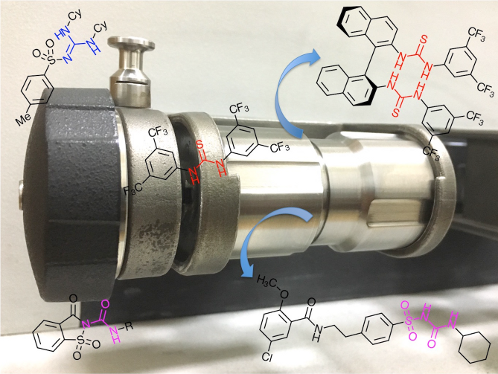
- transferred from the solution into the solid state. In a typical solid state organic synthesis, reactants are simply ground together in a mortar using a pestle, where the mechanical force is exerted by a hand (manual grinding) [15]. Whereas mechanochemistry [16], at least on the laboratory scale, is usually
- associated with mortar and pestle processing, this approach suffers from several issues, such as non-constant energy input leading to inhomogeneous mixing and transfer of mechanical energy, irreproducibility, exposure to air/humidity (unless the experiment is carried out in a glovebox) and finally the
- , plastic) and even milling atmosphere allows reproducible solid state syntheses in such instruments. The progress made over the past 15 years has transformed grinding or milling from a purely physical tool for mechanical processing into a synthetic method of choice when one wishes to conduct chemical






Ni nanoparticles on RGO as reusable heterogeneous catalyst: effect of Ni particle size and intermediate composite structures in C–S cross-coupling reaction
Beilstein J. Org. Chem. 2017, 13, 1796–1806, doi:10.3762/bjoc.13.174

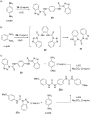
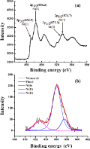
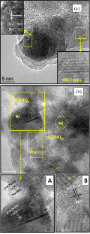
- ) is thus far known to act as the only heterogeneous nanocatalyst for C–S cross-coupling with limited applications and poor yields [24]. In recent years, graphene-based composite materials have become popular because of their unique physical, mechanical and chemical properties [25][26][27]. Graphene, a




Mechanochemical enzymatic resolution of N-benzylated-β3-amino esters
Beilstein J. Org. Chem. 2017, 13, 1728–1734, doi:10.3762/bjoc.13.167

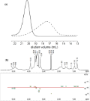
- could be established that the CALB enzyme and N-benzylated-β3-amino esters are stable to the mechanical force caused by HSBM. We then focused our attention on the search of the best conditions for this enzymatic mechanochemical resolution. First of all, we examined the effect of the milling frequency


Theoretical simulation of the infrared signature of mechanically stressed polymer solids
Beilstein J. Org. Chem. 2017, 13, 1710–1716, doi:10.3762/bjoc.13.165
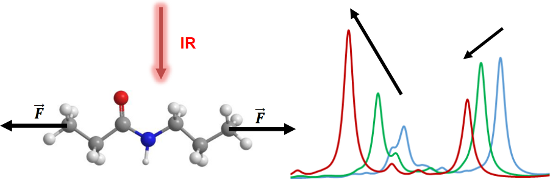
- Matthew S. Sammon Milan Oncak Martin K. Beyer Institut für Ionenphysik und Angewandte Physik, Universität Innsbruck, Technikerstraße 25, 6020 Innsbruck, Austria 10.3762/bjoc.13.165 Abstract Mechanical stress leads to deformation of strands in polymer solids, including elongation of covalent bonds
- and widening of bond angles, which changes the infrared spectrum. Here, the infrared spectrum of solid polymer samples exposed to mechanical stress is simulated by density functional theory calculations. Mechanical stress is described with the external force explicitly included (EFEI) method. The
- infrared bands is not a shift of the peak position, but rather peak broadening and a characteristic change in the relative intensities of the strongest bands, which may serve for the identification and quantification of mechanical stress in polymer solids. Keywords: density functional theory; infrared


A recursive microfluidic platform to explore the emergence of chemical evolution
Beilstein J. Org. Chem. 2017, 13, 1702–1709, doi:10.3762/bjoc.13.164
- mechanical valves. The packing reservoirs represent 3-dimensional structures that take advantage of the tendency of aqueous droplets to float in the surrounding fluorinated oil, and require an external outlet below the device (to allow for excess oil drainage) connected to an automated valve. This has been
- lithography masters: a) droplet synchroniser for b) droplet fuser; c) droplet splitter; d) droplet sorter with air pressure-activated mechanical valve. Supporting Information Supporting Information File 112: Additional material. Acknowledgements We gratefully acknowledge financial support from the EPSRC for




Encaging palladium(0) in layered double hydroxide: A sustainable catalyst for solvent-free and ligand-free Heck reaction in a ball mill
Beilstein J. Org. Chem. 2017, 13, 1661–1668, doi:10.3762/bjoc.13.160
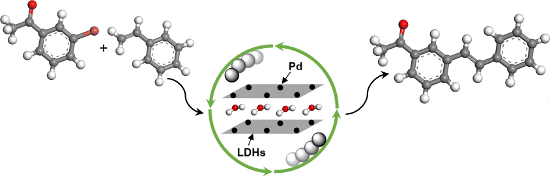
- knowledge, only a few of supported Pd catalysts were used in mechanochemically assisted coupling reactions because of the low mechanical strength of the catalysts, the active component of which is easy to leach and deactivate under HSBM conditions. Mack and co-workers [36] reported a kind of polymer
- received much attention in the organic catalysis for its excellent properties such as low costs, high specific surface area, double-layered structure, anion exchange capacity, high mechanical stability and chemical stability [38][39][40][41][42][43]. Our previous studies have proved that LDH catalysts


Grip on complexity in chemical reaction networks
Beilstein J. Org. Chem. 2017, 13, 1486–1497, doi:10.3762/bjoc.13.147
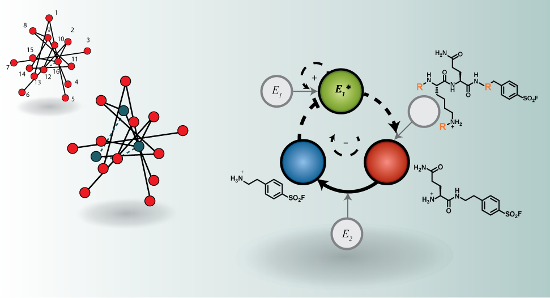
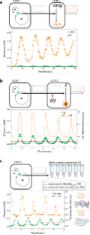
- of a bilayer network composed of the mechanical action of a temperature-responsive gel coupled with various exothermic reactions. Reprinted with permission from [34], copyright 2012 Nature Publishing Group. (b) Small dynamic combinatorial library made from dithiol building blocks. Adapted with




Mechanochemical borylation of aryldiazonium salts; merging light and ball milling
Beilstein J. Org. Chem. 2017, 13, 1463–1469, doi:10.3762/bjoc.13.144
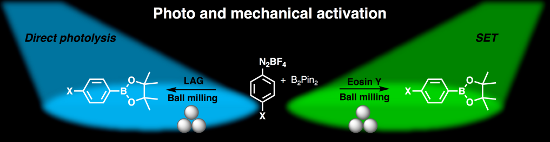
- –solvent charge-transfer complex formation. Keywords: aryldiazonium salts; borylation; eosin Y; mechanochemistry; photocatalysis; Introduction The use of mechanical force to process materials or to induce chemical transformations is perhaps as old as the history of mankind itself [1]. Similarly, from
- time immemorial light has also been present on earth, being perhaps photosynthesis and visions the most fundamental connections between light and living organisms [2]. However, combining synergistically photo- and mechanical activations in organic synthesis is still challenging despite the enormous
- potential of having both activation modes acting simultaneously. In recent years, mechanochemistry, which encompasses the use of mechanical means by milling, grinding, shearing, cavitation or pulling to induce chemical transformations [3] has become fundamental for discovering new chemical reactivity [4][5


Mechanochemistry-assisted synthesis of hierarchical porous carbons applied as supercapacitors
Beilstein J. Org. Chem. 2017, 13, 1332–1341, doi:10.3762/bjoc.13.130
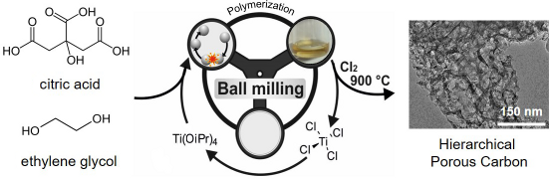
- of synthesis steps and to minimize waste accumulation, at best by avoiding any solvents [7][31]. Lately, mechanochemistry has gained momentum in organic chemistry [32][33][34]. The initiation of chemical reactions by mechanical forces enables organic and inorganic syntheses without the use of any


One-pot synthesis of block-copolyrotaxanes through controlled rotaxa-polymerization
Beilstein J. Org. Chem. 2017, 13, 1310–1315, doi:10.3762/bjoc.13.127
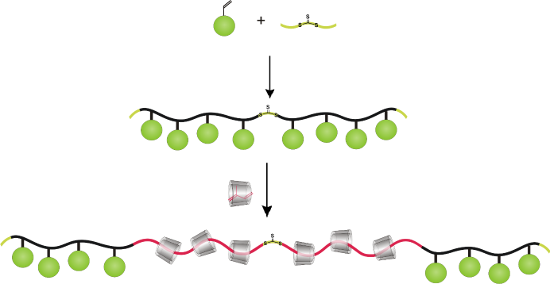
- polymers without chemical modification of the backbone. Through polyrotaxane formation solubility [2][3][4][5], as well as mechanical [1][2][3][6][7][8][9] and electrical properties [10], can be improved. Cross-linking of threaded macrocycles gives rise to so-called slide-ring gels with unique mechanical


Towards open-ended evolution in self-replicating molecular systems
Beilstein J. Org. Chem. 2017, 13, 1189–1203, doi:10.3762/bjoc.13.118

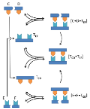
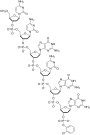
- growth of some simple replicators. Also mechanical forces may be utilized to break up larger assemblies of self-replicating molecules and liberate the assembly edges or fiber ends that promote replication. The most impressive progress with respect to Darwinian evolution has been achieved with RNA-based




From chemical metabolism to life: the origin of the genetic coding process
Beilstein J. Org. Chem. 2017, 13, 1119–1135, doi:10.3762/bjoc.13.111

- mechanical type, as it is, by construction of a recursion, impossible to predict their consequences in the long term (even knowing initial conditions). Living processes are both deterministic and unpredictable. This may read as an oxymoron, but here is a straightforward example using whole numbers



Correlation of surface pressure and hue of planarizable push–pull chromophores at the air/water interface
Beilstein J. Org. Chem. 2017, 13, 1099–1105, doi:10.3762/bjoc.13.109

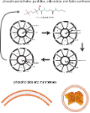
- ]. Mechanical planarization in the ground state increases the conjugation of the push–pull system. As a result, the excitation (or absorption) maximum shifts up to 80 nm to the red [8]. An anionic headgroup is added to produce an amphiphile that self-assembles into monolayers and micelles and enters


Automating multistep flow synthesis: approach and challenges in integrating chemistry, machines and logic
Beilstein J. Org. Chem. 2017, 13, 960–987, doi:10.3762/bjoc.13.97
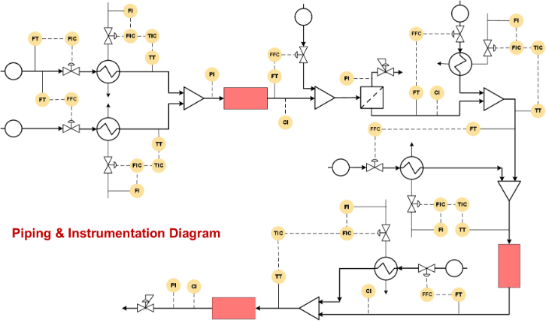
- scale would require the involvement of engineers from various fields viz. chemical, instrumentation, mechanical and electrical. In such cases, it is desired to describe the process in terms of standard symbols (rather than combined chemical structures and diagrams which are most often used in the




Fast and efficient synthesis of microporous polymer nanomembranes via light-induced click reaction
Beilstein J. Org. Chem. 2017, 13, 558–563, doi:10.3762/bjoc.13.54
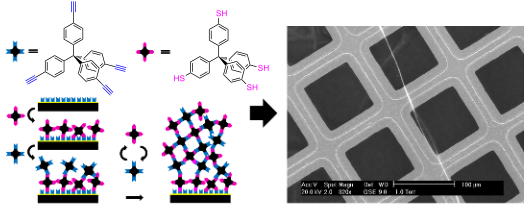
- investigations. The thin films show high mechanical stability as evidenced by the possibility to create feestanding membranes across holes of about 3–5 µm diameter. The rapid and scalable synthetic method for CMP nanomembranes described in this article, along with the possibility to transfer the nanomembranes to





