Search results
Search for "pKa" in Full Text gives 252 result(s) in Beilstein Journal of Organic Chemistry. Showing first 200.
Practical synthetic strategies towards lipophilic 6-iodotetrahydroquinolines and -dihydroquinolines
Beilstein J. Org. Chem. 2016, 12, 1851–1862, doi:10.3762/bjoc.12.174

- considered (Scheme 6). The quinolin-2-one 13 was predicted to be a more amenable alkylation partner than the THQ 14 due to the likely lower pKa of the amide proton. To assess this, 13 was reacted with NaH and 2-iodopropane in DMF at 80 °C overnight. However, 13 displayed a marked lack of reactivity towards


Dinuclear thiazolylidene copper complex as highly active catalyst for azid–alkyne cycloadditions
Beilstein J. Org. Chem. 2016, 12, 1566–1572, doi:10.3762/bjoc.12.151
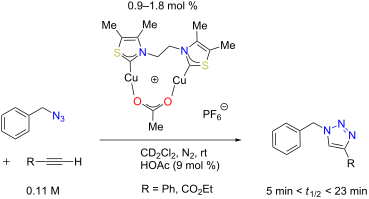
- copper(I) acetate and sodium acetate as additional base in order to deprotonate the thiazolium salt 1b and to form the bisthiazolylidene copper(I) complex 2. Due to the relatively high acidity of the thiazolium precursor (pKa ≈ 18 [44]), a weak base such as sodium acetate yields small equilibrium


Flow carbonylation of sterically hindered ortho-substituted iodoarenes
Beilstein J. Org. Chem. 2016, 12, 1503–1511, doi:10.3762/bjoc.12.147
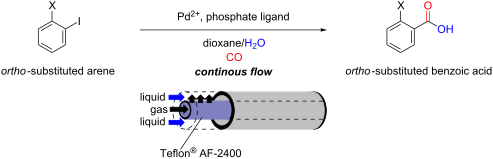
- , did not significantly change the isolated yield of 5. However, changing to the stronger base DBU (pKa in water at 25 °C = 13.5) [40] dramatically reduced the isolated yield (Table 1, entry 8). A wider temperature range was also investigated (Table 1, entries 9–11). This resulted in only a small


The hydrolysis of geminal ethers: a kinetic appraisal of orthoesters and ketals
Beilstein J. Org. Chem. 2016, 12, 1467–1475, doi:10.3762/bjoc.12.143
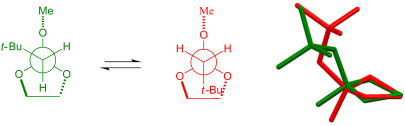
- is non-trivial [6][8][10][12][13]; and indeed the debate about the factors influencing the overall rate of reaction and the synchronicity of steps has yet to achieve consensus [11][14][15]. Factors such as solvent [13], catalyst pKa [9], –OR basicity [6][16][17], the kinetic anomeric effect [18], the


Reactivity studies of pincer bis-protic N-heterocyclic carbene complexes of platinum and palladium under basic conditions
Beilstein J. Org. Chem. 2016, 12, 1334–1339, doi:10.3762/bjoc.12.126
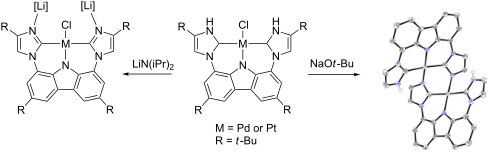
- ) have been shown to form an imidazolyl ligand (e.g., 2) after deprotonation with a basic proton-accepting nitrogen (Figure 1). We are unaware of reports on an experimentally determined pKa value of a PNHC imidazolidene complex, but looking at related derivatives, Isobe showed that a 2-palladated
- pyridine was 3.57 pKa units more basic than pyridine [9][10]. Considering reactions other than simple proton transfer, imidazol-2-yl complexes have recently been used to bind to a second transition metal [11]. Additionally, Cp*Ir complexes from our group [12] demonstrated heterolysis of the H–H bond of H2


Catalytic asymmetric synthesis of biologically important 3-hydroxyoxindoles: an update
Beilstein J. Org. Chem. 2016, 12, 1000–1039, doi:10.3762/bjoc.12.98
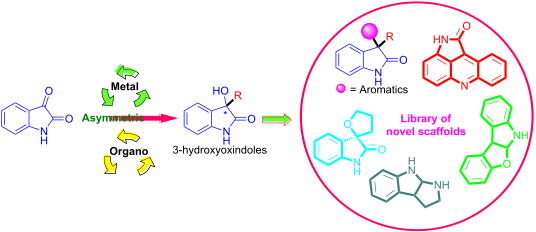
- for a few times without activity loss. However, a long reaction time (120 h) was needed to achieve good results, and the low yields for N-unprotected substrates could be explained by the fact that the amide NH (pKa in DMSO ≈18.5) is more prone to be activated by K2CO3 than MeCN (pKa = 25). The long




1H-Imidazol-4(5H)-ones and thiazol-4(5H)-ones as emerging pronucleophiles in asymmetric catalysis
Beilstein J. Org. Chem. 2016, 12, 918–936, doi:10.3762/bjoc.12.90
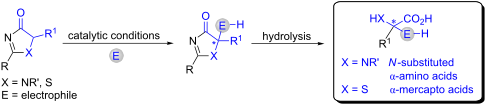
- their pKa values (approximately 19 in DMSO) [19] are much higher, one exception being thioesters [20][21] and pyrazoleamides [22]. As an alternative, some specific heterocycles have been proposed as carboxylic acid surrogates. Examples of this type of heterocycles are oxazol-5-(4H)-ones (or azlactones








cis–trans-Amide isomerism of the 3,4-dehydroproline residue, the ‘unpuckered’ proline
Beilstein J. Org. Chem. 2016, 12, 589–593, doi:10.3762/bjoc.12.57

- isomerism; fluorine; pKa; proline; Introduction The sole genetically encoded secondary amino acid proline (Pro, 1) is known for its unique properties in biological systems. In particular, Pro residues are often found in the s-cis peptidyl-Pro conformation, due to the low energy difference between the s
- models. Data on Pro (1) and (4S)-trifluoromethylproline (3) is used for comparison. Results and Discussion Firstly, we determined the pKa of the ammonium group in the free amino acids (Table 1). Overall the values demonstrate a 0.9 pKa reduction upon introduction of the 3,4-double bond, and a 2.2 pKa
- , this, indeed, has an orientation close to the equatorial CF3-group placement in 3, and is not axial. Next, we determined the pKa of the carboxyl groups in N-acetyl amino acids for two rotameric forms separately (Table 1). All four compounds exhibited similar ΔpKa values [36][37]. Though, absolute


Interactions between 4-thiothymidine and water-soluble cyclodextrins: Evidence for supramolecular structures in aqueous solutions
Beilstein J. Org. Chem. 2016, 12, 549–563, doi:10.3762/bjoc.12.54
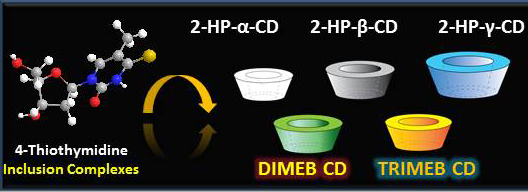
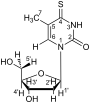
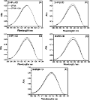
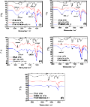
- greater than 9, with a pKa of ca. 9 as described in [26]. Under the latter conditions, the S4TdR-main absorption band located at 337 nm in neutral medium shifted to 321 nm. Moreover, the high molar absorption coefficients (ε) evaluated in [26] suggested that the absorption band of S4TdR was probably



Base metal-catalyzed benzylic oxidation of (aryl)(heteroaryl)methanes with molecular oxygen
Beilstein J. Org. Chem. 2016, 12, 144–153, doi:10.3762/bjoc.12.16
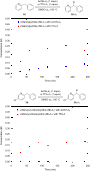
- deuterium incorporation in the benzylic position of 16 and 3h through acid-catalyzed imine–enamine tautomerization is dependent on the strength of the acid used (Figure 1). The rate of deuterium incorporation in 2-benzylpyridine (16, pKa ≈ 5.2) is much faster when using TFA-d1 than with AcOH-d4 [34][35
- ]. With the less basic 2-benzyl-5-chloropyridine (3h, pKa ≈ 3.0) the difference is even more pronounced: Almost no deuterium incorporation could be detected using AcOH-d4 while the reaction ran smoothly using the stronger acid TFA-d1. From this we conclude that when the pyridine nitrogen becomes less
- basic and protonation by the acid thus becomes more difficult, using more equivalents of the acid or a stronger acid is needed to reach full conversion. When we compare the different pKa values of substituted pyridines we see that 2-benzylpyridine (16, pKa ≈ 5.2) is one of the most basic pyridines [34



A journey in bioinspired supramolecular chemistry: from molecular tweezers to small molecules that target myotonic dystrophy
Beilstein J. Org. Chem. 2016, 12, 125–138, doi:10.3762/bjoc.12.14
- of steroids, to determining hydrocarbon pKa values using electrochemistry. The lesson learned, and one I tried to put into practice in my independent career (see below), is that it is very much possible to run a research group focused in quite different areas of chemistry. With an NSF-NATO


Co-solvation effect on the binding mode of the α-mangostin/β-cyclodextrin inclusion complex
Beilstein J. Org. Chem. 2015, 11, 2306–2317, doi:10.3762/bjoc.11.251
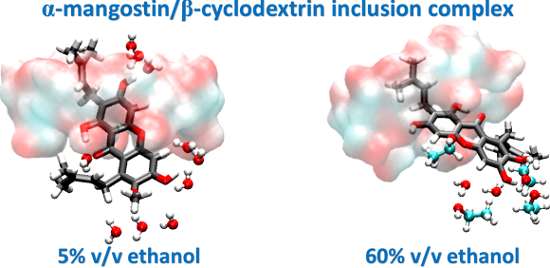
- databank (3C6G), while the α-MGS structure was extracted from the International Union of Crystallography (KP2293) database, see Figure 1. According to the ChemAxon method [25][26][27], the calculated pKa of three hydroxy groups are 7.4 (O6), 7.8 (O3), and 8.2 (O5). For that reason, the α-mangostin was



Convenient preparation of high molecular weight poly(dimethylsiloxane) using thermally latent NHC-catalysis: a structure-activity correlation
Beilstein J. Org. Chem. 2015, 11, 2261–2266, doi:10.3762/bjoc.11.246
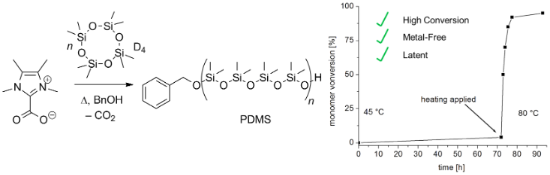
- , emphasizing that nucleophilicity is crucial for successful polymerization. Furthermore, it is interesting to note that the six- and seven-membered NHCs do not show any reactivity here, in spite of being very strong bases. While for a compound like 6-iPr a pKa-value of 28.2 (aqueous solution, 25 °C) was found
- , the five-membered imidazolium derivative 5-Mes was determined to have a pKa-value of only 20.8 (which compares to 15–19 for typical alcohols; in turn, silanols are even more acidic than the corresponding alcohols) [28][29][30][31][32]. At the same time, 5Me-Me-CO2 successfully catalyzed PDMS-formation


Beyond catalyst deactivation: cross-metathesis involving olefins containing N-heteroaromatics
Beilstein J. Org. Chem. 2015, 11, 2223–2241, doi:10.3762/bjoc.11.241
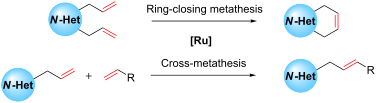
- , the addition of amino additives such as pyridine, morpholine, Et3N or DBU was shown to be detrimental to the G-HII-catalyzed dimerization of styrene (Table 2). Moderate to poor yields in stilbene 7’ were obtained and the value of the yields was correlated with the pKa of the couple ammonium/amine. An


Photoinduced 1,2,3,4-tetrahydropyridine ring conversions
Beilstein J. Org. Chem. 2015, 11, 2166–2170, doi:10.3762/bjoc.11.234
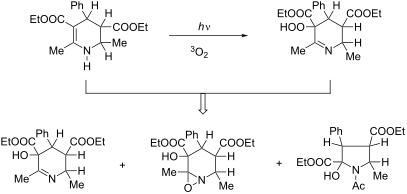
- [26][27]. Superoxide O2−• is a highly reactive molecule [26][28] and it acts as a strong Brönsted base removing a proton from substrates to an extent equivalent to that of the conjugate base with a pKa value of approximately 23 in water [29][30]. A number of weakly acidic organic compounds are


SmI2-mediated dimerization of indolylbutenones and synthesis of the myxobacterial natural product indiacen B
Beilstein J. Org. Chem. 2015, 11, 1700–1706, doi:10.3762/bjoc.11.184

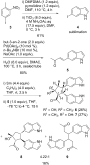
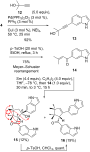
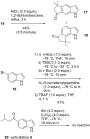
- ][28]. Thus, the indole NH group (pKa about 21 in DMSO) should be able to serve as a stoichiometric proton source that, after β,β'-coupling, would convert one of the Sm(III) enolates to the ketone. Attack of the remaining Sm(III) enolate would lead to Dieckmann-type ring closure, followed by



Deproto-metallation of N-arylated pyrroles and indoles using a mixed lithium–zinc base and regioselectivity-computed CH acidity relationship
Beilstein J. Org. Chem. 2015, 11, 1475–1485, doi:10.3762/bjoc.11.160

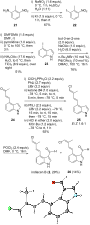
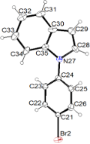
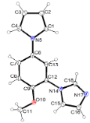
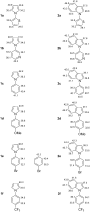
- initio methods [50]. The pKa values for N-methylindole, N-methylpyrrole and N-(dimethylamino)pyrrole as CH acids in THF were experimentally determined by Fraser et al [51]. The latter are more related to our goals and were found to be in good agreement with those computed within the DFT framework
- weak CH acidic compounds while the pKa values in THF solution (Figure 5) covered a 28.8–45.0 span. These data allow the assignment of potential deprotonation sites in the investigated substrates. Also the correlation between gas-phase ΔGacid and the pKa(THF) values can be tracked. In all cases, the CH
- contrast, the regioselectivity observed in case of substrate 2a cannot be explained by the pKa values as the only reason. Otherwise, deprotonation would have been also observed at the 2 position of the indole ring. Whereas the azole nitrogen in 2a cannot coordinate a metal through its electron lone pair






Are D-manno-configured Amadori products ligands of the bacterial lectin FimH?
Beilstein J. Org. Chem. 2015, 11, 1096–1104, doi:10.3762/bjoc.11.123

- -phenylamino-1-deoxy-D-manno-heptulose 10 were obtained as pure α-anomers in 77% and 24% yield, respectively (Scheme 3). The low yield of compound 10 may be explained by the low pKa value (4.62) of aniline compared to a pKa of 8.15 for propargylamine, the latter being clearly more efficient as a nucleophile


Highly selective palladium–benzothiazole carbene-catalyzed allylation of active methylene compounds under neutral conditions
Beilstein J. Org. Chem. 2015, 11, 994–999, doi:10.3762/bjoc.11.111

- times) was found to depend on the nucleophilic strength of the intermediate enolates, and ultimately on pKa values (reactivity scale: diethyl malonate pKa 13.5 > acetoacetate pKa 11.0 > acetylacetone pKa 8.9). As an example, diethyl malonate reacted with allyl methyl carbonate much faster than


Chemoselective O-acylation of hydroxyamino acids and amino alcohols under acidic reaction conditions: History, scope and applications
Beilstein J. Org. Chem. 2015, 11, 446–468, doi:10.3762/bjoc.11.51
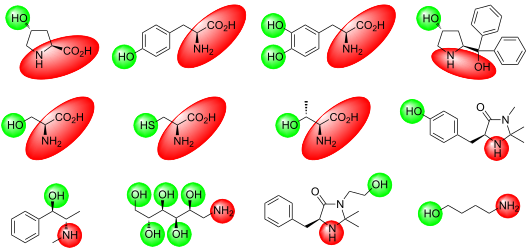
- compounds in the 1930s and 1940s [22][23]. It is a strong acid (pKa ≈ 0.5), quite volatile (bp. 72 °C) and miscible with water, fluorocarbons and most organic solvents [22]. In the late 1940s and throughout the 1950s, trifluoroacetic acid and trifluoroacetic anhydride were the subjects of a number of
- acids were recrystallized from suitable solvents such as acetone, lower alcohols and H2O. Acylation reactions in MeSO3H are more vigorous and exothermic than in CF3CO2H since MeSO3H (pKa ≈ −2) is a stronger acid than CF3CO2H (pKa ≈ 0.5). Their densities are the same (1.48 g/mL at 25 °C), but the melting
- acyl chlorides. The acylating activity of the medium was then fortified by the addition of trifluoromethanesulfonic acid (CF3SO3H), one of the strongest of all acids known (pKa ≈ −5.5), comparable to, or exceeding perchloric and fluorosulfonic acid (although the ordering of acidities is highly




Natural phenolic metabolites with anti-angiogenic properties – a review from the chemical point of view
Beilstein J. Org. Chem. 2015, 11, 249–264, doi:10.3762/bjoc.11.28
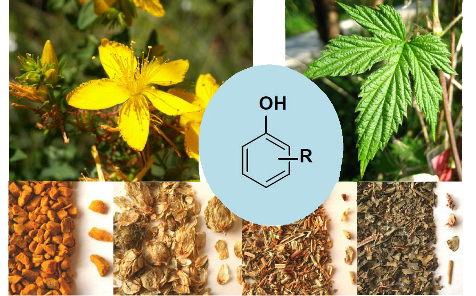
- , the tumor cells express pro-angiogenic factors including growth factors such as the vascular endothelial growth factor (VEGF) and fibroblast growth factor (FGF) and enzymes such as cyclooxygenase 2 (COX-2) and protein kinase A (PKA) as well as signaling molecules such as integrins. The evoked cascade


TEMPO-derived spin labels linked to the nucleobases adenine and cytosine for probing local structural perturbations in DNA by EPR spectroscopy
Beilstein J. Org. Chem. 2015, 11, 219–227, doi:10.3762/bjoc.11.24
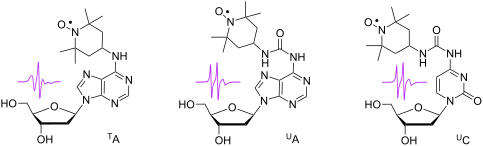
- ] showed one hydrogen bond, located between N6 of TA and N3 of cytidine (Figure S2B, Supporting Information File 1). If TA is protonated on N1 to form TAH+, it could form a wobble-pair with C [47][83] (Figure 3A), which would be expected to decrease the mobility of the spin label. The apparent pKa of the


Highly selective electrochemical fluorination of dithioacetal derivatives bearing electron-withdrawing substituents at the position α to the sulfur atom using poly(HF) salts
Beilstein J. Org. Chem. 2015, 11, 85–91, doi:10.3762/bjoc.11.12
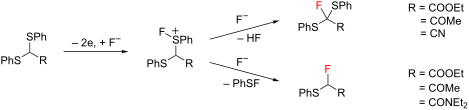
- rather low yields (Table 3, entry 5). The longer electrolysis caused the formation of complicated products. This result is quite different from the case of 1b and 1d (Table 2, entry 1 and Table 3, entry 1). Such different anodic behavior may be attributable to different pKa values of the α-proton of the


A facile synthesis of functionalized 7,8-diaza[5]helicenes through an oxidative ring-closure of 1,1’-binaphthalene-2,2’-diamines (BINAMs)
Beilstein J. Org. Chem. 2015, 11, 9–15, doi:10.3762/bjoc.11.2
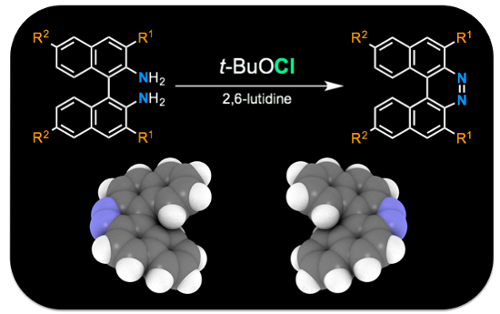
- organic bases like DABCO (pKa 8.93 in DMSO [32]) and DBU (pKa 23.9 in MeCN [33]) gave a lower yield (32%) and no product, respectively (Table 1, entries 14 and 15). As results, the use of the moderately weak organic base 2,6-lutidine (pKa 6.72 in water [34]) successfully afforded 2a in high yield (Table 1


Conjugates of methylated cyclodextrin derivatives and hydroxyethyl starch (HES): Synthesis, cytotoxicity and inclusion of anaesthetic actives
Beilstein J. Org. Chem. 2014, 10, 3087–3096, doi:10.3762/bjoc.10.325
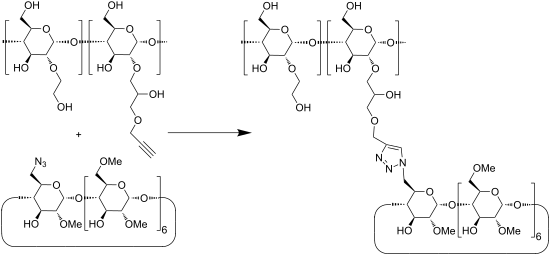
- 2 d reaction time. The decreasing yield was rationalized by the increasing consumption of propargyl glycidyl ether by hydrolysis with increasing OH− concentration. On the other hand, due to the low pKa ≈ 12 of polyglucanes, deprotonation still takes place at very low concentrations of OH− [42][43