


Search results
Search for "pyrimidine" in Full Text gives 207 result(s) in Beilstein Journal of Organic Chemistry. Showing first 200.
Multicomponent reactions in nucleoside chemistry
Beilstein J. Org. Chem. 2014, 10, 1706–1732, doi:10.3762/bjoc.10.179
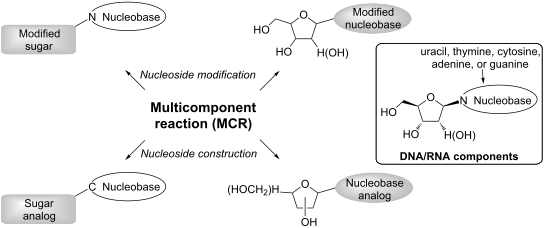
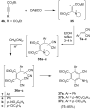
- a secondary amine (i.e., dimethylamine [49][50], diethylamine [51][52], N-methylbenzylamine [49], pyrrolidine [53][54], or piperidine [55][56]) at temperatures ranging from 60 °C to 100 °C afforded the corresponding 5-(alkylaminomethyl)pyrimidine nucleosides 2 (Scheme 2). Compounds 2 served as
- rather limited. Zhang et al. obtained a series of pyrimidine nucleoside-thazolidinone hybrids 15 from 5-formyl-3',5'-di-O-acetyl-2'-deoxyuridine (14), an arylamine and mercaptoacetic acid (Scheme 6) [65]. The reactions were performed in a ionic liquid ([bmim]PF6). Products 15 were obtained in good to


The chemoenzymatic synthesis of clofarabine and related 2′-deoxyfluoroarabinosyl nucleosides: the electronic and stereochemical factors determining substrate recognition by E. coli nucleoside phosphorylases
Beilstein J. Org. Chem. 2014, 10, 1657–1669, doi:10.3762/bjoc.10.173

- ; Introduction Pyrimidine and purine 2-deoxy-2-fluoro-β-D-arabinofuranosides demonstrate a broad spectrum of biological activity [1][2][3][4][5][6][7][8][9] and are valuable constituents of artificial oligonucleotides of great molecular biological and medicinal potential [10][11]. Among this family of
- obtained in 29 and 39% yield, respectively [19]. Previously, we have applied the MacDonald method for the synthesis of α-D-arabinofuranose-1-phosphate (Ara-1P) and showed that it is a versatile substrate for the enzymatic synthesis of both purine and pyrimidine nucleosides [22][23]. In addition, we
- pyrimidine β-D-arabinofuranosides by using α-D-arabinofuranose-1-phosphate (Ara-1P) as the glycosylating agent and the respective recombinant E. coli nucleoside phosphorylases as biocatalysts [22][23]. It was thus shown that Ara-1P is a universal glycosylating substrate for the synthesis of both purine and


Pyrene-modified PNAs: Stacking interactions and selective excimer emission in PNA2DNA triplexes
Beilstein J. Org. Chem. 2014, 10, 1495–1503, doi:10.3762/bjoc.10.154
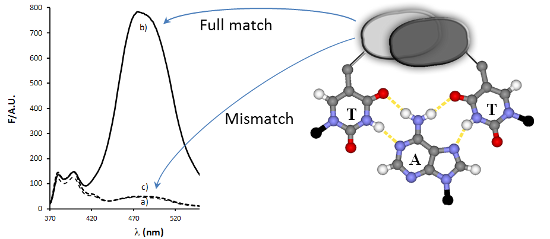
- sequence with prevalence of pyrimidine bases, complementary to cystic fibrosis W1282X point mutation were synthesized. These compounds showed sequence-selective switch-on of pyrene excimer emission in the presence of target DNA, due to PNA2DNA triplex formation, with stability depending on the number and
- recognition; triplex stabilization; Introduction Peptide nucleic acid (PNA) probes are very selective in the recognition of DNA and have been used in a large variety of diagnostic methods, easily allowing the detection of point mutations at very low concentrations [1][2][3]. Poly-pyrimidine PNA can form very
- homopyrimidine sequences since the presence of one or more purine residues destabilizes these complexes and favour the formation of less stable duplexes [8]. Therefore it would be of great value to adopt strategies for the stabilization of triplex structures even in the presence of non-pyrimidine bases. From the


Stereoselective synthesis of carbocyclic analogues of the nucleoside Q precursor (PreQ0)
Beilstein J. Org. Chem. 2014, 10, 1333–1338, doi:10.3762/bjoc.10.135

- ; stereoselective amine synthesis; triol synthesis; Introduction 7-Deazapurine (pyrrolo[2,3-d]pyrimidine) nucleosides are commonly found in nature playing a variety of roles such as building blocks of nucleic acids and tRNA, metabolites or antimetabolites [1]. Deazapurine ribonucleosides also show interesting
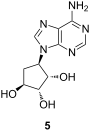
- , respectively [5][6]. In turn, the biosynthesis of PreQ0 originates from guanosine 5’-triphosphate (GTP, 4) [7] (Figure 1) and involves four steps via a tetrahydropterine intermediate. The pyrrolo[2,3-d]pyrimidine core is a privileged scaffold for the development of kinase inhibitors; an inspection of the
- to prepare diverse chiral amine building blocks and react them with a common halo-purine intermediate to obtain the desired final products. The pyrrolo[2,3-d]pyrimidine core of PreQ0 was furnished following a method described by Klepper et al. [13] (Figure 3). The two step process started with the




Synthesis, characterization and DNA interaction studies of new triptycene derivatives
Beilstein J. Org. Chem. 2014, 10, 1290–1298, doi:10.3762/bjoc.10.130
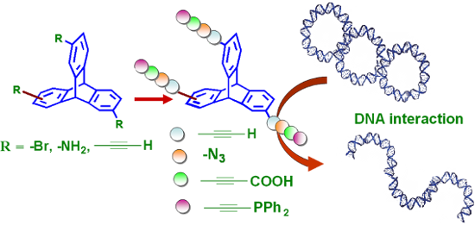
- generated when a purine (A/G) or a pyrimidine (C/T) base is stripped off from the DNA strand and this is considered as the most common type of DNA damage lesions. We generated one abasic site in a 48-base pair long oligomer duplex by treating the DNA (Figure 3) with Uracil DNA Glycosylase (UDG) enzyme


Use of activated enol ethers in the synthesis of pyrazoles: reactions with hydrazine and a study of pyrazole tautomerism
Beilstein J. Org. Chem. 2014, 10, 752–760, doi:10.3762/bjoc.10.70

- species, which are possible for ester compounds 5b and 5c are shown in Figure 3, with the last character of the label being an E indicates enol, O denotes oxo, and (Z,E) – HO vs OH/=O Compound 5b was previously prepared by a ring contraction of pyrimidine-2,4-dione [19]. It is known from the literature
- enol ether/hydrazine is 1:1, as in the case of the reaction with 3c, the formation of 7-aminopyrazolo[1,5-a]pyrimidine-3,6-dicarbonitrile could be expected as a byproduct [24][25]. When hydrazine hydrochloride is used [14], ethyl 3-ethoxypyrazole-4-carboxylate was obtained in 41% yield and the expected



The Flögel-three-component reaction with dicarboxylic acids – an approach to bis(β-alkoxy-β-ketoenamides) for the synthesis of complex pyridine and pyrimidine derivatives
Beilstein J. Org. Chem. 2014, 10, 394–404, doi:10.3762/bjoc.10.37
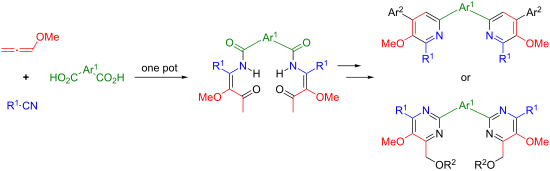
- dihydropyrimidinones or the corresponding dihydropyrimidinethiones. Due to their general importance (e.g. as biologically active compounds) the development of efficient protocols for the preparation of functionalized pyridine [10][11][12][13][14][15][16][17][18][19][20] and pyrimidine derivatives [21][22][23][24][25
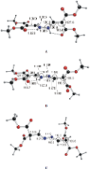
- E- and Z-configured enamide moieties [51][52], finally leading to identical products. After these successful multicomponent reactions we investigated the intramolecular condensations of the bis(β-ketoenamides) 13–15 to pyridine and pyrimidine derivatives. Enamides 13 and 14 were treated with
- acetate in a sealed tube we obtained a 1:1 mixture of bis(pyrimidine) derivative 23a and pyrimidine 23b still containing one β-ketoenamide unit with an overall yield of 68%. However, full conversion of 13 into 23a was achieved by increasing the amount of ammonium acetate to 16 equiv and using a higher


Organobase-catalyzed three-component reactions for the synthesis of 4H-2-aminopyrans, condensed pyrans and polysubstituted benzenes
Beilstein J. Org. Chem. 2014, 10, 141–149, doi:10.3762/bjoc.10.11
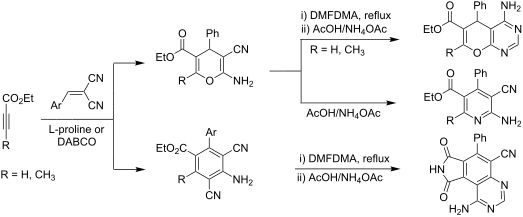
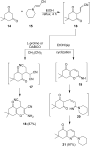
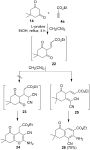
- the products. Finally, these compounds were used for the efficient synthesis of 6-amino-5-cyanonicotinic acid ester derivatives 31a,b, ethyl 4-amino-5H-pyrano[2,3-d]pyrimidine-6-carboxylates 33a,b, 4-amino-6H-pyrrolo[3,4-g]quinazoline-9-carbonitrile 39, and 1,7-diamino-6-(N'-hydroxycarbamimidoyl)-3
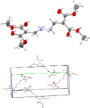
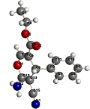
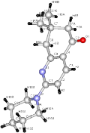
- acid derivatives 31a,b, ethyl 4-amino-5H-pyrano[2,3-d]pyrimidine-6-carboxylates 33a,b, 4-amino-6H-pyrrolo[3,4-g]quinazoline-9-carbonitrile 39, and 1,7-diamino-6-(N'-hydroxycarbamimidoyl)-3-oxo-5-phenyl-3H-isoindole-4-carboxylate 40. X-ray crystal structure of 9. X-ray crystal structure of 13a. X-ray









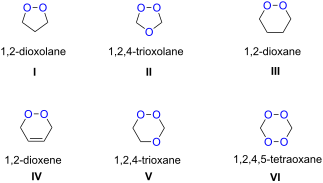
Synthesis of five- and six-membered cyclic organic peroxides: Key transformations into peroxide ring-retaining products
Beilstein J. Org. Chem. 2014, 10, 34–114, doi:10.3762/bjoc.10.6


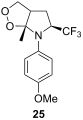


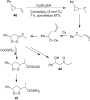


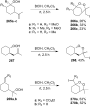


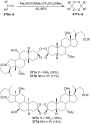


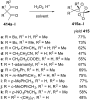


IBD-mediated oxidative cyclization of pyrimidinylhydrazones and concurrent Dimroth rearrangement: Synthesis of [1,2,4]triazolo[1,5-c]pyrimidine derivatives
Beilstein J. Org. Chem. 2013, 9, 2629–2634, doi:10.3762/bjoc.9.298

- Caifei Tang Zhiming Li Quanrui Wang Department of Chemistry, Fudan University, 200433 Shanghai, P. R. of China 10.3762/bjoc.9.298 Abstract Oxidative cyclization of 6-chloro-4-pyrimidinylhydrazones 4 with iodobenzene diacetate (IBD) in dichloromethane gives rise to [1,2,4]triazolo[4,3-c]pyrimidine
- pyrimidine moiety is an important pharmacophore [1]. Especially, the fused bi- or tricyclic heterocyles containing a pyrimidine motif have received considerable interest in the design and discovery of new compounds for pharmaceutical and herbicidal applications [2][3]. For example, the pyrrolo[2,3-d
- ]pyrimidine derivative, ruxolitinib (INCB018424), was discovered as a selective JAK1 and JAK2 inhibitor, which is currently under clinical investigation [4]. To date, a number of fused pyrimidine-type compounds have been successfully commercialized, such as the pyrazolo[3,4-d]pyrimidine allopurinol and the


An overview of the synthetic routes to the best selling drugs containing 6-membered heterocycles
Beilstein J. Org. Chem. 2013, 9, 2265–2319, doi:10.3762/bjoc.9.265
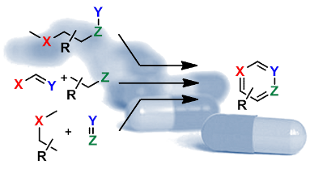
- , pyrimidine-derived analogues (1,3-diazines) are the most common. Pyridazines (1,2-diazines) and pyrazines (1,4-diazines) are less prominent. The main reasons are most probably that pyrimidines are highly abundant in important biogenic molecules such as the ribonucleotides and that this heterocycle can be
- readily obtained through well-established condensation chemistries. In the next sections the most common syntheses of a number of drugs containing the pyrimidine as well as pyridazine and pyrazine scaffolds are presented. Furthermore, some non-aromatic derivatives including bicyclic analogues of these
- structures will be introduced. The additional nitrogen atom in pyrimidine leads to a significantly reduced basicity when compared to simple pyridine (pKa[pyrimidine] = 1.1; pKa[pyridine] = 5.3) as well as a much more electron-deficient ring system. However, owing to the presence of two nitrogen atoms


Synthesis, characterization and luminescence studies of gold(I)–NHC amide complexes
Beilstein J. Org. Chem. 2013, 9, 2216–2223, doi:10.3762/bjoc.9.260
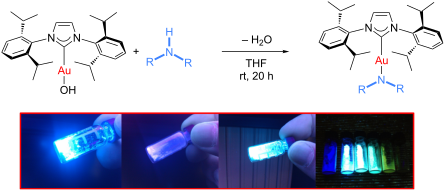
- ) with each (hetero)aromatic amine in THF at room temperature for 20 h. A range of aromatic amines were employed, including aniline, diphenylamine, pyridines, a pyrimidine and one isoquinoline. The corresponding complexes were obtained in analytically pure form and in good yields as yellow or white


The chemistry of amine radical cations produced by visible light photoredox catalysis
Beilstein J. Org. Chem. 2013, 9, 1977–2001, doi:10.3762/bjoc.9.234
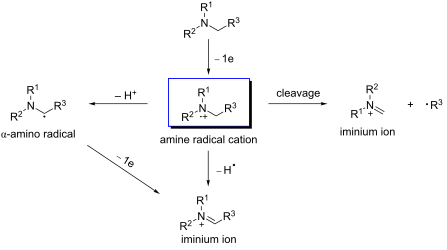
- and coworkers then applied the same strategy to prepare two other types of heterocycles, isoquino[2,1-a][3,1]oxazine and isoquino[2,1-a]pyrimidine (75, Scheme 19) [87]. The use of [Ir(ppy)2(dtbbpy)](PF6) with air as the external oxidant was found to be optimal for catalyzing the reaction. Later, the




One-step synthesis of pyridines and dihydropyridines in a continuous flow microwave reactor
Beilstein J. Org. Chem. 2013, 9, 1957–1968, doi:10.3762/bjoc.9.232
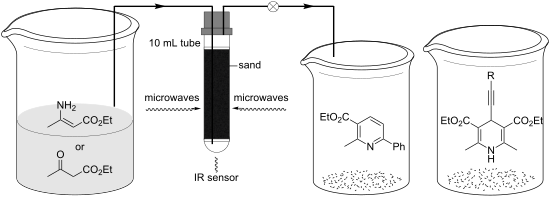
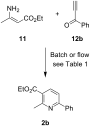
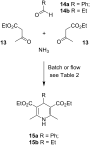
- favourably with microwave-heated batch experiments. For dihydropyrimidinone 8, a flow rate of 2 mL min–1 delivered a very respectable processing rate of 25 g h–1. Following the success of this reactor design in delivering pyridine and pyrimidine heterocycles, albeit from very different processes, and the




Damage of polyesters by the atmospheric free radical oxidant NO3•: a product study involving model systems
Beilstein J. Org. Chem. 2013, 9, 1907–1916, doi:10.3762/bjoc.9.225

- the strongest free-radical oxidants known [E(NO3•/NO3−) = 2.3–2.5 V vs NHE] [9], and recent product studies by us revealed that NO3• readily damages aromatic amino acids and pyrimidine nucleosides through an oxidative pathway [10][11][12][13]. Thus, the ease by which model compounds of biologically


Cyclization of substitued 2-(2-fluorophenylazo)azines to azino[1,2-c]benzo[d][1,2,4]triazinium derivatives
Beilstein J. Org. Chem. 2013, 9, 1873–1880, doi:10.3762/bjoc.9.219
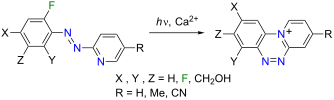
- with increasing number of fluorine atoms at the benzene ring. No triazinium ions were obtained from azo derivatives of 4-cyanopyridine, pyrazine and pyrimidine, presumably due to their instability under the reaction conditions. The experimental results and mechanism are discussed with the aid of DFT
- reactivity of the azines, and CH2OH to provide a potential synthetic handle for the incorporation into more complex structures. Here we present the synthesis of four substituted derivatives of 1a and investigate the preparation of cations derived from pyrazine 2 and pyrimidine 3 shown in Figure 2. Our
- the pyrazine derivative 5-Z (ΔG298 = 2.7 kcal/mol), which also has the lowest TS energy (ΔG‡298 = 18.7 kcal/mol, Table 2). On the other hand, the cyclization of pyrimidine 6-Z is most endergonic and has the highest TS energy among all azoazines considered in this work. These significant differences


The first example of the Fischer–Hepp type rearrangement in pyrimidines
Beilstein J. Org. Chem. 2013, 9, 1819–1825, doi:10.3762/bjoc.9.212

- -pyrimidinediamines. It was found that the outcome of the reaction strongly depends on the structure of the pyrimidines. Activation of the pyrimidine ring by three groups with a positive mesomeric effect is crucial for the intramolecular nitroso group migration. Keywords: Fischer–Hepp rearrangement; nitrosation; 5
- -nitrosopyrimidines; nucleophilic substitution; pyrimidinediamines; Introduction The pyrimidine moiety is an important structural motif in natural products and therefore frequently used as a building block for pharmaceutical agents [1][2]. It is well-known that chemical properties of pyrimidines depend on the π
- -defficient character of this heterocycle. An electrophilic aromatic substitution at the C-5 of a pyrimidine is usually difficult [1][3][4][5]. However, the presence of two or three activating groups leads to the successful introduction of an electrophile (Scheme 1) [1][6][7][8]. On the other hand


An organocatalytic route to 2-heteroarylmethylene decorated N-arylpyrroles
Beilstein J. Org. Chem. 2013, 9, 1480–1486, doi:10.3762/bjoc.9.168
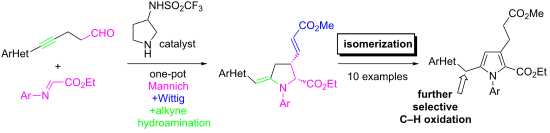
- electronically deficient pyridyl residue was also converted into 5e (80%) while pyrrolidine 4f bearing a pyrazine core underwent aromatization with high efficiency to give 5f (97%). The C2-symmetric scaffold 4g was efficiently converted into 5g (86%) and similar treatment of pyrimidine 4h provided pyrrole 5h in
- heteroaryl substituents, with yields ranging from 64–87%. Oxidation under the same conditions was found to be more troublesome with pyrazine 5f since alcohol 9f was isolated in only 20% yield. Similar treatment of pyrazine 5g and pyrimidine 5h gave a complex mixture of products. While the oxidation of the


3-Pyridylnitrene, 2- and 4-pyrimidinylcarbenes, 3-quinolylnitrenes, and 4-quinazolinylcarbenes. Interconversion, ring expansion to diazacycloheptatetraenes, ring opening to nitrile ylides, and ring contraction to cyanopyrroles and cyanoindoles
Beilstein J. Org. Chem. 2013, 9, 743–753, doi:10.3762/bjoc.9.84
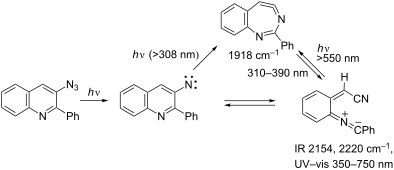
- -diazoethoxycarbonylmethylene)-2-(α-hydroxybenzyl)pyrimidin-4-(2H)-one, have been reported [27]. We find that FVT of the 4- and 2-(5-tetrazolyl)pyrimidines 22–24 also affords cyanopyrroles (Scheme 8). FVT of 2-(5-tetrazolyl)pyrimidine (22) affords a ca. 1:1 ratio of 2- and 3-cyanopyrroles (Scheme 8). The results of FVT of
- -tetrazolyl)pyrimidine (22) [36][37], 2-phenyl-4-(5-tetrazolyl)quinazoline (52) [23], and 5-phenyl-1,2,3-triazolo[1,5-a]quinazoline (53) [23] were prepared according to literature procedures. 4,6-Dimethyl-2-(5-tetrazolyl)pyrimidine (24) and 2,4-dimethyl-6-(5-tetrazolylpyrimidine) (23) were prepared from the
- dimethylpyrimidine-carbonitriles [38][39] by adaptation of the literature method [36][37]. 4,6-Dimethyl-2-(5-tetrazolyl)pyrimidine (24): From 3.0 g (22.5 mmol) of 4.6-dimethylpyrimidine-2-carbonitrile was obtained 2.8 g (71%); mp 209–210 °C (dec); 1H NMR (CDCl3) 12.0 (very broad), 7.37 (s, 1H), 2.50 (s, 6H); MS m/z




Recent progress in the discovery of small molecules for the treatment of amyotrophic lateral sclerosis (ALS)
Beilstein J. Org. Chem. 2013, 9, 717–732, doi:10.3762/bjoc.9.82
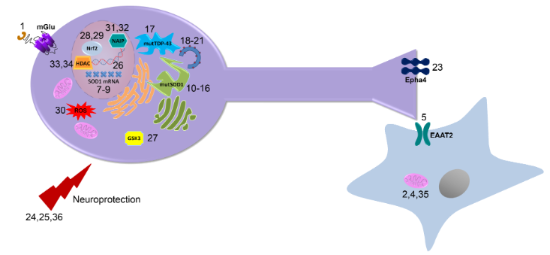
- , allowed the researchers to identify three distinct chemical series that were selected for optimization based on their ability to reduce both cellular toxicity and mutant SOD1 protein aggregation: arylsulfanyl pyrazolones (ASP, 10), cyclohexane-1,3-diones (CHD, 11), and pyrimidine 2,4,6-triones (PYT, 12


Some aspects of radical chemistry in the assembly of complex molecular architectures
Beilstein J. Org. Chem. 2013, 9, 557–576, doi:10.3762/bjoc.9.61

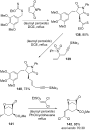
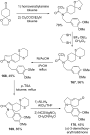
- –cyclisation leading to indoline 97 with an intramolecular Friedel–Crafts reaction to afford a tricyclic derivative 98 substituted by a trifluoromethyl group [44]. The second exploits the presence of both a protected primary amine and an easily substitutable chlorine on the pyrimidine ring in 99a,b to afford













Spin state switching in iron coordination compounds
Beilstein J. Org. Chem. 2013, 9, 342–391, doi:10.3762/bjoc.9.39
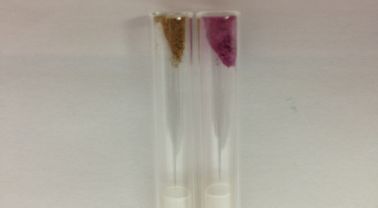


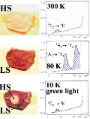
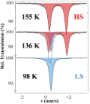




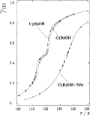


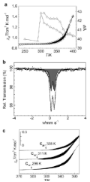
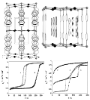
![[Graphic 1]](/bjoc/content/inline/1860-5397-9-39-i3.png?max-width=637&scale=1.18182) ) modes versus the anion volu...
) modes versus the anion volu...






Dipyrazolo[1,5-a:4',3'-c]pyridines – a new heterocyclic system accessed via multicomponent reaction
Beilstein J. Org. Chem. 2012, 8, 2223–2229, doi:10.3762/bjoc.8.251
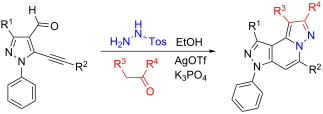
- ; Introduction Condensed pyrazole scaffolds are important substructures of compounds with biological activity and can be found in some well-known drug molecules, such as, for example, Sildenafil (a pyrazolo[4,3-d]pyrimidine) [1][2], Allopurinol (a pyrazolo[3,4-d]pyrimidin-4-one) [3], Zaleplon (a pyrazolo[1,5-a
- ]pyrimidine) [4], and Zolazepam (a pyrazolo[3,4-e][1,4]diazepine derivative, used in veterinary medicine) [5]. Particularly pyrazolopyrimidines are a very frequently accessed class of compounds [6] with the particular importance of the pyrazolo[3,4-d]pyrimidine core, which can closely mimic the purine system


Features of the behavior of 4-amino-5-carboxamido-1,2,3-triazole in multicomponent heterocyclizations with carbonyl compounds
Beilstein J. Org. Chem. 2012, 8, 2100–2105, doi:10.3762/bjoc.8.236
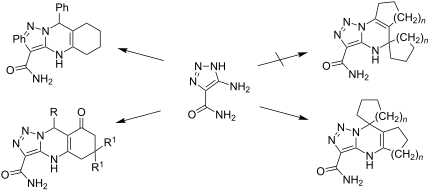
- . However, MS data obtained for the reaction product isolated from the MCR between aminoazole 1 and cycloalkanone 2 may correspond to both structure 3 and 4. Moreover, 1H and 13C NMR spectra of these compounds should contain very similar signals, and we thus used the position of the signal of pyrimidine NH
- contain cross-peaks between pyrimidine NH and spiro-carbon, which is also in good correlation with structure 4. Analogous elucidations allowed the structures of compounds 7 and 9 to be established. Conclusion In summary, two types of heterocyclization reactions involving 4-amino-5-carboxamido-1,2,3
- -triazole and cyclic ketones were studied under conventional thermal heating, and microwave and ultrasonic irradiation. ABB’-type MCR proceeding with chemodifferentiation of cyclopentanone or cyclohexanone molecules yields 4,5,6,7-tetrahydrospiro{cyclopenta[d][1,2,3]triazolo[1,5-a]pyrimidine-8,1



Engineering of indole-based tethered biheterocyclic alkaloid meridianin into β-carboline-derived tetracyclic polyheterocycles via amino functionalization/6-endo cationic π-cyclization
Beilstein J. Org. Chem. 2012, 8, 1901–1908, doi:10.3762/bjoc.8.220

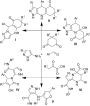
- developed for the construction of a functionalized natural product, meridianin, and its post conversion to pyrimido-β-carboline by cationic π- cyclization. The strategy involves the introduction of an amino group at the C-5 of the pyrimidine ring and utilizing the nucleophilictiy of the C-2 in the indole
- nortopsentins [21][22][23]), dihydroimidazole (discodermindole [24]), oxadiazine (alboinon [25]), piperazine (dragmacidon [26]), maleimide (didemidines [25]), and pyrimidine (meridianins) [27][28][29]. Among these, meridianins (Figure 1), the tethered biheterocycles isolated from the south Atlantic tunicate
- inhibition [48] to inhibition of cGMP-dependent processes [49][50]. In this communication, we report engineering of naturally occurring tethered indole-based biheterocyclic alkaloid meridianins into β-carboline-derived tetracyclic polyheterocycles by amino functionalization of the pyrimidine ring followed by





