Search results
Search for "regioisomers" in Full Text gives 254 result(s) in Beilstein Journal of Organic Chemistry. Showing first 200.
Combined experimental and theoretical studies of regio- and stereoselectivity in reactions of β-isoxazolyl- and β-imidazolyl enamines with nitrile oxides
Beilstein J. Org. Chem. 2016, 12, 2390–2401, doi:10.3762/bjoc.12.233

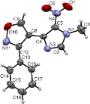
- challenge. We turned our attention to the reaction of enamines with nitrile oxides (or their precursors, hydroxamoyl chlorides). The reaction has been shown to take place regioselectively to form only one of two possible regioisomers [18][19][20][21][22][23][24][25][26]. Therefore, this holds some promise
- around the double bond, and found to be 38.09 kcal∙mol−1 above 1a_1 in free energy. Calculations of the suggested mechanisms (Scheme 3) performed for E-isomer 1a_1 and nitrile oxide 6a allowed localizing a concerted transition state for both, observed and not observed regioisomers 3 and 8, respectively




Palladium-catalyzed ring-opening reactions of cyclopropanated 7-oxabenzonorbornadiene with alcohols
Beilstein J. Org. Chem. 2016, 12, 2189–2196, doi:10.3762/bjoc.12.209

- the C1 position, the formation of two regioisomers is possible (Scheme 4). The bridgehead-oxygen bond can break in two different directions (a or b), creating either a tertiary or secondary cation which after the nucleophilic ring opening creates two different regioisomers. In all cases, the
- cyclopropanated 8 and its proposed ring-opening mechanisms. Formation of the possible regioisomers for the ring opening of asymmetric C1-substituted cyclopropanated oxabenzonorbornadiene. Effects of palladium catalysts and catalyst equivalency on the ring-opening reaction of oxabicyclic alkene 8a with alcohols


Comparing blends and blocks: Synthesis of partially fluorinated diblock polythiophene copolymers to investigate the thermal stability of optical and morphological properties
Beilstein J. Org. Chem. 2016, 12, 2150–2163, doi:10.3762/bjoc.12.205
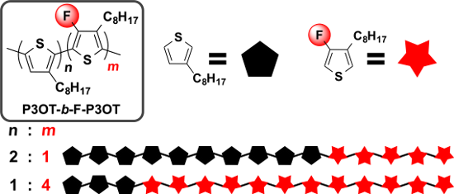
- -fluorinated monomer gives an approximate 4:1 mixture of regioisomers [45][46]. Although this mixture of isomers can afford good regularity under certain conditions, it can be expected to have a detrimental effect on regioregularity [47]. For this reason most block co-polymers utilize a regiochemically pure




Stereo- and regioselectivity of the hetero-Diels–Alder reaction of nitroso derivatives with conjugated dienes
Beilstein J. Org. Chem. 2016, 12, 1949–1980, doi:10.3762/bjoc.12.184
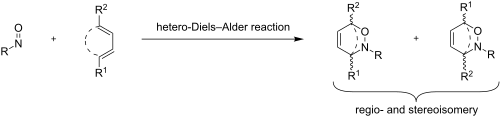
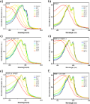
- -heteroarene reactants [91]. Nicholas and co-workers investigated the thermal (uncatalyzed) and Cu(I)-catalyzed reactions of 2-nitrosopyridine with various dienes [92]. Generally, the cycloaddition of an unsymmetrical diene and nitroso compound will lead to two regioisomers – proximal and distal (Scheme 11
- dichloromethane throughout. When the reaction in solution shown in Scheme 20, giving 1,2-oxazine 97, was performed in MeOH, the ratio of regioisomers was changed from 3:2 (in DCM) to 3:1 (in MeOH) [100]. The comparison between the solution and solid-phase syntheses is possible to do with respect to the
- regioselectivity. On the other hand, its isomer 106 gave two regioisomers in a ratio of 2:1 [88][95] (Scheme 21). This was proposed to be due to an increased steric interaction between the phenyl ring at position 4 on the β-lactam ring in 107 and the nitrosobenzene (47) during the formation of product 108. For the






Synthesis of pyrrolo[2,1-f][1,2,4]triazin-4(3H)-ones: Rearrangement of pyrrolo[1,2-d][1,3,4]oxadiazines and regioselective intramolecular cyclization of 1,2-biscarbamoyl-substituted 1H-pyrroles
Beilstein J. Org. Chem. 2016, 12, 1780–1787, doi:10.3762/bjoc.12.168
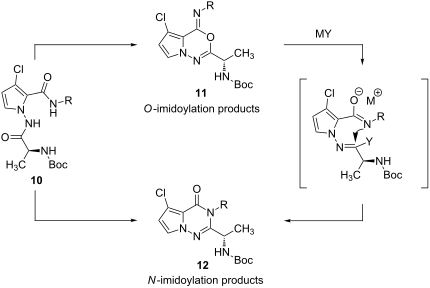
- in low yields (40% combined yield, entry 3, Table 1). Alternatively, when 2.5 equivalents of Et3N were used, the two regioisomers 11a and 12a were obtained in an excellent overall yield of 87% (entry 2, Table 1). In addition, the ratio of 11a to 12a was not significantly affected by reaction times
- and temperatures (entries 4–6, Table 1). Although initial attempts to synthesize pyrrolotriazinone 12a regioselectively were not successful, it should be highlighted that the regioisomers oxadiazine 11a and triazinone 12a could be easily prepared under very mild conditions (0 °C for 5 min), whereas
- and triazinones 12 are non-crystalline, their exact structures were assigned by NMR spectroscopy (1H and 13C). With the literature results alone [9][10][11][12] the identity of the regioisomers could not be accurately confirmed; therefore, the NMR studies were required. As shown in Table 4, different


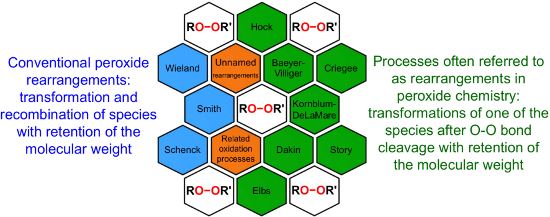
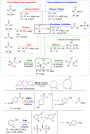
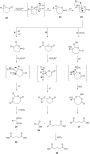
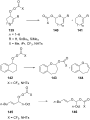
Rearrangements of organic peroxides and related processes
Beilstein J. Org. Chem. 2016, 12, 1647–1748, doi:10.3762/bjoc.12.162













Catalytic Chan–Lam coupling using a ‘tube-in-tube’ reactor to deliver molecular oxygen as an oxidant
Beilstein J. Org. Chem. 2016, 12, 1598–1607, doi:10.3762/bjoc.12.156
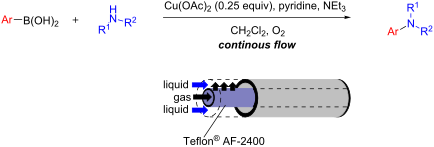
- several examples of literature reported cases where mixtures of regioisomers had been obtained were wrongly assigned. The process described does have certain limitations. For certain nucleophilic substrates no products were obtained when C–N coupling with 4-methoxyphenylboronic acid (17) was attempted


Synthesis of ferrocenyl-substituted 1,3-dithiolanes via [3 + 2]-cycloadditions of ferrocenyl hetaryl thioketones with thiocarbonyl S-methanides
Beilstein J. Org. Chem. 2016, 12, 1421–1427, doi:10.3762/bjoc.12.136

- -Ferrocenyl-5-(selenophen-2-yl)spiro[1,3-dithiolane-4,2’-tricyclo[3.3.1.13,7]decane] (5l); 4-Ferrocenyl-4-(selenophen-2-yl)spiro[1,3-dithiolane-2,2’-tricyclo[3.3.1.13,7]decane] (6l): Isolated as a mixture of regioisomers. Yield: 393 mg (73%; crude product ratio 67:33). Yellow solid; IR (KBr) ν: 3085 (w), 3072


Copper-catalyzed [3 + 2] cycloaddition of (phenylethynyl)di-p-tolylstibane with organic azides
Beilstein J. Org. Chem. 2016, 12, 1309–1313, doi:10.3762/bjoc.12.123

- the generation of regioisomers. In 2002 Sharpless [2] and Meldal [3] independently reported that the addition of catalytic amounts of copper reagent in the AAC allow the reaction to proceed under milder reaction conditions, and there was also an effect on the regioselectivity for the synthesis of 1,4


Multicomponent reactions: A simple and efficient route to heterocyclic phosphonates
Beilstein J. Org. Chem. 2016, 12, 1269–1301, doi:10.3762/bjoc.12.121
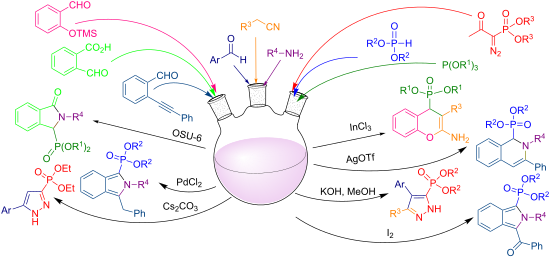
- were obtained which were sterically too crowded for attacking the phosphorus atom of the phosphonates. The use of unsymmetrically substituted diamines led to the corresponding syn-regioisomers as the major product and the anti-regioisomer as the minor product. Some of the synthesized 1,5-benzodiazepin


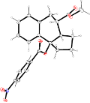
Stereoselective synthesis of tricyclic compounds by intramolecular palladium-catalyzed addition of aryl iodides to carbonyl groups
Beilstein J. Org. Chem. 2016, 12, 1236–1242, doi:10.3762/bjoc.12.118
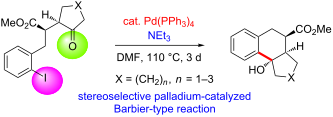
- rings was formed selectively from precursor 5a. We also briefly studied the palladium-catalyzed cyclization of p-methoxy-substituted aryl iodide 6a/b that led under the standard conditions to a mixture containing compound 16 (Scheme 7). We cannot exclude that other regioisomers or even primarily formed




Catalytic asymmetric synthesis of biologically important 3-hydroxyoxindoles: an update
Beilstein J. Org. Chem. 2016, 12, 1000–1039, doi:10.3762/bjoc.12.98
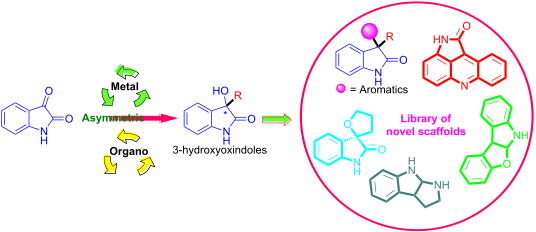
- the 3-position of indoles, while Shi et al. reported that they obtained regioisomers when 3-methylindoles were used (Scheme 49) [66], indicating that the 3-methyl group was important for the observed regioselectivity. Shi et al. established a chiral CPA-catalyzed asymmetric allylation of 3




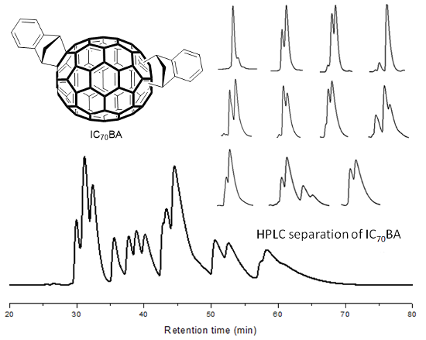
Separation and identification of indene–C70 bisadduct isomers
Beilstein J. Org. Chem. 2016, 12, 903–911, doi:10.3762/bjoc.12.88
- separation; electron acceptor; fullerene bisadduct; organic solar cell; regioisomers; Introduction Organic solar cells (OSCs) are an emerging renewable energy technology that has achieved remarkable progress over the past two decades. Compared to traditional inorganic semiconductor solar cells, OSCs promise
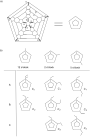
- ]. Therefore, bisadducts of C70 usually consist of three major regioisomers, which have been described as the 12 o’clock, 2 o’clock and 5 o’clock isomers (Figure 2b) [10]. Each of these three regioisomers also includes two or three geometric isomers as a result of the conformation of the substituents. Given
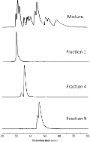
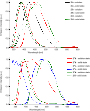
- . Among these fractions, all of the major regioisomers as well as some minor regioisomers of IC70BA were identified. The separation process, full characterizations as well as the device performance of these isomers of IC70BA are presented in this work. Results and Discussion The synthesis of the isomeric




Indenopyrans – synthesis and photoluminescence properties
Beilstein J. Org. Chem. 2016, 12, 825–834, doi:10.3762/bjoc.12.81

- ] may lead to two possible regioisomers: isomer 2 with the benzene ring fused at C5a–C9a and its regioisomer 3 with the benzene ring fused at C4b–C8a (Figure 1). Additionally, due to the new stereocenters created at positions 4 and 4a, each regioisomer could be expressed as a set of diastereoisomers
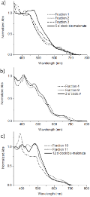
- ). However, a slight bathochromic shift could be observed when methylene chloride was used in contrast to a hypsochromic shift in the more polar solvent acetonitrile. The analysis of the absorption spectra revealed some differences between the regioisomers 2''b and 3''b and diastereoisomers 2' and 2'', as
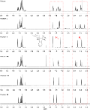
- time, most of the isomer 2'a was recovered and traces of derivative 4a could only be detected in the NMR spectrum. Using the same procedure, the enol-lactone isomeric mixture 2'c/3'c was subjected to the dehydrogenation reaction yielding the regioisomers 4c and 5c (Scheme 2). The 1H NMR spectrum



Diradical reaction mechanisms in [3 + 2]-cycloadditions of hetaryl thioketones with alkyl- or trimethylsilyl-substituted diazomethanes
Beilstein J. Org. Chem. 2016, 12, 716–724, doi:10.3762/bjoc.12.71

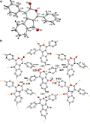
- expected three diastereoisomers. In all cases they belong to the same group of regioisomers. The regioselective formation of products 10 was proved by 13C NMR spectroscopy: the signals attributed to C(2) were found in narrow regions at 54.9–59.4 ppm for 10c, 10f–h and 43.1–45.6 ppm for 10m,n, respectively


Aluminacyclopentanes in the synthesis of 3-substituted phospholanes and α,ω-bisphospholanes
Beilstein J. Org. Chem. 2016, 12, 406–412, doi:10.3762/bjoc.12.43

- regioisomers react in situ with phosphorus dihalides and hydrogen peroxide to afford 1-phenyl(alkyl)-2-arylphospholane oxides 7a–f and 1-phenyl(alkyl)-3-arylphospholane oxides 8a–f in 2:1 ratio in a 69–87% total yield (Table 2). The regioisomers were isolated by column chromatography (hexane/ethyl acetate


Tandem processes promoted by a hydrogen shift in 6-arylfulvenes bearing acetalic units at ortho position: a combined experimental and computational study
Beilstein J. Org. Chem. 2016, 12, 260–270, doi:10.3762/bjoc.12.28
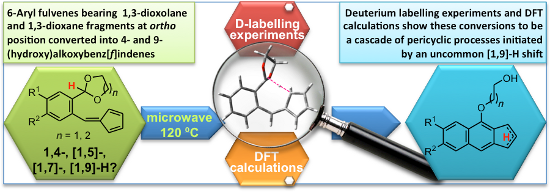
- from medium to low as depicted in Table 1. Despite our chromatographic (column, thin-layer) efforts, additional pure products other than 5 and 6 could not be isolated from the complex final reaction mixtures. The structural determination of the reaction products, the 9- and 4-hydroxyalkoxy regioisomers
- 5 and 6, was easily accomplished by using the habitual analytical and spectroscopic techniques, whereas the distinction between each two regioisomers is basically supported by 1H NMR NOE difference experiments. For the major isomers 5 enhancements of the signals due to the H-C2 and CH2-OAr protons
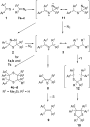
- monodeuterated acetal-fulvene 20 bearing the deuterium atom at C4. This species converted into a 2:1 mixture of the monodeuterated regioisomers 21 and 22 as the only isolated reaction products (Scheme 6). In both compounds, the deuteration percentage at their respective C4 and C9 positions was determined, by 1H


Regioselective palladium-catalyzed ring-opening reactions of C1-substituted oxabicyclo[2,2,1]hepta-2,5-diene-2,3-dicarboxylates
Beilstein J. Org. Chem. 2016, 12, 239–244, doi:10.3762/bjoc.12.25
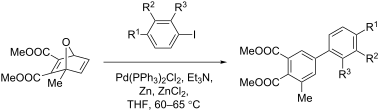
- the steric bulk on the bridgehead carbon decreased the yield. These reactions were found to be highly regioselective, giving only one of the two possible regioisomers in all cases. A diverse collection of novel, highly substituted biphenyl derivatives were obtained. Keywords: aryl iodides
- regioselectivity of the reaction. Two regioisomers are possible for this reaction based on whether the aryl group is added to carbon a or carbon b of 2 (Scheme 3). Our group recently investigated the effect of C1 substitution, with ethyl and methoxycarbonyl substituents, on the palladium-catalyzed ring-opening
- regioisomers, depending on whether the aryl group adds to Ca or Cb. In all cases, only one regioisomer was seen as a result of the addition of the aryl group to Ca. Cleavage of the β-oxygen gives the ring-opened intermediate 9. The palladium species is reduced, producing the final intermediate 10 and


Base metal-catalyzed benzylic oxidation of (aryl)(heteroaryl)methanes with molecular oxygen
Beilstein J. Org. Chem. 2016, 12, 144–153, doi:10.3762/bjoc.12.16
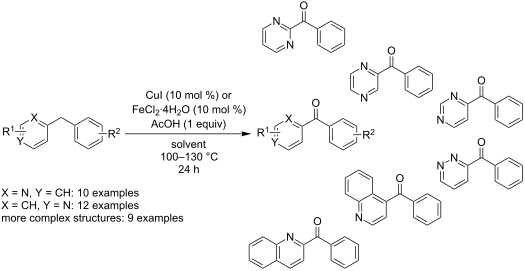
- , entries 10 and 11). When investigating regioisomeric substrates featuring chloro substituents in all possible positions of the pyridine ring only the 4-Cl (pKa ≈ 3.8, Table 2, entries 15 and 16) substrate reaches full conversion under the standard conditions. The 3-Cl and 5-Cl regioisomers have a similar

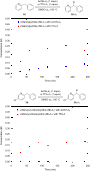


Supramolecular structures based on regioisomers of cinnamyl-α-cyclodextrins – new media for capillary separation techniques
Beilstein J. Org. Chem. 2016, 12, 97–109, doi:10.3762/bjoc.12.11
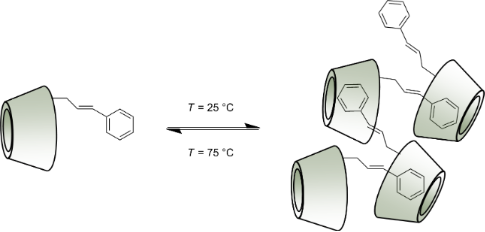
- This work focuses on the preparation and application of supramolecular structures based on mono-cinnamyl-α-cyclodextrins (Cin-α-CD). Pure regioisomers of Cin-α-CD having the cinnamyl moiety at the 2-O- or at the 3-O-position, respectively, were prepared, characterized and applied in capillary
- the regioisomers. The ability of the monomers to self-assemble was proved by various methods including NMR spectroscopy and dynamic light scattering (DLS). The light scattering experiments showed that the monomer units have distinguishable ability to form supramolecular structures in different
- solvents and the size distribution of the aggregates in water can be easily modulated using different external stimuli, such as temperature or competitive guest molecules. The obtained results indicated that the two regioisomers of Cin-α-CD formed different supramolecular assemblies highlighting the fact


Assembly of synthetic Aβ miniamyloids on polyol templates
Beilstein J. Org. Chem. 2015, 11, 2646–2653, doi:10.3762/bjoc.11.284

- correlation. Nuclear magnetic resonance spectroscopy is the analytical method of choice not only to characterize the conversion of template and peptide or to differentiate regioisomers, but also because it can detect noncovalent interactions between peptide strands by NOE contacts or other techniques. The


Synthesis of bi- and bis-1,2,3-triazoles by copper-catalyzed Huisgen cycloaddition: A family of valuable products by click chemistry
Beilstein J. Org. Chem. 2015, 11, 2557–2576, doi:10.3762/bjoc.11.276
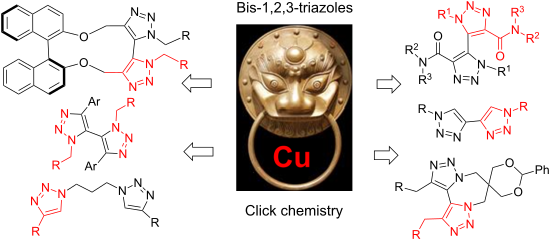
- to biological activity [5][6][7][8]. Originally, this transformation was typically carried out at high temperature and resulted in a mixture of the 1,4 and 1,5 regioisomers (Scheme 1). Fortunately, representing a milestone in this field, the application of Cu(І) as the catalyst was reported by




Iron complexes of tetramine ligands catalyse allylic hydroxyamination via a nitroso–ene mechanism
Beilstein J. Org. Chem. 2015, 11, 2549–2556, doi:10.3762/bjoc.11.275

- regioisomers in the hetero-Diels–Alder reaction with nitroso compounds, yet Cenini et al. only detected one isomer. From this observation they concluded that their Ru-catalysed amination reaction and the Diels–Alder reactions were occurring ‘on metal’ without generation of a free nitroso species [57]. In


Synthesis of D-fructose-derived spirocyclic 2-substituted-2-oxazoline ribosides
Beilstein J. Org. Chem. 2015, 11, 2289–2296, doi:10.3762/bjoc.11.249

- carbohydrate chemistry, they are versatile intermediates in the synthesis of N-linked glycoproteins [20][21][22]. In the context of carbohydrate chemistry, there are two possible regioisomers for glycooxazolines. Firstly, the C1 O-linked 1,2-glycooxazolines (Figure 1, 5) are formed by intramolecular


Efficient synthesis of π-conjugated molecules incorporating fluorinated phenylene units through palladium-catalyzed iterative C(sp2)–H bond arylations
Beilstein J. Org. Chem. 2015, 11, 2012–2020, doi:10.3762/bjoc.11.218

- example, using 4-bromobenzonitrile or ethyl 4-bromobenzoate, the coupling products 7 and 8 were isolated in 70% and 64% yields, respectively. However, other regioisomers were detected in the crude mixtures in trace amounts (e.g., 11–16%), which resulted from the activation of the furyl C–H bond. In
- contrast to these examples, when the reaction was performed with a heteroaryl bromide such as 3-bromopyridine, the two regioisomers 9a and 9b were obtained in 45:55 ratio. On the other hand, it is well known that the C–H bond at the C-3 position of the benzofuran is very reactive in palladium-catalyzed
- fluorine atom might be arylated under this reaction conditions. Using 4-bromobenzaldehyde as coupling partner, a mixture of two regioisomers in 82:18 ratio was obtained, and the C5 arylation product 25 (major regioisomer) was isolated after flash chromatography in 53% yield as pure product. It is important