


Search results
Search for "boron" in Full Text gives 268 result(s) in Beilstein Journal of Organic Chemistry. Showing first 200.
Thermal and oxidative stability of Atlantic salmon oil (Salmo salar L.) and complexation with β-cyclodextrin
Beilstein J. Org. Chem. 2016, 12, 179–191, doi:10.3762/bjoc.12.20
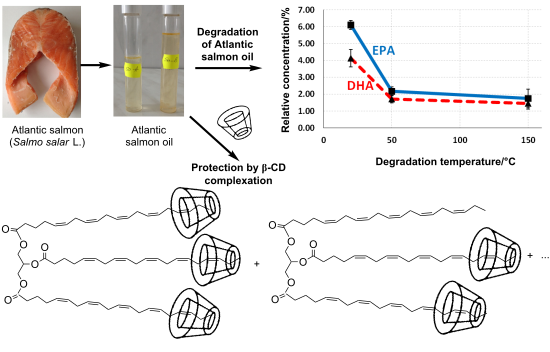
- complexation of ASO. A boron trifluoride–methanol complex (20%, Merck & Co., Inc.) was used for FA derivatization. Finally, Hydranal-Titrant 5, Hydranal-Solvent and Hydranal-Water Standard 10.0 (Sigma-Aldrich, Buchs, Switzerland) were used for the KFT water analysis of β-CD/ASO complexes. ASO extraction The
- profile of nondegraded and degraded ASO was obtained by GC–MS analysis of the corresponding methyl esters (as well as acetals and ketals of FA degradation compounds). For derivatization, approximately 20 mg of ASO or the corresponding sample was dissolved in 3 mL of boron trifluoride–methanol solution in



Spiro-fused carbohydrate oxazoline ligands: Synthesis and application as enantio-discrimination agents in asymmetric allylic alkylation
Beilstein J. Org. Chem. 2016, 12, 166–171, doi:10.3762/bjoc.12.18
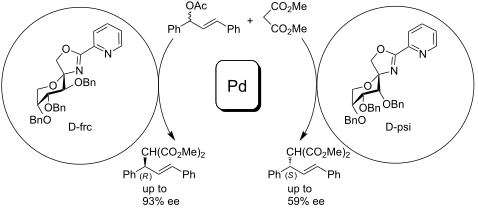
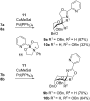
- ester 11 as boron source (Scheme 2) [22][23][24]. 2-Pyridineboronic acid 11 was chosen due to its increased nucleophilicity compared to other boron sources like pinacol boronic esters or MIDA boronates [25][26]. The cross coupling proceeded smoothly in THF and gave ligands 9 and 10 in good yields




Assembly of synthetic Aβ miniamyloids on polyol templates
Beilstein J. Org. Chem. 2015, 11, 2646–2653, doi:10.3762/bjoc.11.284

- the Hot=Tap oligomer. The mixture of azide 9, 2-formylphenylboronic acid (14) and LVFFA shows a single signal set for the esterified product (Figure 8). Another advantage of this system is the cooperativity of imine formation and esterification, because the imino nitrogen coordinates the boron atom


Copper-catalyzed stereoselective conjugate addition of alkylboranes to alkynoates
Beilstein J. Org. Chem. 2015, 11, 2444–2450, doi:10.3762/bjoc.11.265

- the present copper catalysis is proposed in Figure 1. An alkoxycopper complex (A) is initially formed by the reaction of CuOAc, t-BuOK and P(OPh)3. Boron-to-cupper transmetalation between A and the alkylborane 2 occurs to form an alkylcopper(I) species (B) and a t-butoxyborane (9-BBN-Ot-Bu) [12][13


Chiral Cu(II)-catalyzed enantioselective β-borylation of α,β-unsaturated nitriles in water
Beilstein J. Org. Chem. 2015, 11, 2007–2011, doi:10.3762/bjoc.11.217
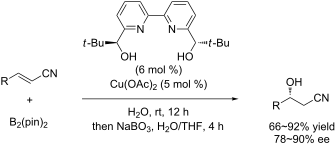
- Lei Zhu Taku Kitanosono Pengyu Xu Shu Kobayashi Department of Chemistry, School of Sciences, The University of Tokyo, Hongo, Bunkyo-ku, Tokyo, Japan 10.3762/bjoc.11.217 Abstract The promising performance of copper(II) complexes was demonstrated for asymmetric boron conjugate addition to α,β
- substrates were suitable despite being insoluble in water. Keywords: carbon–boron bond formation; catalytic asymmetric synthesis; chiral copper(II) catalysis; β-hydroxy nitriles; Introduction In recent years, optically active organoboranes have attracted considerable attraction as versatile synthons for
- the synthesis of biologically interesting compounds and of other materials. In particular, compounds with a nitrile group in the β-position with respect to the boron moiety represent an important subset of organoboron intermediates because these compounds contain two functional groups. Their C–B


Synthesis of constrained analogues of tryptophan
Beilstein J. Org. Chem. 2015, 11, 1997–2006, doi:10.3762/bjoc.11.216
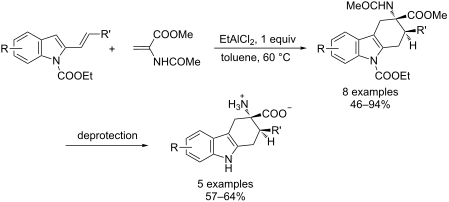
- results are summarized in Table 1. The reaction was ineffective under thermal conditions (Table 1, entry 1). As a consequence we tested simple Lewis acids as potential promoters for the transformation. Magnesium perchlorate, scandium and copper triflate and boron trifluoride failed to give the desired


Polythiophene and oligothiophene systems modified by TTF electroactive units for organic electronics
Beilstein J. Org. Chem. 2015, 11, 1749–1766, doi:10.3762/bjoc.11.191
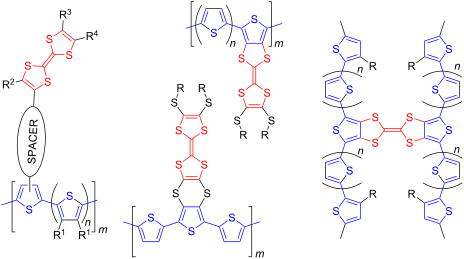
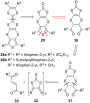
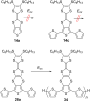
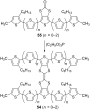
- units into a conjugated network is a standard way to narrow the HOMO/LUMO band gap and examples of such units include dioxopyrrolopyrrole (DPP) [17][18][19], benzodifuranone [20] and boron-dipyrromethene (BODIPY) [21][22]. As a different class of electroactive materials, TTF derivatives are well-known






Pyridinoacridine alkaloids of marine origin: NMR and MS spectral data, synthesis, biosynthesis and biological activity
Beilstein J. Org. Chem. 2015, 11, 1667–1699, doi:10.3762/bjoc.11.183
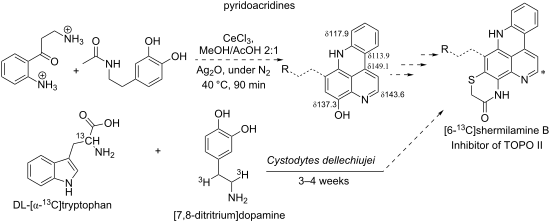
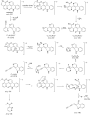
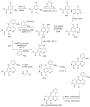
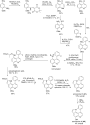
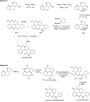
- indole catalyzed by potassium fluoride in alumina and a sufficient amount of 18-crown-6. The product obtained from this reaction was decarboxylated by copper chromite and quinolone to yield arnoamine B. This latter was then demethylated with boron tribromide to afford arnoamine A (40, Scheme 5) [63











Pyridine-promoted dediazoniation of aryldiazonium tetrafluoroborates: Application to the synthesis of SF5-substituted phenylboronic esters and iodobenzenes
Beilstein J. Org. Chem. 2015, 11, 1494–1502, doi:10.3762/bjoc.11.162

- -science [6][18][33][34][35][36][37][38], and material sciences [5][19][38][39] are emerging. Arylboronic acids and arylboronates represent versatile building blocks in organic synthesis [40]. They have found wide applications in transition metal-catalyzed cross-coupling reactions [41][42]. These boron


Synthesis of novel N-cyclopentenyl-lactams using the Aubé reaction
Beilstein J. Org. Chem. 2015, 11, 1060–1067, doi:10.3762/bjoc.11.119

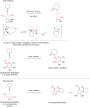
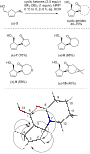
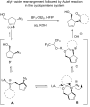
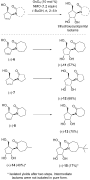
- ·OEt2 Boron trifluoride etherate (0.07 mL, 0.71 mmol) was added to a solution of azido alcohol 3 (0.10 g, 0.71 mmol) and ketones (2.0 mmol, 3 equiv) in HFIP (0.2 mL) cooled to 0 °C. The mixture was warmed to room temperature and stirred for 2–5 h. Upon completion, the reaction was quenched with 15% aq




Design, synthesis and photochemical properties of the first examples of iminosugar clusters based on fluorescent cores
Beilstein J. Org. Chem. 2015, 11, 659–667, doi:10.3762/bjoc.11.74
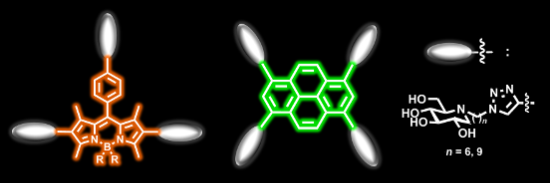
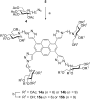
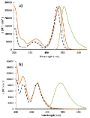
- insights into the multivalent effect observed in CFTR correcting activity. The originality of our approach relies on the fact that, in the structures designed, this is the scaffold itself [29][30], based on a pyrene or a boron-dipyrromethene (F-BODIPY) dye, which has fluorescence activity. Results and
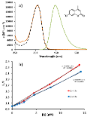
- . Difluoroboradiaza-s-indacenes, commonly named boron-dipyrromethene dyes (F-BODIPY), were logically selected for the construction of the probes. These compounds indeed combine high fluorescence quantum yields and high molar extinction coefficients, strong chemical and photochemical stability in solution and in solid
- substitution at the boron has less influence on the spectroscopic properties of the dyes [42]. So far, major endeavors have been dedicated to the preparation of classical F-BODIPY structures and less common E-BODIPY (E for ethynyl) and the examination of their spectroscopic and salient physical properties [43



Weakly nucleophilic potassium aryltrifluoroborates in palladium-catalyzed Suzuki–Miyaura reactions: relative reactivity of K[4-RC6F4BF3] and the role of silver-assistance in acceleration of transmetallation
Beilstein J. Org. Chem. 2015, 11, 608–616, doi:10.3762/bjoc.11.68

- ability to transmetallation, to coordinate to the organoboronic acid with the three-coordinated boron atom to ArPdL2OH and subsequent transmetallation (Scheme 1). However, some experimental facts indicate the multilateral role of silver(I) compounds AgmY in the acceleration of the Suzuki–Miyaura cross
- the reaction and does not participate in the other steps [19][35]. The boron atom in K[4-RC6F4BF3] is coordinately saturated and transmetallation via transition state A (Scheme 1) is impossible. An alternative pathway is the polarization of the palladium–X bond by Ag+ and the generation of complex


Diastereoselective and enantioselective conjugate addition reactions utilizing α,β-unsaturated amides and lactams
Beilstein J. Org. Chem. 2015, 11, 530–562, doi:10.3762/bjoc.11.60

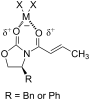
- of boron to α,β-unsaturated carbonyl compounds. Enantioenriched organoboron reagents are useful because they can be used in cross-coupling reactions [98][100] or they can be converted into the corresponding alcohol [101] while retaining the stereochemical information. Transition metals such as Cu
- [102][103][104][105][106][107][108][109][110][111][112], Rh [113][114][115], Ni [116][117], Pd [116][118] and Pt [119][120] have all been successfully used to catalyze the 1,4-additon of boron to α,β-unsaturated carbonyl compounds. Of the transition metals mentioned, copper is the most cost-effective
- and least toxic choice. Though there are many examples of copper-catalyzed 1,4-additions of boron, most of the reports use bis(pinacolato)diboron (B2pin2) as a source of boron. In 2013, Molander and co-workers reported the asymmetric 1,4-addition of bisboronic acid (BBA) and tetrakis(dimethylamino




Cathodic reductive coupling of methyl cinnamate on boron-doped diamond electrodes and synthesis of new neolignan-type products
Beilstein J. Org. Chem. 2015, 11, 200–203, doi:10.3762/bjoc.11.21
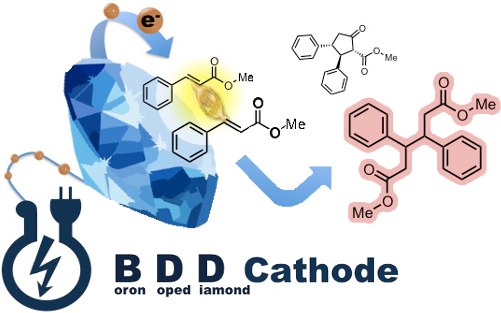
- methyl cinnamate on a boron-doped diamond (BDD) electrode was investigated. The hydrodimer, dimethyl 3,4-diphenylhexanedioate (racemate/meso = 74:26), was obtained in 85% yield as the major product, along with small amounts of cyclic methyl 5-oxo-2,3-diphenylcyclopentane-1-carboxylate. Two new neolignan
- -type products were synthesized from the hydrodimer. Keywords: boron-doped diamond (BDD) electrode; cathodic reduction; electrochemistry; electrosynthesis; neolignan; Introduction Numerous lignans and neolignans were found as secondary plant metabolites, and many of them are known to exhibit
- investigations. Several synthetic approaches, including electrochemical oxidative coupling reactions mimicking biosynthetic pathways, were reported to construct the backbones of these molecules [5]. Recently, boron-doped diamond (BDD) electrodes have attracted a great deal of attention for their wide potential


Cross-dehydrogenative coupling for the intermolecular C–O bond formation
Beilstein J. Org. Chem. 2015, 11, 92–146, doi:10.3762/bjoc.11.13









Efficient deprotection of F-BODIPY derivatives: removal of BF2 using Brønsted acids
Beilstein J. Org. Chem. 2015, 11, 37–41, doi:10.3762/bjoc.11.6
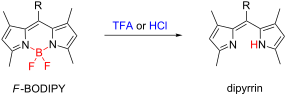
- diversifying the F-BODIPY framework [9]. F-BODIPYs are readily prepared by condensing aldehydes, acyl chlorides or anhydrides with pyrroles and trapping the resulting dipyrrin in situ with boron trifluoride [9][10][11]. F-BODIPYs are generally stable and chemically robust, with photophysical properties that
- recent reports have deployed Lewis acids to achieve this transformation: Thompson and co-workers used boron trihalides in dichloromethane under anhydrous conditions, followed by treatment with acetone/water (10:1) to achieve quantitative removal of the BF2 moiety [18]; Ravikanth and co-workers screened a
- range of metal-based Lewis acids (ZrCl4, TiCl4, AlCl3, Sc(OTf)3, SnCl4) and reported yields up to 96% using ZrCl4 in refluxing methanol/acetonitrile [19]. Related efforts have wrought substitution at boron in F-BODIPY analogues without removing it from the dipyrrin. For example, Lundrigan et al. have


Redox active dendronized polystyrenes equipped with peripheral triarylamines
Beilstein J. Org. Chem. 2014, 10, 3097–3103, doi:10.3762/bjoc.10.326
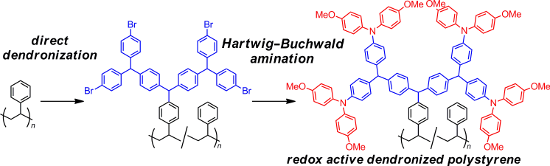
- 2. Di(p-bromophenyl)carbinol (1) was treated with SOCl2 to obtain di(p-bromophenyl)methyl chloride (2) in quantitative yield. A Friedel–Crafts-type alkylation [29] of diphenylsilane 3 with 2 in the presence of boron trifluoride etherate as a Lewis acid gave 4 in 86% yield. The oxidation potential of




Synthesis and properties of novel star-shaped oligofluorene conjugated systems with BODIPY cores
Beilstein J. Org. Chem. 2014, 10, 2704–2714, doi:10.3762/bjoc.10.285

- these two families were studied in order to determine their suitability as emissive materials in photonic applications. Keywords: absorption spectroscopy; BODIPY; cyclic voltammetry; photoluminescence; star-shaped oligofluorene; Introduction The boron-dipyrromethene (BODIPY) or 4,4-difluoro-4-bora-3a



Solution processable diketopyrrolopyrrole (DPP) cored small molecules with BODIPY end groups as novel donors for organic solar cells
Beilstein J. Org. Chem. 2014, 10, 2683–2695, doi:10.3762/bjoc.10.283
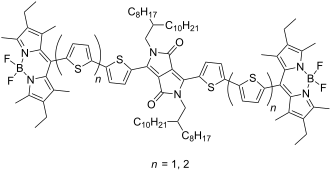
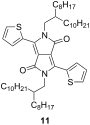
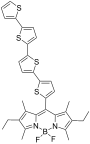
- ). Compound 6 was prepared by acid-catalysed condensation of 5-bromothiophene-2-carbaldehyde with 3-ethyl-2,4-dimethylpyrrole, followed by oxidation with DDQ. Deprotonation with triethylamine and subsequent treatment with boron trifluoride diethyl etherate yielded 6. The entire synthesis was carried out as a




Electrocarboxylation: towards sustainable and efficient synthesis of valuable carboxylic acids
Beilstein J. Org. Chem. 2014, 10, 2484–2500, doi:10.3762/bjoc.10.260
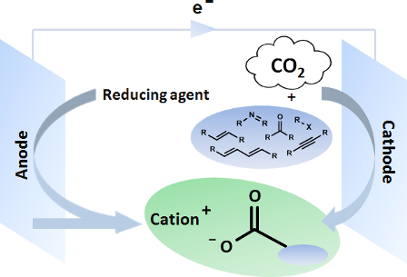
- prepared using cyanides. In the proposed setup for the electrocatalytic preparation of MHA, a boron-doped diamond coated permeable cathode and Pt coated permeable anode rest directly on the cation exchange membrane to decrease ohmic resistance by the membrane, minimizing the required voltage. Hydrogen


A small azide-modified thiazole-based reporter molecule for fluorescence and mass spectrometric detection
Beilstein J. Org. Chem. 2014, 10, 2470–2479, doi:10.3762/bjoc.10.258

- unproblematic toxicology they have almost completely replaced radioactive tags. Widely used representatives include dansyl chloride, fluoresceins, rhodamines and boron-dipyrromethenes (BODIPYs) [1]. Dansyl chloride, with a maximum UV–vis absorption at 369 nm, is one of the first extrinsic fluorescent dyes


Automated solid-phase peptide synthesis to obtain therapeutic peptides
Beilstein J. Org. Chem. 2014, 10, 1197–1212, doi:10.3762/bjoc.10.118

- -histidinyl acetyl (NαHis-ac) chelator (Figure 5) was attached to lysine side chains or the N-terminus of the peptide by manual coupling, whereas the chelation with 99mTc occurred in solution [133]. The incorporation of carbaboranes that can be used for boron neutron capture therapy demonstrated the potential




Amino acid motifs in natural products: synthesis of O-acylated derivatives of (2S,3S)-3-hydroxyleucine
Beilstein J. Org. Chem. 2014, 10, 1135–1142, doi:10.3762/bjoc.10.113
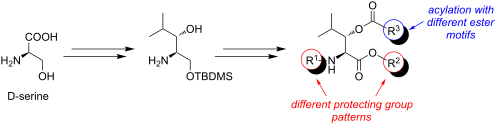
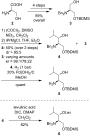
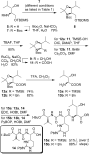
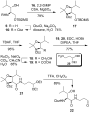
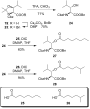
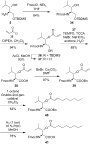
- to introduce an N,O-acetal moiety by transformation of 7 into the dimethyloxazolidine 8, a reaction which required careful optimization though (Scheme 2, Table 1). Using boron trifluoride and 2,2-dimethoxypropane (2,2-DiMP), as known from the synthesis of the structurally related Garner's aldehyde




Synthesis of zearalenone-16-β,D-glucoside and zearalenone-16-sulfate: A tale of protecting resorcylic acid lactones for regiocontrolled conjugation
Beilstein J. Org. Chem. 2014, 10, 1129–1134, doi:10.3762/bjoc.10.112

- rather harsh unfavorable demethylation with boron tribromide in the last step [26]. Without structure verification and characterization ZEN-16-β,D-glucoside (7, Figure 2B) was tentatively identified as a byproduct of the Königs–Knorr glucosylation of ZEN for preparation of ZEN-14-glucoside [27]. In the


Palladium-catalysed cross-coupling reaction of ultra-stabilised 2-aryl-1,3-dihydro-1H-benzo[d]1,3,2-diazaborole compounds with aryl bromides: A direct protocol for the preparation of unsymmetrical biaryls
Beilstein J. Org. Chem. 2014, 10, 1107–1113, doi:10.3762/bjoc.10.109

- π-conjugated organic molecules containing a three-coordinate boron moiety such as trimesitylborane (4), arylalkynyldimesitylborane 5 and 2-aryl-1,3-diethyl-1H-benzo[d]1,3,2-diazaborole 6 (Figure 2) are well known and have received considerable attention due to their interesting luminescence
- characteristics, fluoride ion sensing abilities, emissive as well as electron-transporting properties [8][9][10][11]. Three-coordinate boron compounds are electron-poor and strong π-electron acceptors owing to the empty boron pz-orbital, which is capable of significant delocalisation when attached to an organic π
- -system [11]. These compounds exhibit an unusual stability because of the bulky aryl groups, such as mesityl (2,4,6-trimethylphenyl) groups, which provide steric conjunction around the empty boron pz-orbital thereby blocking the incoming nucleophile (Figure 2, compounds 4 and 5) [12]. Alternatively, three





