


Search results
Search for "derivatization" in Full Text gives 254 result(s) in Beilstein Journal of Organic Chemistry. Showing first 200.
Iridium/N-heterocyclic carbene-catalyzed C–H borylation of arenes by diisopropylaminoborane
Beilstein J. Org. Chem. 2016, 12, 654–661, doi:10.3762/bjoc.12.65

- chromatography over silica gel eluting with hexane/EtOAc. Product-containing fractions were concentrated in vacuo to give a pure borylated product. Catalytic C–H borylation of arenes and related reported boron sources. Scalability and derivatization. Effect of the ligand on the Ir-catalyzed borylation of 2 with


New synthetic strategies for xanthene-dye-appended cyclodextrins
Beilstein J. Org. Chem. 2016, 12, 537–548, doi:10.3762/bjoc.12.53
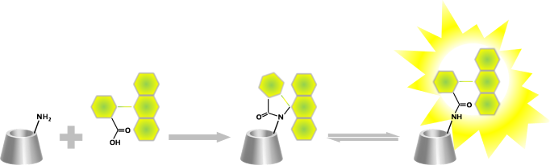
- the spectroscopic data always refer to the mixture obtained by an incomplete fluorescent labeling and not to the fluorescent single-isomer CD derivative. The incomplete fluorescent tagging is reflected by, for example, broad NMR signals [17]. If the goal of the derivatization is the fluorescent
- fluorescent single-isomer CD [18]. If the substrate for the fluorescent labeling is a randomly substituted CD derivative, most commonly, the obtained mixture will contain fluorescently labelled and unlabeled isomers. In this work, our purpose was to develop a generic synthetic method for the derivatization of


The aminoindanol core as a key scaffold in bifunctional organocatalysts
Beilstein J. Org. Chem. 2016, 12, 505–523, doi:10.3762/bjoc.12.50
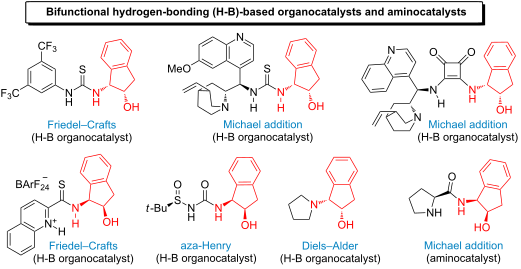
- derivatization. Thus, in the last decade, it has been widely employed in the field of asymmetric catalysis. Regarding the use of aminoindanol derivatives as ligands in organometallic catalytic complexes, the results have been outstanding. Examples are found in (a) the vanadium-catalyzed asymmetric oxidation of


Optimized methods for preparation of 6I-(ω-sulfanyl-alkylene-sulfanyl)-β-cyclodextrin derivatives
Beilstein J. Org. Chem. 2016, 12, 349–352, doi:10.3762/bjoc.12.38
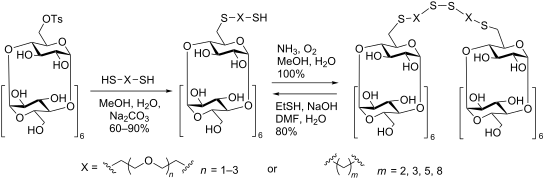
- disulfide can be used directly for functionalization of a gold surface, but its reduction to thiol was not described. In any case, the amide-containing derivative might not be stable enough under basic conditions needed for the polydopamine derivatization by the thiol. Besides, the common problem with the
- obtained alkylene derivative 5g had a low solubility in water and water/alcohol mixtures what represented quite an obstacle for the intended use – derivatization of solid surfaces by treatment with the water solution of the CD derivative. Therefore, we decided also to prepare the derivatives containing the


Enabling technologies and green processes in cyclodextrin chemistry
Beilstein J. Org. Chem. 2016, 12, 278–294, doi:10.3762/bjoc.12.30
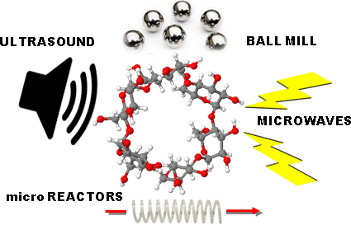
- facilitate the purification steps [9]. Noteworthy examples are the mechanochemical derivatization of saccharides [10][11], the functionalization of CDs and their complexation with organic molecules [12]. Solid state organic reactions using CD cavities as nanoreactors have also been reported [13]. Among non
- -conventional techniques, the largest number of papers is dealing with US-assisted CD solubilization or re-dissolution and in a minor extends CD derivatization. Analogously, ball milling is mostly used in the preparation of CD complexes rather than synthetic preparations. MW-assisted CD chemistry covers 1/4–1/5
- friendly technique that is well suited to the selective chemical modification of CDs from native α-, β- and γ-CD. The use of this method in heterogeneous phase reactions, such as reductions and “click reactions” [14], is well known, as is its use in full CD derivatization in combination with MW irradiation



Thermal and oxidative stability of Atlantic salmon oil (Salmo salar L.) and complexation with β-cyclodextrin
Beilstein J. Org. Chem. 2016, 12, 179–191, doi:10.3762/bjoc.12.20
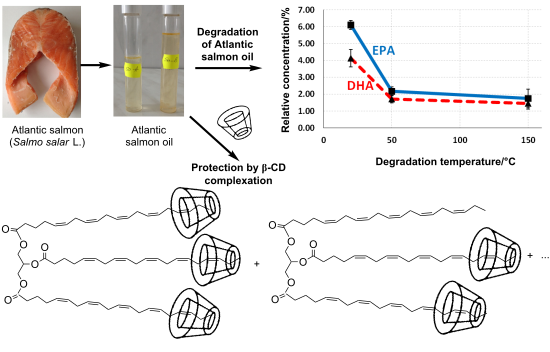
- complexation of ASO. A boron trifluoride–methanol complex (20%, Merck & Co., Inc.) was used for FA derivatization. Finally, Hydranal-Titrant 5, Hydranal-Solvent and Hydranal-Water Standard 10.0 (Sigma-Aldrich, Buchs, Switzerland) were used for the KFT water analysis of β-CD/ASO complexes. ASO extraction The
- subjected to derivatization. Preparation of β-CD/ASO complexes β-CD/ASO complexes were prepared by two methods: (1) the co-crystallization from an ethanol–water mixture, which allows the equilibrium between the complexed and noncomplexed fish oil components to be achieved, and (2) the kneading method, which
- profile of nondegraded and degraded ASO was obtained by GC–MS analysis of the corresponding methyl esters (as well as acetals and ketals of FA degradation compounds). For derivatization, approximately 20 mg of ASO or the corresponding sample was dissolved in 3 mL of boron trifluoride–methanol solution in



Synthesis and reactivity of aliphatic sulfur pentafluorides from substituted (pentafluorosulfanyl)benzenes
Beilstein J. Org. Chem. 2016, 12, 110–116, doi:10.3762/bjoc.12.12
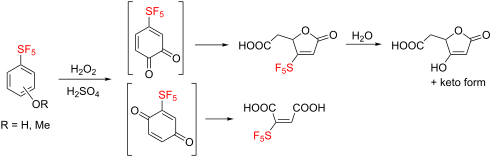
- . Maleic acid 4 was identified in the mixture (25% 19F NMR yield, Scheme 4) but chromatographic separation, crystallization or derivatization (CH2N2) attempts were not successful. Nevertheless, these results show that SF5-substituted para-benzoquinones are most likely intermediates in the formation of 4 by
- exo products in an 8:1 ratio (Scheme 8). In comparison, it is known that maleic anhydride in analogous reactions affords exclusively the endo adduct [29]. Attempts to facilitate the isolation of very polar maleic acid 4 from the reaction mixture by derivatization to dimethyl ester using diazomethane


Catalytic asymmetric formal synthesis of beraprost
Beilstein J. Org. Chem. 2015, 11, 2654–2660, doi:10.3762/bjoc.11.285
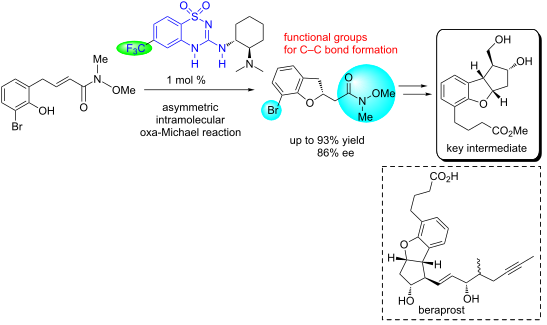
- Our retrosynthetic analysis for 2 is shown in Scheme 1, with the derivatization of 2 to beraprost (1) having already been reported. We planned to introduce the ester side chain on the aromatic ring at a later stage, utilizing radical-mediated reactions with acrylate [22] when the functional group (X
- % yield (dr > 10:1) via the method established in Scheme 3. After derivatization to acetal 22 in 2 steps, we then turned our attention to the introduction of the C4 ester substituents. Amongst various different conditions investigated – including Pd-catalyzed coupling reactions – a halogen-lithium



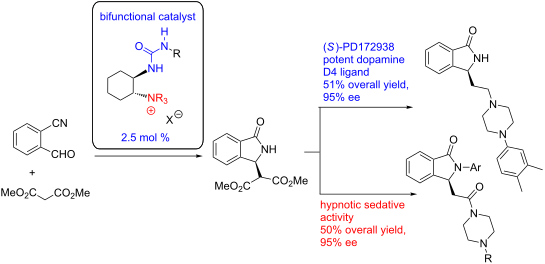
Bifunctional phase-transfer catalysis in the asymmetric synthesis of biologically active isoindolinones
Beilstein J. Org. Chem. 2015, 11, 2591–2599, doi:10.3762/bjoc.11.279
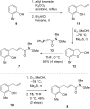
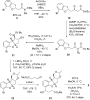
- –7.48 (m, 1H), 5.09–4.99 (m, 1H), 2.97–2.89 (m, 1H), 2.68–2.48 (m, 1H); 13C NMR (100 MHz, CD3OD) δ 172.6, 171.2, 146.8, 131.9, 131.3, 128.1, 122.9, 122.6, 53.4, 38.3. The enantiomeric excess was determined by derivatization of the compound into methyl ester 12 or amide 16. Some chiral, bioactive


Versatile synthesis and biological evaluation of novel 3’-fluorinated purine nucleosides
Beilstein J. Org. Chem. 2015, 11, 2509–2520, doi:10.3762/bjoc.11.272

- cannot be utilized for further derivatization to reach our objectives. This 3’-fluorine-modified adenosine 2 has also been synthesized starting from a well-protected xylofuranosyladenine derivative using a complicated strategy [33]. Similarly, 3’-deoxy-3’-fluoroguanosine (23, Figure 2) was isolated in 2
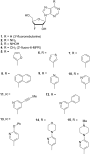
- -substituted purine nucleoside derivatives (Scheme 5). The 2-amino-6-chloropurine (47) was glycosylated with the 3’-fluorine riboside 25 under DBU and trimethylsilyl triflate conditions. The corresponding protected intermediate nucleoside 48 was obtained in 78% yield and utilized for further derivatization



Copper-catalysed asymmetric allylic alkylation of alkylzirconocenes to racemic 3,6-dihydro-2H-pyrans
Beilstein J. Org. Chem. 2015, 11, 2435–2443, doi:10.3762/bjoc.11.264
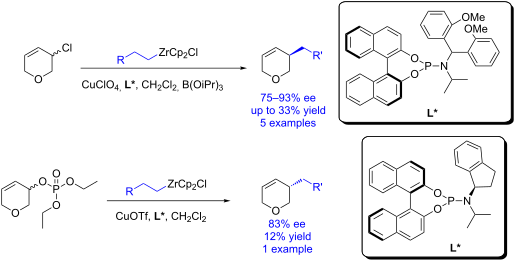
- racemic cyclic allyl halides, such as 1 (Scheme 1a) [26][27]. Tetrahydropyrans are a common motif in natural products and pharmaceuticals and are useful synthetic intermediates. However, the direct asymmetric derivatization of pyrans is rare [28] and enantiomerically enriched tetrahydropyrans are often




Synthesis of quinoline-3-carboxylates by a Rh(II)-catalyzed cyclopropanation-ring expansion reaction of indoles with halodiazoacetates
Beilstein J. Org. Chem. 2015, 11, 1944–1949, doi:10.3762/bjoc.11.210

- indole moiety is found in a large number of bioactive natural products [1][2] and pharmaceutical compounds [3][4] and there has been a large synthetic effort going into the search for mild, efficient and selective procedures for the derivatization of indoles. One of the most efficient approaches is the


Dicarboxylic esters: Useful tools for the biocatalyzed synthesis of hybrid compounds and polymers
Beilstein J. Org. Chem. 2015, 11, 1583–1595, doi:10.3762/bjoc.11.174

- these molecules along with the presence of multiple functional groups make their chemical manipulation difficult. This inherent “fragility” makes biocatalysis an attractive method for their derivatization. Specifically, glycosides and polyhydroxylated compounds can be selectively acylated at specific
- building blocks succinic acid, itaconic acid (34, Figure 11) and butanediol are very attractive. The methylene group in itaconic acid is interesting as a handle for second polymerization or derivatization, but causes steric and reactivity problems in lipase catalysis. Anyhow, Jiang et al. were able to


Pyridine-promoted dediazoniation of aryldiazonium tetrafluoroborates: Application to the synthesis of SF5-substituted phenylboronic esters and iodobenzenes
Beilstein J. Org. Chem. 2015, 11, 1494–1502, doi:10.3762/bjoc.11.162

- benzenethiols [10][11][12], or by the reaction of nitrophenyl disulfides with elemental fluorine [13][14][15][16]. Aromatic and heteroaromatic SF5 compounds are mostly prepared by the derivatization of commercial nitro-(pentafluorosulfanyl)benzenes [14][17][18][19][20][21][22][23][24][25][26][27] and approaches
- [68] applied to 3b provided 8b in only 25% 19F NMR yield. To extend the synthetic utility of the pyridine-mediated derivatization of aryldiazonium tetrafluoroborates we investigated the reaction with iodobenzene and iodine as efficient scavengers of aryl radicals [83][84]. A competitive experiment


Synthesis of novel N-cyclopentenyl-lactams using the Aubé reaction
Beilstein J. Org. Chem. 2015, 11, 1060–1067, doi:10.3762/bjoc.11.119

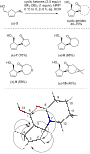
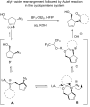
- the desired azido alcohol (±)-3 as an 8:1 regioisomeric mixture. However, we could neither purify nor isolate compound (±)-3 in pure form, which was always accompanied by an undesired isomeric compound. To confirm whether it is a diastereomer or regioisomer, we performed two derivatization reactions




DBU-promoted carboxylative cyclization of o-hydroxy- and o-acetamidoacetophenone
Beilstein J. Org. Chem. 2015, 11, 906–912, doi:10.3762/bjoc.11.102

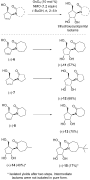
- implies that a nitrogen to carbon acyl migration occurred during the reaction. The derivatization reaction using iodide compounds at higher temperature led to complex product mixtures. o-Acetamidoacetophenone substrates containing methoxy (3b) and bromo (3c) groups also reacted smoothly to afford the
- [27]. After a proton shift from the enol to nitrogen, the resultant intermediate III is carboxylated with carbon dioxide in the presence of DBU to afford intermediate IV, which subsequently undergoes a cyclization reaction to give V. The product is obtained after derivatization with methyl iodide


DNA display of glycoconjugates to emulate oligomeric interactions of glycans
Beilstein J. Org. Chem. 2015, 11, 707–719, doi:10.3762/bjoc.11.81
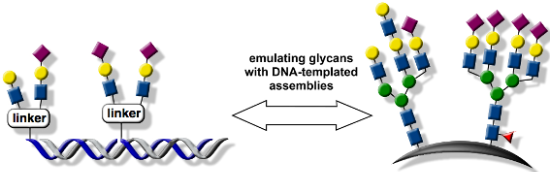
- -diazobenzoyl conjugates 1 and 2 with a guanidine nucleotide (G, derivatization at the 8-position) within DNA (Scheme 1) [18]. The conjugation was performed in solution on dsDNA and was used to introduce either lactose or cellobiose moieties (with and without linker). The substitution degree was proportional to


Selective methylation of kaempferol via benzylation and deacetylation of kaempferol acetates
Beilstein J. Org. Chem. 2015, 11, 288–293, doi:10.3762/bjoc.11.33
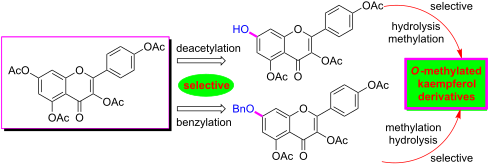
- controllable hydrolysis of multiple O-acetylated kaempferols. Eight mono-, di- and tri-O-methylated kaempferols were thus prepared with excellent yields. The reported protocol could be extended for the selective derivatization of polyhydroxylated natural products like polyketides or phenylpropanoids


Superstructures with cyclodextrins: Chemistry and applications II
Beilstein J. Org. Chem. 2015, 11, 271–272, doi:10.3762/bjoc.11.30
- polyrotaxanes [5][6][7]. The solubility and stability of CD complexes are controllable through the derivatization of CDs. Remarkable progress has been achieved over the past 10 years regarding the regioselective derivatization of cyclodextrins. Synthetic procedures for CD key derivatives such as mono-6-O-tosyl
Properties of cationic monosubstituted tetraalkylammonium cyclodextrin derivatives – their stability, complexation ability in solution or when deposited on solid anionic surface
Beilstein J. Org. Chem. 2015, 11, 192–199, doi:10.3762/bjoc.11.20
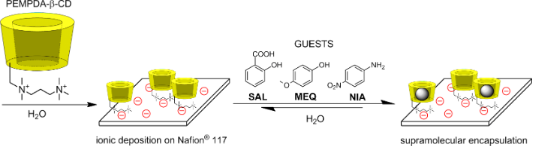
- ][17][18]. This approach offers self-assembled monolayers (SAMs) which can be utilized for derivatization of gold electrodes for the construction of electrochemical sensors [19][20] or even for the development of molecular printboards [21]. These results imply that the structure of CD derivatives


First chemoenzymatic stereodivergent synthesis of both enantiomers of promethazine and ethopropazine
Beilstein J. Org. Chem. 2014, 10, 3038–3055, doi:10.3762/bjoc.10.322




Sequential decarboxylative azide–alkyne cycloaddition and dehydrogenative coupling reactions: one-pot synthesis of polycyclic fused triazoles
Beilstein J. Org. Chem. 2014, 10, 3031–3037, doi:10.3762/bjoc.10.321
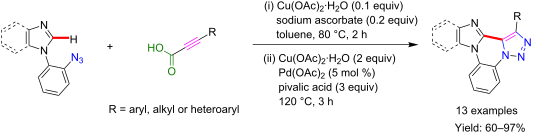
- versatile synthetic functionality for further derivatization reactions. The thiophene-derived alkynoic acid, 2d, provided the corresponding triazole analogs 4d and 4j in 79% and 73%, respectively. Likewise, the alkynoic acid derived from short and long linear alkyl chains also provided good yields (75–88


Synthetic strategies for the fluorescent labeling of epichlorohydrin-branched cyclodextrin polymers
Beilstein J. Org. Chem. 2014, 10, 3007–3018, doi:10.3762/bjoc.10.319
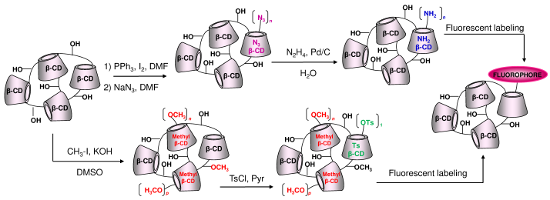
- either by branching the proper cyclodextrin derivatives (pre-branching modification) or by derivatization of the cyclodextrin polymers (post-branching modification). Several examples of both modification types of these macromolecules with additional groups are reported in the literature [5] and an update


Synthesis of uniform cyclodextrin thioethers to transport hydrophobic drugs
Beilstein J. Org. Chem. 2014, 10, 2920–2927, doi:10.3762/bjoc.10.310
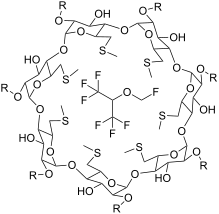
- anaesthesia. Keywords: active pharmaceutical ingredient; binding constant; cyclodextrin; derivatization; gas chromatography; sevoflurane; substitution pattern; Introduction Cyclodextrins (CDs) are cyclic oligomers of α-1,4-linked glucose units. Those CDs consisting of 6, 7, and 8 glucose units are called α




Thermal and oxidative stability of the Ocimum basilicum L. essential oil/β-cyclodextrin supramolecular system
Beilstein J. Org. Chem. 2014, 10, 2809–2820, doi:10.3762/bjoc.10.298
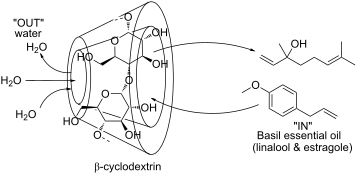
- the corresponding biologically active compounds. These were used as raw mixtures (e.g., extracts for food supplements), as well as purified bioactive compounds for the treatment of various diseases. They were used in natural form or after derivatization to a more bioactive compound, such as the





