Search results
Search for "anisotropy" in Full Text gives 78 result(s) in Beilstein Journal of Organic Chemistry.
An undecacyclic carbon-centered hydrocarbon radical: synthesis and investigation
Beilstein J. Org. Chem. 2026, 22, 1196–1204, doi:10.3762/bjoc.22.95
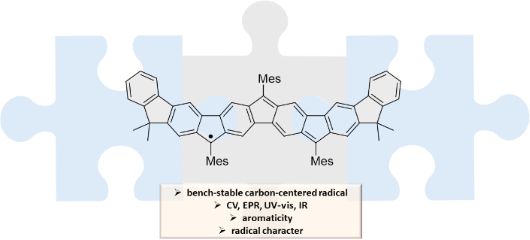
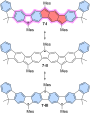
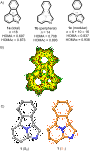
- part of the fully conjugated core, but could be considered as phenyl substituents attached to rings D and D’, which accounts for the fully retained aromaticity. Aromaticity can further be quantified by the investigation of ring currents in the π system. The anisotropy of the induced current density can
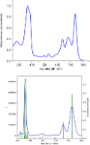
- be calculated and visualized with Herges’ ACID (anisotropy of the induced current density) method (Figure 8) [63][64]. The results suggest antiaromatic behavior for the five-membered rings. For rings B’, B, D’, and D, again a combination of aromatic and antiaromatic character is observed, which is in






Amino acid-based surfactants: sustainable synthesis and antimicrobial mechanisms
Beilstein J. Org. Chem. 2026, 22, 1067–1085, doi:10.3762/bjoc.22.85
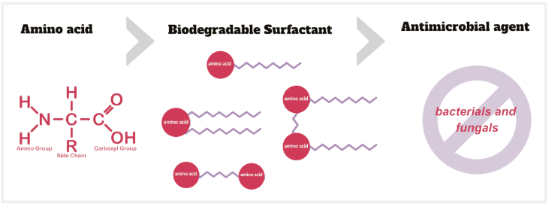
- partitioning (≈30% lower incorporation by fluorescence anisotropy) [56], whereas longer chains (C16) predominantly form micelles, reducing bioavailable monomers as evidenced by CMC studies [47][56]. Comparative analyses demonstrate that arginine–C14 surfactants consistently outperform other configurations


Electrosynthetic access to unsymmetrical oxaza[8]helicenes with high chiral stability and strong circularly polarized luminescence (CPL)
Beilstein J. Org. Chem. 2026, 22, 372–382, doi:10.3762/bjoc.22.25
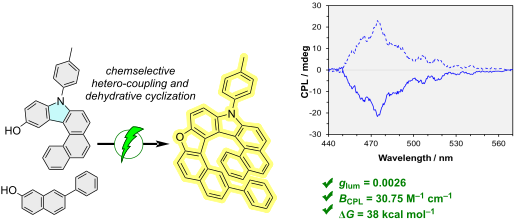
- attributed to the increased deviation from planarity, particularly in the more extended helicenes, consistent with previous studies [60]. To gain further insight, we performed anisotropy of the induced current density (AICD) calculations for 5a and 5b at the B3LYP/6-311G(d,p) level in the gas phase [61]. The




A m-quaterphenyl probe for absolute configurational assignments of primary and secondary amines
Beilstein J. Org. Chem. 2025, 21, 2211–2219, doi:10.3762/bjoc.21.168
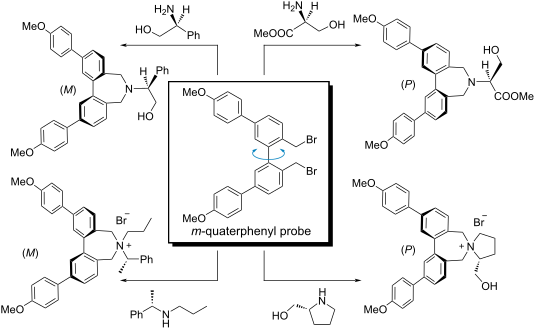
- , empirical approaches based on 1H NMR anisotropy method have gained attention as alternative strategies for stereochemical assignment of chiral molecules. Among these, the modified Mosher method, which utilizes the ring current effects of aryl substituents, has been extensively applied to chiral alcohols [2


Thermodynamics and polarity-driven properties of fluorinated cyclopropanes
Beilstein J. Org. Chem. 2025, 21, 1742–1747, doi:10.3762/bjoc.21.137
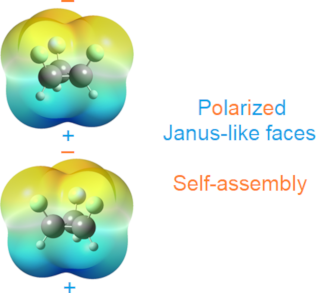
- rely on specific properties such as dielectric anisotropy, where the molecular dipole moment aligns parallel to the molecule’s long axis [19]. Compound 1.2.3-c.c. exhibits a "Janus"-face-like structure, characterized by a positively charged region on one side and a negatively charged region on the


On the aromaticity and photophysics of 1-arylbenzo[a]imidazo[5,1,2-cd]indolizines as bicolor fluorescent molecules for barium tagging in the study of double-beta decay of 136Xe
Beilstein J. Org. Chem. 2025, 21, 1627–1638, doi:10.3762/bjoc.21.126
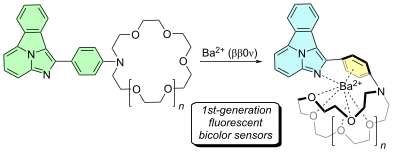
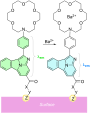
- analysis in terms of stabilization energy. In addition, an analysis of the Anisotropy of the induced current density (ACID) plot [24] calculated for 1 (Figure 3B) shows a significant diatropic ring current formally associated with the peripheral model 1b. Another diatropic contribution can be assigned to
- Equation 1. (B) Anisotropy of the current induced density (ACID) diagram of compound 1. (isosurface value: 0.035 a.u.) (C) Bond distances (in Å) for fully optimized structure of 1, computed at the ground state (S0) and at the first singlet excited state (S1, in orange). Results obtained at the B3LYP-D3BJ/6





Transition-state aromaticity and its relationship with reactivity in pericyclic reactions
Beilstein J. Org. Chem. 2025, 21, 1613–1626, doi:10.3762/bjoc.21.125

- diatropic (i.e., aromatic) ring current observed upon applying the anisotropy of the induced current density (ACID) method [78] or the delocalization observed with the EDDB method (see Figure 5 for the parent process involving the reaction between ethane and ethene). Typically, DGRTs involving C–H bonds are


Synthesis of optically active folded cyclic dimers and trimers
Beilstein J. Org. Chem. 2025, 21, 1603–1612, doi:10.3762/bjoc.21.124
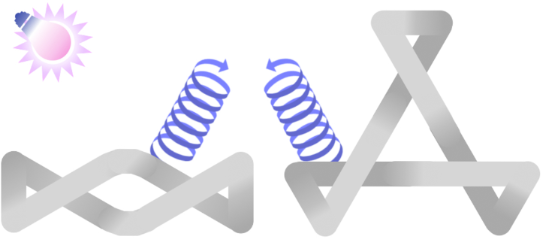
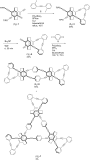
- chiral [2.2]paracyclophane-containing enantiopure ribbon-shaped compounds as the chiral monomers. Unicursal π-conjugated systems were folded at the [2.2]paracyclophane units, and exhibited good photoluminescence quantum efficiencies and CPL anisotropy factors. Opposite chiroptical properties were
- luminescence (CPL) [22][23][24][25] with high photoluminescence (PL) quantum efficiency (ΦPL) and anisotropy. Additionally, the π-stacked structure of [2.2]paracyclophane can be applied at a crossing point. By folding the π-conjugated system using [2.2]paracyclophane as the chiral crossing unit, optically


On the photoluminescence in triarylmethyl-centered mono-, di-, and multiradicals
Beilstein J. Org. Chem. 2025, 21, 964–998, doi:10.3762/bjoc.21.80
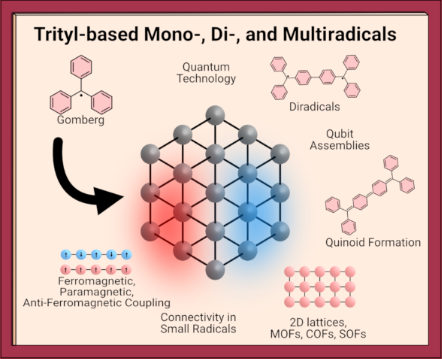
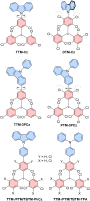
- part of this review, see Table 3). Cooling leads to a reduction of the intensity of the central EPR signal, fine structure, and significant diradical anisotropy, indicating that the triplet state becomes less and less populated (see Figure 12b) [95]. By contrast, the TTM-TTM analogue without chlorine









Unraveling aromaticity: the dual worlds of pyrazole, pyrazoline, and 3D carborane
Beilstein J. Org. Chem. 2025, 21, 412–420, doi:10.3762/bjoc.21.29
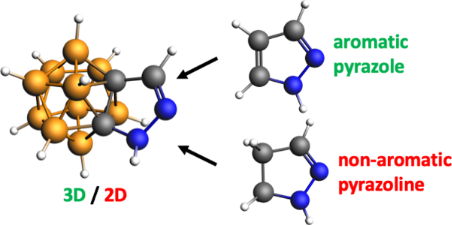
- computed with the ESI-3D program using AIM partition of space [75][76]. The anisotropy of the induced current density (AICD) plots have been computed at the same level of theory [77]. Current density maps have been computed by means of the SYSMOIC package [78][79][80], at the same level of theory. Finally


Oxidation of [3]naphthylenes to cations and dications converts local paratropicity into global diatropicity
Beilstein J. Org. Chem. 2025, 21, 277–285, doi:10.3762/bjoc.21.20
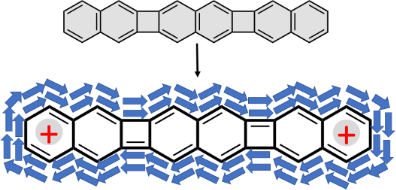
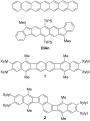
- shift (NICS) calculations and anisotropy of the current induced density (ACID) plots, as they evidenced the presence of a perimetral diatropic global ring current upon oxidation. Keywords: ACID; aromaticity; force constants; NICS; spectroscopy; Introduction Since the discovery of conjugated polymers
- . In this case, the CBDs act as stoppers for whole innermost electron delocalization Anisotropy of the current induced density (ACID) The NICS analysis of the precedent paragraph is therefore consistent with the existence of an emergent global diatropic ring current in m-12+ along the entire molecular


Photoredox-catalyzed intramolecular nucleophilic amidation of alkenes with β-lactams
Beilstein J. Org. Chem. 2024, 20, 2461–2468, doi:10.3762/bjoc.20.210
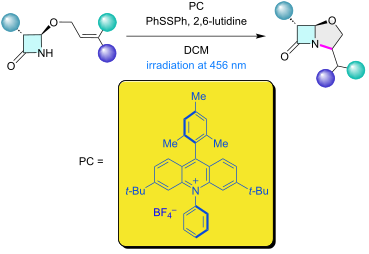
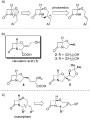
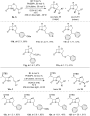
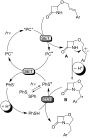
- chemical shifts of these protons in the two isomers could be attributed to the influence of the anisotropy of the neighboring carboxy group of the β-lactam and could be correlated with the configuration at the bridgehead stereocenter [46]. This analysis revealed the preferred formation of the trans- over




Switchable molecular tweezers: design and applications
Beilstein J. Org. Chem. 2024, 20, 504–539, doi:10.3762/bjoc.20.45
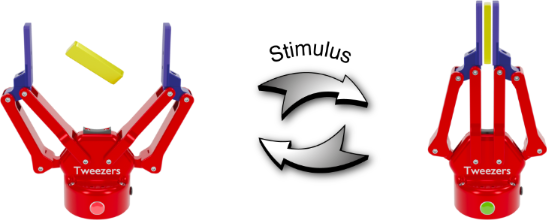
- reversible Zn-induced closing was also achieved. Despite the magnetic anisotropy of Mn(III), no single molecule magnet behavior was observed in either closed form. Nevertheless, this system constitutes a promising example of dual switchable molecular tweezers that can be addressed by two orthogonal stimuli


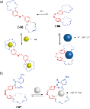


Spatial arrangements of cyclodextrin host–guest complexes in solution studied by 13C NMR and molecular modelling
Beilstein J. Org. Chem. 2024, 20, 331–335, doi:10.3762/bjoc.20.33
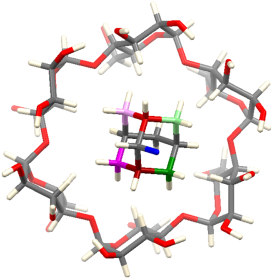
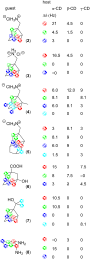
- crystallization of host–guest complexes and their crystallographic analysis. Keywords: anisotropy; 13C NMR; cyclodextrin; host–guest complexes; Introduction Complexation of organic and inorganic compounds with α-, β-, or γ-cyclodextrins and their derivatives [1] is an established tool used in medicine for drug
- anisotropy of the chiral cavity is expressed by differences in the magnetic shielding of prochiral atoms, resulting in signal splitting of the prochiral carbons of the guest molecule in 13C NMR spectra. Adamantan-2-amine hydrochloride was used as a model guest molecule containing three sets of prochiral




Charge carrier transport in perylene-based and pyrene-based columnar liquid crystals
Beilstein J. Org. Chem. 2023, 19, 1755–1765, doi:10.3762/bjoc.19.128
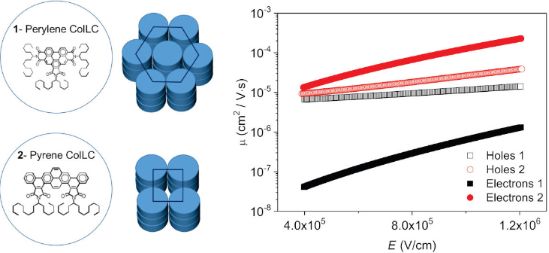
- ), organic light-emitting diodes (OLEDs) and sensors [1][2]. Columnar liquid crystals are attractive due to their solution processability and their self-organization in highly anisotropic supramolecular architectures, which favors the mainly one-dimensional migration of charge carriers with an anisotropy of


Preparation of β-cyclodextrin-based dimers with selectively methylated rims and their use for solubilization of tetracene
Beilstein J. Org. Chem. 2022, 18, 1596–1606, doi:10.3762/bjoc.18.170
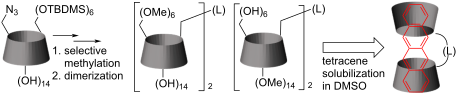
- the spacer is a less polar substituent than an oxygen atom. It justifies the magnetic anisotropy of the space surrounding the aromatic ring, leading to some specific signals becoming isolated and easily distinguishable. For example, a clearly defined H6 signal from the glucose unit A bearing the


Inductive heating and flow chemistry – a perfect synergy of emerging enabling technologies
Beilstein J. Org. Chem. 2022, 18, 688–706, doi:10.3762/bjoc.18.70
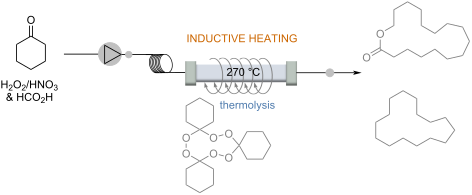
- reaching the nanoscale. The energy barrier of such superparamagnetic nanoparticles to reverse magnetization is directly related to magnetic anisotropy and particle volume [19][20]. In external magnetic fields, these spins rotate in the direction of the magnetic field direction and the axis of magnetic
- moment fluctuates along the magnetocrystalline anisotropy axis. Néel has described the relationship between the relaxation time of the thermal fluctuations of the magnetic moments of the individual domains and the uniaxial anisotropy. In Néel relaxation, the energy barrier for the remanence of




Unsaturated fatty acids and a prenylated tryptophan derivative from a rare actinomycete of the genus Couchioplanes
Beilstein J. Org. Chem. 2021, 17, 2939–2949, doi:10.3762/bjoc.17.203
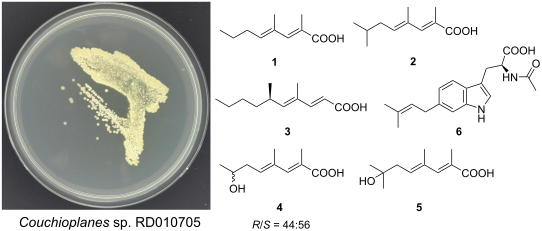
- -octadienoic acid (5), and one prenylated tryptophan derivative, 6-(3,3-dimethylallyl)-N-acetyl-ʟ-tryptophan (6). The enantiomer ratio of 4 was determined to be approximately S/R = 56:44 by a recursive application of Trost’s chiral anisotropy analysis and chiral HPLC analysis of its methyl ester. Compounds 1–5
- mixture (Supporting Information File 1, Figure S25). Furthermore, the slightly excessive 4'a and 4'c were identified to be MPA derivatives of (S)-4, and hence less excessive 4'b and 4'd to be those of (R)-4, by recursive application of Trost’s chiral anisotropy rule to the 1H chemical shift differences
- -7 to C-1' and from H-1' to C-6. The absolute configuration was determined by chiral anisotropy analysis after derivatization with each of the phenylglycine methyl ester (PGME) enantiomers [27], which gave positive ΔδH(S-R) values for NH-1, H-2, H-4, H-5 and H-8 and negative values for H-9, NH-11 and


Effect of a twin-emitter design strategy on a previously reported thermally activated delayed fluorescence organic light-emitting diode
Beilstein J. Org. Chem. 2021, 17, 2894–2905, doi:10.3762/bjoc.17.197
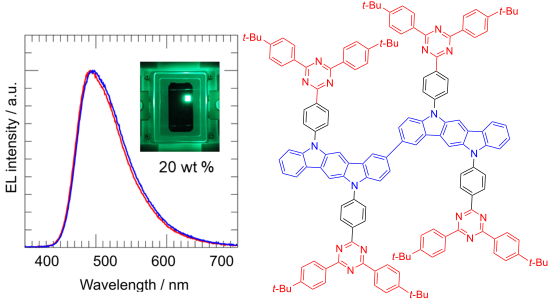
- ) of the device. A compound will emit light perpendicular to its transition dipole moment (TDM), quantified by the anisotropy factor, a. Controlling the orientation of the TDM to lie horizontally in the film (where 1 − a is the fraction of horizontally aligned TDMs) will lead to a maximized amount of
- nearly complete horizontal orientation in a wide number of host matrices. The best combination of properties was obtained in mCBP as a host, with the photoluminescence maximum wavelength, λPL of 479 nm, ΦPL of 70%, and a τd of 121.1 μs for the vacuum-deposited doped film. The anisotropy factor (a) in 5
- . Considering the high degree of horizontal orientation that ICzTRZ already showed in vacuum-deposited films (anisotropy factor of 0.09 in 10 wt % film of mCBP) and the high molecular weight of DICzTRZ, we hypothesized that DICzTRZ may also present horizontal orientation in the film and subsequently improve


Synthesis of new bile acid-fused tetrazoles using the Schmidt reaction
Beilstein J. Org. Chem. 2021, 17, 2611–2620, doi:10.3762/bjoc.17.174
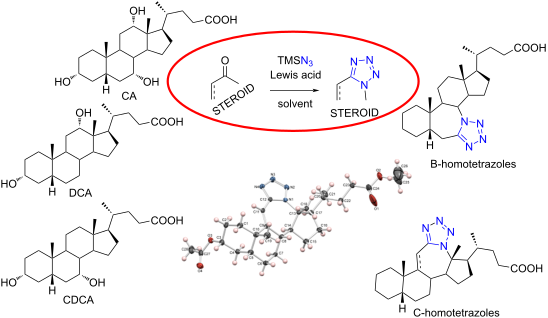
- observations about the preferred migration of the more substituted carbon atom during the Schmidt reaction [49]. Also, a retention of configuration at the C-13 position was confirmed by NOE NMR experiments. The chemical shift of some protons in compounds 13 and 14 exhibited effects of magnetic anisotropy from
- configuration at C-8 was confirmed. Similarly to C-homotetrazoles, magnetic anisotropy effects of the aromatic tetrazole ring are obvious in 1H NMR spectra of compounds 17 and 18. For example, the chemical shift of the H-4α proton is much lower than expected (0.45 ppm). Interestingly, we noticed that crystals


Cryogels: recent applications in 3D-bioprinting, injectable cryogels, drug delivery, and wound healing
Beilstein J. Org. Chem. 2021, 17, 2553–2569, doi:10.3762/bjoc.17.171
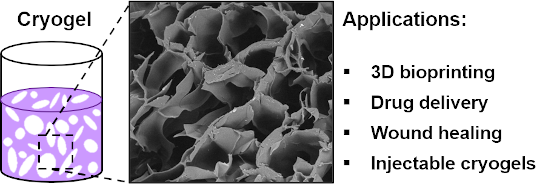
- [20]. This finding was further reiterated by Sen et al., who also explored heterogeneous pore size distribution for tissue engineering applications [21]. Cryostructuring, including directional freezing of cryogels, has been used to achieve varying degrees of porosity and aligned porosity or anisotropy






19F NMR as a tool in chemical biology
Beilstein J. Org. Chem. 2021, 17, 293–318, doi:10.3762/bjoc.17.28
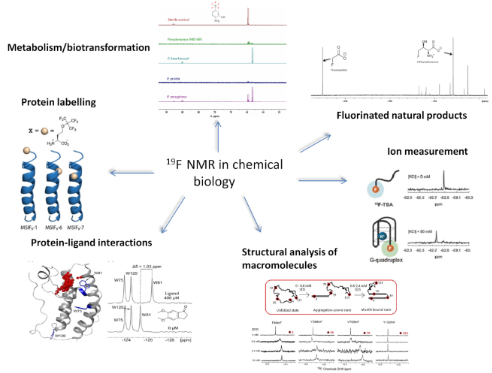
- NMR spectroscopy for drug screening has also evolved in the last decade to become a key tool to study the binding of drug candidates to target proteins. 19F NMR-based screening, which was developed by Dalvit et al., includes fluorine chemical shift anisotropy and exchange for screening (FAXS) [38


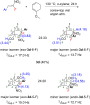
Diels–Alder reaction of β-fluoro-β-nitrostyrenes with cyclic dienes
Beilstein J. Org. Chem. 2021, 17, 283–292, doi:10.3762/bjoc.17.27

- probably such significant difference in the chemical shifts can be explained by the double bond anisotropy of the norbornene molecule [60]. The stereochemical assignments are in full accordance with the values of vicinal (3JH6-F and 3JH1-H6) and long-range coupling constants (4JH6-H7b). According to the



Tuning the solid-state emission of liquid crystalline nitro-cyanostilbene by halogen bonding
Beilstein J. Org. Chem. 2021, 17, 124–131, doi:10.3762/bjoc.17.13
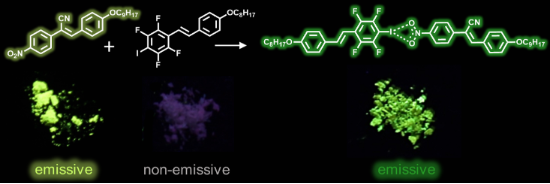
- temperature, which indicates that the strength of the halogen bond is not the only contributor to the mesomorphic behaviour of the halogen-bonded materials. The change in the electronic anisotropy by unsymmetrical substitution with fluorine as present in F3Az will also have an impact on the dispersion


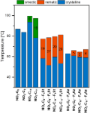




NMR Spectroscopy of supramolecular chemistry on protein surfaces
Beilstein J. Org. Chem. 2020, 16, 2505–2522, doi:10.3762/bjoc.16.203
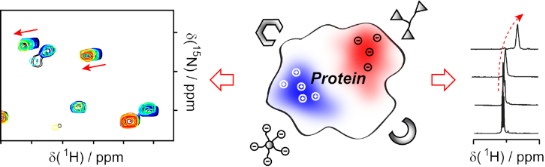
- the lines and decreases the signal intensities even more. In addition, the stabilization of the 14-3-3 peptide interaction in the presence of the ligand was confirmed by biochemical assays such as isothermal titration calorimetry (ITC) and fluorescence anisotropy. On a quest for modulators of 14-3-3
- for measuring binding affinities, such as isothermal titration calorimetry (ITC) or fluorescence anisotropy/polarization, are only able to provide an averaged KD. Outlook In the last two decades, additional NMR methods have been developed to extend the size limits of NMR spectroscopy to very large