


Search results
Search for "nitrocyclopropane" in Full Text gives 2 result(s) in Beilstein Journal of Organic Chemistry.
Highly electrophilic, gem- and spiro-activated trichloromethylnitrocyclopropanes: synthesis and structure
Beilstein J. Org. Chem. 2026, 22, 123–130, doi:10.3762/bjoc.22.5
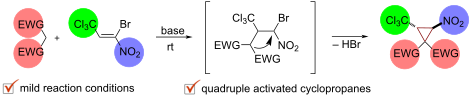
- nitro group upon breaking the C–C bond [16][17]. Substituted nitrocyclopropanes in reactions with various nucleophiles form linear precursors for the synthesis of γ-substituted α-aminobutyric acids [18][19], cyclic nitropyrrolines [20] and isoxazoline N-oxides [18]. The nitrocyclopropane fragment is a
- by several approaches: forming of the CF3-group in a nitrocyclopropane (reaction of 2-nitrocyclopropanecarboxylic acid with sulfur tetrafluoride [31][32]), cyclopropane formation from a nitroethene substrate and a CF3-containing reagent (Corey–Chaykovsky reaction [33]), as well as reactions involving
- -acids (dimethylbarbituric acid, 1,3-indanedione, 3-methyl-1-phenyl-5-pyrazolone). The spiro-fused vic-trichloromethylnitrocyclopropanes 7–9 were obtained in 42–67% yields (Scheme 4). The pyrazolone-conjugated trichloromethyl-containing nitrocyclopropane 9 is formed as a mixture of two diastereomers 9a


First synthesis of acylated nitrocyclopropanes
Beilstein J. Org. Chem. 2023, 19, 892–900, doi:10.3762/bjoc.19.67
- bulkier. The obtained nitrocyclopropane was transformed into furan upon treatment with tin(II) chloride via a ring-opening/ring-closure process. Keywords: acetoxyiodine; conjugate addition; dihydrofuran; nitroalkene; nitrocyclopropane; Introduction 3-Arylated 2-nitrocyclopropane-1,1-dicarbonylic acid
- substituent may prevent the attack of other reagents and suppress the decomposition of the nitrocyclopropane framework. The chemical transformation of cyclopropane 1e was investigated. When a solution of 1e and tin(II) chloride in benzene was heated at 100 °C for 14 h, successive ring-opening/ring-closure
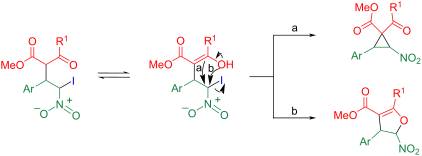
- addition of the 1,3-dicarbonyl compound 3 to nitrostyrene 2 and the α-iodination of the adduct 4, two cyclization modes became possible owing to the ambident property of enol 12. Dihydrofuran 8 was formed in the case of an O-attack, and nitrocyclopropane 1 was formed in the case of a C-attack. Furthermore


Other Beilstein-Institut Open Science Activities



