


Search results
Search for "phosphine catalyst" in Full Text gives 10 result(s) in Beilstein Journal of Organic Chemistry.
C2 to C6 biobased carbonyl platforms for fine chemistry
- Jingjing Jiang,
- Muhammad Noman Haider Tariq,
- Florence Popowycz,
- Yanlong Gu and
- Yves Queneau
Beilstein J. Org. Chem. 2025, 21, 2103–2172, doi:10.3762/bjoc.21.165

Graphical Abstract

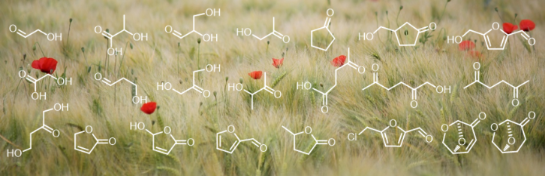
Figure 1: C2–C6 biobased carbonyl building blocks.

Scheme 1: Proposed (2 + 2) route to glycolaldehyde and glycolic acid from erythritol by Cu/AC catalyst (AC = ...

Scheme 2: Reductive amination of GCA.

Scheme 3: N-Formylation of secondary amines by reaction with GCA.

Scheme 4: Synthesis and conversion of hydroxy acetals to cyclic acetals.

Scheme 5: Synthesis of 3-(indol-3-yl)-2,3-dihydrofurans via three-component reaction of glycolaldehyde, indol...

Scheme 6: BiCl3-catalyzed synthesis of benzo[a]carbazoles from 2-arylindoles and α-bromoacetaldehyde ethylene...

Scheme 7: Cu/NCNSs-based conversion of glycerol to glycolic acid and other short biobased acids.

Scheme 8: E. coli-based biotransformation of C1 source molecules (CH4, CO2 and CO) towards C2 glycolic acid.

Scheme 9: N-Formylation of amines with C2 (a) or C3 (b) biomass-based feedstocks.

Scheme 10: Methods for the formation of propanoic acid (PA) from lactic acid (LA).

Scheme 11: Co-polymerization of biobased lactic acid and glycolic acid via a bicatalytic process.

Scheme 12: Oxidation of α-hydroxy acids by tetrachloroaurate(III) in acetic acid–sodium acetate buffer medium.

Figure 2: Selective catalytic pathways for the conversion of lactic acid (LA).

Scheme 13: Synthesis of 1,3-PDO via cross-aldol reaction between formaldehyde and acetaldehyde to 3-hydroxypro...

Scheme 14: Hydrothermal conversion of 1,3-dihydroxy-2-propane and 2,3-dihydroxypropanal to methylglyoxal.

Scheme 15: FLS-catalyzed formose reaction to synthesize GA and DHA.

Scheme 16: GCA and DHA oxidation products of glycerol and isomerization of GCA to DHA under flow conditions us...

Scheme 17: Acid-catalyzed reactions of DHA with alcohols.

Scheme 18: Synthesis of dihydroxyacetone phosphate from dihydroxyacetone.

Scheme 19: Bifunctional acid–base catalyst DHA conversion into lactic acid via pyruvaldehyde or fructose forma...

Scheme 20: Catalytic one-pot synthesis of GA and co-synthesis of formamides and formates from DHA.

Scheme 21: (a) Synthesis of furan derivatives and (b) synthesis of thiophene derivative by cascade [3 + 2] ann...

Scheme 22: Brønsted acidic ionic liquid catalyzed synthesis of benzo[a]carbazole from renewable acetol and 2-p...

Scheme 23: Asymmetric hydrogenation of α-hydroxy ketones to 1,2-diols.

Scheme 24: Synthesis of novel 6-(substituted benzylidene)-2-methylthiazolo [2,3-b]oxazol-5(6H)-one from 1-hydr...

Scheme 25: ʟ-Proline-catalyzed synthesis of anti-diols from hydroxyacetone and aldehydes.

Scheme 26: C–C-bond-formation reactions of a biomass-based feedstock aromatic aldehyde (C5) and hydroxyacetone...

Scheme 27: Ethanol upgrading to C4 bulk chemicals via the thiamine (VB1)-catalyzed acetoin condensation.

Scheme 28: One-pot sequential chemoenzymatic synthesis of 2-aminobutane-1,4-diol and 1,2,4-butanetriol via 1,4...

Scheme 29: Synthesis of 1,4-dihydroxybutan-2-one by microbial transformation.

Scheme 30: Conversion of polyols by [neocuproine)Pd(OAc)]2(OTf)2] to α-hydroxy ketones.

Scheme 31: Chemoselective oxidation of alcohols with chiral palladium-based catalyst 2.

Scheme 32: Electrochemical transformation of furfural to 5-hydroxy-2(5H)-furanone (HFO).

Scheme 33: Selective hydrodeoxygenation of HFO and oxidation to γ-butyrolactone (GBL).

Scheme 34: Photosensitized oxygenation of furan towards HFO via ozonide intermediates.

Scheme 35: Conversion of furfural to HFO and MAN by using mesoporous carbon nitride (SGCN) as photocatalyst.

Scheme 36: Synthesis of HFO from furan derivatives.

Scheme 37: Photooxidation of furfural to 5-hydroxy-2(5H)-furanone (HFO).

Scheme 38: Synthesis of Friedel–Crafts indole adduct from HFO.

Scheme 39: Conversion of HFO to α,γ-substituted chiral γ-lactones.

Scheme 40: Tautomeric transformation of HFO to formylacrylic acid.

Scheme 41: Hydrolysis of HFO to succinic acid in aqueous solution.

Scheme 42: Substitution and condensation reactions of 5-hydroxy-2(5H)-furanone (HFO).

Scheme 43: (a) Conversion of HFO towards valuable C4 chemicals and (b) anodic oxidation of 5-hydroxy-2(5H)-fur...

Figure 3: Conversion of HFO towards other natural and synthetic substances.

Scheme 44: Conversion of furfural to maleic anhydride (reaction a: VOx/Al2O3; reaction b: VPO).

Scheme 45: Conversion of furfural into succinic acid.

Scheme 46: Electro‑, photo‑, and biocatalysis for one-pot selective conversions of furfural into C4 chemicals.

Scheme 47: Production route of furfural from hemicellulose.

Scheme 48: Mechanism for xylose dehydration to furfural through a choline xyloside intermediate.

Scheme 49: Conversion of furfural to furfuryl alcohol and its derivatives.

Scheme 50: Conversion of furfural to furfuryl alcohol and 3-(2-furyl)acrolein.

Scheme 51: The aerobic oxidative condensation of biomass-derived furfural and linear alcohols.

Scheme 52: The single-step synthesis of 2-pentanone from furfural.

Scheme 53: Electrocatalytic coupling reaction of furfural and levulinic acid.

Scheme 54: Conversion of furfural to m-xylylenediamine.

Scheme 55: Conversion of furfural to tetrahydrofuran-derived amines.

Scheme 56: Formation of trans-4,5-diamino-cyclopent-2-enones from furfural.

Scheme 57: Production of pyrrole and proline from furfural.

Scheme 58: Synthesis of 1‑(trifluoromethyl)-8-oxabicyclo[3.2.1]oct-3-en-2-ones from furfural.

Scheme 59: Conversion of furfural to furfural-derived diacids.

Scheme 60: A telescope protocol derived from furfural and glycerol.

Scheme 61: A tandem cyclization of furfural and 5,5-dimethyl-1,3-cyclohexanedione.

Scheme 62: A Ugi four-component reaction to construct furfural-based polyamides.

Scheme 63: One-pot synthesis of γ-acyloxy-Cy7 from furfural.

Scheme 64: Dimerization–Piancatelli sequence toward humins precursors from furfural.

Scheme 65: Conversion of furfural to CPN.

Scheme 66: Synthesis of jet fuels range cycloalkanes from CPN and lignin-derived vanillin.

Scheme 67: Solar-energy-driven synthesis of high-density biofuels from CPN.

Scheme 68: Reductive amination of CPN to cyclopentylamine.

Scheme 69: Asymmetric hydrogenation of C=O bonds of exocyclic α,β-unsaturated cyclopentanones.

Scheme 70: Preparation of levulinic acid via the C5 route (route a) or C6 route (routes b1 and b2).

Scheme 71: Mechanism of the rehydration of HMF to levulinic acid and formic acid.

Scheme 72: Important levulinic acid-derived chemicals.

Scheme 73: Direct conversion of levulinic acid to pentanoic acid.

Scheme 74: Catalytic aerobic oxidation of levulinic acid to citramalic acid.

Scheme 75: Conversion of levulinic acid to 1,4-pentanediol (a) see ref. [236]; b) see ref. [237]; c) see ref. [238]; d) see r...

Scheme 76: Selective production of 2-butanol through hydrogenolysis of levulinic acid.

Scheme 77: General reaction pathways proposed for the formation of 5MPs from levulinic acid.

Scheme 78: Selective reductive amination of levulinic acid to N-substituted pyrroles.

Scheme 79: Reductive amination of levulinic acid to chiral pyrrolidinone.

Scheme 80: Reductive amination of levulinic acid to non-natural chiral γ-amino acid.

Scheme 81: Nitrogen-containing chemicals derived from levulinic acid.

Scheme 82: Preparation of GVL from levulinic acid by dehydration and hydrogenation.

Scheme 83: Ruthenium-catalyzed levulinic acid to chiral γ-valerolactone.

Scheme 84: Catalytic asymmetric hydrogenation of levulinic acid to chiral GVL.

Scheme 85: Three steps synthesis of ε-caprolactam from GVL.

Scheme 86: Multistep synthesis of nylon 6,6 from GVL.

Scheme 87: Preparation of MeGVL by α-alkylation of GVL.

Scheme 88: Ring-opening polymerization of five-membered lactones.

Scheme 89: Synthesis of GVL-based ionic liquids.

Scheme 90: Preparation of butene isomers from GVL under Lewis acid conditions.

Scheme 91: Construction of C5–C12 fuels from GVL over nano-HZSM-5 catalysts.

Scheme 92: Preparation of alkyl valerate from GVL via ring opening/reduction/esterification sequence.

Scheme 93: Construction of 4-acyloxypentanoic acids from GVL.

Scheme 94: Synthesis of 1,4-pentanediol (PDO) from GVL.

Scheme 95: Construction of novel cyclic hemiketal platforms via self-Claisen condensation of GVL.

Scheme 96: Copper-catalyzed lactamization of GVL.

Figure 4: Main scaffolds obtained from HMF.

Scheme 97: Biginelli reactions towards HMF-containing dihydropyrimidinones.

Scheme 98: Hantzsch dihydropyridine synthesis involving HMF.

Scheme 99: The Kabachnik–Fields reaction involving HMF.

Scheme 100: Construction of oxazolidinone from HMF.

Scheme 101: Construction of rhodamine-furan hybrids from HMF.

Scheme 102: A Groebke–Blackburn–Bienaymé reaction involving HMF.

Scheme 103: HMF-containing benzodiazepines by [4 + 2 + 1] cycloadditions.

Scheme 104: Synthesis of fluorinated analogues of α-aryl ketones.

Scheme 105: Synthesis of HMF derived disubstituted γ-butyrolactone.

Scheme 106: Functionalized aromatics from furfural and HMF.

Scheme 107: Diels–Alder adducts from HMF or furfural with N-methylmaleimide.

Scheme 108: Pathway of the one-pot conversion of HMF into phthalic anhydride.

Scheme 109: Photocatalyzed preparation of humins (L-H) from HMF mixed with spoiled HMF residues (LMW-H) and fur...

Scheme 110: Asymmetric dipolar cycloadditions on HMF.

Scheme 111: Dipolar cycloadditions of HMF based nitrones to 3,4- and 3,5-substituted isoxazolidines.

Scheme 112: Production of δ-lactone-fused cyclopenten-2-ones from HMF.

Scheme 113: Aza-Piancatelli access to aza-spirocycles from HMF-derived intermediates.

Scheme 114: Cross-condensation of furfural, acetone and HMF into C13, C14 and C15 products.

Scheme 115: Base-catalyzed aldol condensation/dehydration sequences from HMF.

Scheme 116: Condensation of HMF and active methylene nitrile.

Scheme 117: MBH reactions involving HMF.

Scheme 118: Synthesis of HMF-derived ionic liquids.

Scheme 119: Reductive amination/enzymatic acylation sequence towards HMF-based surfactants.

Scheme 120: The formation of 5-chloromethylfurfural (CMF).

Scheme 121: Conversion of CMF to HMF, levulinic acid, and alkyl levulinates.

Scheme 122: Conversion of CMF to CMFCC and FDCC.

Scheme 123: Conversion of CMF to BHMF.

Scheme 124: Conversion of CMF to DMF.

Scheme 125: CMF chlorine atom substitutions toward HMF ethers and esters.

Scheme 126: Introduction of carbon nucleophiles in CMF.

Scheme 127: NHC-catalyzed remote enantioselective Mannich-type reactions of CMF.

Scheme 128: Conversion of CMF to promising biomass-derived dyes.

Scheme 129: Radical transformation of CMF with styrenes.

Scheme 130: Synthesis of natural herbicide δ-aminolevulinic acid from CMF.

Scheme 131: Four step synthesis of the drug ranitidine from CMF.

Scheme 132: Pd/CO2 cooperative catalysis for the production of HHD and HXD.

Scheme 133: Different ruthenium (Ru) catalysts for the ring-opening of 5-HMF to HHD.

Scheme 134: Proposed pathways for preparing HXD from HMF.

Scheme 135: MCP formation and uses.

Scheme 136: Cu(I)-catalyzed highly selective oxidation of HHD to 2,5-dioxohexanal.

Scheme 137: Synthesis of N‑substituted 3‑hydroxypyridinium salts from 2,5-dioxohexanal.

Scheme 138: Ru catalyzed hydrogenations of HHD to 1,2,5-hexanetriol (a) see ref. [396]; b) see ref. [397]).

Scheme 139: Aviation fuel range quadricyclanes produced by HXD.

Scheme 140: Synthesis of HDGK from HXD and glycerol as a chain extender.

Scheme 141: Synthesis of serinol pyrrole from HXD and serinol.

Scheme 142: Synthesis of pyrroles from HXD and nitroarenes.

Scheme 143: Two-step production of PX from cellulose via HXD.

Scheme 144: Preparation of HCPN from HMF via hydrogenation and ring rearrangement.

Scheme 145: Suggested pathways from HMF to HCPN.

Scheme 146: α-Alkylation of HCPN with ethylene gas.

Scheme 147: Synthesis of 3-(hydroxymethyl)cyclopentylamine from HMF via reductive amination of HCPN.

Scheme 148: Production of LGO and Cyrene® from biomass.

Scheme 149: Synthesis of HBO from LGO and other applications.

Scheme 150: Construction of m-Cyrene® homopolymer.

Scheme 151: Conversion of Cyrene® to THFDM and 1,6-hexanediol.

Scheme 152: RAFT co-polymerization of LGO and butadienes.

Scheme 153: Polycondensation of HO-LGOL and diols with dimethyl adipate.

Scheme 154: Self-condensation of Cyrene® and Claisen–Schmidt reactions.

Scheme 155: Synthesis of 5-amino-2-(hydroxymethyl)tetrahydropyran from Cyrene®.
Synthetic reactions driven by electron-donor–acceptor (EDA) complexes
- Zhonglie Yang,
- Yutong Liu,
- Kun Cao,
- Xiaobin Zhang,
- Hezhong Jiang and
- Jiahong Li
Beilstein J. Org. Chem. 2021, 17, 771–799, doi:10.3762/bjoc.17.67

- perfluoroalkylation of unactivated olefins can be realized with phosphine catalyst and perfluorobutyl iodide (28) under visible-light irradiation. The EDA complex formed by perfluorobutyl iodide (28) and phosphine catalyst induced SET, affording a perfluoroalkyl radical, and then perfluoroalkylation product 97 was

Graphical Abstract

Scheme 1: The electron transfer process in EDA complexes.

Scheme 2: Synthesis of benzo[b]phosphorus oxide 3 initiated by an EDA complex.

Scheme 3: Mechanism of the synthesis of quinoxaline derivative 7.

Scheme 4: Synthesis of imidazole derivative 10 initiated by an EDA complex.

Scheme 5: Synthesis of sulfamoylation product 12 initiated by an EDA complex.

Scheme 6: Mechanism of the synthesis of sulfamoylation product 12.

Scheme 7: Synthesis of indole derivative 22 initiated by an EDA complex.

Scheme 8: Synthesis of perfluoroalkylated pyrimidines 26 initiated by an EDA complex.

Scheme 9: Synthesis of phenanthridine derivative 29 initiated by an EDA complex.

Scheme 10: Synthesis of cis-tetrahydroquinoline derivative 32 initiated by an EDA complex.

Scheme 11: Mechanism of the synthesis of cis-tetrahydroquinoline derivative 32.

Scheme 12: Synthesis of phenanthridine derivative 38 initiated by an EDA complex.

Scheme 13: Synthesis of spiropyrroline derivative 40 initiated by an EDA complex.

Scheme 14: Synthesis of benzothiazole derivative 43 initiated by an EDA complex.

Scheme 15: Synthesis of perfluoroalkyl-s-triazine derivative 45 initiated by an EDA complex.

Scheme 16: Synthesis of indoline derivative 47 initiated by an EDA complex.

Scheme 17: Mechanism of the synthesis of spirocyclic indoline derivative 47.

Scheme 18: Synthesis of cyclobutane product 50 initiated by an EDA complex.

Scheme 19: Mechanism of the synthesis of spirocyclic indoline derivative 50.

Scheme 20: Synthesis of 1,3-oxazolidine compound 59 initiated by an EDA complex.

Scheme 21: Synthesis of trifluoromethylated product 61 initiated by an EDA complex.

Scheme 22: Synthesis of indole alkylation product 64 initiated by an EDA complex.

Scheme 23: Synthesis of perfluoroalkylation product 67 initiated by an EDA complex.

Scheme 24: Synthesis of hydrotrifluoromethylated product 70 initiated by an EDA complex.

Scheme 25: Synthesis of β-trifluoromethylated alkyne product 71 initiated by an EDA complex.

Scheme 26: Mechanism of the synthesis of 2-phenylthiophene derivative 74.

Scheme 27: Synthesis of allylated product 80 initiated by an EDA complex.

Scheme 28: Synthesis of trifluoromethyl-substituted alkynyl product 84 initiated by an EDA complex.

Scheme 29: Synthesis of dearomatized fluoroalkylation product 86 initiated by an EDA complex.

Scheme 30: Mechanism of the synthesis of dearomatized fluoroalkylation product 86.

Scheme 31: Synthesis of C(sp3)–H allylation product 91 initiated by an EDA complex.

Scheme 32: Synthesis of perfluoroalkylation product 93 initiated by an EDA complex.

Scheme 33: Synthesis of spirocyclic indolene derivative 95 initiated by an EDA complex.

Scheme 34: Synthesis of perfluoroalkylation product 97 initiated by an EDA complex.

Scheme 35: Synthesis of alkylated indole derivative 100 initiated by an EDA complex.

Scheme 36: Mechanism of the synthesis of alkylated indole derivative 100.

Scheme 37: Synthesis of arylated oxidized indole derivative 108 initiated by an EDA complex.

Scheme 38: Synthesis of 4-ketoaldehyde derivative 111 initiated by an EDA complex.

Scheme 39: Mechanism of the synthesis of 4-ketoaldehyde derivative 111.

Scheme 40: Synthesis of perfluoroalkylated olefin 118 initiated by an EDA complex.

Scheme 41: Synthesis of alkylation product 121 initiated by an EDA complex.

Scheme 42: Synthesis of acylation product 123 initiated by an EDA complex.

Scheme 43: Mechanism of the synthesis of acylation product 123.

Scheme 44: Synthesis of trifluoromethylation product 126 initiated by an EDA complex.

Scheme 45: Synthesis of unnatural α-amino acid 129 initiated by an EDA complex.

Scheme 46: Synthesis of thioether derivative 132 initiated by an EDA complex.

Scheme 47: Synthesis of S-aryl dithiocarbamate product 135 initiated by an EDA complex.

Scheme 48: Mechanism of the synthesis of S-aryl dithiocarbamate product 135.

Scheme 49: Synthesis of thioether product 141 initiated by an EDA complex.

Scheme 50: Mechanism of the synthesis of borate product 144.

Scheme 51: Synthesis of boronation product 148 initiated by an EDA complex.

Scheme 52: Synthesis of boration product 151 initiated by an EDA complex.

Scheme 53: Synthesis of boronic acid ester derivative 154 initiated by an EDA complex.

Scheme 54: Synthesis of β-azide product 157 initiated by an EDA complex.

Scheme 55: Decarboxylation reaction initiated by an EDA complex.

Scheme 56: Synthesis of amidated product 162 initiated by an EDA complex.

Scheme 57: Synthesis of diethyl phenylphosphonate 165 initiated by an EDA complex.

Scheme 58: Mechanism of the synthesis of diethyl phenylphosphonate derivative 165.

Scheme 59: Synthesis of (Z)-2-iodovinyl phenyl ether 168 initiated by an EDA complex.

Scheme 60: Mechanism of the synthesis of (Z)-2-iodovinyl phenyl ether derivative 168.

Scheme 61: Dehalogenation reaction initiated by an EDA complex.
All-carbon [3 + 2] cycloaddition in natural product synthesis
- Zhuo Wang and
- Junyang Liu
Beilstein J. Org. Chem. 2020, 16, 3015–3031, doi:10.3762/bjoc.16.251
- -workers proposed that the catalytic mechanism involves a reaction between phosphine catalyst A and allene 82 to give B and/or C (Scheme 5B). Catalytic [3 + 2] cycloaddition of B and/or C and alkene D gives the cyclic intermediates E and F in an equilibrium state through a 1,2-proton transfer. The loss of
- phosphine catalyst from E or F affords the cycloaddition product G and the catalyst is regenerated. It is noteworthy that ethyl 2-butynoate (85) can be used as substrate in place of ethyl 2,3-butadienoate (82) in the phosphine-catalyzed [3 + 2] cycloaddition. Ethyl 2-butynoate (85) enters the catalytic
- cycle by reacting with phosphine catalyst A to give H and C. Some total syntheses of hexacyclic Daphniphyllum alkaloids were reported by Li’s group (longeracinphyllin A (10) [41] and daphenylline (11) [42]) and Zhai’s group (daphenylline (11) [43]), applying Lu’s [3 + 2] cycloaddition (Scheme 6). The

Graphical Abstract

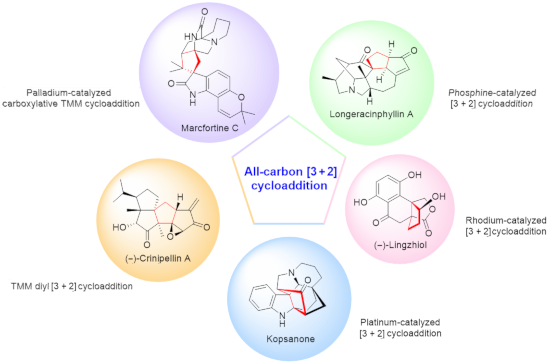
Figure 1: Highly-substituted five-membered carbocycle in biologically significant natural products.

Figure 2: Natural product synthesis featuring the all-carbon [3 + 2] cycloaddition. (Quaternary carbon center...

Scheme 1: Representative natural product syntheses that feature the all-carbon [3 + 2] cyclization as the key...
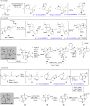
Scheme 2: (A) An intramolecular trimethylenemethane diyl [3 + 2] cycloaddition with allenyl diazo compound 38...
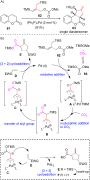
Scheme 3: (A) Palladium-catalyzed intermolecular carboxylative TMM cycloaddition [36]. (B) The proposed mechanism....

Scheme 4: Natural product syntheses that make use of palladium-catalyzed intermolecular [3 + 2] cycloaddition...
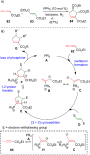
Scheme 5: (A) Phosphine-catalyzed [3 + 2] cycloaddition [17]. (B) The proposed mechanism.

Scheme 6: Lu’s [3 + 2] cycloaddition in natural product synthesis. (A) Synthesis of longeracinphyllin A (10) [41]...

Scheme 7: (A) Phosphine-catalyzed [3 + 2] annulation of unsymmetric isoindigo 100 with allene in the preparat...
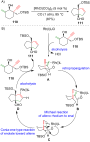
Scheme 8: (A) Rhodium-catalyzed intracmolecular [3 + 2] cycloaddition [49]. (B) The proposed catalytic cycle of t...
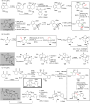
Scheme 9: Total synthesis of natural products reported by Yang and co-workers applying rhodium-catalyzed intr...
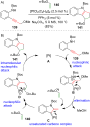
Scheme 10: (A) Platinum(II)-catalyzed intermolecular [3 + 2] cycloaddition of propargyl ether 139 and n-butyl ...
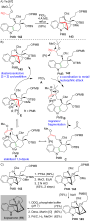
Scheme 11: (A) Platinum-catalyzed intramolecular [3 + 2] cycloaddition of propargylic ketal derivative 142 to ...

Scheme 12: (A) Synthesis of phyllocladanol (21) features a Lewis acid-catalyzed formal intramolecular [3 + 2] ...

Scheme 13: The recent advances of [3 + 2] annulation in natural product synthesis. (A) The preparation of melo...
Enantioconvergent catalysis
- Justin T. Mohr,
- Jared T. Moore and
- Brian M. Stoltz
Beilstein J. Org. Chem. 2016, 12, 2038–2045, doi:10.3762/bjoc.12.192
- enantiopure phosphine catalyst 27 in order to generate the coupled product 30 with both high ee and dr (Scheme 6) [31]. Presumably, the allenyl stereochemistry is destroyed upon 1,4-addition of the phosphine catalyst, resulting in chiral phosphonium adduct 29 that further reacts with deprotonated oxazole 28

Graphical Abstract

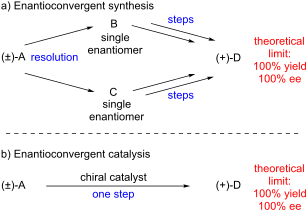
Figure 1: Enantioconvergent methods.

Figure 2: Stereomutative enantioconvergent catalysis.

Scheme 1: Dynamic kinetic resolution by hydrogenation.

Scheme 2: Enantioconvergent synthesis of phosphines governed by Curtin–Hammett/Winstein–Holness kinetics (TMS...

Figure 3: Stereoablative enantioconvergent catalysis.

Scheme 3: Stoltz’ stereoablative oxindole functionalization.

Scheme 4: Fu’s type II enantioconvergent Cu-catalyzed photoredox reaction.

Scheme 5: Stereoablative enantioconvergent allylation and protonation (dba = dibenzylideneacetone).

Scheme 6: Enantioconvergent allylic alkylation with two racemic starting materials.

Figure 4: Enantioconvergent parallel kinetic resolution.

Scheme 7: Enantioconvergent parallel kinetic resolution by two complementary biocatalysts.

Scheme 8: Enantioconvergent PKR by Nocardia EH1.
1H-Imidazol-4(5H)-ones and thiazol-4(5H)-ones as emerging pronucleophiles in asymmetric catalysis
- Antonia Mielgo and
- Claudio Palomo
Beilstein J. Org. Chem. 2016, 12, 918–936, doi:10.3762/bjoc.12.90
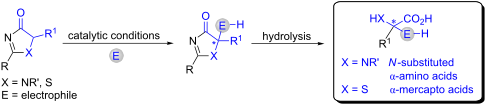
- ] pronucleophiles to γ-substituted allenoates and/or alkynoates in the presence of a C2-symmetric chiral phosphine catalyst. Although γ-substituted allenes have been employed in many phosphine-mediated γ-additions, to date there was virtually no progress on the use of prochiral pronucleophiles in phosphine-mediated
- . Then this basic intermediate is proposed to deprotonate the starting thiazolone thus providing enolate V, which subsequently adds to the γ-carbon of IV to afford intermediate VI. After proton shift, intermediate VI becomes intermediate VII and this eliminates the phosphine catalyst, which enters a new

Graphical Abstract

Figure 1: Some α-substituted heterocycles for asymmetric catalysis, their reactivity patterns against enoliza...

Figure 2: 1H-Imidazol-4(5H)-ones 1 and thiazol-4(5H)-ones 2.
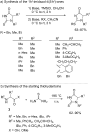
Scheme 1: a) Synthesis of 2-thio-1H-imidazol-4(5H)-ones [55] and b) preparation of the starting thiohydantoins [59].

Scheme 2: Selected examples of the Michael addition of 2-thio-1H-imidazol-4(5H)-ones to nitroalkenes [55]. aReact...

Scheme 3: Michael addition of thiohydantoins to nitrostyrene assisted by Et3N and catalysts C1 and C3. aAbsol...

Scheme 4: Elaboration of the Michael adducts coming from the Michael addition to nitroalkenes [55].

Figure 3: Proposed model for the Michael addition of 1H-imidazol4-(5H)-ones and selected 1H NMR data which su...

Scheme 5: Michael addition 2-thio-1H-imidazol-4(5H)-ones to the α-silyloxyenone 29 [55].

Scheme 6: Elaboration of the Michael adducts coming from the Michael addition to nitroolefins [55].
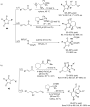
Scheme 7: Rhodanines in asymmetric catalytic reactions: a) Reaction with rhodanines of type 44 [78-80]; b) reactions...

Scheme 8: Michael addition of thiazol-4(5H)-ones to nitroolefins promoted by the ureidopeptide-like bifunctio...

Figure 4: Ureidopeptide-like Brønsted bases: catalyst design. a) Previous known design. b) Proposed new desig...

Scheme 9: Ureidopeptide-like Brønsted base bifunctional catalyst preparation. NMM = N-methylmorpholine, THF =...

Scheme 10: Selected examples of the Michael addition of thiazolones to different nitroolefins promoted by cata...

Scheme 11: Elaboration of the Michael adducts to α,α-disubstituted α-mercaptocarboxylic acid derivatives [85].

Scheme 12: Effect of the nitrogen atom at the aromatic substituent of the thiazolone on yield and stereoselect...

Scheme 13: Michael addition reaction of thiazol-4(5H)ones 74 to α’-silyloxyenone 29 [73].

Scheme 14: Elaboration of the thiazolone Michael adducts [73].

Scheme 15: Enantioselective γ-addition of oxazol-4(5H)-ones and thiazol-4(5H)-ones to allenoates promoted by C6...

Scheme 16: Enantioselective γ-addition of thiazol-4(5H)-ones and oxazol-4(5H)-ones to alkynoate 83 promoted by ...
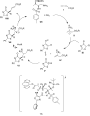
Scheme 17: Proposed mechanism for the C6-catalyzed γ-addition of thiazol-4(5H)-one to allenoates. Adapted from ...

Scheme 18: Catalytic enantioselective α-amination of thiazolones promoted by ureidopeptide like catalysts C5 a...

Scheme 19: Iridium-catalized asymmetric allyllation of substituted oxazol-4(5H)-ones and thiazol-4(5H)-ones pr...
Asymmetric α-amination of 3-substituted oxindoles using chiral bifunctional phosphine catalysts
- Qiao-Wen Jin,
- Zhuo Chai,
- You-Ming Huang,
- Gang Zou and
- Gang Zhao
Beilstein J. Org. Chem. 2016, 12, 725–731, doi:10.3762/bjoc.12.72
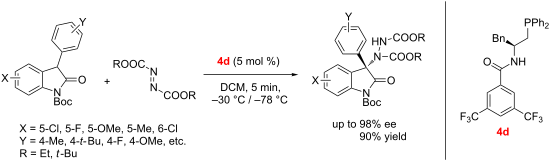
- catalysts is reported. The corresponding products containing a tetrasubstituted carbon center attached to a nitrogen atom at the C-3 position of the oxindole were obtained in high yields and with up to 98% ee. Keywords: 3-aminooxindoles; asymmetric catalysis; phosphine catalyst; tetrasubstituted

Graphical Abstract

Scheme 1: The mimetic activation mode of Mitsunobu reaction.

Scheme 2: Scale-up of the reaction and deprotection of the product.

Figure 1: The 31P NMR spectra research in CD2Cl2.

Scheme 3: Proposed transition-state model.
Enantioselective [3 + 2] annulation of α-substituted allenoates with β,γ-unsaturated N-sulfonylimines catalyzed by a bifunctional dipeptide phosphine
- Huanzhen Ni,
- Weijun Yao and
- Yixin Lu
Beilstein J. Org. Chem. 2016, 12, 343–348, doi:10.3762/bjoc.12.37
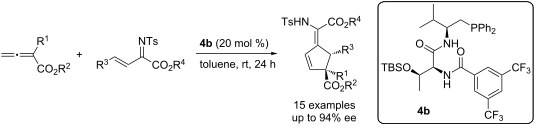
- of a dipeptide phosphine catalyst, a wide range of highly functionalized cyclopentenes bearing an all-carbon quaternary center were obtained in moderate to good yields and with good to excellent enantioselectivities. Keywords: [3 + 2] annulation; α-substituted allenoate; dipeptide phosphine
- phosphine catalyst furnishes the final [3 + 2] annulation product 5. Conclusion In conclusion, we have described the first enantioselective [3 + 2] cycloaddition of α-substituted allenoates with β,γ-unsaturated N-sulfonylimines, catalyzed by amino acid-derived bifunctional phosphines. The [3 + 2] annulation

Graphical Abstract

Scheme 1: The [3 + 2] annulation of α-substituted allenoates reported by He.

Scheme 2: Possible reaction mechanism.
Chiral phosphines in nucleophilic organocatalysis
- Yumei Xiao,
- Zhanhu Sun,
- Hongchao Guo and
- Ohyun Kwon
Beilstein J. Org. Chem. 2014, 10, 2089–2121, doi:10.3762/bjoc.10.218
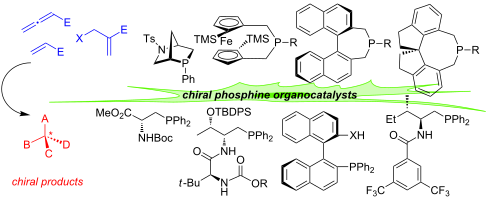
- yields and ee’s. In 2007, based on their peptide catalyst studies, the Miller group developed the first α-amino acid-based phosphine catalyst H1 for enantioselective [3 + 2] annulations of allenoates with enones (Scheme 21) [52]. This catalyst performed multiple roles during the catalytic process, with
- alkenes and MBH adducts, albeit in slightly diminished yields. Shi and co-workers also studied this reaction, but using the chiral bifunctional thiourea-phosphine catalyst G7. The [3 + 2] annulation of MBH carbonate with an activated isatin-based alkene in toluene at room temperature gave the
- corresponding γ-cycloadduct as the major product in 92% yield, with 9:1 dr and 74% ee [77]. Using the amino acid-derived chiral phosphine catalyst H11, Lu and co-workers performed asymmetric [3 + 2] annulations between MBH carbonates and maleimides, obtaining access to a wide range of bicyclic imides in

Graphical Abstract

Figure 1: Cyclic chiral phosphines based on bridged-ring skeletons.

Figure 2: Cyclic chiral phosphines based on binaphthyl skeletons.

Figure 3: Cyclic chiral phosphines based on ferrocene skeletons.

Figure 4: Cyclic chiral phosphines based on spirocyclic skeletons.

Figure 5: Cyclic chiral phosphines based on phospholane ring skeletons.

Figure 6: Acyclic chiral phosphines.

Figure 7: Multifunctional chiral phosphines based on binaphthyl skeletons.

Figure 8: Multifunctional chiral phosphines based on amino acid skeletons.

Scheme 1: Asymmetric [3 + 2] annulations of allenoates with electron-deficient olefins, catalyzed by the chir...

Scheme 2: Asymmetric [3 + 2] annulations of allenoate and enones, catalyzed by the chiral binaphthyl-based ph...

Scheme 3: Asymmetric [3 + 2] annulations of N-substituted olefins and allenoates, catalyzed by the chiral bin...

Scheme 4: Asymmetric [3 + 2] annulations of 2-aryl-1,1-dicyanoethylenes with ethyl allenoate, catalyzed by th...

Scheme 5: Asymmetric [3 + 2] annulations of 3-alkylideneindolin-2-ones with ethyl allenoate, catalyzed by the...

Scheme 6: Asymmetric [3 + 2] annulations of 2,6-diarylidenecyclohexanones with allenoates, catalyzed by the c...

Scheme 7: Asymmetric [3 + 2] annulations of allenoate with alkylidene azlactones, catalyzed by the chiral bin...

Scheme 8: Asymmetric [3 + 2] annulations of C60 with allenoates, catalyzed by the chiral phosphine B6.

Scheme 9: Asymmetric [3 + 2] annulations of α,β-unsaturated esters and ketones with an allenoate, catalyzed b...

Scheme 10: Asymmetric [3 + 2] annulations of exocyclic enones with allenoates, catalyzed by the ferrocene-modi...

Scheme 11: Asymmetric [3 + 2] annulations of enones with an allenylphosphonate, catalyzed by the ferrocene-mod...

Scheme 12: Asymmetric [3 + 2] annulations of 3-alkylidene-oxindoles with ethyl allenoate, catalyzed by the fer...

Scheme 13: Asymmetric [3 + 2] annulations of dibenzylideneacetones with ethyl allenoate, catalyzed by the ferr...

Scheme 14: Asymmetric [3 + 2] annulations of trisubstituted alkenes with ethyl allenoate, catalyzed by the fer...

Scheme 15: Asymmetric [3 + 2] annulations of 2,6-diarylidenecyclohexanones with allenoates, catalyzed by the f...

Scheme 16: Asymmetric [3 + 2] annulations of α,β-unsaturated ketones with ethyl allenoates, catalyzed by the f...

Scheme 17: Asymmetric [3 + 2] annulations of α,β-unsaturated esters with allenoates, catalyzed by the ferrocen...

Scheme 18: Asymmetric [3 + 2] annulations of alkylidene azlactones with allenoates, catalyzed by the chiral sp...

Scheme 19: Asymmetric [3 + 2] annulations of α-trimethylsilyl allenones and electron-deficient olefins, cataly...

Scheme 20: Asymmetric [3 + 2] annulations of α,β-unsaturated ketones with an allenone, catalyzed by the chiral...

Scheme 21: Asymmetric [3 + 2] annulations of cyclic enones with allenoates, catalyzed by the chiral α-amino ac...

Scheme 22: Asymmetric [3 + 2] annulations of arylidenemalononitriles and analogues with an allenoate, catalyze...

Scheme 23: Asymmetric [3 + 2] annulations of α,β-unsaturated esters with an allenoate, catalyzed by the chiral...

Scheme 24: Asymmetric [3 + 2] annulations of 3,5-dimethyl-1H-pyrazole-derived acrylamides with an allenoate, c...

Scheme 25: Asymmetric [3 + 2] annulations of maleimides with allenoates, catalyzed by the chiral phosphine H10....

Scheme 26: Asymmetric [3 + 2] annulations of α-substituted acrylates with allenoate, catalyzed by the chiral p...

Scheme 27: Asymmetric [3 + 2] annulation of an N-tosylimine with an allenoate, catalyzed by the chiral phosphi...

Scheme 28: Asymmetric [3 + 2] annulations of N-tosylimines with an allenoate, catalyzed by the chiral phosphin...

Scheme 29: Asymmetric [3 + 2] annulations of N-tosylimines with an allenoate, catalyzed by the chiral phosphin...

Scheme 30: Asymmetric [3 + 2] annulations of N-diphenylphosphinoyl aromatic imines with butynoates, catalyzed ...

Scheme 31: Asymmetric [3 + 2] annulations of N-tosylimines with allenylphosphonates, catalyzed by the chiral p...

Scheme 32: Asymmetric [3 + 2] annulation of an N-tosylimine with an allenoate, catalyzed by the chiral phosphi...

Scheme 33: Asymmetric [3 + 2] annulations of N-diphenylphosphinoyl aromatic imines with allenoates (top), cata...

Scheme 34: Asymmetric [3 + 2] annulation of N-diphenylphosphinoylimines with allenoates, catalyzed by the chir...

Scheme 35: Asymmetric [3 + 2] annulation of an azomethine imine with an allenoate, catalyzed by the chiral pho...

Scheme 36: Asymmetric [3 + 2] annulations between α,β-unsaturated esters/ketones and 3-butynoates, catalyzed b...

Scheme 37: Asymmetric intramolecular [3 + 2] annulations of electron-deficient alkenes and MBH carbonates, cat...

Scheme 38: Asymmetric [3 + 2] annulations of methyleneindolinone and methylenebenzofuranone derivatives with M...

Scheme 39: Asymmetric [3 + 2] annulations of activated isatin-based alkenes with MBH carbonates, catalyzed by ...

Scheme 40: Asymmetric [3 + 2] annulations of maleimides with MBH carbonates, catalyzed by the chiral phosphine ...

Scheme 41: A series of [3 + 2] annulations of various activated alkenes with MBH carbonates, catalyzed by the ...

Scheme 42: Asymmetric [3 + 2] annulations of an alkyne with isatins, catalyzed by the chiral phosphine F1.

Scheme 43: Asymmetric [4 + 2] annulations catalyzed by the chiral phosphine B1.

Scheme 44: Asymmetric [4 + 2] annulations catalyzed by the chiral phosphine H5.

Scheme 45: Asymmetric [4 + 2] annulations catalyzed by the chiral phosphines H13 and H12.

Scheme 46: Asymmetric [4 + 2] annulations catalyzed by the chiral phosphine H6.

Scheme 47: Kerrigan’s [2 + 2] annulations of ketenes with imines, catalyzed by the chiral phosphine B7.

Scheme 48: Asymmetric [4 + 1] annulations, catalyzed by the chiral phosphine G6.

Scheme 49: Asymmetric homodimerization of ketenes, catalyzed by the chiral phosphine F5 and F6.

Scheme 50: Aza-MBH/Michael reactions, catalyzed by the chiral phosphine G1.

Scheme 51: Tandem RC/Michael additions, catalyzed by the chiral phosphine H14.

Scheme 52: Intramolecular tandem RC/Michael addition, catalyzed by the chiral phosphine H15.

Scheme 53: Double-Michael addition, catalyzed by the chiral aminophosphine G9.

Scheme 54: Tandem Michael addition/Wittig olefinations, mediated by the chiral phosphine BIPHEP.

Scheme 55: Asymmetric Michael additions, catalyzed by the chiral phosphines H7, H8, and H9.

Scheme 56: Asymmetric γ-umpolung additions, catalyzed by the chiral phosphine A1.

Scheme 57: Asymmetric γ-umpolung additions, catalyzed by the chiral phosphines E2 and E3.

Scheme 58: Intramolecular γ-additions of hydroxy-2-alkynoates, catalyzed by the chiral phosphine D2.

Scheme 59: Intra-/intermolecular γ-additions, catalyzed by the chiral phosphine D2.

Scheme 60: Intermolecular γ-additions, catalyzed by the chiral phosphines B5 and B3.

Scheme 61: Intermolecular γ-additions, catalyzed by the chiral phosphines E6 and B4.

Scheme 62: Asymmetric allylic substitution of MBH acetates, catalyzed by the chiral phosphine G2.

Scheme 63: Allylic substitutions between MBH acetates or carbonates and an array of nucleophiles, catalyzed by...

Scheme 64: Asymmetric acylation of diols, catalyzed by the chiral phosphines E4 and E5.

Scheme 65: Kinetic resolution of secondary alcohols, catalyzed by the chiral phosphine E8 and E9.
The catalytic performance of Ru–NHC alkylidene complexes: PCy3 versus pyridine as the dissociating ligand
- Stefan Krehl,
- Diana Geißler,
- Sylvia Hauke,
- Oliver Kunz,
- Lucia Staude and
- Bernd Schmidt
Beilstein J. Org. Chem. 2010, 6, 1188–1198, doi:10.3762/bjoc.6.136
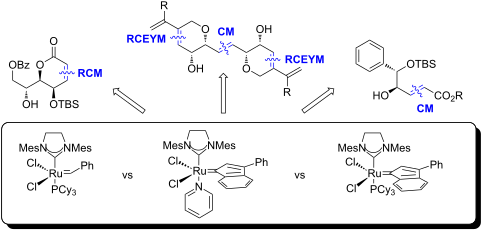
- deactivation side for phosphine catalyst E, and to the enhanced initiation side for pyridine catalyst H. The most remarkable result from this set of experiments, however, is a collapse of conversion if benzylidene catalyst D is used in acetic acid. With D, a reproducible conversion of only 9% to the

Graphical Abstract

Figure 1: Ru-based metathesis catalysts.

Scheme 1: RCM of an allyl ether catalyzed by catalyst H.

Figure 2: Solvent screening for the RCM of 1 catalyzed by H (standardized conditions as denoted in Scheme 1).

Figure 3: Comparison of catalysts D, E and H in toluene and acetic acid (standardized conditions as denoted i...

Figure 4: Conversion vs catalyst loading for the RCM of 1 in acetic acid (standardized conditions as denoted ...

Scheme 2: Catalyst screening for RCM of acrylate 3a.

Figure 5: Acrylates 3 and their RCM products 4.

Scheme 3: Ring closing enyne metathesis reactions.

Scheme 4: Cross metathesis reactions with allylic alcohol 8.
Suzuki–Miyaura cross-coupling reaction of 1-aryltriazenes with arylboronic acids catalyzed by a recyclable polymer-supported N-heterocyclic carbene–palladium complex catalyst
- Guangming Nan,
- Fang Ren and
- Meiming Luo
Beilstein J. Org. Chem. 2010, 6, No. 70, doi:10.3762/bjoc.6.70
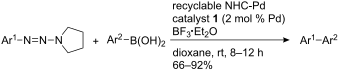
- , while the homogeneous Pd-phosphine catalyst system gave very low product yields with these substrates [29]. The good reactivity and chemoselectivity may allow haloaryltriazenes to be used as substrates for differential cross-coupling reactions in the same way as haloarenediazonium salts [33]. Conclusion

Graphical Abstract

Scheme 1: Synthesis of the polymer-supported NHC–Pd catalyst 1.

Scheme 2: Reaction of 1-(3-nitrophenyl)-2-(pyrrolidin-1-yl)diazene and phenylboronic acid.



