


Search results
Search for "humidity" in Full Text gives 297 result(s) in Beilstein Journal of Nanotechnology. Showing first 200.
Environmental applications of silver nanoparticles: state-of-the-art review and emerging trends
Beilstein J. Nanotechnol. 2026, 17, 697–736, doi:10.3762/bjnano.17.49
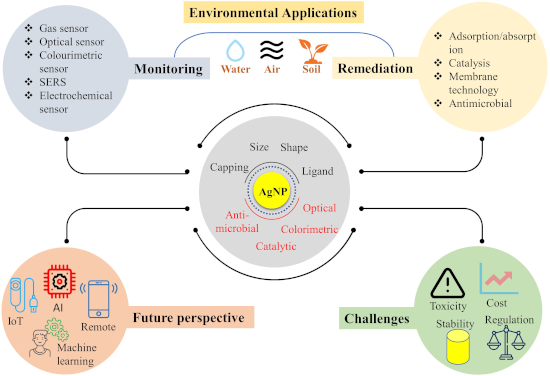
- using an Ag-modified (CeO2–Al2O3) nanocomposite, achieving oxidation rates of 96% and 98%, respectively. Additionally, the reaction selectivity exceeded 97%. The relative humidity enhanced gas-phase photolysis in the presence of UV [168]. Bifunctional zeolite-Ag catalysts (ZSM-5||Ag/γ-Al2O3) showed 100
- temperatures, depending on the ratios, with an increase in relative humidity from 0% to 40% [171]. The air filter comprises nanosilver and TiO2 for photocatalytic reduction and antimicrobial activity against VOCs, bacteria, and fungi [172]. The VOC degradation was estimated in a 10 m3 area and found to be 91.6


Decontamination from water pollutants and pathogens by electrospun nanofibers doped with heavy-atom-free borafluorene-BODIPY photosensitizers
Beilstein J. Nanotechnol. 2026, 17, 668–682, doi:10.3762/bjnano.17.46
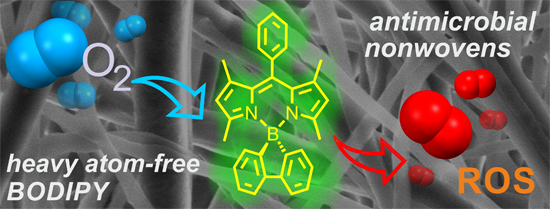
- received without additional purification. Electrospinning process All samples were electrospun using an electrospinning chamber (FLUIDNATEK® LE-5, Bioinicia, Spain) with air conditioning (Bioinicia, Spain) at room temperature and a humidity of ~35% (Figure 2). PCL was dissolved in acetic acid and formic



Recent progress in enhancing built-in electric fields of perovskite solar cells via junction engineering
Beilstein J. Nanotechnol. 2026, 17, 602–621, doi:10.3762/bjnano.17.42
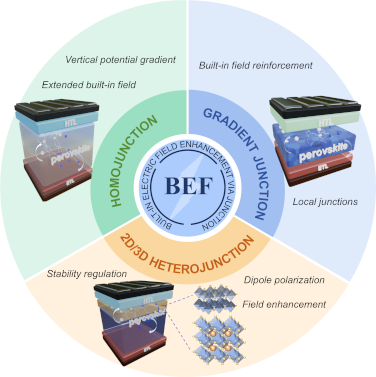
- solar cells optimized by BF4− AMD retained 90.97% and 85.95% of their initial efficiencies for PTAA and Poly-TPD HTLs, respectively, demonstrating improved stability at 85 °C and high humidity. Although doping-enhanced hole-transport layers can locally increase the BEF, this effect is largely confined
- device efficiency of 23.2% with negligible hysteresis. Moreover, combined grain-boundary passivation and band-structure modulation by BP NSs enabled unencapsulated devices to retain over 92% efficiency maintained for 150 days (3,600 h) at 25 °C and 40% ± 10% relative humidity. Although this operational
- , which promoted exciton dissociation and carrier transport. This method is compatible with low-temperature processing and maintains stability for over 1000 h. The device retained about 90% of its initial PCE after 1000 h in an unpackaged room-temperature environment with 25% humidity. The Sn/Pb gradient




Probing tribological evolution in atomically thin MoS2 at different scales
Beilstein J. Nanotechnol. 2026, 17, 586–597, doi:10.3762/bjnano.17.40
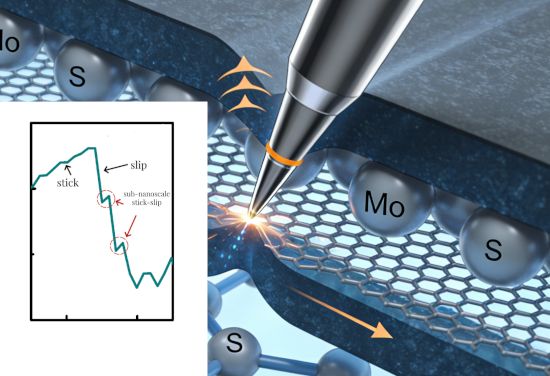
- constant ±5% for all tests), (2) normal and lateral forces were calibrated via the non-contact method [20] to quantify absolute force values, (3) all tests were performed under ambient conditions (20–30 °C, 30–40% relative humidity) to avoid environmental interference, and (4) all friction measurements


Nanocarrier-integrated multilayer films produced by 3D printing for improved skin adhesion and curcumin photostability
Beilstein J. Nanotechnol. 2026, 17, 440–453, doi:10.3762/bjnano.17.30
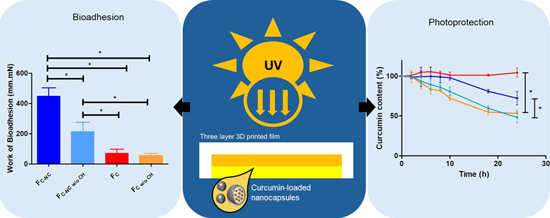
- controlled ambient humidity to prevent premature surface drying. The viscoelastic properties of the hydrogels ensured that the previously deposited layer remained tacky and capable of bonding with the subsequent layer. Interlayer continuity was qualitatively verified by cross-sectional inspection, which


First-principles study on elastic properties of Cu, (Cu1−x,Nix)3Sn and interfacial mechanical properties of (Cu1−x,Nix)3Sn/Cu in the lead-free solder joint
Beilstein J. Nanotechnol. 2026, 17, 428–439, doi:10.3762/bjnano.17.29
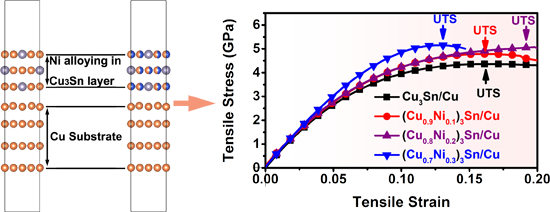
- humidity, the reliability of solder joints has become a major issue in practice [2][8]. As far as lead-containing solders are concerned, the high quality of solder joints can be attributed to the formation of a continuous Pb layer, serving as a barrier layer to separate the intermetallics in solders from


Polycatecholamine nanocoatings on stainless steel: the effect on attachment of human fibroblasts and platelets
Beilstein J. Nanotechnol. 2026, 17, 365–380, doi:10.3762/bjnano.17.25
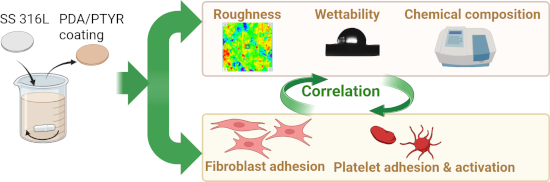
- ) (Sigma-Aldrich, Munich, Germany) and 1% (v/v) penicillin streptomycin (Sigma-Aldrich, Munich, Germany) at 37 °C and a controlled atmosphere of 5% CO2 and 95% relative humidity. Samples were sterilized by immersion in 70% EtOH for 30 min, followed by washing in sterile PBS three times (Gibco, ThermoFisher




Advancing nanolithography: a comprehensive review of materials for local anodic oxidation with AFM
Beilstein J. Nanotechnol. 2026, 17, 275–291, doi:10.3762/bjnano.17.19
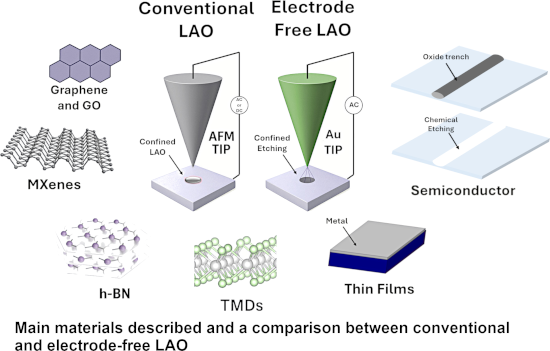
- technique. 2.1 Mechanism of LAO The key to LAO lies in the formation of a nanoscale water meniscus between the AFM tip and the sample surface, as depicted in Figure 1b. Under ambient humidity, the water layer serves as an electrolyte, enabling electrochemical reactions. When a positive voltage is applied to
- advantages and limitations. 2.2 Factors influencing oxidation The effectiveness and precision of LAO depend strongly on ambient humidity, which governs formation and size of the water meniscus. Optimal relative humidity (RH) between 35% and 55% ensures reproducible oxidation, while higher humidity enlarges
- the meniscus and broadens oxide lines. Conversely, lower humidity reduces meniscus volume and enables narrower, better-defined features. Although RH of 35–55% is widely used for Si and other common substrates, the optimal range can shift depending on the substrate surface chemistry, hydrophilicity


Durable antimicrobial activity of fabrics functionalized with zeolite ion-exchanged nanomaterials against Staphylococcus aureus and Escherichia coli
Beilstein J. Nanotechnol. 2026, 17, 262–274, doi:10.3762/bjnano.17.18
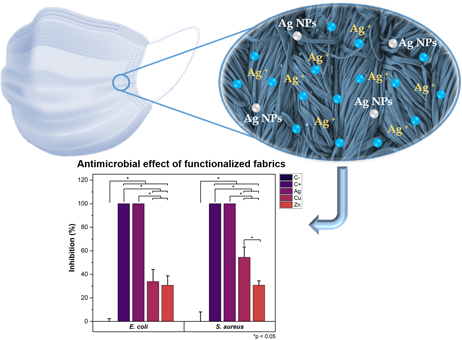
- ]. The susceptibility of bacteria to antimicrobial materials may depend on several factors, such as dose, humidity, and strain specificity [42][43]. Silver has been shown to exert a biocidal effect similar to that of copper against several E. coli and S. aureus strains using lower doses [43]. Likewise




Functional surface engineering for cultural heritage protection: the role of superhydrophobic and superoleophobic coatings – a comprehensive review
Beilstein J. Nanotechnol. 2026, 17, 63–96, doi:10.3762/bjnano.17.6
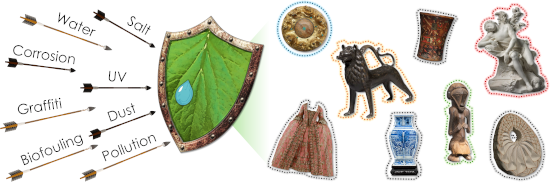
- environmental conditions, offering long-term protection against light, humidity, pollutants, and other agents of deterioration. Finally, the coating should be safe and ethically acceptable, avoiding the use of hazardous substances and respecting the cultural, historical, and aesthetic significance of the object
- water-absorbent) [53], while, if in indoor environment, they may experience biological fouling (fungi or bacteria) [54][55], which might initiate bio-deterioration [56]. If the substrate is metallic, corrosion caused by water (rain when outdoor and humidity fluctuation when indoor) is the main issue
- and buildings, as well as marble statues both in outdoor and indoor environments). Many approaches are used to solve several issues arising from their intrinsic properties such as porosity, which may cause fungal or bacterial fouling [58], and surface chemistry and the affinity to water and humidity




Quantitative estimation of nanoparticle/substrate adhesion by atomic force microscopy
Beilstein J. Nanotechnol. 2026, 17, 1–14, doi:10.3762/bjnano.17.1

- humidity (RH) and a temperature of 25 °C, whereas the D-LFC method measurements were performed at 40% RH and a temperature of 18 °C. All measurements were taken with a scan angle of 90° with respect to the long axis of the cantilever, and the z-scale used in Gwyddion for data analysis was set to 14 nm
- as humidity and temperature, may also have contributed, particularly through enhanced capillary forces between tip and sample during AFM characterization. In general, as the NPs size increases, the lateral force required to push NPs is expected to increase. This expectation is attributed to the
- manipulation as a first approximation for the work of adhesion as the details in the process of manipulation are rather complex including adhesion, static and dynamic friction, and humidity [49]. Due to the challenges in direct calculation of the dissipated work, the work of separation is approximated using



Ultrathin water layers on mannosylated gold nanoparticles
Beilstein J. Nanotechnol. 2025, 16, 2183–2198, doi:10.3762/bjnano.16.151
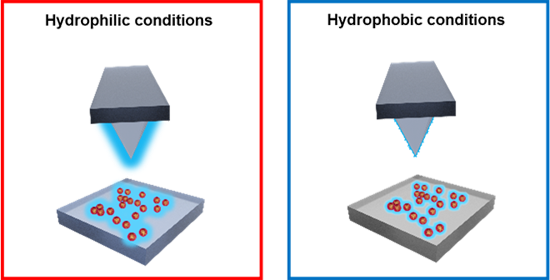
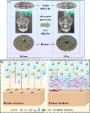
- Physics Center (DIPC), Donostia, Spain Fritz-Haber-Institut der Max-Planck-Gesellschaft, Berlin, Germany Fakultät für Physik, Universität Duisburg, Germany Ikerbasque Basque Foundation for Science, Bilbao, Spain 10.3762/bjnano.16.151 Abstract We investigated the effect of air humidity on two gold
- light scattering, and infrared spectroscopy. We probed particles adsorbed on hydrophilic and hydrophobic surfaces with atomic force microscopy (AFM) and vibrational sum frequency generation (VSFG) spectroscopy, both operated under variable air humidity. For AFM, we additionally tested hydrophilic and
- hydrophobic tips. While VSFG indicated preferential hydration of the dimannoside and proved conformational changes in the organic ligands, AFM provided sub-nanometer changes in particle topography due to water adsorption. In general, the dimannoside nanoparticles condense ultrathin water layers upon humidity



Molecular and mechanical insights into gecko seta adhesion: multiscale simulations combining molecular dynamics and the finite element method
Beilstein J. Nanotechnol. 2025, 16, 2055–2076, doi:10.3762/bjnano.16.141
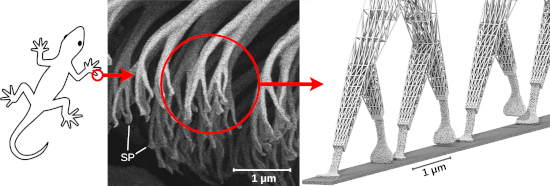
- scales involved. In previous research, we used molecular dynamics simulations to explore various aspects of gecko adhesion [10][11][12][13]. We found that humidity increases the force required to pull a spatula off from a substrate [10][12], a phenomenon also observed in high-humidity atomic force
- gecko keratin [11]. It also helped clarify other aspects of humidity-enhanced adhesion, revealing that keratin softening due to water uptake accounts for only a minor part of the increase in adhesion on very smooth surfaces [13]. The present paper builds on our previous research and extends the
- parametrization of our coarse-grained potential against united-atom simulations of gecko keratin on nonpolar surfaces [10]. Hydrophilic substrates, roughness, and humidity, which introduce additional mechanisms such as keratin softening and capillary forces, have been addressed in our previous spatula-scale






Beyond the shell: exploring polymer–lipid interfaces in core–shell nanofibers to carry hyaluronic acid and β-caryophyllene
Beilstein J. Nanotechnol. 2025, 16, 2015–2033, doi:10.3762/bjnano.16.139
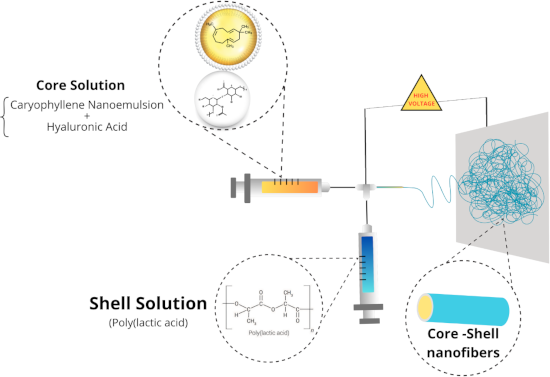
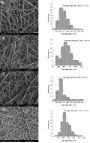
- fibers without the lipid core. Furthermore, maintaining ambient relative humidity below 45% proved essential for processing stability. Comprehensive morphological characterization via scanning electron microscopy confirmed the uniformity of the fibers. At the same time, confocal microscopy, cross
- concentration, surface tension, conductivity, and solvent volatility, alongside careful consideration of electrospinning conditions, such as temperature and humidity [18][19]. The polymer selection of nanofibers intended for biomedical applications must prioritize not only mechanical strength, controlled
- evaporation within the core, as also reported by Ricaurte et al. (2022) [46]. Air relative humidity was additionally found to influence solvent evaporation and the formation of uniform HA fibers. Similar to the observations reported by Yao et al. (2013), a stable process without interruptions was only




Mechanical property measurements enabled by short-term Fourier-transform of atomic force microscopy thermal deflection analysis
Beilstein J. Nanotechnol. 2025, 16, 1952–1962, doi:10.3762/bjnano.16.136
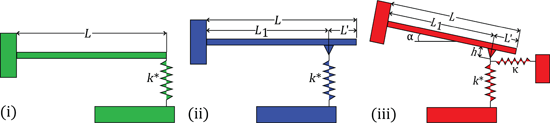
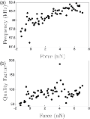
- An Agilent Keysight 5500 AFM was used in all experiments with measurements conducted under ambient laboratory conditions of 20–40% humidity. Four samples were analyzed in the experiments, namely, a silicon wafer, freshly-cleaved HOPG, poly(ethylene oxide) (PEO), and polydimethylsiloxane (PDMS). The




Targeting the vector of arboviruses Aedes aegypti with nanoemulsions based on essential oils: a review with focus on larvicidal and repellent properties
Beilstein J. Nanotechnol. 2025, 16, 1894–1913, doi:10.3762/bjnano.16.132
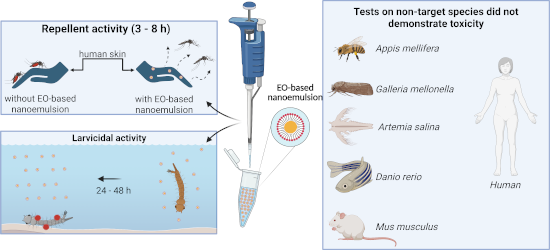
- stress, being easily degradable or evaporated upon exposure to air, light, heat, and humidity during processing, use, or storage [27][28]. Their volatile nature, susceptibility to oxidation, and insolubility in water limit their industrial application [29]. To overcome these limitations
- ][41][42]. Aedes aegypti is a species of mosquito of the Culicidae family, order Diptera, native to Africa and distributed throughout various regions of the world. This extensive distribution occurs due to the sum of several factors, such as dispersion favored by high temperatures and high humidity


Electrical, photocatalytic, and sensory properties of graphene oxide and polyimide implanted with low- and medium-energy silver ions
Beilstein J. Nanotechnol. 2025, 16, 1794–1811, doi:10.3762/bjnano.16.123
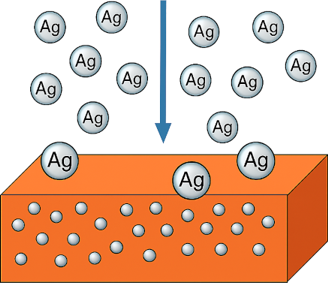
- Department of Inorganic Chemistry, University of Chemistry and Technology, Prague 6, 166 28, Czech Republic Ion Beam Center, Helmholtz-Zentrum Dresden Rossendorf, 01328 Dresden, Germany 10.3762/bjnano.16.123 Abstract Precise control of electrical conductivity, humidity sensitivity, and photocatalytic
- atomic force microscopy. Electrical properties as a function of air humidity were evaluated using a two-point method, and photocatalytic activity was tested by monitoring the UV-induced decomposition of rhodamine B. The results demonstrate that ion implantation significantly reduces surface resistivity
- and enhances both the photocatalytic activity and humidity sensitivity of GO and PI. The most pronounced improvements occurred at higher fluences, where defect generation and partial deoxygenation contributed to optimal performance. Ion implantation thus represents an effective approach for tuning the


Beyond the bilayer: multilayered hygroscopic actuation in pine cone scales
Beilstein J. Nanotechnol. 2025, 16, 1695–1710, doi:10.3762/bjnano.16.119
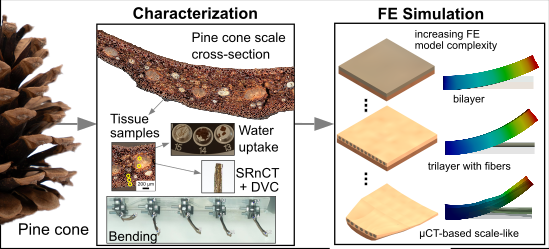
- function of relative humidity. There were distinct differences between tissues and a pronounced hysteresis between sorption and desorption. Finite element analysis was performed on geometries ranging from simplified bilayer models to complex remodeled scales. Simulation results showed an underestimation of
- technical applications [1][2][3][4]. Of particular interest are, for example, Banksia seed pods [5][6], Hakea fruits [7][8], and scales of pine cones [9][10][11][12], which passively respond to changes in ambient relative humidity by shape morphing to facilitate seed dispersal. In the case of pine cones
- the bending motion of the scale. One crucial influencing factor is the difference within or between tissues, as Eger et al. [23] highlighted. The authors measured the relative change of moisture content as a function of relative humidity by gravimetric water uptake measurements of the sclereid cells


Laser processing in liquids: insights into nanocolloid generation and thin film integration for energy, photonic, and sensing applications
Beilstein J. Nanotechnol. 2025, 16, 1428–1498, doi:10.3762/bjnano.16.104






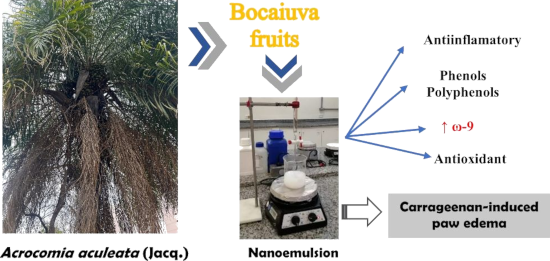
Acrocomia aculeata oil-loaded nanoemulsion: development, anti-inflammatory properties, and cytotoxicity evaluation
Beilstein J. Nanotechnol. 2025, 16, 1277–1288, doi:10.3762/bjnano.16.93
- . Six- to eight-week-old female Swiss mice weighing 22 to 28 g were used [66]. Animals were acclimatized under laboratory conditions (25 ± 3 °C, 65 ± 5% humidity) with a 12/12 h light/dark cycle. Animals had free access to food and water at all times and were deprived of food 6 h before the experiment


Functional bio-packaging enhanced with nanocellulose from rice straw and cinnamon essential oil Pickering emulsion for fruit preservation
Beilstein J. Nanotechnol. 2025, 16, 1234–1245, doi:10.3762/bjnano.16.91
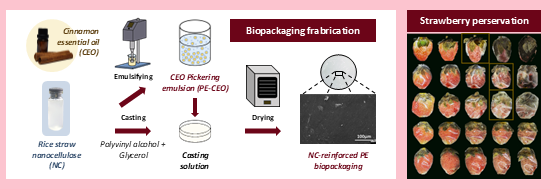
- the sample (g·m−1·h−1·Pa−1), L is the sample thickness (m), ΔP is the vapor pressure difference (Pa), S is the saturation vapor pressure at the test temperature (Pa), R1 is the relative humidity inside the dish, and R2 is the relative humidity at the cup. The surface morphology of the biopackaging



Chitosan nanocomposite containing rotenoids: an alternative bioinsecticidal approach for the management of Aedes aegypti
Beilstein J. Nanotechnol. 2025, 16, 1197–1208, doi:10.3762/bjnano.16.88
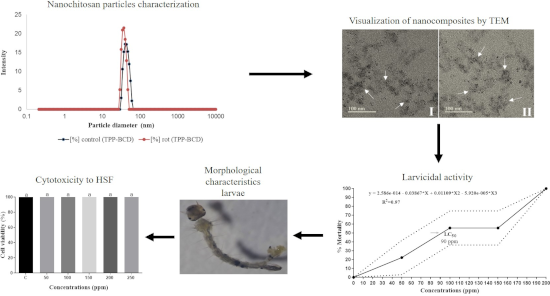
- by global warming, including rising temperatures, heavy rainfalls, and high humidity, have accelerated mosquito reproduction and expanded its geographic spread. In 2023, dengue reached a record 5 million cases in 80 countries, including historically non-endemic regions such as the United States



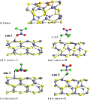
Electronic and optical properties of chloropicrin adsorbed ZnS nanotubes: first principle analysis
Beilstein J. Nanotechnol. 2025, 16, 1184–1196, doi:10.3762/bjnano.16.87
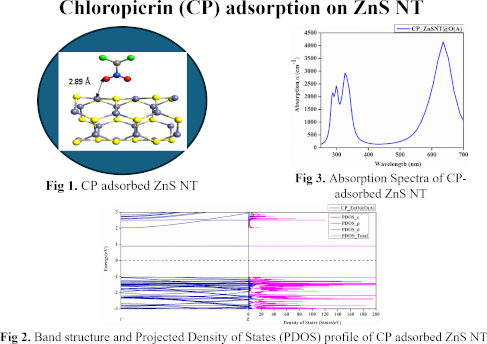
- humidity sensing performance compared to that of ZnO/ZnS nanorod arrays and ZnO nanorod arrays, with enhanced response, faster recovery, good linearity, and reliable reproducibility across a wide range of relative humidity conditions at room temperature. Giri et al. [48] demonstrated that phase-selective



Influence of ion beam current on the structural, optical, and mechanical properties of TiO2 coatings: ion beam-assisted vs conventional electron beam evaporation
Beilstein J. Nanotechnol. 2025, 16, 1097–1112, doi:10.3762/bjnano.16.81
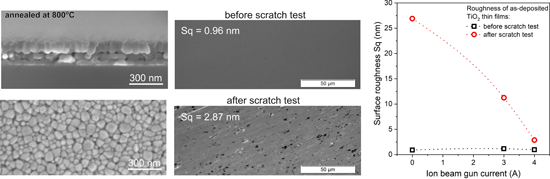
- structure, and the improvement of stability and homogeneity of the coatings. In addition, it is possible to modify the microstructure, resulting in dense, nearly stoichiometric films that are much more resistant to temperature and humidity changes than films deposited in the conventional EBE process [4][9




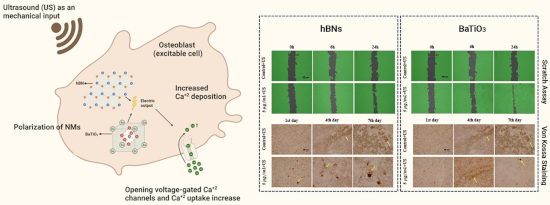
Piezoelectricity of hexagonal boron nitrides improves bone tissue generation as tested on osteoblasts
Beilstein J. Nanotechnol. 2025, 16, 1068–1081, doi:10.3762/bjnano.16.78
- (PS, Capricorn Scientific), and 1% ʟ-glutamine (Pan Biotech). Cells were incubated at 37 °C with 5% percent CO2 and 90% humidity. All experiments were performed after cells reached 100% confluence, and the NMs treatment procedure was the same. Both types of NMs were dispersed in cell culture medium
- -plane bending vibration, respectively [43]. The broad band at 3200 cm−1 could be attributed to stretching vibrations of hydroxyl groups (O–H) of hBNs or humidity. Supporting Information File 1, Figure S3 (d) displays the Raman spectrum of hBNs, which reveals a dominant peak at 1367 cm−1, in line with





