


Search results
Search for "CVD" in Full Text gives 215 result(s) in Beilstein Journal of Nanotechnology. Showing first 200.
TEM sample preparation of lithographically patterned permalloy nanostructures on silicon nitride membranes
Beilstein J. Nanotechnol. 2024, 15, 1–12, doi:10.3762/bjnano.15.1

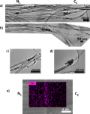
- , we initially fabricated the nanostructures on a 200 µm thick Si substrate with 100 nm thick SiN buffer layers on both sides. The buffer layers were deposited with low-pressure CVD to ensure stress-free films. The fabrication process is shown in Figure 10. First, we made the nanostructure using lift


A combined gas-phase dissociative ionization, dissociative electron attachment and deposition study on the potential FEBID precursor [Au(CH3)2Cl]2
Beilstein J. Nanotechnol. 2023, 14, 1178–1199, doi:10.3762/bjnano.14.98
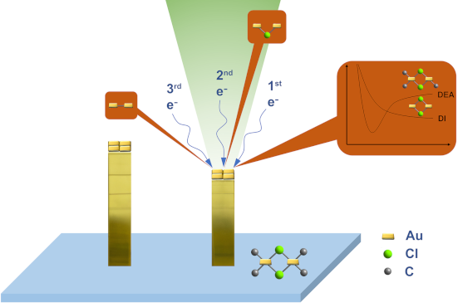
- electron beam energy and current, the substrate material, the environment inside the deposition chamber, and the composition of the precursor [14][15][16][17]. Heretofore, various chemical vapor deposition (CVD) precursors have been applied for FEBID depositions. For gold nanostructures, these include, for
- example, dimethyl(acetylacetonate)gold(III) (Au(acac)(CH3)2), dimethyl(trifluoroacetylacetonate)gold(III) (Au(tfac)(CH3)2), and dimethyl(hexafluoroacetylacetonate)gold(III) (Au(hfac)(CH3)2) [18]. Although these precursors have proven suitable for CVD, in FEBID their application has mainly resulted in
- amorphous matrixes of carbon with embedded metal crystallites and a gold content of 2–3 atom % [19], 10–40 atom % [20], and 8–20 atom % [21], respectively. This is most likely due to the fact that the CVD process is thermally driven, while in FEBID, the precursor fragmentation is primarily electron driven



Nanoarchitectonics of photothermal materials to enhance the sensitivity of lateral flow assays
Beilstein J. Nanotechnol. 2023, 14, 988–1003, doi:10.3762/bjnano.14.82
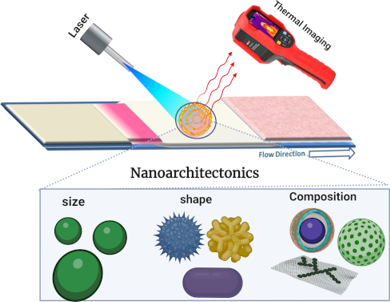
- ://biorender.com/. This content is not subject to CC BY 4.0. Funding Authors are grateful for the financial support received from Science and Engineering Research Board, Government of India, DST(CVD/2020/000778) and Department of Biotechnology, Government of India (BT/PR27222/NNT/28/1337/2017). ES acknowledges the


Isolation of cubic Si3P4 in the form of nanocrystals
Beilstein J. Nanotechnol. 2023, 14, 971–979, doi:10.3762/bjnano.14.80

- products of CVD synthesis [39], could provide a faster diffusion channel and play a key role in Si3P4 formation. Moreover, the heating of amorphous silicon is also known to induce an irreversible transition to the crystalline state above 700 °C [40]. Next, a synthesis of pre-annealed SP670 that consisted


Low temperature atomic layer deposition of cobalt using dicobalt hexacarbonyl-1-heptyne as precursor
Beilstein J. Nanotechnol. 2023, 14, 951–963, doi:10.3762/bjnano.14.78
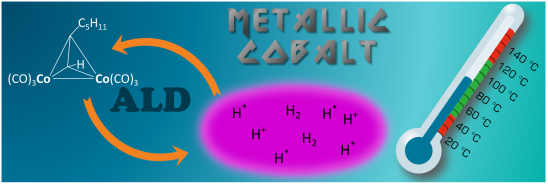
- decomposition of one of the precursors. In this case, the process is within the regime of chemical vapour deposition (CVD), resulting in a continuous film growth. It is therefore essential to carry out the ALD process in a way that the first precursor only reacts with the second precursor during the second half
- under inert gas atmosphere. The bubbler was heated to 30 °C, which will result in a vapour pressure of 15.7 mbar according to the published Antoine parameters of Georgi and co-workers [23]. Pure argon (6N) was used as carrier gas for bubbling. The depositions in CVD mode were done with a continuous
- CVD to ALD: determining the upper temperature limit The metallic cobalt deposition process is based on the precursor dicobalt hexacarbonyl-1-heptyne [Co2(CO)6HC≡CC5H11]. The synthesis and basic characteristics of which have been described by Georgi and co-workers [23]. A schematic sketch of the


Control of morphology and crystallinity of CNTs in flame synthesis with one-dimensional reaction zone
Beilstein J. Nanotechnol. 2023, 14, 741–750, doi:10.3762/bjnano.14.61
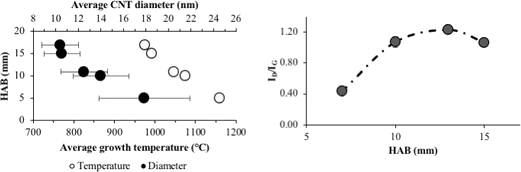
- . To date, many researchers have shown promising results on the synthesis control of CNTs to produce tailored CNT morphologies and properties through conventional furnace-based methods. Progress in CNT synthesis processes has been achieved mostly using chemical vapor deposition (CVD). Various studies
- on the growth control in CVD conclude that independent parameters, such as fuel selection, synthesis temperature, vapor pressure, and catalyst, govern CNT growth [6]; all can be manipulated for synthesis control. CVD is preferred because of the high degree of control and the possibility to synthesize
- at relatively low temperatures. However, CVD consumes a lot of energy for CNT growth, leading to increased production cost and, thus, making high-quality CNTs too expensive for practical applications. Alternatively, similar growth mechanisms of CNTs using the less common flame synthesis method are


On the use of Raman spectroscopy to characterize mass-produced graphene nanoplatelets
Beilstein J. Nanotechnol. 2023, 14, 509–521, doi:10.3762/bjnano.14.42
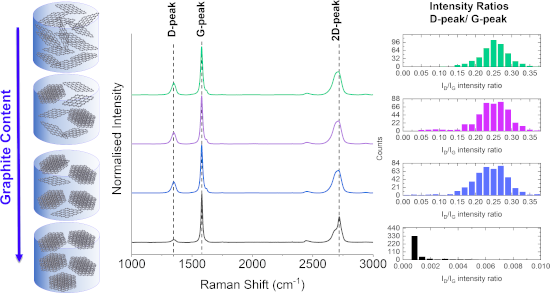
- materials, either from large mechanically exfoliated flakes or CVD-grown materials. When measuring the Raman spectrum from aggregated few-layer graphene (FLG) powder, where many particles are probed in a single measurement, the Raman 2D peak still typically appears as a symmetric shape, although with lower


Studies of probe tip materials by atomic force microscopy: a review
Beilstein J. Nanotechnol. 2022, 13, 1256–1267, doi:10.3762/bjnano.13.104
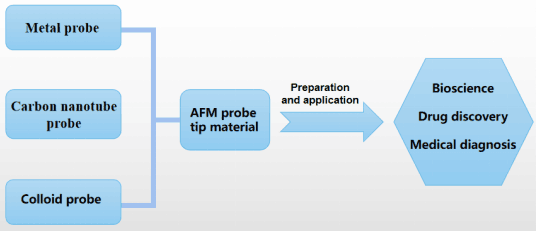
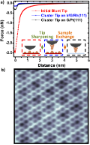
- assembly methods, direct growth of carbon nanotubes by chemical vapor deposition (CVD) allows for increased bond strength between CNT tips and AFM probes. A pore growth method was used by Hafner et al. [42]. The method uses AFM imaging in contact mode to flatten the silicon tip, followed by hydrogen
- fluoride oxidation at the anode to form nanopores of 50–100 nm in diameter. After electrodeposition, the carbon nanotubes are grown by CVD at 750 °C. If the carbon nanotubes do not grow in a suitable trend, they are removed by oxidation. The CNT tips are then grown again by CVD. The CVD nanotube tips can
- optimal location on a flat tip. Due to the considerable length, a subsequent cutting process is required. Since the perpendicularity of the carbon nanotube probe is difficult to achieve in the above mentioned pore growth method, Edgeworth et al. [43] demonstrated a catalytic CVD (cCVD) growth method that
DNA aptamer selection and construction of an aptasensor based on graphene FETs for Zika virus NS1 protein detection
Beilstein J. Nanotechnol. 2022, 13, 873–881, doi:10.3762/bjnano.13.78
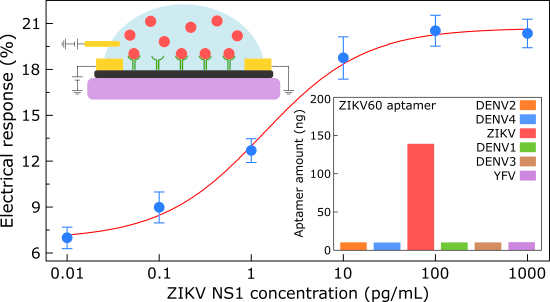
- characterization utilizing field-effect transistors fabricated using single-layer graphene grown by chemical vapor deposition (CVD) and transferred to Si/SiO2 substrates. The wafers were purchased from Graphene Platform and we produced graphene transistors by conventional photolithography, following the procedures
- layer of SU-8. Figure S1a (Supporting Information File 1) shows an optical microscopy image of the typical CVD graphene device used in this work. The functionalization of the graphene devices with ZIKV60 aptamers was realized by overnight incubation in wet atmosphere with a 5 μL drop of 1 μM ZIKV60
- a Hill–Langmuir curve fitted to the experimental data (R2 = 0.9969). ZIKV60 aptamer characteristics. Supporting Information Optical microscopy image of our typical CVD graphene device, schematic illustration of the resulting ZIKV60-functionalized graphene devices and experimental setup used in the



Optimizing PMMA solutions to suppress contamination in the transfer of CVD graphene for batch production
Beilstein J. Nanotechnol. 2022, 13, 796–806, doi:10.3762/bjnano.13.70
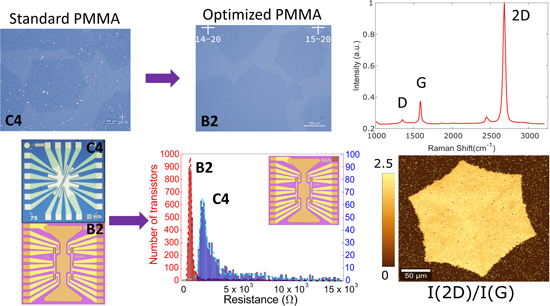
- devices and applications [1][2][3]. Among the production methods, chemical vapor deposition (CVD) made substantial progress over the years and now guarantees high-quality standards for the growth of batches of graphene samples over wafer-scale areas [4][5][6]. This progress allowed for the fabrication of
- a wide range of 2D material-based devices and heterostructures, especially in optoelectronics [7][8][9]. At present, one of the remaining challenges in the fabrication of graphene-based devices lies in the reproducibility: More than the CVD itself, the transfer process from the growth substrate (e.g
- be considered: (i) metallic particles from the Cu or Ni etching process and (ii) PMMA residues after the removal and rinsing processes. Both contaminations are leading causes of undesired p-type doping in CVD graphene, accompanied by a deterioration of its electrical properties [19][20][21][22]. The




Tunable high-quality-factor absorption in a graphene monolayer based on quasi-bound states in the continuum
Beilstein J. Nanotechnol. 2022, 13, 675–681, doi:10.3762/bjnano.13.59

- traditional lithography, and then employ the conventional wet-base transfer method to transfer a CVD-grown graphene monolayer onto the grating structure. Conclusion In summary, an active graphene absorber, consisting of a graphene monolayer and a substrate spaced by a dielectric grating, is proposed and


Reliable fabrication of transparent conducting films by cascade centrifugation and Langmuir–Blodgett deposition of electrochemically exfoliated graphene
Beilstein J. Nanotechnol. 2022, 13, 666–674, doi:10.3762/bjnano.13.58
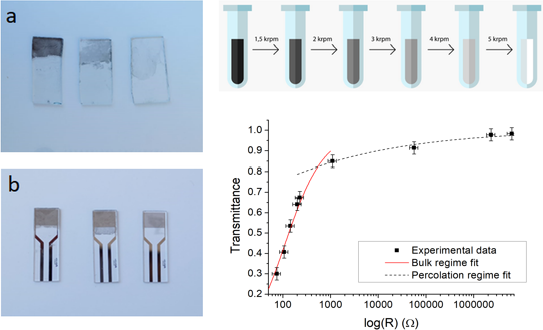
- delve into fundamental properties was augmented with an outlook towards potential applications [1]. Over the past decades, a great number of different methods for the synthesis of graphene and other 2D materials has been proposed, including micromechanical cleavage [2], chemical vapor deposition (CVD


Revealing local structural properties of an atomically thin MoSe2 surface using optical microscopy
Beilstein J. Nanotechnol. 2022, 13, 572–581, doi:10.3762/bjnano.13.49

- , in the AFM image in Figure 2c, one can clearly see the presence of particle aggregates, which were reported to be oxidation products (MoOxSey or MoO3) either through the CVD growth process or through aging in air. Sahoo et al. have reported that the aging of WSe2 flakes by exposure to air produces


Electrostatic pull-in application in flexible devices: A review
Beilstein J. Nanotechnol. 2022, 13, 390–403, doi:10.3762/bjnano.13.32
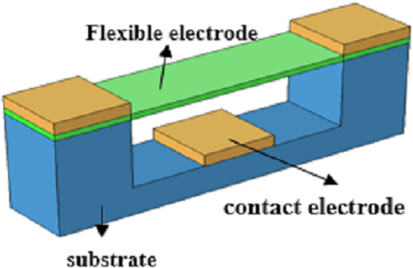
- contact electrodes [25][26], or intermediate layer [27], and can greatly improve the life cycles of switches. However, CNTs prepared by CVD are randomly oriented, and positioning CNTs at the desired location is a challenge that hinders scalable manufacturing. Ward et al. [28] and Cha et al. [21] used spin
- quickly realize positioning and alignment of CNTs in 10–60 s. GR-NEM switches Based on the large-scale fabrication of graphene (GR) using CVD and oxygen plasma etching, GR-NEM switches have attracted the attention of researchers. Table 2 summarizes GR-NEM switch structures described in the literature. Two
- CVD for analog and digital bandwidth phase shifters. The phase shift was 355°/dB in the analog design at 2.4 GHz and 138°/dB in the digital design. Anjum et al. [60] used GR/MoS2 composite materials as beam to decrease the pull-in voltage below 1 V, which can be used in RF applications requiring low


Sputtering onto liquids: a critical review
Beilstein J. Nanotechnol. 2022, 13, 10–53, doi:10.3762/bjnano.13.2
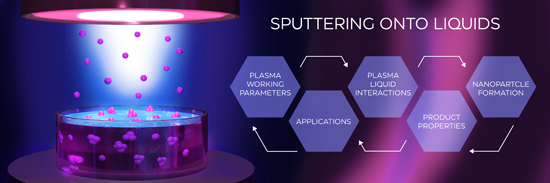
- . These chemical methods can be divided into two major techniques, namely chemical vapor deposition (CVD) with liquid-phase synthesis and colloidal synthesis. In general, the colloidal synthesis of NPs is highly acclaimed due to its versatility [16]. So-called bio-assisted methods, biosynthesis, or green






Chemical vapor deposition of germanium-rich CrGex nanowires
Beilstein J. Nanotechnol. 2021, 12, 1365–1371, doi:10.3762/bjnano.12.100
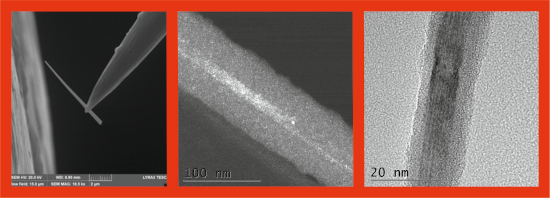
- effort to prepare a Cr/Ge deposit in a nanostructured form. Using chemical vapor deposition (CVD), we succeeded to synthesize deposits containing CrGex NWs. Their structure was elucidated and measurements of individual NWs were carried out to determine their electrical resistivity. Results and Discussion
- resistivity component in the nanowire–deposit system. Conclusion Using CVD, we synthetized deposits containing CrGex NWs. The complex elemental composition was determined, the structure was elucidated, and resistivity measurements of individual NWs were performed and discussed. These measurements revealed the
- /filled nanoscale cables suitable for medicinal magnetic transport. Experimental CrGex deposits were synthetized using CVD. In a custom-made twin furnace (Supporting Information File 1, Figure S12), chromium(III) acetylacetonate powder (Sigma-Aldrich, 99.99%) was heated to 110 °C and evaporated in the



Irradiation-driven molecular dynamics simulation of the FEBID process for Pt(PF3)4
Beilstein J. Nanotechnol. 2021, 12, 1151–1172, doi:10.3762/bjnano.12.86
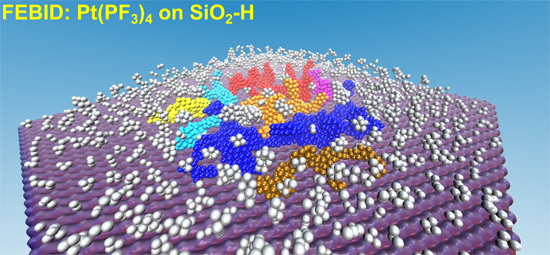
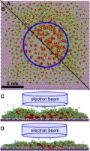
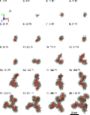
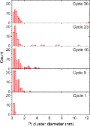
- working chamber. Nowadays, FEBID permits the fabrication of nanostructures with sizes down to a few nanometers, which is similar to the size of the incident electron beam [7]. To date, FEBID mainly relies on precursor molecules developed for chemical vapor deposition (CVD), a process mainly governed by








Properties of graphene deposited on GaN nanowires: influence of nanowire roughness, self-induced nanogating and defects
Beilstein J. Nanotechnol. 2021, 12, 566–577, doi:10.3762/bjnano.12.47
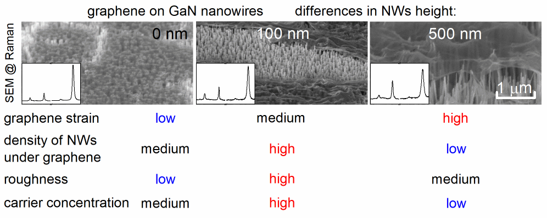
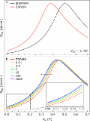
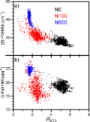
- a separate analysis of graphene strain, carrier concentration, and defects. The presented analysis is also important in the tracing of the interdependencies of the parameters which characterize graphene properties. Experimental Monolayer graphene was grown by chemical vapour deposition (CVD) on a




Spontaneous shape transition of MnxGe1−x islands to long nanowires
Beilstein J. Nanotechnol. 2021, 12, 366–374, doi:10.3762/bjnano.12.30
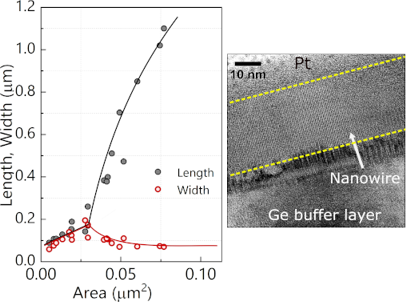
- obtained via chemical methods [28][29] or via vapor–solid–liquid (VLS) and, less frequently, vapor–solid–solid (VSS) mechanisms. A metallic droplet (liquid or solid) acts as a catalyst, in chemical vapor deposition (CVD), or as a seed, in molecular beam epitaxy (MBE), for the NW growth [7][30][31]. By


Gold(I) N-heterocyclic carbene precursors for focused electron beam-induced deposition
Beilstein J. Nanotechnol. 2021, 12, 257–269, doi:10.3762/bjnano.12.21
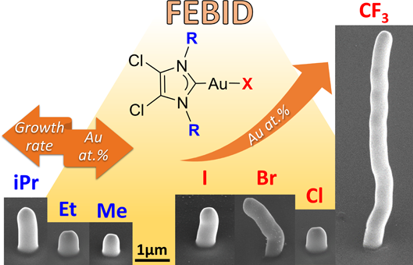
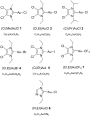
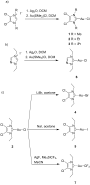
- applications from plasmonics [10] to optoelectronics [13]. Gold FEBID precursors (Figure 1) have had a similar history as other metal precursors, as the first tested compounds were taken from the existing library of gold precursors for chemical vapour deposition (CVD). The first compounds tested were gold





A review on the green and sustainable synthesis of silver nanoparticles and one-dimensional silver nanostructures
Beilstein J. Nanotechnol. 2021, 12, 102–136, doi:10.3762/bjnano.12.9
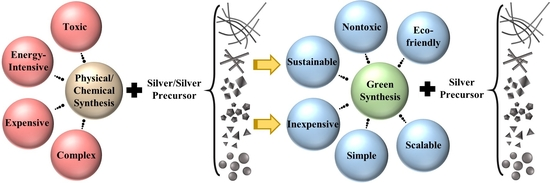
- deposition process. Chemical vapor deposition (CVD) and atomic layer deposition (ALD) are among other chemical methods for nanoparticle synthesis. CVD is a method that allows production of nanoparticles on a substrate [241]. The process consists of three steps. First, the addition of a volatile precursor in
- precursor for this purpose [241]. An important advantage of this technique is the establishment of a silver-metal-oxide (e.g. SiO2 or TiO2) nanocomposite coating using only one deposition step [241]. The CVD method also provides many opportunities for the synthesis of silver-coated materials with varying


Towards 3D self-assembled rolled multiwall carbon nanotube structures by spontaneous peel off
Beilstein J. Nanotechnol. 2020, 11, 1865–1872, doi:10.3762/bjnano.11.168

- change within CNTs and to optimize the formation of complex CNT structures, the possibility to couple aerosol-assisted chemical vapor deposition (AACVD) [20] and chemical vapor deposition (CVD) was explored [16]. For detailed synthesis and characterization protocols, including control experiments, please
- by the index with an ascending numerical order. Therefore, the two synthesis sequences described here lead to C1/N2/C3 and C1/N2/C3/N4 structures. The coupling of AACVD and CVD leads to MWCNTs with a compositional change [16]. In addition to obtaining the expected vertically aligned MWCNT forests or
- prepared by following a general approach detailed recently [16]. MWCNTs were synthesized at 800 °C with argon (Ar, 99.999%, BOC) as the carrier flow using an AACVD setup [12][23]. Briefly, MWCNTs were grown on silicon wafer substrates (10 × 20 mm2, Sibert, UK) by using an aerosol CVD setup consisting of a



One-step synthesis of carbon-supported electrocatalysts
Beilstein J. Nanotechnol. 2020, 11, 1419–1431, doi:10.3762/bjnano.11.126
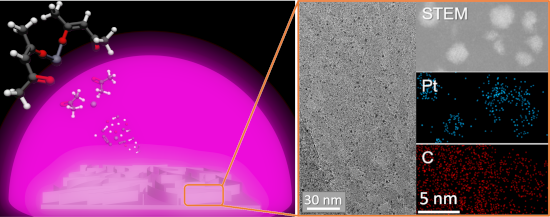
- Abstract Cost-efficiency, durability, and reliability of catalysts, as well as their operational lifetime, are the main challenges in chemical energy conversion. Here, we present a novel, one-step approach for the synthesis of Pt/C hybrid material by plasma-enhanced chemical vapor deposition (PE-CVD). The
- applications as they show significantly improved electrochemical long-term stability compared to the industrial standard HiSPEC 4000. The PE-CVD process is furthermore expected to be extendable to the general deposition of metal-containing carbon materials from other commercially available metal
- acetylacetonate precursors. Keywords: electrocatalyst; fuel cells; hybrid nanomaterial; long-term stability; nanoparticle embedding; one-step synthesis; plasma-enhanced chemical vapor deposition (PE-CVD); Introduction The global fuel cell market reached a value of $4.5 billion USD in 2018 and is projected to




Effect of localized helium ion irradiation on the performance of synthetic monolayer MoS2 field-effect transistors
Beilstein J. Nanotechnol. 2020, 11, 1329–1335, doi:10.3762/bjnano.11.117
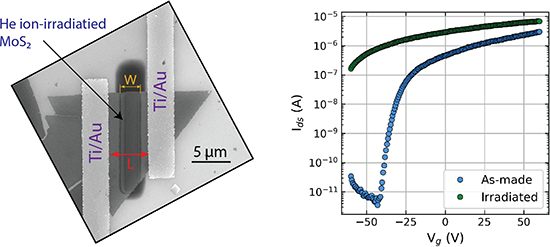
- demonstrated impressive on/off ratios (approx. 107) in field-effect transistors (FETs), while maintaining carrier mobilities that may be adequate for commercial applications [1][2]. At the same time, advances in chemical vapor deposition (CVD) techniques have allowed for the reliable millimeter-scale synthesis
- synthesized using a CVD microreactor method, described in detail in [33], directly on 285 nm SiO2/Si substrates, which also served as the back-gate in the FET configuration. MoS2 flakes were contacted with electrodes using standard electron beam lithography on polymethyl methacrylate (PMMA) resist, followed
- applications. Experimental design and basic electrical characteristics. (a) Sketch demonstrating the irradiation strategy on contacted CVD-grown monolayer MoS2 devices. The green area marks the designed irradiation area. (b) SEM image of an irradiated device. W marks the width of the exposed region, while L is


Revealing the local crystallinity of single silicon core–shell nanowires using tip-enhanced Raman spectroscopy
Beilstein J. Nanotechnol. 2020, 11, 1147–1156, doi:10.3762/bjnano.11.99
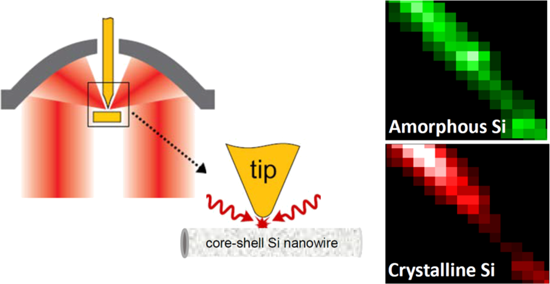
- to chemical vapor deposition (CVD), and enables direct nanowire growth in a bottom-up manner. The nanowire composition, in particular the doping concentration, can be controlled by an adequate adjustment of the synthesis gas mixture, e.g., by setting the SiH4/B2H6 ratio during the synthesis of boron
- -doped silicon nanowires (SiNWs). A rational strategy to obtain radial homo- and heterojunctions is to overcoat the as-grown nanowires within the same reaction chamber by implementing a conventional CVD process (e.g., thermal SiH4-CVD) yielding core–shell nanowires [14]. Although ideal epitaxial growth
- grains with different orientation. Furthermore, catalyst migration along the SiNW backbone was observed in some cases (Figure 1c). Although the SiNWs grown by the VLS mechanism possess are crystalline, the silicon shells deposited onto the nanowires by thermal CVD (here using a temperature of 520 °C) can





