
Search results
Search for "animals" in Full Text gives 157 result(s) in Beilstein Journal of Nanotechnology.
Optimal fractal tree-like microchannel networks with slip for laminar-flow-modified Murray’s law
Beilstein J. Nanotechnol. 2018, 9, 482–489, doi:10.3762/bjnano.9.46

- better convective heat transfer performance, but needs a larger pumping power. Thus, the optimal design of the channel layout to achieve better mass and heat transfer performance is needed. Fractal tree-like branched networks are found abundant in nature, for example, in the vascular systems of animals


Liquid-crystalline nanoarchitectures for tissue engineering
Beilstein J. Nanotechnol. 2018, 9, 205–215, doi:10.3762/bjnano.9.22

- twisted plywood structure with a curvature [64]. Similar architectures can be found in the exoskeletal tissues of invertebrate animals, which are mineralized dense matrices of aligned chitin nanofibrils [16]. In these tissues, ultrastructures analogous to cholesteric mesophase are displayed as Bouligand


Humidity-dependent wound sealing in succulent leaves of Delosperma cooperi – An adaptation to seasonal drought stress
Beilstein J. Nanotechnol. 2018, 9, 175–186, doi:10.3762/bjnano.9.20

- ) restoration of the mechanical properties of the injured organ. Often self-repair is used as an umbrella term comprising both self-sealing and self-healing. Interestingly, these definitions hold true for the self-repair in plants, animals and technical materials, whereas in the latter, the sealing and the


Hyperthermic intracavitary nanoaerosol therapy (HINAT) as an improved approach for pressurised intraperitoneal aerosol chemotherapy (PIPAC): Technical description, experimental validation and first proof of concept
Beilstein J. Nanotechnol. 2017, 8, 2729–2740, doi:10.3762/bjnano.8.272

- to PIPAC-MIP, HINAT provides the opportunity to perform further studies concerning the treatment of peritoneal carcinomatosis or other aerosol-accessible kinds of cancer (e.g., lung cancer) on animals even smaller than pigs due to the minimal required access space for feeding nanometre-sized aerosols
- ), Johnson & Johnson, Hummelsbütteler Steindamm 71, Norderstedt, Schleswig-Holstein, Germany. The permission was obtained from the local authorities and the local board on animal welfare. All applicable international, national, and/or institutional guidelines for the care and use of animals and handling with


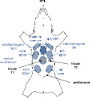


Evaluating the toxicity of TiO2-based nanoparticles to Chinese hamster ovary cells and Escherichia coli: a complementary experimental and computational approach
Beilstein J. Nanotechnol. 2017, 8, 2171–2180, doi:10.3762/bjnano.8.216

- workers, consumers and the environment. The conventional (i.e., experimental) risk assessment approaches using laboratory animals are often expensive, time-consuming and problematic from an ethical point of view. Thus novel, fast and cheaper procedures for risk assessment are necessary, without the


Collembola cuticles and the three-phase line tension
Beilstein J. Nanotechnol. 2017, 8, 1714–1722, doi:10.3762/bjnano.8.172

- on Collembola cuticles has been the subject of recent studies where surface features with overhanging geometries are presented as having a decisive role [4][7]. Such geometry occurs in several Collembola species [4] but is not a universal trait in these animals [5][6]. The presence or lack of
- wetting states with any value of θ0 [26], but such structures are not a universal trait in these animals [5][6]. The upper limit of θ0 is about 120° for real surfaces, observed on perfluorinated polymers, or 156 ° for a theoretical surface with no surface tension [27]. Insect waxes fall in the range of 90
- °, below the contact angle observed in both summer- and winter-acclimated animals (Figure 5). The coverage of epicuticular wax was previously assumed to be either the top of the cuticular granules, leaving the areas between the granules exposed, or the entirety of the cuticle, recent studies conclude that


![[Graphic 16]](/bjnano/content/inline/2190-4286-8-172-i22.png?max-width=637&scale=1.18182) . A system with θ0 = 105°, S = 0.1 μm a...
. A system with θ0 = 105°, S = 0.1 μm a...
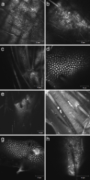

Air–water interface of submerged superhydrophobic surfaces imaged by atomic force microscopy
Beilstein J. Nanotechnol. 2017, 8, 1671–1679, doi:10.3762/bjnano.8.167

- sensory systems. Biological surfaces are the basis of the discovery and are models for the development of biomimetic surfaces. The conquest of land some 450 million years ago led to the evolution of an almost endless variety of surface structures and functionalities in plants and animals [3]. One of the

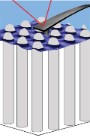


Nanoantenna-assisted plasmonic enhancement of IR absorption of vibrational modes of organic molecules
Beilstein J. Nanotechnol. 2017, 8, 975–981, doi:10.3762/bjnano.8.99
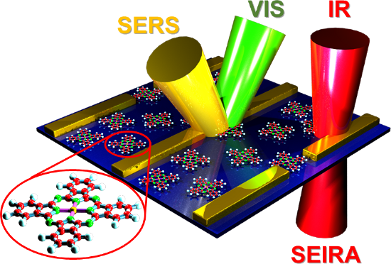
- A similar approach was used for the investigation of cortisol using SEIRA. Among other organic compounds, the steroid hormones are of great importance because they influence many physiological processes in humans and animals. Cortisol is the major glucocorticoid hormone produced in the adrenal gland



When the going gets rough – studying the effect of surface roughness on the adhesive abilities of tree frogs
Beilstein J. Nanotechnol. 2016, 7, 2116–2131, doi:10.3762/bjnano.7.201

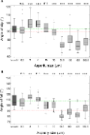
- [18][19][24]. Comparing performance with other climbing organisms Several previous studies have examined the effect of surface roughness on the climbing capabilities of other adhesive pad bearing organisms. These include animals with hairy rather than smooth adhesive pads, as well as animals which
- possess claws as well as adhesive pads. Additionally, there are studies of plant surfaces that have evolved to be anti-adhesive as far as insects are concerned. The effects of surface roughness on animals with hairy pads (geckos, spiders, insects such as beetles) are reasonably predictable. When the
- medical field, as Chen et al. already demonstrated their potential for use as surgical graspers [54]. Experimental Experimental animals Tree frogs Litoria caerulea (n = 8), were used in these investigations. Their mass was 16.7 ± 6.5 g (mean ± standard deviation) and snout-vent length 57.6 ± 5.5 mm. The




“Sticky invasion” – the physical properties of Plantago lanceolata L. seed mucilage
Beilstein J. Nanotechnol. 2016, 7, 1918–1927, doi:10.3762/bjnano.7.183

- characteristic of plants that grow in dry or disturbed habitats [1][3]. The presence of mucilage results in different benefits for the plant including (1) fixation of diaspores to the ground, (2) water supply essential for germinating an embryo or (3) egzo- and endozoochoric dispersal by animals [1][2][3
- subarctic and low-lying tropical areas [5][7]. Species of the genus Plantago are used as a source of mucilage produced by vegetative parts [6] as well as by seeds [1]. Plantago seeds are dispersed by animals [8][9]. They can be eaten by sparrows and then spread by their droppings (endozoochory). Also, they
- can stick to the feet of the animals, the fur or the bird plumage enabling further dispersal (epizoochory) [8]. P. lanceolata seed mucilage was identified as an acid polysaccharide complex containing, in addition to pectins, different sugars, e.g., pentose, galactose, xylose [10][11]. The mucilage


Chitosan-based nanoparticles for improved anticancer efficacy and bioavailability of mifepristone
Beilstein J. Nanotechnol. 2016, 7, 1861–1870, doi:10.3762/bjnano.7.178

- microplate reader. Pharmacokinetic study Animals Male Sprague-Dawley (SD) rats (180–220 g) were supplied by the Experimental Animal Center of Zhejiang Province and were housed with a 12 h dark/light cycle for three days before starting the experiment. The rats were fed a standard diet with water to drink ad
- libitum. Before drug administration, the rats were fasted overnight with free access to water. All studies involving animals were carried out in accordance with the National Nature Science Foundation of China (NSFC) regulation concerning the care and use of experimental animals and approved by our Animal
- Care and Use Committee to reduce the suffering and use of animals. Oral administration Eight male SD rats were randomly divided into two groups (n = 4). Group 1 was given a single 30 mg/kg dose of MIF (in soybean oil solution) and Group 2 was given a single dose of MCNs equivalent to the same dosage of


Effective intercalation of zein into Na-montmorillonite: role of the protein components and use of the developed biointerfaces
Beilstein J. Nanotechnol. 2016, 7, 1772–1782, doi:10.3762/bjnano.7.170

- interactions that can occur in less-studied proteins. Zein is the major storage protein of corn and an important source of protein in the human diet either through direct consumption or through consumption of animals whose feed is based on corn, such as poultry or swines [13]. Although zein is known since 1821




Antitumor magnetic hyperthermia induced by RGD-functionalized Fe3O4 nanoparticles, in an experimental model of colorectal liver metastases
Beilstein J. Nanotechnol. 2016, 7, 1532–1542, doi:10.3762/bjnano.7.147

- hyperthermia values above 500 W/g for magnetic fluids. These fluids have been administrated to rats, but instead of injecting MNP fluid directly into liver tumors, intravascular administration of MNPs in animals with induced colorectal tumors has been performed. Afterwards the animals were exposed to an
- of the Fe3O4@PMAO_RGD nanoparticles were administered through the splenic artery into the hepatic artery in a group of eight rats (MNpG), without observation of aggregation or arterial thrombosis in any of the animals. The other eight rats were intra-arterially infused with saline and used as
- field intensity of 14 kA/m until a liver temperature of 43 °C was reached and then this temperature was maintained for 21 min. In all the animals exposed to the electromagnetic applicator (EA), the body temperature remained within safe margins, and rapidly reverted to normal values after returning the


Influence of ambient humidity on the attachment ability of ladybird beetles (Coccinella septempunctata)
Beilstein J. Nanotechnol. 2016, 7, 1322–1329, doi:10.3762/bjnano.7.123
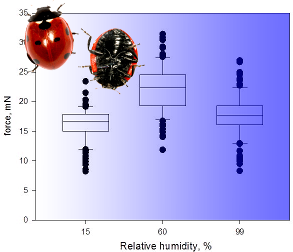
- wet adhesive system of C. septempunctata? (2) Is the attachment ability in both sexes likewise affected by ambient humidity? Experimental Animals For this study, the seven-spotted ladybird beetle Coccinella septempunctata LINNAEUS 1758 (Coleoptera, Coccinellidae) was chosen (Figure 1A). This beetle
- traction force is dependent on the attachment ability of the pulling animal. This method has been used in previous studies [7][14][40]. We let the beetle pull for one minute and then repeated the experiment in a second run, to make sure that the performance of individual animals was stable. In total, 10
- Experiment 1. To exclude an influence of physiological conditions of individual animals on different experimental days, a second run was executed. In this run, 9 beetles (3 females and 6 males) were tested. Individual beetles were tested on one day at all three levels of relative humidity in a randomized


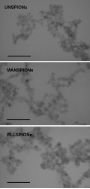
High antiviral effect of TiO2·PL–DNA nanocomposites targeted to conservative regions of (−)RNA and (+)RNA of influenza A virus in cell culture
Beilstein J. Nanotechnol. 2016, 7, 1166–1173, doi:10.3762/bjnano.7.108

- . Influenza A viruses (IAVs) are prominent in infectious diseases of humans and animals and periodically cause epidemics and epizootics. At present, the development of new antiviral drugs based on native or chemically modified nucleic acids is under scrutiny. Researchers all over the world explore the

Multiwalled carbon nanotube hybrids as MRI contrast agents
Beilstein J. Nanotechnol. 2016, 7, 1086–1103, doi:10.3762/bjnano.7.102
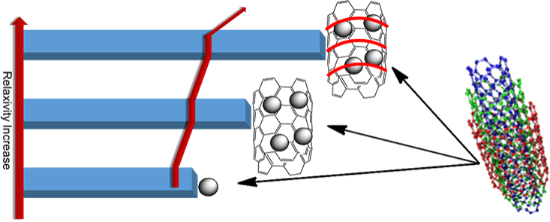
- concentrations up to 400 µg/mL, did not express hemolytic activity higher than 5% [38][39]. Several toxicity studies of the hybrids in animals have already been reported. SPIO@Lac-Gly/PDDA/oMWCNT#Liu was injected into mice (tail vein) at a dose of 10 mg/kg. Short-term discoloration of the tails was observed, but



Improved biocompatibility and efficient labeling of neural stem cells with poly(L-lysine)-coated maghemite nanoparticles
Beilstein J. Nanotechnol. 2016, 7, 926–936, doi:10.3762/bjnano.7.84

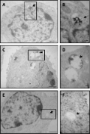
- ]. Animals To obtain neural stem cells, wild type C57Bl/6NCrl mice were used. All animal procedures were approved by Internal Review Board of the Ethical Committee of the School of Medicine, University of Zagreb, and were in accordance with the Ethical Codex of Croatian Society for Laboratory Animal Science
- . All experiments were carried out in accordance with the EU Directive 2010/63/EU on the protection of animals used for scientific purposes. Neural stem cell culture Neural stem cells (NSCs) were isolated from pregnant female mice as previously described [28][29]. Briefly, at gestation day 14.5, embryos




Frog tongue surface microstructures: functional and evolutionary patterns
Beilstein J. Nanotechnol. 2016, 7, 893–903, doi:10.3762/bjnano.7.81

- demonstrated for South American horned frogs (genus Ceratophrys) that the adhesive forces that frog tongues can produce and withstand are even higher than the body weight of the animals, at least if measured against a glass surface [7]. Further, we found that adhesive forces are higher if less mucus remained
Comparative kinematical analyses of Venus flytrap (Dionaea muscipula) snap traps
Beilstein J. Nanotechnol. 2016, 7, 664–674, doi:10.3762/bjnano.7.59
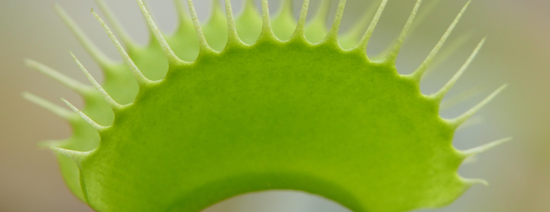
- seasonally inundated [10][11], can reportedly grow in a submersed state for months and is also capable of capturing aquatic animals, e.g., newts [12]. Detailed investigations regarding these potentially coincidental captures do not exist, and the question arises whether the traps function reliably under


Unraveling the neurotoxicity of titanium dioxide nanoparticles: focusing on molecular mechanisms
Beilstein J. Nanotechnol. 2016, 7, 645–654, doi:10.3762/bjnano.7.57

- and are widely used in many fields. Numerous in vivo studies, exposing experimental animals to these NPs through systematic administration, have suggested that TiO2 NPs can accumulate in the brain and induce brain dysfunction. Nevertheless, the exact mechanisms underlying the neurotoxicity of TiO2 NPs
- detected in the main organs of experimental animals [5][6] and in exhaled breath condensate of exposed workers [7]. This accumulation can in turn damage affected organs and induce dysfunction. The brain is of particular interest, as it is unable to regenerate from damage. Consequently, the neurotoxicity of
Novel roles for well-known players: from tobacco mosaic virus pests to enzymatically active assemblies
Beilstein J. Nanotechnol. 2016, 7, 613–629, doi:10.3762/bjnano.7.54
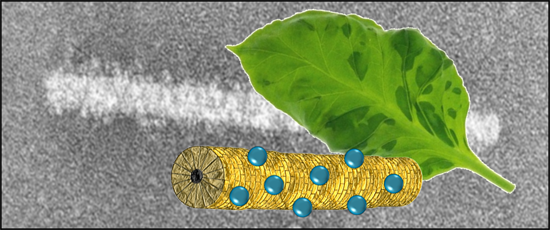
- make use of plant or bacterial viruses non-pathogenic for warm-blooded animals, or of non-infectious virus shells which lack part or all of the viral genome. Several viruses may be genetically engineered to increase the number of selectively addressable binding sites, or to alter specific properties of
- -programmed to produce many thousands of virus copies. Viruses have been discovered in virtually all types of organisms, with numerous well-characterized species adapted to animals, plants, fungi, or prokaryotic bacteria or archaea. As they may have an enormous impact on the physiological status and health of
- some review articles [6][71][72]). Although they have in common that they are non-pathogenic for humans and animals, spherical plant viral or bacteriophage particles serve predominantly as nanocontainers for cargo or reaction vessels, and as presentation systems for bio-effective molecules such as


Molecular machines operating on the nanoscale: from classical to quantum
Beilstein J. Nanotechnol. 2016, 7, 328–350, doi:10.3762/bjnano.7.31

- food molecules by animals [1]. The main physical principles of their operation are more or less understood by now [2][3], although the statistico-mechanical details of any single particular molecular motor (e.g., a representative of a large family of kinesin motors) are not well understood. The

![[Graphic 40]](/bjnano/content/inline/2190-4286-7-31-i86.png?max-width=637&scale=1.18182) with depth ε. Bias Δμ < 0 per one rotation tur...
with depth ε. Bias Δμ < 0 per one rotation tur...

![[Graphic 48]](/bjnano/content/inline/2190-4286-7-31-i94.png?max-width=637&scale=1.18182) , for the most asymmetric sawtooth mod...
, for the most asymmetric sawtooth mod...


Surface coating affects behavior of metallic nanoparticles in a biological environment
Beilstein J. Nanotechnol. 2016, 7, 246–262, doi:10.3762/bjnano.7.23
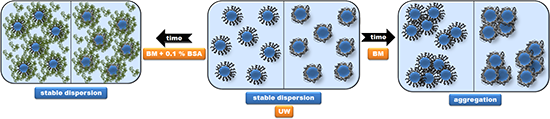
- obtained from healthy twelve weeks old male Wistar rats. Animals were killed by narketan/xilapan anesthesia following the whole blood collection by cardiac puncture. The experiment was approved by the Ethics Committee for Animal Studies of the Institute for Medical Research and Occupational Health




Nanostructured superhydrophobic films synthesized by electrodeposition of fluorinated polyindoles
Beilstein J. Nanotechnol. 2015, 6, 2078–2087, doi:10.3762/bjnano.6.212
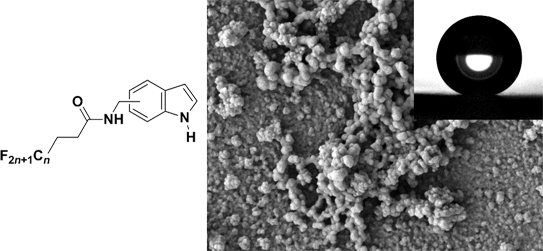
- , in both animals and plants, and allow them surviving against predators or hostile environments such as extremely humid or dry regions, for example [7][8][9][10][11][12]. Bioinspiration has shown the importance of developing structured surfaces in the presence of low surface energy materials that




Analysis of soil bacteria susceptibility to manufactured nanoparticles via data visualization
Beilstein J. Nanotechnol. 2015, 6, 1635–1651, doi:10.3762/bjnano.6.166

- communities [18][19]; quantum dots (QDs) were linked to DNA damage of both freshwater mussels and gills [24]; and carbon nanotubes have been found to induce harmful effects to various organs (such as aquatic animals, bacteria, and plants) [25]. MNPs in soil can cause compositional changes to soil bacterial