


Search results
Search for "cellular uptake" in Full Text gives 137 result(s) in Beilstein Journal of Nanotechnology.
PVP-coated, negatively charged silver nanoparticles: A multi-center study of their physicochemical characteristics, cell culture and in vivo experiments
Beilstein J. Nanotechnol. 2014, 5, 1944–1965, doi:10.3762/bjnano.5.205

- biological media (i.e., in the presence of proteins) the surface of silver nanoparticles is rapidly coated by a protein corona that influences their physicochemical and biological properties including cellular uptake. Silver nanoparticles are taken up by cell-type specific endocytosis pathways as
- have investigated whether STXM can be applied to investigate the cellular uptake process of silver nanoparticles in human mesenchymal stem cells (hMSC). For this purpose, hMSC were grown on collagen-coated Si3N4-membranes and incubated for 24 h with O2-free aqueous dispersions of silver particles (c
- without major mechanical stress for a cell is a useful tool to detect internalized metallic nanoparticles within cells [86]. As reported in the literature, the cellular uptake of nanoparticles is a conserved process during which extracellular substances are internalized by enclosing them into vesicles




Carbon-based smart nanomaterials in biomedicine and neuroengineering
Beilstein J. Nanotechnol. 2014, 5, 1849–1863, doi:10.3762/bjnano.5.196
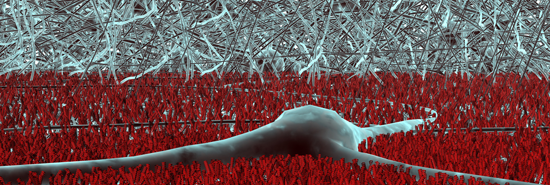
- were incubated with oxidised NDs, suggesting it was a specific consequence of the surface chemistry of NDs. Nonetheless, Xing and co-workers noted that NDs and oxidised NDs induce overall less DNA damage than that caused by MWCNTs. The investigation of the cellular uptake mechanisms of NDs is also a
- key aspect for biological applications of NDs. Vaijayanthimala and colleagues [75] reported that cellular uptake was strictly related to the surface functionalisation of NDs and that it took place through clathrin-mediated, energy-dependent, endocytosis processes. Schrand et al. [76] also investigated


Biocompatibility of cerium dioxide and silicon dioxide nanoparticles with endothelial cells
Beilstein J. Nanotechnol. 2014, 5, 1795–1807, doi:10.3762/bjnano.5.190
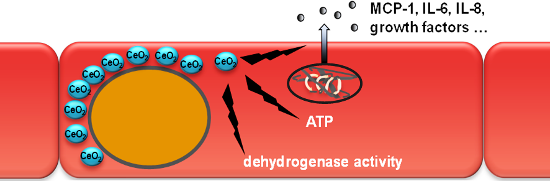
- indicated a steric stabilization of nanoparticles due to interaction with proteins. After cellular uptake, the CeO2 nanoparticles were localized around the nucleus in a ring-shaped manner. The nanoparticles revealed concentration and time, but no size-dependent effects on the cellular adenosine triphosphate
- predictions are not possible at present. Nevertheless, the different behavior could explained, at least in parts, by the exposure of different intracellular nanoparticle amounts per cell as a result of cell type specific variations in cellular uptake and exocytosis rates. We also investigated the release of
- fibroblasts (BJ cells, American Type Culture Collection (ATCC), USA) were used as positive cells for CD90 (fibroblast phenotype). 10,000 cells were measured for each sample and analysis was performed using CellQuest ProTM software (Becton Dickinson GmbH, Germany). Cellular uptake and intracellular


Influence of surface-modified maghemite nanoparticles on in vitro survival of human stem cells
Beilstein J. Nanotechnol. 2014, 5, 1732–1737, doi:10.3762/bjnano.5.183

- cellular uptake of the magnetic nanoparticles and enhance their specific targeting effect, surface functionalization has to be employed to coat the nanoparticle surface with ligands that could specifically interact with the receptors overexpressed in the cell membrane. While the size of the dry


Different endocytotic uptake mechanisms for nanoparticles in epithelial cells and macrophages
Beilstein J. Nanotechnol. 2014, 5, 1625–1636, doi:10.3762/bjnano.5.174
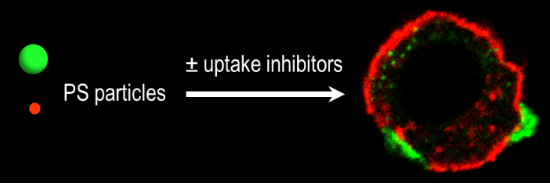
- , Murtenstrasse 50, 3008 Bern, Switzerland Institute of Anatomy, University of Bern, Baltzerstrasse 2, 3000 Bern 9, Switzerland 10.3762/bjnano.5.174 Abstract Precise knowledge regarding cellular uptake of nanoparticles is of great importance for future biomedical applications. Four different endocytotic uptake
- describes two different cellular uptake mechanisms: pinocytosis, which involves the uptake of fluids and molecules within small vesicles and phagocytosis, which is responsible for engulfing large particles (e.g., microorganisms and cell debris). Pinocytosis covers macropinocytosis, clathrin-mediated
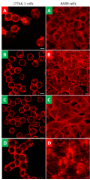
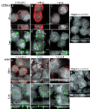
- and mβcd-treated A549 cells. The 1 µm particles were not observed inside the epithelial cells under any condition (Figure 5). Discussion For any future biomedical application of engineered NPs, it is mandatory to fundamentally understand their interaction with living systems. The cellular uptake



Precise quantification of silica and ceria nanoparticle uptake revealed by 3D fluorescence microscopy
Beilstein J. Nanotechnol. 2014, 5, 1616–1624, doi:10.3762/bjnano.5.173
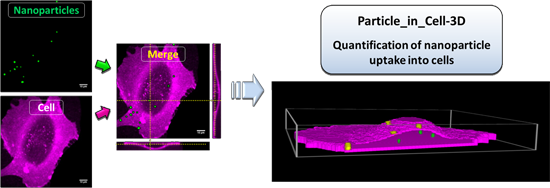
- Adriano A. Torrano Christoph Brauchle Department of Chemistry and Center for NanoScience (CeNS), University of Munich (LMU), Butenandtstrasse 5-13(E), 81377 Munich, Germany 10.3762/bjnano.5.173 Abstract Particle_in_Cell-3D is a powerful method to quantify the cellular uptake of nanoparticles. It
- automatic image analysis. This method is called Particle_in_Cell-3D and was described in detail in a previous publication [5]. In this work we briefly describe Particle_in_Cell-3D and present how it was successfully applied to precisely quantify the cellular uptake of silica and ceria nanoparticles. Silica
- custom-made macro for the widely used ImageJ software [26] and can be downloaded from the ImageJ Documentation Portal [27]. It is a semi-automatic image analysis routine designed to quantify the cellular uptake of nanoparticles by processing image stacks obtained by two-color confocal fluorescence


Current state of laser synthesis of metal and alloy nanoparticles as ligand-free reference materials for nano-toxicological assays
Beilstein J. Nanotechnol. 2014, 5, 1523–1541, doi:10.3762/bjnano.5.165
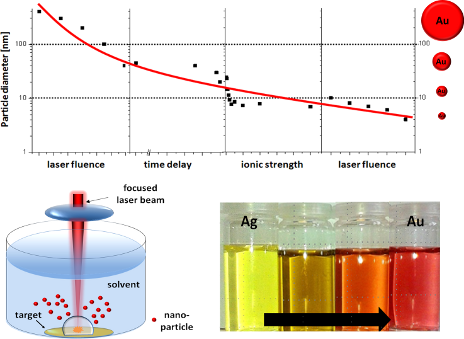
- approach is centrifugation at varying speed, yielding different size fractions [55]. This method was successfully applied in biological studies dealing with size dependent cellular uptake [56] and bioimaging [57] of gold nanoparticles. However, a rather labour-intensive preparation protocol as well as the


In vitro interaction of colloidal nanoparticles with mammalian cells: What have we learned thus far?
Beilstein J. Nanotechnol. 2014, 5, 1477–1490, doi:10.3762/bjnano.5.161
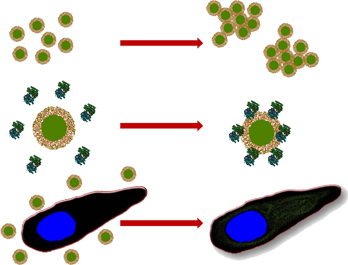
- penetration, which need to be considered in in vivo experiments, can be neglected. The kinetics of internalization can depend strongly on the physicochemical properties of the NPs, the type of cells, and other parameters. Cellular uptake studies of NPs require as much characterization of the NP materials as
- cellular uptake [62]. If the cell cultures are turned upside-down, i.e., the cells are hanging in the culture medium, NP agglomerates that have precipitated at the bottom would not reach the cells and thus the effective NP concentration would be dramatically reduced [88]. In contrast, in conventional
- , the eventual loss of internalized NPs as a result of mitotic division, NP exocytosis, or NP transcytosis on the other hand has not been comprehensively studied yet. Cellular uptake studies of NPs require as much characterization of the NP material as currently possible. However, many physicochemical


Protein-coated pH-responsive gold nanoparticles: Microwave-assisted synthesis and surface charge-dependent anticancer activity
Beilstein J. Nanotechnol. 2014, 5, 1452–1462, doi:10.3762/bjnano.5.158
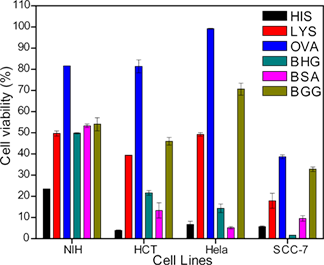
- differential effect of AuNPs on the cell viabilities of the fibroblasts and the cancer cell lines. Additional studies, such as cellular uptake and in vivo studies must be conducted to unravel the mechanism involved in the internalization of AuNPs and to understand the anticancer properties of the prepared


The protein corona protects against size- and dose-dependent toxicity of amorphous silica nanoparticles
Beilstein J. Nanotechnol. 2014, 5, 1380–1392, doi:10.3762/bjnano.5.151
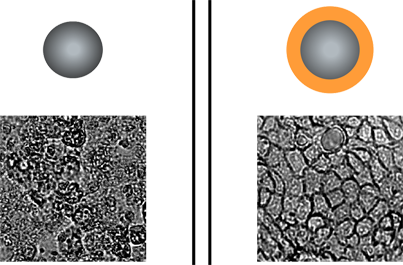
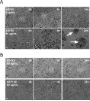
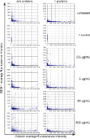
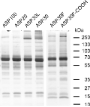
- explanation, corona formation reduced ASP30 cellular uptake, which was however not significantly affected by ASP surface charge in our model. Collectively, our study uncovers an impact of ASP size as well as of the protein corona on cellular toxicity, which might be relevant for processes at the nano–bio
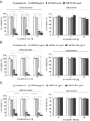
- protein corona on the cellular uptake Nanoparticle uptake is an important determinant for nanopathology [22][34][35]. To investigate the effect of the protein corona on cellular uptake mechanisms we analyzed the uptake of two fluorescently labeled ASPs with comparable physico-chemical characteristics
- carboxylation (ASP30F versus ASP30-COOH; Table 1) we did not, however, observe a significant difference in cellular uptake (Figure 7A/B). As reflected by the rather similar zeta potential after incubation of the different ASP in protein-containing medium the protein corona seems to shield the charged ASP




Antimicrobial properties of CuO nanorods and multi-armed nanoparticles against B. anthracis vegetative cells and endospores
Beilstein J. Nanotechnol. 2014, 5, 789–800, doi:10.3762/bjnano.5.91
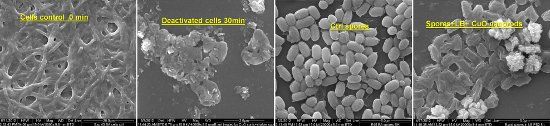
- particles were spear shaped with one tapered end. Most likely the tapered spears of P5 penetrate easily into the bacterial cell on collision causing more cellular damage and cell death compared to the nanorods. The shape of the nanoparticles is known to be an important contributor in their cellular uptake


In vitro toxicity and bioimaging studies of gold nanorods formulations coated with biofunctional thiol-PEG molecules and Pluronic block copolymers
Beilstein J. Nanotechnol. 2014, 5, 546–553, doi:10.3762/bjnano.5.64
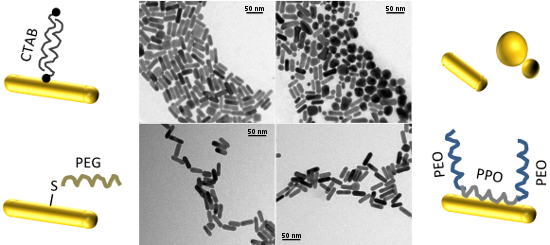
- the encapsulated AuNRs synthesized in this study. The bright red and orange scattered spots located within the cells suggest that the AuNRs were internalized into the cells by non-specific cellular uptake since no biomolecules were attached to our gold formulations. Huang et al. performed a similar





