
Search results
Search for "adhesive" in Full Text gives 246 result(s) in Beilstein Journal of Nanotechnology. Showing first 200.
The capillary adhesion technique: a versatile method for determining the liquid adhesion force and sample stiffness
Beilstein J. Nanotechnol. 2015, 6, 11–18, doi:10.3762/bjnano.6.2

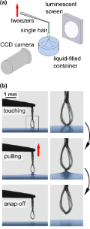
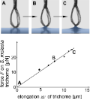
- outgrowths such as hairs or trichomes, which widely occur on biological surfaces, sometimes have unique adhesive and elastic properties optimally adapted to specific functional requirements. As these are often mimicked in technical applications, their characterization is of great interest in a biomimetic
- interface by the trichome tips which hold it under perturbations without the loss of air by bubble formation. Although the adhesive force of small elastic structures play a key role in understanding biological and biomimetic structures (as well as sensors, micromechanical or microfluidic systems), the
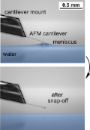
- precise, simultaneous measurement of both the elastic and the adhesive properties of small mechanical systems is not trivial. Here, we present a novel technique, the capillary adhesion technique (CAT), for the combined determination of the adhesion force of a single small structural entity to a liquid and


Exploring plasmonic coupling in hole-cap arrays
Beilstein J. Nanotechnol. 2015, 6, 1–10, doi:10.3762/bjnano.6.1

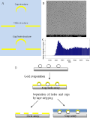
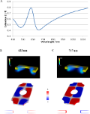
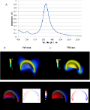
- arrays were generated in the same process and were separated physically by tape striping with a transparent adhesive tape (90 µm thick blue PVC Tape from Semiconductor Production Systems). The tape was subsequently placed onto a glass substrate for characterization. The tape stripped cap/hole arrays left




Aquatic versus terrestrial attachment: Water makes a difference
Beilstein J. Nanotechnol. 2014, 5, 2424–2439, doi:10.3762/bjnano.5.252

- ]. The mechanisms involved in wet and dry adhesion are different (Table 6). Dry adhesion occurs in a dry environment and no fluid film is involved. When adhesion takes place in a humid environment, there is a substantial increase in adhesive forces [38]. Moreover, some animals secrete a liquid themselves
- separates two hydrophilic surfaces in air. Pulling the surfaces apart will create a larger air–water boundary surface area. The surface tension of the liquid will resist to this increase and this is manifest as an adhesive force. According to [3] Laplace's law ought to be applied: The pressure difference
- viridula can walk under water [43]. This beetle develops higher adhesive forces on hydrophobic surfaces compared to hydrophilic ones. The hydrophobic setose pads of the beetle hold air under water, so if it encounters hydrophobic surfaces the contact interface gets de-wetted, but not on hydrophilic


Interaction of dermatologically relevant nanoparticles with skin cells and skin
Beilstein J. Nanotechnol. 2014, 5, 2363–2373, doi:10.3762/bjnano.5.245

- [20]. A pre-treatment with tape stripping of 20 adhesive tapes, which according to our own unpublished data corresponds to a removal of approximately 70–80% of the stratum corneum, only slightly increased the penetration depth to 5.1 ± 2.5 µm. Additionally, the penetration profile of AgNP was analyzed


Inorganic Janus particles for biomedical applications
Beilstein J. Nanotechnol. 2014, 5, 2346–2362, doi:10.3762/bjnano.5.244
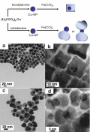
- theory of heterogeneous nucleation, this can be achieved by decreasing the concentration of the precursor below supersaturation, at which the homogeneous nucleation would be favourable [61]. Furthermore, the additional term of Gibbs free energy for the adhesive energy at the interface between the seeds






Modification of a single-molecule AFM probe with highly defined surface functionality
Beilstein J. Nanotechnol. 2014, 5, 2122–2128, doi:10.3762/bjnano.5.221

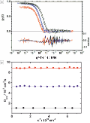
- ramped over the surface in isopropanol, and more than 1000 force curves were recorded for each of the five probes. Among them, 17–26% showed adhesive interactions appearing at a tip–surface separation greater than zero. Typical force curves obtained were shown in Figure 2A and Figure 2B for the Si probe
- spring constant is 10 pN/nm and tip curvature is 2 nm. The Au-coated AFM probes (CSG10/Au) were gifts from NT-MDT with 2.5 nm adhesive Ti layer and 35 nm Au layer, the nominal spring constant is 110 pN/nm and tip curvature is 35 nm. The aminopropylsilane-coated glass slides (C18-5131-M20) were purchased


Nanomanipulation and environmental nanotechnology
Beilstein J. Nanotechnol. 2014, 5, 2079–2080, doi:10.3762/bjnano.5.216
- understanding of friction and adhesive forces on the nanoscale. Last but not least, we would like to mention that this Thematic Series was partially inspired by the “Advanced Materials Science Networking (AMASING)” workshop organized by Prof. Gianaurelio Cuniberti in Da Nang, Vietnam, in March 2013. This was
Effects of surface functionalization on the adsorption of human serum albumin onto nanoparticles – a fluorescence correlation spectroscopy study
Beilstein J. Nanotechnol. 2014, 5, 2036–2047, doi:10.3762/bjnano.5.212

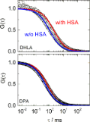
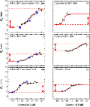
- concentrations). The mixture was allowed to equilibrate for ≈8 min at room temperature before loading into the sample cell. The cell consists of two standard cover slips (20 × 20 and 32 × 24 mm2) separated by two strips of double-sided adhesive tape (thickness 0.2 µm), leaving a 1 mm-wide channel for the sample



PVP-coated, negatively charged silver nanoparticles: A multi-center study of their physicochemical characteristics, cell culture and in vivo experiments
Beilstein J. Nanotechnol. 2014, 5, 1944–1965, doi:10.3762/bjnano.5.205
- such as macropinocytosis, clathrin- and caveolin-mediated endocytosis, and clathrin- and caveolin-independent endocytosis [81][82][83]. Other possible mechanisms such as receptor-mediated diffusion through membrane pores and passive uptake by van der Waals or steric interactions (summarized as adhesive




Synthesis of Pt nanoparticles and their burrowing into Si due to synergistic effects of ion beam energy losses
Beilstein J. Nanotechnol. 2014, 5, 1864–1872, doi:10.3762/bjnano.5.197

- silicon surfaces (cut from the same sample) joined face-to-face with glue (epoxy/adhesive substance). The range of 50 keV neon ions in Si is ≈107 nm with a longitudinal straggling of ≈46 nm. Therefore, one can expect a modified region of ≈130 nm below the surface upon ion bombardment. However, an



Controlling the dispersion of supported polyoxometalate heterogeneous catalysts: impact of hybridization and the role of hydrophilicity–hydrophobicity balance and supramolecularity
Beilstein J. Nanotechnol. 2014, 5, 1749–1759, doi:10.3762/bjnano.5.185
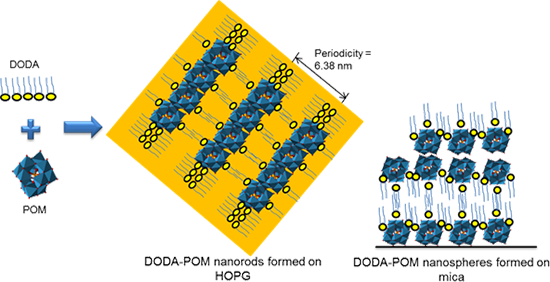
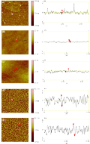
- , and the hybrid materials were imaged by using an etched Si tapping mode cantilever of the TESP type (Bruker AFM probes), having a nominal radius of curvature of 8 nm. Samples were glued on a magnetic stainless steel disc by using double-sided adhesive tape before mounting on to the “J” type


Equilibrium states and stability of pre-tensioned adhesive tapes
Beilstein J. Nanotechnol. 2014, 5, 1725–1731, doi:10.3762/bjnano.5.182
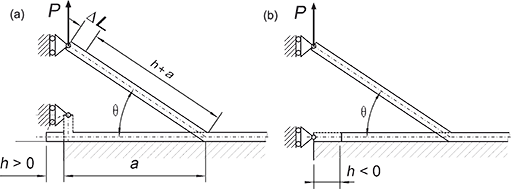
- understanding of adhesion of thin films is of prominent importance in a huge number of biological and biomechanical applications. As an example, the extraordinary adhesive abilities characterizing the hairy attachment systems of insects, reptiles and spiders have drawn significant research efforts aimed at
- reproducing such properties in artificial bio-mimetic adhesives [1][2][3]. In nature, many adhesive systems consist of arrays of hierarchical hairs or setae, enabling large contact areas and hence high adhesion owing to the van der Waals interaction forces [4]. This morphology enables many insects, spiders
- and numerical models. In nature, on the other side, geckos exhibit extremely high adhesive performance also on rough substrates. The secret of this amazing behavior is mainly related to the fibrillar hierarchical geometry of the adhesion pads that makes these structures very compliant, despite the
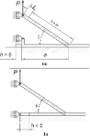

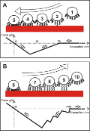
![[Graphic 5]](/bjnano/content/inline/2190-4286-5-182-i14.png?max-width=637&scale=1.18182) as a function of the peeling angle θeq at equilibrium (a); the tot...
as a function of the peeling angle θeq at equilibrium (a); the tot...


![[Graphic 11]](/bjnano/content/inline/2190-4286-5-182-i20.png?max-width=637&scale=1.18182) as a function of the peeling angle θeq at equilibrium, for differen...
as a function of the peeling angle θeq at equilibrium, for differen...
Different endocytotic uptake mechanisms for nanoparticles in epithelial cells and macrophages
Beilstein J. Nanotechnol. 2014, 5, 1625–1636, doi:10.3762/bjnano.5.174
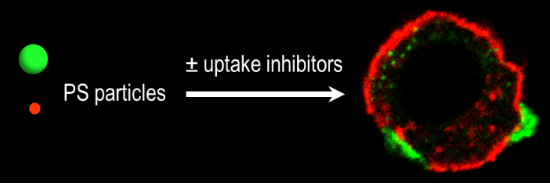
- receptor mediated diffusion via membrane pores as well as passive uptake by van der Waals or steric interactions (subsumed as adhesive interactions) [64][65] were proposed by the authors of these studies. Conclusion It was shown that the particle size is critical in determining which endocytotic uptake



Hydrophobic interaction governs unspecific adhesion of staphylococci: a single cell force spectroscopy study
Beilstein J. Nanotechnol. 2014, 5, 1501–1512, doi:10.3762/bjnano.5.163

- repetitive DNA sequences that are thought to facilitate the plasticity of genomes by allowing for enhanced genomic diversification due to recombinational events [5]. Although the S. carnosus genome encodes some homologues of adhesion factors found in S. aureus, it lacks the majority of adhesive molecules of
- , yet, due to adhesive forces, a deep global minimum is recorded. Further retraction provokes a loss of contact (“jump-off contact”). In the repulsive regime (F > 0), a force of 150 pN is not enough to deform the bacterium: With a force trigger of 150 nN, only an indentation of ca. 10 nm is reached (cf
- parameters for single cell force spectroscopy as detailed above, we can now specify the large differences in the adhesion of S. carnosus to hydrophobic and to hydrophilic surfaces, c.f. Figure 7A and Figure 7B: On the hydrophobic surface, a clear snap-in event is detectable, followed by a large adhesive peak


In vitro interaction of colloidal nanoparticles with mammalian cells: What have we learned thus far?
Beilstein J. Nanotechnol. 2014, 5, 1477–1490, doi:10.3762/bjnano.5.161
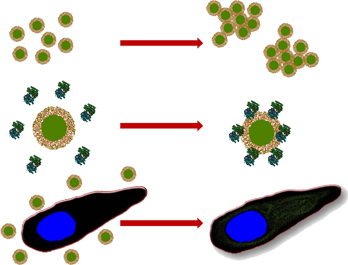
- ., "yes" or "no"), but rather are based on different kinetics. However, non-adhesive cell lines, i.e., cell suspensions, can be different and examples in which no significant internalization of NPs happened are reported [31]. Coming back to adhesive cell-lines, the first step in NP internalization
- , thus indicating alternative pathways for NPs to penetrate the cell plasma membrane [46][47]. Besides other possible mechanisms, passive diffusion through (transient) membrane pores and passive uptake by van der Waals or steric interactions (subsumed as adhesive interactions) have been suggested [48


From sticky to slippery: Biological and biologically-inspired adhesion and friction
Beilstein J. Nanotechnol. 2014, 5, 1450–1451, doi:10.3762/bjnano.5.157
- surfaces adapted to the enhancement, reduction, or optimization of their frictional and adhesive behavior. The study of these adaptations may also provide inspirations for the design of biologically-inspired artificial surfaces. The majority of books which discuss the biomechanics of contact phenomena are
- large number of studies have been published which focus on the biotribology and the bioadhesion in various biological systems. The research on frictional and adhesive properties of very diverse biological surfaces and interfaces became a broad research field at the boundary between physics and biology

Model systems for studying cell adhesion and biomimetic actin networks
Beilstein J. Nanotechnol. 2014, 5, 1193–1202, doi:10.3762/bjnano.5.131
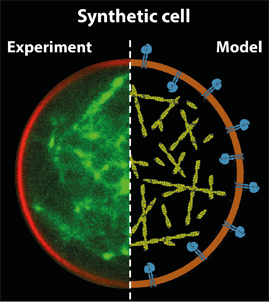
- environment and the adhesive state of the cell by transmitting chemical signals into the cytoplasm [10][11]. In addition to this outside-in signalling process integrins can undergo conformational changes, which are called inside-out activation. These changes are primarily induced by talin, a major actin
- , which were functionalised with RGD peptides. The adhesive gold nanoparticles had a diameter below 8 nm, which allowed the binding of one integrin molecule per RGD-functionalised nanoparticle [18]. If the distance between adjacent integrin-binding gold nanoparticles was less than 70 nm, cell adhesion was
- [18]. These results showed that integrin signalling enables cells to amplify small environmental differences in adhesive cues to large differences in adhesion strength. As the cortical cytoskeleton of all cells is formed by the assembly of actin microfilaments, their linkage to adhesion-mediating


Physical principles of fluid-mediated insect attachment - Shouldn’t insects slip?
Beilstein J. Nanotechnol. 2014, 5, 1160–1166, doi:10.3762/bjnano.5.127

- Jan-Henning Dirks Department of New Materials and Biosystems, Max Planck Institute for Intelligent Systems, Stuttgart, Germany 10.3762/bjnano.5.127 Abstract Insects use either hairy or smooth adhesive pads to safely adhere to various kinds of surfaces. Although the two types of adhesive pads are
- morphologically different, they both form contact with the substrate via a thin layer of adhesive fluid. To model adhesion and friction forces generated by insect footpads often a simple “wet adhesion” model is used, in which two flat undeformable substrates are separated by a continuous layer of fluid. This
- these assumptions are not valid in many cases of insect adhesion. Future tribological models for insect adhesion thus need to incorporate deformable adhesive pads, non-Newtonian properties of the adhesive fluid and/or partially “dry” or solid-like contact between the pad and the substrate. Keywords


Trade-offs in sensitivity and sampling depth in bimodal atomic force microscopy and comparison to the trimodal case
Beilstein J. Nanotechnol. 2014, 5, 1144–1151, doi:10.3762/bjnano.5.125

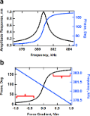
- implementation of Rodriguez and Garcia was for imaging in the attractive regime [12][13]. In the repulsive imaging regime the cantilever tip intermittently impacts the sample and thus the images are governed by contact forces that are a consequence of elastic, plastic, viscous or adhesive surface behaviors, in




Dry friction of microstructured polymer surfaces inspired by snake skin
Beilstein J. Nanotechnol. 2014, 5, 1091–1103, doi:10.3762/bjnano.5.122
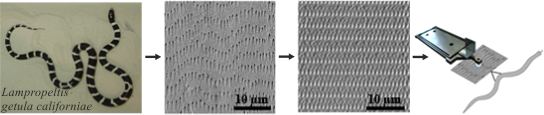
- that a decrease in frictional coefficient is due to the reduction of adhesive components of the frictional mechanisms [51][52]. Another approach to explain the reduction in frictional coefficient on many microstructured surfaces could be the possibility of trapping of loose wear particles within the
- , Tokyo, Japan) at an acceleration voltage of 2–3 kV and a Hitachi TM3000 (Hitachi High-Technologies Corporation, Tokyo, Japan) at an acceleration voltage of 5 kV. Prior to visualization, the material was fixed to the aluminium stub with a carbon-bearing adhesive pad and sputter-coated with a 20 nm thick


Nanoforging – Innovation in three-dimensional processing and shaping of nanoscaled structures
Beilstein J. Nanotechnol. 2014, 5, 1066–1070, doi:10.3762/bjnano.5.118

- more difficult to position nanoobjects and to control their geometry in three individual dimensions. Adhesive effects become dominant and forces such as gravity are negligible. Other macroscopical versatile processes like casting or cutting are not reproducible to the nanoscale, at the moment. For


Insect attachment on crystalline bioinspired wax surfaces formed by alkanes of varying chain lengths
Beilstein J. Nanotechnol. 2014, 5, 1031–1041, doi:10.3762/bjnano.5.116
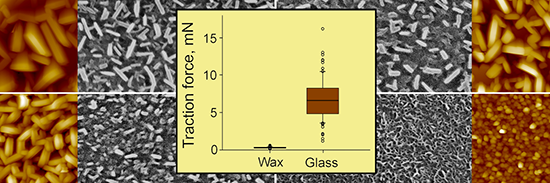
- experimental studies. The aim of this study was to examine the effect of different parameters of crystalline wax coverage on insect attachment. We performed traction experiments with the beetle Coccinella septempunctata and pull-off force measurements with artificial adhesive systems (tacky
- 30 fold, reduction of insect attachment forces on the wax surfaces when compared with the reference glass sample. Attachment of the beetles to the wax substrates probably relied solely on the performance of adhesive pads. We found no influence of the wax coatings on the subsequent attachment ability
- of beetles. The obtained data are explained by the reduction of the real contact between the setal tips of the insect adhesive pads and the wax surfaces due to the micro- and nanoscopic roughness introduced by wax crystals. Experiments with polydimethylsiloxane semi-spheres showed much higher forces



A nanometric cushion for enhancing scratch and wear resistance of hard films
Beilstein J. Nanotechnol. 2014, 5, 1005–1015, doi:10.3762/bjnano.5.114
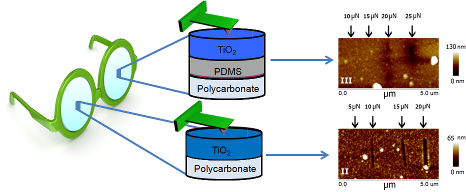
- dissipation during deformation of the hard film. In their classic model of friction, Bowden and Tabor [13] divide the friction into two terms, a plowing term and an adhesion term. The latter is associated with friction arising from the energy required to break the adhesive bonds, and the former from the
- ]. Many elastomers are known to exhibit high friction. This is due to the adhesion component of friction, which leads to extensive growth of the junctions between the interfaces under sliding. For instance, the frictional stress in rubber is almost entirely due to adhesive interactions which cause the
- measurements the data were collected by the fixed Silicon-Charge Particle Detector (ULTRATM, ORTEC) with detector scattering angle of 2.7 msr. A normal incidentbeam was used in all measurements. All samples were mounted on the holder by double sided, self-adhesive carbon tape. Charging effect on the kapton was



Molecular biology approaches in bioadhesion research
Beilstein J. Nanotechnol. 2014, 5, 983–993, doi:10.3762/bjnano.5.112

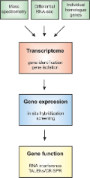
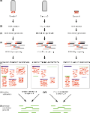
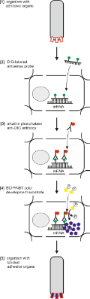
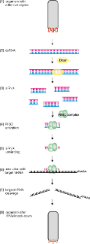
- assembled hypothetical complementary DNA originating from isolated messenger RNA) expressed in the region of the animal containing adhesive-producing cells; secondly, in situ hybridization (ISH) screening provides the (temporal and) spatial expression of target transcripts; thirdly, RNA interference (RNAi
- ) allows for the elucidation of selected genes by their manipulation in vivo. These tools provide highly detailed molecular information about the adhesive-related proteins. This would impact mainly research on permanent adhesives made up of a combination of carbohydrates and proteins. Indeed, even
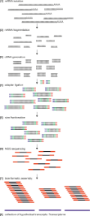
- specific tissues. 1.3 Sequencing a transcriptome With respect to the generation of a transcriptome that contains adhesion related genes of an organism, it can be favorable to only select the tissue that contains the adhesive organs. This can have several advantages: First, it will drastically reduce the
Direct observation of microcavitation in underwater adhesion of mushroom-shaped adhesive microstructure
Beilstein J. Nanotechnol. 2014, 5, 903–909, doi:10.3762/bjnano.5.103
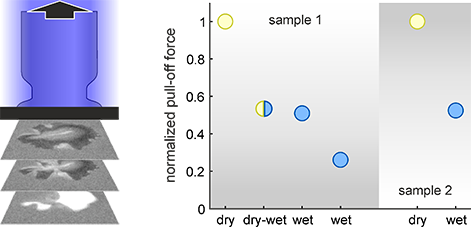
- , M.; Gorb, S. J. R. Soc., Interface 2008, 5, 383–385] proposed to explain the strong underwater adhesion of mushroom-shaped adhesive microstructures (MSAMSs). For this purpose, we measured the pull-off forces of individual MSAMSs by detaching them from a glass substrate under different wetting
- .; Gorb, S. N. Underwater adhesion of mushroom-shaped adhesive microstructure: An air-entrapment effect. In Biological and biomimetic adhesives: Challenges and opportunities; Santos, R.; Aldred, N.; Gorb, S. N.; Flammang, P., Eds.; The Royal Society of Chemistry: Cambridge, U.K., 2013; pp 65–71] rather
- than by cavitation. These results obtained due to the high-speed visualisation of the contact behavior at nanoscale-confined interfaces allow for a microscopic understanding of the underwater adhesion of MSAMSs and may aid in further development of artificial adhesive microstructures for applications