

Search results
Search for "adsorbates" in Full Text gives 123 result(s) in Beilstein Journal of Nanotechnology.
Materials challenges in solid-state sensors for continuous monitoring of ions in water
Beilstein J. Nanotechnol. 2026, 17, 935–973, doi:10.3762/bjnano.17.66
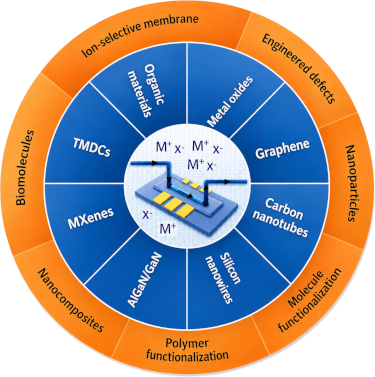
- structure, charge transfer in metal oxide semiconductor channels is strongly influenced by their defect chemistry, surface adsorbates, and polaronic transport behavior. Charges primarily transfer through defect-induced n-type conduction by a combination of band-like transport and polaron hopping. The charge
- delocalized π-electrons, with extremely high mobility. Charge transfer from adsorbates or ions occurs by electron donation or withdrawal, shifting the Fermi level and modulating carrier density. Hopping transport only occurs if graphene is heavily defected (e.g., reduced graphene oxide, rGO) [117]. Graphene
- , fabrication processes often leave polymer residues and adsorbates that deteriorate electronic quality, and large-area CVD graphene suffers from structural non-uniformities, including grain boundaries, wrinkles, and non-uniform doping, that create substantial device-to-device variability [120]. Beyond these


Sustainable fabrication of 2D-based devices through reuse of substrates with microfabricated electrodes
Beilstein J. Nanotechnol. 2026, 17, 818–827, doi:10.3762/bjnano.17.58
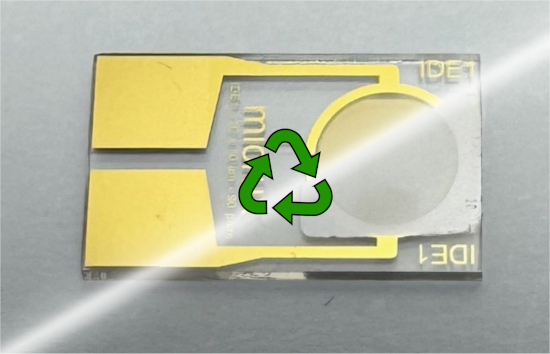
- in gold-assisted exfoliation methods) [43][44]. Interestingly, in devices that had not been annealed, the entire flake was more easily removed, presumably due to weaker adhesion resulting from interfacial adsorbates or trapped air (see Supporting Information File 1, Figure S12). Despite the


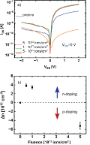
Tuning the electronic properties of defect-rich MoS2
Beilstein J. Nanotechnol. 2026, 17, 796–805, doi:10.3762/bjnano.17.56
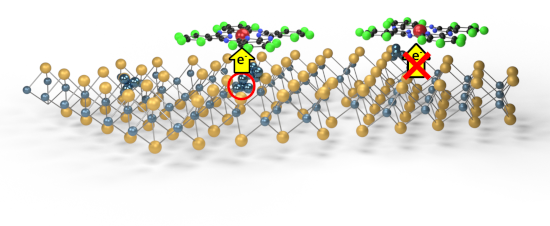
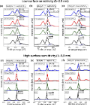
- levels or valence band features in photoemission can be attributed to different origins including a change of the electron density at the considered atom, different screening of the remaining photo-hole, or shifts of the reference (Fermi) level. Screening effects by additional adsorbates depend strongly
- observation of distinct defects in the microstructure already upon low ion dosing [21][32], as well as significant alterations of the Mo/S atomic ratio [19][20][21]. We ascribe the variations of the initial doping level in our samples to the presence of step edges and/or non-detectable traces of adsorbates


Probing internal continua and atomic ultrafast charge transfer within size-controlled nanoparticles by post-collision interaction in core-hole clock spectroscopy
Beilstein J. Nanotechnol. 2026, 17, 505–514, doi:10.3762/bjnano.17.33
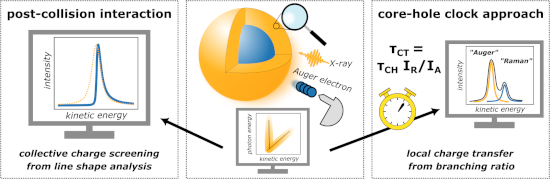
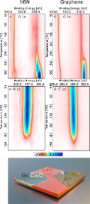
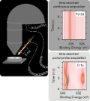
- 1b, yields the charge transfer time in relation to the core-hole lifetime based on a model of independent exponential decay [20][21]. The validity and capabilities of the CHC approach was demonstrated across various sample systems, including gas adsorbates on surfaces [22][23], two-dimensional



Defects and defect-mediated engineering of two-dimensional materials: challenges and open questions
Beilstein J. Nanotechnol. 2026, 17, 454–488, doi:10.3762/bjnano.17.31





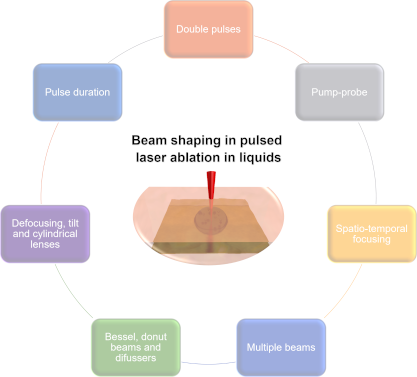
Beam shaping techniques for pulsed laser ablation in liquids: Unlocking tunable control of nanoparticle synthesis in liquids
Beilstein J. Nanotechnol. 2026, 17, 309–342, doi:10.3762/bjnano.17.22
- with calibration standards [95] or thermogravimetric analysis in the presence of organic species or adsorbates [73]. When reporting NP yields, several practical issues must be considered. Collection efficiencies are generally below unity, meaning that the ablated mass does not directly equal the NP







Ambient pressure XPS at MAX IV
Beilstein J. Nanotechnol. 2025, 16, 1677–1694, doi:10.3762/bjnano.16.118

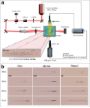
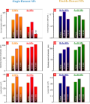
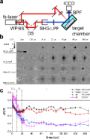
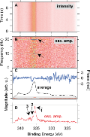
- –probe mode during experiment 1. (E) Profile of the injected gas pulse over time. (F) Time evolution of the nitrogen-containing products of NH3 oxidation. (G) Time evolution of the surface adsorbates. (A) Pd 3d core level spectra measured in continuous mode during experiment 2 in surface sensitive





Dendrimer-modified carbon nanotubes for the removal and recovery of heavy metal ions from water
Beilstein J. Nanotechnol. 2025, 16, 1522–1532, doi:10.3762/bjnano.16.107
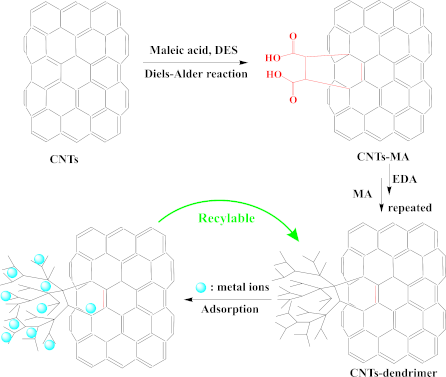
- Freundlich isotherm fitting and heterogeneous surface characteristics. However, the adsorption behavior can vary on many factors such as type of adsorbates, adsorbent composition, reaction conditions, and degree of functionality. In our case, the adsorption behavior of pure CNT-based dendrimer adsorbents


Laser processing in liquids: insights into nanocolloid generation and thin film integration for energy, photonic, and sensing applications
Beilstein J. Nanotechnol. 2025, 16, 1428–1498, doi:10.3762/bjnano.16.104






Parylene-coated platinum nanowire electrodes for biomolecular sensing applications
Beilstein J. Nanotechnol. 2025, 16, 1392–1400, doi:10.3762/bjnano.16.101
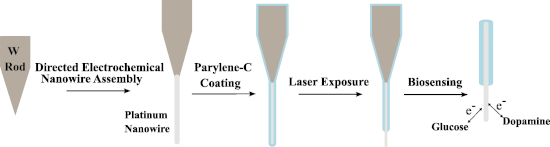
- , the first peak is around −300 mV, corresponding to the chemisorption onto the platinum surface and dehydrogenation of glucose. This indicates formation of intermediate adsorbate forms on the platinum surface. The second peak around 150 mV is due to the further oxidation of intermediate adsorbates with


Single-layer graphene oxide film grown on α-Al2O3(0001) for use as an adsorbent
Beilstein J. Nanotechnol. 2025, 16, 1082–1087, doi:10.3762/bjnano.16.79
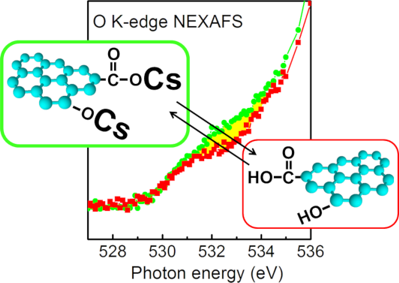
- 4, 7, and 9. Both the electronic structure and the normalized amount of Cs adsorbates were dependent on the pH scale. These fundamental aspects provide us important information for developing new adsorbent materials using GO. Results and Discussion Large-area and single-layer graphene oxide growth


Focused ion and electron beams for synthesis and characterization of nanomaterials
Beilstein J. Nanotechnol. 2025, 16, 613–616, doi:10.3762/bjnano.16.47
- unrivaled spatial resolution and 3D capabilities, focused ion and electron beams technologies face challenges in reproducibility and scalability, hindering their commercial applications. Hence, these techniques require better understanding of the atomistic mechanisms involving ions, electrons, adsorbates

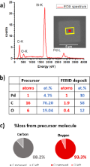
Electron beam-based direct writing of nanostructures using a palladium β-ketoesterate complex
Beilstein J. Nanotechnol. 2025, 16, 530–539, doi:10.3762/bjnano.16.41
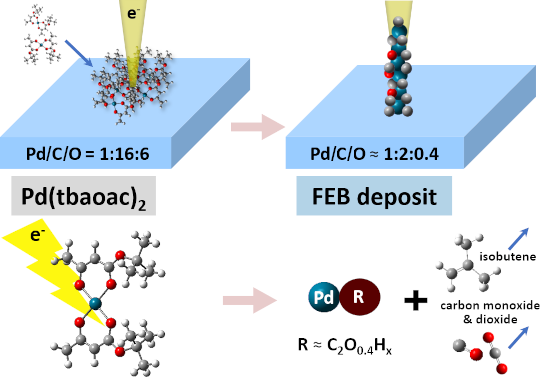
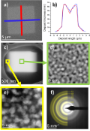
- given the same molecular and electron flux. However, for the pillar, the surface diffusion contribution of adsorbates is lower as the diffusing molecules need to travel a longer distance from the surface to reach the irradiated area. Also, molecules are lost because of thermal decomposition that is


Impact of adsorbate–substrate interaction on nanostructured thin films growth during low-pressure condensation
Beilstein J. Nanotechnol. 2025, 16, 473–483, doi:10.3762/bjnano.16.36
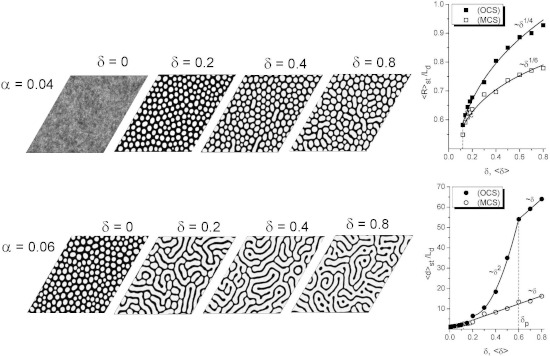
- = 0.5, that is, the spatial integration step; Δt = 10−3 is the time step. The Fourier spectral method is used [45][46] to take spatial derivatives. As initial conditions, we assume that the substrate is free of adsorbates by taking x(r,0) = 0; boundary conditions are periodic. We fix σ2 = 0.01 for all


A review of metal-organic frameworks and polymers in mixed matrix membranes for CO2 capture
Beilstein J. Nanotechnol. 2025, 16, 155–186, doi:10.3762/bjnano.16.14
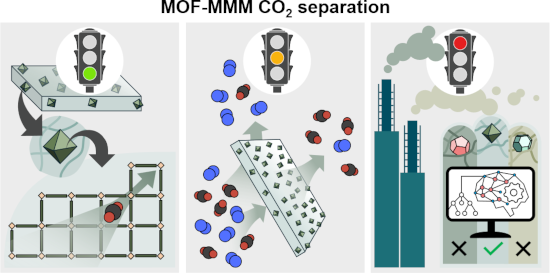
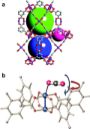
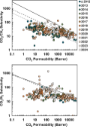
- ]. This strategy capitalizes on the combination of high surface areas and the tunable nature of pore openings and channels of MOFs, achieving selective CO2 adsorption by size exclusion [55], illustrated in Figure 2a. The kinetic diameter of competing adsorbates is the most commonly quoted metric for size




Laser synthesis of nanoparticles in organic solvents – products, reactions, and perspectives
Beilstein J. Nanotechnol. 2024, 15, 638–663, doi:10.3762/bjnano.15.54
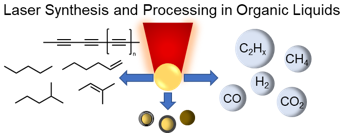
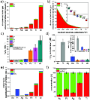
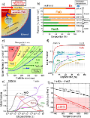
- may be unintendedly created as by-products, potentially found as surface adsorbates on the produced colloidal particles, compromising the nominal purity. However, molecular surface adsorbates may contribute to enhanced functionality in application scenarios, for example, through hindering kinetic





Directed growth of quinacridone chains on the vicinal Ag(35 1 1) surface
Beilstein J. Nanotechnol. 2024, 15, 556–568, doi:10.3762/bjnano.15.48
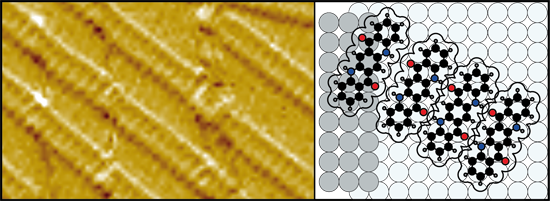
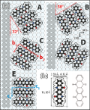
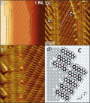
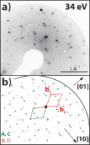
- , which can be used to direct the growth of nanostructures of adsorbates. The adsorption at step edges, as opposed to that on the terraces in between, is often favored because the additional interactions between the adsorbate and the atoms of the step edge contribute to the adsorption energy Eads. This
- step decoration can be exploited to grow 1D chain-like structures of adsorbates that otherwise tend to form two-dimensional (2D) domains on flat terraces. Examples are atoms forming 1D metallic chains [11][12][13][14][15] and organic molecules forming 1D chains at step edges of vicinal metal surfaces


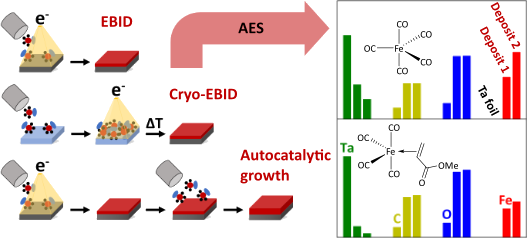
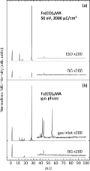
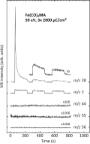
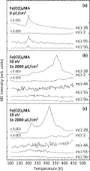
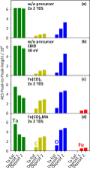
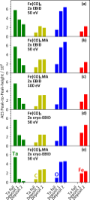
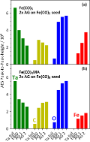
Electron-induced deposition using Fe(CO)4MA and Fe(CO)5 – effect of MA ligand and process conditions
Beilstein J. Nanotechnol. 2024, 15, 500–516, doi:10.3762/bjnano.15.45



Controllable physicochemical properties of WOx thin films grown under glancing angle
Beilstein J. Nanotechnol. 2024, 15, 350–359, doi:10.3762/bjnano.15.31
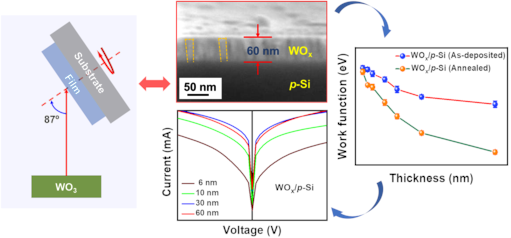
- separate peaks. The intense peak at 530.7 eV can be assigned to lattice O atoms (OL) in the stoichiometric WO3 structure, whereas the peaks at 531.5 eV are due to the presence of OV in the films [40]. In addition, the presence of surface adsorbates (at 532.6 eV) is observed in both the as-deposited and


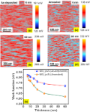


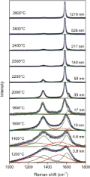
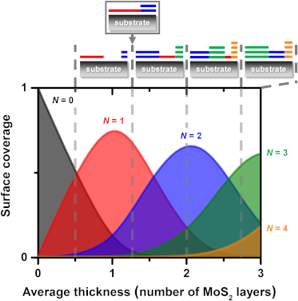
Determining by Raman spectroscopy the average thickness and N-layer-specific surface coverages of MoS2 thin films with domains much smaller than the laser spot size
Beilstein J. Nanotechnol. 2024, 15, 279–296, doi:10.3762/bjnano.15.26


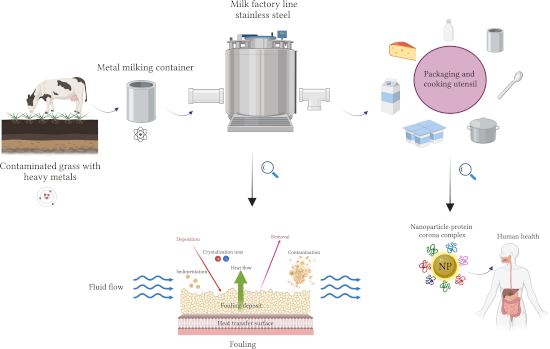
Multiscale modelling of biomolecular corona formation on metallic surfaces
Beilstein J. Nanotechnol. 2024, 15, 215–229, doi:10.3762/bjnano.15.21
- Monte Carlo (KMC) simulations as implemented in the CoronaKMC tool [26] were employed to investigate competitive adsorption and to determine the composition of the protein corona. This method models adsorbates as hard spheres, which adsorb and desorb to the surface of the NPs, with different
- orientations of each protein treated as different potential adsorbates to allow for a more physically realistic model of corona formation for anisotropic proteins. In brief, a standard kinetic Monte Carlo routine is used to advance the simulation from one event, collision of an incoming adsorbate with the NP
- nm−2) and mass abundance (represented as a percentage of the total adsorbed mass). These calculations were performed utilizing the most recent KMC method modifications, including an alternative mode in which the acceptance–rejection criteria for incoming adsorbates are altered to allow replacement of


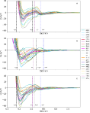


unDrift: A versatile software for fast offline SPM image drift correction
Beilstein J. Nanotechnol. 2023, 14, 1225–1237, doi:10.3762/bjnano.14.101

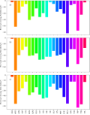
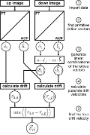
- ]. Offline drift correction strategies, in contrast, correct the effect of drift in SPM images after the measurement. Drift correction has been carried out based on the apparent movement of stationary features (e.g., fixed defects or adsorbates) traceable in consecutive images [5][29][30][31] or images with


From a free electron gas to confined states: A mixed island of PTCDA and copper phthalocyanine on Ag(111)
Beilstein J. Nanotechnol. 2022, 13, 1572–1577, doi:10.3762/bjnano.13.131
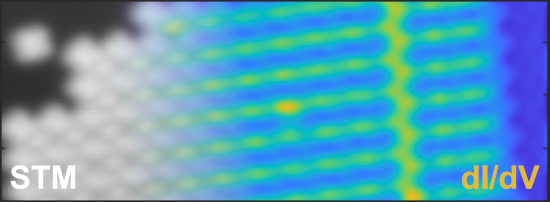
- , often with a single row of P2C, as well as large islands of pure PTCDA and lone CuPc adsorbates around the islands. While the small amount of P2C is not relevant to this study, we found it an unavoidable byproduct of our preparation. It is not clear why we observe the P2C phase as isolated rows within


Topographic signatures and manipulations of Fe atoms, CO molecules and NaCl islands on superconducting Pb(111)
Beilstein J. Nanotechnol. 2022, 13, 1–9, doi:10.3762/bjnano.13.1
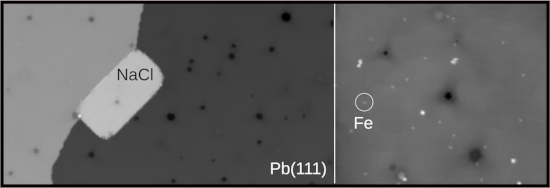
- demonstrated. We show a general propensity of these adsorbates to diffuse at low temperature under gentle scanning conditions. Our findings provide new insights into high-resolution probe microscopy imaging with terminated tips, decoupling atoms and molecules by NaCl islands or tip-induced lateral manipulation
- microscopy (STM) and atomic force microscopy (AFM) are required to accurately disentangle structural and electronic properties of atomic or molecular structures on these superconducting platforms. STM/AFM generally allows for a controlled repositioning of adsorbates, both by lateral and vertical
- low temperature. This differs distinctly from the adsorption on Pb(110), which has also been performed. In contrast, NaCl islands and single Fe atoms are more stable. Nevertheless, a general propensity for a tip-induced displacement of these adsorbates on the Pb(111) surface can be fulfilled. We


Two dynamic modes to streamline challenging atomic force microscopy measurements
Beilstein J. Nanotechnol. 2021, 12, 1226–1236, doi:10.3762/bjnano.12.90

- that we can register. When scanning in air, achieving this goal is complicated by substantial adhesive forces associated with surface water and/or other adsorbates, which means that the onset of repulsive interaction should be registered against a strong background of attraction. This task can be