


Search results
Search for "spatula" in Full Text gives 26 result(s) in Beilstein Journal of Nanotechnology.
Micro- and nanoscale effects in biological and bioinspired materials and surfaces
Beilstein J. Nanotechnol. 2026, 17, 214–217, doi:10.3762/bjnano.17.14
- adhesion. They combined molecular dynamics for the simulation of the adhesive contact between the gecko spatula and the substrate with finite element modeling of the mechanical behavior of the adhesive seta to understand key aspects of gecko seta adhesion across scales. Besides these studies, focusing on
Subdigital integumentary microstructure in Cyrtodactylus (Squamata: Gekkota): do those lineages with incipiently expressed toepads exclusively exhibit adhesive setae?
Beilstein J. Nanotechnol. 2026, 17, 38–56, doi:10.3762/bjnano.17.4
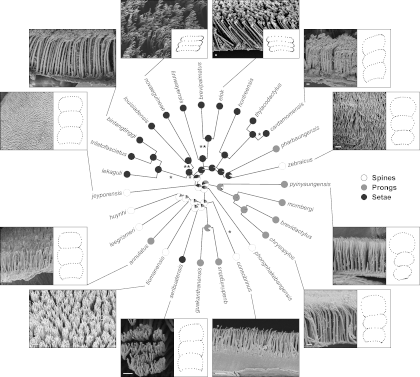
- setae can be packed more closely together without interfering with neighbouring setae, whereas gecko setae with their multiple tips are arborescent and thus require more distant spacing to avoid interference between neighbouring stalks. Therefore, tip/spatula density might be a better predictor of


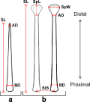
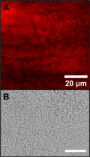
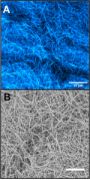
Visualizing nanostructures in supramolecular hydrogels: a correlative study using confocal and cryogenic scanning electron microscopy
Beilstein J. Nanotechnol. 2025, 16, 2274–2284, doi:10.3762/bjnano.16.156
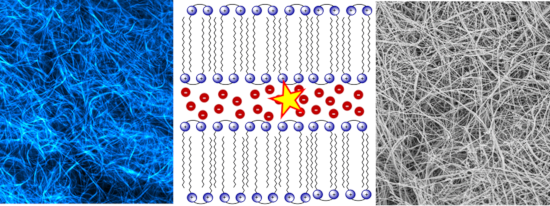
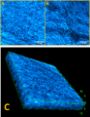
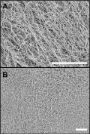
- 100× (N.A. = 1.3 Oil) (DIC), resolution 140 nm, total magnification 1000×. Spectral irradiance at 561 nm and 100% laser power is 88.4 W·m−2. For imaging of compressed samples, a sample of gel around the size of the end of a spatula was placed upon a circular glass coverslip in a holder. A plastic O




Molecular and mechanical insights into gecko seta adhesion: multiscale simulations combining molecular dynamics and the finite element method
Beilstein J. Nanotechnol. 2025, 16, 2055–2076, doi:10.3762/bjnano.16.141
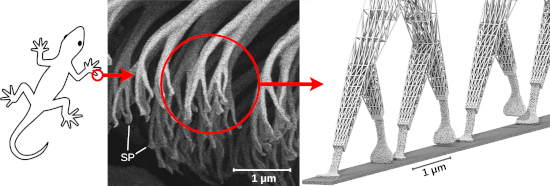
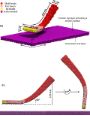
- dynamics to capture molecular interactions at the spatula–substrate interface and finite element method to simulate the mechanical behavior of the larger setal shaft. This hybrid approach enables synchronized simulations that resolve both fine-scale interfacial dynamics and overall structural deformation
- . The model reproduces key aspects of spatula behavior during adhesion and detachment, showing that spatula–substrate contact evolves through a combination of bending, sliding, and peeling, depending on the spatula’s initial orientation. Our results further demonstrate that lateral sliding can delay
- limitations inherent in single-scale models. Keywords: finite element method; gecko adhesion; hybrid modeling; molecular dynamics; multiscale simulations; seta; spatula; Introduction Geckos possess the ability to adhere to a variety of substrates, a trait attributed to specialized micro- and nanoscale






Functional fibrillar interfaces: Biological hair as inspiration across scales
Beilstein J. Nanotechnol. 2024, 15, 664–677, doi:10.3762/bjnano.15.55
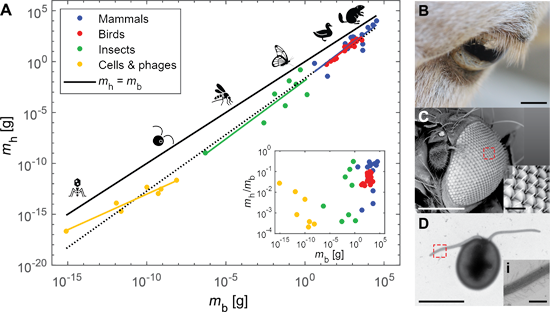
- functions [57][59]. Green dock beetles (G. viridula) have been observed to possess three distinct types of adhesive hairs: discoidal, spatula-shaped, and sharp-tipped. The males possess adhesive hairs with discoidal tips, which are capable of generating large adhesive forces [57]. They are hypothesized to
- be used by males to attach securely to females when mating [59]. Both males and females possess adhesive hairs with spatula-shaped and sharp tips. The spatula-shaped tips enable reversibility of adhesion, while the sharp-tipped hairs are used for generating friction [59]. For microorganisms, while


Insect attachment on waxy plant surfaces: the effect of pad contamination by different waxes
Beilstein J. Nanotechnol. 2024, 15, 385–395, doi:10.3762/bjnano.15.35
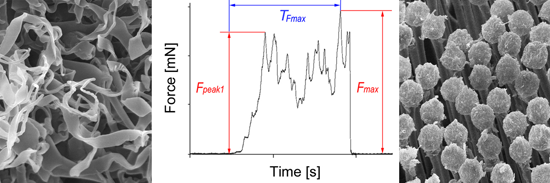
- [1][38]). Tenent setae of these pads have different shapes of the tip: (1) a flat discoidal terminal element in mushroom-like setae situated in the central part of the basal and distal tarsomeres (only in males, present in all legs); (2) a flat and widened end plate called spatula in setae located
- contact elements of artificial attachment systems [43][44], revealed a strong adaptation of the discoidal tips to long-term adhesion on smooth substrates, especially needed for firm attachment of males to smooth female elytra during mating. Setae with spatula-shaped or pointed tips are better adapted to




Comparative electron microscopy particle sizing of TiO2 pigments: sample preparation and measurement
Beilstein J. Nanotechnol. 2024, 15, 317–332, doi:10.3762/bjnano.15.29

- photons are absorbed by the carbon black pigment resulting in greater brightness. The TiO2 sample was mixed with carbon black, linseed oil, and filler (BaSO4) in defined proportions using a spatula, transferred to an automatic muller and mulled (2 × 50 revolutions). A drawdown (240 μm) of the mixture was


Growing up in a rough world: scaling of frictional adhesion and morphology of the Tokay gecko (Gekko gecko)
Beilstein J. Nanotechnol. 2022, 13, 1292–1302, doi:10.3762/bjnano.13.107
- spatula on surfaces with asperities ranging from 100–300 nm, and Gillies et al. [29] manipulated the surface roughness of a macroscopic engineered rough surface in which they manipulated the wavelength and amplitude of peaks that were on the same length scale of the subdigital lamellae. Both studies found


Ciprofloxacin-loaded dissolving polymeric microneedles as a potential therapeutic for the treatment of S. aureus skin infections
Beilstein J. Nanotechnol. 2022, 13, 517–527, doi:10.3762/bjnano.13.43
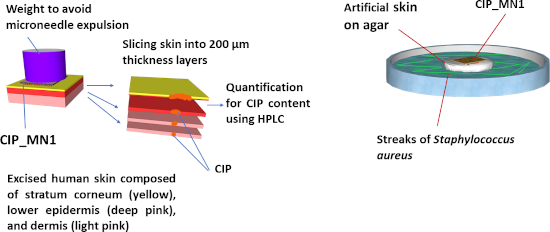
- ) (PDMS) molds (Micropoint company, Singapore). Each hole in the mold was 200 µm in depth and 50 µm diameter. The molds were then centrifuged at 1370g for 20 min to allow the polymer solution to fill the mold holes. Excess mixture was removed by scraping with a spatula and the molds was left for 5 h to
- PDMS mold and spread with a spatula. The mold is then centrifuged to fill the mold holes. The baking layer, which is free of the drug, is then spread over the mold, centrifuged, and allowed to dry forming polymeric microneedles. Schematic presentation of the skin deposition study of CIP_MN1. The full


Physical constraints lead to parallel evolution of micro- and nanostructures of animal adhesive pads: a review
Beilstein J. Nanotechnol. 2021, 12, 725–743, doi:10.3762/bjnano.12.57
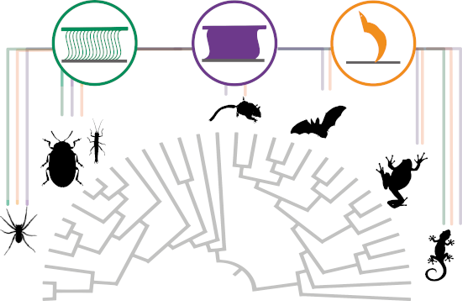
- spatula, terminating tips of the cuticle outgrowths in hairy systems form the superficial film. These films are responsible for proper contact formation with the substrate due to their low bending stiffness at a minimum load [239]. The film/spatula is able to adapt to the surface profile and to replicate
- [108] (© 2018 Büscher et al., published by Frontiers, distributed under the terms of the Creative Commons Attribution License (CC BY)). Compliancy of adhesive structures to the substrate (A,B) and contact splitting (C). (A) Contact of a spatula of the beetle Gastrophysa viridula with a surface with
- microscale roughness. (B) Soft smooth pad requires additional load to form an adhesive contact (B, upper image), whereas the adhesion interaction pulls the elastic thin film of the spatula into a complete contact with the rough substrate surface (Figure 6A and 6B are from [241] and were adapted by permission


Nanoporous smartPearls for dermal application – Identification of optimal silica types and a scalable production process as prerequisites for marketed products
Beilstein J. Nanotechnol. 2019, 10, 1666–1678, doi:10.3762/bjnano.10.162

- 75 to 180 min, depending on the solvent volume. After the second drying step, the obtained free flowing, dry powder was removed. When a film was formed on the glass wall, the film was removed from the wall using a spatula. Potential aggregates were deaggregated by stirring the powder, whereby the




Stationary beam full-field transmission helium ion microscopy using sub-50 keV He+: Projected images and intensity patterns
Beilstein J. Nanotechnol. 2019, 10, 1648–1657, doi:10.3762/bjnano.10.160

- #549649) and NaCl (Plano Product #46-2). A small amount (≈1 mg) of the powder was deposited either from a spatula (BN and MgO) or scratched with a scalpel blade (NaCl) onto TEM grids without any support membrane (finder grids from Ted Pella Product #79750, Maxtaform™ Style H2, 200 mesh Cu grids) moistened


A comparison of tarsal morphology and traction force in the two burying beetles Nicrophorus nepalensis and Nicrophorus vespilloides (Coleoptera, Silphidae)
Beilstein J. Nanotechnol. 2019, 10, 47–61, doi:10.3762/bjnano.10.5

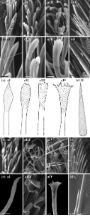
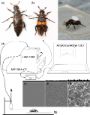
- bristle-like hairs was highest on the hind tarsus and lowest on the middle and fore tarsus (Table 1). The ventral hairy surfaces of the tarsi were divided by a median longitudinal hairless stripe (Figure 1: hs). The tips of hairs with broadened tips range from lanceolate to spatula-shaped and can
- therefore be subdivided into four classes, i.e., (1) lanceolate (aI) with a broadened plate tapering towards one apical tip (Figure 2a–e: aI), followed by (2) intermediate spatula-shaped aII ending with 4–8 apical tips (Figure 2a–c: aII), (3) spatula-shaped with a broad plate ending in 8–12 irregularly
- shaped apical tips (Figure 2a–e: aIII) and (4) broadly spatula-shaped only found in N. nepalensis (Figure 2c–e: aIV). On their dorsal side, the hair tips show a nodule-like fine structure (Figure 2e: aIV), whereas on the ventral side, a fish-bone-like fine-ribbed structure can be observed (Figure 2b


Contact splitting in dry adhesion and friction: reducing the influence of roughness
Beilstein J. Nanotechnol. 2019, 10, 1–8, doi:10.3762/bjnano.10.1

- lamella length (low-level-hierarchy attachment element) and inter-lamella spacing, and if the substrate roughness is comparable to the lateral dimension of a single spatula (high-level-hierarchy attachment element) [18][19]. Several studies performed with artificial fibrillar structures reported that


Graphene composites with dental and biomedical applicability
Beilstein J. Nanotechnol. 2018, 9, 801–808, doi:10.3762/bjnano.9.73
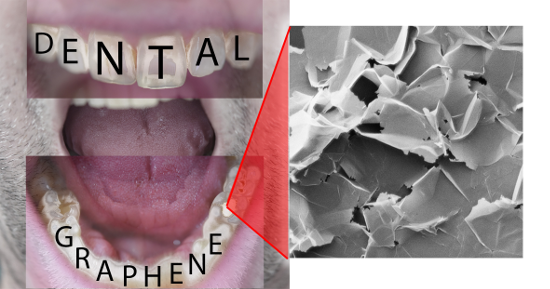
- was hand-mixed with all the poly(acrylic acid) solution for 20 s using a stainless steel spatula, and then the remaining GI powder was added and mixed for a further 20 s. Dynamic viscosity measurements The viscosity of all the poly(acrylic acid) solutions was measured with a digital viscometer
- covered with an acetate strip and aligned using nylon wedges and a locating pin. The hand-mixed GI restorative plastic mass was applied to one side of the split-mould immediately after mixing using the stainless steel spatula and allowed to flow into the mould to minimise air bubble incorporation in the


Synthesis and characterization of two new TiO2-containing benzothiazole-based imine composites for organic device applications
Beilstein J. Nanotechnol. 2018, 9, 721–739, doi:10.3762/bjnano.9.67
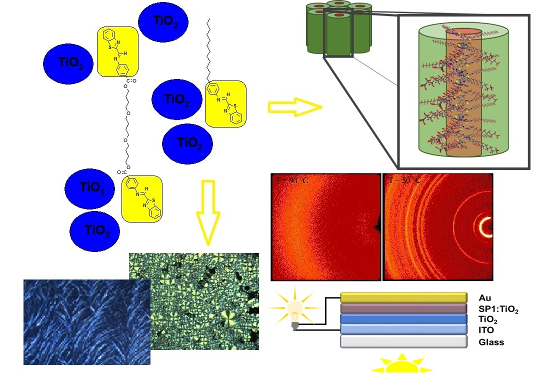
- , while for DSC studies, the mixture was scratched with a spatula and put into aluminum pans. Assembly and characterization of organic devices Samples for photocurrent measurements were prepared on ITO patterned glass substrates (Osilla S211) to form ITO/TiO2/SP1 (or SP1:P3HT, SP1:TiO2, SP1:PC71BM or P3HT







Bombyx mori silk/titania/gold hybrid materials for photocatalytic water splitting: combining renewable raw materials with clean fuels
Beilstein J. Nanotechnol. 2018, 9, 187–204, doi:10.3762/bjnano.9.21
- ) PEO/silk (step 2) or (ii) the PEO-free silk solution (step 2a) in the Teflon dish and stirred manually with a wooden spatula until a homogeneous liquid was obtained. The Teflon dish was covered with a glass Petri dish and left on the laboratory bench over night at room temperature. Step 4: The




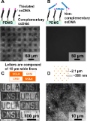
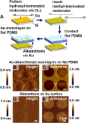
Patterning of supported gold monolayers via chemical lift-off lithography
Beilstein J. Nanotechnol. 2017, 8, 2648–2661, doi:10.3762/bjnano.8.265

- deionized water, and cleaned two additional times. Clean glass pieces were stored in deionized water until they were rinsed and blown dry immediately before use. Using a plastic spatula with a tapered tip, 1–2 drops of degassed PDMS (10:2 elastomer/curing agent by weight) were placed on the silicon pieces



When the going gets rough – studying the effect of surface roughness on the adhesive abilities of tree frogs
Beilstein J. Nanotechnol. 2016, 7, 2116–2131, doi:10.3762/bjnano.7.201

- to the beads’ diameter being close to that of the frog’s toe pads (area ca 4 mm2); therefore close contact could be made by a significant proportion of the pad on the bead. This effect has also been seen in geckos, where adhesive forces on larger roughnesses were high, due to a restoration of spatula
- particle size is big enough for the tip of the hair (often a spatula) to make full contact, adhesion and friction forces are similar to those on smooth surfaces. Only when the spatula size is larger than the particle size do the forces decline. For instance, the setal hairs of geckos are built so that they




Influence of ambient humidity on the attachment ability of ladybird beetles (Coccinella septempunctata)
Beilstein J. Nanotechnol. 2016, 7, 1322–1329, doi:10.3762/bjnano.7.123
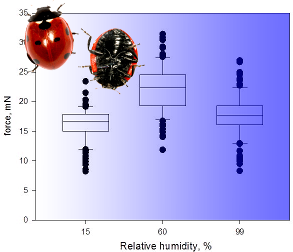
- with a pointed, filamentous tips (Figure 1E), (2) setae with lanceolate tips (Figure 1F), (3) setae with a flattened and rounded, spatula-shaped tips (Figure 1G), and (4) setae terminated with discoidal terminal elements (Figure 1K). All four types of tarsal adhesive setae were found in males. Females


Hydration of magnesia cubes: a helium ion microscopy study
Beilstein J. Nanotechnol. 2016, 7, 302–309, doi:10.3762/bjnano.7.28
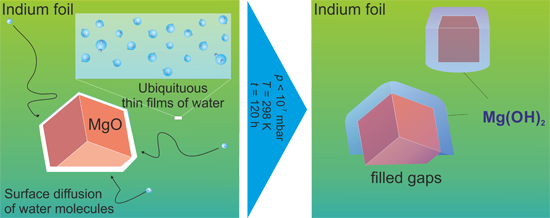
- with a spatula into a high purity indium foil of 130 μm thickness (purity 99.99%, Alfa Aesar, 12206 LOT: N17A040). This soft and conductive substrate was used as-received or dried through vacuum treatment (base pressure below 3·10−7 mbar) at room temperature for four days. The latter procedure was



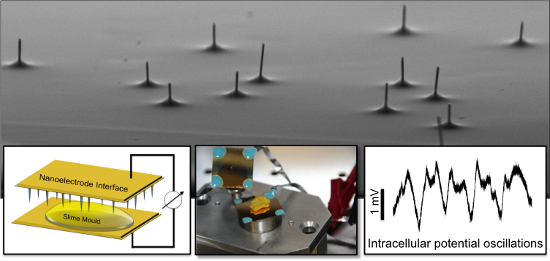
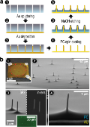
Functional fusion of living systems with synthetic electrode interfaces
Beilstein J. Nanotechnol. 2016, 7, 296–301, doi:10.3762/bjnano.7.27
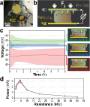
- spatula from a 2–3 day-old macroplasmodium and placed upside down onto a planar gold electrode (PGE) mounted on a nonconductive holding platform (Figure 2a,b). As Physarum p. exhibits rapid membrane regeneration after rupture, this macroplasmodial mass was allowed to recover for 1–2 min before mounting

Equilibrium states and stability of pre-tensioned adhesive tapes
Beilstein J. Nanotechnol. 2014, 5, 1725–1731, doi:10.3762/bjnano.5.182
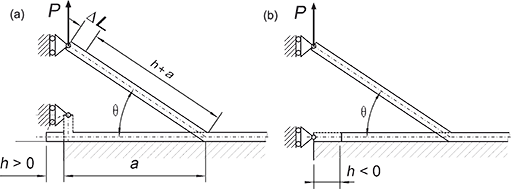
- and some vertebrates to climb on almost any surface, from smooth ones to cinder block-like surfaces [5]. In this respect, it has been shown in [6][7] that the highly flexible terminal spatula elements, which behave as compliant contacting surfaces, play a crucial role in the adhesion. Many efforts
- opposing feet and toes leading to a V-shaped geometry [9][10][32][33][34][35], which can be modelled by multiple-peeling schemes, as shown in [15][17][36], in which, based on the ground-breaking analysis proposed by Kendall [37], the crucial role of the spatula-shaped terminal elements in the biological

![[Graphic 5]](/bjnano/content/inline/2190-4286-5-182-i14.png?max-width=637&scale=1.18182) as a function of the peeling angle θeq at equilibrium (a); the tot...
as a function of the peeling angle θeq at equilibrium (a); the tot...


![[Graphic 11]](/bjnano/content/inline/2190-4286-5-182-i20.png?max-width=637&scale=1.18182) as a function of the peeling angle θeq at equilibrium, for differen...
as a function of the peeling angle θeq at equilibrium, for differen...
Insect attachment on crystalline bioinspired wax surfaces formed by alkanes of varying chain lengths
Beilstein J. Nanotechnol. 2014, 5, 1031–1041, doi:10.3762/bjnano.5.116
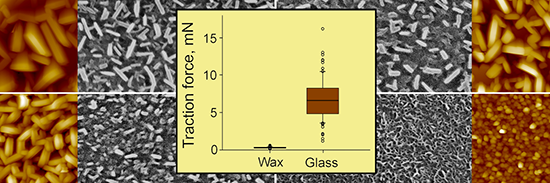
- ventrally curved claws with a claw tip diameter of about 4 μm [42] and hairy adhesive pads situated on the ventral side of the two first proximal tarsomeres (Figure 5a). Pads are covered with numerous tiny setae having various tip shapes, from sharp-pointed to spatula-like, ranging in width from ca. 1.8 to



Fibrillar adhesion with no clusterisation: Functional significance of material gradient along adhesive setae of insects
Beilstein J. Nanotechnol. 2014, 5, 837–845, doi:10.3762/bjnano.5.95
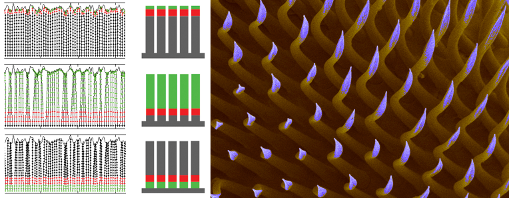
- different autofluorescences mentioned in the text. The arrows indicate the dorso-ventral material gradient in exemplary setae. S, exemplary spatula-like seta; P, exemplary seta with a pointed tip. Scale bars, 25 µm. From [12] (Nature Publishing Group). Typical configurations of the filamentary structure





