Search results
Search for "stability" in Full Text gives 1460 result(s) in Beilstein Journal of Organic Chemistry. Showing first 200.
Amino acid-based surfactants: sustainable synthesis and antimicrobial mechanisms
Beilstein J. Org. Chem. 2026, 22, 1067–1085, doi:10.3762/bjoc.22.85
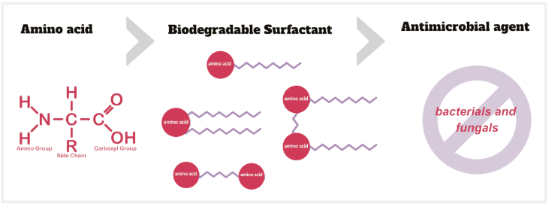
- single-chain analogues, lowering the critical micelle concentration (CMC) and improving interfacial stability properties critical for the formation of stable micelles and bilayers [46]. This effect is illustrated by the LANHC series (Table 1, entries 3–6), which exhibits CMC values between 0.032 and 0.16
- attractive for formulations where pH stability is critical [57]. Gemini surfactants Gemini surfactants (Figure 4d), a sophisticated class of amphiphiles, are defined by their unique structure: two hydrophobic chains covalently bonded to a shared nitrogen atom within the polar headgroup, which is often amino
- to optimize the charge distribution and bioactivity [57][72]. Representing the most sophisticated architecture, these surfactants exhibit exceptional performance metrics: CMC values 100–1000 times lower than monomeric surfactants; thermal stability up to 300 °C [70] and MIC values reported as low as


Synthesis of novel 1,2,4-oxadiazole-isoxazoline hybrids and their in silico potential with adenosine receptors
Beilstein J. Org. Chem. 2026, 22, 1033–1047, doi:10.3762/bjoc.22.82
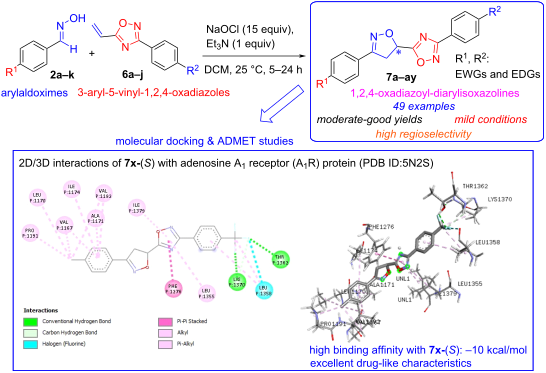
- essential. Future studies should therefore focus on in vitro and in vivo biological evaluation to confirm receptor activity, clarify agonist versus antagonist behavior, establish structure–activity relationships (SAR), and assess pharmacokinetic stability and toxicity profiles. General structure of


Z-Selective semihydrogenation of alkynes via Ni/Lewis acid synergistic catalyzed system using DMF as hydrogen source and solvent
Beilstein J. Org. Chem. 2026, 22, 1004–1012, doi:10.3762/bjoc.22.79
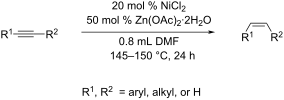
- ], it offers practical advantages over traditional hydrogen sources such as H₂, including high stability, operational simplicity, and ease of handling under ambient conditions – features that align with the practical requirements of synthetic chemistry [24][42]. Its compatibility with both Lewis acids



Novel macrocycles: from synthesis to supramolecular function
Beilstein J. Org. Chem. 2026, 22, 982–985, doi:10.3762/bjoc.22.76
- extraction efficiency even when flooded with competing anions. Furthermore, by evaluating the recyclability and solvent stability of covalent versus noncovalent immobilization, the study offers key design rules for building durable separation materials. While solid-supported systems demonstrate the
Electrochemical reduction of unsaturated carbon–carbon bonds via 3d transition-metal catalysis
Beilstein J. Org. Chem. 2026, 22, 955–981, doi:10.3762/bjoc.22.75
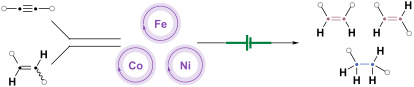
- stability of intermediates and the compatibility of the anodic and cathodic processes. In this review, the distinction between these two cell configurations is represented schematically by the number of bars placed between the electrodes, where a single bar denotes an undivided cell and a double bar denotes








Diastereodivergent electrophilic trapping of α-boryl lithium derivatives
Beilstein J. Org. Chem. 2026, 22, 882–887, doi:10.3762/bjoc.22.68
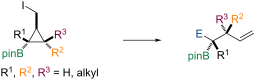
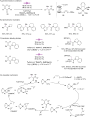
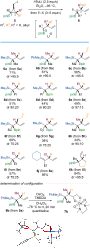
- effects suggests that the adjacent stereocenter at C2 might play a key role in the conformational stability and the stereochemical outcome. We therefore set out to extend the scope of the transformation by probing how substitution at the C2 position of precursor 2 affects the diastereoselectivity of the




Site-specific labelling of native peptides and proteins: chemical and enzymatic strategies
Beilstein J. Org. Chem. 2026, 22, 857–881, doi:10.3762/bjoc.22.67
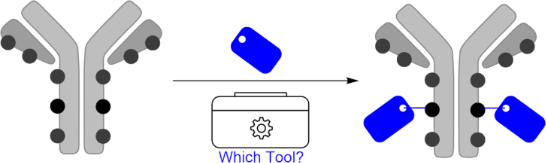
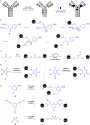
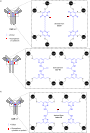
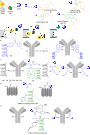
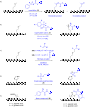
- reagents, organic solvents or chaotropic agents must be avoided to preserve protein stability, preventing folding heterogeneity and supporting sustainability. Scalability. For therapeutic and industrial applications, modification methods should minimise waste and curtail costs, reflected in low process
- . Incorporating cytotoxic payloads into bis-sulfone reagents yielded functional conjugates that exhibited stability in the presence of albumin in vivo [28]. Notably, this technology offers one of the few established routes to generate highly homogeneous ADC candidates, with a moderate level of drug loading, from
- , cytotoxin or SpyCatcher protein [40]. Despite the considerable modification of the chemical space around the antibody’s hinge region, antigen affinity and antibody stability are largely retained. Translating disulfide chemistries into therapeutic applications requires optimisation of key parameters








The trans-influence in gold chemistry from a catalytic perspective
Beilstein J. Org. Chem. 2026, 22, 838–856, doi:10.3762/bjoc.22.66
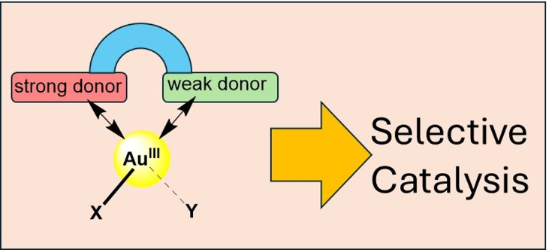
- gold(III) complexes has more recently become a focus of interest. Although often underestimated or not considered, the ligand trans-influence is a crucial factor in determining the reactivity of gold(III) compounds; it modifies not only bond polarisation, dissociation energies and thermal stability but
- -mediated reaction mechanisms. Following a brief discussion of general considerations, this Perspective examines how ligand structure and the resulting trans-influence determine reactivity and stability of gold(III) complexes supported by tridentate (pincer) ligands and in bidentate chelates, including
- an important role, affecting reaction rates, thermal stability, reaction pathways and selectivity. Various approaches have been taken to quantify these effects. Given the ubiquitous nature of gold(I) complexes LAuX and the fact that in such systems steric effects tend to be negligible, many studies


Unsymmetrical sulfoxides with sterically hindered catechol fragment: synthesis, structure, electrochemical properties, and antiradical activity
Beilstein J. Org. Chem. 2026, 22, 828–837, doi:10.3762/bjoc.22.65
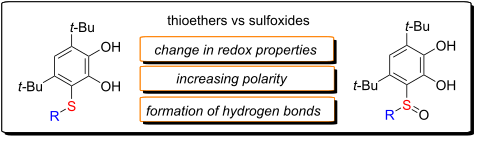
- , and antibacterial agents [6][7][8]. However, the practical utility of such type of compounds extends beyond biomedical applications. For instance, Michael addition reactions between dithiols and phenolic compounds yield cross-linked, colorless polymer films with universal adhesion and high stability


Knoevenagel condensation of 4,5- and 1,8-diazafluorenes
Beilstein J. Org. Chem. 2026, 22, 803–812, doi:10.3762/bjoc.22.62
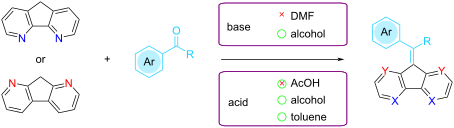
- and demonstrated higher basicity of the nitrogens in 1,8-diazafluorene as compared with those of 4,5-diazafluorene. Therefore, the protonation (and corresponding repulsion impeding the condensation) effect plays the decisive role solely for compound 2. Additionally, we evaluated the stability of the
- into 1,8-diazafluorenone by oxygen present in the reaction mixture. Therefore, the position of nitrogen atoms in diazafluorenes strongly affects their reactivity in acidic media via protonation, electrostatic repulsion, and stability of the condensation products. Therefore, the equilibrium in the




Synthetic study of vic-bromination of diarylacetylenes, easy purification and separation
Beilstein J. Org. Chem. 2026, 22, 795–802, doi:10.3762/bjoc.22.61
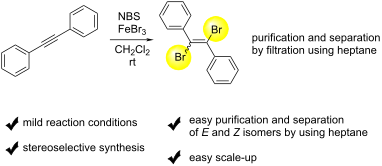
- ). Poor selectivity as shown in entries 1 and 2 might be due to the stability of the intermediate. In the cases of Table 2, entries 3–6 residues such as MeO, F, Br and CN as the substituent at para position of the benzene ring in 1d–g, the selectivity of E and Z and the isolated yield of the E isomer



Halogenated azobenzene acrylates: from efficient solution photoswitching to stable solid-state photochromic materials
Beilstein J. Org. Chem. 2026, 22, 782–794, doi:10.3762/bjoc.22.60
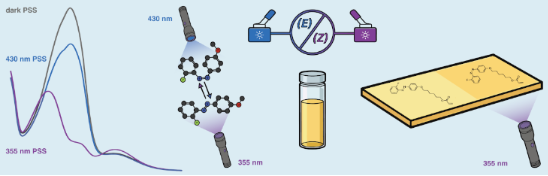
- arrangement. Kinetics studies identified the most stable Z-isomer of the difluoro derivative (τ1/2 = 3.74/6.59 h at 60 °C in DCE/CDCl3). The monofluoro derivative embedded in a polystyrene film demonstrated photoresponsive behavior and remarkable stability by maintaining a macroscopically visible color change
- noticeable. The eventual thermal back Z → E switching was investigated in the dark at 60 °C during 14 h revealing a minor change in the shade and pointing to a high thermal stability of Z-1a in the polystyrene film. Azobenzene 1a was also copolymerized with an acrylate matrix. The photoswitching performance
- derivatives are planar, nonplanar disubstituted derivatives with diminished conjugation possess blue-shifted absorption and lower conversion efficiency. The stability of the resulting Z-isomers ( values) can be tuned similarly. In solution, the difluoro derivative 1b was identified as the most stable and


Design, synthesis, and biological evaluation of FXR/ASK1 dual-target modulators
Beilstein J. Org. Chem. 2026, 22, 771–781, doi:10.3762/bjoc.22.59
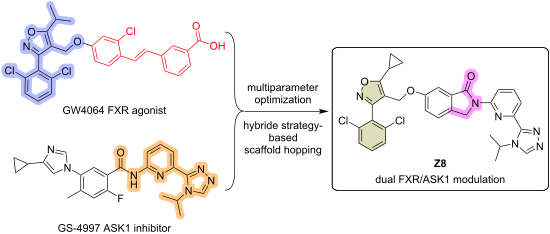
- comprehensive multiparameter optimization, compound Z8 emerged as a lead FXR/ASK1 dual modulator, demonstrating suitable liver microsome stability and high target selectivity. Collectively, compound Z8 holds great promise for the treatment of MASH. FXR agonist activity of all compounds. Results of the dual


Preparation of 3-(alkylamino)imidazo[1,2-a]pyridine-2-carbaldehydes via Kornblum oxidation and unexpected ring-opening reactions of the corresponding alcohols under oxidative conditions
Beilstein J. Org. Chem. 2026, 22, 763–770, doi:10.3762/bjoc.22.58
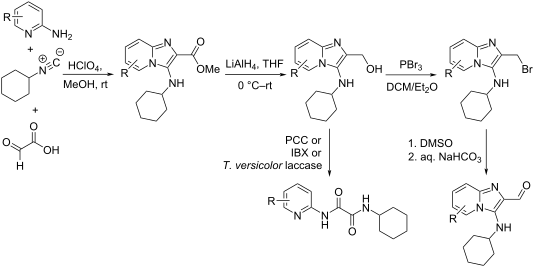
- reductive amination in mind. Imidazo[1,2-a]pyridin-3-amines bearing an aldehyde substituent at the 2-position have not been previously reported and we were uncertain as to their stability. Attempted reduction of the ester (13b) to the corresponding aldehyde using DIBAL-H met with failure, with unreacted


Synthesis of heterocycles based on azomethine ylides from α-amino acids (or amines) and carbonyl compounds
Beilstein J. Org. Chem. 2026, 22, 705–741, doi:10.3762/bjoc.22.55
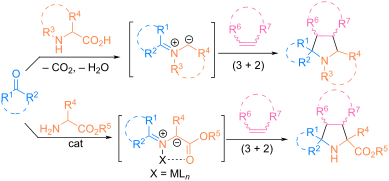
- efficient synthesis of a series of polysubstituted enantioenriched pyrrolidine derivatives 48 possessing a spiroindene molecular structure (Scheme 22) [59]. Based on the results of DFT calculations, it was suggested that the [6 + 3] cycloaddition product for benzofulvene 47 loses aromatic stability and


Using generative AI to transform peptide hits into small molecule leads
Beilstein J. Org. Chem. 2026, 22, 672–679, doi:10.3762/bjoc.22.51
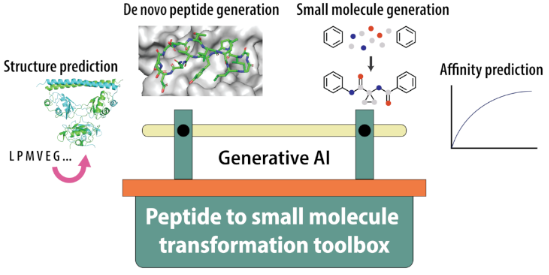
- , hampered by pharmacokinetic liabilities such as poor metabolic stability, limited membrane permeability, and low oral bioavailability. In some cases, peptides may be suitable for therapeutic use after installing a small number of chemical modifications (e.g., lipidation of peptide hormones such as GLP-1


Photoorganocatalytic trifluoromethylation of (het)arenes in green conditions
Beilstein J. Org. Chem. 2026, 22, 662–671, doi:10.3762/bjoc.22.50
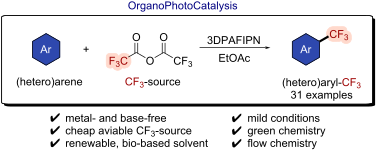
- compounds play a crucial role in pharmaceuticals, agrochemicals, and advanced functional materials. A substantial fraction of newly approved drugs feature a CF3 group, reflecting its unique ability to modulate the chemical stability, lipophilicity, and biological activity of active pharmaceutical


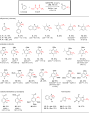


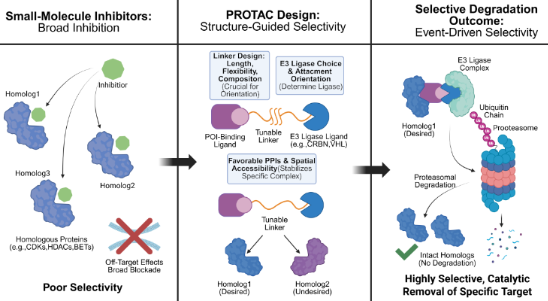
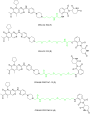
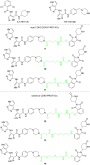
Advantages of PROTACs in achieving selective degradation of homologous protein families
Beilstein J. Org. Chem. 2026, 22, 628–661, doi:10.3762/bjoc.22.49









Computational prediction of C–H hydricities and their use in predicting the regioselectivity of electron-rich C–H functionalisation reactions
Beilstein J. Org. Chem. 2026, 22, 603–610, doi:10.3762/bjoc.22.46
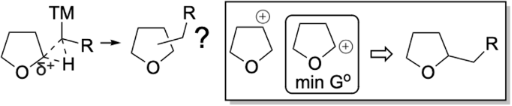
- primarily anthracene derivatives and benzyl C–H bonds, suggesting potential systematic errors in QM computations or experimental measurements. Radical and cation stabilities generally follow the trend: tertiary > secondary > primary methyl carbon stability. Our study also explores the correlation between


![[Graphic 6]](/bjoc/content/inline/1860-5397-22-46-i8.svg?max-width=637&scale=1.18182)


Experimental and DFT studies on the regioselective methanolysis of 5-azido-9-oxabicyclo[6.1.0]nonan-4-yl 4-nitrobenzoate isomers
Beilstein J. Org. Chem. 2026, 22, 547–556, doi:10.3762/bjoc.22.40
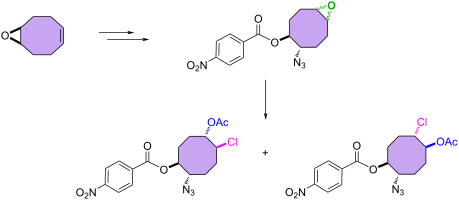
- difference between TS1 and TS2 (4.7 kcal/mol), compared to that between TS3 and TS4 (6.9 kcal/mol), can be attributed to hydrogen-bond stabilization in TS2, indicating that conformational effects play a more dominant role than hydrogen bonding in determining transition-state stability. Mulliken charge


Get a better glimpse on sequential photoreactions of trisnorbornadienes with 19F NMR spectroscopy
Beilstein J. Org. Chem. 2026, 22, 527–534, doi:10.3762/bjoc.22.38
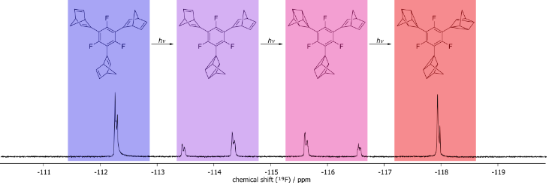
- substituents has been examined in more detail for 2-cyano-3-arylnorbornadienes. And these studies have shown that the substituents in ortho position lead to an increased thermal stability in comparison with the meta and para-substituted isomers [54]. Although the longer half-life of the trisquadricyclane may


Synthesis of a HDAC inhibitor–nanogold probe for cryo-EM visualization in class I HDAC co-repressor complexes
Beilstein J. Org. Chem. 2026, 22, 480–485, doi:10.3762/bjoc.22.35
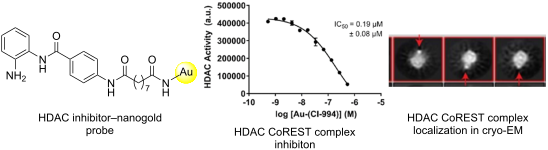
- , and was stable for days stored at −20 °C (stability determined by 1H NMR, Figures S1–S4 in Supporting Information File 1). For the conjugation of 9 to Au–NH2, an excess of 9 was used to drive the conjugation reaction to completion. Unreacted 9 was then removed by repeated washing with water and buffer



Recent advances in the stereoselective synthesis of distal biaxially chiral molecules
Beilstein J. Org. Chem. 2026, 22, 461–479, doi:10.3762/bjoc.22.34
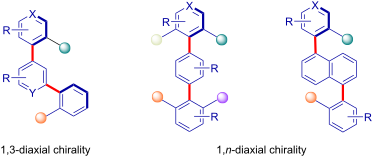
- , overcoming the challenges of steric complexity and dynamic stability to achieve efficient and general construction remains a critical issue. This review summarizes recent advances in the field of distal biaxial chirality, highlighting three major synthetic strategies: direct one-step construction of distal
- suffer from the challenges of difficult stereoselectivity control and low conformational stability. For this reason, numerous attempts have been made towards the efficient construction of distally biaxially chiral skeletons, and a variety of synthetic strategies such as [2 + 2 + 2] cycloaddition and


Synthesis and stereochemical analysis of dynamic planar chiral oxa[7]orthocyclophene
Beilstein J. Org. Chem. 2026, 22, 436–442, doi:10.3762/bjoc.22.30

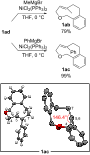
- oxacyclophene enabled the efficient and divergent synthesis of C6-substituted derivatives. The stereochemical analysis of the oxacyclophenes revealed that the iodo- and methyl-substituted derivatives have reasonable stereochemical stability. The planar chirality of the methyl-substituted oxacyclophene was
- ][3][4][5][6][7][8][9][10], we previously synthesized hetera[7]orthocyclophenes 1 having a heteroatom-embedded ansa-chain (X = O or NR) and an (E)-alkene moiety (Figure 1) [6][9], and found that the orthocyclophenes exhibit dynamic planar chirality in a wide range of stereochemical stability depending
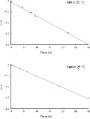
- on the differences of the heteroatom and substituents on the (E)-alkene moiety [11][12]. The half-lives of the optical activity optt1/2 of 1aa (X = O, Y = H) and 1ba (X = NTs, Y = H) were 380 h and 56.7 h at 25 °C, respectively, indicating that the stereochemical stability of the oxygen-containing






Cone p-aminocalix[4]arenes enriched with ‘clickable’ alkyne or azide functionalities
Beilstein J. Org. Chem. 2026, 22, 399–415, doi:10.3762/bjoc.22.28
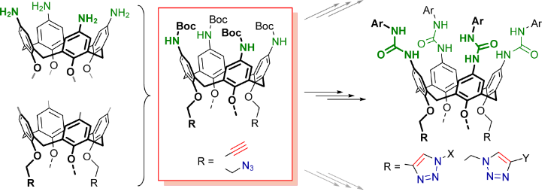
- thermodynamic and kinetic stability of the capsules and the guest exchange processes [55][56][57][58][59][60]. This has made dimerization of tetraureacalix[4]arenes one of the most explored self-organization processes in calixarene supramolecular chemistry, which has been used in the template synthesis of
- groups [100], the presence of one bulky moiety at the narrow rim of the tetraureacalix[4]arene does not lead to a significant difference in the stability of the homodimers formed by compound 49, at least in a chloroform solution. To further confirm the ability of calixarene 49 to form capsules, the 1H
- aqueous phase (at ≈4.8 ppm) along with a signal from dissolved water (1.56 ppm). Considering the low solubility of water in chloroform, the stability of the capsules in water-saturated CDCl3 seems reasonable, because the dimers are held together by at least 16 hydrogen bonds between the urea groups. On