


Search results
Search for "cyclopropanation" in Full Text gives 93 result(s) in Beilstein Journal of Organic Chemistry.
Unusual highly diastereoselective Rh(II)-catalyzed dimerization of 3-diazo-2-arylidenesuccinimides provides access to a new dibenzazulene scaffold
Beilstein J. Org. Chem. 2022, 18, 533–538, doi:10.3762/bjoc.18.55
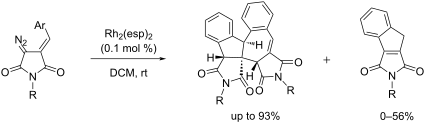
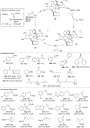
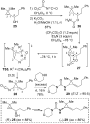
- formation of a single diastereomer at the cyclopropanation step can be explained by the preferred approach of carbene A from the least sterically hindered side of indene C and the π-stacking interaction of the aromatic fragment of indene and the benzylidene substituent of the carbene. The conversion of


Strategies for the synthesis of brevipolides
Beilstein J. Org. Chem. 2021, 17, 2399–2416, doi:10.3762/bjoc.17.157
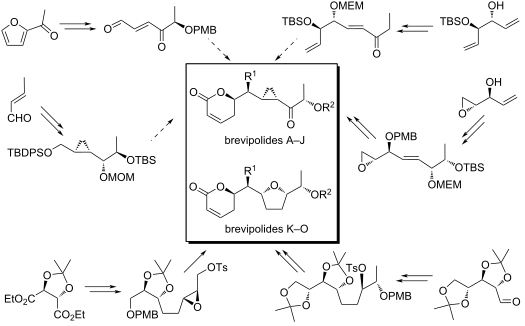
- –Smith cyclopropanation; Hyptis brevipes Poit; ring-closing metathesis; Introduction Hyptis brevipes Poit. is an invasive plant species belonging to the mint family Lamiaceae [1][2][3][4]. This plant has been reported to originate from tropical America but is now distributed broadly in other tropical
- commercially available (E)-p-methoxycinnamic acid (17). The vital intermediate 16 is expected from cyclopropyl epoxy alcohol 18, which in turn can be prepared from allylic alcohol 19 via the Furukawa-modified Simmons–Smith cyclopropanation and VO-mediated epoxidation. Acetylfuran (20) is chosen as the six
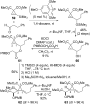
- influence the stereo-outcome for the later cyclopropanation step. Thus, treatment of 25 with diethylzinc and diiodomethane delivered the expected syn-cyclopropyl carbinol 26 as the major diastereomer (dr 95:5) in 90% yield. After the protection of the secondary alcohol as MOM ether, the primary alcohol was


Asymmetric organocatalyzed synthesis of coumarin derivatives
Beilstein J. Org. Chem. 2021, 17, 1952–1980, doi:10.3762/bjoc.17.128
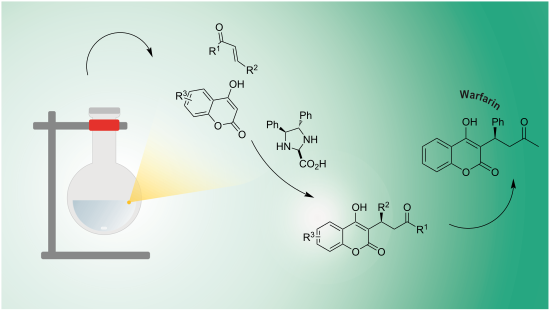
- of spiroonxindole-cyclopropa[c]coumarins 75 through the cyclopropanation of 3-acylcoumarins 43 and 3-halooxindoles 74 [58]. The authors chose a quinine-derived squaramide catalyst 73 to perform the [2 + 1] cycloaddition. This catalyst reacts with 3-halooxindole, generating an ammonium salt which is




Synthesis of β-triazolylenones via metal-free desulfonylative alkylation of N-tosyl-1,2,3-triazoles
Beilstein J. Org. Chem. 2021, 17, 762–770, doi:10.3762/bjoc.17.66
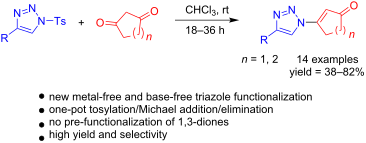
- many bioactive heterocycles [36]. These are also important precursors of diazo adducts which are used in insertion, cyclopropanation, and various rearrangements to construct various cyclic as well as acyclic moieties under metal-catalysed conditions [37][38]. On the contrary, under basic conditions


[2 + 1] Cycloaddition reactions of fullerene C60 based on diazo compounds
Beilstein J. Org. Chem. 2021, 17, 630–670, doi:10.3762/bjoc.17.55
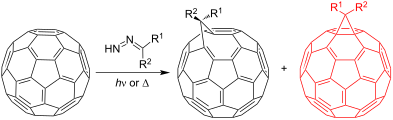
- promising. They are synthesized in two main reactions: nucleophilic cyclopropanation according to the Bingel method and thermal addition of diazo compounds. This present review summarizes the material on the synthesis of monofunctionalized methanofullerenes – analogues of [60]PCBM – based on various diazo
- ]PCBM; diazo compounds; mechanisms and optimal conditions of cyclopropanation; methanofullerenes C60; Introduction Taking into consideration that all life on Earth is of organic origin. with carbon as its basic element (20% by weight of every living organism, and the fourth most abundant element in the
- processes, among which reactions leading to methanofullerenes are widely used. Two main synthetic methods for the production of methanofullerenes can be distinguished (Scheme 1): nucleophilic cyclopropanation with stabilized carbanions that occurs by the addition–cleavage mechanism – the Bingel reaction (I
The preparation and properties of 1,1-difluorocyclopropane derivatives
Beilstein J. Org. Chem. 2021, 17, 245–272, doi:10.3762/bjoc.17.25
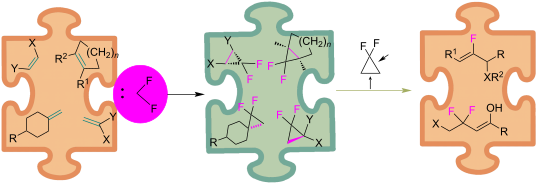
- activity; cyclopropanation; difluorocyclopropane derivatives; synthesis; Introduction The chemistry of cyclopropane derivatives is one of the most intensively developing fields of organic chemistry. In the past decade there have been made many investigations to develop new chemo-, regio- and
- difluorocyclopropane and its derivatives can be distinguished: carbene and non-carbene methods of cyclopropanation along with functional group transformations of existing cyclopropanes. The most popular route to prepare fluorocyclopropanes is to generate fluorine-containing carbenes (or carbenoids), which then react
- with multiple bonds, resulting in cyclopropanation. One of the important properties of fluorine-containing carbenes and carbenoids is their electrophilicity, which is a result of the high electronegativity of fluorine. Also, fluorine has an +M effect which tends to reduce the reactivity of the carbenes




Au(III) complexes with tetradentate-cyclam-based ligands
Beilstein J. Org. Chem. 2021, 17, 186–192, doi:10.3762/bjoc.17.18
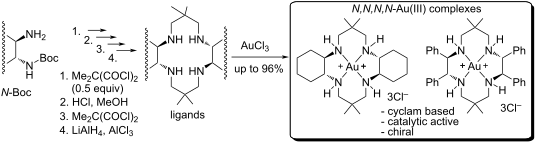
- ; cyclam derivatives; cyclopropanation; Introduction The importance of gold for humankind dates long back, and gold is linked to the evolution of many parts of the society. Contrary to the general fascination and importance of gold, the potential as homogenous catalyst has been neglected, compared to a
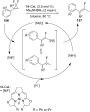
- cyclopropanation of styrene with propargyl ester [49][50][51][52] (Table 1) were selected as test reactions. These reactions have previously been studied with different gold(I) and gold(III) catalysts and a variety of substrates, thus providing a solid background for comparison. A large difference in the catalytic
- ) catalysis of the cyclopropanation reaction, where complex 5a-Au(III) and 6a-Au(III) gave full conversion in 1 hour and 12 hours, respectively (Table 1, entries 4 and 5). The cyclopropyl product 11 was obtained in >90% yield and high cis diastereoselectivity (up to 74% de), similar to our previous studies


Synthesis of novel fluorinated building blocks via halofluorination and related reactions
Beilstein J. Org. Chem. 2020, 16, 2562–2575, doi:10.3762/bjoc.16.208
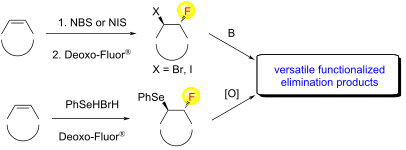
- interactions are marked with blue two-headed arrows. Mechanism of the reaction of the cyclopropanation of the compounds (rac)-2a,b and (rac)-5a with t-BuOK. Presumed mechanism of the reaction of the compound (rac)-6b with t-BuOK. Cyclizations of halofluorinated tetrahydrophthalimides with DBU. Relevant NOESY


Copper catalysis with redox-active ligands
Beilstein J. Org. Chem. 2020, 16, 858–870, doi:10.3762/bjoc.16.77
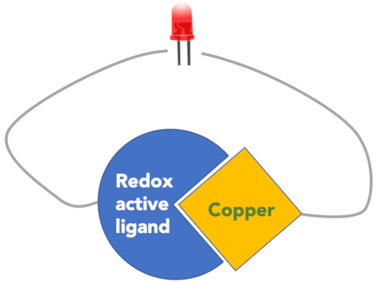
- cyclopropanation through a strained redox-active ligand framework reminiscent of the entatic state model. Products are obtained as a mixture of cis and trans isomers. Funding This work has been supported through funding from the Université de Strasbourg, CNRS, IDEX Excellence Initiative (AD), Emergence Sorbonne


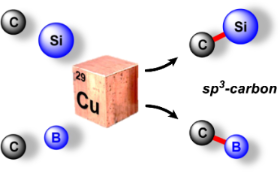
Recent advances in Cu-catalyzed C(sp3)–Si and C(sp3)–B bond formation
Beilstein J. Org. Chem. 2020, 16, 691–737, doi:10.3762/bjoc.16.67
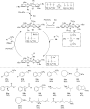
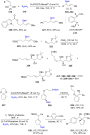
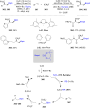
- alcohol due to decomposition. Nonetheless, several products could be transformed into molecules of greater complexity. For example, cyclopropanation could be achieved to give 269. Additionally, TBS protection of 268 followed by ring closing metathesis (RCM) led to the interesting 6-membered silacycle 270






Synthesis of organic liquid crystals containing selectively fluorinated cyclopropanes
Beilstein J. Org. Chem. 2020, 16, 674–680, doi:10.3762/bjoc.16.65
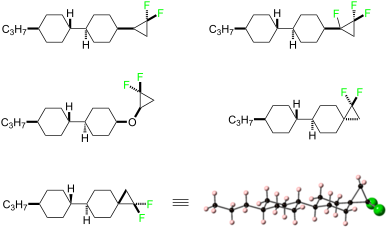
- 18 in a very straightforward manner, and the product could be isolated by chromatography in 72% yield [17]. This olefin was then subject to a difluorocarbene cyclopropanation using TMSCF3 and NaI, and this generated both isomers, 11a and 11b, in a ratio of 5:1, respectively. After three


Visible-light-induced addition of carboxymethanide to styrene from monochloroacetic acid
Beilstein J. Org. Chem. 2020, 16, 398–408, doi:10.3762/bjoc.16.38
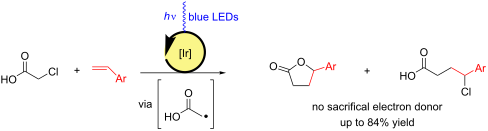
- decarboxylative activation we anticipated its possibilities in cyclopropanation. The chloromethyl radical generation by photoredox catalysis is a useful strategy for cyclopropanation [58]. Most photoredox catalyzed, decarboxylative generations of carbon-centered radicals are based on the formation of “stabilized
- cyclopropanation. We have screened a series of strongly oxidizing photoredox catalysts and various alkenes, but unfortunately we were thus far unsuccessful in obtaining cyclopropane derivatives (see experimental section). Conclusion We have shown that it is possible to use monochloroacetic acid to form two types
- chloromethyl radical can be formed with photoredox catalysis from monochloroacetic acid, but we were not yet able to apply such reactions in a productive manner, such as in cyclopropanation reactions. A part of the industry around monochloroacetic acid. Cyclic voltammogram of monochloroacetic acid and


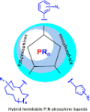
Architecture and synthesis of P,N-heterocyclic phosphine ligands
Beilstein J. Org. Chem. 2020, 16, 362–383, doi:10.3762/bjoc.16.35
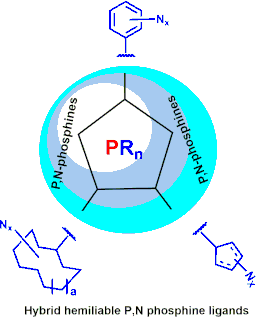
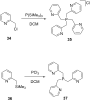
- -(diphenylphosphine)ethyl)-4,5-diazafluorene ligand 47 which includes a cyclopropylated intermediate (45, Scheme 8). The ligand was prepared by an initial cyclopropanation of diazafluorene 44. For this, 44 was treated with a dibromomethane solution in THF in the presence of sodium hydride under reflux for four hours




Combination of multicomponent KA2 and Pauson–Khand reactions: short synthesis of spirocyclic pyrrolocyclopentenones
Beilstein J. Org. Chem. 2020, 16, 200–211, doi:10.3762/bjoc.16.23
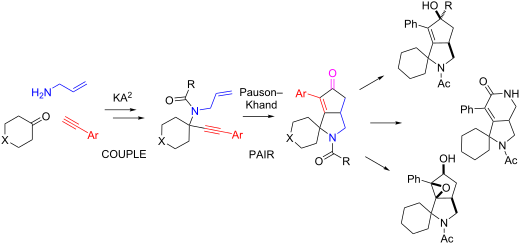
- presence of camphorsulfonic acid did not give the desired amine, supporting the hypothesis of steric hindrance at such position [57]. Similarly, Simmons–Smith cyclopropanation reaction [58] did not work, and so as for the cycloaddition reaction with Danishefsky’s diene, possibly due to steric hindrance




AgNTf2-catalyzed formal [3 + 2] cycloaddition of ynamides with unprotected isoxazol-5-amines: efficient access to functionalized 5-amino-1H-pyrrole-3-carboxamide derivatives
Beilstein J. Org. Chem. 2019, 15, 2623–2630, doi:10.3762/bjoc.15.255

- -mediated reactions of alkynes (Scheme 1, path b). In 2007, Echavarren and co-workers have developed an intramolecular cyclopropanation reaction of 1,6-enynes by silver catalysis, involving probably the generation of a silver-carbene species [15]. Wang and co-workers reported a range of propargylic esters
- tethered to cyclohexadienones that can be converted into complex polycycles by Ag-carbenoid-initiated cascades [16]. Recently, Zhu’s group developed a tandem 1,3‑dipolar cycloaddition/cyclopropanation silver-catalyzed reaction of enynals with alkenes [17]. In our previous studies, this silver carbene


Cyclopropanation–ring expansion of 3-chloroindoles with α-halodiazoacetates: novel synthesis of 4-quinolone-3-carboxylic acid and norfloxacin
Beilstein J. Org. Chem. 2019, 15, 2156–2160, doi:10.3762/bjoc.15.212
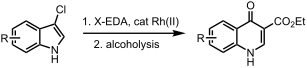
- efficient way of synthesizing two synthetically versatile 4-quinolone-3-carboxylate building blocks by cyclopropanation-ring expansion of 3-chloroindoles with α-halodiazoacetates as the key step. This novel transformation was applied towards the synthesis of the antibiotic drug norfloxacin. Keywords
- : catalysis; cyclopropanation; indole; norfloxacin quinoline; quinolone; Rh(II); ring expansion; Introduction The development and use of metal carbenes occupy a central part in the field of the C–H functionalization [1]. Among the metal carbenes, the transient Rh carbenes, usually made by Rh-catalyzed
- decomposition of diazo compounds, are particularly versatile intermediates in organic synthesis, as they partake in cyclopropanation and C–H insertion reactions with high levels of selectivity [2]. This transition-metal-catalyzed carbene transfer has emerged as a mild and attractive route to indole


Reusable and highly enantioselective water-soluble Ru(II)-Amm-Pheox catalyst for intramolecular cyclopropanation of diazo compounds
Beilstein J. Org. Chem. 2019, 15, 357–363, doi:10.3762/bjoc.15.31
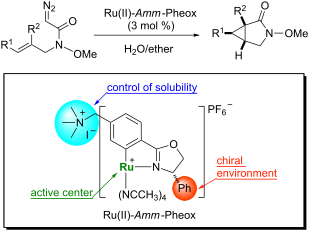
- Hibarigaoka, Tempaku-Cho, Toyohashi 441-8580, Japan 10.3762/bjoc.15.31 Abstract A reusable and highly enantioselective catalyst for the intramolecular cyclopropanation of various diazo ester and Weinreb amide derivatives was developed. The reactions catalyzed by a water-soluble Ru(II)-Amm-Pheox catalyst
- crucial for the intramolecular cyclopropanation reaction in a water/ether biphasic medium. The water-soluble catalyst could be reused at least six times with little loss in yield and enantioselectivity. Keywords: asymmetric synthesis; carbene transfer; cyclopropanation; diazoester; intramolecular
- processing [1][2][3][4][5][6][7][8][9][10][11][12][13]. Thus, the study of organic reactions in water is an important area of research [14][15][16][17][18][19][20][21]. Nevertheless, only a few catalytic cyclopropanation reactions were carried out in aqueous media [22][23][24][25][26][27][28]. In our


Sigmatropic rearrangements of cyclopropenylcarbinol derivatives. Access to diversely substituted alkylidenecyclopropanes
Beilstein J. Org. Chem. 2019, 15, 333–350, doi:10.3762/bjoc.15.29
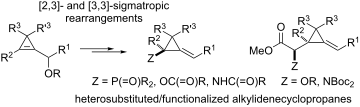
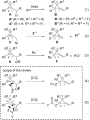
- (TBS) ether of propargyl alcohol by a rhodium-catalyzed cyclopropanation with an aryldiazoacetate followed by reduction of the ester moiety and protecting group manipulation. Phosphinite 6a, generated from alcohol 5a under standard conditions, did not undergo a [2,3]-sigmatropic rearrangement into the







Synthesis of 1,2-divinylcyclopropanes by metal-catalyzed cyclopropanation of 1,3-dienes with cyclopropenes as vinyl carbene precursors
Beilstein J. Org. Chem. 2019, 15, 285–290, doi:10.3762/bjoc.15.25

- Abstract The synthesis of 1,2-divinylcyclopropanes by the reaction of cyclopropenes with 1,3-dienes is reported. The process relies on the ability of ZnCl2 or [Rh2(OAc)4] to generate metal–vinyl carbene intermediates from cyclopropenes, which effect cyclopropanation of 1,3-dienes. Most of the reactions
- proceeded in reasonable yields while the diastereoselectivity strongly depends on the structure of the diene. An example of an intramolecular process as well as the use of furan and 1,4-cyclohexadiene as dienes are also reported. Keywords: cyclopropanation; cyclopropenes; dienes; divinylcyclopropanes
- cyclopropanecarboxaldehydes [10] or reactions of metallated vinylcyclopropanes with suitable electrophiles are commonly employed (Scheme 1a) [11][12][13]. In a more convergent approach where the cyclopropane ring is created at the last stage, divinylcyclopropanes can be prepared by cyclopropanation of 1,3-dienes with metal




Oxidative radical ring-opening/cyclization of cyclopropane derivatives
Beilstein J. Org. Chem. 2019, 15, 256–278, doi:10.3762/bjoc.15.23
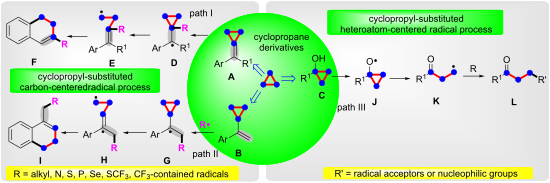
- cyclopropanols 91 derived from Kulinkovich cyclopropanation into linear enones 147 was developed by Wu and co-workers [121]. The approach features the regioselective cleavage of the cyclopropane rings in EtOH at room temperature with cheap and readily available Co(acac)2 as the catalyst and air as the reagent








Gold-catalyzed ethylene cyclopropanation
Beilstein J. Org. Chem. 2019, 15, 67–71, doi:10.3762/bjoc.15.7
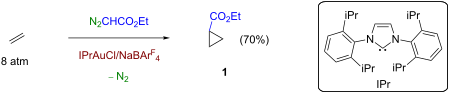
- transfer; cyclopropane; cyclopropylcarboxylate; ethylene cyclopropanation; ethyl diazoacetate; gold catalysis; Introduction Nowadays the olefin cyclopropanation through metal-catalyzed carbene transfer starting from diazo compounds to give olefins constitutes a well-developed tool (Scheme 1a), with an
- compounds bearing a carboxylate substituent are the most commonly employed carbene precursors toward olefin cyclopropanation, their use with ethylene leads to cyclopropane (Scheme 1b). De Bruin and co-workers have described [4] such product in a minor, secondary reaction (yields <12%) while studying the
- = tetrakis(3,5-bis(trifluoromethyl)phenyl)borate) catalyzes the ethylene cyclopropanation with ethyl diazoacetate as the carbene precursor, under mild conditions, with moderate yields (ca. 70%, EDA-based). Results and Discussion Diazo compounds N2=CRR’ usually react with metal complexes of groups 8–11 with


Novel photochemical reactions of carbocyclic diazodiketones without elimination of nitrogen – a suitable way to N-hydrazonation of C–H-bonds
Beilstein J. Org. Chem. 2018, 14, 2250–2258, doi:10.3762/bjoc.14.200

- , giving rise to the formation of hydrazone 3 as the final reaction product (Scheme 1). On direct irradiation of tricyclic diazodiketones 1 possessing endo-configuration (Figure 2), one would expect in addition to the Wolff rearrangement also the occurrence of an intramolecular cyclopropanation (with 1b,d


Nanoreactors for green catalysis
Beilstein J. Org. Chem. 2018, 14, 716–733, doi:10.3762/bjoc.14.61
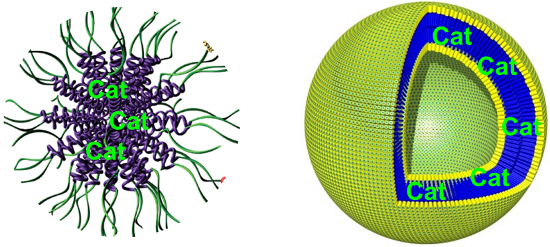
- asymmetric aldol reaction of cyclohexanone and 4-nitrobenzaldehyde [83]. Cross-linked polymersome nanoreactors were also used to perform asymmetric cyclopropanation reactions in water [15]. These products are highly desired intermediates in the preparation of agrochemicals and pharmaceuticals [84][85][86
- ]. To perform cyclopropanation reactions in polymersomes, the membrane was cross-linked with bisoxazoline (BOX) ligands complexing the copper catalyst. Cyclopropanation reactions were efficiently performed in water, resulting in high yields and enantioselectivities, comparable to those when the reaction
- -proline 4b-catalyzed reactionsa: Asymmetric cyclopropanation reaction of styrene derivatives and ethyl diazoacetatea. Acknowledgements The authors acknowledge support from Horizon 2020 FET-Open program 737266 - ONE-FLOW; with regard to the graphical abstract we acknowledge Dennis Vriezema and Pille et al


Acid-catalyzed ring-opening reactions of a cyclopropanated 3-aza-2-oxabicyclo[2.2.1]hept-5-ene with alcohols
Beilstein J. Org. Chem. 2017, 13, 2888–2894, doi:10.3762/bjoc.13.281
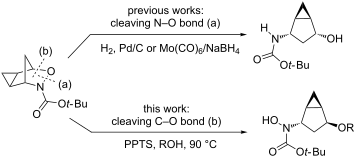
- ; alcohol nucleophiles; cyclopropanation; heterobicyclic compounds; ring-opening reactions; Introduction Heterobicyclic alkenes are useful templates to generate complex cyclic and acyclic systems [1][2]. 3-Aza-2-oxabicyclic alkenes are particularly interesting due to their asymmetric nature and the ability
- ], organozinc or Grignard reagents [12], Rh [13], and Ru [14] catalysts. Another interesting modification of the alkene component is cyclopropanation. To date, there are a few reported examples in the literature of the cyclopropanation of 3-aza-2-oxabicyclic alkenes [15][16][17]. The addition of a cyclopropane


Dialkyl dicyanofumarates and dicyanomaleates as versatile building blocks for synthetic organic chemistry and mechanistic studies
Beilstein J. Org. Chem. 2017, 13, 2235–2251, doi:10.3762/bjoc.13.221
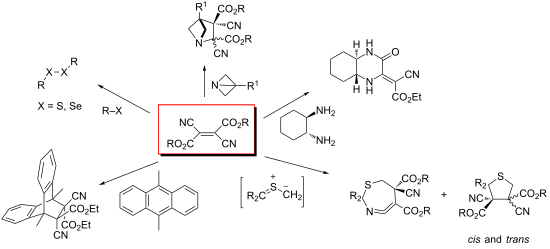
- mechanistic explanation of this cyclopropanation reaction is based on the assumption that the intermediate zwitterion 18a undergoes either a 1,3- or 1,5-electrocyclization leading to 15 or thiolanes 19a. The experiments with both isomers of 1b showed that the reactions proceeded non-stereospecifically and
- alkyl cyanoacetates 2. Methods for the synthesis of dialkyl dicyanofumarates E-1 from alkyl bromoacetates 3. Reaction of dimethyl dicyanofumarate (E-1b) with dimethoxycarbene [(MeO)2C:] generated in situ from the precursor 7. Cyclopropanation of diethyl dicyanofumarate (E-1a) through reaction with the
- thiophene derived sulfur ylide 12. Cyclopropanation of dimethyl dicyanofumarate (E-1b) through a stepwise reaction with the in situ generated thiocarbonyl S-isopropanide 16a. The [2 + 2]-cycloadditions of dimethyl dicyanofumarate (E-1b) with electron-rich ethylenes 20 and 22. The [2 + 2]-cycloaddition of





