


Search results
Search for "retrosynthetic analysis" in Full Text gives 141 result(s) in Beilstein Journal of Organic Chemistry.
Strategies for the synthesis of brevipolides
Beilstein J. Org. Chem. 2021, 17, 2399–2416, doi:10.3762/bjoc.17.157
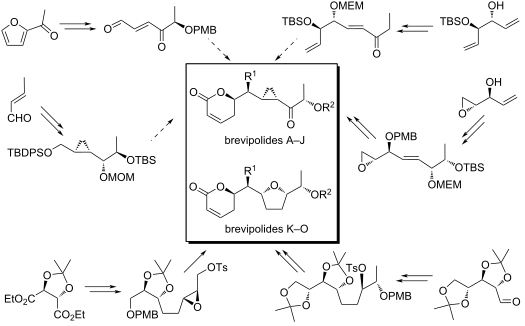
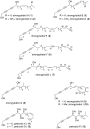
- design new synthetic methodologies for reproducing these natural products and their analogues as well as to develop new pharmaceuticals from them. Structures of brevipolides A–O (1 – 15). Retrosynthetic analysis of brevipolide H (8) by Kumaraswamy. Attempt to synthesize brevipolide H (8) by Kumaraswamy
- . (R,R)-Noyori cat. = RuCl[N-(tosyl)-1,2-diphenylethylenediamine)(p-cymene)]. Attempt to synthesize brevipolide H (8) by Kumaraswamy (continued). Retrosynthetic analysis of brevipolide H (8) by Hou. Synthesis ent-brevipolide H (ent-8) by Hou. Retrosynthetic analysis of brevipolide H (8) by Mohapatra
- . Attempt to synthesize brevipolide H (8) by Mohapatra. Attempt to synthesize brevipolide H (8) by Mohapatra (continued). (+)-(IPC)2-BCl = (+)-B-chloro-diisopinocampheylborane. Retrosynthetic analysis of brevipolide H (8) by Hou. Synthesis of brevipolide H (8) by Hou. Retrosynthetic analysis of brevipolide


Free-radical cyclization approach to polyheterocycles containing pyrrole and pyridine rings
Beilstein J. Org. Chem. 2021, 17, 1490–1498, doi:10.3762/bjoc.17.105

- parameters are drawn at 50% probability level. Molecular structure of compound 17a, displacement parameters are drawn at 50% probability level. Retrosynthetic analysis of heterocycles A and B. Free-radical cyclization of N-protected and N-unprotected pyrroles 1a and 2. Synthesis of 2H-pyrido[2,1-a]pyrrolo


Synthesis of multiply fluorinated N-acetyl-D-glucosamine and D-galactosamine analogs via the corresponding deoxyfluorinated glucosazide and galactosazide phenyl thioglycosides
Beilstein J. Org. Chem. 2021, 17, 1086–1095, doi:10.3762/bjoc.17.85
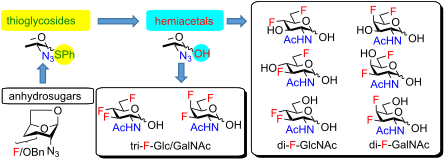
- resulting from the low stability of amino sugar hemiacetals. The prepared polyfluorinated thiodonors and hemiacetals are valuable intermediates in oligosaccharide synthesis and their utility in glycosylation is currently being studied in our group. Retrosynthetic analysis of the target fluoro analogs



Total synthesis of pyrrolo[2,3-c]quinoline alkaloid: trigonoine B
Beilstein J. Org. Chem. 2021, 17, 730–736, doi:10.3762/bjoc.17.62
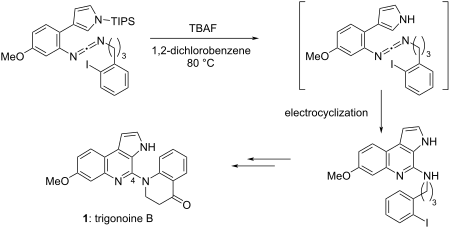
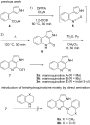
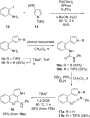
- introduction of a tetrahydroquinoline moiety by direct amination to triflate 7. Retrosynthetic analysis of the pyrrolo[2,3-c]quinoline ring construction. Synthesis of N-substituted 4-aminopyrrolo[3,2-c]quinoline 18. Synthesis of the tetrahydroquinoline moiety through cycloamination. Synthesis of trigonoine B





Designed whole-cell-catalysis-assisted synthesis of 9,11-secosterols
Beilstein J. Org. Chem. 2021, 17, 581–588, doi:10.3762/bjoc.17.52
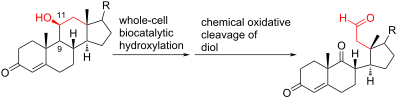
- approach to 9,11-secosterols is depicted in the retrosynthetic analysis in Scheme 1. There are two key steps in obtaining the skeleton of the secosterol. The first is (di)hydroxylation at C9 (C11), and the second is C9–C11-bond cleavage, which can be carried out by a well-developed chemical oxidation of
- ; HRMS (m/z): [M + H]+ calcd, 317.1747; found, 317.1755. A) Tetracyclic core of steroids and possible sites of bond cleavages for secosteroids. B)The first 9,11-secosteroid isolated in 1972 [7]. Retrosynthetic analysis of 9,11-secosterols. Synthesis of starting materials. Reagents and conditions: i


Total synthesis of decarboxyaltenusin
Beilstein J. Org. Chem. 2021, 17, 224–228, doi:10.3762/bjoc.17.22

- thorough biological investigations (as have been suggested by the European Food Safety Authority, EFSA [19]), we considered it useful to supply a more straightforward synthesis of this compound, for which we here propose the obvious name decarboxyaltenusin. Results and Discussion In a retrosynthetic
- analysis, we envisioned a Suzuki coupling of two suitably substituted arenes. Silyl protecting groups like the tert-butyldimethylsilyl group (TBS) were considered appropriate for all projected reaction steps. The boronate moiety 6a was prepared starting with 4-methylcatechol (2), which was initially


Synthesis of 6,13-difluoropentacene
Beilstein J. Org. Chem. 2020, 16, 2136–2140, doi:10.3762/bjoc.16.181
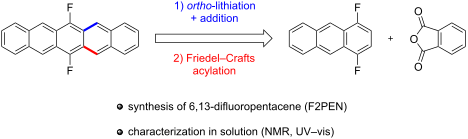
- two fluorine substituents was investigated. The retrosynthetic analysis for this strategy is shown in Scheme 1. The formation of the C5,5a-bond colored in red could be accomplished by an intramolecular Friedel–Crafts type acylation with the acylium-cation intermediate 6. The corresponding carboxylic
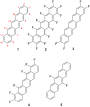
- -difluoroanthracene. This strategy could be applicable for the synthesis of differently substituted 6,13-difluoropentacenes as well. Structures of pentacene and fluorinated pentacenes. UV–vis spectrum of F2PEN 5 in CH2Cl2. Retrosynthetic analysis of F2PEN 5. Synthesis of F2PEN 5. Decomposition of diol 13 in solution



Synthesis of the tetrasaccharide repeating unit of the O-specific polysaccharide of Azospirillum doebereinerae type strain GSF71T using linear and one-pot iterative glycosylations
Beilstein J. Org. Chem. 2020, 16, 1700–1705, doi:10.3762/bjoc.16.141
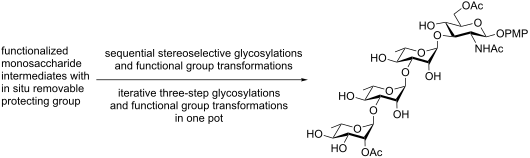
- glycosylation in one pot was developed and is reported herein. Results and Discussion At the beginning, the retrosynthetic analysis suggested that a sequential glycosylation reaction using judiciously protected monosaccharide thioglycosides could be the best strategy for achieving the desired tetrasaccharide 1


One-step route to tricyclic fused 1,2,3,4-tetrahydroisoquinoline systems via the Castagnoli–Cushman protocol
Beilstein J. Org. Chem. 2020, 16, 1456–1464, doi:10.3762/bjoc.16.121
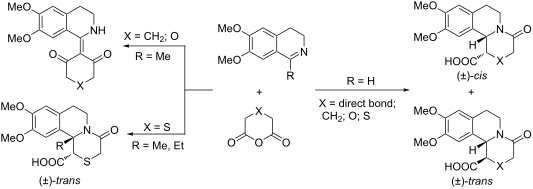
- . Mechanistic pathways for the reaction between cyclic anhydrides and imines. Retrosynthetic analysis of the target compounds. Reaction of 6,7-dimethoxy-3,4-dihydroisoquinoline (18) with anhydrides 5–8. Reagents and conditions: xylene, inert atmosphere, 120 °C, 6 h. Reaction of 1-methyl-3,4-dihydroisoquinoline
- system using the Castagnoli–Cushman reaction between 6,7-dimethoxy-3,4-dihydroisoquinoline (18) and its 1-substituted derivatives 19 and 20, and the anhydrides 5–8. This approach also could allow the construction of bioisosteric O- and S-analogs of the target systems as it is shown by the retrosynthetic
- analysis (Scheme 3). For the present studies the employed starting imines 18–20, were prepared by a Bischler–Napieralski condensation, using procedures available in the literature [30][31]. Reactions of 6,7-dimethoxy-3,4-dihydroisoquinoline (18) with anhydrides 5–8 The reaction between 18 and anhydrides 5


Towards the total synthesis of chondrochloren A: synthesis of the (Z)-enamide fragment
Beilstein J. Org. Chem. 2020, 16, 670–673, doi:10.3762/bjoc.16.64
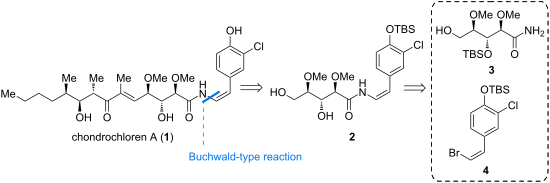
- ][19][20], whereas the (Z)-bromide 4 can be generated in a four-step sequence with a 39% overall yield, including a palladium-catalyzed, stereoselective dehalogenation [21][22][23][24][25]. Retrosynthetic analysis of chondrochlorene A (1). Synthesis of amide 3 [16][17][18][19][20]. TIPDSCl2 = 1,3


Chemical synthesis of the pentasaccharide repeating unit of the O-specific polysaccharide from Escherichia coli O132 in the form of its 2-aminoethyl glycoside
Beilstein J. Org. Chem. 2019, 15, 2563–2568, doi:10.3762/bjoc.15.249
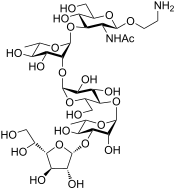
- reducing end of the target pentasaccharide that will allow further conjugation using the terminal amine without affecting the glycosidic stereochemistry. Further retrosynthetic analysis of the target pentasaccharide 1 revealed that a [3 + 2] strategy will be the most suitable one for the total synthesis of
- repeating unit in the form of its 2-aminoethyl glycoside. Retrosynthetic analysis for the synthesis of the target pentasaccharide 1. Synthesis of the disaccharide acceptor 5. Synthesis of the trisaccharide acceptor 11. Synthesis of the non-reducing end disaccharides (16a and 16b). Synthesis of the target




Synthesis of a dihalogenated pyridinyl silicon rhodamine for mitochondrial imaging by a halogen dance rearrangement
Beilstein J. Org. Chem. 2019, 15, 2333–2343, doi:10.3762/bjoc.15.226
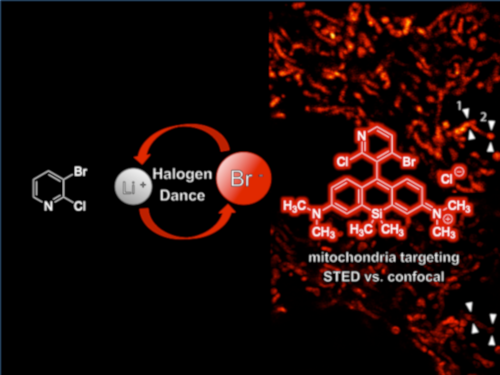
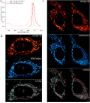
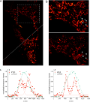
- using a HoloMonitor® M4 time-lapse cytometer. Cell proliferation was followed for 14.5 h (30 min between images) and corresponding time-lapse movies are available in Supporting Information Files 2–5, scale bar 50 µm. Comparison of optical properties of different silicon rhodamines. Retrosynthetic
- analysis of the proposed small molecule bimodal probe [18F]16 for both optical and PET imaging of cancer cells with up-regulated mitochondrial activity. Optimization of the HD rearrangement of 19 and subsequent reaction with xanthone 17 to the silicon rhodamine dye 15. Comparison of optical properties of



Synthesis of acremines A, B and F and studies on the bisacremines
Beilstein J. Org. Chem. 2019, 15, 2271–2276, doi:10.3762/bjoc.15.219

- ]. Nevertheless, to the best of our knowledge, no asymmetric entry to this class of natural products has been described. Our retrosynthetic analysis of 5 is depicted in Scheme 1. The prenyl side chain would be introduced by transition metal-catalyzed cross coupling of vinyl iodide 9. Compound 9 in turn could be
- transformation requires enzymatic catalysis in nature. Selected members of the acremine family [3][4][5]. Retrosynthetic analysis of acremine F (5). Total synthesis of acremine F (5). Synthesis of acremines A and B through selective oxidation of acremine F. Proposed biomimetic dimerization of 5. Attempted


Synthesis and biological evaluation of truncated derivatives of abyssomicin C as antibacterial agents
Beilstein J. Org. Chem. 2019, 15, 1468–1474, doi:10.3762/bjoc.15.147
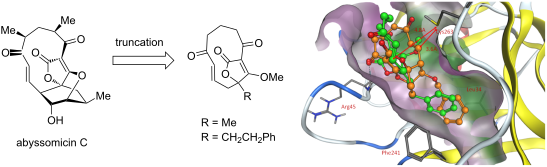
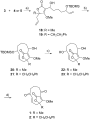
- reasonable positioning for a reaction with Cys263. B) Ligand interaction diagrams for atrop-O-benzyl-desmethyl-abyssomicin C (left) and compound 2 (right), showing similar interactions and similar shape. Retrosynthetic analysis of the truncated derivatives 1 and 2 of abyssomicin C. Synthesis of the building


An efficient synthesis of the guaiane sesquiterpene (−)-isoguaiene by domino metathesis
Beilstein J. Org. Chem. 2019, 15, 858–862, doi:10.3762/bjoc.15.83
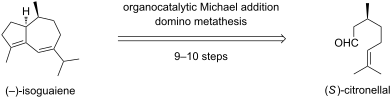
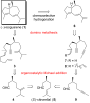
- sesquiterpene (−)-isoguaiene (1) using either a trienyne or a dienediyne metathesis and highly diastereoselective organocatalytic Michael additions of aldehydes derived from 5 as the key steps. Structures of the sesquiterpene (−)-isoguaiene (1) and the trisnorsesquiterpene clavukerin A (2). Retrosynthetic
- analysis for (−)-isoguaiene (1). Synthesis of 1 by relay metathesis of trienyne 3. a) HC(OMe)3, 4 mol % LiBF4, MeOH, reflux, 80%; b) (i) BH3·Me2S, THF, 0 °C to rt, (ii) 30% H2O2, 10% NaOH, 0 °C to rt, 97%; c) 5 mol % TPAP, NMO, CH2Cl2, rt, 97%; d) 13, THF, rt to reflux, 96%; e) 25 mol % TsOH, THF, H2O




An improved synthesis of adefovir and related analogues
Beilstein J. Org. Chem. 2019, 15, 801–810, doi:10.3762/bjoc.15.77
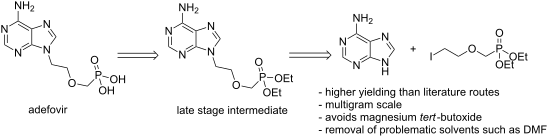
- incorporation of an amidine moiety allows for regioselective alkylations with 14 and facilitates the synthesis of novel N7-substituted adefovir analogues. Adefovir (1) and its prodrug 2. Retrosynthetic analysis of 6 to synthons 9 and 10. Retrosynthesis of 6 to synthons 14 and 3. HMBC spectrum confirms N7


Solid-phase synthesis of biaryl bicyclic peptides containing a 3-aryltyrosine or a 4-arylphenylalanine moiety
Beilstein J. Org. Chem. 2019, 15, 761–768, doi:10.3762/bjoc.15.72
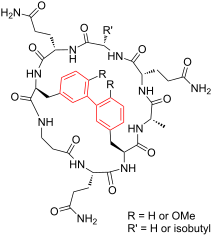
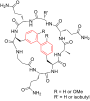
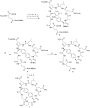
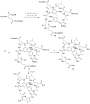
- or a Tyr-Tyr linkage. Results and Discussion Synthesis of the biaryl bicyclic peptide 1 We first planned the synthesis of the biaryl bicyclic peptide 1 incorporating a Phe-Phe linkage based on the retrosynthetic analysis depicted in Scheme 1. According to this analysis, the key steps are the
- macrolactamization step. This work constitutes the first solid-phase synthetic approach to biaryl bicyclic peptides. The method described is general and allows access to a diversity of novel Phe- and Tyr-containing biaryl bicyclic peptides. Structure of biaryl bicyclic peptides 1–3. Retrosynthetic analysis for the



Unexpected loss of stereoselectivity in glycosylation reactions during the synthesis of chondroitin sulfate oligosaccharides
Beilstein J. Org. Chem. 2019, 15, 137–144, doi:10.3762/bjoc.15.14
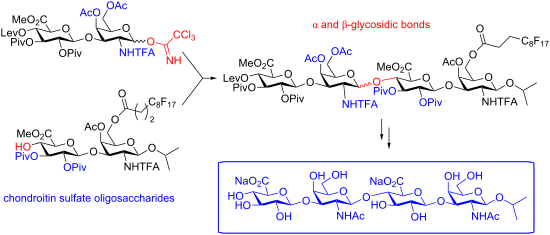
- the influence of the acceptor structure and reactivity on the stereoselectivity of glycosylation reactions [49] and give information on the design of building blocks for the synthesis of long CS sequences. Retrosynthetic analysis for the preparation of CS oligosaccharides. Lev = levulinyl; Piv


Synthesis of a tubugi-1-toxin conjugate by a modulizable disulfide linker system with a neuropeptide Y analogue showing selectivity for hY1R-overexpressing tumor cells
Beilstein J. Org. Chem. 2019, 15, 96–105, doi:10.3762/bjoc.15.11
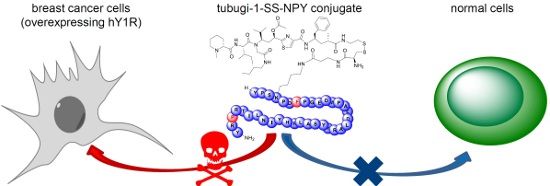
- of linkers are unsuitable, as they rendered the peptide inactive (results not shown). However, disulfide-bonded linkers retained activity, presumably by cleavage in the reductive milieu of cancer cells, if connected via a short ester or amide linkage at the C-terminus. The retrosynthetic analysis
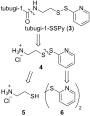
- ). Retrosynthetic analysis of the modular attachment linker tubugi-1-SSPy (3). Synthesis of tubugi-1-SSPy (3): a) LiOH·H2O, THF/H2O, 0 °C → rt; b) Ac2O, py; c) 4, HBTU, DMF, DIPEA, MeOH, under N2 atmosphere, 42% (3 steps). Synthesis of the tubugi-1–NPY conjugate [K4(C(tubugi-1)-βA-),F7,L17,P34]-hNPY (8). Toxin




Synthesis of pyrrolidine-based hamamelitannin analogues as quorum sensing inhibitors in Staphylococcus aureus
Beilstein J. Org. Chem. 2018, 14, 2822–2828, doi:10.3762/bjoc.14.260
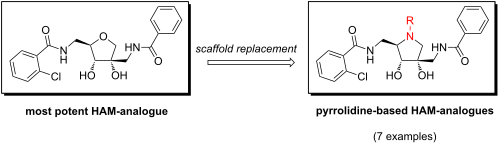
- functionalized side chains are introduced prior to coupling and ring closure to afford 8. This new synthetic route would be more convergent and efficient for the preparation of 3. Retrosynthetic analysis led to 9 and 10 as two key synthons, which would be assembled via a Mitsunobu–Fukuyama reaction, and


Stereoselective total synthesis and structural revision of the diacetylenic diol natural products strongylodiols H and I
Beilstein J. Org. Chem. 2018, 14, 2313–2320, doi:10.3762/bjoc.14.206
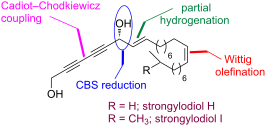
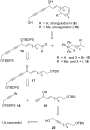
- strongylodiol I The retrosynthetic analysis for strongylodiols H and I is delineated in Scheme 1. We envisaged that the target molecules strongylodiol H (9) and strongylodiol I (10) can be synthesized by a Wittig reaction of a common intermediate aldehyde 14 with triphenylphosphonium Wittig salts 15 and 16



Studies towards the synthesis of hyperireflexolide A
Beilstein J. Org. Chem. 2018, 14, 2106–2111, doi:10.3762/bjoc.14.185

- 5 could not only act as a surrogate for C-9 carbonyl but also facilitate installation of an angular methyl group. The retrosynthetic analysis for hyperireflexolide A is depicted in Scheme 1. We envisioned that hyperireflexolide A (1) could be synthesized by metal-catalyzed opening of the epoxide 2


Synthetic avenues towards a tetrasaccharide related to Streptococcus pneumonia of serotype 6A
Beilstein J. Org. Chem. 2018, 14, 1095–1102, doi:10.3762/bjoc.14.95

- sequential glycosylation strategies. Results and Discussion Keeping in mind our objective to synthesize the SPn 6A tetrasaccharide following stepwise as well as one-pot synthetic strategies based on common building blocks, a retrosynthetic analysis was made which led us to galactose-based donor 2 [26
- linkages could be prepared with a yield and a selectivity which were high enough to allow the one-pot synthesis. The tetrasaccharides associated with the pneumonicoccal serogroup 6. Retrosynthetic analysis. Preparation of D-glucosyl donor 6. Reaction conditions: a) NapBr/PMBCl, NaH, DMF, rt, 12 h, 90% (6a


Sequential Ugi reaction/base-induced ring closing/IAAC protocol toward triazolobenzodiazepine-fused diketopiperazines and hydantoins
Beilstein J. Org. Chem. 2018, 14, 626–633, doi:10.3762/bjoc.14.49

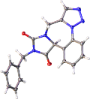
- examples. X-ray crystal structure of hydantoin-fused triazolobenzodiazepine 10a. (Displacement ellipsoids are drawn at the 30% probability level.) Retrosynthetic analysis towards 2,5-diketopiperazine fused triazolobenzodiazepine. Ugi 4-CR reaction. Synthesis of diketopiperazine-fused triazolobenzodiazepine





Diastereoselective auxiliary- and catalyst-controlled intramolecular aza-Michael reaction for the elaboration of enantioenriched 3-substituted isoindolinones. Application to the synthesis of a new pazinaclone analogue
Beilstein J. Org. Chem. 2018, 14, 593–602, doi:10.3762/bjoc.14.46

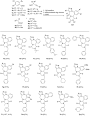
- efficient stereocontrol. To the best of our knowledge such approach involving a double auxiliary and catalyst stereocontrol was never applied before to asymmetric synthesis of enantioenriched isoindolinones. Results and Discussion Retrosynthetic analysis From a retrosynthetic point of view, (3S)-NH free 3
- active chiral 3-substituted isoindolinones. Esters 12a–e, 13 prepared, isolated yield. Benzamides 6a–d, 7a–e, 8 prepared, isolated yield. Phase transfer catalysts (PTC) used in this study. ORTEP plot of isoindolinone (2R,3S)-3a (CCDC 1590565) [68]. Retrosynthetic analysis of NH free chiral 3-substituted





