


Search results
Search for "retrosynthetic analysis" in Full Text gives 141 result(s) in Beilstein Journal of Organic Chemistry.
High-yielding continuous-flow synthesis of antimalarial drug hydroxychloroquine
Beilstein J. Org. Chem. 2018, 14, 583–592, doi:10.3762/bjoc.14.45
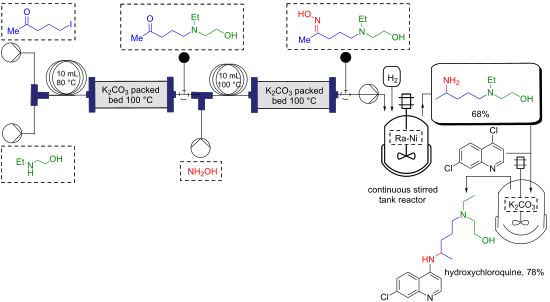
- ]. With these issues in mind, we carried out a retrosynthetic analysis (Scheme 2) in which 10, an iodo analogue to the starting material 3, could be generated in a single step via a decarboxylative ring-opening of α-acetyl butyrolactone 8. The iodo analogue 10 could then be used without isolation to


The photodecarboxylative addition of carboxylates to phthalimides as a key-step in the synthesis of biologically active 3-arylmethylene-2,3-dihydro-1H-isoindolin-1-ones
Beilstein J. Org. Chem. 2017, 13, 2833–2841, doi:10.3762/bjoc.13.275
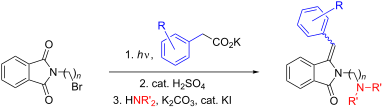
- retrosynthetic analysis is depicted in Scheme 1. The initial step comprises the photodecarboxylative addition of phenylacetate to commercially available N-(bromoalkyl)phthalimides, yielding the corresponding benzylated hydroxyphthalimidine derivatives as key intermediates. Subsequent acid-catalyzed dehydration
- ]. Molecular structures of AL-12, AL-12B and AL-5. Crystal structures of photoaddition products 3a (left) and 3b (right). Crystal structure of (E)-7a. Side view and front view. Crystal structure of (Z)-8a. Side view and front view. Retrosynthetic analysis of AL-12, AL-12B and AL-5 (in their neutral forms) and


A semisynthesis of 3'-O-ethyl-5,6-dihydrospinosyn J based on the spinosyn A aglycone
Beilstein J. Org. Chem. 2017, 13, 2603–2609, doi:10.3762/bjoc.13.257
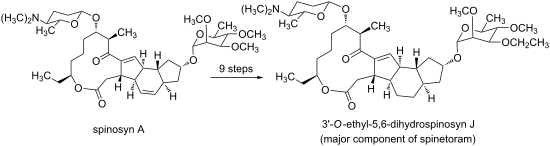
- to synthesize other rhamnose analogues. The structures of spinosad and spinetoram. Chemical modifications of spinosyn J and spinosyn L. Retrosynthetic analysis of 3'-O-ethyl-5,6-dihydrospinosyn J. Hydrolysis of spinosyn A and formation of the aglycone and D-forosamine. Synthesis of 3-O-ethyl-2,4-di-O


A mechanochemical approach to access the proline–proline diketopiperazine framework
Beilstein J. Org. Chem. 2017, 13, 2169–2178, doi:10.3762/bjoc.13.217
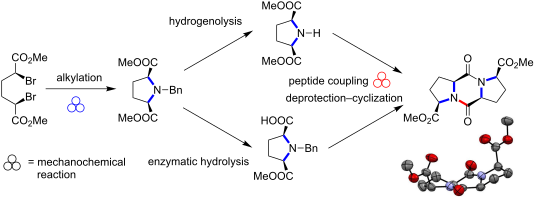
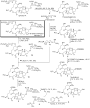
- only to symmetrical products and can be detrimental for more fragile molecules such as substituted enantiomerically pure compounds. As shown by a retrosynthetic analysis (Scheme 1), a classical milder approach would consist in preparing first the dipeptide, followed by an intramolecular ester


Synthesis of substituted Z-styrenes by Hiyama-type coupling of oxasilacycloalkenes: application to the synthesis of a 1-benzoxocane
Beilstein J. Org. Chem. 2017, 13, 2122–2127, doi:10.3762/bjoc.13.209

- established in applying the Buchwald–Hartwig coupling to 15, producing the benzoxocane 24, which contains the carbon skeleton of heliannuol A. Retrosynthetic analysis of heliannuol A. Hydrosilylation of alkynols. Hydrogenation of benzoxocane 24. Pd-catalyzed couplings of oxasilacycloalkenes with aryl iodides


Preactivation-based chemoselective glycosylations: A powerful strategy for oligosaccharide assembly
Beilstein J. Org. Chem. 2017, 13, 2094–2114, doi:10.3762/bjoc.13.207
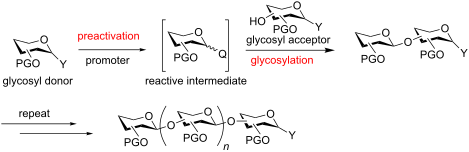
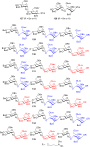
- acid synthesis. With continuous development, the preactivation strategy will achieve wider applications in complex carbohydrate synthesis. Representative structures of products formed by the preactivation-based dehydrative glycosylation of glycosyl hemiacetal. Retrosynthetic analysis of pentasaccharide







The chemistry and biology of mycolactones
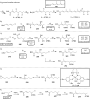
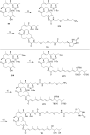
Beilstein J. Org. Chem. 2017, 13, 1596–1660, doi:10.3762/bjoc.13.159









Total syntheses of the archazolids: an emerging class of novel anticancer drugs
Beilstein J. Org. Chem. 2017, 13, 1085–1098, doi:10.3762/bjoc.13.108
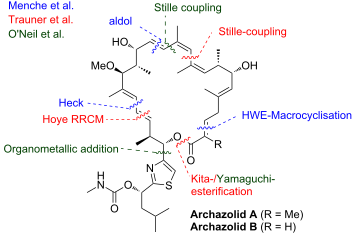
- been described again by the Menche group following a sequence that was related to their archazolid A synthesis. Menche’s retrosynthetic analysis and strategy As a prelude to initiating a synthetic campaign directed towards the archazolids the Menche group first elucidated the full stereochemistry and
- synthesis was enabled by the group of Trauner and will be discussed below. Trauner’s retrosynthetic analysis and strategy Shortly after the total synthesis of archazolid A (1) by Menche et al. [41] the total synthesis of archazolid B 2 was reported by Trauner and co-workers [43]. As shown in Scheme 8, they
- to synthesize archazolid B (2) in only 19 steps from (S)-Roche ester 41 (longest linear sequence). O'Neil’s retrosynthetic analysis and strategy As discussed above one of the main difficulties of any archazolid synthesis involves the labile C1 to C5-dienoate system, which is prone to isomerization


First total synthesis of kipukasin A
Beilstein J. Org. Chem. 2017, 13, 855–862, doi:10.3762/bjoc.13.86
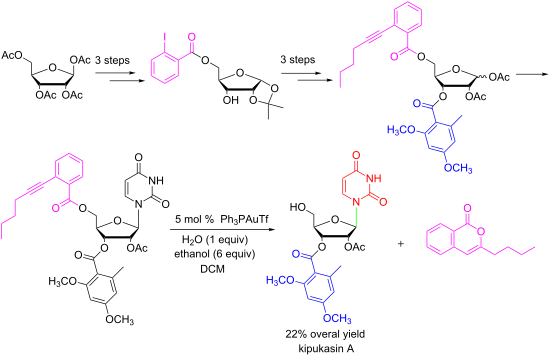
- ’-transesterification is inevitable to occur in nucleosides [19][20][21]. The synthetic route would be lengthy and cumbersome. Therefore, a practical total synthesis is in high demand to facilitate the preparation of other kipukasins and their analogues. The retrosynthetic analysis is shown in Figure 2 (path b
- ) complexes with high yield and selectivity. The conditions are very mild and neutral. In the present paper, we continue to use ortho-alkynylbenzoate as protecting group for the 5’-OH group to fulfill the total synthesis of kipukasin A. According to the retrosynthetic analysis, we firstly started to synthesis
- -5''), 103.4 (C-5), 96.4 (C-3''), 87.4 (C-1'), 84.0 (C-4'), 73.2 (C-2'), 72.1 (C-3'), 62.2 (C-5'), 56.0 (OMe-4''), 55.5 (OMe-2''), 20.7 (Me-6'), 20.3 (Me-6''); HRMS (ESI) m/z: [M + Na]+ calcd for C21H24N2O10Na, 487.1329; found, 487.1327. Structures of kipukasins A–J. Retrosynthetic analysis of


Synthesis of D-manno-heptulose via a cascade aldol/hemiketalization reaction
Beilstein J. Org. Chem. 2017, 13, 795–799, doi:10.3762/bjoc.13.79

- reported differentially protected ketoheptose building blocks may find further application in the preparation of structurally diverse D-manno-heptulose derivatives. Retrosynthetic analysis of D-manno-heptulose. Initial attempt on the synthesis of the C4 aldehyde from D-lyxose (5). Synthesis of


Total synthesis of a Streptococcus pneumoniae serotype 12F CPS repeating unit hexasaccharide
Beilstein J. Org. Chem. 2017, 13, 164–173, doi:10.3762/bjoc.13.19
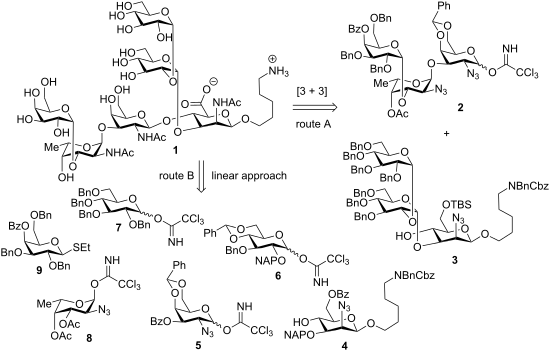
- disaccharide branch at C3 of β-D-ManpNAcA and C3 of α-L-FucpNAc [15]. We established a total synthesis of the hexasaccharide repeat unit as a first step toward a detailed immunological analysis of S. pneumoniae 12F. Results and Discussion Retrosynthetic analysis. Initially, a convergent [3 + 3] synthesis of


Synthesis of acylhydrazino-peptomers, a new class of peptidomimetics, by consecutive Ugi and hydrazino-Ugi reactions
Beilstein J. Org. Chem. 2016, 12, 2865–2872, doi:10.3762/bjoc.12.285

- ) azapeptoid, (f) hydrazinopeptide and (g) hydrazinopeptoid. Some biologically active peptoids. Biologically active hydrazinopeptides and representation of the hydrazino turn. General structure of the acylhydrazino-peptomers synthesized in this study. Retrosynthetic analysis. Synthesis of hydrazides 3a–c


cis-Diastereoselective synthesis of chroman-fused tetralins as B-ring-modified analogues of brazilin
Beilstein J. Org. Chem. 2016, 12, 2816–2822, doi:10.3762/bjoc.12.280

- . Retrosynthetic analysis of the designed B-ring-modified analogues of brazilin. The synthetic challenge associated with the synthesis of 5 by IFCEA of 6 (above) and recent literature reports of cis-diastereoselective synthesis of related tetracyclic molecules via intramolecular Friedel–Crafts cyclization


Facile synthesis of indolo[3,2-a]carbazoles via Pd-catalyzed twofold oxidative cyclization
Beilstein J. Org. Chem. 2016, 12, 2490–2494, doi:10.3762/bjoc.12.243
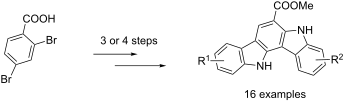
- applied to the synthesis of malasseziazoles by Knölker et al. [14]. However, the main challenge in retrosynthetic analysis was to achieve the regioselective cyclizaion, since the formation of undesired regioisomeric monocyclized products would block the further cyclization. If the reaction follows the
- materials. The operational simplicity combined with the convenience for introducing substituents to the aromatic rings makes this method useful. Natural indolo[3,2-a]carbazole alkaloids. Retrosynthetic analysis of indolo[3,2-a]carbazoles. Reagents and conditions: (a) H2SO4, MeOH; (b) Ar-NH2, Pd(OAc)2, BINAP


A new paradigm for designing ring construction strategies for green organic synthesis: implications for the discovery of multicomponent reactions to build molecules containing a single ring
Beilstein J. Org. Chem. 2016, 12, 2420–2442, doi:10.3762/bjoc.12.236
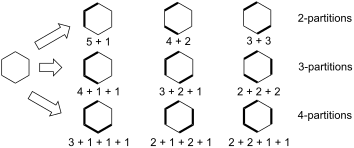
- economy; green organic synthesis; integer partitioning; reactions; probability; retrosynthetic analysis; ring construction strategy; Introduction The ring motif is a key feature in chemical structures that has long attracted the attention of synthetic organic chemists in their quest to implement novel
- greenness. In research practice, synthetic organic chemists rely on a combination of retrosynthetic analysis [91][92][93][94][95][96][97], similarity and analogy patterning to known reactions, bond dissociation energy and bond polarity analysis (forward and umpolung), chemical intuition, and random
- vast library of reactions that they are familiar with from personal experience or through their readings of the literature. Extending known reaction strategy and bond forming-bond breaking themes by analogy is a very useful method. Though retrosynthetic analysis is a powerful tool in the arsenal, its








Enduracididine, a rare amino acid component of peptide antibiotics: Natural products and synthesis
Beilstein J. Org. Chem. 2016, 12, 2325–2342, doi:10.3762/bjoc.12.226
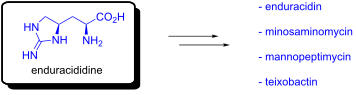
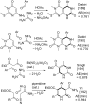
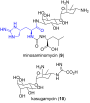
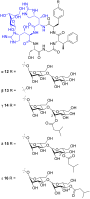
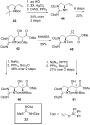
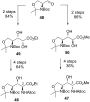
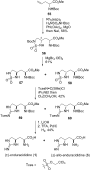
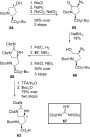
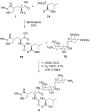
- . Synthesis of (±)-enduracididine (1) and (±)-allo-enduracididine (3). Synthesis of L-allo-enduracididine (3). Synthesis of protected L-allo-enduracididine 63. Synthesis of β-hydroxyenduracididine derivative 69. Synthesis of minosaminomycin (9). Retrosynthetic analysis of mannopeptimycin aglycone (77












Elongated and substituted triazine-based tricarboxylic acid linkers for MOFs
Beilstein J. Org. Chem. 2016, 12, 2267–2273, doi:10.3762/bjoc.12.219

- the Suzuki–Miyaura coupling [11]. A retrosynthetic analysis (Figure 3) of extended mono-functionalized triazinetricarboxylic acids 2 calls for tris(4-bromoaryl)-1,3,5-triazines 3 and boronic acids 4 with an additional carboxylic acid functionality. The respective methyl carboxylate of boronic acid 4
- , right). The two structures in the lower half have been calculated with B3LYP//6-31G*. Mono-substituted TATB linkers 1b–d were successfully employed in the isoreticular syntheses of PCN-6 MOFs [10]. Retrosynthetic analysis for extended TATBs 2: triple Suzuki coupling between tribromotriazines 3 and


Practical synthetic strategies towards lipophilic 6-iodotetrahydroquinolines and -dihydroquinolines
Beilstein J. Org. Chem. 2016, 12, 1851–1862, doi:10.3762/bjoc.12.174

- bromides or aryl chlorides, but initial investigation with 6-bromo-THQs indicated that these were remarkably unreactive in cross-coupling reactions [14], and a reliable and scalable synthesis of the likely more reactive iodides was, therefore, sought. We first considered the retrosynthetic analysis shown


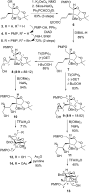
Synthesis of the C8’-epimeric thymine pyranosyl amino acid core of amipurimycin
Beilstein J. Org. Chem. 2016, 12, 1765–1771, doi:10.3762/bjoc.12.165
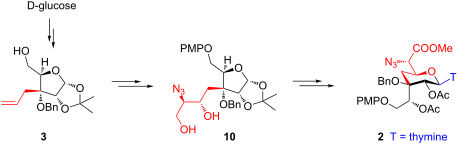
- hydroxy and 1,2-dihydroxyethyl side chain at C3’ having a C8’ epimeric center, (b) an C5’ amino acid pendant and (c) the thymine nucleobase (2). Our results in this regard are described herein. Result and Discussion As shown in retrosynthetic analysis (Scheme 1), we envisioned that the substituted 2,7






Organic chemistry meets polymers, nanoscience, therapeutics and diagnostics
Beilstein J. Org. Chem. 2016, 12, 1638–1646, doi:10.3762/bjoc.12.161
- both art and photography at Illinois Institute of Technology, but science and scientists ended up deciding me. It started with Chem. 237, Organic Chemistry. This course was taught by Pete Johnson, who introduced me to retrosynthetic analysis, and in the process showed me how I could achieve the




NeoPHOX – a structurally tunable ligand system for asymmetric catalysis
Beilstein J. Org. Chem. 2016, 12, 1185–1195, doi:10.3762/bjoc.12.114
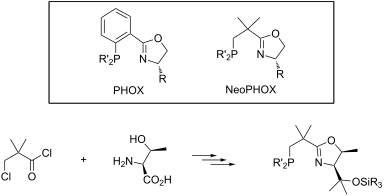
- phospinooxazoline ligands. Asymmetric hydrogenation with iridium-NeoPHOX catalysts [19]. Employing L-valine as a starting material for C5 substituted oxazoline. Retrosynthetic analysis for NeoPHOX ligands derived from serine and threonine. Crystal structures of selected Ir-complexes. Hydrogen atoms, COD and BArF
- anions were omitted for clarity. Retrosynthetic analysis for NeoPHOX ligands. Synthesis of 1st generation NeoPHOX Ir-complexes [19]. Synthesis of a C(5)-disubstituted NeoPHOX-Ir complex. Revisited synthetic strategy for the preparation of a threonine-based NeoPHOX ligand. Undesired β-lactam formation


Towards the total synthesis of keramaphidin B
Beilstein J. Org. Chem. 2016, 12, 1096–1100, doi:10.3762/bjoc.12.104
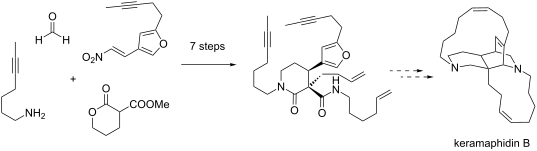
- reported in due course. Keramaphidin B (1). Retrosynthetic analysis of keramaphidin B. Enantio- and diastereoselective bifunctional thiourea 12 organocatalysed Michael addition. (a) CO(OMe)2, LHMDS, THF, −78 °C to rt, 83%; (b) 20 mol % 12, toluene, −20 °C, 24 h, 95:5 dr (13:14), 90:10 er for 13, 99% yield



Catalytic asymmetric formal synthesis of beraprost
Beilstein J. Org. Chem. 2015, 11, 2654–2660, doi:10.3762/bjoc.11.285
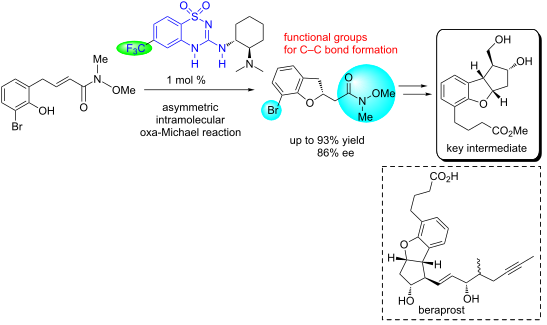
- Our retrosynthetic analysis for 2 is shown in Scheme 1, with the derivatization of 2 to beraprost (1) having already been reported. We planned to introduce the ester side chain on the aromatic ring at a later stage, utilizing radical-mediated reactions with acrylate [22] when the functional group (X
- (1). Retrosynthetic analysis of beraprost (1). Preparation of Michael precursors 7 and 8. First attempt at the synthesis of 2 from 6. Achievement of a formal synthesis of 2. Optimization of asymmetric intramolecular oxa-Michael reaction. Supporting Information Supporting Information File 476



Total synthesis of panicein A2
Beilstein J. Org. Chem. 2015, 11, 1991–1996, doi:10.3762/bjoc.11.215

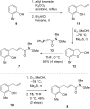
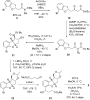
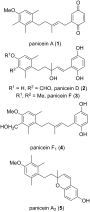
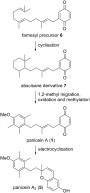
- with the earlier report that stated 5 exhibits in vitro cytotoxicity against a number of cell lines (ED50 = 5 μg/mL). Members of the panicein family of aromatic sesquiterpenoids. Proposed biogenesis of panicein A2 (5). Retrosynthetic analysis of panicein A2 (5). Synthesis of ketone 13. Synthesis of



Design and synthesis of propellane derivatives and oxa-bowls via ring-rearrangement metathesis as a key step
Beilstein J. Org. Chem. 2015, 11, 1727–1731, doi:10.3762/bjoc.11.188
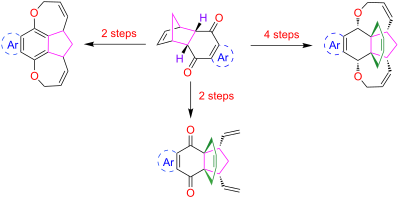
- target molecule, eventually to arrive at simple starting materials by working in an opposite direction to a chemical synthesis. The ‘retrosynthetic analysis’ was first introduced by E. J. Corey and defined as “it is a problem solving technique for transforming the structure of a synthetic target molecule
- to a sequence of progressively simpler structures along a pathway which ultimately leads to a simple or commercially available starting materials for a chemical synthesis” [1] . Generally, this type of retrosynthetic analysis has been used to design [2][3][4][5][6] the target molecule. However, a





