Search results
Search for "protecting groups" in Full Text gives 332 result(s) in Beilstein Journal of Organic Chemistry. Showing first 200.
Chemical synthesis of C6-tetrazole ᴅ-mannose building blocks and access to a bioisostere of mannuronic acid 1-phosphate
Beilstein J. Org. Chem. 2021, 17, 1527–1532, doi:10.3762/bjoc.17.110
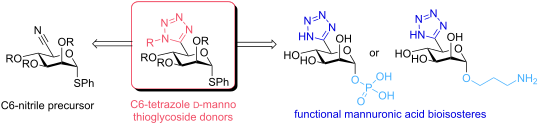
- appropriate chemoenzymatic syntheses [21][22][23]. Conclusion We have established synthetic access to a series of C6-tetrazole thioglycoside monosaccharide building blocks with capability for orthogonal C4- and tetrazole N-protecting groups. We demonstrate anomeric manipulation of these donors to new


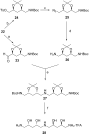
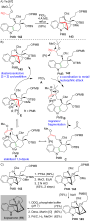
Total synthesis of ent-pavettamine
Beilstein J. Org. Chem. 2021, 17, 1440–1446, doi:10.3762/bjoc.17.99
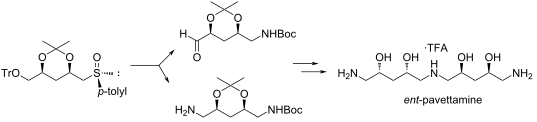
- group did not yield the desired product [22][23][24][25][26]. Several selective trityl deprotection attempts gave different results: either the reaction did not proceed at all yielding starting material, or both the trityl and benzyl group were removed or all three protecting groups were removed. Based
- pavettamine, in order to obtain the enantiomer. The final deprotection step proved particularly efficient, with two protecting groups being removed simultaneously to unveil the desired target. Structure of pavettamine 1 and its enantiomer 2. Crystal structure of compound 9. Single crystal X-ray structure of


Double-headed nucleosides: Synthesis and applications
Beilstein J. Org. Chem. 2021, 17, 1392–1439, doi:10.3762/bjoc.17.98
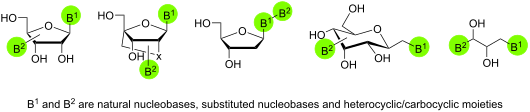
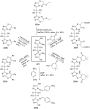
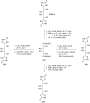
- first hydrolyzed using NaOH followed by the reaction with TBDMSCl and benzoyl chloride to get the N6-benzoyl-3’,5’-O-diTBDMS-protected nucleoside 74. Removal of the silyl-protecting groups in the double-headed nucleoside 74 with TBAF in THF resulted in the formation of the desired doubled-headed
- was reduced in the presence of NaBH4 followed by the treatment with MsCl in pyridine to get the nucleoside salt 129. Next, the pyridinium group was replaced by an N3-protected thymine in basic medium followed by removal of the protecting groups and the selective DMTr protection of the C-5′-hydroxy
- simultaneous removal of tert-butyldimethylsilyl and amidine protecting groups, respectively (Scheme 41 and Scheme 42) [26]. The incorporation of the double-headed nucleosides 159 and 163 into oligonucleotides resulted in the formation of thermally stable DNA:RNA duplexes due to an efficient π–π stacking





Heterogeneous photocatalytic cyanomethylarylation of alkenes with acetonitrile: synthesis of diverse nitrogenous heterocyclic compounds
Beilstein J. Org. Chem. 2021, 17, 1171–1180, doi:10.3762/bjoc.17.89
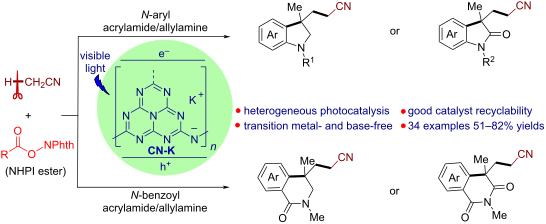
- , delivering the corresponding regioisomers 8l and 8l’ in 62% with 1:1.6 ratio. Moreover, the naphthalene and tetrahydroisoquinoline-derived acrylamides were also compatible, giving the polycyclic products 8m and 8n in 77% and 70%, respectively. Additionally, protecting groups such as isopropyl, benzyl, or


Metal-free glycosylation with glycosyl fluorides in liquid SO2
Beilstein J. Org. Chem. 2021, 17, 964–976, doi:10.3762/bjoc.17.78

- We started our study by short screening of the glycosylation conditions in liquid SO2 (Table 1). To avoid a potential cleavage of acid-labile protecting groups and to obtain an easily analyzable reaction mixture, pivaloyl-protected mannosyl fluoride α-1a as a relatively stable disarmed glycosyl donor
- fluoride α-1a to form bis-mannosides α-8 in good yields (Scheme 2). In a series of pivaloyl-protected mannosides 3 a substrate-controlled α-selectivity due to the favoring effect of both neighboring ester-type protecting groups and the anomeric effect was observed [3]. On the other hand, mixing of glycosyl
- basic nitrogen or fluorophilic trimethylsilyl group in the molecule of the glycosyl acceptor (Figure S1, Supporting Information File 1). To our delight, no cleavage of the pivaloyl protecting groups in liquid SO2 medium was observed and the main side-product formed in the series of mannosides 3 was the



Beyond ribose and phosphate: Selected nucleic acid modifications for structure–function investigations and therapeutic applications
Beilstein J. Org. Chem. 2021, 17, 908–931, doi:10.3762/bjoc.17.76
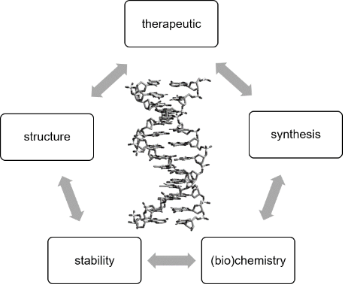
- necessary protecting groups are present on the nucleobase and sugar moieties [76][77]. Unlike the phosphodiester linkage of natural DNA, the AM1 modification is an example of a non-ionic backbone. The crystal structure of a 13-mer RNA duplex with a single central AM1 modification revealed that this
- ]. Starting with a prepared 5'-iodo-4'-fluorouridine analogue that had been used in previous attempts of this synthesis, they removed the acetyl protecting groups at C3' and C2' with NH3/MeOH to give 5'-iodo-4'-fluorouridine [211]. Selective protection of the 2'-OH with TBDMS-Cl followed by protection of the




Enhanced target cell specificity and uptake of lipid nanoparticles using RNA aptamers and peptides
Beilstein J. Org. Chem. 2021, 17, 891–907, doi:10.3762/bjoc.17.75
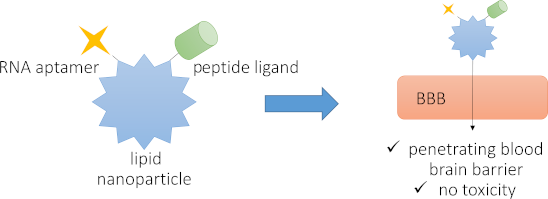
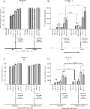
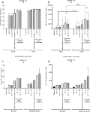
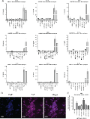
- removal of the side-chain protecting groups was achieved by using trifluoroacetic acid (TFA)/phenol/water/triisopropylsilane (TIPS) 88:5:5:2 (3 × 60 min). After cleavage, the remaining resin was extracted with DCM (2 × 10 min). All DCM extracts and TFA cleavages were combined, and the resulting mixture



Synthesis and properties of oligonucleotides modified with an N-methylguanidine-bridged nucleic acid (GuNA[Me]) bearing adenine, guanine, or 5-methylcytosine nucleobases
Beilstein J. Org. Chem. 2021, 17, 622–629, doi:10.3762/bjoc.17.54
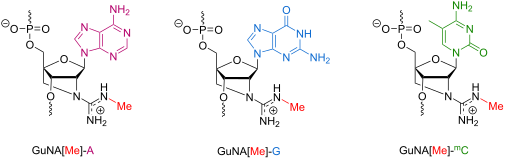
- immunologically unfavorable cytosine (C), is needed. The preparation of all four phosphoramidites (A, G, mC, and T) is generally not easy because each nucleobase differs in the sensitivity to reactions, and appropriate protecting groups need to be selected [8][21][22][23]. We recently achieved the synthesis of
Designed whole-cell-catalysis-assisted synthesis of 9,11-secosterols
Beilstein J. Org. Chem. 2021, 17, 581–588, doi:10.3762/bjoc.17.52
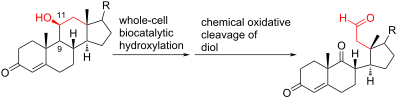
- 9α-hydroxylated diol. The following oxidative cleavage of the C–C bond with a mild oxidant leads to the steroid with an appropriately broken steroid skeleton. The method provides the target compound in only two steps, without any manipulations involving protecting groups. The present method features


1,2,3-Triazoles as leaving groups: SNAr reactions of 2,6-bistriazolylpurines with O- and C-nucleophiles
Beilstein J. Org. Chem. 2021, 17, 410–419, doi:10.3762/bjoc.17.37
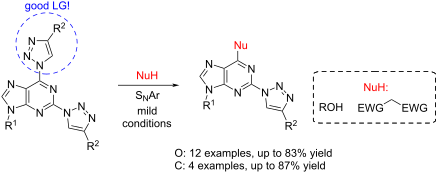
- (5.0 equiv). The excess of base and alcohol was required due to the cleavage of acetyl protecting groups. Products 3g–i were obtained in yields of up to 79% (Scheme 4). Furthermore, purification of the products 3g–i was complicated due to their poor solubility in organic solvents. The C6
- regioselectivity of SNAr reactions was proved by 13C NMR comparison of the products 3a–i with similar compounds from literature [61]. Intriguingly, we were able to conserve the acetate protecting groups in product 3j, when the SNAr reaction was performed in the presence of DBU used as base. The artificial
- dinucleotide analogue 3j was obtained in 25% isolated yield. We have explored also reactions of 2,6-bistriazolylpurines 2a and 2c with water in buffered and basic medium, respectively (Scheme 5). The buffered conditions (NaOAc/DMSO/H2O) were sufficiently mild to maintain the acetyl protecting groups in product


19F NMR as a tool in chemical biology
Beilstein J. Org. Chem. 2021, 17, 293–318, doi:10.3762/bjoc.17.28
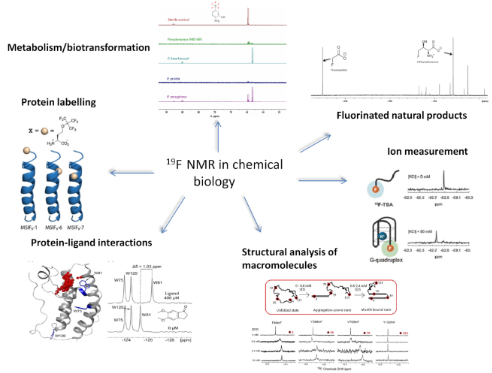
- aliphatic amino acid, (E)-2-amino-5-(pentafluorosulfanyl)pent-4-enoic acid (14, Figure 1), SF5NVa [21]. Most recently, Cobb et al. [22] reported the synthesis of several pentafluorosulfanyl phenylalanine derivatives with suitable protecting groups to allow incorporation into peptides through common solid


Total synthesis of decarboxyaltenusin
Beilstein J. Org. Chem. 2021, 17, 224–228, doi:10.3762/bjoc.17.22

- analysis, we envisioned a Suzuki coupling of two suitably substituted arenes. Silyl protecting groups like the tert-butyldimethylsilyl group (TBS) were considered appropriate for all projected reaction steps. The boronate moiety 6a was prepared starting with 4-methylcatechol (2), which was initially


All-carbon [3 + 2] cycloaddition in natural product synthesis
Beilstein J. Org. Chem. 2020, 16, 3015–3031, doi:10.3762/bjoc.16.251
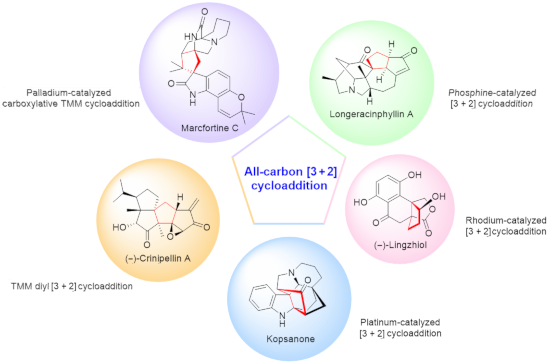
- development of the all-carbon [3 + 2] cyclization with the reactive functional groups’ compatibilities and/or without the use of protecting groups [83][84] can improve the synthetic efficiency and make this class of reactions more attractive to the synthetic scientist for applications. Lastly, we anticipate







Changed reactivity of secondary hydroxy groups in C8-modified adenosine – lessons learned from silylation
Beilstein J. Org. Chem. 2020, 16, 2854–2861, doi:10.3762/bjoc.16.234

- being preferentially formed. Optimization of the protection scheme lead to a new and economic route to the desired C8-alkynylated building block and its incorporation in RNA. Keywords: nucleoside chemistry; protecting groups; RNA synthesis; Sonogashira reaction; Introduction Oligoribonucleotides


Enzyme-instructed morphological transition of the supramolecular assemblies of branched peptides
Beilstein J. Org. Chem. 2020, 16, 2709–2718, doi:10.3762/bjoc.16.221

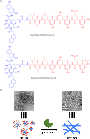
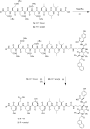
- synthesis (SPPS) [47] to produce the peptides shown in Scheme 1. We first synthesized the peptide segments (i.e., Fmoc-DEDDDLLIG (1a) and acetyl-DEDDDLLIG (2a)). We kept the tert-butyl protecting groups of aspartic acid for the coupling reaction with Nap-ffky. We used 2,2,2-trifluoroethanol (TFE) in
- , we used TFA at room temperature for 2 h to cleave the tert-butyl protecting groups of 1b and 2b. After adding diethyl ether to precipitate the crude peptides, centrifugation, and washing three times, we used reversed-phase HPLC and acetonitrile (containing 0.1% TFA) and double-distilled water




Optical detection of di- and triphosphate anions with mixed monolayer-protected gold nanoparticles containing zinc(II)–dipicolylamine complexes
Beilstein J. Org. Chem. 2020, 16, 2687–2700, doi:10.3762/bjoc.16.219
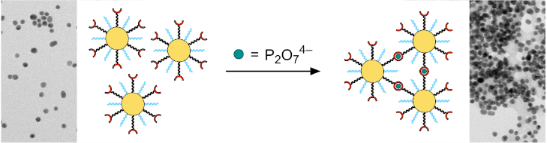
- tendency to migrate and a generally higher stability with respect to thiol-containing AuNPs [37][38][39]. A further advantage is the straightforward ligand synthesis, which does not require the use of protecting groups as in the case of thiols. The ligand 1 served as the solubilizing component and was


Synthesis of 4-substituted azopyridine-functionalized Ni(II)-porphyrins as molecular spin switches
Beilstein J. Org. Chem. 2020, 16, 2589–2597, doi:10.3762/bjoc.16.210
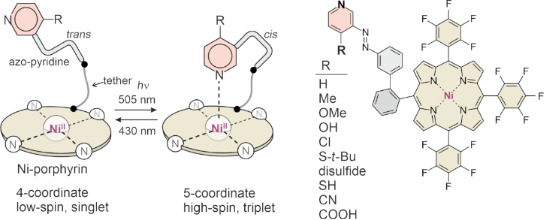
- -iodophenylazo)-4-chloropyridine (17) with LiSSiMe3 (8) [28], t-BuSH (13) and HSCH2CH2CO2CH3 (15) [29]. Electron-deficient aromatic, silylated thiols exhibit very labile Si–S bonds [30]. Thus, even bulky silyl protection groups are not suitable as protecting groups for the subsequent Suzuki reaction


The B & B approach: Ball-milling conjugation of dextran with phenylboronic acid (PBA)-functionalized BODIPY
Beilstein J. Org. Chem. 2020, 16, 2272–2281, doi:10.3762/bjoc.16.188
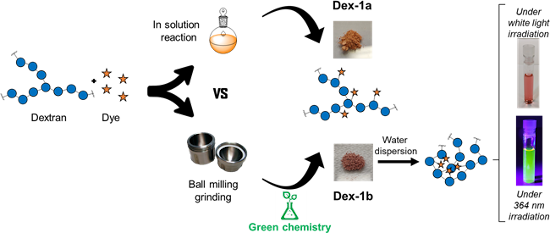
- related esters are relevant synthetic building blocks widely employed as cross-coupling reagents [14] as well as protecting groups for polyols and diamines [15][16]. Moreover, the reversible covalent interaction of boronic acids with specifically oriented cis-1,2 and 1,3-diols has been successfully


Photosensitized direct C–H fluorination and trifluoromethylation in organic synthesis
Beilstein J. Org. Chem. 2020, 16, 2151–2192, doi:10.3762/bjoc.16.183
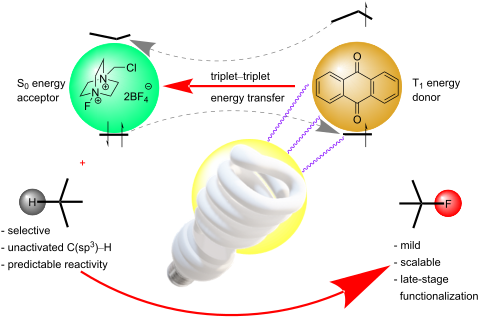
- with Selectfluor® [153]. The authors justified the use of protecting groups due to their extensive use in peptide synthesis. Of all the PGs tested, phthalimide (Phth)- and trifluoroacetate (TFA)-protected substrates underwent photosensitized C–H fluorination to give the highest yield of 80% and 71% of






Syntheses of spliceostatins and thailanstatins: a review
Beilstein J. Org. Chem. 2020, 16, 1991–2006, doi:10.3762/bjoc.16.166

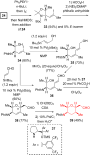
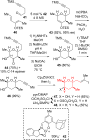
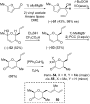
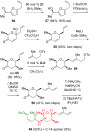
- manipulation of the C-4 and C-6 protecting groups gave the secondary allylic alcohol 71, which underwent an epoxidation with mCPBA to give 72. A second sequence of C-4/C-6 protection, manipulation, and oxidation gave the aldehyde 73. The disadvantages of this route include the overall length (13 or 14 steps
- ) gave the C-phenyl glucoside 75 [36]. Notably, the use of oxidants other than BQ gave either the TMS enol ether or the 2,3-dihydro-6-phenyl-4H-pyran-4-one. The C-3 exocyclic methylene group was introduced by a Wittig olefination, and after the manipulation of the protecting groups, a VO(acac)2-catalyzed




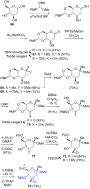


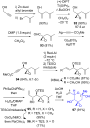
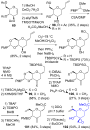


Synthesis, docking study and biological evaluation of ᴅ-fructofuranosyl and ᴅ-tagatofuranosyl sulfones as potential inhibitors of the mycobacterial galactan synthesis targeting the galactofuranosyltransferase GlfT2
Beilstein J. Org. Chem. 2020, 16, 1853–1862, doi:10.3762/bjoc.16.152
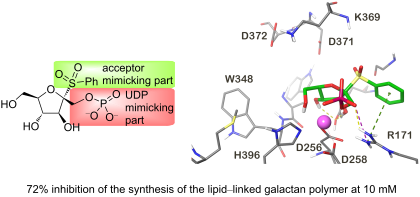
- -chloroperbenzoic acid (m-CPBA, 12 equiv) led to the simultaneous phosphorylation of the hydroxy group and to the oxidation of the sulfide to give 1-O-dibenzyloxyphosphoryl-ᴅ-fructofuranosyl sulfones 7α, 8α, 8β and 9α in excellent yields (Scheme 1). Final removal of benzyl protecting groups by catalytic
- of the benzyl protecting groups in later stages of the synthesis. This advantage makes the overall synthesis of the target molecules one reaction step shorter in comparison with the synthesis starting from pivalate 11 (Scheme 3). With alcohols 17 in hand, the synthesis continued with their
- obtained by acetonide hydrolysis under acidic conditions followed by the final catalytic hydrogenation of the benzyl protecting groups in derivatives 22. Evaluation of the effects of the target compounds on the synthesis of lipid-linked galactan precursors The availability of a series of compounds with


Nonenzymatic synthesis of anomerically pure, mannosyl-based molecular probes for scramblase identification studies
Beilstein J. Org. Chem. 2020, 16, 1732–1739, doi:10.3762/bjoc.16.145
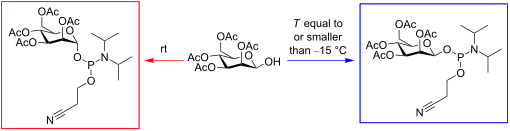
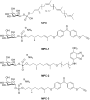
- MPC-2. There, the NBD tag was only partially stable to the conditions used to remove the protecting groups in the final step (NH3 in MeOH, Figure 3). Under such alkaline conditions, a considerable amount of degradation of NBD was observed, making an additional purification step necessary to obtain
- (DCM), and ETT served as the activator. The subsequent oxidation of the unstable phosphite triester to the more stable phosphotriester was performed with t-BuOOH. The resulting intermediates were then treated overnight with a solution of ammonia in methanol to remove the protecting groups. An overall
- t-BuOOH, and finally, the protecting groups were removed under basic conditions to give either MPC-1 or MPC-2 as ammonium salts. ETT = 5-(ethylthio)-1H-tetrazole. Preparation of mannosyl phosphoramidites. Starting from 2,3,4,6-tetra-O-acetyl-β-ᴅ-mannopyranose (β-4Ac-Man), the phosphitylation using 2



A dynamic combinatorial library for biomimetic recognition of dipeptides in water
Beilstein J. Org. Chem. 2020, 16, 1588–1595, doi:10.3762/bjoc.16.131
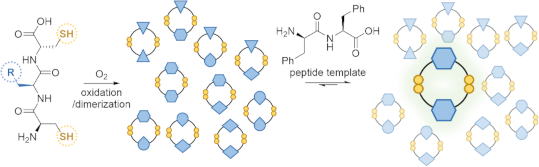
- CXC peptide building block design (single-letter code) were the terminal amino acids are cysteine (C) and the X can be any amino acid (Scheme 1a). This allows for rapid synthesis of various new building bocks by standard Fmoc based SPPS using Trt protecting groups for cysteine, which are subsequently


Fluorinated phenylalanines: synthesis and pharmaceutical applications
Beilstein J. Org. Chem. 2020, 16, 1022–1050, doi:10.3762/bjoc.16.91
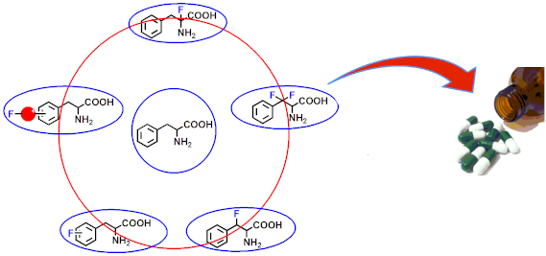
- 43 to generate 44. The isotope exchange was explored by using [18F]-TBA in DMF at 130 °C for 10 min to give [18F]-44. Decarbonylation of 44 was achieved by treatment with Rh(PPh3)3Cl to afford 45 and the subsequent removal of protecting groups gave 46. Conventional reactions yielded the desired
- 148 in variable yields with partial racemization. Phthalimido and trifluoroacetyl N-terminal protecting groups (R1 = Phth or TFA) and unprotected C-terminal derivatives (R2 = H) provided the most efficient outcomes (80 and 67% yield, respectively). An N-acetyl group was also suitable as protecting
- group for the reaction providing the desired product with 57% yield. Also, methyl and ethyl esters as C-terminal protecting groups in combination with phthalimino as the N-terminal protecting group, were both successfully explored. However, when the trifluoroacetyl amide was used as a substrate the


Copper-catalysed alkylation of heterocyclic acceptors with organometallic reagents
Beilstein J. Org. Chem. 2020, 16, 1006–1021, doi:10.3762/bjoc.16.90
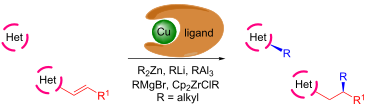
- efficient one to achieve an enantioselectivity of up to 96% ee. Interestingly, piperidones with different carbamate protecting groups (Me, Et, Ph, tosyl, and Bn, respectively) were tolerated, and a high enantioselectivity could also be obtained with several other dialkylzinc reagents (e.g., iPr2Zn and n
- reagents and protecting groups were examined, providing the products with good yield (up to 90%) and ee (up to 95%). Copper-catalysed conjugate addition reactions to alkenyl-substituted heterocycles Chiral heterocyclic aromatic compounds are crucial motifs in natural products and bioactive molecules, and