


Search results
Search for "reactive intermediates" in Full Text gives 134 result(s) in Beilstein Journal of Organic Chemistry.
- the safety of a chemical procedure, but also the proper selection of solvents, starting materials, and technologies used to generate and control reactive intermediates. In addition, the need for minimizing toxic waste and the respective disposal cost highlights how crucial it is to consider the
Superelectrophilic activation of 5-hydroxymethylfurfural and 2,5-diformylfuran: organic synthesis based on biomass-derived products
- Dmitry S. Ryabukhin,
- Dmitry N. Zakusilo,
- Mikhail O. Kompanets,
- Anton A.Tarakanov,
- Irina A. Boyarskaya,
- Tatiana O. Artamonova,
- Mikhail A. Khohodorkovskiy,
- Iosyp O. Opeida and
- Aleksander V. Vasilyev
Beilstein J. Org. Chem. 2016, 12, 2125–2135, doi:10.3762/bjoc.12.202
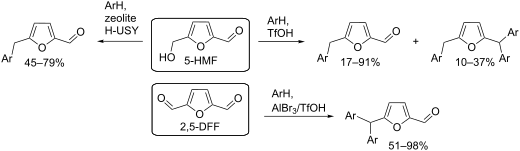
- (Scheme 1). All species A, B, C, and D may play a role as reactive intermediates derived from 1a and 2 in superacids. To estimate the electrophilic properties of cations A, B, C, and D we performed quantum chemical calculations by the DFT method (Table 1). HOMO and LUMO energies, global electrophilicity

Graphical Abstract

Figure 1: Formation of 5-HMF from D-glucose or D-fructose followed by oxidation to 2,5-DFF.

Scheme 1: Protonation of 5-HMF (1a) and 2,5-DFF (2) leading to cationic species A, B, C, D.

Figure 2: X-ray crystal structure of compounds 5a (a), and 5c (b) (ORTEP diagrams, ellipsoid contour of proba...
Enantioconvergent catalysis
- Justin T. Mohr,
- Jared T. Moore and
- Brian M. Stoltz
Beilstein J. Org. Chem. 2016, 12, 2038–2045, doi:10.3762/bjoc.12.192
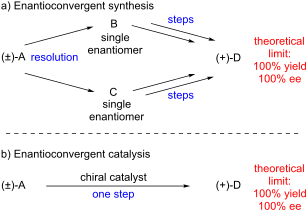
- reactive intermediates. Three important types of enantioconvergent catalysis are specifically discussed herein: type I – stereomutative, type II – stereoablative [8], and type III – parallel kinetic resolution [9]. The primary criteria for all enantioconvergent catalytic reactions are: The starting

Graphical Abstract

Figure 1: Enantioconvergent methods.

Figure 2: Stereomutative enantioconvergent catalysis.

Scheme 1: Dynamic kinetic resolution by hydrogenation.

Scheme 2: Enantioconvergent synthesis of phosphines governed by Curtin–Hammett/Winstein–Holness kinetics (TMS...

Figure 3: Stereoablative enantioconvergent catalysis.

Scheme 3: Stoltz’ stereoablative oxindole functionalization.

Scheme 4: Fu’s type II enantioconvergent Cu-catalyzed photoredox reaction.

Scheme 5: Stereoablative enantioconvergent allylation and protonation (dba = dibenzylideneacetone).

Scheme 6: Enantioconvergent allylic alkylation with two racemic starting materials.

Figure 4: Enantioconvergent parallel kinetic resolution.

Scheme 7: Enantioconvergent parallel kinetic resolution by two complementary biocatalysts.

Scheme 8: Enantioconvergent PKR by Nocardia EH1.
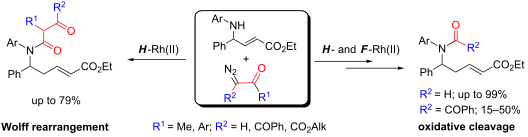
Unusual reactions of diazocarbonyl compounds with α,β-unsaturated δ-amino esters: Rh(II)-catalyzed Wolff rearrangement and oxidative cleavage of N–H-insertion products
- Valerij A. Nikolaev,
- Jury J. Medvedev,
- Olesia S. Galkina,
- Ksenia V. Azarova and
- Christoph Schneider
Beilstein J. Org. Chem. 2016, 12, 1904–1910, doi:10.3762/bjoc.12.180
- ; transition-metal-catalyzed reactions; Wolff rearrangement; Introduction Transition-metal-catalyzed reactions of diazocarbonyl compounds (DCC) with different organic substrates comprise a powerful tool of organic synthesis [1][2][3][4][5][6][7][8]. Of prime importance was found to be the ability of reactive
- intermediates generated from diazo compounds (ammonium, oxonium, C=X-ylides and others) to react with a variety of electrophiles/nucleophiles yielding complex and challenging organic molecules from relatively straightforward initial compounds [9][10]. The research group by Hu and co-workers elaborated recently

Graphical Abstract

Scheme 1: Catalytic reactions of diazocarbonyl compounds with unsaturated δ-amino esters.

Figure 1: The structures of the starting compounds 1–3 and catalysts used in this study.

Scheme 2: The assumed pathway for the occurance of amides 6a–c by way of the catalytic Wolff rearrangement.

Scheme 3: The assumed mechanism for the formation of the amides 4 and 7 during oxidative cleavage of the N–H-...
Rearrangements of organic peroxides and related processes
- Ivan A. Yaremenko,
- Vera A. Vil’,
- Dmitry V. Demchuk and
- Alexander O. Terent’ev
Beilstein J. Org. Chem. 2016, 12, 1647–1748, doi:10.3762/bjoc.12.162
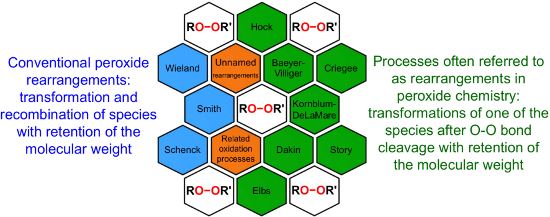

Graphical Abstract
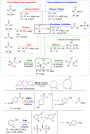
Figure 1: The named transformations considered in this review.

Scheme 1: The Baeyer–Villiger oxidation.

Scheme 2: The general mechanism of the peracid-promoted Baeyer–Villiger oxidation.

Scheme 3: General mechanism of the Lewis acid-catalyzed Baeyer–Villiger rearrangement.

Scheme 4: The theoretically studied mechanism of the BV oxidation reaction promoted by H2O2 and the Lewis aci...

Scheme 5: Proton movements in the transition states of the Baeyer–Villiger oxidation.

Scheme 6: The dependence of the course of the Baeyer–Villiger oxidation on the type of O–O-bond cleavage in t...
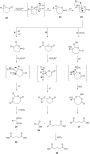
Scheme 7: The acid-catalyzed Baeyer–Villiger oxidation of cyclic epoxy ketones 22.

Scheme 8: Oxidation of isophorone oxide 29.

Scheme 9: Synthesis of acyl phosphate 32 from acyl phosphonate 31.

Scheme 10: Synthesis of aflatoxin B2 (36).

Scheme 11: The Baeyer–Villiger rearrangement of ketones 37 to lactones 38.

Scheme 12: Synthesis of 3,4-dimethoxybenzoic acid (40) via Baeyer–Villiger oxidation.

Scheme 13: Oxone transforms α,β-unsaturated ketones 43 into vinyl acetates 44.

Scheme 14: The Baeyer–Villiger oxidation of ketones 45 using diaryl diselenide and hydrogen peroxide.

Scheme 15: Baeyer–Villiger oxidation of (E)-2-methylenecyclobutanones.

Scheme 16: Oxidation of β-ionone (56) by H2O2/(BnSe)2 with formation of (E)-2-(2,6,6-trimethylcyclohex-1-en-1-...

Scheme 17: The mechanism of oxidation of ketones 58a–f by hydrogen peroxide in the presence of arsonated polys...

Scheme 18: Oxidation of ketone (58b) by H2O2 to 6-methylcaprolactone (59b) catalyzed by Pt complex 66·BF4.

Scheme 19: Oxidation of ketones 67 with H2O2 in the presence of [(dppb}Pt(µ-OH)]22+.

Scheme 20: The mechanism of oxidation of ketones 67 in the presence of [(dppb}Pt(µ-OH)]22+ and H2O2.

Scheme 21: Oxidation of benzaldehydes 69 in the presence of the H2O2/MeReO3 system.

Scheme 22: Oxidation of acetophenones 72 in the presence of the H2O2/MeReO3 system.

Scheme 23: Baeyer–Villiger oxidation of 2-adamantanone (45c) in the presence of Sn-containing mesoporous silic...

Scheme 24: Aerobic Baeyer–Villiger oxidation of ketones 76 using metal-free carbon.

Scheme 25: A regioselective Baeyer-Villiger oxidation of functionalized cyclohexenones 78 into a dihydrooxepin...

Scheme 26: The oxidation of aldehydes and ketones 80 by H2O2 catalyzed by Co4HP2Mo15V3O62.

Scheme 27: The cleavage of ketones 82 with hydrogen peroxide in alkaline solution.

Scheme 28: Oxidation of ketones 85 to esters 86 with H2O2–urea in the presence of KHCO3.

Scheme 29: Mechanism of the asymmetric oxidation of cyclopentane-1,2-dione 87a with the Ti(OiPr)4/(+)DET/t-BuO...

Scheme 30: The oxidation of cis-4-tert-butyl-2-fluorocyclohexanone (93) with m-chloroperbenzoic acid.

Scheme 31: The mechanism of the asymmetric oxidation of 3-substituted cyclobutanone 96a in the presence of chi...

Scheme 32: Enantioselective Baeyer–Villiger oxidation of cyclic ketones 98.

Scheme 33: Regio- and enantioselective Baeyer–Villiger oxidation of cyclic ketones 101.

Scheme 34: The proposed mechanism of the Baeyer–Villiger oxidation of acetal 105f.

Scheme 35: Synthesis of hydroxy-10H-acridin-9-one 117 from tetramethoxyanthracene 114.

Scheme 36: The Baeyer–Villiger oxidation of the fully substituted pyrrole 120.

Scheme 37: The Criegee rearrangement.

Scheme 38: The mechanism of the Criegee reaction of a peracid with a tertiary alcohol 122.

Scheme 39: Criegee rearrangement of decaline ethylperoxoate 127 into ketal 128.

Scheme 40: The ionic cleavage of 2-methoxy-2-propyl perester 129.

Scheme 41: The Criegee rearrangement of α-methoxy hydroperoxide 136.
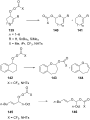
Scheme 42: Synthesis of enol esters and acetals via the Criegee rearrangement.

Scheme 43: Proposed mechanism of the transformation of 1-hydroperoxy-2-oxabicycloalkanones 147a–d.

Scheme 44: Transformation of 3-hydroxy-1,2-dioxolanes 151 into diketone derivatives 152.

Scheme 45: Criegee rearrangement of peroxide 153 with the mono-, di-, and tri-O-insertion.

Scheme 46: The sequential Criegee rearrangements of adamantanes 157a,b.

Scheme 47: Synthesis of diaryl carbonates 160a–d from triarylmethanols 159a–d through successive oxygen insert...

Scheme 48: The synthesis of sesquiterpenes 162 from ketone 161 with a Criegee rearrangement as one key step.

Scheme 49: Synthesis of trans-hydrindan derivatives 164, 165.

Scheme 50: The Hock rearrangement.

Scheme 51: The general scheme of the cumene process.

Scheme 52: The Hock rearrangement of aliphatic hydroperoxides.
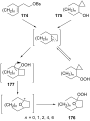
Scheme 53: The mechanism of solvolysis of brosylates 174a–c and spiro cyclopropyl carbinols 175a–c in THF/H2O2....

Scheme 54: The fragmentation mechanism of hydroperoxy acetals 178 to esters 179.

Scheme 55: The acid-catalyzed rearrangement of phenylcyclopentyl hydroperoxide 181.

Scheme 56: The peroxidation of tertiary alcohols in the presence of a catalytic amount of acid.

Scheme 57: The acid-catalyzed reaction of bicyclic secondary alcohols 192 with hydrogen peroxide.

Scheme 58: The photooxidation of 5,6-disubstituted 3,4-dihydro-2H-pyrans 196.

Scheme 59: The oxidation of tertiary alcohols 200a–g, 203a,b, and 206.

Scheme 60: Transformation of functional peroxide 209 leading to 2,3-disubstitued furans 210 in one step.

Scheme 61: The synthesis of carbazoles 213 via peroxide rearrangement.

Scheme 62: The construction of C–N bonds using the Hock rearrangement.

Scheme 63: The synthesis of moiety 218 from 217 which is a structural motif in the antitumor–antibiotic of CC-...

Scheme 64: The in vivo oxidation steps of cholesterol (219) by singlet oxygen.

Scheme 65: The proposed mechanism of the rearrangement of cholesterol-5α-OOH 220.

Scheme 66: Photochemical route to artemisinin via Hock rearrangement of 223.

Scheme 67: The Kornblum–DeLaMare rearrangement.

Scheme 68: Kornblum–DeLaMare transformation of 1-phenylethyl tert-butyl peroxide (225).

Scheme 69: The synthesis 4-hydroxyenones 230 from peroxide 229.

Scheme 70: The Kornblum–DeLaMare rearrangement of peroxide 232.

Scheme 71: The reduction of peroxide 234.

Scheme 72: The Kornblum–DeLaMare rearrangement of endoperoxide 236.

Scheme 73: The rearrangement of peroxide 238 under Kornblum–DeLaMare conditions.

Scheme 74: The proposed mechanism of rearrangement of peroxide 238.

Scheme 75: The Kornblum–DeLaMare rearrangement of peroxides 242a,b.

Scheme 76: The base-catalyzed rearrangements of bicyclic endoperoxides having electron-withdrawing substituent...

Scheme 77: The base-catalyzed rearrangements of bicyclic endoperoxides 249a,b having electron-donating substit...

Scheme 78: The base-catalyzed rearrangements of bridge-head substituted bicyclic endoperoxides 251a,b.

Scheme 79: The Kornblum–DeLaMare rearrangement of hydroperoxide 253.

Scheme 80: Synthesis of β-hydroxy hydroperoxide 254 from endoperoxide 253.

Scheme 81: The amine-catalyzed rearrangement of bicyclic endoperoxide 263.

Scheme 82: The base-catalyzed rearrangement of meso-endoperoxide 268 into 269.

Scheme 83: The photooxidation of 271 and subsequent Kornblum–DeLaMare reaction.

Scheme 84: The Kornblum–DeLaMare rearrangement as one step in the oxidation reaction of enamines.

Scheme 85: The Kornblum–DeLaMare rearrangement of 3,5-dihydro-1,2-dioxenes 284, 1,2-dioxanes 286, and tert-but...

Scheme 86: The Kornblum–DeLaMare rearrangement of epoxy dioxanes 290a–d.

Scheme 87: Rearrangement of prostaglandin H2 292.

Scheme 88: The synthesis of epicoccin G (297).

Scheme 89: The Kornblum–DeLaMare rearrangement used in the synthesis of phomactin A.

Scheme 90: The Kornblum–DeLaMare rearrangement in the synthesis of 3H-quinazolin-4-one 303.

Scheme 91: The Kornblum–DeLaMare rearrangement in the synthesis of dolabriferol (308).

Scheme 92: Sequential transformation of 3-substituted 2-pyridones 309 into 3-hydroxypyridine-2,6-diones 311 in...

Scheme 93: The Kornblum–DeLaMare rearrangement of peroxide 312 into hydroxy enone 313.

Scheme 94: The Kornblum–DeLaMare rearrangement in the synthesis of polyfunctionalized carbonyl compounds 317.

Scheme 95: The Kornblum–DeLaMare rearrangement in the synthesis of (Z)-β-perfluoroalkylenaminones 320.

Scheme 96: The Kornblum–DeLaMare rearrangement in the synthesis of γ-ketoester 322.

Scheme 97: The Kornblum–DeLaMare rearrangement in the synthesis of diterpenoids 326 and 328.

Scheme 98: The synthesis of natural products hainanolidol (331) and harringtonolide (332) from peroxide 329.

Scheme 99: The synthesis of trans-fused butyrolactones 339 and 340.

Scheme 100: The synthesis of leucosceptroid C (343) and leucosceptroid P (344) via the Kornblum–DeLaMare rearra...

Scheme 101: The Dakin oxidation of arylaldehydes or acetophenones.

Scheme 102: The mechanism of the Dakin oxidation.

Scheme 103: A solvent-free Dakin reaction of aromatic aldehydes 356.

Scheme 104: The organocatalytic Dakin oxidation of electron-rich arylaldehydes 358.

Scheme 105: The Dakin oxidation of electron-rich arylaldehydes 361.

Scheme 106: The Dakin oxidation of arylaldehydes 358 in water extract of banana (WEB).

Scheme 107: A one-pot approach towards indolo[2,1-b]quinazolines 364 from indole-3-carbaldehydes 363 through th...

Scheme 108: The synthesis of phenols 367a–c from benzaldehydes 366a-c via acid-catalyzed Dakin oxidation.

Scheme 109: Possible transformation paths of the highly polarized boric acid coordinated H2O2–aldehyde adduct 3...

Scheme 110: The Elbs oxidation of phenols 375 to hydroquinones.

Scheme 111: The mechanism of the Elbs persulfate oxidation of phenols 375 affording p-hydroquinones 376.

Scheme 112: Oxidation of 2-pyridones 380 under Elbs persulfate oxidation conditions.

Scheme 113: Synthesis of 3-hydroxy-4-pyridone (384) via an Elbs oxidation of 4-pyridone (382).

Scheme 114: The Schenck rearrangement.

Scheme 115: The Smith rearrangement.

Scheme 116: Three main pathways of the Schenck rearrangement.

Scheme 117: The isomerization of hydroperoxides 388 and 389.

Scheme 118: Trapping of dioxacyclopentyl radical 392 by oxygen.

Scheme 119: The hypothetical mechanism of the Schenck rearrangement of peroxide 394.

Scheme 120: The autoxidation of oleic acid (397) with the use of labeled isotope 18O2.

Scheme 121: The rearrangement of 18O-labeled hydroperoxide 400 under an atmosphere of 16O2.

Scheme 122: The rearrangement of the oleate-derived allylic hydroperoxides (S)-421 and (R)-425.

Scheme 123: Mechanisms of Schenck and Smith rearrangements.

Scheme 124: The rearrangement and cyclization of 433.

Scheme 125: The Wieland rearrangement.

Scheme 126: The rearrangement of bis(triphenylsilyl) 439 or bis(triphenylgermyl) 441 peroxides.

Scheme 127: The oxidative transformation of cyclic ketones.

Scheme 128: The hydroxylation of cyclohexene (447) in the presence of tungstic acid.

Scheme 129: The oxidation of cyclohexene (447) under the action of hydrogen peroxide.

Scheme 130: The reaction of butenylacetylacetone 455 with hydrogen peroxide.

Scheme 131: The oxidation of bridged 1,2,4,5-tetraoxanes.

Scheme 132: The proposed mechanism for the oxidation of bridged 1,2,4,5-tetraoxanes.

Scheme 133: The rearrangement of ozonides.

Scheme 134: The acid-catalyzed oxidative rearrangement of malondialdehydes 462 under the action of H2O2.
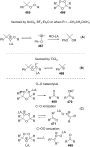
Scheme 135: Pathways of the Lewis acid-catalyzed cleavage of dialkyl peroxides 465 and ozonides 466.

Scheme 136: The mechanism of the transformation of (tert-butyldioxy)cyclohexanedienones 472.

Scheme 137: The synthesis of Vitamin K3 from 472a.

Scheme 138: Proposed mechanism for the transformation of 478d into silylated endoperoxide 479d.

Scheme 139: The rearrangement of hydroperoxide 485 to form diketone 486.

Scheme 140: The base-catalyzed rearrangement of cyclic peroxides 488a–g.

Scheme 141: Synthesis of chiral epoxides and aldols from peroxy hemiketals 491.

Scheme 142: The multistep transformation of (R)-carvone (494) to endoperoxides 496a–e.

Scheme 143: The decomposition of anthracene endoperoxide 499.

Scheme 144: Synthesis of esters 503 from aldehydes 501 via rearrangement of peroxides 502.

Scheme 145: Two possible paths for the base-promoted decomposition of α-azidoperoxides 502.

Scheme 146: The Story decomposition of cyclic diperoxide 506a.

Scheme 147: The Story decomposition of cyclic triperoxide 506b.

Scheme 148: The thermal rearrangement of endoperoxides A into diepoxides B.

Scheme 149: The transformation of peroxide 510 in the synthesis of stemolide (511).

Scheme 150: The possible mechanism of the rearrangement of endoperoxide 261g.

Scheme 151: The photooxidation of indene 517.

Scheme 152: The isomerization of ascaridole (523).

Scheme 153: The isomerization of peroxide 525.

Scheme 154: The thermal transformation of endoperoxide 355.

Scheme 155: The photooxidation of cyclopentadiene (529) at a temperature higher than 0 °C.

Scheme 156: The thermal rearrangement of endoperoxides 538a,b.

Scheme 157: The transformation of peroxides 541.

Scheme 158: The thermal rearrangements of strained cyclic peroxides.

Scheme 159: The thermal rearrangement of diacyl peroxide 551 in the synthesis of C4-epi-lomaiviticin B core 553....

Scheme 160: The 1O2 oxidation of tryptophan (554) and rearrangement of dioxetane intermediate 555.

Scheme 161: The Fe(II)-promoted cleavage of aryl-substituted bicyclic peroxides.

Scheme 162: The proposed mechanism of the Fe(II)-promoted rearrangement of 557a–c.

Scheme 163: The reaction of dioxolane 563 with Fe(II) sulfate.

Scheme 164: Fe(II)-promoted rearrangement of 1,2-dioxane 565.

Scheme 165: Fe(II) cysteinate-promoted rearrangement of 1,2-dioxolane 568.

Scheme 166: The transformation of 1,2-dioxanes 572a–c under the action of FeCl2.

Scheme 167: Fe(II) cysteinate-promoted transformation of tetraoxane 574.

Scheme 168: The CoTPP-catalyzed transformation of bicyclic endoperoxides 600a–d.

Scheme 169: The CoTPP-catalyzed transformation of epoxy-1,2-dioxanes.

Scheme 170: The Ru(II)-catalyzed reactions of 1,4-endoperoxide 261g.

Scheme 171: The Ru(II)-catalyzed transformation as a key step in the synthesis of elyiapyrone A (610) from 1,4-...

Scheme 172: Peroxides with antimalarial activity.

Scheme 173: The interaction of iron ions with artemisinin (616).

Scheme 174: The interaction of FeCl2 with 1,2-dioxanes 623, 624.

Scheme 175: The mechanism of reaction 623 and 624 with Fe(II)Cl2.

Scheme 176: The reaction of bicyclic natural endoperoxides G3-factors 631–633 with FeSO4.

Scheme 177: The transformation of terpene cardamom peroxide 639.
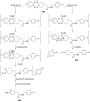
Scheme 178: The different ways of the cleavage of tetraoxane 643.

Scheme 179: The LC–MS analysis of interaction of tetraoxane 646 with iron(II)heme 647.

Scheme 180: The rearrangement of 3,6-epidioxy-1,10-bisaboladiene (EDBD, 649).

Scheme 181: Easily oxidized substrates.

Scheme 182: Biopathway of synthesis of prostaglandins.

Scheme 183: The reduction and rearrangements of isoprostanes.

Scheme 184: The partial mechanism for linoleate 658 oxidation.

Scheme 185: The transformation of lipid hydroperoxide.

Scheme 186: The acid-catalyzed cleavage of the product from free-radical oxidation of cholesterol (667).

Scheme 187: Two pathways of catechols oxidation.

Scheme 188: Criegee-like or Hock-like rearrangement of the intermediate hydroperoxide 675 in dioxygenase enzyme...

Scheme 189: Carotinoides 679 cleavage by carotenoid cleavage dioxygenases.
One-pot synthesis of 4′-alkyl-4-cyanobiaryls on the basis of the terephthalonitrile dianion and neutral aromatic nitrile cross-coupling
- Roman Yu. Peshkov,
- Elena V. Panteleeva,
- Wang Chunyan,
- Evgeny V. Tretyakov and
- Vitalij D. Shteingarts
Beilstein J. Org. Chem. 2016, 12, 1577–1584, doi:10.3762/bjoc.12.153

- -coupling; cyanoarenes; reactive intermediates; reductive alkylation; Introduction Alkylcyanobiphenyls are well known largely due to their mesogenic properties, which were discovered by Gray in the 1970th [1][2]. Alkylcyanobiphenyls and their analogs (e.g., dialkyl and alkoxy alkyl derivatives) are still

Graphical Abstract

Scheme 1: The main synthetic approaches to alkylcyanobiphenyls.

Scheme 2: Para-cyanophenylation of substituted benzonitriles 2 by dianion 12− with the formation of a long-li...

Scheme 3: para-Cyanophenylation of 1-cyanonaphthalene 5i by dianion 12− with subsequent butylation providing ...
The EIMS fragmentation mechanisms of the sesquiterpenes corvol ethers A and B, epi-cubebol and isodauc-8-en-11-ol
- Patrick Rabe and
- Jeroen S. Dickschat
Beilstein J. Org. Chem. 2016, 12, 1380–1394, doi:10.3762/bjoc.12.132
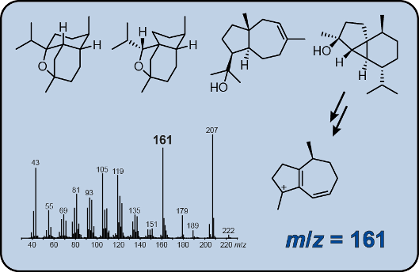
- to 3c+·, followed by α-cleavage to F3+·. Two subsequent hydrogen rearrangements result in the conjugated reactive intermediates G3+· and H3+·, which may be followed by the elimination of water to I3+· that upon α-cleavage yields the benzyl cation J3+. Finally, PMA43 reveals a clean formation of the

Graphical Abstract

Scheme 1: Structures of corvol ethers A (1) and B (2), epi-cubebol (3), and isodauc-8-en-11-ol (4). Carbon nu...
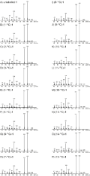
Figure 1: Mass spectra of unlabelled 1 and all fifteen positional isomers of (13C1)-1.
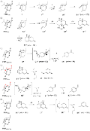
Scheme 2: PMAs and EIMS fragmentation mechanisms for the fragment ions A) m/z = 179, B) m/z = 161, C) m/z = 1...
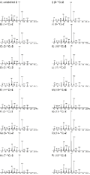
Figure 2: Mass spectra of unlabelled 2 and all fifteen positional isomers of (13C1)-2.
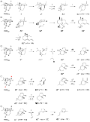
Scheme 3: PMAs and EIMS fragmentation mechanisms for the fragment ions A) m/z = 179, B) m/z = 161, C) m/z = 1...
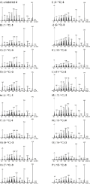
Figure 3: Mass spectra of unlabelled 3 and all fifteen positional isomers of (13C1)-3.
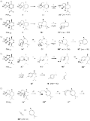
Scheme 4: PMAs and EIMS fragmentation mechanisms for the fragment ions A) m/z = 207, B) m/z = 179, C) m/z = 1...
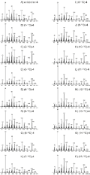
Figure 4: Mass spectra of unlabelled 4 and all fifteen positional isomers of (13C1)-4.
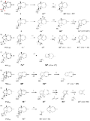
Scheme 5: PMAs and EIMS fragmentation mechanisms for the fragment ions A) m/z = 207, B) m/z = 189, C) m/z = 1...
Efficient syntheses of climate relevant isoprene nitrates and (1R,5S)-(−)-myrtenol nitrate
- Sean P. Bew,
- Glyn D. Hiatt-Gipson,
- Graham P. Mills and
- Claire E. Reeves
Beilstein J. Org. Chem. 2016, 12, 1081–1095, doi:10.3762/bjoc.12.103

- rac-3 (Scheme 1). The formation and reaction of these reactive intermediates with NO generates O3 and mixtures of IPNs, i.e., rac-7–(E)-10 (Scheme 1). Contributing to the complexity of the climate chemistry associated with 1 is its oxidation to ketones, e.g., 11 and rac-6 and aldehydes, e.g., rac-5

Graphical Abstract

Scheme 1: Simplified overview outlining how a small number of different IPNs are synthesised and are able to ...

Scheme 2: Protocols for the synthesis of O-nitrated alcohols using (±)-isoprene epoxide and 2° alcohols as st...

Scheme 3: Attempted synthesis of O-nitrate ester rac-19 and rac-20 synthesis.

Scheme 4: Olah et al. O-nitrated alcohol syntheses of 23–33 using N-nitro-2,4-6-trimethylpyridinium tetrafluo...

Scheme 5: O-nitration study using 22 and the alcohols 34–37.

Scheme 6: Silver nitrate mediated synthesis of 2-oxopropyl nitrate 43.

Scheme 7: Application of isoprene for the synthesis of precursors to IPNs and synthesis via ‘halide for nitra...

Scheme 8: Synthesis of (E)-3-methyl-4-chlorobut-2-en-1-ol ((E)-60) and (Z)-3-methyl-4-chlorobut-2-en-1-ol ((Z...

Scheme 9: Using NOESY interactions to establish the conformations of the C=C bonds within (E)-10 and (Z)-9.

Scheme 10: Synthesis of isoprene nitrates (E)-11 and (Z)-12 from ketone 63.

Scheme 11: Attempted synthesis of rac-8 from O-mesylate rac-71.

Scheme 12: Synthesis of O-nitrate 73 from O-mesylate 72.

Scheme 13: Attempted synthesis of 2° alcohol containing 1° nitrate ester rac-19 and the unexpected synthesis o...

Scheme 14: Synthesis of monoterpene derived (1R,5S)-(−)-myrtenol nitrate 86.
(Thio)urea-mediated synthesis of functionalized six-membered rings with multiple chiral centers
- Giorgos Koutoulogenis,
- Nikolaos Kaplaneris and
- Christoforos G. Kokotos
Beilstein J. Org. Chem. 2016, 12, 462–495, doi:10.3762/bjoc.12.48
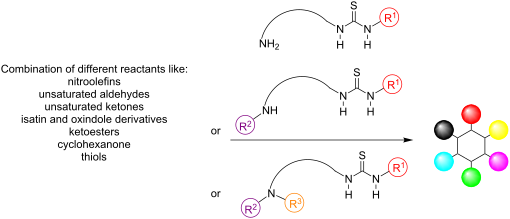
- of intermediates have been proposed to be the reactive intermediates in many reactions such as aldol, Michael, Mannich, and α-functionalization (α-chlorination, α-amination, α-fluorination) reactions. Proline-type organocatalysts are considered priviliged, because their corresponding enamines exist

Graphical Abstract

Scheme 1: Activation of carbonyl compounds via enamine and iminium intermediates [2].

Scheme 2: Electronic and steric interactions present in enamine activation mode [2].

Scheme 3: Electrophilic activation of carbonyl compounds by a thiourea moiety.

Scheme 4: Asymmetric synthesis of dihydro-2H-pyran-6-carboxylate 3 using organocatalyst 4 [16].

Scheme 5: Possible hydrogen-bonding for the reaction of (E)-methyl 2-oxo-4-phenylbut-3-enoate [16].

Scheme 6: Asymmetric desymmetrization of 4,4-cyclohexadienones using the Michael addition reaction with malon...

Scheme 7: The enantioselective synthesis of α,α-disubstituted cycloalkanones using catalyst 11 [18].

Scheme 8: The enantioselective synthesis of indolo- and benzoquinolidine compounds through aza-Diels–Alder re...

Scheme 9: Enantioselective [5 + 2] cycloaddition [20].

Scheme 10: Asymmetric synthesis of oxazine derivatives 26 [21].

Scheme 11: Asymmetric synthesis of bicyclo[3.3.1]nonadienone, core 30 present in (−)-huperzine [22].

Scheme 12: Asymmetric inverse electron-demand Diels-Alder reaction catalyzed by amine-thiourea 34 [23].

Scheme 13: Asymmetric entry to morphan skeletons, catalyzed by amine-thiourea 37 [24].

Scheme 14: Asymmetric transformation of (E)-2-nitroallyl acetate [25].

Scheme 15: Proposed way of activation.

Scheme 16: Asymmetric synthesis of nitrobicyclo[3.2.1]octan-2-one derivatives [26].

Scheme 17: Asymmetric tandem Michael–Henry reaction catalyzed by 50 [27].

Scheme 18: Asymmetric Diels–Alder reactions of 3-vinylindoles 51 [29].

Scheme 19: Proposed transition state and activation mode of the asymmetric Diels–Alder reactions of 3-vinylind...

Scheme 20: Desymmetrization of meso-anhydrides by Chin, Song and co-workers [30].

Scheme 21: Desymmetrization of meso-anhydrides by Connon and co-workers [31].

Scheme 22: Asymmetric intramolecular Michael reaction [32].

Scheme 23: Asymmetric addition of malonate to 3-nitro-2H-chromenes 67 [33].

Scheme 24: Intramolecular desymmetrization through an intramolecular aza-Michael reaction [34].

Scheme 25: Enantioselective synthesis of (−)-mesembrine [34].

Scheme 26: A novel asymmetric Michael–Michael reaction [35].

Scheme 27: Asymmetric three-component reaction catalyzed by Takemoto’s catalyst 77 [46].

Scheme 28: Asymmetric domino Michael–Henry reaction [47].

Scheme 29: Asymmetric domino Michael–Henry reaction [48].

Scheme 30: Enantioselective synthesis of derivatives of 3,4-dihydro-2H-pyran 89 [49].

Scheme 31: Asymmetric addition of α,α-dicyano olefins 90 to 3-nitro-2H-chromenes 91 [50].

Scheme 32: Asymmetric three-component reaction producing 2,6-diazabicyclo[2.2.2]octanones 95 [51].

Scheme 33: Asymmetric double Michael reaction producing substituted chromans 99 [52].

Scheme 34: Enantioselective synthesis of multi-functionalized spiro oxindole dienes 106 [53].

Scheme 35: Organocatalyzed Michael aldol cyclization [54].

Scheme 36: Asymmetric synthesis of dihydrocoumarins [55].

Scheme 37: Asymmetric double Michael reaction en route to tetrasubstituted cyclohexenols [56].

Scheme 38: Asymmetric synthesis of α-trifluoromethyl-dihydropyrans 121 [58].

Scheme 39: Tyrosine-derived tertiary amino-thiourea 123 catalyzed Michael hemiaketalization reaction [59].

Scheme 40: Enantioselective entry to bicyclo[3.2.1]octane unit [60].

Scheme 41: Asymmetric synthesis of spiro[4-cyclohexanone-1,3’-oxindoline] 126 [61].

Scheme 42: Kinetic resolution of 3-nitro-2H-chromene 130 [62].

Scheme 43: Asymmetric synthesis of chromanes 136 [63].

Scheme 44: Wang’s utilization of β-unsaturated α-ketoesters 87 [64,65].

Scheme 45: Asymmetric entry to trifluoromethyl-substituted dihydropyrans 144 [66].

Scheme 46: Phenylalanine-derived thiourea-catalyzed domino Michael hemiaketalization reaction [67].

Scheme 47: Asymmetric synthesis of α-trichloromethyldihydropyrans 149 [68].

Scheme 48: Takemoto’s thiourea-catalyzed domino Michael hemiaketalization reaction [69].

Scheme 49: Asymmetric synthesis of densely substituted cyclohexanes [70].

Scheme 50: Enantioselective synthesis of polysubstituted chromeno [4,3-b]pyrrolidine derivatines 157 [71].

Scheme 51: Enantioselective synthesis of spiro-fused cyclohexanone/5-oxazolone scaffolds 162 [72].

Scheme 52: Utilizing 2-mercaptobenzaldehydes 163 in cascade processes [73,74].

Scheme 53: Proposed transition state of the initial sulfa-Michael step [74].

Scheme 54: Asymmetric thiochroman synthesis via dynamic kinetic resolution [75].

Scheme 55: Enantioselective synthesis of thiochromans [76].

Scheme 56: Enantioselective synthesis of chromans and thiochromans synthesis [77].

Scheme 57: Enantioselective sulfa-Michael aldol reaction en route to spiro compounds [78].

Scheme 58: Enantioselective synthesis of 4-aminobenzo(thio)pyrans 179 [79].

Scheme 59: Asymmetric synthesis of tetrahydroquinolines [80].

Scheme 60: Novel asymmetric Mannich–Michael sequence producing tetrahydroquinolines 186 [81].

Scheme 61: Enantioselective synthesis of biologically interesting chromanes 190 and 191 [82].

Scheme 62: Asymmetric tandem Henry–Michael reaction [83].

Scheme 63: An asymmetric synthesis of substituted cyclohexanes via a dynamic kinetic resolution [84].

Scheme 64: Three component-organocascade initiated by Knoevenagel reaction [85].

Scheme 65: Asymmetric Michael reaction catalyzed by catalysts 57 and 211 [86].

Scheme 66: Proposed mechanism for the asymmetric Michael reaction catalyzed by catalysts 57 and 211 [86].

Scheme 67: Asymmetric facile synthesis of hexasubstituted cyclohexanes [87].

Scheme 68: Dual activation catalytic mechanism [87].

Scheme 69: Asymmetric Michael–Michael/aldol reaction catalyzed by catalysts 57, 219 and 214 [88].

Scheme 70: Asymmetric synthesis of substituted cyclohexane derivatives, using catalysts 57 and 223 [89].

Scheme 71: Asymmetric synthesis of substituted piperidine derivatives, using catalysts 223 and 228 [90].

Scheme 72: Asymmetric synthesis of endo-exo spiro-dihydropyran-oxindole derivatives catalyzed by catalyst 232 [91]....

Scheme 73: Asymmetric synthesis of carbazole spiroxindole derivatives, using catalyst 236 [92].

Scheme 74: Enantioselective formal [2 + 2] cycloaddition of enal 209 with nitroalkene 210, using catalysts 23 ...

Scheme 75: Asymmetric synthesis of polycyclized hydroxylactams derivatives, using catalyst 242 [94].

Scheme 76: Asymmetric synthesis of product 243, using catalyst 246 [95].

Scheme 77: Formation of the α-stereoselective acetals 248 from the corresponding enol ether 247, using catalys...

Scheme 78: Selective glycosidation, catalyzed by Shreiner’s catalyst 23 [97].
Recent advances in N-heterocyclic carbene (NHC)-catalysed benzoin reactions
- Rajeev S. Menon,
- Akkattu T. Biju and
- Vijay Nair
Beilstein J. Org. Chem. 2016, 12, 444–461, doi:10.3762/bjoc.12.47
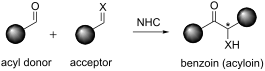
- ]. Meanwhile, the Breslow intermediate is produced from the aldehyde by the thiazolium 31-derived NHC. The union of these two reactive intermediates furnished α-amidoketones 32 in excellent yields (Scheme 18). A diastereoselective [4 + 1] annulation of phthalaldehyde with imines leading to the formation of cis

Graphical Abstract
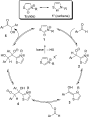
Scheme 1: Breslow’s proposal on the mechanism of the benzoin condensation.

Scheme 2: Imidazolium carbene-catalysed homo-benzoin condensation.

Scheme 3: Homo-benzoin condensation in aqueous medium.

Scheme 4: Homobenzoin condensation catalysed by bis(benzimidazolium) salt 8.

Scheme 5: List of assorted chiral NHC-catalysts used for asymmetric homobenzoin condensation.

Scheme 6: A rigid bicyclic triazole precatalyst 15 in an efficient enantioselective benzoin reaction.

Scheme 7: Inoue’s report of cross-benzoin reactions.

Scheme 8: Cross-benzoin reactions catalysed by thiazolium salt 17.

Scheme 9: Catalyst-controlled divergence in cross-benzoin reactions.

Scheme 10: Chemoselective cross-benzoin reactions catalysed by a bulky NHC.

Scheme 11: Selective intermolecular cross-benzoin condensation reactions of aromatic and aliphatic aldehydes.

Scheme 12: Chemoselective cross-benzoin reaction of aliphatic and aromatic aldehydes.

Scheme 13: Cross-benzoin reactions of trifluoromethyl ketones developed by Enders.

Scheme 14: Cross-benzoin reactions of aldehydes and α-ketoesters.

Scheme 15: Enantioselective cross-benzoin reactions of aliphatic aldehydes and α-ketoesters.

Scheme 16: Dynamic kinetic resolution of β-halo-α-ketoesters via cross-benzoin reaction.

Scheme 17: Enantioselective benzoin reaction of aldehydes and alkynones.

Scheme 18: Aza-benzoin reaction of aldehydes and acylimines.

Scheme 19: NHC-catalysed diastereoselective synthesis of cis-2-amino 3-hydroxyindanones.

Scheme 20: Cross-aza-benzoin reactions of aldehydes with aromatic imines.

Scheme 21: Enantioselective cross aza-benzoin reaction of aliphatic aldehydes with N-Boc-imines.

Scheme 22: Chemoselective cross aza-benzoin reaction of aldehydes with N-PMP-imino esters.

Scheme 23: NHC-catalysed coupling reaction of acylsilanes with imines.

Scheme 24: Thiazolium salt-mediated enantioselective cross-aza-benzoin reaction.

Scheme 25: Aza-benzoin reaction of enals with activated ketimines.

Scheme 26: Isatin derived ketimines as electrophiles in cross aza-benzoin reaction with enals.

Scheme 27: Aza-benzoin reaction of aldehydes and phosphinoylimines catalysed by the BAC-carbene.

Scheme 28: Nitrosoarenes as the electrophilic component in benzoin-initiated cascade reaction.

Scheme 29: One-pot synthesis of hydroxamic esters via aza-benzoin reaction.

Scheme 30: Cookson and Lane’s report of intramolecular benzoin condensation.

Scheme 31: Intramolecular cross-benzoin condensation between aldehyde and ketone moieties.

Scheme 32: Intramolecular crossed aldehyde-ketone benzoin reactions.

Scheme 33: Enantioselective intramolecular crossed aldehyde-ketone benzoin reaction.

Scheme 34: Chromanone synthesis via enantioselective intramolecular cross-benzoin reaction.

Scheme 35: Intramolecular cross-benzoin reaction of chalcones.

Scheme 36: Synthesis of bicyclic tertiary alcohols by intramolecular benzoin reaction.

Scheme 37: A multicatalytic Michael–benzoin cascade process for cyclopentanone synthesis.

Scheme 38: Enamine-NHC dual-catalytic, Michael–benzoin cascade reaction.

Scheme 39: Iminium-cross-benzoin cascade reaction of enals and β-oxo sulfones.

Scheme 40: Intramolecular benzoin condensation of carbohydrate-derived dialdehydes.

Scheme 41: Enantioselective intramolecular benzoin reactions of N-tethered keto-aldehydes.

Scheme 42: Asymmetric cross-benzoin reactions promoted by camphor-derived catalysts.

Scheme 43: NHC-Brønsted base co-catalysis in a benzoin–Michael–Michael cascade.

Scheme 44: Divergent catalytic dimerization of 2-formylcinnamates.

Scheme 45: One-pot, multicatalytic asymmetric synthesis of tetrahydrocarbazole derivatives.

Scheme 46: NHC-chiral secondary amine co-catalysis for the synthesis of complex spirocyclic scaffolds.
Dynamic behavior of rearranging carbocations – implications for terpene biosynthesis
- Stephanie R. Hare and
- Dean J. Tantillo
Beilstein J. Org. Chem. 2016, 12, 377–390, doi:10.3762/bjoc.12.41
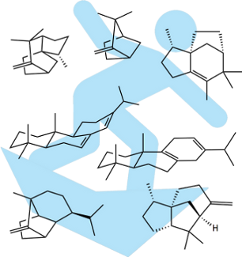
- have pointed to the possibility that inherent dynamical tendencies of reactive intermediates may play important roles in enzyme evolution. Here we review key studies on the dynamical behavior of carbocations. First we provide an introduction to dynamical behavior and how it is examined using modern
- reactive intermediates often meet this criterion and exhibit what are called “non-statistical dynamic effects”, that is, product distributions that cannot be rationalized by traditional TST [19][29][30]. These effects (highlighted through the examples discussed below) are typically described using

Graphical Abstract
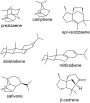
Figure 1: Representative terpenes.

Figure 2: Two different models showing how energy evolves throughout the course of a reaction: (a) a two-dime...

Figure 3: A depiction of the “snowboarder” analogy for reactions displaying non-statistical dynamic effects. ...

Figure 4: The tetramethylbromonium ion system [14].

Figure 5: The reaction mechanisms of interest in the PES and dynamics studies of Dupuis and co-workers (R = CH...

Figure 6: The portion of the norborn-2-en-7-ylmethyl cation PES examined by Ghigo et al. [60]. Energies reported ...

Figure 7: The transformation of 2-norbornyl cation to 1,3-dimethylcyclopentyl cation.
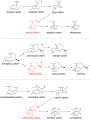
Figure 8: Carbocation rearrangements for which trajectory calculations were used to estimate lifetimes of sec...
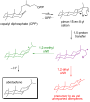
Figure 9: Carbocation rearrangements involved in abietadiene formation.
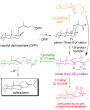
Figure 10: Carbocation rearrangements involved in miltiradiene formation.
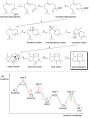
Figure 11: Top: carbocation rearrangements involved in epi-isozizaene formation. Bottom: reaction coordinate d...
Copper-mediated synthesis of N-alkenyl-α,β-unsaturated nitrones and their conversion to tri- and tetrasubstituted pyridines
- Dimitra Kontokosta,
- Daniel S. Mueller,
- Dong-Liang Mo,
- Wiktoria H. Pace,
- Rachel A. Simpson and
- Laura L. Anderson
Beilstein J. Org. Chem. 2015, 11, 2097–2104, doi:10.3762/bjoc.11.226

- hydroxylamines, as well as N-alkenyl and N-arylnitrones [1][2][3][4][5]. We have discovered that when this transformation is performed with oxime and hydroxamic acid substrates, these reactive intermediates can be accessed and subsequently rearrange to a variety of challenging organic fragments and heterocyclic

Graphical Abstract
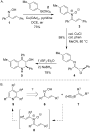
Scheme 1: Use of a Chan–Lam reaction for the synthesis of tetrahydroquinolines and potential extension to pyr...
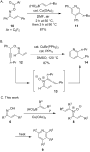
Scheme 2: Examples of pyridine synthesis from oxime precursors [51,52].

Scheme 3: Solvent effect on conversion of N-alkenylnitrones to pyridines.

Scheme 4: Mechanistic experiments.
An unusually stable chlorophosphite: What makes BIFOP–Cl so robust against hydrolysis?
- Roberto Blanco Trillo,
- Jörg M. Neudörfl and
- Bernd Goldfuss
Beilstein J. Org. Chem. 2015, 11, 313–322, doi:10.3762/bjoc.11.36
- , in Pd catalysts. Keywords: chirality; hydrolysis; phosphorus; rearrangements; terpenoids; Introduction Phosphorus halides are highly reactive intermediates for the synthesis of phosphites and phosphoramidites [1][2][3][4][5], which are widely used, for example, as ligands in catalysts [6][7][8][9

Graphical Abstract

Scheme 1: Fenchyl-based ligands used as building blocks for phosphorous ligands or organoaluminum reagents.

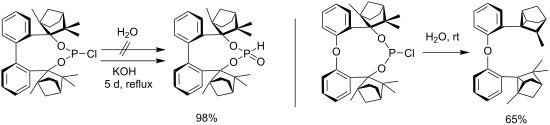
Scheme 2: Reaction of BIFOP–Cl (1) to BIFOP–(O)H (2) and of O–BIFOP–Cl (3) yielding O–BIFOP–H (4), O–BIFOP–(O...

Figure 1: 31P NMR (125 MHz, CDCl3) of O–BIFOP–Cl (3, δ = 161.9) after the addition of 1 equiv H2O and formati...

Figure 2: X-ray crystal structure of diphenyl ether-2,2’-biscyclofenchene 7. Ellipsoids are shown with 50% pr...

Scheme 3: Proposed mechanism for the formation of diphenyl ether-2,2’-biscyclofenchene 7 through stabilizatio...

Figure 3: 31P NMR (125 MHz, CDCl3) of O–BIFOP–H (4, δ = 152.5) adding O2 after a) 5 min; b) 15 min; c) 120 mi...

Figure 4: X-ray crystal structure of BIFOP-Cl 1. Ellipsoids are shown with 50% probability [15].

Scheme 4: The different backbones provoke different reactivities due to tighter encapsulation of the P–Cl uni...

Figure 5: X-ray crystal structure of O-BIFOP-Cl (3). Ellipsoids are shown with 50% probability.
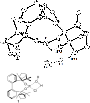
Figure 6: Transition state structure for the reaction of BIFOP–Cl (1) with water (BP86/def-SV(P)).
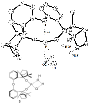
Figure 7: Transition state structure for the reaction of O-BIFOP–Cl (3) with water (BP86/def-SV(P)).
The Shono-type electroorganic oxidation of unfunctionalised amides. Carbon–carbon bond formation via electrogenerated N-acyliminium ions
- Alan M. Jones and
- Craig E. Banks
Beilstein J. Org. Chem. 2014, 10, 3056–3072, doi:10.3762/bjoc.10.323
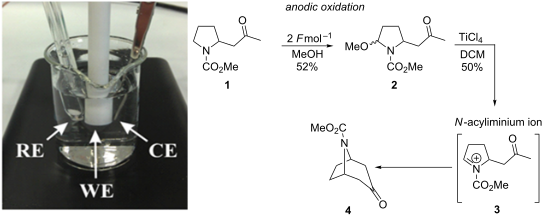
- of the generated reactive intermediates and assist in the formation of the desired products. Tin, silicon or sulfur-based electroauxiliaries have proved useful in this endeavour. Yoshida and co-workers developed an organothio electroauxiliary that is selectively cleaved under anodic oxidation

Graphical Abstract

Scheme 1: Application of anodic oxidation to the generation of new carbon-carbon bonds [11].

Scheme 2: The influence of the amino protecting group on the “kinetic” and “thermodynamic” anodic methoxylati...

Scheme 3: Example of the application of the cation pool method [17].

Scheme 4: A thiophenyl electroauxiliary allows for regioselective anodic oxidation [32].

Scheme 5: A diastereoselective cation carbohydroxylation reaction and postulated intermediate 18 [18].

Scheme 6: A radical addition and electron transfer reaction of N-acyliminium ions generated electrosynthetica...

Scheme 7: Catalytic indirect anodic fluorodesulfurization reaction [37].

Figure 1: Schematic of a cation flow system and also shown is the electrochemical microflow reactor reported ...

Figure 2: Example of a parallel laminar flow set-up. Figure redrawn from reference [38].

Figure 3: A catch and release cation pool method [42].

Scheme 8: Micromixing effects on yield 92% vs 36% and ratio of alkylation products [43].

Figure 4: Schematic illustration of the anodic substitution reaction system using acoustic emulsification. Fi...

Scheme 9: Electrooxidation to prepare a chiral oxidation mediator and application to the kinetic resolution o...

Scheme 10: Electrooxidation reactions on 4-membered ring systems [68].

Figure 5: Example of a chiral auxiliary Shono-oxidation intermediate [69].

Scheme 11: An electrochemical multicomponent reaction where a carbon felt anode and platinum cathode were util...

Scheme 12: Preparation of dienes using the Shono oxidation [23].

Scheme 13: Combination of an electroauxiliary mediated anodic oxidation and RCM to afford spirocyclic compound...

Scheme 14: Total synthesis of (+)-myrtine (66) using an electrochemical approach [78].

Scheme 15: Total synthesis of (−)-A58365A (70) and (±)-A58365B (71) [79].

Scheme 16: Anodic oxidation used in the preparation of the poison frog alkaloid 195C [80].

Scheme 17: Preparation of iminosugars using an electrochemical approach [81].

Scheme 18: The electrosynthetic preparation of α-L-fucosidase inhibitors [84,85].

Scheme 19: Enantioselective synthesis of the anaesthetic ropivacaine 85 [71].

Scheme 20: The preparation of synthetically challenging aza-nucleosides employing an electrochemical step [88].

Scheme 21: Synthesis of a bridged tricyclic diproline analogue 93 that induces α-helix conformation into linea...

Scheme 22: Synthesis of (i) a peptidomimetic and (ii) a functionalised peptide from silyl electroauxiliary pre...

Scheme 23: Examples of Phe7–Phe8 mimics prepared using an electrochemical approach [93].

Scheme 24: Preparation of arginine mimics employing an electrooxidation step [96].

Scheme 25: Preparation of chiral cyclic amino acids [20].

Scheme 26: Two-step preparation of Nazlinine 117 using Shono flow electrochemistry [101].
Recent advances in the electrochemical construction of heterocycles
- Robert Francke
Beilstein J. Org. Chem. 2014, 10, 2858–2873, doi:10.3762/bjoc.10.303
- substrate is electrochemically inactive. In many cases, undesired side-reactions can be avoided by using redox mediators, since reactive intermediates do not accumulate on the electrode surface. Moreover, the indirect approach is often used in order to inhibit electrode passivation caused by formation of
- nucleophilic trapping of anodically formed iminium (23) or alkoxycarbenium species (24). The reactive intermediates can be generated directly from ethers or carboxylic acid amides (Scheme 9) [32]. However, aliphatic ethers and amides generally exhibit high oxidation potentials, and a large number of functional

Graphical Abstract

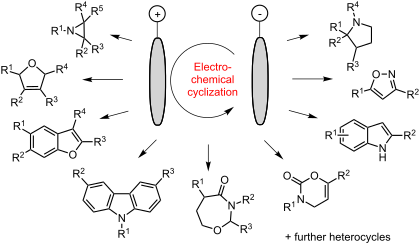
Figure 1: Common types of electrochemically induced cyclization reactions.

Scheme 1: Principle of indirect electrolysis.

Scheme 2: Anodic intramolecular cyclization of olefines in methanol.

Scheme 3: Anodic cyclization of olefines in CH2Cl2/DMSO.

Scheme 4: Intramolecular coupling of 1,6-dienes in CH2Cl2/DMSO.

Scheme 5: Cyclization of bromopropargyloxy ester 12.

Scheme 6: Proposed mechanism for the radical cyclization of bromopropargyloxy ester 12.
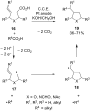
Scheme 7: Preparation of pyrrolidines and tetrahydrofurans via Kolbe-type electrolysis of unsaturated carboxy...

Scheme 8: Anodic cyclization of chalcone oximes 19.

Scheme 9: Generation of N-acyliminium (23) and alkoxycarbenium species (24) from amides and ethers with and w...

Scheme 10: Anodic cyclization of dipeptide 25.

Scheme 11: Anodic cyclization of a dipeptide using an electroauxiliary.

Scheme 12: Anodic cyclization of hydroxyamino compound 29.

Scheme 13: Cyclization of unsaturated thioacetals using the ArS(ArSSAr)+ mediator.

Scheme 14: Cyclization of biaryl 35 to carbazol 36 as key-step of the synthesis of glycozoline (37).

Scheme 15: Electrosynthesis of 39 as part of the total synthesis of alkaloids 40 and 41.

Scheme 16: Wacker-type cyclization of alkenyl phenols 42.

Scheme 17: Cathodic synthesis of indol derivatives.

Scheme 18: Fluoride mediated anodic cyclization of α-(phenylthio)acetamides.

Scheme 19: Synthesis of 2-substituted benzoxazoles from Schiff bases.

Scheme 20: Synthesis of euglobal model compounds via electrochemically induced Diels–Alder cycloaddition.

Scheme 21: Cycloaddition of anodically generated N-acyliminium species 58 with olefins and alkynes.

Scheme 22: Electrochemical aziridination of olefins.

Scheme 23: Proposed mechanism for the aziridination reaction.

Scheme 24: Electrochemical synthesis of benzofuran and indole derivatives.

Scheme 25: Anodic anellation of catechol derivatives 66 with different 1,3-dicarbonyl compounds.

Scheme 26: Electrosynthesis of 1,2-fused indoles from catechol and ketene N,O-acetals.

Scheme 27: Reaction of N-acyliminium pools with olefins having a nucleophilic substituent.

Scheme 28: Synthesis of thiochromans using the cation-pool method.

Scheme 29: Electrochemical synthesis and diversity-oriented modification of 73.
Electrocarboxylation: towards sustainable and efficient synthesis of valuable carboxylic acids
- Roman Matthessen,
- Jan Fransaer,
- Koen Binnemans and
- Dirk E. De Vos
Beilstein J. Org. Chem. 2014, 10, 2484–2500, doi:10.3762/bjoc.10.260
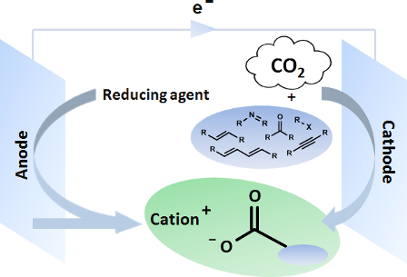
- hazardous reducing agents by clean electrons. In this case, the high thermodynamic stability of CO2 is by-passed by a simple one-electron reduction at an electrode, leading to in situ generation of reactive intermediates. Often, room temperature conditions are sufficient, considering that the energy of the

Graphical Abstract

Scheme 1: Synthesis of salicylic acid and p-hydroxybenzoic acid via Kolbe–Schmidt reaction [16-20].

Scheme 2: Electroreduction of carbon dioxide to formic acid, methanol or methane.

Scheme 3: Electrochemical fixation of CO2 in olefins.

Scheme 4: Electrohydrodimerisation of acrylonitrile to adiponitrile [32].

Scheme 5: Parallel paired electrosynthesis of phthalide and tert-butylbenzaldehyde dimethylacetal [34].

Scheme 6: Overview of electrocarboxylation setups using (a) a sacrificial anode, (b) an inert anode, generati...

Scheme 7: General mechanism of the electrochemical dicarboxylation of conjugated dienes [49].

Scheme 8: Reported anodic reactions for the electrocarboxylation of 1,3-butadiene.

Scheme 9: General mechanism for electrocarboxylation of alkynes.

Scheme 10: Electrocarboxylation of ethyl cinnamate [70].

Scheme 11: General electrocarboxylation mechanism for carbonyl compounds (Y = O) and imines (Y = NH) [75-77].

Scheme 12: Electrocarboxylation mechanism of butyraldehyde proposed by Doherty [78].

Scheme 13: Electrocarboxylation of AMN to HN using a sacrificial aluminum anode [86].

Scheme 14: Electrocarboxylation of benzalaniline using a sacrificial aluminum anode [105].

Scheme 15: Electrocarboxylation of p-isobutylacetophenone with stable electrodes [94,95].

Scheme 16: Electrochemical carboxylation of MMP to MHA [110,111].

Scheme 17: General mechanism for electrocarboxylation of alkyl halides [122,124-126,128].

Scheme 18: Electrocarboxylation of benzylic chlorides as synthesis route for NSAIDs.

Scheme 19: Electrocarboxylation of 1,4-dibromo-2-butene [144].

Scheme 20: Convergent paired electrosynthesis of cyanoacetic acid, with X− = F4B−, ClO4−, HSO4−, Cl−, Br− [147].

Scheme 21: General scheme of carboxylation of weak acidic hydrocarbons with electrogenerated bases. RH: weakly...

Scheme 22: Electrocarboxylation of N-methyldiglycolimide to methoxymethane-1,1,1’-tricarboxylate precursors. R1...

Scheme 23: Electrochemical dimerization of CO2 with stable electrodes [153].
Phosphinocyclodextrins as confining units for catalytic metal centres. Applications to carbon–carbon bond forming reactions
- Matthieu Jouffroy,
- Rafael Gramage-Doria,
- David Sémeril,
- Dominique Armspach,
- Dominique Matt,
- Werner Oberhauser and
- Loïc Toupet
Beilstein J. Org. Chem. 2014, 10, 2388–2405, doi:10.3762/bjoc.10.249
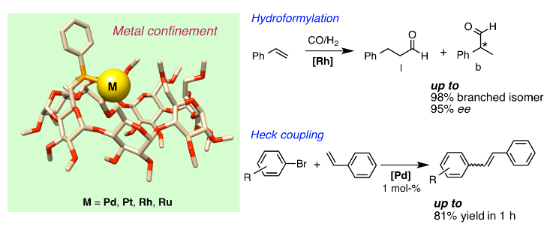
- reactive intermediates or assist the reduction–elimination step [80][82]. Conclusion In conclusion, we have shown that the cavity-shaped phosphines HUGPHOS-1 and HUGPHOS-2 exclusively form monophosphine complexes with Pd(II), Pt(II), Rh(I), and Ru(II) cations. In all these complexes, the CD cavity tightly

Graphical Abstract

Figure 1: CD-based mono- and diphosphines with inward-pointing phosphorus atoms.

Scheme 1: Complexation of a "PdCl(dmba)" unit by HUGPHOS ligands.

Scheme 2: Reaction of HUGPHOS-1 with [MCl2(PhCN)2] complexes (M = Pd, Pt). Only one isomer with a given MeO–M...

Scheme 3: Synthesis of complexes 3–5.
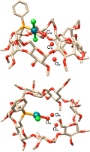
Figure 2: X-ray structure of aqua palladium complex 5 [44] (top: side view; bottom: view from the primary face). ...

Scheme 4: Dehydration of Pd(II) complex 5.

Figure 3: Ruthenium complexes 7 and 8 in Newman projection along the Ru–P bond.

Figure 4: Titration of HUGPHOS-1 with [Rh(CO)2Cl]2 at 25 °C.

Scheme 5: Synthesis of rhodium carbonyl complexes 9–11.

Scheme 6: Synthesis of rhodium complexes 12 and 13.

Scheme 7: Selective formation of complex 14 under 40 bar CO/H2 at 80 °C.

Figure 5: High pressure NMR spectra of 13 under CO/H2 (1:1) recorded in toluene-d8 (at various temperatures a...

Figure 6: IR spectra of 14 recorded in CH2Cl2 at 50 °C under 40 bar of CO/H2 1:1.
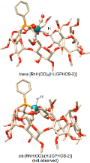
Figure 7: Calculated structures (Spartan 10) of trigonal bipyramidal [RhH(CO)3(HUGPHOS-2)] with the phosphoru...

Scheme 8: Possible mechanism for the hydroformylation of styrene when using monophosphine complexes 12 or 13 ...

Scheme 9: Simplified Heck coupling mechanism when using HUGPHOS-1 or HUGPHOS-2 as ligands. Doted lines stand ...
Photochemical approach to functionalized benzobicyclo[3.2.1]octene structures via fused oxazoline derivatives from 4- and 5-(o-vinylstyryl)oxazoles
- Ivana Šagud,
- Simona Božić,
- Željko Marinić and
- Marija Šindler-Kulyk
Beilstein J. Org. Chem. 2014, 10, 2222–2229, doi:10.3762/bjoc.10.230

- framework of numerous important biologically active natural compounds or their metabolites [1]. Properly functionalized bicyclo[3.2.1]octanes have proved as useful reactive intermediates in stereoselective transformations making these derivatives powerful building blocks in organic synthetic strategies [2

Graphical Abstract

Scheme 1: Synthesis of 4- (1) and 5-(2-vinylstyryl)oxazoles (2).

Scheme 2: Irradiation of 4- (1) and 5-(2-vinylstyryl)oxazoles (2) (crude reaction mixtures).

Figure 1: Part of 1H NMR spectra in C6D6 of the crude photomixtures after 200 min (300 nm, rt ) of irradiatio...

Scheme 3: Plausible mechanisms of oxazoline ring-opening in photoproduct 10.

Figure 2: 1H NMR spectra in C6D6 of rel-(9S)-12a (a) and rel-(9S)-11 (b).

Scheme 4: Mechanism of the formation of polycyclic compounds (8–10).

Scheme 5: Reactions of the photochemical product 8 with EtOH, MeOD and H2O/silica gel.

Scheme 6: Plausible mechanisms of oxazoline ring opening in photoproduct 10 and formation of 12.
A new charge-tagged proline-based organocatalyst for mechanistic studies using electrospray mass spectrometry
- J. Alexander Willms,
- Rita Beel,
- Martin L. Schmidt,
- Christian Mundt and
- Marianne Engeser
Beilstein J. Org. Chem. 2014, 10, 2027–2037, doi:10.3762/bjoc.10.211
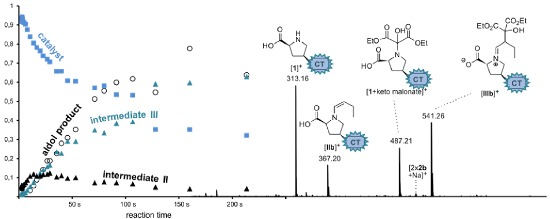
- quite a number of different species. Side products, off-cycle resting states, reagent degradation products and impurities of various origins may be present in much higher concentration than the interesting reactive intermediates. Thus, ESI spectra of reacting solutions can be frustratingly complicated

Graphical Abstract

Figure 1: The new charge-tagged proline-derived catalyst 1.

Scheme 1: Inverse aldol reaction with aldehyde donors according to Jørgensen [54]. We studied the reaction for R ...

Scheme 2: Synthesis of 4-(pyridin-4-yl)phenol (5).

Scheme 3: Synthesis of the charge-tagged proline catalyst 1.

Figure 2: Molecular structure of 7 in the solid state.

Scheme 4: Proposed catalytic cycle [36-38] for the aldol reaction with aldehyde donors [54]; CT = charge tag, a: R = Ph, ...

Figure 3: Experimental setup for continuous-flow ESIMS experiments using two mixing tee microreactors directl...
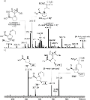
Figure 4: ESI mass spectra of acetonitrile solutions of diethyl ketomalonate and butyraldehyde (a) with unmod...
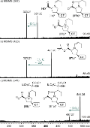
Figure 5: ESI(+) CID MS/MS spectra of mass-selected intermediates a) [IIb]+, b) the butyl ester derivative [I...

Figure 6: Normalized relative intensities in ESI spectra recorded for the inverse aldol reaction of butyralde...
Isoxazolium N-ylides and 1-oxa-5-azahexa-1,3,5-trienes on the way from isoxazoles to 2H-1,3-oxazines
- Alexander F. Khlebnikov,
- Mikhail S. Novikov,
- Yelizaveta G. Gorbunova,
- Ekaterina E. Galenko,
- Kirill I. Mikhailov,
- Viktoriia V. Pakalnis and
- Margarita S. Avdontceva
Beilstein J. Org. Chem. 2014, 10, 1896–1905, doi:10.3762/bjoc.10.197

- isoxazolium N-ylides from N-unsubstituted isoxazole derivatives. The formation of such ylides as reactive intermediates in the reactions of bases on isoxazolium salts was earlier supposed [6][7][8][9]. However, the detection of isoxazolium N-ylides has never been reported. Recently, we found an alternative

Graphical Abstract

Scheme 1: Mechanistic scheme of the formation of 2H-1,3-oxazine by the reaction of isoxazoles with a diazo co...

Scheme 2: Mechanistic scheme of the formation of 2H-1,3-oxazine by the reaction of azirine with a diazo compo...

Figure 1: Energy profiles for the transformations of ylides C, (3Z)-1-oxa-5-azahexa-1,3,5-triene D and oxazin...

Figure 2: Energy profiles for the transformations of (3Z)-1-oxa-5-azahexa-1,3,5-triene D and oxazines E deriv...

Scheme 3: Reaction of isoxazole 1a and diazo ester 2a.

Figure 3: Molecular structures of compounds 3a,k, displacement parameters are drawn at 50% probability level.

Figure 4: Molecular structures of compounds 4a,b, displacement parameters are drawn at 50% probability level.

Scheme 4: Isodesmic reactions for 1,3-oxazines 3d,e,n,o and 1-oxa-5-azahexa-1,3,5-trienes 4a,b,g,h.
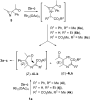
Scheme 5: Reaction of complementary isoxazole 1a and azirine 5 with diazo esters.
Theoretical studies on the intramolecular cyclization of 2,4,6-t-Bu3C6H2P=C: and effects of conjugation between the P=C and aromatic moieties
- Masaaki Yoshifuji and
- Shigekazu Ito
Beilstein J. Org. Chem. 2014, 10, 1032–1036, doi:10.3762/bjoc.10.103
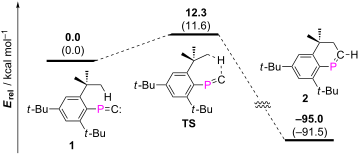
- cyclization of 1 would be necessary to develop the chemistry of reactive intermediates containing low-coordinated heavier main group elements [17]. Additionally, the structure of 2 is expected to be quite unique as the P=C π-system is nearly coplanar with the aromatic ring. In our previous paper, unique photo

Graphical Abstract

Scheme 1: (a) The original FBW rearrangement reaction and (b) the phosphorus version of FBW rearrangement.

Scheme 2: Intramolecular C–H insertion of phosphanylidenecarbene.

Figure 1: Optimized structure of the transition state (TS) for the intramolecular C–H insertion of 1 [MP2(Ful...

Figure 2: Computationally characterized cyclization procedures of 1 affording 2 [MP2(full)/6-31G(d)]. Values ...

Figure 3: Displacement vectors of the transition state (ν = 216.93 i cm–1).

Figure 4: Optimized structure of 2 [MP2(full)/6-31G(d)]. Bond distances (Å): P1–C1 1.678, C1–C2 1.491, P1–C3 ...

Figure 5: HOMO (left) and LUMO (right) of 2.
Thermodynamically stable [4 + 2] cycloadducts of lanthanum-encapsulated endohedral metallofullerenes
- Yuta Takano,
- Yuki Nagashima,
- M. Ángeles Herranz,
- Nazario Martín and
- Takeshi Akasaka
Beilstein J. Org. Chem. 2014, 10, 714–721, doi:10.3762/bjoc.10.65
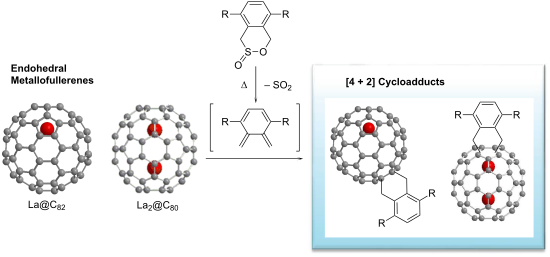
- Discussion Synthesis and characterization of La2@C80 cycloadducts o-Quinodimethanes 2a and 2b were generated in situ by thermolysis of the corresponding sultines 1a and 1b in toluene at 80 °C (Scheme 1). The highly reactive intermediates are trapped efficiently by La2@C80, which acts as a dienophile to form

Graphical Abstract

Scheme 1: Synthesis of [4 + 2] adducts of La2@C80.
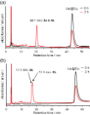
Figure 1: HPLC profiles of the reaction solutions (black) before and (red) after the reaction of La2@C80 and ...
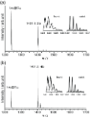
Figure 2: MALDI–TOF mass (negative mode) spectra of (a) 3b and (b) 4b, using 1,1,4,4-tetraphenyl-1,3-butadien...

Figure 3: UV–vis/near-IR absorption spectra of 3b and 4b recorded by the diode array detector of the HPLC app...

Figure 4: MALDI–TOF mass spectrum (negative mode) of the reaction mixture from La2@C80 and 1a, using 1,1,4,4-...

Figure 5: 1H NMR spectra of (a) the mixture of 3a and 4a in C2D2Cl4 at 248 K, and (b) isolated 4a at 230 K, r...
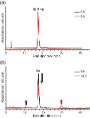
Figure 6: HPLC profiles of the mixture of 3a and 4a, (a) after heating in refluxing 1,2-dichlorobenzene and (...

Figure 7: HPLC profiles of the reaction mixture of 3b and 4b, (black) before and (red) after heating in reflu...

Figure 8: UV–vis/near-IR absorption spectra of 3b and 4a in toluene.

Figure 9: Temperature-dependent 1H NMR spectra of 4a in C2D2Cl4 (left) at 300 MHz, and (right) at 500 MHz for...

Scheme 2: Synthesis of [4 + 2] adducts of La@C82.

Figure 10: HPLC profiles of the reaction mixture for 5b. Conditions: column, Buckyprep (Ø 4.6 mm × 250 mm); el...

Figure 11: MALDI–TOF mass spectra (negative mode) of 5b, using 1,1,4,4-tetraphenyl-1,3-butadiene as matrix.

Figure 12: Vis–near-IR spectra of 5b, 6 and La@C82 in CS2.

Figure 13: 1H NMR spectrum of [5b]− in acetone-d6/CS2 (3/1 = v/v) at 223 K.

Figure 14: 13C NMR spectrum of [5b]− in acetone-d6/CS2 (3/1 = v/v).

Figure 15: HPLC profiles for comparison of the thermal stabilities of (a) 5b and (b) 6 at 30 °C. Conditions: c...
Flow microreactor synthesis in organo-fluorine chemistry
- Hideki Amii,
- Aiichiro Nagaki and
- Jun-ichi Yoshida
Beilstein J. Org. Chem. 2013, 9, 2793–2802, doi:10.3762/bjoc.9.314
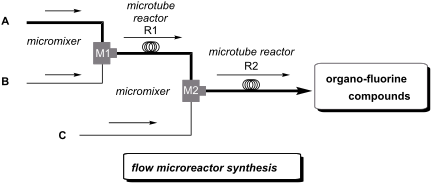
- characteristic features of microstructures are responsible for their effectiveness. In particular, brilliant works of the generation and reactions of reactive intermediates that cannot be done in batch reactors have been developed by means of ‘space integration methodology’, where a sequence of reactions is
- which allow the generation and reactions of reactive intermediates before decomposition. By virtue of these characteristic features, the residence time control in flow microreactors makes the generation of highly reactive species possible, including their reactions on a preparative scale within a second

Graphical Abstract

Scheme 1: Direct fluorination using microreactor systems.

Scheme 2: Use of DAST in continuous-flow reactors.

Scheme 3: Flow microreactor synthesis of fluorinated epoxides.

Scheme 4: Highly controlled isomerization of gem-difluoroalkenes.

Scheme 5: Flow system for catalytic aromatic fluorination.

Scheme 6: Continuous-flow reactor for electrophilic aromatic fluorination.

Scheme 7: Examples of [18F]-radiolabeled molecular imaging probes.

Scheme 8: Flow microreactor synthesis of dipeptides.

Scheme 9: Flow synthesis involving SNAr reactions.

Scheme 10: Flow synthesis of fluoroquinolone antibiotics.

Scheme 11: Highly controlled formation of PFPMgBr.

Scheme 12: Selective flow synthesis of photochromic diarylethenes.

Scheme 13: Flow microreactor system for perfluoroalkylation by generation of perfluoroalkyllithiums in the pre...

Scheme 14: Integrated flow microreactor system for perfluoroalkylation by generation of perfluoroalkyllithiums...
The chemistry of amine radical cations produced by visible light photoredox catalysis
- Jie Hu,
- Jiang Wang,
- Theresa H. Nguyen and
- Nan Zheng
Beilstein J. Org. Chem. 2013, 9, 1977–2001, doi:10.3762/bjoc.9.234
- Jie Hu Jiang Wang Theresa H. Nguyen Nan Zheng Department of Chemistry, University of Arkansas, Fayetteville, AR 72701, USA 10.3762/bjoc.9.234 Abstract Amine radical cations are highly useful reactive intermediates in amine synthesis. They have displayed several modes of reactivity leading to some
- initialize radical polymerization of HEA. Because of ring strain, cyclopropanes are prone to ring opening via cleavage of one of the three C–C bonds. The resulting reactive intermediates have been shown to participate in a number of synthetic/mechanistic applications [103][104]. One of these applications is
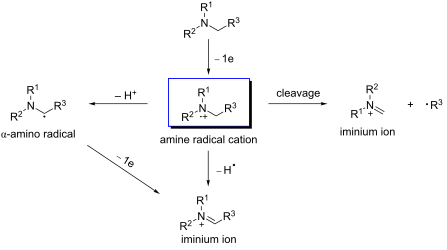
- electron strictly dependent upon the small molecules encountered. Amines typically act as an electron donor to reductively quench the photoexcited state while they are oxidized to the corresponding amine radical cations. The resulting nitrogen radical cations are highly useful reactive intermediates that

Graphical Abstract

Scheme 1: Amine radical cations’ mode of reactivity.

Scheme 2: Reductive quenching of photoexcited Ru complexes by Et3N.

Scheme 3: Photoredox aza-Henry reaction.

Scheme 4: Formation of iminium ions using BrCCl3 as stoichiometric oxidant.

Scheme 5: Oxidative functionalization of N-aryltetrahydroisoquinolines using Eosin Y.

Scheme 6: Synthetic and mechanistic studies of Eosin Y-catalyzed aza-Henry reaction.

Scheme 7: Oxidative functionalization of N-aryltetrahydroisoquinolines using RB and GO.

Scheme 8: Merging Ru-based photoredox catalysis and Lewis base catalysis for the Mannich reaction.

Scheme 9: Merging Au-based photoredox catalysis and Lewis base catalysis for the Mannich reaction.

Scheme 10: Merging Ru-based photoredox catalysis and Cu-catalyzed alkynylation reaction.

Scheme 11: Merging Ru-based photoredox catalysis and NHC catalysis.

Scheme 12: 1,3-Dipolar cycloaddition of photogenically formed azomethine ylides.

Scheme 13: Plausible mechanism for photoredox 1,3-dipolar cycloaddition.

Scheme 14: Photoredox-catalyzed cascade reaction for the synthesis of fused isoxazolidines.

Scheme 15: Plausible mechanism for the photoredox-catalyzed cascade reaction.

Scheme 16: Photoredox-catalyzed α-arylation of glycine derivatives.

Scheme 17: Photoredox-catalyzed α-arylation of amides.

Scheme 18: Intramolecular interception of iminium ions by sulfonamides.

Scheme 19: Intramolecular interception of iminium ions by alcohols and sulfonamides.

Scheme 20: Intermolecular interception of iminium ions by phosphites.

Scheme 21: Photoredox-catalyzed oxidative phosphonylation by Eosin Y.
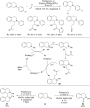
Scheme 22: Conjugated addition of α-amino radicals to Michael acceptors.

Scheme 23: Conjugated addition of α-amino radicals to Michael acceptors assisted by a Brønsted acid.

Scheme 24: Conjugated addition of α-amino radicals derived from anilines to Michael acceptors.

Scheme 25: Oxygen switch between two pathways involving α-amino radicals.

Scheme 26: Interception of α-amino radicals by azodicarboxylates.

Scheme 27: α-Arylation of amines.

Scheme 28: Plausible mechanism for α-arylation of amines.

Scheme 29: Photoinduced C–C bond cleavage of tertiary amines.

Scheme 30: Photoredox cleavage of C–C bonds of 1,2-diamines.

Scheme 31: Proposed mechanism photoredox cleavage of C–C bonds.

Scheme 32: Intermolecular [3 + 2] annulation of cyclopropylamines with olefins.

Scheme 33: Proposed mechanism for intermolecular [3 + 2] annulation.

Scheme 34: Photoinduced clevage of N–N bonds of aromatic hydrazines and hydrazides.
Gold-catalyzed regioselective oxidation of propargylic carboxylates: a reliable access to α-carboxy-α,β-unsaturated ketones/aldehydes
- Kegong Ji,
- Jonathan Nelson and
- Liming Zhang
Beilstein J. Org. Chem. 2013, 9, 1925–1930, doi:10.3762/bjoc.9.227
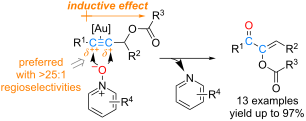
- carboxylate; Introduction We reported in 2010 [1] that α-oxo gold carbenes could be conveniently generated as reactive intermediates in gold-catalyzed intermolecular oxidation of alkynes. By using pyridine N-oxides [1] and later 8-substituted quinoline N-oxides [2] as the external oxidants, this approach

Graphical Abstract

Scheme 1: Generation of α-oxo gold carbenes via intermolecular oxidation of alkynes: a non-diazo approach.

Scheme 2: Gold-catalyzed regioselective oxidation of a sterically biased internal alkyne.

Scheme 3: Gold-catalyzed oxidation of the propargylic acetate 4a and the mechanistic rationale.

Scheme 4: A drastically different outcome by using diphenyl sulfoxide as the oxidant.

Figure 1: The impact of ligands on the ratio of 5a-OAc and 5a-H in the gold-catalyzed oxidation of 4a (reacti...

Figure 2: Natural charges at and the 13C chemical shifts of the alkynyl carbons in 4a.



