Search results
Search for "[3 2]-cycloaddition" in Full Text gives 145 result(s) in Beilstein Journal of Organic Chemistry.
Synthesis and reactivity of aliphatic sulfur pentafluorides from substituted (pentafluorosulfanyl)benzenes
Beilstein J. Org. Chem. 2016, 12, 110–116, doi:10.3762/bjoc.12.12
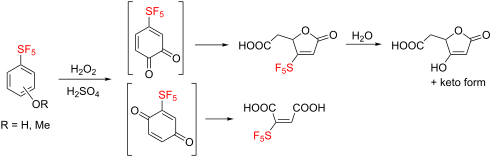
- were not successful. The dimethyl maleate derivative was formed but was accompanied by the [3 + 2] cycloaddition product 22. With excess of diazomethane, clean and efficient formation of 22 was observed (Scheme 9). Acid 4 was stable in water, methanol, isopropylalcohol, boiling benzene, or boiling


Recent developments in copper-catalyzed radical alkylations of electron-rich π-systems
Beilstein J. Org. Chem. 2015, 11, 2278–2288, doi:10.3762/bjoc.11.248
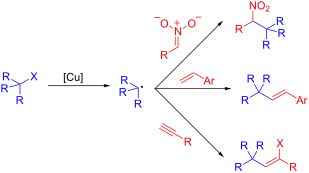
- -directed synthesis of Z-alkenes. Scope of the phenol-directed Z-alkene synthesis. Rationale for the formal [3 + 2] cycloaddition. Scope of the formal [3 + 2] cycloaddition. Benzylation of styrenes using copper catalysis. Copper-catalyzed carboiodination of alkynes. Copper-catalyzed trans-carbohalogenation
- + 2] cycloaddition of styrenes and α-bromo keto esters. Using this method, various substituted dihydrofurans were produced in high yields (Scheme 15). Electron-rich and electron-poor styrenes as well as alkyl and aryl keto esters were combined to provide diversely substituted dihydrofurans. The
- alkenylation reactions. However, the product of addition of a secondary bromo keto ester possesses an acidic α-proton. This proton can be deprotonated by diisopropylamine, and the resulting enolate cyclizes onto the newly formed benzylic halide to form the dihydrofuran (Scheme 14). This method is formally a [3


Effective ascorbate-free and photolatent click reactions in water using a photoreducible copper(II)-ethylenediamine precatalyst
Beilstein J. Org. Chem. 2015, 11, 1950–1959, doi:10.3762/bjoc.11.211
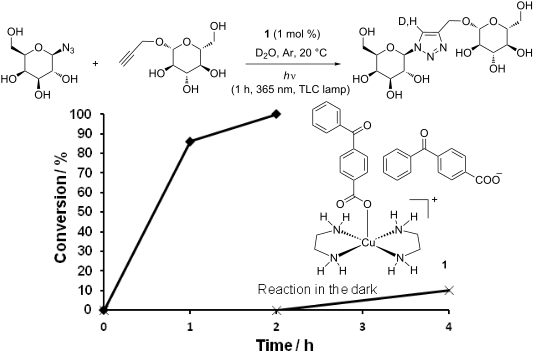
- Since the discovery in 2002 that copper(I) could catalyze the Huisgen alkyne–azide [3 + 2] cycloaddition with high selectivity for the 1,4-triazole [1][2], the so-called copper(I)-catalyzed alkyne–azide cycloaddition (CuAAC) has become a privileged reaction which is widely employed in all areas of the


SmI2-mediated dimerization of indolylbutenones and synthesis of the myxobacterial natural product indiacen B
Beilstein J. Org. Chem. 2015, 11, 1700–1706, doi:10.3762/bjoc.11.184

- and Meyer–Schuster rearrangement 6-prenoylindole was synthesized and reductively dimerized to a cyclopentane in a [3 + 2] cycloaddition by treatment with SmI2 in THF. From 4-iodoindole, the natural product indiacen B from the myxobacterium Sandaracinus amylolyticus was synthesized for the first time
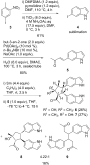
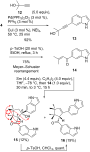
- Nicolaou and Procter [31][32]. The pattern of geometrical [3 + 2] cycloaddition was also obtained with inverted enone moieties. 6-Prenoylindole (14) was synthesized in two steps from 6-iodoindole (4) by Sonogashira coupling with propargylic alcohol 12 and subsequent Meyer–Schuster rearrangement [33
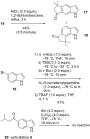
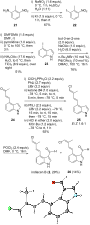
- . Meyer–Schuster rearrangement of 13 and SmI2-mediated reductive [3 + 2] cycloaddition, followed by elimination to cyclopentene 16. Selected NOESY correlations for compound 15 are given. Nazarov-type cyclization of 14 to cyclopentanones 17 and 18; synthesis of verticillatine B (20). Synthesis and X-ray



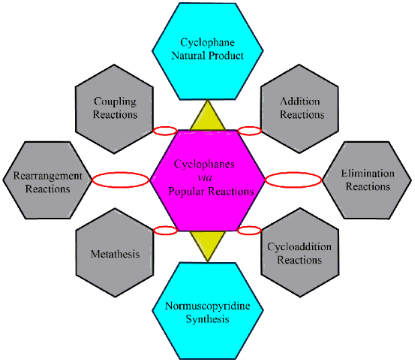
Selected synthetic strategies to cyclophanes
Beilstein J. Org. Chem. 2015, 11, 1274–1331, doi:10.3762/bjoc.11.142
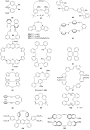
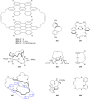
- (Scheme 51). [3 + 2] Cycloaddition (1,3-dipolar cycloaddition/click reaction): In 2010, Raghunathan and co-workers [185] have synthesized a C2-symmetric triazolophane by a copper(I)-catalyzed azide-alkyne cycloaddition, involving a click reaction. The dipropargyl fluorenyl derivative 299 was prepared from






Azobenzene-based inhibitors of human carbonic anhydrase II
Beilstein J. Org. Chem. 2015, 11, 1129–1135, doi:10.3762/bjoc.11.127
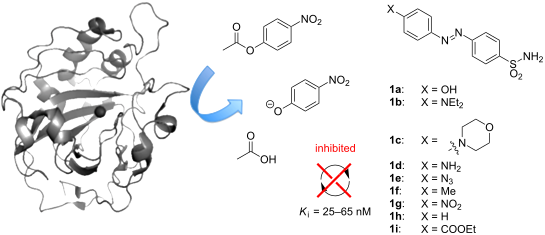
- -pot reaction over three steps in 25%. By diazotization of 1d and trapping the salt with TMS-azide, we obtained azido azobenzene 1e in 63% yield through a [3 + 2] and retro-[3 + 2] cycloaddition (Scheme 1b) according to the procedure of Barral et al [10]. For the Mills reaction, different nitroso


C-5’-Triazolyl-2’-oxa-3’-aza-4’a-carbanucleosides: Synthesis and biological evaluation
Beilstein J. Org. Chem. 2015, 11, 328–334, doi:10.3762/bjoc.11.38

- the H-4a proton that resonates at 2.18 ppm as a doublet of doublet of doublets. 5’-Azido-2’-oxa-3’-aza-4’a-carbanucleosides 11 and 12 were independently engaged in a CuI-catalyzed Huisgen [3 + 2] cycloaddition reaction with a series of substituted alkynes 17, according to the procedure described by
- formation of viral plaques or virus-induced cytopathogenicity by 50% is expressed as EC50. Conclusion In summary, starting from 5’-azido-2’-oxa-3’-azanucleosides, a new series of C-5’-triazolyl-2’-oxo-3’-aza-4’a-carbanucleosides has been synthesized by using a CuI-catalyzed Huisgen [3 + 2] cycloaddition


An improved procedure for the preparation of Ru(bpz)3(PF6)2 via a high-yielding synthesis of 2,2’-bipyrazine
Beilstein J. Org. Chem. 2015, 11, 61–65, doi:10.3762/bjoc.11.9
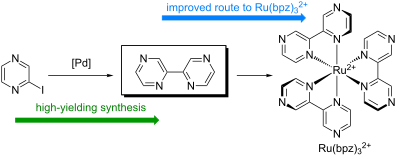
- couplings [13][14], and photooxygenation reactions [15][16]. Similarly, Zheng has reported oxidatively initiated indole synthesis [17] and [3 + 2] cycloaddition [18][19] reactions using photocatalyst 2. Finally, a variety of transition metal complexes bearing bipyrazyl ligands have been prepared and


Three-component synthesis of C2F5-substituted pyrazoles from C2F5CH2NH2·HCl, NaNO2 and electron-deficient alkynes
Beilstein J. Org. Chem. 2015, 11, 16–24, doi:10.3762/bjoc.11.3

- C2F5CHN2, that participates in a [3 + 2] cycloaddition with electron-deficient alkynes in dichloromethane. Keywords: cycloaddition; fluorine; pentafluoroethyl group; pentafluoroethyldiazomethane; pyrazole; Introduction Incorporation of fluorinated fragments into organic compounds might affect their
- -dicarbonyl compounds (or their synthons) with hydrazines [39][40][41][42][43][44]. In this context, novel practical methods to C2F5-pyrazoles are needed. Last year, Ma and colleagues synthesized CF3-pyrazoles by [3 + 2] cycloaddition between in situ generated CF3CHN2 and alkynes [45]. This method, however
- with C2F5CHN2 to give only 3,5-disubstituted pyrazoles. Formation of 3,4-disubstituted isomers was observed. Disubstituted alkynes behaved differently, because of controversial electronic and steric effects. According to the orbital symmetry rules, the [3 + 2] cycloaddition must lead to pyrazoles with


Sequential decarboxylative azide–alkyne cycloaddition and dehydrogenative coupling reactions: one-pot synthesis of polycyclic fused triazoles
Beilstein J. Org. Chem. 2014, 10, 3031–3037, doi:10.3762/bjoc.10.321
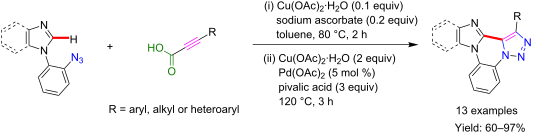
- methodology is more convenient to produce the complex polycyclic molecules in a simple way. Keywords: copper(II) acetate; decarboxylative CuAAC; dehydrogenative coupling; fused triazoles; one-pot synthesis; Introduction The copper-catalyzed Huisgen [3 + 2] cycloaddition (or copper-catalyzed azide–alkyne
- several advantages over the classical C–C bond formation method including the stability and preparation of the starting material and the non-hazardous byproducts. In 2011, Kolarovič et al. [6] first reported the copper-catalyzed decarboxylative [3 + 2] cycloaddition reaction of 2-alkynoic acid with
- formation of 4 is described in Scheme 5. Initially alkynoic acid 2 undergoes decarboxylation to form the copper acetylide (A) in the presence of the Cu+ catalyst which is generated by the reduction of Cu2+ with sodium ascorbate. The obtained copper acetylide undergoes regioselective [3 + 2] cycloaddition


Synthesis of 2-trifluoromethylpyrazolo[5,1-a]isoquinolines via silver triflate-catalyzed or electrophile-mediated one-pot tandem reaction
Beilstein J. Org. Chem. 2014, 10, 2286–2292, doi:10.3762/bjoc.10.238

- Gynecology, Jiangxi Provincial people's Hospital, Nanchang, Jiangxi 330006, P. R. China 10.3762/bjoc.10.238 Abstract An efficient one-pot tandem cyclization/[3 + 2] cycloaddition reaction of N’-(2-alkynylbenzylidene)hydrazides with ethyl 4,4,4-trifluorobut-2-ynoate under silver triflate-catalyzed or
- electrophile-mediated conditions is described. Various trifluoromethylated pyrazolo[5,1-a]isoquinolines were afforded in moderate to excellent yield by this developed method. Keywords: [3 + 2] cycloaddition; electrophile; N’-(2-alkynylbenzylidene)hydrazide; silver triflate; tandem; Introduction Isoquinolines
- reaction of N’-(2-alkynylbenzylidene)hydrazides 1a (0.3 mmol) and ethyl 4,4,4-trifluorobut-2-ynoate (2, 0.6 mmol) using NaOAc (0.45 mmol) as base, in the presence of AgOTf (5 mol %) and 4 Å MS (75 mg) in CH2Cl2 (3 mL) at room temperature overnight. Surprisingly, the unexpected [3 + 2] cycloaddition product


Expanding the scope of cyclopropene reporters for the detection of metabolically engineered glycoproteins by Diels–Alder reactions
Beilstein J. Org. Chem. 2014, 10, 2235–2242, doi:10.3762/bjoc.10.232
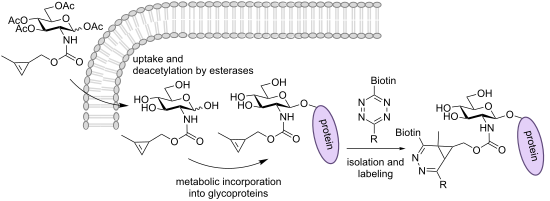
- bioorthogonal labeling reactions that allow visualization [5][6]. Whereas in the first report on glycan labeling by this approach the ketone–hydrazide ligation was employed [7], later investigations mainly relied on the Staudinger ligation [8] and azide–alkyne [3 + 2] cycloaddition (copper-catalyzed [9][10] or



Expeditive synthesis of trithiotriazine-cored glycoclusters and inhibition of Pseudomonas aeruginosa biofilm formation
Beilstein J. Org. Chem. 2014, 10, 1981–1990, doi:10.3762/bjoc.10.206
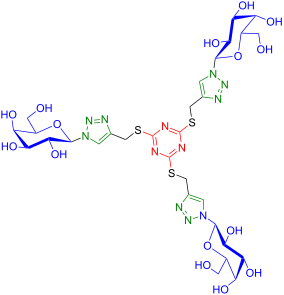
- 34% yield. A second [3 + 2] cycloaddition with a different glycoside, such as D-glycopyranosyl azide 8, under the same conditions, provided for example the mixed Gal2-Glc triazine cluster 17 (Scheme 2). The efficient conjugation of unprotected glycosyl azides to trithiotriazine 2 thus provides


The search for new amphiphiles: synthesis of a modular, high-throughput library
Beilstein J. Org. Chem. 2014, 10, 1578–1588, doi:10.3762/bjoc.10.163

- , palmitoleic and oleic tails. However the mannose reactions of chains longer than C11 and oleic were unable to reach completion, which was attributed to the α-linkage of the azide at the anomeric centre, creating steric hindrance for the [3 + 2] cycloaddition. The yields for triple-chain amphiphiles are


Bis(β-lactosyl)-[60]fullerene as novel class of glycolipids useful for the detection and the decontamination of biological toxins of the Ricinus communis family
Beilstein J. Org. Chem. 2014, 10, 1504–1512, doi:10.3762/bjoc.10.155
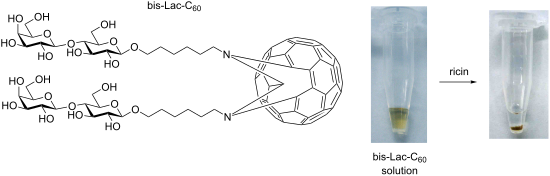
- , Tsukuba, 305-8565, Japan 10.3762/bjoc.10.155 Abstract Glycosyl-[60]fullerenes were first used as decontaminants against ricin, a lactose recognition proteotoxin in the Ricinus communis family. A fullerene glycoconjugate carrying two lactose units was synthesized by a [3 + 2] cycloaddition reaction


Carbohydrate PEGylation, an approach to improve pharmacological potency
Beilstein J. Org. Chem. 2014, 10, 1433–1444, doi:10.3762/bjoc.10.147
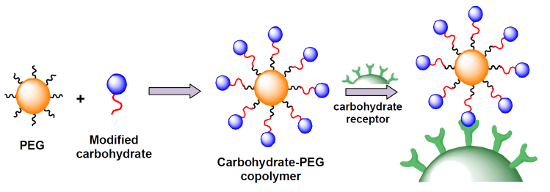
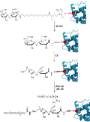
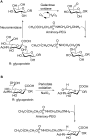
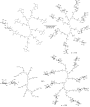
- by the use of a [3 + 2] cycloaddition reaction of an alkyne-bearing PEG reagent and an azide-functionalized tyrosine residue genetically incorporated on human superoxide dismutase-1 [30]. GlycoPEGylation, targeting carbohydrate sites, was conceived to produce a more homogeneous product with lower






Microwave-assisted Cu(I)-catalyzed, three-component synthesis of 2-(4-((1-phenyl-1H-1,2,3-triazol-4-yl)methoxy)phenyl)-1H-benzo[d]imidazoles
Beilstein J. Org. Chem. 2014, 10, 1413–1420, doi:10.3762/bjoc.10.145

- reacts with azidobenzene 1a affording intermediate 6 by a [3 + 2] cycloaddition reaction. The intermediate 6 yields 4-((1-phenyl-1H-1,2,3-triazol-4-yl)methoxy)benzaldehyde intermediate 7 after protonolysis of the C–Cu bond. This intermediate reacts with 1,2-diaminobenzene (3a) under the formation of the


Visible-light photoredox catalyzed synthesis of pyrroloisoquinolines via organocatalytic oxidation/[3 + 2] cycloaddition/oxidative aromatization reaction cascade with Rose Bengal
Beilstein J. Org. Chem. 2014, 10, 1233–1238, doi:10.3762/bjoc.10.122
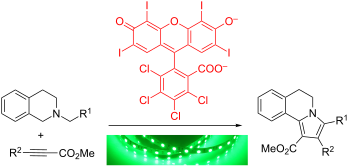
- Carlos Vila Jonathan Lau Magnus Rueping Institute of Organic Chemistry, RWTH Aachen University, Landoltweg 1, D-52074 Aachen, Germany 10.3762/bjoc.10.122 Abstract Pyrrolo[2,1-a]isoquinoline alkaloids have been prepared via a visible light photoredox catalyzed oxidation/[3 + 2] cycloaddition
- /oxidative aromatization cascade using Rose Bengal as an organo-photocatalyst. A variety of pyrroloisoquinolines have been obtained in good yields under mild and metal-free reaction conditions. Keywords: alkaloids; [3 + 2] cycloaddition; organocatalysis; oxidation; photochemistry; photoredox catalysis; Rose
- organic synthesis [10][11][12][13][14][15][16][17][18][19][20]. For example, dipolar [3 + 2] cycloaddition using azomethine ylides [21] is a powerful class of reactions that permits the synthesis of structural complex molecules in a straightforward way and has been used for the efficient synthesis of this


Site-selective covalent functionalization at interior carbon atoms and on the rim of circumtrindene, a C36H12 open geodesic polyarene
Beilstein J. Org. Chem. 2014, 10, 956–968, doi:10.3762/bjoc.10.94
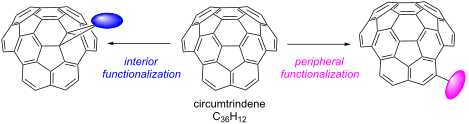
- unit. Representative synthetic reactions of fullerene C60 (2) include cyclopropanation [29][30], [3 + 2] cycloaddition [31][32], [4 + 2] cycloaddition [33], nucleophilic addition [34], and radical addition reactions [35]. Two of the earliest and most widely used reactions, the Bingel–Hirsch reaction
- [29][30] and the Prato reaction [31][32] are illustrated in Scheme 1. The Bingel–Hirsch reaction affords a cyclopropanated fullerene 7, and the Prato reaction gives a [3 + 2] cycloaddition adduct 8. Concurrent with the development of covalent functionalization, numerous noncovalent functionalization
- the great electrophilicity of circumtrindene in the Bingel–Hirsch reaction, it came as no surprise that circumtrindene can act as a good dipolarophile in a [3 + 2] cycloaddition reaction as well. Accordingly, the azomethine ylide 23 generated in situ from N-methylglycine and formaldehyde adds to




Copper–phenanthroline catalysts for regioselective synthesis of pyrrolo[3′,4′:3,4]pyrrolo[1,2-a]furoquinolines/phenanthrolines and of pyrrolo[1,2-a]phenanthrolines under mild conditions
Beilstein J. Org. Chem. 2014, 10, 692–700, doi:10.3762/bjoc.10.62

- cycloaddition is presented in Scheme 3. The base (DBU) abstracts the acidic proton of furo[3,2-h]quinolinium 9a to generate the 1,3-dipole I. The Cu(II)–phenanthroline system activates the maleimide dipolarophile via coordination with the carbonyl group to undergo a [3 + 2] cycloaddition with the 1,3-dipole to
- synthesized (Scheme 5) from phenanthroline (11) and 2′-bromoacetophenones 8a and 8d, under basic alumina/microwave (180 W) conditions. These were then subjected to the optimized [3 + 2] cycloaddition protocol with different N-phenylmaleimide dipolarophiles 4a–c, which eventually produced similar cycloadducts


Isocyanide-based multicomponent reactions towards cyclic constrained peptidomimetics
Beilstein J. Org. Chem. 2014, 10, 544–598, doi:10.3762/bjoc.10.50



Silver and gold-catalyzed multicomponent reactions
Beilstein J. Org. Chem. 2014, 10, 481–513, doi:10.3762/bjoc.10.46
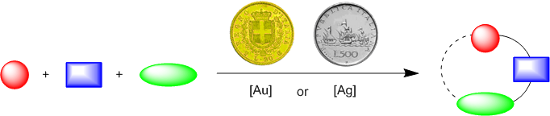
- transformation, i.e., [3 + 2] cycloaddition (Scheme 9). Another application of an A3-MCR for the improvement of molecular complexity was published by Kokezu and Srinivas [39]. The authors suggested a straightforward AuBr3-catalyzed route to 2-, 3-, or 5-propargylamine substituted indoles 9. The reactions were
- reaction involving nitriles 52 as pro-nucleophiles (Scheme 28) [71]. Wu and co-workers successfully employed the isoquinolinium-2-ylamides 43 as an ylidic species in two-component tandem [3 + 2]-cycloaddition reactions with a series of substrates including dimethyl acetylenedicarboxylate [72
- isoquinolinium-2-ylamide 43 undergoes a [3 + 2]-cycloaddition reaction with carbodiimide 54. Further intramolecular rearrangement yields the desired 1-(isoquinolin-1-yl)guanidine 55. Moreover, isoquinolinium-2-ylamides 43 can participate as 1,3-dipoles in [3 + 2]-cycloaddition reactions with in situ generated


Less reactive dipoles of diazodicarbonyl compounds in reaction with cycloaliphatic thioketones – First evidence for the 1,3-oxathiole–thiocarbonyl ylide interconversion
Beilstein J. Org. Chem. 2013, 9, 2751–2761, doi:10.3762/bjoc.9.309

- compounds. Preliminary experiments, however, showed that under standard conditions, a cycloaddition of diazodimedone and dimethyl diazomalonate with thiobenzophenone did not occur [5][6]. On the other hand, recent studies showed that the [3 + 2]-cycloaddition of this thioketone with many diazodicarbonyl




New developments in gold-catalyzed manipulation of inactivated alkenes
Beilstein J. Org. Chem. 2013, 9, 2586–2614, doi:10.3762/bjoc.9.294
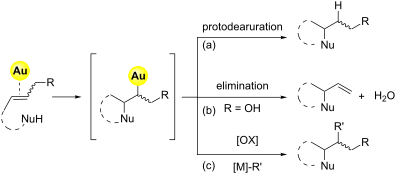
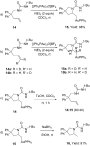
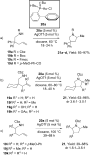
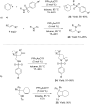
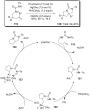
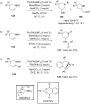
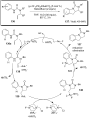
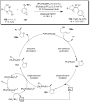
- carbolactonization of terminal alkenes with arylboronic acids. Synthesis of tricyclic indolines via gold-catalyzed formal [3 + 2] cycloaddition. Gold(I) catalyzed aminoarylation of terminal alkenes in presence of Selectfluor [dppm = bis(diphenylphosphino)methane]. Mechanistic investigation on the aminoarylation of








Synthesis and characterization of novel bioactive 1,2,4-oxadiazole natural product analogs bearing the N-phenylmaleimide and N-phenylsuccinimide moieties
Beilstein J. Org. Chem. 2013, 9, 2202–2215, doi:10.3762/bjoc.9.259
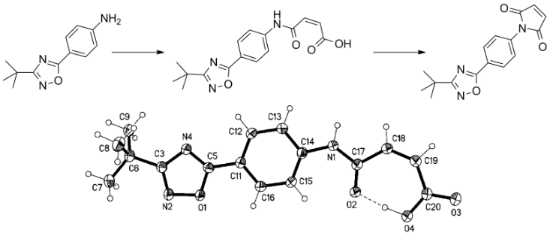
- catalyzed [3 + 2] cycloaddition reaction. Unfortunately, the yield for this reaction was very low (<20%). In order to obtain compound 1 by the 1,3 dipolar cycloaddition route we changed the protocol. We synthesized the nitro derivative 2 (3-tert-butyl-5-(4-nitrophenyl)-1,2,4-oxadiazole) in situ by using the