


Search results
Search for "boron" in Full Text gives 268 result(s) in Beilstein Journal of Organic Chemistry. Showing first 200.
Photocatalytic trifluoromethoxylation of arenes and heteroarenes in continuous-flow
Beilstein J. Org. Chem. 2020, 16, 1305–1312, doi:10.3762/bjoc.16.111
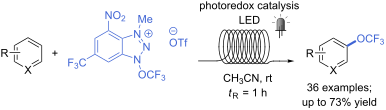
- poor yields. Other synthetically useful substituents, including cyano, nitro, phenylsulphonyl, (pinacolato)boron, and alkyl groups could be tolerated in the reaction (24–30), leading to a yield range between 26 and 65%. The trifluoromethoxylation of pyridine, pyrimidine, and thiophene derivatives also



Fluorinated phenylalanines: synthesis and pharmaceutical applications
Beilstein J. Org. Chem. 2020, 16, 1022–1050, doi:10.3762/bjoc.16.91
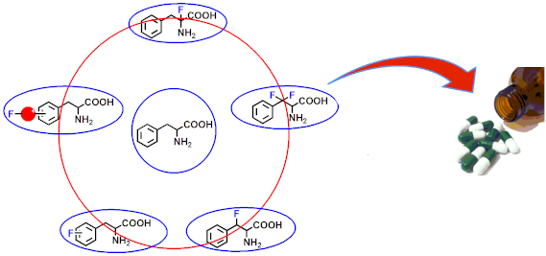
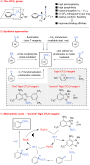
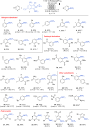
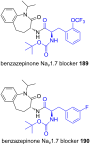
- yields of 25–35% and with a radiochemical purity of more than 99%. The 18F-labeling of 4-borono-ᴅ,ʟ-phenylalanine (BPA) provided a potential tool for cancer treatment by boron neutron capture therapy [53] (Scheme 16). The syntheses of a variety of clinically relevant radiotracers including protected 4
- used in PET due to its relatively long half-life (109 min). In this section we highlight two selected 18FPhe derivatives which are used for PET tumor detection. 4-Borono-2-[18F]fluoro-ᴅ,ʟ-phenylalanine ([18F]FBPA, 70), is a fluorinated derivative of the parent compound designed for boron neutron


Suzuki–Miyaura cross coupling is not an informative reaction to demonstrate the performance of new solvents
Beilstein J. Org. Chem. 2020, 16, 1001–1005, doi:10.3762/bjoc.16.89
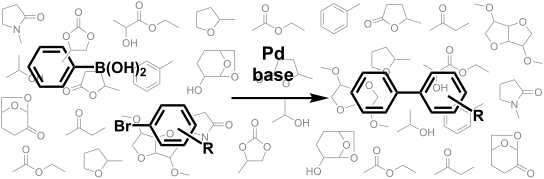
- the key fundamental principles of boron and palladium speciation and the role of the base in the Suzuki–Miyaura reaction. For researchers developing safer solvents, the Mizoroki–Heck reaction is a more suitable cross-coupling methodology to demonstrate solvent performance [28]. The reaction kinetics


Towards triptycene functionalization and triptycene-linked porphyrin arrays
Beilstein J. Org. Chem. 2020, 16, 763–777, doi:10.3762/bjoc.16.70

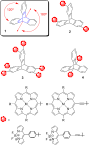
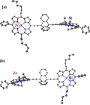
- investigated for its use as a rigid isolating unit in the synthesis of multichromophoric arrays. Sonogashira cross-coupling conditions are utilized to attach various porphyrins and boron dipyrromethenes (BODIPYs) to the triptycene scaffold. While there are previous examples of triptycene porphyrin complexes





Recent advances in Cu-catalyzed C(sp3)–Si and C(sp3)–B bond formation
Beilstein J. Org. Chem. 2020, 16, 691–737, doi:10.3762/bjoc.16.67
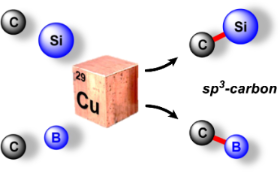
- incorporating silicon or boron into new or existing drugs, in addition to their use as building blocks in cross-coupling reactions en route to various targets of both natural and unnatural origins. In this review, recent protocols relying on copper-catalyzed sp3 carbon–silicon and carbon–boron bond-forming
- boron can lead to dative bond formation with enzymes, and therefore increase binding affinity. As shown in Scheme 1, several silicon [9][10][11][12] and boron-containing [13][14][15][16] drugs have already entered the market, or are currently in the drug development pipeline. As the number of drugs
- with Suginome’s PhMe2Si-BPin [35] as a silicon pro-nucleophile (Scheme 11A) [36]. The mechanism followed the expected pathway involving transmetallation from boron to copper to form the corresponding Cu–Si species III. This intermediate then adds to the imine 45 to give intermediate IV, which after






Direct borylation of terrylene and quaterrylene
Beilstein J. Org. Chem. 2020, 16, 621–627, doi:10.3762/bjoc.16.58
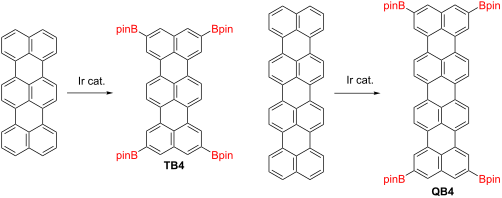
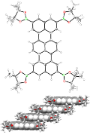
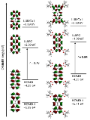
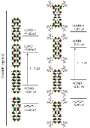
- highest band of terrylene at 553 nm is mainly caused by transition from HOMO (−4.59 eV) to LUMO (−2.30 eV) (oscillator strength, f = 0.76). Although the frontier MOs for TB4 are overall destabilized due to the smaller electronegativity of boron, the impact of substituents to the HOMO and LUMO






Regioselectively α- and β-alkynylated BODIPY dyes via gold(I)-catalyzed direct C–H functionalization and their photophysical properties
Beilstein J. Org. Chem. 2020, 16, 587–595, doi:10.3762/bjoc.16.53
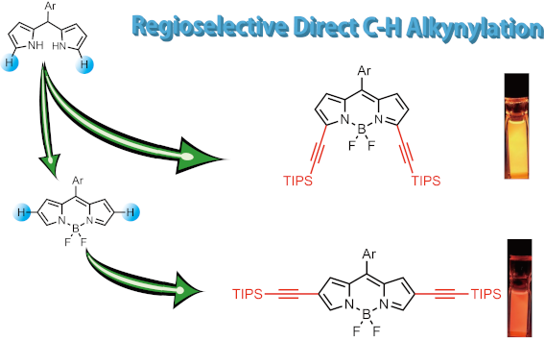
- -materials. Keywords: alkynylation; BODIPY; direct C–H functionalization; gold(I); Introduction Boron-dipyrromethene (BODIPY, 1) and its derivatives are representative families of fluorophores that have been widely used in applications for bioimaging [1][2][3][4][5][6], photodynamic therapy [7][8][9][10
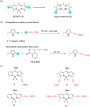
- prepared regioselectively, through the C–H alkynylation of 1 without any directing groups. In addition, the corresponding dipyrromethane 2, which is a precursor of BODIPY, was first transformed into the alkynylated form under catalytic conditions, and subsequent oxidation followed by boron complexation to
- mixture was treated with 2,3-dichloro-5,6-dicyano-1,4-benzoquinone (DDQ) to give the α,α'-diethynyl-substituted dipyrrin 7a. Subsequent boron complexation in the presence of trimethylsilyl chloride (TMSCl) as a fluoride scavenger afforded 4a in 16% yield over three steps. Separately, α-ethynyl



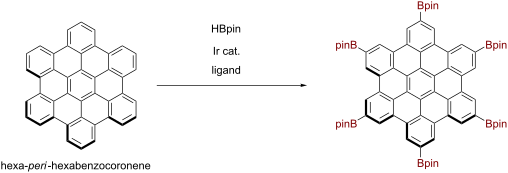
Six-fold C–H borylation of hexa-peri-hexabenzocoronene
Beilstein J. Org. Chem. 2020, 16, 391–397, doi:10.3762/bjoc.16.37
- 50% probability; all hydrogen atoms and solvent molecules (pentane) are omitted for clarity; gray: carbon; olive green: boron; red: oxygen. (b) Side view of 1. (c) Packing mode of 1. Photophysical properties of 1. (a) UV–vis absorption (solid lines) spectra, fluorescence (dotted line) spectrum


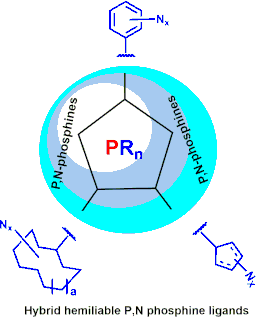
Architecture and synthesis of P,N-heterocyclic phosphine ligands
Beilstein J. Org. Chem. 2020, 16, 362–383, doi:10.3762/bjoc.16.35
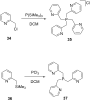
- 57. Coupling of 57 with Ph2PCl·BH3 resulted in the boron-protected ligand 58, which was deprotected with Et3N. Alternatively, 1,1’-bis(diphenylphosphino)ferrocene (dppf) with palladium(II) acetate was used to catalyze the reduction of 55 generating the pyridine scaffold 57. Subsequent lithiation and




Copper-catalyzed enantioselective conjugate addition of organometallic reagents to challenging Michael acceptors
Beilstein J. Org. Chem. 2020, 16, 212–232, doi:10.3762/bjoc.16.24
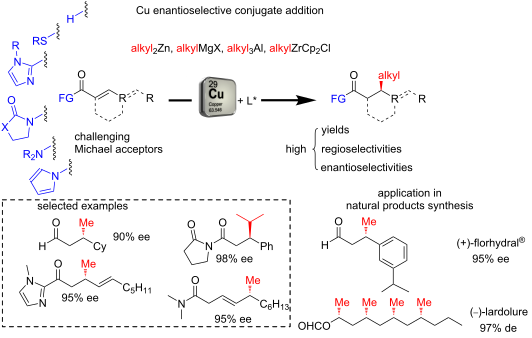
- ]. Indeed, due to their poor reactivity compared to other Michael acceptors, catalytic asymmetric conjugate additions of organometallic reagents to N,N-dialkylenamides remained a real challenge. However, thanks to the synergistic action of the boron-based Lewis acid BF3∙Et2O, CuBr∙SMe2, and the chiral (R,S




Efficient method for propargylation of aldehydes promoted by allenylboron compounds under microwave irradiation
Beilstein J. Org. Chem. 2020, 16, 168–174, doi:10.3762/bjoc.16.19
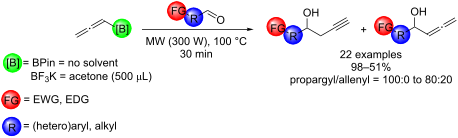
- were obtained in short reaction time, high yield and purity without the need of any solvent when allenylboronic acid pinacol ester was used, or using a minimal amount of acetone when potassium allenyltrifluoroborate was used. Keywords: boron compounds; microwave; propargylation; regioselectivity
- ] or boron [26][27][28] to perform propargylation reactions typically requires catalysis by Lewis acids or bases and although the utility of allenylstannanes is further indicated by the commercial availability of some of them, the toxicity of these compounds makes them inappropriate for the use in
- lower yields or the decomposition of the boron reagent 1 (Table 1, entries 3 and 4). It is worth to note that when the reaction was carried out with conventional heating (100 °C), the desired product was not observed after 1 h. A similar behavior was previously observed by Schaus [32]. Next, the


An improved, scalable synthesis of Notum inhibitor LP-922056 using 1-chloro-1,2-benziodoxol-3-one as a superior electrophilic chlorinating agent
Beilstein J. Org. Chem. 2019, 15, 2790–2797, doi:10.3762/bjoc.15.271
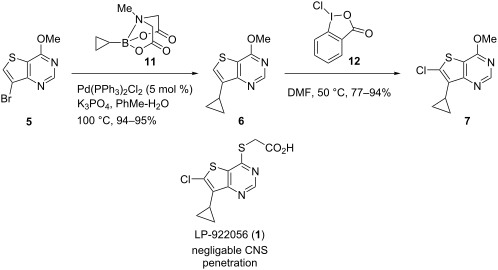
- acid (c-PrB(OH)2) to the corresponding MIDA-boronate 11 would improve the quality of the reagent and slow release of the active boron species during the course of the reaction would allow us to reduce the number of molar equivalents required to improve conversion [16]. Palladium-mediated cross coupling




Arylisoquinoline-derived organoboron dyes with a triaryl skeleton show dual fluorescence
Beilstein J. Org. Chem. 2019, 15, 2612–2622, doi:10.3762/bjoc.15.254
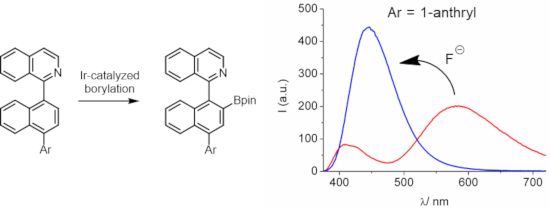
- ratiometric response by the build-up of a hypsochromically shifted emission signal. Keywords: anions; dyes; fluorescence; laser-flash photolysis; organoboron; Introduction Boron-containing tri- and tetra-coordinated chromophores have attracted considerable interest due to their often peculiar and highly
- advantageous photophysical properties that include spectrally tunable and highly intense fluorescence [1][2]. On the one hand, those compounds that contain the boron atom in a valence-saturated situation corresponding to sp3 hybridization (such as Bodipy dyes [3][4], N,C-chelate organoboron dyes [5][6][7][8][9
- , boron with sp2 hybridization, such as in triarylboranes, offers the possibility to modulate fluorescence properties by the addition of Lewis bases (e.g., fluoride ions [27][28][29][30][31]) or by exploring the electron-accepting properties of the boron, including charge-transfer and photoinduced



A new approach to silicon rhodamines by Suzuki–Miyaura coupling – scope and limitations
Beilstein J. Org. Chem. 2019, 15, 2569–2576, doi:10.3762/bjoc.15.250
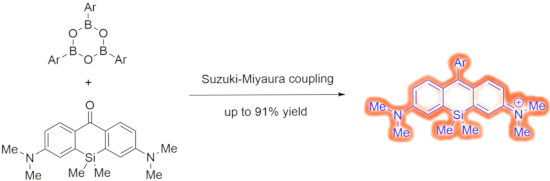
- gave access to silicon rhodamines in poor to moderate yields, we wanted to improve these first valuable experimental results. Results: The preparation of the xanthene triflate was enhanced and several boron sources were screened to find the optimal coupling partner. After optimization of the palladium
- reaction could be a valuable approach to silicon rhodamines. Thus, we aimed at the optimization of coupling conditions as well as evaluation of the best boron compounds for coupling. Since carboxylic acid-substituted dyes like compound 17 (X = Si, R = COOH) can be easily coupled to tumor binding vectors
- , we wanted to investigate if these dyes are also accessible by Suzuki–Miyaura coupling. Results and Discussion Optimization of reaction conditions At first we investigated the effects of different catalysts and boron compounds on the synthesis of silicon rhodamine 22 via Suzuki–Miyaura cross coupling


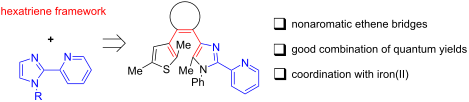
Photochromic diarylethene ligands featuring 2-(imidazol-2-yl)pyridine coordination site and their iron(II) complexes
Beilstein J. Org. Chem. 2019, 15, 2428–2437, doi:10.3762/bjoc.15.235
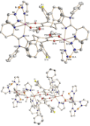
- similar to those in 8, which confirms a HS-Fe(II) ion. The Fe–O bond lengths vary between 2.1333(15) Å and 2.3110(16) Å. Curiously, the O–B bond distances to the tetrahedral boron ion do not differ in length with 1.453(3) and 1.449(3) Å, respectively. Each of the two interior Fe ions is linked to the


Functional panchromatic BODIPY dyes with near-infrared absorption: design, synthesis, characterization and use in dye-sensitized solar cells
Beilstein J. Org. Chem. 2019, 15, 1758–1768, doi:10.3762/bjoc.15.169
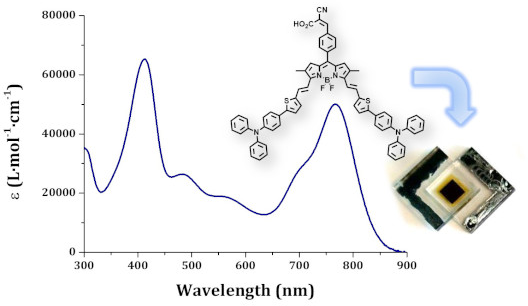
- Polymères Université de Mons - UMONS / Materia Nova Place du Parc, 20, B-7000 Mons, Belgium ICPEES – UMR7515, CNRS-Université de Strasbourg, 25 rue Becquerel, 67087 Strasbourg CEDEX 02, France 10.3762/bjoc.15.169 Abstract We report two novel functional dyes based on a boron-dipyrromethene (BODIPY) core
- were computed by density functional theory modelling (DFT) and characterized through UV–vis spectroscopy and cyclic voltammetry (CV) measurements. Finally, we report preliminary results obtained using these functional dyes as photosensitizers in dye-sensitized solar cells (DSSCs). Keywords: boron
- phthalocyanines [10][11], organic push–pull compounds [12], and boron-dipyrromethene [13] (BODIPY®). BODIPY dyes are one of the most extensively studied class of fluorophores due to their unique properties, including high absorption coefficients in the visible and NIR ranges, high fluorescence quantum yields, and


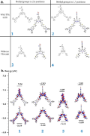


N-(1-Phenylethyl)aziridine-2-carboxylate esters in the synthesis of biologically relevant compounds
Beilstein J. Org. Chem. 2019, 15, 1722–1757, doi:10.3762/bjoc.15.168

- bulkiness of the tert-butyldimethylsilyloxy group in 205 three different approaches to stereoselective dihydroxylations of the C=C bond were elaborated. Thus, treatment with Oxone® gave the anti-epoxide 206 which was regioselectively opened in a boron


Synthesis, enantioseparation and photophysical properties of planar-chiral pillar[5]arene derivatives bearing fluorophore fragments
Beilstein J. Org. Chem. 2019, 15, 1601–1611, doi:10.3762/bjoc.15.164
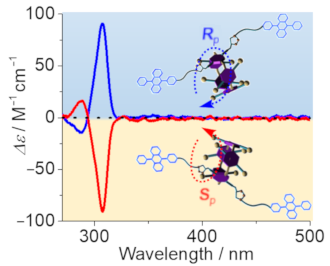
- -dimethoxybenzene (1.7 g, 1.2 mmol) and 7 (55.8 mg, 0.3 mmol) in 1,2-dichloroethane (150 mL), paraformaldehyde (271.5 mg, 3.0 mmol) was added under nitrogen atmosphere. Then, boron trifluoride diethyl etherate (120 μL) was added to the solution and the mixture was stirred at room temperature for 1 h. Water (100 mL

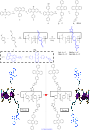


Borylation and rearrangement of alkynyloxiranes: a stereospecific route to substituted α-enynes
Beilstein J. Org. Chem. 2019, 15, 1416–1424, doi:10.3762/bjoc.15.141

- rearrangement of the so-formed alkynyloxiranyl borates. This stereospecific process overall transfers the cis or trans-stereochemistry of the starting alkynyloxiranes to the resulting 1,3-enynes. Keywords: boron; enyne; lithium; oxirane; rearrangement; Introduction Lithiated oxiranes are useful intermediates
- Shimizu [6][7], and our experience on the metalation of alkynyloxiranes and reactivity studies of the so-formed alkynyloxirane anions [12][13], we explored the reaction of such anions with various boron derivatives in order to produce stereodefined α-enynes after Matteson-type rearrangement [14] and
- neopentylglycol ester 2b proved slightly better (Table 1, entry 2). The pinacol ester 2c turned out to be the most effective reagent for this transformation, giving around 70% of 3 after isolation and purification (Table 1, entry 3). These results showed that the steric bulk at the boron atom seems to facilitate


Anomeric sugar boronic acid analogues as potential agents for boron neutron capture therapy
Beilstein J. Org. Chem. 2019, 15, 1355–1359, doi:10.3762/bjoc.15.135
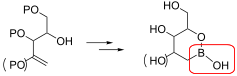
- suitable agents for boron neutron capture therapy (BNCT) became a major need. Among many others, sugar boronic acids have recently attracted attention as boron carriers. Herein we report the synthesis and preliminary biological studies of two new sugar analogues containing a boronic acid at the anomeric
- position. The analogues were obtained by hydroboration of proper open-chain terminal alkenes that, after quenching with water, spontaneously afforded cyclic boronic acids with hemiacetal-like structures. Keywords: antitumor agents; boron neutron capture therapy; boronic acid; hydroboration; sugar analogue
- ; Introduction Boron neutron capture therapy (BNCT) belongs to the so-called binary therapies for cancer treatment. It is based on the fission reaction after a low-energy neutron capture by a 10B atom. The neutron capture reaction gives rise to two high linear energy transfer (LET) particles (an α-particle and a


Robust perfluorophenylboronic acid-catalyzed stereoselective synthesis of 2,3-unsaturated O-, C-, N- and S-linked glycosides
Beilstein J. Org. Chem. 2019, 15, 1275–1280, doi:10.3762/bjoc.15.125
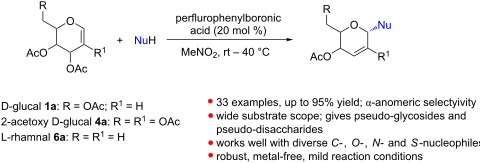
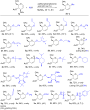
- results obtained using boron trifluoride diethyl etherate [32]. We then applied the perfluorophenylboronic acid catalyst to promote the reaction between 2,3,4,6-tetra-O-acetyl-D-glucal (4a) and O- and S-nucleophiles (Figure 2). The Ferrier-catalyzed rearrangements of 2-substituted sugars such as 2,3,4,6



Synthesis of aryl cyclopropyl sulfides through copper-promoted S-cyclopropylation of thiophenols using cyclopropylboronic acid
Beilstein J. Org. Chem. 2019, 15, 1162–1171, doi:10.3762/bjoc.15.113
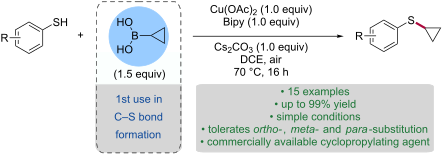
- cyclopropyl trifluoborate (29). Optimization of the reaction conditions for the copper-promoted S-cyclopropylation of thiophenol 14a with boron-based cyclopropylating reagents. Supporting Information Supporting Information File 284: Copies of NMR spectra of synthesized compounds. Acknowledgements This work


Extending mechanochemical porphyrin synthesis to bulkier aromatics: tetramesitylporphyrin
Beilstein J. Org. Chem. 2019, 15, 1149–1153, doi:10.3762/bjoc.15.111
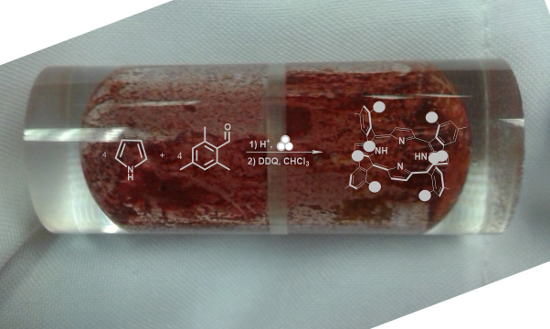
- the first-reported conditions of the Lindsey synthesis, mesitaldehyde “failed to give good yields” of TMP [11]. Later studies of modified reaction conditions employing boron trifluoride as the acid catalyst, and small amounts of ethanol as a co-catalyst, were successful in producing TMP with yields


Synthesis of the aglycon of scorzodihydrostilbenes B and D
Beilstein J. Org. Chem. 2019, 15, 610–616, doi:10.3762/bjoc.15.56
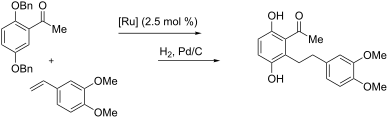
- -D-glucose pentaacetate in the presence of an excess of boron trifluoride etherate [20], a regioselective reaction occurred at the phenolic group in ortho-position to the alkyl side chain to give mono-glycosylated product 12. Chelation of the carbonyl and the neighboring phenolic group by the Lewis
- equipped with a stirring bar and a connection to the combined nitrogen/vacuum line. The flask was charged with dihydrostilbene 9 (330 mg, 1.04 mmol) and β-glucose pentaacetate (814 mg, 2.08 mmol) and closed with a septum. The air in the flask was replaced by nitrogen. Then, dichloromethane (4 mL) and boron


Synthesis of nonracemic hydroxyglutamic acids
Beilstein J. Org. Chem. 2019, 15, 236–255, doi:10.3762/bjoc.15.22
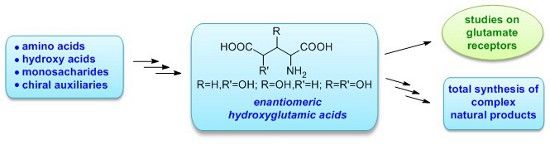
- boron trifluoride-catalyzed reaction with trimethylsilyl cyanide were separated chromatographically. Their transformation into (2R,3S)-2 and (2S,3S)-2, respectively, required the removal of the p-methoxybenzyl group and an acidic hydrolysis (Scheme 14) [65]. From D-glucose D-Glucose may be used as a
- decomposition of this stereoisomer including racemization at Cα. From pentose via 2,3-aziridino-γ-lactone In the so called “2,3-aziridino-γ-lactone methodology” [18][99][100] ribose (or lyxose) is used as a starting material [101][102] which is transformed into the lactone 95 in several steps [99]. Boron
- cleanly liberates (2S,3S,4S)-4 (Scheme 25) [100]. This methodology opens the way to (3S,4S)-3-hydroxy-4-methoxy- (104) and 3,4-dimethoxy-L-glutamic acid (105) since selective opening of the lactone ring in 95 can be accomplished by boron trifluoride etherate-catalyzed methanolysis at low temperatures to





