Search results
Search for "enol ether" in Full Text gives 123 result(s) in Beilstein Journal of Organic Chemistry.
Carbohydrate-auxiliary assisted preparation of enantiopure 1,2-oxazine derivatives and aminopolyols
Beilstein J. Org. Chem. 2012, 8, 662–674, doi:10.3762/bjoc.8.74
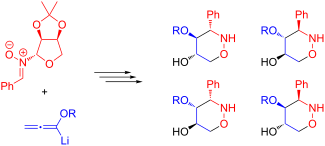
- -dihydro-2H-1,2-oxazines. Their enol ether double bond was then subjected to a hydroboration followed by an oxidative work-up, and finally the auxiliary was removed. The described three-step procedure enabled the synthesis of enantiopure hydroxylated 1,2-oxazines. Typical examples were treated with
- reagents [33]. Here we report on the application of a nitrone with an L-erythronolactone-derived auxiliary for the synthesis of 3,6-dihydro-2H-1,2-oxazine derivatives of type D. Their selected transformations, including hydroboration of the enol ether moiety, oxidative work-up, glycosyl cleavage, and




Facile isomerization of silyl enol ethers catalyzed by triflic imide and its application to one-pot isomerization–(2 + 2) cycloaddition
Beilstein J. Org. Chem. 2012, 8, 658–661, doi:10.3762/bjoc.8.73

- on triflic imide (Tf2NH)-catalyzed reactions [8], we accidentally found that the isomerization of kinetically favourable silyl enol ethers into thermodynamically stable ones occurs smoothly in the presence of Tf2NH. When the TBS enol ether 1a was treated with a catalytic amount of Tf2NH (1.0 mol
- CH3CN (entry 6). When 10-camphorsulfonic acid (5 mol %) was used as a catalyst for 1 h, the isomerization was incomplete (entry 7). Enol ethers bearing typical silyl groups were also isomerized (entries 8–12). The decomposition of TMS enol ether 1b into 3b slightly increased at ambient temperature
- compared to that at −10 °C (entries 8 and 9). In the reaction of TIPS enol ether 1d, the reaction rate decreased and more catalyst (5 mol %) was necessary to achieve equilibrium within 5 min (entry 12). Several silyl enol ethers were explored for catalytic isomerization under the optimized conditions (1


Recent developments in gold-catalyzed cycloaddition reactions
Beilstein J. Org. Chem. 2011, 7, 1075–1094, doi:10.3762/bjoc.7.124
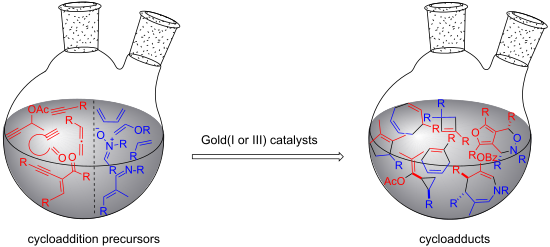
- is regenerated. When using a dienol silyl ether such as 21 (Scheme 12) as the diene component, the formation of the (4 + 2) products can be justified in terms of an alternative mechanism consisting of a 5-exo nucleophilic attack of the silyl enol ether moiety on the electrophilically activated alkyne


One-pot Diels–Alder cycloaddition/gold(I)-catalyzed 6-endo-dig cyclization for the synthesis of the complex bicyclo[3.3.1]alkenone framework
Beilstein J. Org. Chem. 2011, 7, 1007–1013, doi:10.3762/bjoc.7.114
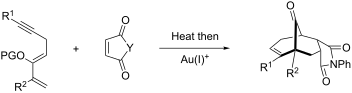
- generate carbon-bridged frameworks of various sizes through a gold(I)-catalyzed carbocyclization [13]. Although the cyclization of enol ether 5 can produce 5-exo and 6-endo products, we found that gold complexes 6, having bulky phosphine ligands such as 2-bis(tert-butylphosphino)biphenyl, gave exclusively
- Diels–Alder reaction/Au(I)-catalyzed 6-endo-dig carbocyclization (Scheme 3). Cycloaddition between diene 12 and dienophile 13 should provide the endo cycloadduct 14, which, in the presence of a gold(I) catalyst, would form the gold complex A. This undergoes a carbocyclization of enol ether [24][25][26


Multicomponent reaction access to complex quinolines via oxidation of the Povarov adducts
Beilstein J. Org. Chem. 2011, 7, 980–987, doi:10.3762/bjoc.7.110
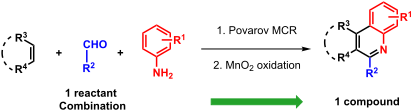
- , commercial reagents and additives on the oxidation of an elimination-prone Povarov tetrahydroquinoline substrate. In this way, tetrahydroquinolines 17,17' were synthesized as a mixture of isomers from the enol ether 14, p-bromoaniline (15) and p-chlorobenzaldehyde (16) under Sc(OTf)3 catalysis using standard


A racemic formal total synthesis of clavukerin A using gold(I)-catalyzed cycloisomerization of 3-methoxy-1,6-enynes as the key strategy
Beilstein J. Org. Chem. 2011, 7, 740–743, doi:10.3762/bjoc.7.84
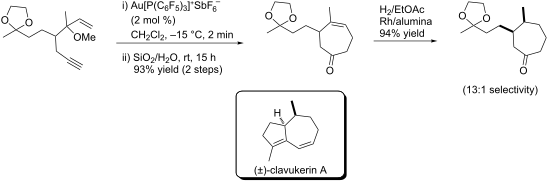
- relatively unstable enol ether 12, which was then immediately treated with aqueous silica gel to give the ketone 4 in 93% yield over two steps. Formation of 12 was unambiguously confirmed by the analysis of 1H NMR data of the crude reaction mixture. From a mechanistic viewpoint, the reaction presumably


Metathesis access to monocyclic iminocyclitol-based therapeutic agents
Beilstein J. Org. Chem. 2011, 7, 699–716, doi:10.3762/bjoc.7.81

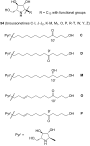
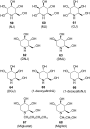
- opening is frequently troublesome, being governed by a number of factors. An improvement in the selectivity and efficiency of the total synthesis of (+)-1-deoxynojirimycin (62) (24% overall yield) was made by Poisson et al. [65], who developed a one-pot tandem protocol involving enol ether RCM
- hydride traps. Satisfactory results in RCM were, however, obtained from 78: in the presence of the 2nd-generation Grubbs catalyst 5 and benzoquinone in refluxing toluene, 78 was converted into the cyclized enol ether 79 in 70% yield, while with the Hoveyda–Grubbs catalyst (6, 10 mol %; benzoquinone 10 mol





Gold-catalyzed alkylation of silyl enol ethers with ortho-alkynylbenzoic acid esters
Beilstein J. Org. Chem. 2011, 7, 648–652, doi:10.3762/bjoc.7.76
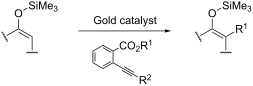
- -induced in situ construction of leaving groups and subsequent nucleophilic attack on the silyl enol ethers. The generated leaving compound abstracts a proton to regenerate the silyl enol ether structure. Keywords: alkylation; gold catalysis; leaving group; silyl enol ether; substitution reaction
- reaction of silyl enol ethers with ortho-alkynylbenzoic acid esters which leads to the formation of α-alkylated silyl enol ethers (path b). We examined the reactions of silyl enol ether 1a with ortho-alkynylbenzoic acid benzyl esters 2 in the presence of gold catalysts under several reaction conditions and
- the results are summarized in Table 1 [18][19][20][21]. With a cationic gold catalyst, derived from Ph3PAuCl and AgClO4, the reaction of 1a with 2a proceeded at 80 °C over 2 h and the benzylated silyl enol ether 3a was obtained in 35% yield, along with the eliminated isocoumarin 4a and recovered 2a in


A gold-catalyzed alkyne-diol cycloisomerization for the synthesis of oxygenated 5,5-spiroketals
Beilstein J. Org. Chem. 2011, 7, 570–577, doi:10.3762/bjoc.7.66
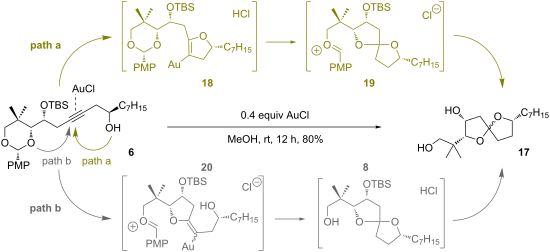
- methanol. Path a, which corresponds roughly to our original experimental designs, involves initial gold-catalyzed 5-endo-dig cyclization to dihydrofuran 18. Once the regiochemistry is established, any number of condensation pathways would lead to spiroketal 17. For example, protonation of the enol ether


Recent advances in carbocupration of α-heterosubstituted alkynes
Beilstein J. Org. Chem. 2010, 6, No. 77, doi:10.3762/bjoc.6.77

- ) undergo carbocupration to give the branched product 16 in good yields and as single isomers irrespective of whatever substitutents are present on the starting alkyne 14 a,b (R = H, Me, Scheme 8) [8][9]. The vinylic organocopper 15 is more stable than the corresponding β-metalated enol ether 5a: 5a


Addition of lithiated enol ethers to nitrones and subsequent Lewis acid induced cyclizations to enantiopure 3,6-dihydro-2H-pyrans – an approach to carbohydrate mimetics
Beilstein J. Org. Chem. 2010, 6, No. 75, doi:10.3762/bjoc.6.75

- -derived nitrones afforded syn- or anti-configured hydroxylamine derivatives 4a–d that were cyclized under Lewis acidic conditions to yield functionalized dihydropyrans cis- or trans-5a–d containing an enol ether moiety. This functional group was employed for a variety of subsequent reactions such as
- dihydroxylation or bromination. Bicyclic enol ether 19 was oxidatively cleaved to provide the highly functionalized ten-membered ring lactone 20. The synthesized enantiopure aminopyrans 24, 26, 28 and 30 can be regarded as carbohydrate mimetics. Trimeric versions of 24 and 28 were constructed via their attachment
- ether, dihydropyran, and dihydrofuran, all added smoothly to glyceraldehyde-derived nitrones 2a or 2b after lithiation with tert-butyllithium. Whereas in the reaction with uncomplexed nitrones, 1.5 equivalents of the respective lithiated enol ether were sufficient to obtain the desired syn-products with


Shelf-stable electrophilic trifluoromethylating reagents: A brief historical perspective
Beilstein J. Org. Chem. 2010, 6, No. 65, doi:10.3762/bjoc.6.65
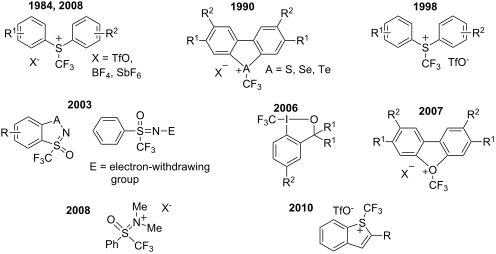
- trifluoromethylating power of chalcogenium salts increased in the order Te < Se < S while nitro-substituted reagents showed higher reactivity than non-nitrated reagents [14]. Matching the power of the trifluoromethylating agent with the nucleophile (carbanion, silyl enol ether, enamine, phenol, aniline, phosphine


One-pot three-component synthesis of quinoxaline and phenazine ring systems using Fischer carbene complexes
Beilstein J. Org. Chem. 2010, 6, No. 52, doi:10.3762/bjoc.6.52
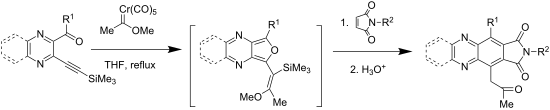
- unstable enol ether 8. No aromatized product was isolated, even under mild acidic conditions. As part of a general effort to prepare aza-analogues of hydrophenanthrene natural products (including morphine alkaloids and abietanes) and tetracyclic triterpenes, the coupling of o-alkynyl pyrazine/quinoxaline


Fused bicyclic piperidines and dihydropyridines by dearomatising cyclisation of the enolates of nicotinyl-substituted esters and ketones
Beilstein J. Org. Chem. 2010, 6, No. 22, doi:10.3762/bjoc.6.22
- Heloise Brice Jonathan Clayden Stuart D. Hamilton School of Chemistry, University of Manchester, Oxford Rd., Manchester M13 9PL, United Kingdom 10.3762/bjoc.6.22 Abstract The silyl enol ether derivatives of ketones or esters tethered by a hydrocarbon or ether linkage to the 3-position of a
- : bicyclic; cyclisation; dearomatisation; enol ether; heterocycle; pyridine; quinoline; Introduction Oxidative [1][2][3] or reductive (nucleophilic) [4][5][6][7][8][9][10][11][12][13][14][15][16][17][18][19][20][21] dearomatising cyclisation reactions are effective strategies for rapidly building complexity
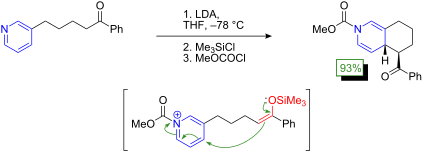
- it into a silyl enol ether 9. Silyl enol ethers and ketene acetals are known to add effectively to pyridinium species in an intermolecular manner [42][43][44][45][46]. Thus 7 was converted to silyl enol ether 9 in excellent yield under standard conditions. A single geometrical isomer was obtained


Synthesis of lipophilic 1-deoxygalactonojirimycin derivatives as D-galactosidase inhibitors
Beilstein J. Org. Chem. 2010, 6, No. 21, doi:10.3762/bjoc.6.21
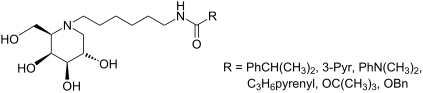
- -isopropylidene iminosugar 12. Starting from enol ether 10 [26][27], treatment with m-chloroperbenzoic acid gave the 5-O-chlorobenzoic ester via the corresponding 5,6-epoxide. This ester underwent hydrolysis under basic conditions to afford the L-arabino-hexos-5-ulose 11, which was immediately used for the next


Enantioselective synthesis of tricyclic amino acid derivatives based on a rigid 4-azatricyclo[5.2.1.02,6]decane skeleton
Beilstein J. Org. Chem. 2009, 5, No. 81, doi:10.3762/bjoc.5.81

- , and thus proximity-facilitated tandem hydride transfer/cyclization sequence [33]. Since the yields of rac-15 from the alkene rac-13 were low, we turned our attention to an alternative approach via the enol ether 18, which was available from 9 as a 1:1 mixture of E/Z-isomers by Wittig reaction with
- MeOCH=PPh3 (Scheme 4). The selective hydrolysis of the enol ether moiety in 18 in the presence of the N-Boc-protective group was achieved by using trichloroacetic acid. The desired endo-configured aldehyde 15 was thus available in only two steps in good 64% overall yield from 9. After oxidation of 15 to




Mitomycins syntheses: a recent update
Beilstein J. Org. Chem. 2009, 5, No. 33, doi:10.3762/bjoc.5.33






End game strategies towards the total synthesis of vibsanin E, 3-hydroxyvibsanin E, furanovibsanin A, and 3-O-methylfuranovibsanin A
Beilstein J. Org. Chem. 2008, 4, No. 34, doi:10.3762/bjoc.4.34

- ) by a Claisen rearrangment (via the silyl enol ether) was not high yielding and produced many side products. Ozonolysis of 25 afforded the acetone sidechain (i.e. 26) in acceptable yield (50%). Other methods to unmask the ketone functionality failed, for example, dihydroxylation followed by oxidative
- procedure based on the epoxidation of silyl enol ethers. Ketone 23 was smoothly converted into the TBS enol ether 27 (85% yield) with TBS triflate, which was then treated with dimethyldioxirane (DMDO). When work up was restricted to a simple 1 M hydrochloric acid wash (i.e. separatory funnel) only the
- diketone dehydration (i.e. phosphorus pentaoxide [23]). For Padwa’s protocol the TMS enol ether 33 was required, which was obtained in 75% from sequential treatment of 30 with LDA and TMSCl. Subsequent reaction of 33 with Padwa’s electrophile 34 [24] and silver tetrafluoroborate gave a complex mixture with


Sordarin, an antifungal agent with a unique mode of action
Beilstein J. Org. Chem. 2008, 4, No. 31, doi:10.3762/bjoc.4.31

- (Swern), which was converted to the corresponding silyl enol ether. Saegusa oxidation [23] of the latter occurred regioselectively to afford 15, which underwent intramolecular cycloaddtion in benzene at 40 °C. A final deprotection gave sordaricin methyl ester (3) in 16 linear steps from 8 and 9 with an
- silylation / cycloaddition conditions that had successfully advanced 94 to 95, and it was recovered unchanged after many such attempts. Thus, extensive studies were performed to find suitable conditions for the silylation reaction. Silyl enol ether formation failed to occur under Corey-Gross (LDA, R3SiCl


Total synthesis of the indolizidine alkaloid tashiromine
Beilstein J. Org. Chem. 2008, 4, No. 8, doi:10.1186/1860-5397-4-8
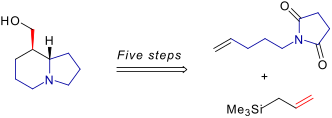
- after cross-metathesis, would allow access to chiral allylsilanes 9 with R1 being an alkoxy or acyloxy group. Furthermore, this would generate products 10 and/or 11 with a readily oxidised enol-ether/ester side chain for progression to tashiromine. We were, of course, mindful that these functions could


Contemporary organosilicon chemistry
Beilstein J. Org. Chem. 2007, 3, No. 4, doi:10.1186/1860-5397-3-4
- . Notwithstanding the earlier, pioneering work of chemists such as Eaborn, 1968 was notable for many innovations we now take for granted, including the development of silyl enol ether chemistry by Stork and Hudrlik, and the eponymous olefination reaction by Peterson. These landmark papers triggered a massive growth
An efficient synthesis of novel pyrano[2,3-d]- and furopyrano[2,3-d]pyrimidines via indium- catalyzed multi- component domino reaction
Beilstein J. Org. Chem. 2006, 2, No. 11, doi:10.1186/1860-5397-2-11
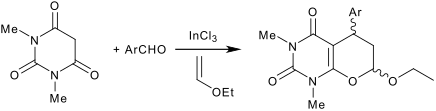
- type of cycloaddition using an amino aldehyde and a benzyl enol ether in presence of ethylene diammonium acetate and triethyl orthoformate has been reported earlier but this method has its own merits and limitations.[36] Results and Discussions On treatment of 1,3-dimethylbarbituric acid 1, 4


Do α-acyloxy and α-alkoxycarbonyloxy radicals fragment to form acyl and alkoxycarbonyl radicals?
Beilstein J. Org. Chem. 2006, 2, No. 10, doi:10.1186/1860-5397-2-10
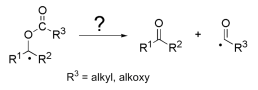
- atom transfer (Figure 2). The resulting radical 5 rebounds back to the enol ether in a 1,5-cyclization to provide 6. In the crucial self-terminating step, radical 6 is suggested to fragment to product 2 and radical X•. Related steps are involved in the formation of ketone 3 (not shown), except that the
- radical cyclization of enol ether 11a with tributyltin hydride (0.1 M) followed by chromatographic purification provided 14a in 95% yield as an inseparable 1:2 mixture of exo and endo isomers. Likewise, cyclization of enol ester 11b provided a 1:2 mixture of 14b-exo and 14b-endo in 68% isolated yield. The