


Search results
Search for "interconversion" in Full Text gives 151 result(s) in Beilstein Journal of Organic Chemistry.
Further exploration of the heterocyclic diversity accessible from the allylation chemistry of indigo
Beilstein J. Org. Chem. 2015, 11, 481–492, doi:10.3762/bjoc.11.54
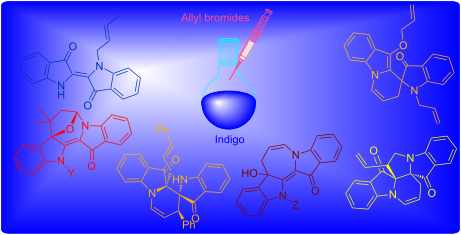
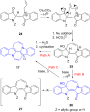
- -membered ring [8]. However, analysis of the 13C NMR spectra of these products indicated only a single set of peaks in each case and no evidence for a diastereomeric mixture. Presumably, the atropisomeric rotation barrier is sufficiently low at room temperature to allow for interconversion. While




A comparative study of the interactions of cationic hetarenes with quadruplex-DNA forming oligonucleotide sequences of the insulin-linked polymorphic region (ILPR)
Beilstein J. Org. Chem. 2014, 10, 2963–2974, doi:10.3762/bjoc.10.314
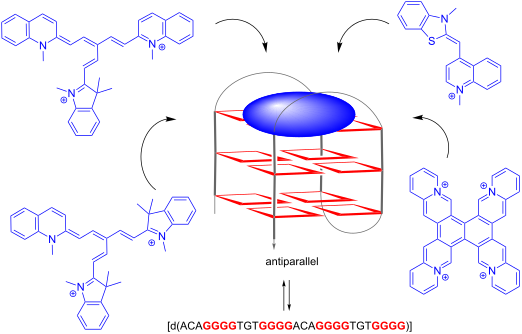
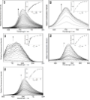
- demonstrate a delicate equilibrium between the different quadruplex forms and some kinetic barriers that result in rather slow interconversion processes. Nevertheless, to provide comparable data, in this study we used slowly cooled ILPR-quadruplex a2 to ensure that we have the same relative population of


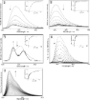


Microsolvation and sp2-stereoinversion of monomeric α-(2,6-di-tert-butylphenyl)vinyllithium as measured by NMR
Beilstein J. Org. Chem. 2014, 10, 2521–2530, doi:10.3762/bjoc.10.263

- averaged resonance position of (δcis + δtrans)/2 [24]. The temperature-dependent pseudo-first-order rate constants kψ of this interconversion were determined with a computer program [25][26][27][28] that can simulate and plot AB line shapes for visual comparison with the experimental spectra. This


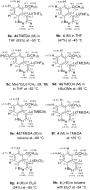


Pyrrolidine nucleotide analogs with a tunable conformation
Beilstein J. Org. Chem. 2014, 10, 1967–1980, doi:10.3762/bjoc.10.205
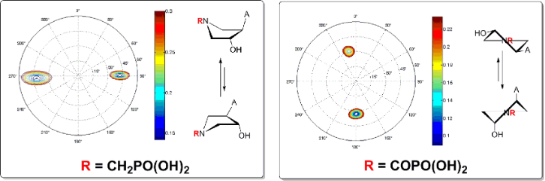
- existence of the two rotamers prompted us to estimate the energy barrier of their interconversion. We therefore performed variable 31P NMR measurements of 14 at different temperatures (starting at 25 °C with a 10 °C step, with the last measurement taken at 100 °C) and a line-shape analysis of an uncoupled
- , exchanging two-site 31P system (Figure 9). This enabled us to obtain the rate constants of the exchange at different temperatures and estimate the activation parameters of the interconversion such as the Gibbs free energy of activation ΔG‡298 = 80.7 kJ/mol; the enthalpy of activation ΔH‡ = 23.8 kJ/mol; and


Use of activated enol ethers in the synthesis of pyrazoles: reactions with hydrazine and a study of pyrazole tautomerism
Beilstein J. Org. Chem. 2014, 10, 752–760, doi:10.3762/bjoc.10.70

- a rapid exchange between tautomeric forms was expected – and in DMSO-d6 solution – where we assumed slower interconversion rates due to the acceptor properties of this solvent. However, the solubility in CDCl3 turned out to be very low for the studied compounds, so that only 1H NMR spectra could be



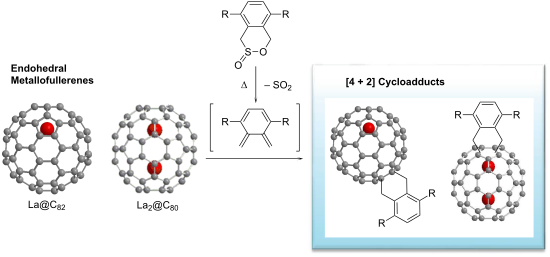
Thermodynamically stable [4 + 2] cycloadducts of lanthanum-encapsulated endohedral metallofullerenes
Beilstein J. Org. Chem. 2014, 10, 714–721, doi:10.3762/bjoc.10.65
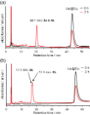
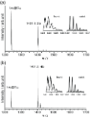
- of the cycloadducts of EMFs has not been well-studied to date; the investigation of this interconversion serves to demonstrate the existence of a dynamic process in the molecules and is regarded as one index of the bonding energy of the addition position of the fullerene and the addend. Among various
- slow or fast to allow their observation in an NMR time scale. The signals from the AB-quartet of 4a coalesce at 290 K (= Tc) indicate a dynamic process, which is attributed to the boat-to-boat interconversion of the cyclohexane ring of the addend similarly to the related carbocyclic analogues of C60






Chromatographically separable rotamers of an unhindered amide
Beilstein J. Org. Chem. 2014, 10, 701–706, doi:10.3762/bjoc.10.63
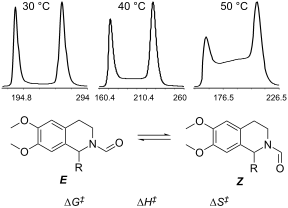
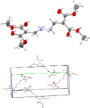
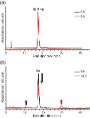
- .10.63 Abstract Surprisingly stable formamide rotamers were encountered in the tetrahydroisoquinoline and morphinan series of alkaloids. We investigated the hindered rotation around the amide bond by dynamic high-performance liquid chromatography (DHPLC) and kinetic measurements of the interconversion of
- the second development immediately followed the air-drying of the plate. If one hour at room temperature lay between the first and the second development, two weak off-diagonal spots indicated that interconversion of both species had taken place to a small extent. When the temperature was increased to
- 75 °C during a 15 min drying period, four spots with roughly equal intensity resulted from the second 2D-TLC run and indicated complete interconversion. A look into the literature revealed that the occurrence of separable amide rotamers of 1-benzyl-N-formyl-1,2,3,4-tetrahydroisoquinolines had been


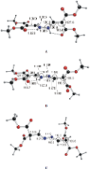
![[Graphic 2]](/bjoc/content/inline/1860-5397-10-63-i3.png?max-width=637&scale=1.18182) ) in 4 (BP-D3/def2-SVP).
) in 4 (BP-D3/def2-SVP).

Recent applications of the divinylcyclopropane–cycloheptadiene rearrangement in organic synthesis
Beilstein J. Org. Chem. 2014, 10, 163–193, doi:10.3762/bjoc.10.14
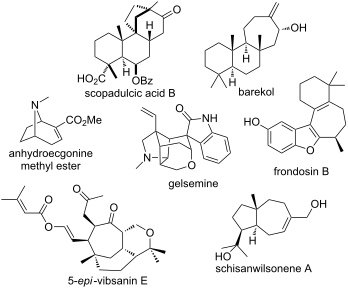
- desired DVCPR in almost quantitative yield at elevated temperature, followed by removal of the silyl-protecting group under acidic conditions to furnish cycloheptenone 70. Standard functional group interconversion furnished diolefin 71. Subjection of this compound to Heck coupling conditions resulted in
- 96, for which the yield and enantioselectivity was determined starting from 93. Standard functional group interconversion first provided exo-methylene 97, followed by ruthenium-catalyzed oxidative cleavage of the installed exo-methylene moiety [94] to give tricyclic ketone 98, which can be converted




The difluoromethylene (CF2) group in aliphatic chains: Synthesis and conformational preference of palmitic acids and nonadecane containing CF2 groups
Beilstein J. Org. Chem. 2014, 10, 18–25, doi:10.3762/bjoc.10.4

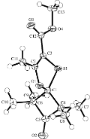
- -tetrafluorohexadecanoic acid (6c). The X-ray structure of 8,8,11,11-tetrafluorononadecane (27). Conformational interconversion of 1,4-di-CF2 motif. Synthesis route to 8,8-difluorohexadecanoic acid (6a). The synthesis of palmitic acid analogues 6b and 6c. Synthesis route to the tetrafluorinated alkane 27. Supporting




Plakilactones G and H from a marine sponge. Stereochemical determination of highly flexible systems by quantitative NMR-derived interproton distances combined with quantum mechanical calculations of 13C chemical shifts
Beilstein J. Org. Chem. 2013, 9, 2940–2949, doi:10.3762/bjoc.9.331
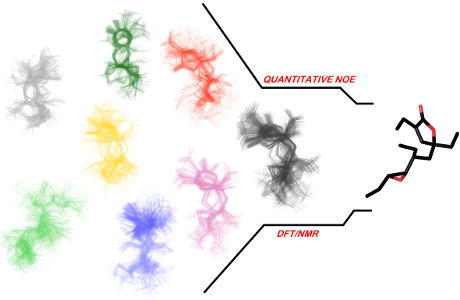
- extend the application of NMR-derived interproton distances to a highly flexible molecular system with simultaneous assignment of four non-contiguous stereocenters. Chemical derivatization and quantum mechanical calculations of 13C on plakilactone G along with a plausible biogenetic interconversion
- consistent with anti-1,2-diol type C. Therefore the 7R,8S configuration is assigned. Notably, considering the plausible biogenetic interconversion of an epoxide and a diol, the above absolute configuration at C-7 and C-8 of plakilactone G is in full agreement with the trans-epoxide 2b. Having assigned the
- probability of 62.9% (Table 5), whereas for 1b–d we found a probability of 1.9%, 5.4% and 29.7% (Table 5), respectively. Isomers 1a and 1d differ only in the configuration at C-4, and considering a putative interconversion between diol 1 and epoxide 2 and a common biogenetic pathway in combination with the


Less reactive dipoles of diazodicarbonyl compounds in reaction with cycloaliphatic thioketones – First evidence for the 1,3-oxathiole–thiocarbonyl ylide interconversion
Beilstein J. Org. Chem. 2013, 9, 2751–2761, doi:10.3762/bjoc.9.309

- temperature dependence of the main reaction product type obtained from dimethyl diazomalonate and 2,2,4,4-tetramethyl-3-thioxocyclobutanе-1-one as well as to verify reversibility of the thiocarbonyl ylide and 1,3-oxathiole interconversion, the calculations of the energy profile for the transformation of 1,3
- . Thus, the observed process is the first example of a reversible interconversion of a 1,3-oxathiole into the corresponding thiirane via the corresponding thiocarbonyl ylide. Subsequently formed thiirane easily undergoes desulfurization, and finally the respective alkene is formed as an isolable compound
- interconversion and to explain the observed dependence in the formation of the main reaction product type from the temperature, the computations were performed at the DFT PBE1PBE/6-31G(d) level of the energy profile for the transformation of 1,3-oxathiole 3e to alkene 5e (Figure 3, Supporting Information File 1




Biosynthesis of rare hexoses using microorganisms and related enzymes
Beilstein J. Org. Chem. 2013, 9, 2434–2445, doi:10.3762/bjoc.9.281
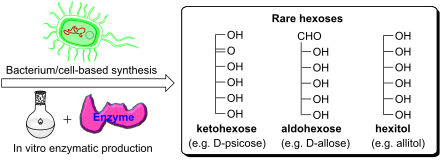
- extensively studied, particularly from D-galactose by L-arabinose isomerase (AI, EC 5.3.1.4) (Scheme 1) [14][15][16][17][18][19][20]. As the interconversion equilibrium between D-galactose and D-tagatose shifts toward D-tagatose at higher temperatures, biocatalysts with greater thermal stability are preferred
- residues in the active site, the metal coordinating site and the substrate-binding site of these enzymes (Figure 1) [37][38]. After all, the interconversion between D-fructose and D-psicose catalyzed by DTEase enzymes is an equilibrium process, thus large scale and high yield production of D-psicose as
- -phosphate isomerase from Lactococcus lactis [74] catalyze two reversible isomerization reactions (interconversion between D-psicose and D-allose vs interconversion between D-psicose and D-altrose) with D-altrose as a byproduct. In contrast, L-rhamnose isomerase from Bacillus pallidus [75] and ribose-5


An overview of the synthetic routes to the best selling drugs containing 6-membered heterocycles
Beilstein J. Org. Chem. 2013, 9, 2265–2319, doi:10.3762/bjoc.9.265
- protonation steps. This is followed by Boc-protection and interconversion of the ethyl ester to its amide derivative 2.82 in 80% overall yield for this telescoped process. The primary amide in 2.82 was then oxidised via a modern variant of the classical Hoffmann rearrangement using phenyliodine diacetate


Sequential Diels–Alder/[3,3]-sigmatropic rearrangement reactions of β-nitrostyrene with 3-methyl-1,3-pentadiene
Beilstein J. Org. Chem. 2013, 9, 2137–2146, doi:10.3762/bjoc.9.251

- intermediate. The initially isolated nitronic ester cycloadducts underwent tin(IV)-catalyzed interconversion, presumably via zwitterion intermediates. Cycloadducts derived from the reaction at the less substituted double bond of (E)-3-methyl-1,3-pentadiene underwent a [3,3]-sigmatropic rearrangement on heating
- nitronic ester 7 or formation of nitronic ester 4, presumably depending on relative thermodynamic stabilities of the two nitronic esters. Thus, it is thought that nitronic ester 4 is at least 2 kcal/mol more stable than nitronic ester 7. Interconversion of nitronic esters 5 and 6 is thought to occur via
- )-catalyzed [3,3]-sigmatropic rearrangement of nitronic ester 5 affords nitro compound 16 (vide infra). The rapid interconversion of nitronic esters 2 and 3 likely reflects the greater ease of rotation for the cyclo zwitterion 17. Here bond breaking and reformation is at a secondary rather than tertiary


An investigation of the observed, but counter-intuitive, stereoselectivity noted during chiral amine synthesis via N-chiral-ketimines
Beilstein J. Org. Chem. 2013, 9, 2103–2112, doi:10.3762/bjoc.9.247

- , these researchers refer back to an earlier body of literature that focused on cis/trans-imine interconversion in protic solvents or at high temperature [55][56][57]. A directly relevant study by Boyd et al. [55] convincingly established that protic solvents allow PEA imine isomerization, while aprotic


Structures of the reaction products of the AZADO radical with TCNQF4 or thiourea
Beilstein J. Org. Chem. 2013, 9, 1487–1491, doi:10.3762/bjoc.9.169

- usually seen in other thiourea-derived complexes [13]. It is anticipated from the X-ray data at room temperature that AZADO molecules within the thiourea channels are disordered and it appears to be due to dynamic interconversion between the six orientations with essentially equal occupancies of the


True and masked three-coordinate T-shaped platinum(II) intermediates
Beilstein J. Org. Chem. 2013, 9, 1352–1382, doi:10.3762/bjoc.9.153
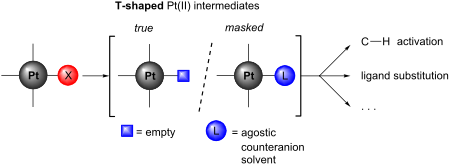
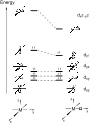
- bending energy profile maintains the same basic features: the T-shaped configurations of the 14-electron species are energy minima, and their cis-like to trans-like interconversion occurs via transition states with Y-shaped configurations [2]. The X-ray structure of the recently reported three-coordinate





Establishing the concept of aza-[3 + 3] annulations using enones as a key expansion of this unified strategy in alkaloid synthesis
Beilstein J. Org. Chem. 2013, 9, 1170–1178, doi:10.3762/bjoc.9.131
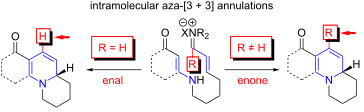
- -isopropeleine interconversion. Retrosynthesis of propyleine (12). Synthesis of allyl alcohol 25. Catalyst screening and optimization. Synthesis of the annulation precursor 17. Aza-[3 + 3] annulations of 17-cis. Supporting Information Supporting Information File 110: Experimental section. Acknowledgements


Use of 3-[18F]fluoropropanesulfonyl chloride as a prosthetic agent for the radiolabelling of amines: Investigation of precursor molecules, labelling conditions and enzymatic stability of the corresponding sulfonamides
Beilstein J. Org. Chem. 2013, 9, 1002–1011, doi:10.3762/bjoc.9.115
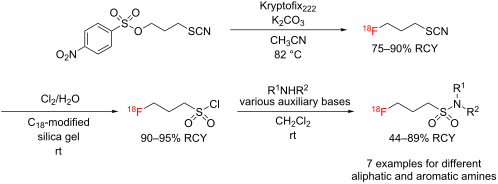
- electrophilic agents can be exchanged by reaction with fluoride even in the presence of water to form the corresponding sulfonyl fluorides [21]. Hence, the sulfonyl chloride has to be generated by interconversion of a different, less reactive sulfur-containing functional group after radiofluorination. Sulfonyl
- transformation of the thiocyano group of 9 to the chlorosulfonyl group leading to 3-fluoropropanesulfonyl chloride (10). This functional group interconversion using aqueous chlorine has been known for a long time [27] but has received little attention in synthetic organic chemistry. Following this approach




Appel-reagent-mediated transformation of glycosyl hemiacetal derivatives into thioglycosides and glycosyl thiols
Beilstein J. Org. Chem. 2013, 9, 974–982, doi:10.3762/bjoc.9.112

- the gated 1H coupled 13C NMR spectra of compounds 32 and 33 confirmed the exclusive formation of β-products [47][48]. It is presumed that the reaction of the glycosyl hemiacetal derivative with the combination of CBr4 and PPh3 furnished α-glycosyl bromide in the first step. Interconversion of the α


4-Pyridylnitrene and 2-pyrazinylcarbene
Beilstein J. Org. Chem. 2013, 9, 754–760, doi:10.3762/bjoc.9.85
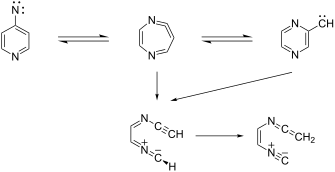
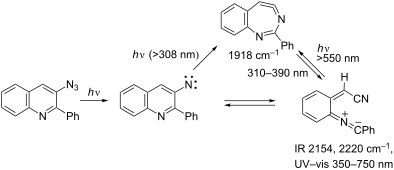
- -diazacyclohepta-1,2,4,6-tetraene (20). Further photolysis causes ring opening to the ketenimine 27. Keywords: carbene–nitrene interconversion; diazepines; flash vacuum thermolysis; matrix photochemistry; nitrile ylides; reactive intermediates; Introduction The carbene–nitrene interconversion exemplified with
- contraction is highly exothermic, the product will be chemically activated [14], and therefore interconversion of the two cyanopyrroles cannot be avoided. Only a minute trace of 4,4’-azopyridine is formed under these conditions. The total yield of the cyanopyrroles is low because of heavy charring inside the
- pyrolysis tube. The exact mechanisms of ring contraction in arylnitrenes are under investigation, but in the case of 2-pyridylnitrene (Scheme 2) three routes to the cyanopyrroles have been described [10], as has their thermal interconversion [9][10]. The analogous, concerted ring contraction of


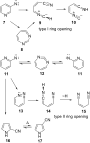




3-Pyridylnitrene, 2- and 4-pyrimidinylcarbenes, 3-quinolylnitrenes, and 4-quinazolinylcarbenes. Interconversion, ring expansion to diazacycloheptatetraenes, ring opening to nitrile ylides, and ring contraction to cyanopyrroles and cyanoindoles
Beilstein J. Org. Chem. 2013, 9, 743–753, doi:10.3762/bjoc.9.84
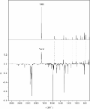
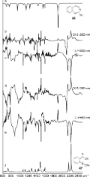
- either the nitrenes or the diazacycloheptatetraenes to nitrile ylides. Keywords: carbene-nitrene interconversion; diazepines; flash vacuum thermolysis; matrix photochemistry; nitrile ylides; reactive intermediates; Introduction A multitude of rearrangements of heterocyclic nitrenes have been described
- drop to 1.2:1 due to the thermal interconversion of 7 and 8 [10][20]. The reaction mechanism was probed by calculations at the B3LYP/6-31G* level, which has been found to be adequate for other, similar reactions [11][13][17][21]. The transition state for the ring opening of the cyclic ketenimine 16 to
- strongly exothermic reactions. Consequently, when the reaction is performed in the low-pressure gas phase, the reaction products carry excess thermal (rovibrational) energy, which facilitates the sigmatropic shifts of H, CN, and CH3, which will cause interconversion of the cyanopyrroles [28]. In many cases




Complete σ* intramolecular aromatic hydroxylation mechanism through O2 activation by a Schiff base macrocyclic dicopper(I) complex
Beilstein J. Org. Chem. 2013, 9, 585–593, doi:10.3762/bjoc.9.63
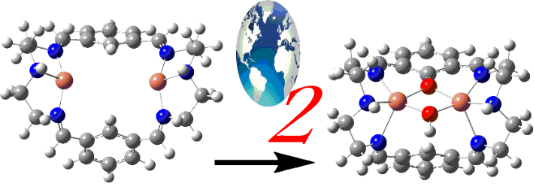
- topic is still to unravel, either experimentally or by calculations, which of the side-on μ-η2:η2-peroxo and bis(μ-oxo) isomeric Cu2O22+ cores are present, and in the case that they exist, to study the feasibility of their interconversion [15][16][17][18][19], tuning either the metallic complex or the


Inter- and intramolecular enantioselective carbolithiation reactions
Beilstein J. Org. Chem. 2013, 9, 313–322, doi:10.3762/bjoc.9.36

- . These secondary α-carbamoyloxybenzyllithiums are configurationally stable and can be trapped. The authors assume that the problem of these enantioselective carbolithiations is due to the interconversion of the conformers, formed by coordination of n-BuLi and the chiral ligand, being too slow, and that





Radical zinc-atom-transfer-based carbozincation of haloalkynes with dialkylzincs
Beilstein J. Org. Chem. 2013, 9, 236–245, doi:10.3762/bjoc.9.28
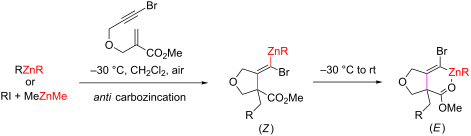
- -bromovinyl radical 15 of E geometry. Substitution by electron-withdrawing groups slows down E to Z isomerization of vinylic radicals, and therefore, due to the presence of the bromine atom, interconversion of (E)-15 into (Z)-15 should not be fast. Thus, (E)-15 reacts by Zn atom transfer prior to its





