


Search results
Search for "key intermediate" in Full Text gives 287 result(s) in Beilstein Journal of Organic Chemistry. Showing first 200.
Recent synthesis of thietanes
- Jiaxi Xu
Beilstein J. Org. Chem. 2020, 16, 1357–1410, doi:10.3762/bjoc.16.116
- starting material was converted into bis(hydroxymethyl)quinolizidinone 56. After mesylation and the double displacement with sodium sulfide, spirothietane-quinolizidine 57 was obtained as a key intermediate. It was further applied in the total synthesis of four different natural products of Nuphar
- series of thietanose nucleosides 118 [53]. Similarly, enatiomeric thietanose nucleosides 123 were prepared from L-xylose [53] (Scheme 24). In 2010, Takahata and co-workers designed and synthesized thietane-fused nucleosides. They first prepared a key intermediate spiro acetal 125, which was converted

Graphical Abstract

Figure 1: Examples of biologically active thietane-containing molecules.

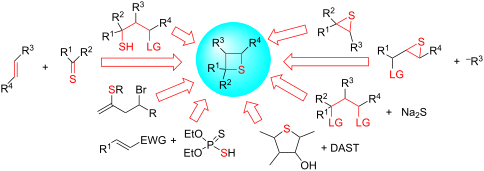
Figure 2: The diverse methods for the synthesis of thietanes.

Scheme 1: Synthesis of 1-(thietan-2-yl)ethan-1-ol (10) from 3,5-dichloropentan-2-ol (9).

Scheme 2: Synthesis of thietanose nucleosides 2,14 from 2,2-bis(bromomethyl)propane-1,3-diol (11).

Scheme 3: Synthesis of methyl 3-vinylthietane-3-carboxylate (19).

Scheme 4: Synthesis of 1,6-thiazaspiro[3.3]heptane (24).

Scheme 5: Synthesis of 6-amino-2-thiaspiro[3.3]heptane hydrochloride (28).

Scheme 6: Synthesis of optically active thietane 31 from vitamin C.

Scheme 7: Synthesis of an optically active thietane nucleoside from diethyl L-tartrate (32).

Scheme 8: Synthesis of thietane-containing spironucleoside 40 from 5-aldo-3-O-benzyl-1,2-O-isopropylidene-α-D...

Scheme 9: Synthesis of optically active 2-methylthietane-containing spironucleoside 43.

Scheme 10: Synthesis of a double-linked thietane-containing spironucleoside 48.

Scheme 11: Synthesis of two diastereomeric thietanose nucleosides via 2,4-di(benzyloxymethyl)thietane (49).

Scheme 12: Synthesis of the thietane-containing PI3k inhibitor candidate 54.

Scheme 13: Synthesis of the spirothietane 57 as the key intermediate to Nuphar sesquiterpene thioalkaloids.

Scheme 14: Synthesis of spirothietane 61 through a direct cyclic thioetherification of 3-mercaptopropan-1-ol.

Scheme 15: Synthesis of thietanes 66 from 1,3-diols 62.

Scheme 16: Synthesis of thietanylbenzimidazolone 75 from (iodomethyl)thiazolobenzimidazole 70.

Scheme 17: Synthesis of 2-oxa-6-thiaspiro[3.3]heptane (80) from bis(chloromethyl)oxetane 76 and thiourea.

Scheme 18: Synthesis of the thietane-containing glycoside, 2-O-p-toluenesulfonyl-4,6-thioanhydro-α-D-gulopyran...

Scheme 19: Synthesis of methyl 4,6-thioanhydro-α-D-glucopyranoside (89).

Scheme 20: Synthesis of thietane-fused α-D-galactopyranoside 93.

Scheme 21: Synthesis of thietane-fused α-D-gulopyranoside 100.

Scheme 22: Synthesis of 3,5-anhydro-3-thiopentofuranosides 104.

Scheme 23: Synthesis of anhydro-thiohexofuranosides 110, 112 and 113 from from 1,2:4,5-di-O-isopropylidene D-f...

Scheme 24: Synthesis of optically active thietanose nucleosides from D- and L-xyloses.

Scheme 25: Synthesis of thietane-fused nucleosides.

Scheme 26: Synthesis of 3,5-anhydro-3-thiopentofuranosides.

Scheme 27: Synthesis of 2-amino-3,5-anhydro-3-thiofuranoside 141.

Scheme 28: Synthesis of thietane-3-ols 145 from (1-chloromethyl)oxiranes 142 and hydrogen sulfide.

Scheme 29: Synthesis of thietane-3-ol 145a from chloromethyloxirane (142a).

Scheme 30: Synthesis of thietane-3-ols 145 from 2-(1-haloalkyl)oxiranes 142 and 147 with ammonium monothiocarb...
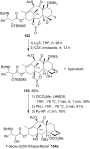
Scheme 31: Synthesis of 7-deoxy-5(20)thiapaclitaxel 154a, a thietane derivative of taxoids.

Scheme 32: Synthesis of 5(20)-thiadocetaxel 158 from 10-deacetylbaccatin III (155).

Scheme 33: Synthesis of thietane derivatives 162 as precursors for deoxythiataxoid synthesis through oxiraneme...

Scheme 34: Synthesis of 7-deoxy 5(20)-thiadocetaxel 154b.

Scheme 35: Mechanism for the formation of the thietane ring in 171 from oxiranes with vicinal leaving groups 1...

Scheme 36: Synthesis of cis-2,3-disubstituted thietane 175 from thiirane-2-methanol 172.

Scheme 37: Synthesis of a bridged thietane 183 from aziridine cyclohexyl tosylate 179 and ammonium tetrathiomo...
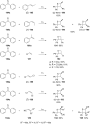
Scheme 38: Synthesis of thietanes via the photochemical [2 + 2] cycloaddition of thiobenzophenone 184a with va...
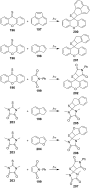
Scheme 39: Synthesis of spirothietanes through the photo [2 + 2] cycloaddition of cyclic thiocarbonyls with ol...

Scheme 40: Photochemical synthesis of spirothietane-thioxanthenes 210 from thioxanthenethione (208) and butatr...

Scheme 41: Synthesis of thietanes 213 from 2,4,6-tri(tert-butyl)thiobenzaldehyde (211) with substituted allene...

Scheme 42: Photochemical synthesis of spirothietanes 216 and 217 from N-methylthiophthalimide (214) with olefi...

Scheme 43: Synthesis of fused thietanes from quadricyclane with thiocarbonyl derivatives 219.
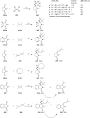
Scheme 44: Synthesis of tricyclic thietanes via the photo [2 + 2] cycloaddition of N-methyldithiosuccinimides ...
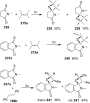
Scheme 45: Synthesis of tricyclic thietanes via the photo [2 + 2] cycloaddition of N-methylthiosuccinimide/thi...

Scheme 46: Synthesis of tricyclic thietanes via the photo [2 + 2] cycloaddition of N-alkylmonothiophthalimides...

Scheme 47: Synthesis of spirothietanes from dithiosuccinimides 223 with 2,3-dimethyl-2-butene (215a).

Scheme 48: Synthesis of thietanes 248a,b from diaryl thione 184b and ketene acetals 247a,b.

Scheme 49: Photocycloadditions of acridine-9-thiones 249 and pyridine-4(1H)-thione (250) with 2-methylacrynitr...

Scheme 50: Synthesis of thietanes via the photo [2 + 2] cycloaddition of mono-, di-, and trithiobarbiturates 2...
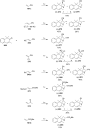
Scheme 51: Synthesis of spirothietanes via the photo [2 + 2] cycloaddition of 1,1,3-trimethyl-2-thioxo-1,2-dih...

Scheme 52: Synthesis of spirothietanes via the photo [2 + 2] cycloaddition of thiocoumarin 286 with olefins.

Scheme 53: Photochemical synthesis of thietanes 296–299 from semicyclic and acyclic thioimides 292–295 and 2,3...

Scheme 54: Photochemical synthesis of spirothietane 301 from 1,3,3-trimethylindoline-2-thione (300) and isobut...

Scheme 55: Synthesis of spirobenzoxazolethietanes 303 via the photo [2 + 2] cycloaddition of alkyl and aryl 2-...

Scheme 56: Synthesis of spirothietanes from tetrahydrothioxoisoquinolines 306 and 307 with olefins.

Scheme 57: Synthesis of spirothietanes from 1,3-dihydroisobenzofuran-1-thiones 311 and benzothiophene-1-thione...

Scheme 58: Synthesis of 2-triphenylsilylthietanes from phenyl triphenylsilyl thioketone (316) with electron-po...

Scheme 59: Diastereoselective synthesis of spiropyrrolidinonethietanes 320 via the photo [2 + 2] cycloaddition...

Scheme 60: Synthesis of bicyclic thietane 323 via the photo [2 + 2] cycloaddition of 2,4-dioxo-3,4-dihydropyri...

Scheme 61: Photo-induced synthesis of fused thietane-2-thiones 325 and 326 from silacyclopentadiene 324 and ca...

Scheme 62: Synthesis of highly strained tricyclic thietanes 328 via the intramolecular photo [2 + 2] cycloaddi...

Scheme 63: Synthesis of tri- and pentacyclic thietanes 330 and 332, respectively, through the intramolecular p...

Scheme 64: Synthesis of tricyclic thietanes 334 via the intramolecular photo [2 + 2] cycloaddition of N-vinylt...

Scheme 65: Synthesis of tricyclic thietanes 336 via the intramolecular photo [2 + 2] cycloaddition of N-but-3-...

Scheme 66: Synthesis of tricyclic thietanes via the intramolecular photo [2 + 2] cycloaddition of N-but-3-enyl...

Scheme 67: Synthesis of tetracyclic thietane 344 through the intramolecular photo [2 + 2] cycloaddition of N-[...
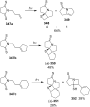
Scheme 68: Synthesis of tri- and tetracyclic thietanes 348, 350, and 351, through the intramolecular photo [2 ...

Scheme 69: Synthesis of tetracyclic fused thietane 354 via the photo [2 + 2] cycloaddition of vinyl 2-thioxo-3H...

Scheme 70: Synthesis of highly rigid thietane-fused β-lactams via the intramolecular photo [2 + 2] cycloadditi...

Scheme 71: Asymmetric synthesis of a highly rigid thietane-fused β-lactam 356a via the intramolecular photo [2...

Scheme 72: Diastereoselective synthesis of the thietane-fused β-lactams via the intramolecular photo [2 + 2] c...

Scheme 73: Asymmetric synthesis of thietane-fused β-lactams 356 via the intramolecular photo [2 + 2] cycloaddi...

Scheme 74: Synthesis of the bridged bis(trifluoromethyl)thietane from 2,2,4,4-tetrakis(trifluoromethyl)-1,3-di...

Scheme 75: Synthesis of the bridged-difluorothietane 368 from 2,2,4,4-tetrafluoro-1,3-dithietane (367) and qua...

Scheme 76: Synthesis of bis(trifluoromethyl)thietanes from 2,2,4,4-tetrakis(trifluoromethyl)-1,3-dithietane (3...

Scheme 77: Synthesis of 2,2-dimethylthio-4,4-di(trifluoromethyl)thietane (378) from 2,2,4,4-tetrakis(trifluoro...

Scheme 78: Formation of bis(trifluoromethyl)thioacetone (381) through nucleophilic attack of dithietane 363 by...

Scheme 79: Synthesis of 2,2-bis(trifluoromethyl)thietanes from 2,2,4,4-tetrakis(trifluoromethyl)-1,3-dithietan...

Scheme 80: Synthesis of the bridged bis(trifluoromethyl)thietane 364 from of 2,2,4,4-tetrakis(trifluoromethyl)...

Scheme 81: Synthesis of 2,4-diiminothietanes 390 from alkenimines and 4-methylbenzenesulfonyl isothiocyanate (...

Scheme 82: Synthesis of arylidene 2,4-diiminothietanes 393 starting from phosphonium ylides 391 and isothiocya...

Scheme 83: Synthesis of thietane-2-ylideneacetates 397 through a DABCO-catalyzed formal [2 + 2] cycloaddition ...

Scheme 84: Synthesis of 3-substituted thietanes 400 from (1-chloroalkyl)thiiranes 398.

Scheme 85: Synthesis of N-(thietane-3-yl)azaheterocycles 403 and 404 through reaction of chloromethylthiirane (...

Scheme 86: Synthesis of 3-sulfonamidothietanes 406 from sulfonamides and chloromethylthiirane (398a).

Scheme 87: Synthesis of N-(thietane-3-yl)isatins 408 from chloromethylthiirane (398a) and isatins 407.

Scheme 88: Synthesis of 3-(nitrophenyloxy)thietanes 410 from nitrophenols 409 and chloromethylthiirane (398a).

Scheme 89: Synthesis of N-aryl-N-(thietane-3-yl)cyanamides 412 from N-arylcyanamides 411 and chloromethylthiir...

Scheme 90: Synthesis of 1-(thietane-3-yl)pyrimidin-2,4(1H,3H)-diones 414 from chloromethylthiirane (398a) and ...

Scheme 91: Synthesis of 2,4-diiminothietanes 418 from 2-iminothiiranes 416 and isocyanoalkanes 415.

Scheme 92: Synthesis of 2-vinylthietanes 421 from thiiranes 419 and 3-chloroallyl lithium (420).

Scheme 93: Synthesis of thietanes from thiiranes 419 and trimethyloxosulfonium iodide 424.

Scheme 94: Mechanism for synthesis of thietanes 425 from thiiranes 419 and trimethyloxosulfonium iodide 424.

Scheme 95: Synthesis of functionalized thietanes from thiiranes and dimethylsulfonium acylmethylides.

Scheme 96: Mechanism for the rhodium-catalyzed synthesis of functionalized thietanes 429 from thiiranes 419 an...

Scheme 97: Synthesis of 3-iminothietanes 440 through thermal isomerization from 4,5-dihydro-1,3-oxazole-4-spir...

Scheme 98: Synthesis of thietanes 443 from 3-chloro-2-methylthiolane (441) through ring contraction.

Scheme 99: Synthesis of an optically active thietanose 447 from D-xylose involving a ring contraction.

Scheme 100: Synthesis of optically thietane 447 via the DAST-mediated ring contraction of 448.

Scheme 101: Synthesis of the optically thietane nucleoside 451 via the ring contraction of thiopentose in 450.

Scheme 102: Synthesis of spirothietane 456 from 3,3,5,5-tetramethylthiolane-2,4-dithione (452) and benzyne (453...

Scheme 103: Synthesis of thietanes 461 via photoisomerization of 2H,6H-thiin-3-ones 459.

Scheme 104: Phosphorodithioate-mediated synthesis of 1,4-diarylthietanes 465.

Scheme 105: Mechanism of the phosphorodithioate-mediated synthesis of 1,4-diarylthietanes 465.

Scheme 106: Phosphorodithioate-mediated synthesis of trisubstituted thietanes (±)-470.

Scheme 107: Mechanism on the phosphorodithioate-mediated synthesis of trisubstituted thietanes.

Scheme 108: Phosphorodithioate-mediated synthesis of thietanes (±)-475.

Scheme 109: Phosphorodithioate-mediated synthesis of 1,2-disubstituted thietanes from aldehydes 476 and acrylon...

Scheme 110: Phosphorodithioate-mediated synthesis of 1,2-disubstituted thietanes via a one-pot three-component ...

Scheme 111: Mechanism for the phosphorodithioate-mediated synthesis of 1,2-disubstituted thietanes via three-co...

Scheme 112: Phosphorodithioate-mediated synthesis of substituted 3-nitrothietanes.

Scheme 113: Mechanism on the phosphorodithioate-mediated synthesis of 1,2-disubstituted thietanes (±)-486.

Scheme 114: Asymmetric synthesis of (S)-2-phenylthietane (497).

Scheme 115: Asymmetric synthesis of optically active 2,4-diarylthietanes.

Scheme 116: Synthesis of 3-acetamidothietan-2-one 503 via the intramolecular thioesterification of 3-mercaptoal...

Scheme 117: Synthesis of 4-substituted thietan-2-one via the intramolecular thioesterification of 3-mercaptoalk...

Scheme 118: Synthesis of 4,4-disubstituted thietan-2-one 511 via the intramolecular thioesterification of the 3...

Scheme 119: Synthesis of a spirothietan-2-one 514 via the intramolecular thioesterification of 3-mercaptoalkano...

Scheme 120: Synthesis of thiatetrahydrolipstatin starting from (S)-(−)-epichlorohydrin ((S)-142a).

Scheme 121: Synthesis of 2-phenethyl-4-(propan-2-ylidene)thietane (520) from 5-bromo-6-methyl-1-phenylhept-5-en...

Scheme 122: Synthesis of 2-phenethyl-4-(propan-2-ylidene)thietane (520) directly from S-(5-bromo-6-methyl-1-phe...

Scheme 123: Synthesis of 2-alkylidenethietanes from S-(2-bromoalk-1-en-4-yl)thioacetates.
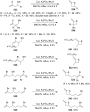
Scheme 124: Synthesis of 2-alkylidenethietanes from S-(2-bromo/chloroalk-1-en-4-yl)thiols.

Scheme 125: Synthesis of spirothietan-3-ol 548 from enone 545 and ammonium hydrosulfide.

Scheme 126: Asymmetric synthesis of the optically active thietanoside from cis-but-2-ene-1,4-diol (47).
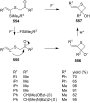
Scheme 127: Synthesis of 2-alkylidenethietan-3-ols 557 via the fluoride-mediated cyclization of thioacylsilanes ...

Scheme 128: Synthesis of 2-iminothietanes via the reaction of propargylbenzene (558) and isothiocyanates 560 in...

Scheme 129: Synthesis of 2-benzylidenethietane 567 via the nickel complex-catalyzed electroreductive cyclizatio...

Scheme 130: Synthesis of 2-iminothietanes 569 via the photo-assisted electrocyclic reaction of N-monosubstitute...

Scheme 131: Synthesis of ethyl 3,4-diiminothietane-2-carboxylates from ethyl thioglycolate (570) and bis(imidoy...
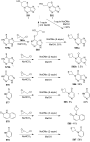
Scheme 132: Synthesis of N-(thietan-3-yl)-α-oxoazaheterocycles from azaheterocyclethiones and chloromethyloxira...

Scheme 133: Synthesis of thietan-3-yl benzoate (590) via the nickel-catalyzed intramolecular reductive thiolati...

Scheme 134: Synthesis of 2,2-bis(trifluoromethyl)thietane from 3,3-bis(trifluoromethyl)-1,2-dithiolane.

Scheme 135: Synthesis of thietanes from enamines and sulfonyl chlorides.

Scheme 136: Synthesis of spirothietane 603 via the [2 + 3] cycloaddition of 2,2,4,4-tetramethylcyclobutane-1,3-...

Scheme 137: Synthesis of thietane (605) from 1-bromo-3-chloropropane and sulfur.
Fluorinated phenylalanines: synthesis and pharmaceutical applications
- Laila F. Awad and
- Mohammed Salah Ayoup
Beilstein J. Org. Chem. 2020, 16, 1022–1050, doi:10.3762/bjoc.16.91
- the protected ᴅ,ʟ-N-Boc-2-bromophenylalanine (89) using a Stille coupling reaction to give the o-vinyl derivative 90 as key intermediate. A hydroboration reaction of compound 90 afforded the primary alcohol 91, which was directly fluorinated and deprotected to give the free amino acids 93 (ᴅ and ʟ

Graphical Abstract

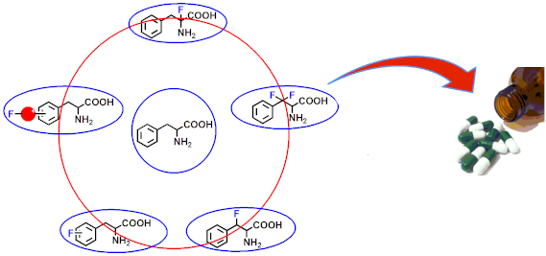
Figure 1: Categories I–V of fluorinated phenylalanines.

Scheme 1: Synthesis of fluorinated phenylalanines via Jackson’s method.

Scheme 2: Synthesis of all-cis-tetrafluorocyclohexylphenylalanines.

Scheme 3: Synthesis of ʟ-4-[sulfono(difluoromethyl)]phenylalanine (nPt: neopentyl, TCE: trichloroethyl).

Scheme 4: Synthesis of ʟ-4-[sulfono(difluoromethyl)]phenylalanine derivatives 17.

Scheme 5: Synthesis of fluorinated Phe analogues from Cbz-protected aminomalonates.

Scheme 6: Synthesis of tetrafluorophenylalanine analogues via the 3-methyl-4-imidazolidinone auxiliary 25.

Scheme 7: Synthesis of tetrafluoro-Phe derivatives via chiral auxiliary 31.

Scheme 8: Synthesis of 2,5-difluoro-Phe and 2,4,5-trifluoro-Phe via Schöllkopf reagent 34.

Scheme 9: Synthesis of 2-fluoro- and 2,6-difluoro Fmoc-Phe derivatives starting from chiral auxiliary 39.

Scheme 10: Synthesis of 2-[18F]FPhe via chiral auxiliary 43.

Scheme 11: Synthesis of FPhe 49a via photooxidative cyanation.

Scheme 12: Synthesis of FPhe derivatives via Erlenmeyer azalactone synthesis.

Scheme 13: Synthesis of (R)- and (S)-2,5-difluoro Phe via the azalactone method.

Scheme 14: Synthesis of 3-bromo-4-fluoro-(S)-Phe (65).

Scheme 15: Synthesis of [18F]FPhe via radiofluorination of phenylalanine with [18F]F2 or [18F]AcOF.

Scheme 16: Synthesis of 4-borono-2-[18F]FPhe.

Scheme 17: Synthesis of protected 4-[18F]FPhe via arylstannane derivatives.

Scheme 18: Synthesis of FPhe derivatives via intermediate imine formation.

Scheme 19: Synthesis of FPhe derivatives via Knoevenagel condensation.

Scheme 20: Synthesis of FPhe derivatives 88a,b from aspartic acid derivatives.

Scheme 21: Synthesis of 2-(2-fluoroethyl)phenylalanine derivatives 93 and 95.

Scheme 22: Synthesis of FPhe derivatives via Zn2+ complexes.

Scheme 23: Synthesis of FPhe derivatives via Ni2+ complexes.

Scheme 24: Synthesis of 3,4,5-trifluorophenylalanine hydrochloride (109).

Scheme 25: Synthesis of FPhe derivatives via phenylalanine aminomutase (PAM).

Scheme 26: Synthesis of (R)-2,5-difluorophenylalanine 115.

Scheme 27: Synthesis of β-fluorophenylalanine via 2-amino-1,3-diol derivatives.

Scheme 28: Synthesis of β-fluorophenylalanine derivatives via the oxazolidinone chiral auxiliary 122.

Scheme 29: Synthesis of β-fluorophenylalanine from pyruvate hemiketal 130.

Scheme 30: Synthesis of β-fluorophenylalanine (136) via fluorination of β-hydroxyphenylalanine (137).

Scheme 31: Synthesis of β-fluorophenylalanine from aziridine derivatives.

Scheme 32: Synthesis of β-fluorophenylalanine 136 via direct fluorination of pyruvate esters.

Scheme 33: Synthesis of β-fluorophenylalanine via fluorination of ethyl 3-phenylpyruvate enol using DAST.

Scheme 34: Synthesis of β-fluorophenylalanine derivatives using photosensitizer TCB.

Scheme 35: Synthesis of β-fluorophenylalanine derivatives using Selectflour and dibenzosuberenone.

Scheme 36: Synthesis of protected β-fluorophenylalanine via aziridinium intermediate 150.

Scheme 37: Synthesis of β-fluorophenylalanine derivatives via fluorination of α-hydroxy-β-aminophenylalanine d...

Scheme 38: Synthesis of β-fluorophenylalanine derivatives from α- or β-hydroxy esters 152a and 155.

Scheme 39: Synthesis of a series of β-fluoro-Phe derivatives via Pd-catalyzed direct fluorination of β-methyle...

Scheme 40: Synthesis of series of β-fluorinated Phe derivatives using quinoline-based ligand 162 in the Pd-cat...

Scheme 41: Synthesis of β,β-difluorophenylalanine derivatives from 2,2-difluoroacetaldehyde derivatives 164a,b....

Scheme 42: Synthesis of β,β-difluorophenylalanine derivatives via an imine chiral auxiliary.

Scheme 43: Synthesis of α-fluorophenylalanine derivatives via direct fluorination of protected Phe 174.

Figure 2: Structures of PET radiotracers of 18FPhe derivatives.

Figure 3: Structures of melfufen (179) and melphalan (180) anticancer drugs.

Figure 4: Structure of gastrazole (JB95008, 181), a CCK2 receptor antagonist.

Figure 5: Dual CCK1/CCK2 antagonist 182.

Figure 6: Structure of sitagliptin (183), an antidiabetic drug.

Figure 7: Structure of retaglpitin (184) and antidiabetic drug.

Figure 8: Structure of evogliptin (185), an antidiabetic drug.

Figure 9: Structure of LY2497282 (186) a DPP-4 inhibitor for the treatment of type II diabetes.

Figure 10: Structure of ulimorelin (187).

Figure 11: Structure of GLP1R (188).
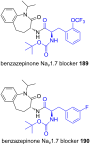
Figure 12: Structures of Nav1.7 blockers 189 and 190.
Aryl-substituted acridanes as hosts for TADF-based OLEDs
- Naveen Masimukku,
- Dalius Gudeika,
- Oleksandr Bezvikonnyi,
- Ihor Syvorotka,
- Rasa Keruckiene,
- Dmytro Volyniuk and
- Juozas V. Grazulevicius
Beilstein J. Org. Chem. 2020, 16, 989–1000, doi:10.3762/bjoc.16.88
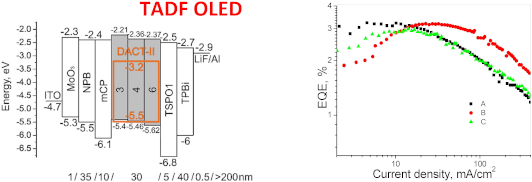
- prepared using simple synthetic procedures and characterized as hosts for TADF-based OLEDs. Results and Discussion Synthesis and characterization The synthetic routes for acridan derivatives 3–6 are outlined in Scheme 1. The key intermediate, 2,7-dibromo-9,9-dimethyl-9,10-dihydroacridine (1) was prepared

Graphical Abstract

Scheme 1: Synthesis of acridan-based compounds 3–6. Reagents and conditions: (a) bromoethane, KOH, tetrabutyl...

Figure 1: Theoretically calculated HOMO and LUMO levels distributions and optimized geometries of 3–6 DFT cal...

Figure 2: DSC curves of compounds 4 and 5.

Figure 3: Absorption and PL spectra (λex = 330 nm) of compounds 3–6. a) Absorption spectra as neat films, dil...

Figure 4: a) Cyclic voltammogram of derivative 3 in dichloromethane (a three-electrode cell consisting of a p...
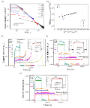
Figure 5: TOF photocurrent transients for holes in vacuum-deposited layers of compound 4 (a); hole mobility v...
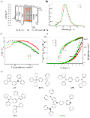
Figure 6: Energy diagrams of the fabricated OLEDs (a); normalized electroluminescence spectra of devices A–C ...
Preparation of 2-phospholene oxides by the isomerization of 3-phospholene oxides
- Péter Bagi,
- Réka Herbay,
- Nikolett Péczka,
- Zoltán Mucsi,
- István Timári and
- György Keglevich
Beilstein J. Org. Chem. 2020, 16, 818–832, doi:10.3762/bjoc.16.75
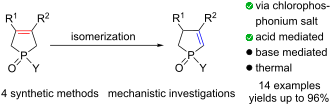
- -phospholenium chlorides 3 was only postulated. Herein, two additional derivatives, the 4-methylphenyl- and ethyl-1-chloro-3-methyl-2-phospholenium chlorides 3c and 3h were isolated and characterized, which confirmed the key intermediate of the proposed mechanism. The chloro-2-phospholenium salts 3 were then

Graphical Abstract

Figure 1: Examples for catalytically or biologically active molecules containing five-membered P-heterocyclic...

Scheme 1: Comparison of the isomerization of 1-phenyl-3-phospholene oxide (5), 1-phenyl-3-methyl-3-phospholen...
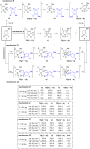
Scheme 2: Three possible reaction mechanisms considered in the theoretical studies for the isomerization of 3...

Figure 2: The full time experimental kinetic curves (a); The initial part of the kinetic curves of 1c–f and 1h...

Scheme 3: Computed reaction mechanism of the 3-phospholene oxide (1) 2-phospholene oxide (4) isomerization un...

Scheme 4: Computed reaction mechanism of the 3-phospholene oxide (1) 2-phospholene oxide (4) isomerization un...
Combining enyne metathesis with long-established organic transformations: a powerful strategy for the sustainable synthesis of bioactive molecules
- Valerian Dragutan,
- Ileana Dragutan,
- Albert Demonceau and
- Lionel Delaude
Beilstein J. Org. Chem. 2020, 16, 738–755, doi:10.3762/bjoc.16.68
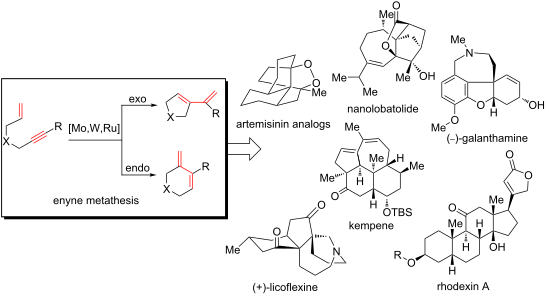
- the cis-disubstituted double bond in the latter was performed under a high pressure of hydrogen, leading to the saturated tricyclic scaffold that was used as a key intermediate in the total synthesis of lycoflexine (15, Scheme 18). Manzamine alkaloids A highly interesting application of a metathesis
- the corresponding bicyclic dienic scaffolds. The subsequent hydroboration and aminohydroxylation carried out on these bicyclic dienes provided the AB subunit as a key intermediate component of manzamines A (16a) and E (16b, Scheme 19). Eventually, several highly elaborated transformations of the AB

Graphical Abstract

Scheme 1: Intramolecular (A) and intermolecular (B) enyne metathesis reactions.

Scheme 2: Ene–yne and yne–ene mechanisms for intramolecular enyne metathesis reactions.

Scheme 3: Metallacarbene mechanism in intermolecular enyne metathesis.
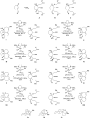
Scheme 4: The Oguri strategy for accessing artemisinin analogs 1a–c through enyne metathesis.

Scheme 5: Access to the tetracyclic core of nanolobatolide (2) via tandem enyne metathesis followed by an Eu(...

Scheme 6: Synthesis of (−)-amphidinolide E (3) using an intermolecular enyne metathesis as the key step.

Scheme 7: Synthesis of amphidinolide K (4) by an enyne metathesis route.

Scheme 8: Trost synthesis of des-epoxy-amphidinolide N (5) [72].

Scheme 9: Enyne metathesis between the propargylic derivative and the allylic alcohol in the synthesis of the...

Scheme 10: Synthetic route to amphidinolide N (6a).

Scheme 11: Synthesis of the stereoisomeric precursors of amphidinolide V (7a and 7b) through alkyne ring-closi...

Scheme 12: Synthesis of the anthramycin precursor 8 from ʟ-methionine by a tandem enyne metathesis–cross metat...

Scheme 13: Synthesis of (−)‐clavukerin A (9) and (−)‐isoclavukerin A (10) by an enyne metathesis route startin...

Scheme 14: Synthesis of (−)-isoguaiene (11) through an enyne metathesis as the key step.

Scheme 15: Synthesis of erogorgiaene (12) by a tandem enyne metathesis/cross metathesis sequence using the sec...

Scheme 16: Synthesis of (−)-galanthamine (13) from isovanilin by an enyne metathesis.

Scheme 17: Application of enyne metathesis for the synthesis of kempene diterpenes 14a–c.

Scheme 18: Synthesis of the alkaloid (+)-lycoflexine (15) through enyne metathesis.

Scheme 19: Synthesis of the AB subunits of manzamine A (16a) and E (16b) by enyne metathesis.

Scheme 20: Jung's synthesis of rhodexin A (17) by enyne metathesis/cross metathesis reactions.

Scheme 21: Total synthesis of (−)-flueggine A (18) and (+)-virosaine B (19) from Weinreb amide by enyne metath...

Scheme 22: Access to virgidivarine (20) and virgiboidine (21) by an enyne metathesis route.

Scheme 23: Enyne metathesis approach to (−)-zenkequinone B (22).

Scheme 24: Access to C-aryl glycoside 23 by an intermolecular enyne metathesis/Diels–Alder cycloaddition.

Scheme 25: Synthesis of spiro-C-aryl glycoside 24 by a tandem intramolecular enyne metathesis/Diels–Alder reac...

Scheme 26: Pathways to (−)-exiguolide (25) by Trost’s Ru-catalyzed enyne cross-coupling and cross-metathesis [94].
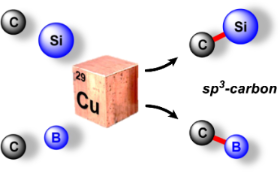
Recent advances in Cu-catalyzed C(sp3)–Si and C(sp3)–B bond formation
- Balaram S. Takale,
- Ruchita R. Thakore,
- Elham Etemadi-Davan and
- Bruce H. Lipshutz
Beilstein J. Org. Chem. 2020, 16, 691–737, doi:10.3762/bjoc.16.67
- resulted in 99% of the borylated product 414, which may indicate the presence of a radical intermediate in the second, protodeboronation step. Therefore, the key intermediate is the 1,4-adduct 415, which in the presence of base and water affords the saturated product (e.g., 410, 411; Scheme 66) [129]. The

Graphical Abstract

Scheme 1: Pharmaceuticals possessing a silicon or boron atom.

Scheme 2: The first Cu-catalyzed C(sp3)–Si bond formation.

Scheme 3: Conversion of benzylic phosphate 6 to the corresponding silane.

Scheme 4: Conversion of alkyl triflates to alkylsilanes.

Scheme 5: Conversion of secondary alkyl triflates to alkylsilanes.

Scheme 6: Conversion of alkyl iodides to alkylsilanes.

Scheme 7: Trapping of intermediate radical through cascade reaction.

Scheme 8: Radical pathway for conversion of alkyl iodides to alkylsilanes.

Scheme 9: Conversion of alkyl ester of N-hydroxyphthalimide to alkylsilanes.

Scheme 10: Conversion of gem-dibromides to bis-silylalkanes.

Scheme 11: Conversion of imines to α-silylated amines (A) and the reaction pathway (B).

Scheme 12: Conversion of N-tosylimines to α-silylated amines.

Scheme 13: Screening of diamine ligands.

Scheme 14: Conversion of N-tert-butylsulfonylimines to α-silylated amines.

Scheme 15: Conversion of aldimines to nonracemic α-silylated amines.

Scheme 16: Conversion of N-tosylimines to α-silylated amines.

Scheme 17: Reaction pathway [A] and conversion of aldehydes to α-silylated alcohols [B].

Scheme 18: Conversion of aldehydes to benzhydryl silyl ethers.

Scheme 19: Conversion of ketones to 1,2-diols (A) and conversion of imines to 1,2-amino alcohols (B).

Scheme 20: Ligand screening (A) and conversion of aldehydes to α-silylated alcohols (B).

Scheme 21: Conversion of aldehydes to α-silylated alcohols.

Scheme 22: 1,4-Additions to α,β-unsaturated ketones.

Scheme 23: 1,4-Additions to unsaturated ketones to give β-silylated derivatives.

Scheme 24: Additions onto α,β-unsaturated lactones to give β-silylated lactones.

Scheme 25: Conversion of α,β-unsaturated to β-silylated lactams.

Scheme 26: Conversion of N-arylacrylamides to silylated oxindoles.

Scheme 27: Conversion of α,β-unsaturated carbonyl compounds to silylated tert-butylperoxides.

Scheme 28: Catalytic cycle for Cu(I) catalyzed α,β-unsaturated compounds.

Scheme 29: Conversion of p-quinone methides to benzylic silanes.

Scheme 30: Conversion of α,β-unsaturated ketimines to regio- and stereocontrolled allylic silanes.

Scheme 31: Conversion of α,β-unsaturated ketimines to enantioenriched allylic silanes.

Scheme 32: Regioselective conversion of dienedioates to allylic silanes.

Scheme 33: Conversion of alkenyl-substituted azaarenes to β-silylated adducts.

Scheme 34: Conversion of conjugated benzoxazoles to enantioenriched β-silylated adducts.

Scheme 35: Conversion of α,β-unsaturated carbonyl indoles to α-silylated N-alkylated indoles.

Scheme 36: Conversion of β-amidoacrylates to α-aminosilanes.

Scheme 37: Conversion of α,β-unsaturated ketones to enantioenriched β-silylated ketones, nitriles, and nitro d...

Scheme 38: Regio-divergent silacarboxylation of allenes.

Scheme 39: Silylation of diazocarbonyl compounds, (A) asymmetric and (B) racemic.

Scheme 40: Enantioselective hydrosilylation of alkenes.

Scheme 41: Conversion of 3-acylindoles to indolino-silanes.

Scheme 42: Proposed mechanism for the silylation of 3-acylindoles.

Scheme 43: Silyation of N-chlorosulfonamides.

Scheme 44: Conversion of acyl silanes to α-silyl alcohols.

Scheme 45: Conversion of N-tosylaziridines to β-silylated N-tosylamines.

Scheme 46: Conversion of N-tosylaziridines to silylated N-tosylamines.

Scheme 47: Conversion of 3,3-disubstituted cyclopropenes to silylated cyclopropanes.

Scheme 48: Conversion of conjugated enynes to 1,3-bis(silyl)propenes.

Scheme 49: Proposed sequence for the Cu-catalyzed borylation of substituted alkenes.

Scheme 50: Cu-catalyzed synthesis of nonracemic allylic boronates.

Scheme 51: Cu–NHC catalyzed synthesis of α-substituted allylboronates.
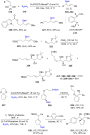
Scheme 52: Synthesis of α-chiral (γ-alkoxyallyl)boronates.

Scheme 53: Cu-mediated formation of nonracemic cis- or trans- 2-substituted cyclopropylboronates.

Scheme 54: Cu-catalyzed synthesis of γ,γ-gem-difluoroallylboronates.

Scheme 55: Cu-catalyzed hydrofunctionalization of internal alkenes and vinylarenes.

Scheme 56: Cu-catalyzed Markovnikov and anti-Markovnikov borylation of alkenes.

Scheme 57: Cu-catalyzed borylation/ortho-cyanation/Cope rearrangement.
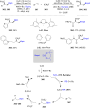
Scheme 58: Borylfluoromethylation of alkenes.

Scheme 59: Cu-catalyzed synthesis of tertiary nonracemic alcohols.

Scheme 60: Synthesis of densely functionalized and synthetically versatile 1,2- or 4,3-borocyanated 1,3-butadi...

Scheme 61: Cu-catalyzed trifunctionalization of allenes.

Scheme 62: Cu-catalyzed selective arylborylation of arenes.

Scheme 63: Asymmetric borylative coupling between styrenes and imines.

Scheme 64: Regio-divergent aminoboration of unactivated terminal alkenes.

Scheme 65: Cu-catalyzed 1,4-borylation of α,β-unsaturated ketones.

Scheme 66: Cu-catalyzed protodeboronation of α,β-unsaturated ketones.

Scheme 67: Cu-catalyzed β-borylation of α,β-unsaturated imines.

Scheme 68: Cu-catalyzed synthesis of β-trifluoroborato carbonyl compounds.

Scheme 69: Asymmetric 1,4-borylation of α,β-unsaturated carbonyl compounds.

Scheme 70: Cu-catalyzed ACB and ACA reactions of α,β-unsaturated 2-acyl-N-methylimidazoles.

Scheme 71: Cu-catalyzed diborylation of aldehydes.

Scheme 72: Umpolung pathway for chiral, nonracemic tertiary alcohol synthesis (top) and proposed mechanism for...

Scheme 73: Cu-catalyzed synthesis of α-hydroxyboronates.

Scheme 74: Cu-catalyzed borylation of ketones.

Scheme 75: Cu-catalyzed borylation of unactivated alkyl halides.

Scheme 76: Cu-catalyzed borylation of allylic difluorides.

Scheme 77: Cu-catalyzed borylation of cyclic and acyclic alkyl halides.

Scheme 78: Cu-catalyzed borylation of unactivated alkyl chlorides and bromides.

Scheme 79: Cu-catalyzed decarboxylative borylation of carboxylic acids.
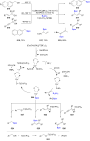
Scheme 80: Cu-catalyzed borylation of benzylic, allylic, and propargylic alcohols.
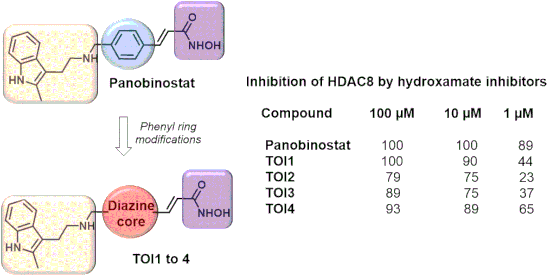
Design and synthesis of diazine-based panobinostat analogues for HDAC8 inhibition
- Sivaraman Balasubramaniam,
- Sajith Vijayan,
- Liam V. Goldman,
- Xavier A. May,
- Kyra Dodson,
- Sweta Adhikari,
- Fatima Rivas,
- Davita L. Watkins and
- Shana V. Stoddard
Beilstein J. Org. Chem. 2020, 16, 628–637, doi:10.3762/bjoc.16.59
- the key intermediate aldehyde 25 (Scheme 4). Initially, we explored the Suzuki coupling reaction for substrate 4. Gratifyingly, the reaction product 24 was produced in 41% yield from our developed synthetic strategy. Then, compound 24 was subjected to an SeO2 oxidation reaction. The oxidation reaction

Graphical Abstract

Figure 1: Chemical structures of the target diazine-based surrogates for the central core of panobinostat.

Figure 2: Docking pose for panobinostat and panobinostat derivatives in the HDAC8 receptor. (a) Overlay of al...

Figure 3: General building blocks for the visualized targets.

Scheme 1: Reaction conditions: a) MeOH, H2SO4 (5 drops), MS 4 Å (2 pieces), 68 °C, 8 h, 81%; b) DIBAL-H (1.2 ...
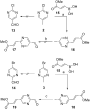
Scheme 2: Reaction conditions: a) boronic acid 15 (1.3 equiv), PdCl2(PPh3)2 (0.1 equiv), dioxane/H2O (3:1), Na...

Scheme 3: Reaction conditions: a) 5-bromo-2-chloropyrimidine (1 equiv), ethyl formate (1.5 equiv), THF (20 mL...

Scheme 4: Reaction conditions: a) boronic acid 15 (1.3 equiv), PdCl2(PPh3)2 (0.1 equiv), dioxane/H2O (8:2, Na2...
Synthesis of triphenylene-fused phosphole oxides via C–H functionalizations
- Md. Shafiqur Rahman and
- Naohiko Yoshikai
Beilstein J. Org. Chem. 2020, 16, 524–529, doi:10.3762/bjoc.16.48
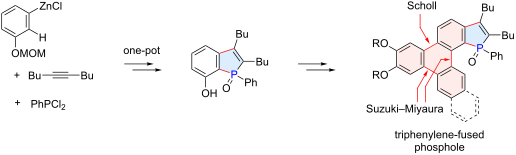
- and the carbohelicene moieties (Scheme 1) [16]. The approach focused on the regioselective one-pot synthesis of a 7-hydroxybenzo[b]phosphole derivative from an 3-alkoxyphenylzinc reagent, an alkyne, and dichlorophenylphosphine [17]. The hydroxy group of this key intermediate served as a handle for the
- strong blue fluorescence in solution. The absorption and emission profiles of the π-extended phosphole oxide revealed their characteristics as hybrids of 2,3-dialkoxytriphenylene and 1-phenyl-2,3-dialkylbenzo[b]phosphole. We anticipate that the key intermediate of the present synthesis, 3, and related
- ) side view). UV–vis absorption (solid lines) and fluorescence (dashed lines) spectra of compounds 8a–c. Syntheses of PAH-fused phospholes featuring a 7-hydroxybenzo[b]phosphole as a key intermediate. Synthesis of phosphole-fused ortho-teraryl compounds 7. Oxidative cyclization of phosphole-fused ortho

Graphical Abstract

Figure 1: Examples of functional molecules based on π-extended phospholes.

Scheme 1: Syntheses of PAH-fused phospholes featuring a 7-hydroxybenzo[b]phosphole as a key intermediate.

Scheme 2: Synthesis of phosphole-fused ortho-teraryl compounds 7.

Scheme 3: Oxidative cyclization of phosphole-fused ortho-teraryl compounds 7 into triphenylene-fused phosphol...
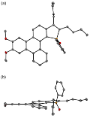
Figure 2: ORTEP drawings of compound 8a (thermal ellipsoids set at 50% probability). a) top view; b) side vie...

Figure 3: UV–vis absorption (solid lines) and fluorescence (dashed lines) spectra of compounds 8a–c.
Aerobic synthesis of N-sulfonylamidines mediated by N-heterocyclic carbene copper(I) catalysts
- Faïma Lazreg,
- Marie Vasseur,
- Alexandra M. Z. Slawin and
- Catherine S. J. Cazin
Beilstein J. Org. Chem. 2020, 16, 482–491, doi:10.3762/bjoc.16.43

- catalytic strategy for the one-pot synthesis of N-sulfonylamidines is described. The cationic copper(I) complexes were found to be highly active and efficient under mild conditions in air and in the absence of solvent. A copper acetylide is proposed as key intermediate in this transformation. Keywords

Graphical Abstract

Scheme 1: Formation of sulfonyltriazoles and sulfonamidines.

Figure 1: Catalytic systems used in this study.

Scheme 2: Synthetic access to complexes 4–6 [30].

Scheme 3: Variation of sulfonylazides. Reaction conditions: phenylacetylene (0.5 mmol), sulfonyl azide (0.6 m...
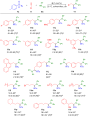
Scheme 4: Variation of alkynes. Reaction conditions: alkyne (0.5 mmol), tosyl azide (0.6 mmol), diisopropylam...

Scheme 5: Variation of the amine substrate. Reaction conditions: phenylacetylene (0.5 mmol), tosyl azide (0.6...

Scheme 6: Reactivity of “non-sulfonyl” azide [33]. Reaction conditions: phenylacetylene (0.5 mmol), benzyl azide ...

Scheme 7: Reactivity of diphenylphosphoryl azide. Reaction conditions: phenylacetylene (0.5 mmol), diphenylph...

Scheme 8: Proposed mechanism for the formation of sulfonamidine.

Scheme 9: Stoichiometric reaction between 6 and 8.

Scheme 10: Synthesis of copper-acetylide intermediate A via [Cu(Cl)(Triaz)].

Scheme 11: Catalytic reaction involving copper-acetylide complex A.
Copper-promoted/copper-catalyzed trifluoromethylselenolation reactions
- Clément Ghiazza and
- Anis Tlili
Beilstein J. Org. Chem. 2020, 16, 305–316, doi:10.3762/bjoc.16.30

- arylcopper(I) species was the key intermediate. Terminal alkynes were also investigated under similar reaction conditions (Scheme 13) [37]. Aromatic and π-activated aliphatic substrates led to the desired products in moderate to very good yields. Moreover, vinyl sulfone derivatives were formed when the
- alkynes. The latter was also a key intermediate for the formation of α-trifluoromethylselenylated vinylsulfone. It is worth noting that the strategy for the trifluoromethylselenolation of boronic acid developed in our laboratory was applied in 2019 for the synthesis of the selenylated analog 30 of

Graphical Abstract

Scheme 1: Process for the formation of C(sp3)–SeCF3 bonds with [(bpy)CuSeCF3]2 developed by the group of Weng....

Scheme 2: Trifluoromethylselenolation of vinyl and (hetero)aryl halides with [(bpy)CuSeCF3]2 by the group of ...

Scheme 3: Trifluoromethylselenolation of terminal alkynes using [(bpy)CuSeCF3]2 by the group of You and Weng.

Scheme 4: Trifluoromethylselenolation of carbonyl compounds with [(bpy)CuSeCF3]2 by the group of Weng.

Scheme 5: Trifluoromethylselenolation of α,β-unsaturated ketones with [(bpy)CuSeCF3]2 by the group of Weng.

Scheme 6: Trifluoromethylselenolation of acid chlorides with [(bpy)CuSeCF3]2 by the group of Weng.

Scheme 7: Synthesis of 2-trifluoromethylselenylated benzofused heterocycles with [(bpy)CuSeCF3]2 by the group...

Scheme 8: Difunctionalization of terminal alkenes and alkynes with [(bpy)CuSeCF3]2 by the group of Liang.

Scheme 9: Synthesis of Me4NSeCF3.

Scheme 10: Oxidative trifluoromethylselenolation of terminal alkynes and boronic acid derivatives with Me4NSeCF...

Scheme 11: Trifluoromethylselenolation of diazoacetates and diazonium salts with Me4NSeCF3 by the group of Goo...

Scheme 12: Trifluoromethylselenolation with ClSeCF3 by the group of Tlili and Billard.
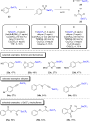
Scheme 13: Trifluoromethylselenolation with TsSeCF3 by the group of Tlili and Billard.

Scheme 14: Copper-catalyzed synthesis of a selenylated analog 30 of Pretomanid developed by the group of Tlili...
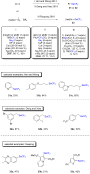
Scheme 15: One-pot procedures for C–SeCF3 bond formations developed by Hor and Weng, Deng and Xiao, and Ruepin...
Recent developments in photoredox-catalyzed remote ortho and para C–H bond functionalizations
- Rafia Siddiqui and
- Rashid Ali
Beilstein J. Org. Chem. 2020, 16, 248–280, doi:10.3762/bjoc.16.26
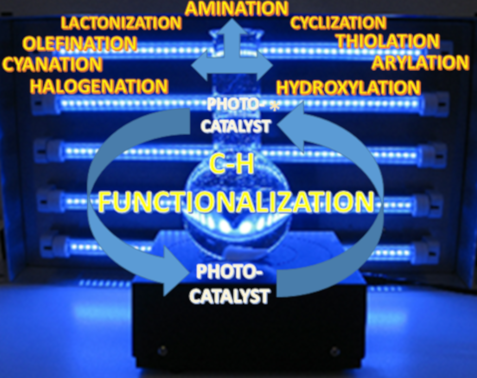
- -coumarins are a key intermediate for diverse natural products, and they have already been synthesized by various research groups with different procedures [132][133][134][135][136][137][138]. Inspired by previous work, Gomez and co-workers reported the preparation of benzo-3,4-coumarins using photoredox

Graphical Abstract

Figure 1: List of photoredox catalysts used for C–H bond functionalizations.

Figure 2: List of metal-based photoredox catalysts used in this review article.

Figure 3: Jablonski diagram.

Figure 4: Photoredox catalysis via reductive or oxidative pathways. D = donor, A = acceptor, S = substrate, P...
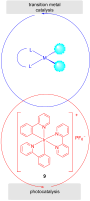
Figure 5: Schematic representation of the combination of photoredox catalysis and transition metal catalysis.

Scheme 1: Weinreb amide C–H olefination.

Figure 6: Mechanism for the formation of 21 from 19 using photoredox catalyst 11.

Scheme 2: C–H olefination of phenolic ethers.

Scheme 3: Decarboxylative acylation of acetanilides.

Figure 7: Mechanism for the formation of 30 from acetanilide derivatives.

Scheme 4: Synthesis of fluorenone derivatives by intramolecular deoxygenative acylation of biaryl carboxylic ...

Figure 8: Mechanism for the photoredox-catalyzed synthesis of fluorenone derivatives.

Scheme 5: Synthesis of benzothiazoles via aerobic C–H thiolation.

Figure 9: Plausible mechanism for the construction of benzothiazoles from benzothioamides.

Scheme 6: Synthesis of benzothiazoles via oxidant-free C–H thiolation.
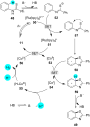
Figure 10: Mechanism involved in the synthesis of benzothiazoles via oxidant-free C–H thiolation.

Scheme 7: Synthesis of indoles via C–H cyclization of anilides with alkynes.

Scheme 8: Preparation of 3-trifluoromethylcoumarins via C–H cyclization of arylpropiolate esters.

Figure 11: Mechanistic pathway for the synthesis of coumarin derivatives via C–H cyclization.

Scheme 9: Monobenzoyloxylation without chelation assistance.

Figure 12: Plausible mechanism for the formation of 71 from 70.

Scheme 10: Aryl-substituted arenes prepared by inorganic photoredox catalysis using 12a.

Figure 13: Proposed mechanism for C–H arylations in the presence of 12a and a Pd catalyst.

Scheme 11: Arylation of purines via dual photoredox catalysis.

Scheme 12: Arylation of substituted arenes with an organic photoredox catalyst.

Scheme 13: C–H trifluoromethylation.

Figure 14: Proposed mechanism for the trifluoromethylation of 88.

Scheme 14: Synthesis of benzo-3,4-coumarin derivatives.

Figure 15: Plausible mechanism for the synthesis of substituted coumarins.

Scheme 15: Oxidant-free oxidative phosphonylation.

Figure 16: Mechanism proposed for the phosphonylation reaction of 100.

Scheme 16: Nitration of anilines.

Figure 17: Plausible mechanism for the nitration of aniline derivatives via photoredox catalysis.

Scheme 17: Synthesis of carbazoles via intramolecular amination.

Figure 18: Proposed mechanism for the formation of carbazoles from biaryl derivatives.

Scheme 18: Synthesis of substituted phenols using QuCN.

Figure 19: Mechanism for the synthesis of phenol derivatives with photoredox catalyst 8.

Scheme 19: Synthesis of substituted phenols with DDQ (5).
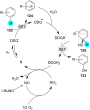
Figure 20: Possible mechanism for the generation of phenols with the aid of photoredox catalyst 5.

Scheme 20: Aerobic bromination of arenes using an acridinium-based photocatalyst.

Scheme 21: Aerobic bromination of arenes with anthraquinone.

Figure 21: Proposed mechanism for the synthesis of monobrominated compounds.

Scheme 22: Chlorination of benzene derivatives with Mes-Acr-MeClO4 (2).

Figure 22: Mechanism for the synthesis of 131 from 132.
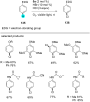
Scheme 23: Chlorination of arenes with 4CzIPN (5a).

Figure 23: Plausible mechanism for the oxidative photocatalytic monochlorination using 5a.

Scheme 24: Monofluorination using QuCN-ClO4 (8).

Scheme 25: Fluorination with fluorine-18.

Scheme 26: Aerobic amination with acridinium catalyst 3a.

Figure 24: Plausible mechanism for the aerobic amination using acridinium catalyst 3a.
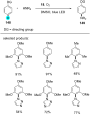
Scheme 27: Aerobic aminations with semiconductor photoredox catalyst 18.

Scheme 28: Perfluoroalkylation of arenes.

Scheme 29: Synthesis of benzonitriles in the presence of 3a.

Figure 25: Plausible mechanism for the synthesis of substituted benzonitrile derivatives in the presence of 3a....
Allylic cross-coupling using aromatic aldehydes as α-alkoxyalkyl anions
- Akihiro Yuasa,
- Kazunori Nagao and
- Hirohisa Ohmiya
Beilstein J. Org. Chem. 2020, 16, 185–189, doi:10.3762/bjoc.16.21

- ) species B. The 1,2-addition of silylcopper(I) B to the aromatic aldehyde 1 [15][16][17][18][19] and the subsequent [1,2]-Brook rearrangement from the obtained α-silyl-substituted copper(I) alkoxide C forms the key intermediate, an α-silyloxybenzylcopper(I) species D. The transmetallation between D and an

Graphical Abstract

Scheme 1: Our strategy.

Scheme 2: Allylic cross-coupling using aldehydes as α-alkoxyalkyl anions.

Scheme 3: Substrate scope and reaction conditions. a) reactions were carried out with 1 (0.4 mmol), 2 (0.2 mm...

Scheme 4: Stoichiometric reaction.

Scheme 5: Possible pathway.
Attempted synthesis of a meta-metalated calix[4]arene
- Christopher D. Jurisch and
- Gareth E. Arnott
Beilstein J. Org. Chem. 2019, 15, 1996–2002, doi:10.3762/bjoc.15.195
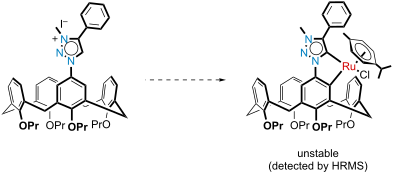
- 5 in 44% yield which was comparable to the yields reported by Albrecht [20]. Synthesis of the calix[4]arene ruthenacycle Satisfied that the published methods worked in our hands, we then set about synthesizing the targeted mesoionic calix[4]arene ruthenacycle. Our first key intermediate was

Graphical Abstract

Figure 1: Inherent chirality generated by meta-substitution – the two structures are non-superposable mirror ...

Figure 2: General approach by Albrecht for MIC directed cyclometalation via C–H activation; M = Ru(II), Ir(II...

Figure 3: Concept of cyclometalated calix[4]arene target.
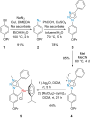
Scheme 1: Synthesis of model mesoionic carbene 5.

Scheme 2: Attempted Ullmann-coupling to give monoazide 7.

Scheme 3: Synthesis of monoazidocalix[4]arene 7 under optimized conditions.

Scheme 4: Synthesis of the putative calix[4]arene mesoionic carbene ruthenium complex 13.

Figure 4: High-resolution mass spectrum (ESI+) of putative ruthenacycle calix[4]arene 13.
A review of the total syntheses of triptolide
- Xiang Zhang,
- Zaozao Xiao and
- Hongtao Xu
Beilstein J. Org. Chem. 2019, 15, 1984–1995, doi:10.3762/bjoc.15.194
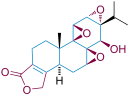
- grams without losing of yield) for the synthesis of key intermediate 8. In order to further improve the synthesis of the key intermediate triptophenolide methyl ether (8), van Tamelen and co-workers further developed a synthesis as shown in Scheme 4 (Figure 2, route F) [70]. This synthesis features two
- key cyclization precursor ketoester 15, which was cyclized in the presence of SnCl4 to give tricyclic intermediate 83, followed by steps of functional group modification to install the butenolide (D-ring), and to finish the racemic synthesis of the key intermediate triptophenolide methyl ether (8) in
- conversion of 89 to vinyl triflate 90, followed by reduction and palladium-catalyzed carbonylation–lactone formation to give key intermediate 8 [75][76][77]. After that, the three successive epoxides were installed by known procedures with some modification. The highlights were the introduction of the second

Graphical Abstract

Figure 1: Structures of triptolide (1), triptonide (2), tripdiolide (3), 16-hydroxytriptolide (4), triptrioli...

Figure 2: Syntheses of triptolide.

Scheme 1: Berchtold’s synthesis of triptolide.

Scheme 2: Li’s formal synthesis of triptolide.

Scheme 3: van Tamelen’s asymmetric synthesis of triptonide and triptolide.

Scheme 4: Van Tamelen’s (method II) formal synthesis of triptolide.

Scheme 5: Sherburn’s formal synthesis of triptolide.

Scheme 6: van Tamelen’s biogenetic type total synthesis of triptolide.

Scheme 7: Yang’s total synthesis of triptolide.

Scheme 8: Key intermediates or transformations of routes J–N.
Application of chiral 2-isoxazoline for the synthesis of syn-1,3-diol analogs
- Juanjuan Feng,
- Tianyu Li,
- Jiaxin Zhang and
- Peng Jiao
Beilstein J. Org. Chem. 2019, 15, 1840–1847, doi:10.3762/bjoc.15.179
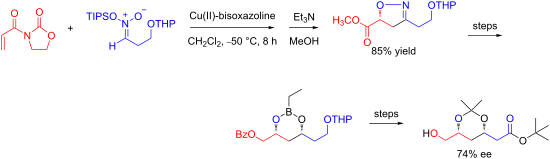
- well tolerate PTSA-catalyzed methanolysis. Conclusion In conclusion, we synthesized tert-butyl (3S,5R)-6-hydroxy-3,5-O-isopropylidene-3,5-dihydroxyhexanoate (16), which is enantiomeric to a key intermediate for atorvastatin, from a chiral 2-isoxazoline (3). The β-hydroxy ketone 7 obtained from 3 could

Graphical Abstract

Scheme 1: Accesses to tert-butyl 3,5-O-isopropylidene-3,5-dihydroxyhexanoates. (a) Previous methods using Cla...

Scheme 2: Attempted oxidations of 4.

Scheme 3: Preparations of 16 and related syn-1,3-diol compounds.

Scheme 4: Attempted oxidations of 6'.

Scheme 5: Attempted selective protections of internal 1,3-hydroxy groups: (a) acetonizations of 1,3-diols; (b...
N-(1-Phenylethyl)aziridine-2-carboxylate esters in the synthesis of biologically relevant compounds
- Iwona E. Głowacka,
- Aleksandra Trocha,
- Andrzej E. Wróblewski and
- Dorota G. Piotrowska
Beilstein J. Org. Chem. 2019, 15, 1722–1757, doi:10.3762/bjoc.15.168

- selective desilylation and N-debenzylation with simultaneous N-Boc protection and served as a key intermediate for installation of a dimethylhexylene fragment in Julia–Kocienski olefination [56]. Pyrrolidine alkaloids (−)-hygrine ((S)-61) and (−)-hygroline ((2S,2'S)-62) were isolated from many natural
- hydrolysis. Installation of the allyl group at the nitrogen atom required prior derivatization as an oxazolidin-2-one and Birch reduction to furnish 204. To construct a properly functionalized piperidine ring olefin metathesis was performed to supply the key intermediate 205. Taking advantage of the steric

Graphical Abstract

Figure 1: Examples of three-carbon chirons.

Figure 2: Structures of derivatives of N-(1-phenylethyl)aziridine-2-carboxylic acid 5–8.

Figure 3: Synthetic equivalency of aziridine aldehydes 6.

Scheme 1: Synthesis of N-(1-phenylethyl)aziridine-2-carboxylates 5. Reagents and conditions: a) TEA, toluene,...

Scheme 2: Absolute configuration at C2 in (2S,1'S)-5a. Reagents and conditions: a) 20% HClO4, 80 °C, 30 h the...

Scheme 3: Major synthetic strategies for a 2-ketoaziridine scaffold [R* = (R)- or (S)-1-phenylethyl; R′ = Alk...

Scheme 4: Synthesis of cyanide (2S,1'S)-13. Reagents and conditions: a) NH3, EtOH/H2O, rt, 72 h; b) Ph3P, CCl4...

Scheme 5: Synthesis of key intermediates (R)-16 and (R)-17 for (R,R)-formoterol (14) and (R)-tamsulosin (15)....

Scheme 6: Synthesis of mitotic kinesin inhibitors (2R/S,1'R)-23. Reagents and conditions: a) H2, Pd(OH)2, EtO...

Scheme 7: Synthesis of (R)-mexiletine ((R)-24). Reagents and conditions: a) TsCl, TEA, DMAP, CH2Cl2, rt, 1 h;...

Scheme 8: Synthesis of (−)-cathinone ((S)-27). Reagents and conditions: a) PhMgBr, ether, 0 °C; b) H2, 10% Pd...

Scheme 9: Synthesis of N-Boc-norpseudoephedrine ((1S,2S)-(+)-29) and N-Boc-norephedrine ((1R,2S)-29). Reagent...

Scheme 10: Synthesis of (−)-ephedrine ((1R,2S)-31). Reagents and conditions: a) TfOMe, MeCN then NaBH3CN, rt; ...

Scheme 11: Synthesis of xestoaminol C ((2S,3R)-35), 3-epi-xestoaminol C ((2S,3S)-35) and N-Boc-spisulosine ((2S...

Scheme 12: Synthesis of ʟ-tryptophanol ((S)-41). Reagents and conditions: a) CDI, MeCN, rt, 1 h then TMSI, MeC...

Scheme 13: Synthesis of ʟ-homophenylalaninol ((S)-42). Reagents and conditions: a) NaH, THF, 0 °C to −78 °C, 1...

Scheme 14: Synthesis of ᴅ-homo(4-octylphenyl)alaninol ((R)-47) and a sphingolipid analogue (R)-48. Reagents an...

Scheme 15: Synthesis of florfenicol ((1R,2S)-49). Reagents and conditions: a) (S)-1-phenylethylamine, TEA, MeO...

Scheme 16: Synthesis of natural tyroscherin ((2S,3R,6E,8R,10R)-55). Reagents and conditions: a) I(CH2)3OTIPS, t...

Scheme 17: Syntheses of (−)-hygrine (S)-61, (−)-hygroline (2S,2'S)-62 and (−)-pseudohygroline (2S,2'R)-62. Rea...

Scheme 18: Synthesis of pyrrolidine (3S,3'R)-68, a fragment of the fluoroquinolone antibiotic PF-00951966. Rea...

Scheme 19: Synthesis of sphingolipid analogues (R)-76. Reagents and conditions: a) BnBr, Mg, THF, reflux, 6 h;...

Scheme 20: Synthesis of ᴅ-threo-PDMP (1R,2R)-81. Reagents and conditions: a) TMSCl, NaI, MeCN, rt, 1 h 50 min,...

Scheme 21: Synthesis of the sphingolipid analogue SG-14 (2S,3S)-84. Reagents and conditions: a) LiAlH4, THF, 0...

Scheme 22: Synthesis of the sphingolipid analogue SG-12 (2S,3R)-88. Reagents and conditions: a) 1-(bromomethyl...

Scheme 23: Synthesis of sphingosine-1-phosphate analogues DS-SG-44 and DS-SG-45 (2S,3R)-89a and (2S,3R)-89a. R...

Scheme 24: Synthesis of N-Boc-safingol ((2S,3S)-95) and N-Boc-ᴅ-erythro-sphinganine ((2S,3R)-95). Reagents and...

Scheme 25: Synthesis of ceramide analogues (2S,3R)-96. Reagents and conditions: a) NaBH4, ZnCl2, MeOH, −78 °C,...

Scheme 26: Synthesis of orthogonally protected serinols, (S)-101 and (R)-102. Reagents and conditions: a) BnBr...

Scheme 27: Synthesis of N-acetyl-3-phenylserinol ((1R,2R)-105). Reagents and conditions: a) AcOH, CH2Cl2, refl...

Scheme 28: Synthesis of (S)-linezolid (S)-107. Reagents and conditions: a) LiAlH4, THF, 0 °C to reflux; b) Boc2...

Scheme 29: Synthesis of (2S,3S,4R)-2-aminooctadecane-1,3,4-triol (ᴅ-ribo-phytosphingosine) (2S,3S,4R)-110. Rea...

Scheme 30: Syntheses of ᴅ-phenylalanine (R)-116. Reagents and conditions: a) AcOH, CH2Cl2, reflux, 4 h; b) MsC...

Scheme 31: Synthesis of N-Boc-ᴅ-3,3-diphenylalanine ((R)-122). Reagents and conditions: a) PhMgBr, THF, −78 °C...

Scheme 32: Synthesis of ethyl N,N’-di-Boc-ʟ-2,3-diaminopropanoate ((S)-125). Reagents and conditions: a) NaN3,...

Scheme 33: Synthesis of the bicyclic amino acid (S)-(+)-127. Reagents and conditions: a) BF3·OEt2, THF, 60 °C,...

Scheme 34: Synthesis of lacosamide, (R)-2-acetamido-N-benzyl-3-methoxypropanamide (R)-130. Reagents and condit...

Scheme 35: Synthesis of N-Boc-norfuranomycin ((2S,2'R)-133). Reagents and conditions: a) H2C=CHCH2I, NaH, THF,...

Scheme 36: Synthesis of MeBmt (2S,3R,4R,6E)-139. Reagents and conditions: a) diisopropyl (S,S)-tartrate (E)-cr...

Scheme 37: Synthesis of (+)-polyoxamic acid (2S,3S,4S)-144. Reagents and conditions: a) AD-mix-α, MeSO2NH2, t-...

Scheme 38: Synthesis of the protected 3-hydroxy-ʟ-glutamic acid (2S,3R)-148. Reagents and conditions: a) LiHMD...

Scheme 39: Synthesis of (+)-isoserine (R)-152. Reagents and conditions: a) AcCl, MeCN, rt, 0.5 h then Na2CO3, ...

Scheme 40: Synthesis of (3R,4S)-N3-Boc-3,4-diaminopentanoic acid (3R,4S)-155. Reagents and conditions: a) Ph3P...

Scheme 41: Synthesis of methyl (2S,3S,4S)-4-(dimethylamino)-2,3-dihydroxy-5-methoxypentanoate (2S,3S,4S)-159. ...

Scheme 42: Syntheses of methyl (3S,4S) 4,5-di-N-Boc-amino-3-hydroxypentanoate ((3S,4S)-164), methyl (3S,4S)-4-N...

Scheme 43: Syntheses of (3R,5S)-5-(aminomethyl)-3-(4-methoxyphenyl)dihydrofuran-2(3H)-one ((3R,5S)-168). Reage...

Scheme 44: Syntheses of a series of imidazolin-2-one dipeptides 175–177 (for R' and R'' see text). Reagents an...

Scheme 45: Syntheses of (2S,3S)-N-Boc-3-hydroxy-2-hydroxymethylpyrrolidine ((2S,3S)-179). Reagents and conditi...

Scheme 46: Syntheses of enantiomers of 1,4-dideoxy-1,4-imino-ʟ- and -ᴅ-lyxitols (2S,3R,4S)-182 and (2R,3S,4R)-...

Scheme 47: Synthesis of 1,4-dideoxy-1,4-imino-ʟ-ribitol (2S,3S,4R)-182. Reagents and conditions: a) AcOH, CH2Cl...

Scheme 48: Syntheses of 1,4-dideoxy-1,4-imino-ᴅ-arabinitol (2R,3R,4R)-182 and 1,4-dideoxy-1,4-imino-ᴅ-xylitol ...

Scheme 49: Syntheses of natural 2,5-imino-2,5,6-trideoxy-ʟ-gulo-heptitol ((2S,3R,4R,5R)-184) and its C4 epimer...

Scheme 50: Syntheses of (−)-dihydropinidine ((2S,6R)-187a) (R = C3H7) and (2S,6R)-isosolenopsins (2S,6R)-187b ...

Scheme 51: Syntheses of (+)-deoxocassine ((2S,3S,6R)-190a, R = C12H25) and (+)-spectaline ((2S,3S,6R)-190b, R ...

Scheme 52: Synthesis of (−)-microgrewiapine A ((2S,3R,6S)-194a) and (+)-microcosamine A ((2S,3R,6S)-194b). Rea...

Scheme 53: Syntheses of ʟ-1-deoxynojirimycin ((2S,3S,4S,5R)-200), ʟ-1-deoxymannojirimycin ((2S,3S,4S,5S)-200) ...

Scheme 54: Syntheses of 1-deoxy-ᴅ-galacto-homonojirimycin (2R,3S,4R,5S)-211. Reagents and conditions: a) MeONH...

Scheme 55: Syntheses of 7a-epi-hyacinthacine A1 (1S,2R,3R,7aS)-220. Reagents and conditions: a) TfOTBDMS, 2,6-...

Scheme 56: Syntheses of 8-deoxyhyacinthacine A1 ((1S,2R,3R,7aR)-221). Reagents and conditions: a) H2, Pd/C, PT...

Scheme 57: Syntheses of (+)-lentiginosine ((1S,2S,8aS)-227). Reagents and conditions: a) (EtO)2P(O)CH2COOEt, L...

Scheme 58: Syntheses of 8-epi-swainsonine (1S,2R,8S,8aR)-231. Reagents and conditions: a) Ph3P=CHCOOMe, MeOH, ...

Scheme 59: Synthesis of a protected vinylpiperidine (2S,3R)-237, a key intermediate in the synthesis of (−)-sw...

Scheme 60: Synthesis of a modified carbapenem 245. Reagents and conditions: a) AcOEt, LiHMDS, THF, −78 °C, 1.5...
Recent advances on the transition-metal-catalyzed synthesis of imidazopyridines: an updated coverage
- Gagandeep Kour Reen,
- Ashok Kumar and
- Pratibha Sharma
Beilstein J. Org. Chem. 2019, 15, 1612–1704, doi:10.3762/bjoc.15.165
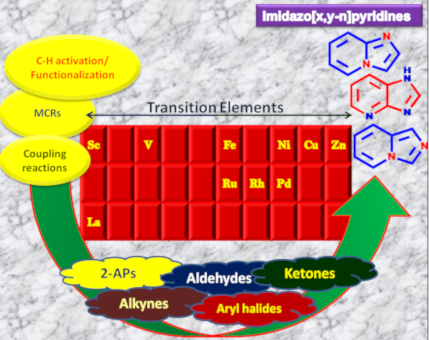

Graphical Abstract

Figure 1: Various drugs having IP nucleus.

Figure 2: Participation percentage of various TMs for the syntheses of IPs.

Scheme 1: CuI–NaHSO4·SiO2-catalyzed synthesis of imidazo[1,2-a]pyridines.

Scheme 2: Experimental examination of reaction conditions.

Scheme 3: One-pot tandem reaction for the synthesis of 2-haloimidazopyridines.

Scheme 4: Mechanistic scheme for the synthesis of 2-haloimidazopyridine.

Scheme 5: Copper-MOF-catalyzed three-component reaction (3-CR) for imidazo[1,2-a]pyridines.

Scheme 6: Mechanism for copper-MOF-driven synthesis.

Scheme 7: Heterogeneous synthesis via titania-supported CuCl2.

Scheme 8: Mechanism involving oxidative C–H functionalization.

Scheme 9: Heterogeneous synthesis of IPs.

Scheme 10: One-pot regiospecific synthesis of imidazo[1,2-a]pyridines.

Scheme 11: Vinyl azide as an unprecedented substrate for imidazo[1,2-a]pyridines.

Scheme 12: Radical pathway.

Scheme 13: Cu(I)-catalyzed transannulation approach for imidazo[1,5-a]pyridines.

Scheme 14: Plausible radical pathway for the synthesis of imidazo[1,5-a]pyridines.

Scheme 15: A solvent-free domino reaction for imidazo[1,2-a]pyridines.

Scheme 16: Cu-NPs-mediated synthesis of imidazo[1,2-a]pyridines.

Scheme 17: CuI-catalyzed synthesis of isoxazolylimidazo[1,2-a]pyridines.

Scheme 18: Functionalization of 4-bromo derivative via Sonogashira coupling reaction.

Scheme 19: A plausible reaction pathway.

Scheme 20: Cu(I)-catalyzed intramolecular oxidative C–H amidation reaction.

Scheme 21: One-pot synthetic reaction for imidazo[1,2-a]pyridine.

Scheme 22: Plausible reaction mechanism.

Scheme 23: Cu(OAc)2-promoted synthesis of imidazo[1,2-a]pyridines.

Scheme 24: Mechanism for aminomethylation/cycloisomerization of propiolates with imines.

Scheme 25: Three-component synthesis of imidazo[1,2-a]pyridines.

Figure 3: Scope of pyridin-2(1H)-ones and acetophenones.

Scheme 26: CuO NPS-promoted A3 coupling reaction.

Scheme 27: Cu(II)-catalyzed C–N bond formation reaction.

Scheme 28: Mechanism involving Chan–Lam/Ullmann coupling.

Scheme 29: Synthesis of formyl-substituted imidazo[1,2-a]pyridines.

Scheme 30: A tandem sp3 C–H amination reaction.

Scheme 31: Probable mechanistic approach.

Scheme 32: Dual catalytic system for imidazo[1,2-a]pyridines.

Scheme 33: Tentative mechanism.

Scheme 34: CuO/CuAl2O4/ᴅ-glucose-promoted 3-CCR.

Scheme 35: A tandem CuOx/OMS-2-based synthetic strategy.

Figure 4: Biomimetic catalytic oxidation in the presence of electron-transfer mediators (ETMs).

Scheme 36: Control experiment.

Scheme 37: Copper-catalyzed C(sp3)–H aminatin reaction.

Scheme 38: Reaction of secondary amines.

Scheme 39: Probable mechanistic pathway.

Scheme 40: Coupling reaction of α-azidoketones.

Scheme 41: Probable pathway.

Scheme 42: Probable mechanism with free energy calculations.

Scheme 43: MCR for cyanated IP synthesis.

Scheme 44: Substrate scope for the reaction.

Scheme 45: Reaction mechanism.

Scheme 46: Probable mechanistic pathway for Cu/ZnAl2O4-catalyzed reaction.

Scheme 47: Copper-catalyzed double oxidative C–H amination reaction.

Scheme 48: Application towards different coupling reactions.

Scheme 49: Reaction mechanism.

Scheme 50: Condensation–cyclization approach for the synthesis of 1,3-diarylated imidazo[1,5-a]pyridines.

Scheme 51: Optimized reaction conditions.

Scheme 52: One-pot 2-CR.

Scheme 53: One-pot 3-CR without the isolation of chalcone.

Scheme 54: Copper–Pybox-catalyzed cyclization reaction.

Scheme 55: Mechanistic pathway catalyzed by Cu–Pybox complex.

Scheme 56: Cu(II)-promoted C(sp3)-H amination reaction.

Scheme 57: Wider substrate applicability for the reaction.

Scheme 58: Plausible reaction mechanism.

Scheme 59: CuI assisted C–N cross-coupling reaction.

Scheme 60: Probable reaction mechanism involving sp3 C–H amination.

Scheme 61: One-pot MCR-catalyzed by CoFe2O4/CNT-Cu.

Scheme 62: Mechanistic pathway.

Scheme 63: Synthetic scheme for 3-nitroimidazo[1,2-a]pyridines.

Scheme 64: Plausible mechanism for CuBr-catalyzed reaction.

Scheme 65: Regioselective synthesis of halo-substituted imidazo[1,2-a]pyridines.

Scheme 66: Synthesis of 2-phenylimidazo[1,2-a]pyridines.

Scheme 67: Synthesis of diarylated compounds.

Scheme 68: CuBr2-mediated one-pot two-component oxidative coupling reaction.

Scheme 69: Decarboxylative cyclization route to synthesize 1,3-diarylimidazo[1,5-a]pyridines.

Scheme 70: Mechanistic pathway.

Scheme 71: C–H functionalization reaction of enamines to produce diversified heterocycles.

Scheme 72: A plausible mechanism.

Scheme 73: CuI-promoted aerobic oxidative cyclization reaction of ketoxime acetates and pyridines.

Scheme 74: CuI-catalyzed pathway for the formation of imidazo[1,2-a]pyridine.

Scheme 75: Mechanistic pathway.

Scheme 76: Mechanistic rationale for the synthesis of products.

Scheme 77: Copper-catalyzed synthesis of vinyloxy-IP.

Scheme 78: Regioselective product formation with propiolates.

Scheme 79: Proposed mechanism for vinyloxy-IP formation.

Scheme 80: Regioselective synthesis of 3-hetero-substituted imidazo[1,2-a]pyridines with different reaction su...

Scheme 81: Mechanistic pathway.

Scheme 82: CuI-mediated synthesis of 3-formylimidazo[1,2-a]pyridines.

Scheme 83: Radical pathway for 3-formylated IP synthesis.

Scheme 84: Pd-catalyzed urea-cyclization reaction for IPs.

Scheme 85: Pd-catalyzed one-pot-tandem amination and intramolecular amidation reaction.

Figure 5: Scope of aniline nucleophiles.

Scheme 86: Pd–Cu-catalyzed Sonogashira coupling reaction.

Scheme 87: One-pot amide coupling reaction for the synthesis of imidazo[4,5-b]pyridines.

Scheme 88: Urea cyclization reaction for the synthesis of two series of pyridines.

Scheme 89: Amidation reaction for the synthesis of imidazo[4,5-b]pyridines.

Figure 6: Amide scope.

Scheme 90: Pd NPs-catalyzed 3-component reaction for the synthesis of 2,3-diarylated IPs.

Scheme 91: Plausible mechanistic pathway for Pd NPs-catalyzed MCR.

Scheme 92: Synthesis of chromenoannulated imidazo[1,2-a]pyridines.

Scheme 93: Mechanism for the synthesis of chromeno-annulated IPs.

Scheme 94: Zinc oxide NRs-catalyzed synthesis of imidazo[1,2-a]azines/diazines.

Scheme 95: Zinc oxide-catalyzed isocyanide based GBB reaction.

Scheme 96: Reaction pathway for ZnO-catalyzed GBB reaction.

Scheme 97: Mechanistic pathway.

Scheme 98: ZnO NRs-catalyzed MCR for the synthesis of imidazo[1,2-a]azines.

Scheme 99: Ugi type GBB three-component reaction.

Scheme 100: Magnetic NPs-catalyzed synthesis of imidazo[1,2-a]pyridines.

Scheme 101: Regioselective synthesis of 2-alkoxyimidazo[1,2-a]pyridines catalyzed by Fe-SBA-15.

Scheme 102: Plausible mechanistic pathway for the synthesis of 2-alkoxyimidazopyridine.

Scheme 103: Iron-catalyzed synthetic approach.

Scheme 104: Iron-catalyzed aminooxygenation reaction.

Scheme 105: Mechanistic pathway.

Scheme 106: Rh(III)-catalyzed double C–H activation of 2-substituted imidazoles and alkynes.

Scheme 107: Plausible reaction mechanism.

Scheme 108: Rh(III)-catalyzed non-aromatic C(sp2)–H bond activation–functionalization for the synthesis of imid...

Scheme 109: Reactivity and selectivity of different substrates.

Scheme 110: Rh-catalyzed direct C–H alkynylation by Li et al.

Scheme 111: Suggested radical mechanism.

Scheme 112: Scandium(III)triflate-catalyzed one-pot reaction and its mechanism for the synthesis of benzimidazo...

Scheme 113: RuCl3-assisted Ugi-type Groebke–Blackburn condensation reaction.

Scheme 114: C-3 aroylation via Ru-catalyzed two-component reaction.

Scheme 115: Regioselective synthetic mechanism.

Scheme 116: La(III)-catalyzed one-pot GBB reaction.

Scheme 117: Mechanistic approach for the synthesis of imidazo[1,2-a]pyridines.

Scheme 118: Synthesis of imidazo[1,2-a]pyridine using LaMnO3 NPs under neat conditions.

Scheme 119: Mechanistic approach.

Scheme 120: One-pot 3-CR for regioselective synthesis of 2-alkoxy-3-arylimidazo[1,2-a]pyridines.

Scheme 121: Formation of two possible products under optimization of the catalysts.

Scheme 122: Mechanistic strategy for NiFe2O4-catalyzed reaction.

Scheme 123: Two-component reaction for synthesizing imidazodipyridiniums.

Scheme 124: Mechanistic scheme for the synthesis of imidazodipyridiniums.

Scheme 125: CuI-catalyzed arylation of imidazo[1,2-a]pyridines.

Scheme 126: Mechanism for arylation reaction.

Scheme 127: Cupric acetate-catalyzed double carbonylation approach.

Scheme 128: Radical mechanism for double carbonylation of IP.

Scheme 129: C–S bond formation reaction catalyzed by cupric acetate.

Scheme 130: Cupric acetate-catalyzed C-3 formylation approach.

Scheme 131: Control experiments for signifying the role of DMSO and oxygen.

Scheme 132: Mechanism pathway.

Scheme 133: Copper bromide-catalyzed CDC reaction.

Scheme 134: Extension of the substrate scope.

Scheme 135: Plausible radical pathway.

Scheme 136: Transannulation reaction for the synthesis of imidazo[1,5-a]pyridines.

Scheme 137: Plausible reaction pathway for denitrogenative transannulation.

Scheme 138: Cupric acetate-catalyzed C-3 carbonylation reaction.

Scheme 139: Plausible mechanism for regioselective C-3 carbonylation.

Scheme 140: Alkynylation reaction at C-2 of 3H-imidazo[4,5-b]pyridines.

Scheme 141: Two-way mechanism for C-2 alkynylation of 3H-imidazo[4,5-b]pyridines.

Scheme 142: Palladium-catalyzed SCCR approach.

Scheme 143: Palladium-catalyzed Suzuki coupling reaction.

Scheme 144: Reaction mechanism.

Scheme 145: A phosphine free palladium-catalyzed synthesis of C-3 arylated imidazopyridines.

Scheme 146: Palladium-mediated Buchwald–Hartwig cross-coupling reaction.

Figure 7: Structure of the ligands optimized.

Scheme 147: Palladium acetate-catalyzed direct arylation of imidazo[1,2-a]pyridines.

Scheme 148: Palladium acetate-catalyzed mechanistic pathway.

Scheme 149: Palladium acetate-catalyzed regioselective arylation reported by Liu and Zhan.

Scheme 150: Mechanism for selective C-3 arylation of IP.

Scheme 151: Pd(II)-catalyzed alkenylation reaction with styrenes.

Scheme 152: Pd(II)-catalyzed alkenylation reaction with acrylates.

Scheme 153: A two way mechanism.

Scheme 154: Double C–H activation reaction catalyzed by Pd(OAc)2.

Scheme 155: Probable mechanism.

Scheme 156: Palladium-catalyzed decarboxylative coupling.

Scheme 157: Mechanistic cycle for decarboxylative arylation reaction.

Scheme 158: Ligand-free approach for arylation of imidazo[1,2-a]pyridine-3-carboxylic acids.

Scheme 159: Mechanism for ligandless arylation reaction.

Scheme 160: NHC-Pd(II) complex assisted arylation reaction.

Scheme 161: C-3 arylation of imidazo[1,2-a]pyridines with aryl bromides catalyzed by Pd(OAc)2.

Scheme 162: Pd(II)-catalyzed C-3 arylations with aryl tosylates and mesylates.

Scheme 163: CDC reaction for the synthesis of imidazo[1,2-a]pyridines.

Scheme 164: Plausible reaction mechanism for Pd(OAc)2-catalyzed synthesis of imidazo[1,2-a]pyridines.

Scheme 165: Pd-catalyzed C–H amination reaction.

Scheme 166: Mechanism for C–H amination reaction.

Scheme 167: One-pot synthesis for 3,6-di- or 2,3,6-tri(hetero)arylimidazo[1,2-a]pyridines.

Scheme 168: C–H/C–H cross-coupling reaction of IPs and azoles catalyzed by Pd(II).

Scheme 169: Mechanistic cycle.

Scheme 170: Rh-catalyzed C–H arylation reaction.

Scheme 171: Mechanistic pathway for C–H arylation of imidazo[1,2-a]pyridine.

Scheme 172: Rh(III)-catalyzed double C–H activation of 2-phenylimidazo[1,2-a]pyridines and alkynes.

Scheme 173: Rh(III)-catalyzed mechanistic pathway.

Scheme 174: Rh(III)-mediated oxidative coupling reaction.

Scheme 175: Reactions showing functionalization of the product obtained by the group of Kotla.

Scheme 176: Mechanism for Rh(III)-catalyzed oxidative coupling reaction.

Scheme 177: Rh(III)-catalyzed C–H activation reaction.

Scheme 178: Mechanistic cycle.

Scheme 179: Annulation reactions of 2-arylimidazo[1,2-a]pyridines and alkynes.

Scheme 180: Two-way reaction mechanism for annulations reaction.

Scheme 181: [RuCl2(p-cymene)]2-catalyzed C–C bond formation reaction.

Scheme 182: Reported reaction mechanism.

Scheme 183: Fe(III) catalyzed C-3 formylation approach.

Scheme 184: SET mechanism-catalyzed by Fe(III).

Scheme 185: Ni(dpp)Cl2-catalyzed KTC coupling.

Scheme 186: Pd-catalyzed SM coupling.

Scheme 187: Vanadium-catalyzed coupling of IP and NMO.

Scheme 188: Mechanistic cycle.

Scheme 189: Selective C3/C5–H bond functionalizations by mono and bimetallic systems.

Scheme 190: rGO-Ni@Pd-catalyzed C–H bond arylation of imidazo[1,2-a]pyridine.

Scheme 191: Mechanistic pathway for heterogeneously catalyzed arylation reaction.

Scheme 192: Zinc triflate-catalyzed coupling reaction of substituted propargyl alcohols.
Enantioselective PCCP Brønsted acid-catalyzed aza-Piancatelli rearrangement
- Gabrielle R. Hammersley,
- Meghan F. Nichol,
- Helena C. Steffens,
- Jose M. Delgado,
- Gesine K. Veits and
- Javier Read de Alaniz
Beilstein J. Org. Chem. 2019, 15, 1569–1574, doi:10.3762/bjoc.15.160
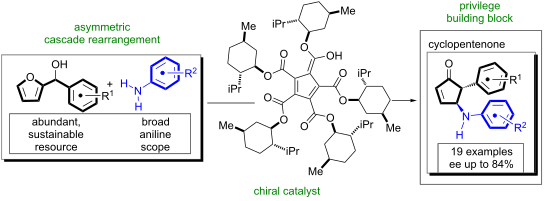
- hypothesized that a PCCP-derived catalyst could be used. It is proposed that the chiral anion moieties serve to interact with the key intermediate 5 during the enantiodetermining electrocyclization step [35][36][37]. A tentative mechanistic hypothesis for the asymmetric aza-Piancatelli is shown in Figure 1

Graphical Abstract

Figure 1: Proposed mechanism of the asymmetric aza-Piancatelli reaction.

Scheme 1: Asymmetric aza-Piancatelli rearrangement with a range of substituted anilines. *To simplify the pur...

Scheme 2: Asymmetric aza-Piancatelli rearrangement with a range of substituted furylcarbinols. *To simplify t...
Synthesis and biological evaluation of truncated derivatives of abyssomicin C as antibacterial agents
- Leticia Monjas,
- Peter Fodran,
- Johanna Kollback,
- Carlo Cassani,
- Thomas Olsson,
- Maja Genheden,
- D. G. Joakim Larsson and
- Carl-Johan Wallentin
Beilstein J. Org. Chem. 2019, 15, 1468–1474, doi:10.3762/bjoc.15.147
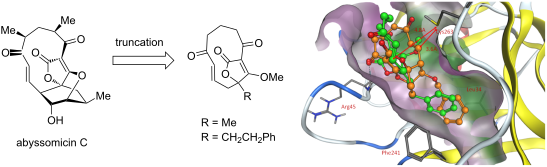
- allyldioxazaborolidine 11), respectively. The tetronate building blocks 4 and 5 were further converted to the corresponding enolates using lithium diisopropylamide and allowed to react with the common key intermediate 3 to afford the hydroxyalkylated products 18 and 19, in 78% and 59% yield, respectively (Scheme 4

Graphical Abstract

Figure 1: Structure of abyssomicins C, B, D, atrop-abyssomicin C, atrop-O-benzyl-abyssomicin C and atrop-O-be...

Figure 2: A) Docking poses for atrop-O-benzyl-desmethyl-abyssomicin C (orange) and compound 2 (green) showing...

Scheme 1: Retrosynthetic analysis of the truncated derivatives 1 and 2 of abyssomicin C.

Scheme 2: Synthesis of the building block 3. a) TBDMSCl (0.5 equiv), NaH (1.0 equiv), THF, 0 °C to rt, 16 h, ...

Scheme 3: Synthesis of the building blocks 4 and 5. a) TFA (1.1 equiv), CH2Cl2, rt, 24 h, 84% (14: R = Me) an...
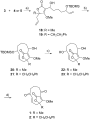
Scheme 4: Reaction of the building block 3 with 4 or 5 for the synthesis of compounds 1 and 2. a) 4 or 5 with...
Synthesis of non-racemic 4-nitro-2-sulfonylbutan-1-ones via Ni(II)-catalyzed asymmetric Michael reaction of β-ketosulfones
- Alexander N. Reznikov,
- Anastasiya E. Sibiryakova,
- Marat R. Baimuratov,
- Eugene V. Golovin,
- Victor B. Rybakov and
- Yuri N. Klimochkin
Beilstein J. Org. Chem. 2019, 15, 1289–1297, doi:10.3762/bjoc.15.127
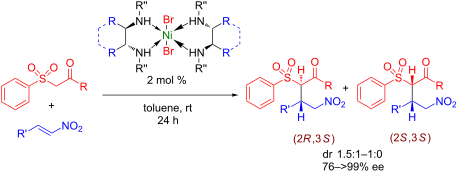
- ) complexes [56]. The above considerations lead to the use of β-ketosulfones in the Ni(II)-catalyzed reaction, since the proposed mechanism [47], that involves the formation of cyclic Ni enolate, and the high CH acidity of ketosulfones (pKa 9.8–10.5 [4]). The formation of the key intermediate can be provided

Graphical Abstract
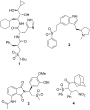
Figure 1: Рharmacologically active sulfones.

Figure 2: Structures of the ligands L1–L8.

Figure 3: Evolution of the conversion of 5 and diastereomeric composition of the products of reaction of 5a w...

Figure 4: Time profile of epimerization and retro-Michael reaction of (2R,3S)-8a in chloroform-d solution.

Figure 5: ORTEP diagram of (2R,3S)-8d.
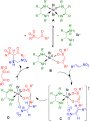
Scheme 1: The proposed mechanism of asymmetric addition of β-ketosulfones to nitroalkenes.

Scheme 2: Transition state models for asymmetric addition of β-ketosulfones to nitroalkenes.
Catalytic asymmetric oxo-Diels–Alder reactions with chiral atropisomeric biphenyl diols
- Chi-Tung Yeung,
- Wesley Ting Kwok Chan,
- Wai-Sum Lo,
- Ga-Lai Law and
- Wing-Tak Wong
Beilstein J. Org. Chem. 2019, 15, 955–962, doi:10.3762/bjoc.15.92
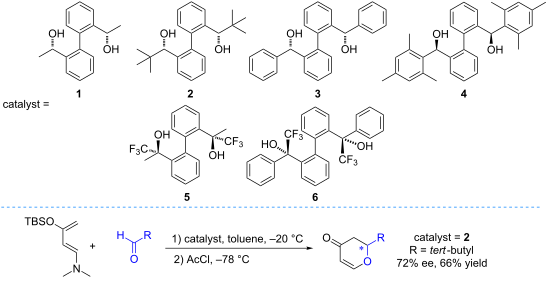
- ). For this reason, another strategy of obtaining high % ee of d was employed. Chiral resolution of racemic-d with (R)-menthyl chloroformate gave a high % ee of this key intermediate d. After column chromatographic purification of the crude reaction mixture, the corresponding diastereomers (R)-e or (S)-e

Graphical Abstract

Scheme 1: Chiral biphenyl diol organocatalysts 1–6.

Scheme 2: Synthesis of 3.

Figure 1: (a) Single crystal X-ray structure of 3: showing intra- and intermolecular hydrogen bonds (green da...

Scheme 3: Synthesis of 4.

Scheme 4: Synthesis of 6.

Figure 2: X-ray crystal structure of (P)-(S,S)-6 at two different orientations to show (a) P atropselectiviti...
Efficient synthesis of 4-substituted-ortho-phthalaldehyde analogues: toward the emergence of new building blocks
- Clémence Moitessier,
- Ahmad Rifai,
- Pierre-Edouard Danjou,
- Isabelle Mallard and
- Francine Cazier-Dennin
Beilstein J. Org. Chem. 2019, 15, 721–726, doi:10.3762/bjoc.15.67

- the addition of a protecting step of the unstable key intermediate 4,5-dihydroisobenzofuran-5-ol. Oxidation and deprotection steps were also studied in order to provide an effective availability of these two dialdehyde compounds that may increase their future applications. Keywords: demethylation
- ). To our delight, the remarkable stability of the methoxy group under the same synthesis conditions introduces the key intermediate 4-methoxyphthalaldehyde (5b) with an excellent conversion rate and minimal OPA formation (Table 2, entry 6). Compound 5b was then isolated by column chromatography in 63
- key intermediate 4,5-dihydroisobenzofuran-5-ol (3) before reaching the oxidation step. The methoxy protecting group and the DDQ oxidation reagent were found to be the most efficient. Moreover, deprotection of 4-methoxy-ortho-phthalaldehyde (5b) was successfully achieved using [Bmim]Br and p-TsOH on

Graphical Abstract

Scheme 1: Synthesis of 4,5-dihydroisobenzofuran-5-ol (3).

Scheme 2: Protection strategy of 4,5-dihydroisobenzofuran-5-ol (3).

Scheme 3: Oxidation of 5-substituted-4,5-dihydroisobenzofuran-5-ol in presence of SeO2 or DDQ.

Scheme 4: Synthesis of 4-hydroxy-ortho-phthalaldehyde (6) through MAOS demethylation of 4-methoxy-ortho-phtha...
Homo- and hetero-difunctionalized β-cyclodextrins: Short direct synthesis in gram scale and analysis of regiochemistry
- Gábor Benkovics,
- Mihály Bálint,
- Éva Fenyvesi,
- Erzsébet Varga,
- Szabolcs Béni,
- Konstantina Yannakopoulou and
- Milo Malanga
Beilstein J. Org. Chem. 2019, 15, 710–720, doi:10.3762/bjoc.15.66
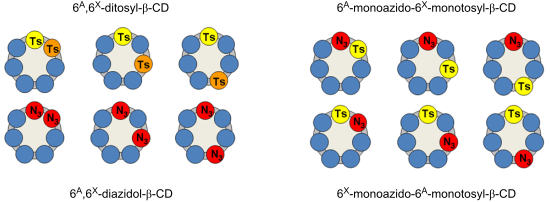
- -identical functional groups on the primary side. Three different types of reactions were investigated to obtain 6A-monoazido-6X-monotosyl-β-CD (a key intermediate for the preparation of various hetero-difunctionalized β-CDs), having three possible regioisomers and consequently three pairs of

Graphical Abstract

Figure 1: Schematic representation of β-CD with glucopyranose atom numbering and with alphabetic labeling of ...

Scheme 1: Syntheses of 6A,6X-diazido-β-CDs as reference compounds using the “capping” literature method [11,12].

Scheme 2: Syntheses of homo-difunctionalized β-CDs using different reaction conditions.

Figure 2: HPLC chromatograms of the authentic 6A,6X-diazido-β-CDs with known regiochemistry (references 1–3, Scheme 1...

Figure 3: NMR spectral regions of the three ditosyl regioisomers in D2O (500 MHz). The signals of the tosylat...

Scheme 3: Syntheses of 6A-monoazido-6X-monotosyl-β-CDs using starting materials obtained from different react...

Figure 4: Reversed-phase HPLC chromatograms of 6A-monoazido-6X-monotosyl-β-CDs prepared through reactions 4–8....

Figure 5: HPLC separation of regioisomers and pseudoenantiomers of 6A-monoazido-6X-monotosyl-β-CD prepared in...

Figure 6: Reversed-phase HPLC chromatograms of 6A,6X-diazido-β-CDs prepared in reactions 9–13.
Aqueous olefin metathesis: recent developments and applications
- Valerio Sabatino and
- Thomas R. Ward
Beilstein J. Org. Chem. 2019, 15, 445–468, doi:10.3762/bjoc.15.39
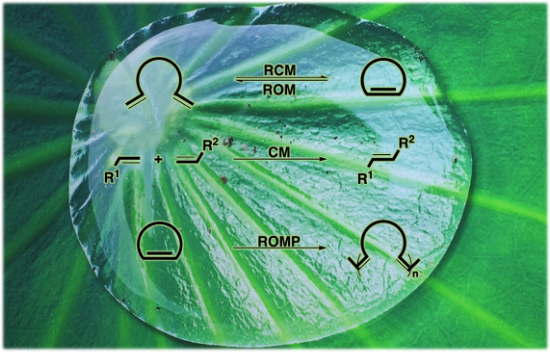
- as key intermediate. A [2 + 2] cycloaddition with a second olefin leads to the formation of intermediate IV, followed by a retro [2 + 2] cycloaddition that regenerates catalyst I and releases the metathesis product. This visionary mechanistic proposal was later confirmed by experimental studies [17

Graphical Abstract

Scheme 1: Most common metathesis reactions. Ring-opening metathesis polymerization (ROMP), acyclic diene meta...

Scheme 2: Catalytic cycle for metathesis proposed by Chauvin.
Figure 1: Some of the most representative catalysts for aqueous metathesis. a) Well-defined ruthenium catalys...

Scheme 3: First aqueous ROMP reactions catalyzed by ruthenium(III) salts.

Scheme 4: Degradation pathway of first generation Grubbs catalyst (G-I) in methanol.

Scheme 5: Synthesis of Blechert-type catalysts 19 and 20.

Figure 2: Chemical structure and components of amphiphilic molecule PTS and derivatives.

Scheme 6: RCM of selected substrates in the presence of the surfactant PTS. Conditionsa: The reaction was car...

Scheme 7: RCM reactions of substrates 31 and 33 with the encapsulated G-II catalyst.

Scheme 8: Living ROMP of norbornene derivatives 35 and 36 with phosphine-based catalysts bearing quaternary a...

Scheme 9: Synthesis of water-soluble catalysts 3 and 4 bearing quaternary ammonium tags.

Scheme 10: In situ formation of catalyst 5 bearing a quaternary ammonium group.

Scheme 11: Catalyst recycling of an ammonium-bearing catalyst.

Scheme 12: Removal of the water-soluble catalyst 12 through host–guest interaction with silica-gel-supported β...

Scheme 13: Selection of artificial metathases reported by Ward and co-workers (ArM 1 based on biotin–(strept)a...

Figure 3: In vivo metathesis with an artificial metalloenzyme based on the biotin–streptavidin technology.

Scheme 14: Artificial metathase based on covalent anchoring approach. α-Chymotrypsin interacts with catalyst 66...

Scheme 15: Assembling an artificial metathase (ArM 4) based on the small heat shock protein from M. Jannaschii...

Scheme 16: Artificial metathases based on cavity-size engineered β-barrel protein nitrobindin (NB4exp). The HG...

Scheme 17: Artificial metathase based on cutinase (ArM 8) and resulting metathesis activities.

Scheme 18: Site-specific modification of proteins via aqueous cross-metathesis. The protein structure is based...

Scheme 19: a) Allyl homocysteine (Ahc)-modified proteins as CM substrates. b) Incorporation of Ahc in the Fc p...

Scheme 20: On-DNA cross-metathesis reaction of allyl sulfide 99.

Scheme 21: Preparation of BODIPY-containing profluorescent probes 102 and 104.

Scheme 22: Metathesis-based ethylene detection in live cells.

Scheme 23: First example of stapled peptides via olefin metathesis.
Mn-mediated sequential three-component domino Knoevenagel/cyclization/Michael addition/oxidative cyclization reaction towards annulated imidazo[1,2-a]pyridines
- Olga A. Storozhenko,
- Alexey A. Festa,
- Delphine R. Bella Ndoutoume,
- Alexander V. Aksenov,
- Alexey V. Varlamov and
- Leonid G. Voskressensky
Beilstein J. Org. Chem. 2018, 14, 3078–3087, doi:10.3762/bjoc.14.287
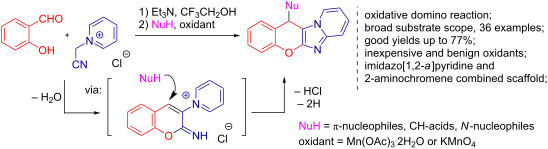
- key intermediate of the domino sequence (Scheme 1, reaction 1). Taking into account the capability of 2-iminochromenes to perform as Michael acceptors [39][40][41], we envisioned the diversification of the substitution pattern at the chromene ring to be a realizable and an appealing target

Graphical Abstract
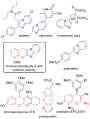
Figure 1: Biologically relevant imidazo[1,2-a]pyridines and chromenes.
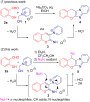
Scheme 1: Domino formation of imidazopyridines and current work.

Scheme 2: Scope of the reaction between N-(cyanomethyl)pyridinium chloride, o-hydroxybenzaldehydes, and nitro...

Scheme 3: Scope of the reaction of o-hydroxybenzaldehydes with N-(cyanomethyl)pyridinium chloride and indoles...
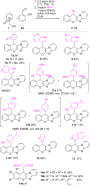
Scheme 4: Scope of the nucleophiles in the reaction of o-hydroxyarylaldehydes with N-(cyanomethyl)pyridinium ...
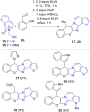
Scheme 5: N-(Cyanomethyl)thieno[2,3-c]pyridinium chloride (15) and 6-(cyanomethyl)-1-methyl-1H-pyrrolo[2,3-c]...

Figure 2: General view of the molecule 7b in the crystal state (CCDC 1849215). Anisotropic displacement param...

Scheme 6: The presumed mechanism for the formation of target chromenoimidazopyridines (reaction 1) and additi...



