


Search results
Search for "cascade reaction" in Full Text gives 146 result(s) in Beilstein Journal of Organic Chemistry.
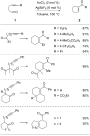
Preparation of optically active bicyclodihydrosiloles by a radical cascade reaction
Beilstein J. Org. Chem. 2013, 9, 1326–1332, doi:10.3762/bjoc.9.149
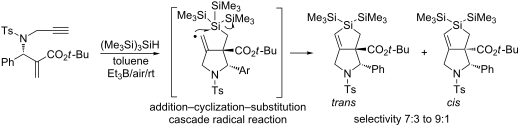
- 10.3762/bjoc.9.149 Abstract Bicyclodihydrosiloles were readily prepared from optically active enyne compounds by a radical cascade reaction triggered by tris(trimethylsilyl)silane ((Me3Si)3SiH). The reaction was initiated by the addition of a silyl radical to an α,β-unsaturated ester, forming an α
- : bicyclodihydrosilole; free radical; radical cascade reaction; SHi reaction; tris(trimethylsilyl)silane; Introduction Radical cyclization occupies a unique position in organic synthesis because it is a useful reaction for the construction of cyclic molecules [1][2][3][4][5][6][7][8][9][10]. The radical cascade
- cyclization process is also an interesting synthetic reaction that often provides an efficient method [11][12][13]. Recently, we reported a new type of higher-order radical cascade reaction between chiral enyne compounds and Bu3SnH, which is recognized as a useful reagent in radical reactions [14]. In this


Anionic cascade reactions. One-pot assembly of (Z)-chloro-exo-methylenetetrahydrofurans from β-hydroxyketones
Beilstein J. Org. Chem. 2013, 9, 1319–1325, doi:10.3762/bjoc.9.148

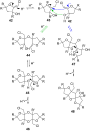
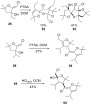
- formed in only poor yields. The major product was isolated in 36% yield and its structure was unambiguously determined as the (Z)-chloro-exo-methylenetetrahydrofuran 6. The generation of 6 can be rationalized as depicted in Scheme 2. Under the basic conditions employed for the cascade reaction, 1,1





Palladium-catalyzed synthesis of N-arylated carbazoles using anilines and cyclic diaryliodonium salts
Beilstein J. Org. Chem. 2013, 9, 1202–1209, doi:10.3762/bjoc.9.136

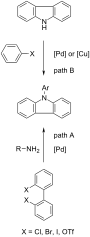
- present an alternative Pd-catalyzed method for the construction of N-substituted carbazoles based on a stable, cyclic iodonium salt and electron-deficient anilines [24][25]. In the initial C–N bond-forming step of this cascade reaction, a ring opening of the cyclic iodonium salt through the amine is




Cascade radical reaction of substrates with a carbon–carbon triple bond as a radical acceptor
Beilstein J. Org. Chem. 2013, 9, 1148–1155, doi:10.3762/bjoc.9.128
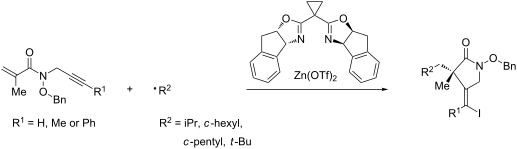
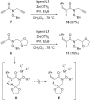
- –carbon triple bond as a radical acceptor. When substrates with a methacryloyl moiety and a carbon–carbon triple bond as two polarity-different radical acceptors were employed, the cascade reaction proceeded effectively. A high level of enantioselectivity was also obtained by a proper combination of
- and limitation of the cascade transformation of hydroxamate esters with carbon–carbon triple bonds, the substrates of choice were 5, 6A–C, 7 and 8 having hydroxamate ester functionality (Figure 3). At first, we studied the cascade reaction of 5 with an acryloyl moiety and 6A–C with a methacryloyl
- 6A–C. Enantioselective cascade reaction of 6A–C. Reaction of propiolic acid derivatives 7 and 8. Opposite regiochemical cyclization using substrate 12. Cascade reaction of 14. Enantioselective cascade reaction of 14 and 16. Reaction of 6A–C in the presence of chiral ligand. Reaction of 14 and 16 in




Synthesis of skeletally diverse alkaloid-like molecules: exploitation of metathesis substrates assembled from triplets of building blocks
Beilstein J. Org. Chem. 2013, 9, 775–785, doi:10.3762/bjoc.9.88
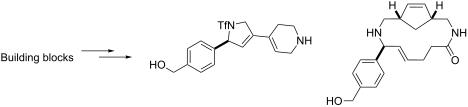
- metathesis substrate (such as 14 or 16). Finally, a metathesis cascade reaction would yield a product scaffold (such as 15 and 17). It was planned that many of the product scaffolds would bear an o-nitrophenylsulfonyl protecting group. The combinations of building blocks were carefully chosen to ensure that
- metathesis cascade reaction of 32 was remarkable [25]. Presumably, in this case, the metathesis cascade leads to the generation of the intermediate 59 (Scheme 5); the intermediate could then react to conclude the metathesis cascade (to give 45 after deprotection), or cyclopropanate [25] the terminal alkene


Reactions of salicylaldehyde and enolates or their equivalents: versatile synthetic routes to chromane derivatives
Beilstein J. Org. Chem. 2012, 8, 2166–2175, doi:10.3762/bjoc.8.244

- cascade reaction of salicylaldehyde (5) and malononitrile (20) involving an aldol reaction followed by intramolecular cyclization and finally a dehydration to give intermediate 21. A subsequent Michael addition of the indole (25) to intermediate 21 gives cation 26, which loses a proton to give the product
- reaction between salicylaldehyde (5) and acetonitrile (28) involving an aldol reaction, cyclization and dehydration. A subsequent Michael addition of nitromethane (30) to the product of the cascade reaction gave the desired product 32. Kovalenko and co-workers used a quantitative amount of piperidine in
- (5), acetonitrile (28) and nitromethane (30) to give 2-aminochromene 32 in 88% yield and 84% enatiomeric excess (Scheme 11) [24]. The reaction was found to be equally efficient when malononitrile (20) and cyanoacetate 29 were used instead of 28. The reaction is thought to proceed through a cascade


Copper-catalyzed CuAAC/intramolecular C–H arylation sequence: Synthesis of annulated 1,2,3-triazoles
Beilstein J. Org. Chem. 2012, 8, 1771–1777, doi:10.3762/bjoc.8.202
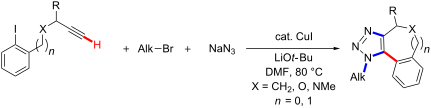
- fully substituted 1,2,3-triazoles with excellent chemo- and regioselectivities. Likewise, the optimized catalytic system proved applicable to the direct preparation of 1,2-diarylated azoles through a one-pot C–H/N–H arylation reaction. Keywords: cascade reaction; C–H functionalization; copper
- chromatography on silica gel (n-hexane/EtOAc). Copper-catalyzed step-economical C–H arylation-based cascade reaction. Copper-catalyzed sequential catalysis with alkyne 1a. Copper-catalyzed reaction sequence using alkyl bromides 2. General reaction conditions: 1 (1.00 mmol), 2 (1.00 mmol), NaN3 (1.05 mmol), CuI


Organocatalytic cascade aza-Michael/hemiacetal reaction between disubstituted hydrazines and α,β-unsaturated aldehydes: Highly diastereo- and enantioselective synthesis of pyrazolidine derivatives
Beilstein J. Org. Chem. 2012, 8, 1710–1720, doi:10.3762/bjoc.8.195
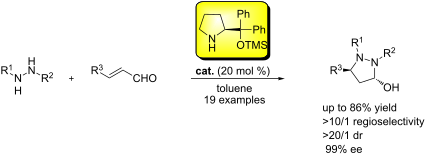
- stereoselective cascade reaction for the synthesis of the pyrazolidine compounds through organocatalysis. In this paper, we present a convenient access to racemic and enantioenriched 5-hydroxypyrazolidines through a domino aza-Michael/hemiacetal organocatalytic sequence of disubstituted hydrazines to α,β
- pyrazolidine derivatives through the cascade aza-Michael/hemiacetal reaction between disubstituted hydrazines and α,β-unsaturated aldehydes. The asymmetric version of this one-pot cascade reaction has also been realized with (S)-diphenylprolinol trimethylsilyl ether 1m as a secondary amine organocatalyst, and


Organocatalytic tandem Michael addition reactions: A powerful access to the enantioselective synthesis of functionalized chromenes, thiochromenes and 1,2-dihydroquinolines
Beilstein J. Org. Chem. 2012, 8, 1668–1694, doi:10.3762/bjoc.8.191

- acyclic α,β-unsaturated compounds In the previously reported organocatalytic tandem oxa-Michael–aldol reactions, the instantaneous dehydration of the β-hydroxyaldimine intermediates generates products with only one stereogenic center. Hong et al. [52] in 2009 reported a novel quadruple-cascade reaction
- cascade reaction starts in an analogous manner to that previously mentioned, although the first oxa-Michael step is followed by a second Michael addition to form the chroman unit. A series of α,β-unsaturated aldehydes were reacted with the o-hydroxy-β-nitrostyrene as shown in Scheme 11. Except for the
- quadruple-cascade reaction exemplifies an efficient three-component reaction. In 2010 Wang et al. [11] reported the highly enantioselective synthesis of trisubstituted chiral 4H-chromenes 20 through iminium-allenamide catalysis. The reaction consists of a Michael–Michael-cascade sequence between alkynals 5






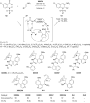
Organocatalytic C–H activation reactions
Beilstein J. Org. Chem. 2012, 8, 1374–1384, doi:10.3762/bjoc.8.159
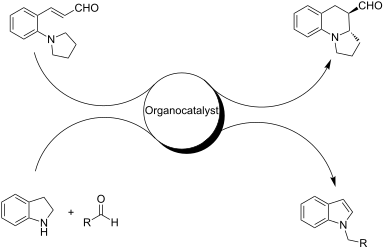
- -annulation cascade reaction with N,N-(dialkylamino)benzaldehydes, a process in which a 1,5-hydride shift occurs followed by larger ring formation [16]. After the evaluation of different Brønsted acid catalysts, diphenylphosphate (20 mol %) was identified as a suitable catalyst for the reaction. Toluene again
- more organocatalytic non-asymmetric and asymmetric sp3 C–H activation processes are expected [37]. Triflic acid-catalysed synthesis of cyclic aminals. PTSA-catalysed synthesis of cyclic aminals. Plausible mechanism for cyclic aminal synthesis. Annulation cascade reaction with double nucleophiles
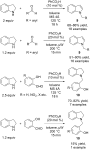
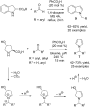
- . Mechanism for the indole-annulation cascade reaction. Synthesis of N-alkylpyrroles and δ-hydroxypyrroles. Synthesis of N-alkylindoles 9 and N-alkylindolines 10. Mechanistic study for the N-alkylpyrrole formation. Benzoic acid catalysed decarboxylative redox amination. Organocatalytic redox reaction of ortho



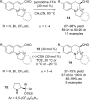


Chemistry of polyhalogenated nitrobutadienes, 10: Synthesis of highly functionalized heterocycles with a rigid 6-amino-3-azabicyclo[3.1.0]hexane moiety
Beilstein J. Org. Chem. 2012, 8, 621–628, doi:10.3762/bjoc.8.69

- 75–90% yield (Scheme 6). A conceivable mechanism for the cascade reaction that leads to the pyrazoles 27 and 28 is presented in Scheme 7. Initially, the trichlorobutene I is formed upon addition of the arylhydrazine to the nitro-substituted butadiene 25. Subsequent elimination of benzotriazole


Enaminones in a multicomponent synthesis of 4-aryldihydropyridines for potential applications in photoinduced intramolecular electron-transfer systems
Beilstein J. Org. Chem. 2012, 8, 441–447, doi:10.3762/bjoc.8.50

- /aromatic amines, ethyl propiolate and benzaldehyde [14], or by a cascade reaction of 1-phenylpropynone or ethyl propiolate with primary amines and aldehyde [15]. Enaminones are versatile starting materials for the synthesis of many classes of organic compounds and heterocyclic systems [16][17], and are




Synthesis of fused tricyclic amines unsubstituted at the ring-junction positions by a cascade condensation, cyclization, cycloaddition then decarbonylation strategy
Beilstein J. Org. Chem. 2012, 8, 107–111, doi:10.3762/bjoc.8.11
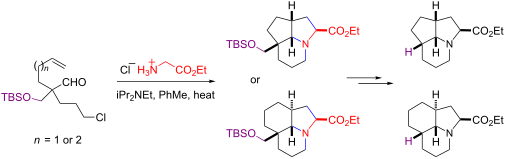
- ; dipolar cycloaddition; heterocycle; tricyclic; Introduction Cascade reaction sequences [1] provide a rapid and efficient means to build complexity in organic chemistry. One such sequence involves a cyclization followed by in situ intramolecular cycloaddition to give three new rings in a single


Amines as key building blocks in Pd-assisted multicomponent processes
Beilstein J. Org. Chem. 2011, 7, 1387–1406, doi:10.3762/bjoc.7.163
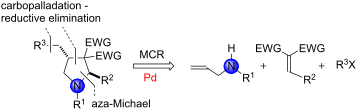
- , giving good to excellent yields (Scheme 10) [9]. Barluenga and coworkers reported a synthesis of spiroacetals 22, through a Pd(II)-catalyzed three-component cascade reaction, starting from an alkynol, an aldehyde and a primary amine. The authors suggested that the first step of the reaction was the
- basic media. A subsequent Pd-mediated intermolecular alkylation with the dihalogeno substrate followed by an intramolecular N-arylation furnished 2-substituted indoles 68. In this cascade reaction, the palladium catalyst intervenes in three different coupling reactions: Intermolecular N-alkenylation, C


Efficient gold(I)/silver(I)-cocatalyzed cascade intermolecular N-Michael addition/intramolecular hydroalkylation of unactivated alkenes with α-ketones
Beilstein J. Org. Chem. 2011, 7, 1100–1107, doi:10.3762/bjoc.7.126
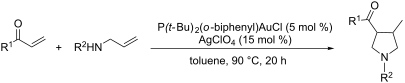
- molecules. Disappointingly, no conversion was observed when (t-Bu)2(o-diphenyl)PAuOTf only was used as the catalyst. Since dual-metal-catalysis is of interest from the perspective of unique reactivity [26][27][28][29][30][31][32][33][34][35][36][37][38][39][40], we explored a new cascade reaction involving
- mixture did not have a noticeable effect on the yield of 3a (Table 1, entries 8–11). To identify further the optimal reaction conditions for the gold(I)/silver(I)-cocatalyzed cascade reaction, a number of dual-metal catalyst systems, composed of 15 mol % of silver salt with 5 mol % of gold(I) complex in
- activity and diastereo-induction in this cascade reaction (Table 2, entries 5–9). Among the complexes examined, (t-Bu)2(o-biphenyl)PAuCl gave the best result (Table 2, entry 5). Further screening of solvents revealed that toluene gave the best result, while the other solvents, dioxane, nitromethane, 1,2


Recent advances in the gold-catalyzed additions to C–C multiple bonds
Beilstein J. Org. Chem. 2011, 7, 897–936, doi:10.3762/bjoc.7.103
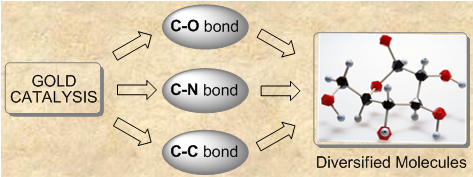
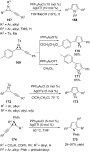
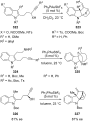
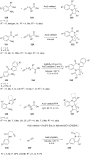
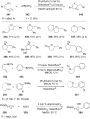
- substituted naphthalenes 296 [151]. This cascade reaction involves a tandem sequence of 1,3- and 1,2-migration of two different migrating groups. Jin and Yamamoto prepared the fused tri- and tetracyclic enones 298 through an efficient gold(III)-catalyzed tandem reaction, heteroenyne metathesis, and Nazarov
- the tosylate followed by the interaction with the imine and a Nazarov-like cyclization. Barluenga et al. reported a gold-catalyzed cascade reaction involving an unusual intramolecular redox process in which 5-heteroaryl-substituted ketone derivatives 372 were obtained from secondary 5-hexyn-1-ols 370
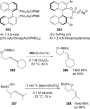
- a highly enantioselective three-component (393–395) cascade reaction which involved an enantioselective [4 + 2] cycloaddition reaction catalyzed by a chiral phosphoric acid and a subsequent catalytic intramolecular hydroamination by a gold(I) complex (Scheme 64) [180]. Further studies revealed that












Nano copper oxide catalyzed synthesis of symmetrical diaryl sulfides under ligand free conditions
Beilstein J. Org. Chem. 2011, 7, 886–891, doi:10.3762/bjoc.7.101

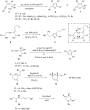
- 1, 2 and 3). Conclusion We have developed a CuO nanoparticles catalyzed synthesis of symmetrical diaryl sulfides via cascade reaction of aryl halides with potassium thiocyanate under ligand free conditions. The reaction avoids foul smelling thiols and the catalyst is economical, air stable


Synthetic applications of gold-catalyzed ring expansions
Beilstein J. Org. Chem. 2011, 7, 767–780, doi:10.3762/bjoc.7.87
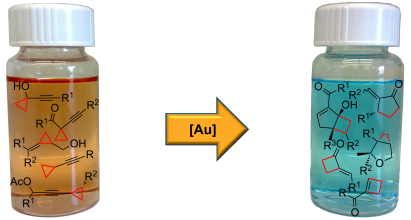
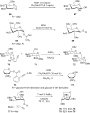
- nucleophilic oxidant in this context [40]. The gold-catalyzed intramolecular nucleophilic attack of heteroatoms on alkynes, followed by ring expansion, represents an appropriate method for the synthesis of furans and pyrroles. In 2006, Schmalz and co-workers reported a gold-catalyzed cascade reaction of


Construction of cyclic enones via gold-catalyzed oxygen transfer reactions
Beilstein J. Org. Chem. 2011, 7, 606–614, doi:10.3762/bjoc.7.71
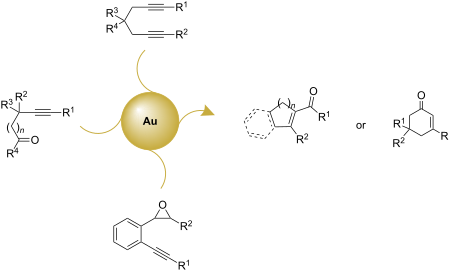
- and the final product 4. The isolated intermediate 5 could be transformed into a mixture of 6 and 4 under the reaction conditions, finally yielding 4 via intramolecular aldol condensation. This gold-catalyzed cyclization of alkynyl ketones to enones was successfully utilized in a cascade reaction by




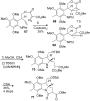
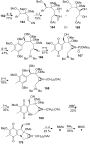
Mitomycins syntheses: a recent update
Beilstein J. Org. Chem. 2009, 5, No. 33, doi:10.3762/bjoc.5.33






Reversible intramolecular photocycloaddition of a bis(9-anthrylbutadienyl)paracyclophane – an inverse photochromic system. (Photoactive cyclophanes 5)
Beilstein J. Org. Chem. 2009, 5, No. 20, doi:10.3762/bjoc.5.20
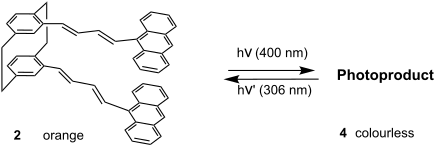
- to dibenzoequinine, a stable polycyclic molecule [27]. In that case, the first Diels-Alder addition is immediately followed by a second, because of the superimposition of the newly formed diene and the ene centres (cascade reaction). This is not possible in the present situation, considering Figure





